CBSE Class 12 History Question Paper 2020 Set 61-1-3 Solutions
Finished viewing? Save it for later —
Download CBSE Class 12 History Question Paper 2020 Set 61-1-3 Solutions (PDF · 15 pages)About CBSE Class 12 History Question Paper 2020 Set 61-1-3 Solutions
CBSE Class 12 History Question Paper 2020 Set 61-1-3 Solutions is available here for free download. Published by CBSE for Class 12, this solution can be viewed online or downloaded as a PDF (15 pages). Candidates preparing for Class 12 can use CBSE Class 12 History Question Paper 2020 Set 61-1-3 Solutions to understand the exam pattern, the type of questions asked, and the overall difficulty level.
Frequently Asked Questions
How can I download CBSE Class 12 History Question Paper 2020 Set 61-1-3 Solutions?
Open this page and click the Download button to save CBSE Class 12 History Question Paper 2020 Set 61-1-3 Solutions as a PDF. It is completely free on AglaSem Docs.
Is CBSE Class 12 History Question Paper 2020 Set 61-1-3 Solutions free to download?
Yes. CBSE Class 12 History Question Paper 2020 Set 61-1-3 Solutions can be viewed online and downloaded as a PDF free of cost on AglaSem Docs.
How many pages does CBSE Class 12 History Question Paper 2020 Set 61-1-3 Solutions have?
CBSE Class 12 History Question Paper 2020 Set 61-1-3 Solutions contains 15 pages, which you can read online or download together as a single PDF.
Where can I find more Class 12 study material?
You can find more Class 12 question papers, sample papers, syllabus, and answer keys on AglaSem Docs.
CBSE Class 12 History Question Paper 2020 Set 61-1-3 Solutions – Text
Read the full text of this solution below — useful to quickly search, copy and reference the content online without downloading the PDF.
📄 View text version (15 pages)
Page 1
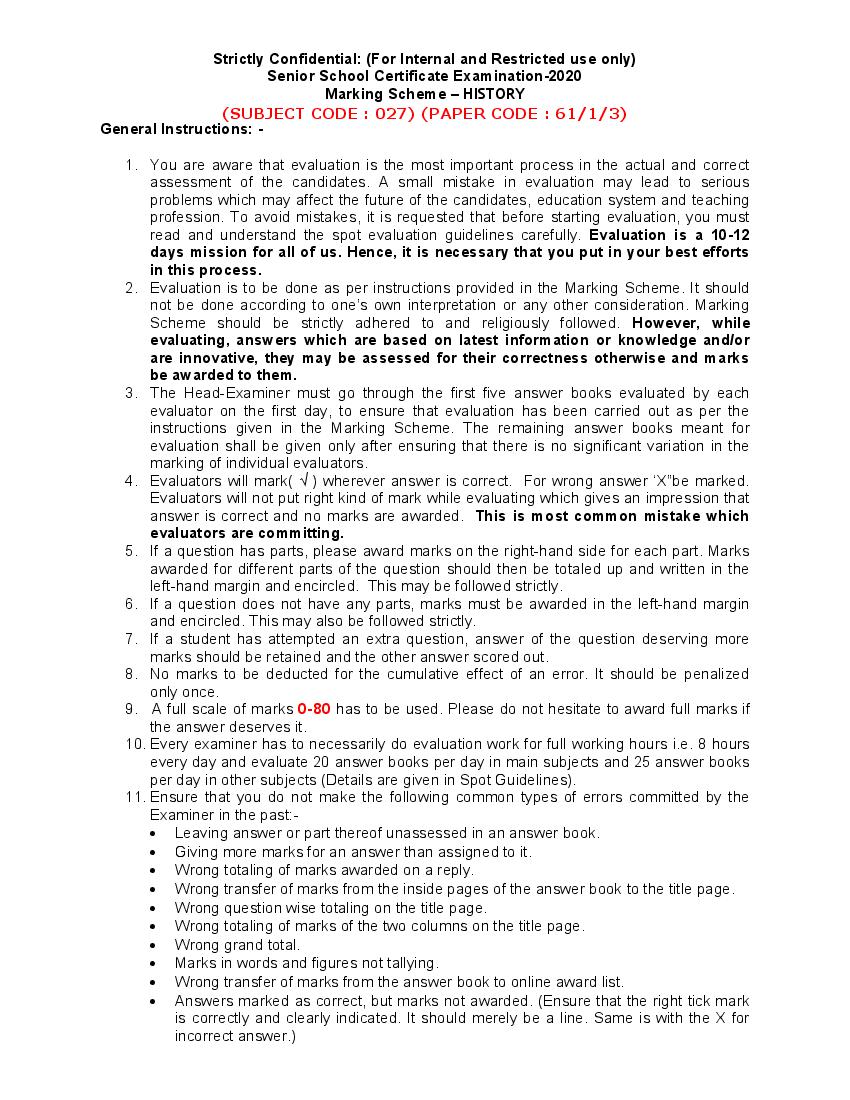
Senior School Certificate Examination-2020
Marking Scheme – HISTORY
(SUBJECT CODE : 027) (PAPER CODE : 61/1/3)
General Instructions: -
1. You are aware that evaluation is the most important process in the actual and correct
assessment of the candidates. A small mistake in evaluation may lead to serious
problems which may affect the future of the candidates, education system and teaching
profession. To avoid mistakes, it is requested that before starting evaluation, you must
read and understand the spot evaluation guidelines carefully. Evaluation is a 10-12
days mission for all of us. Hence, it is necessary that you put in your best efforts
in this process.
2. Evaluation is to be done as per instructions provided in the Marking Scheme. It should
not be done according to one’s own interpretation or any other consideration. Marking
Scheme should be strictly adhered to and religiously followed. However, while
evaluating, answers which are based on latest information or knowledge and/or
are innovative, they may be assessed for their correctness otherwise and marks
be awarded to them.
3. The Head-Examiner must go through the first five answer books evaluated by each
evaluator on the first day, to ensure that evaluation has been carried out as per the
instructions given in the Marking Scheme. The remaining answer books meant for
evaluation shall be given only after ensuring that there is no significant variation in the
marking of individual evaluators.
4. Evaluators will mark( √ ) wherever answer is correct. For wrong answer ‘X”be marked.
Evaluators will not put right kind of mark while evaluating which gives an impression that
answer is correct and no marks are awarded. This is most common mistake which
evaluators are committing.
5. If a question has parts, please award marks on the right-hand side for each part. Marks
awarded for different parts of the question should then be totaled up and written in the
left-hand margin and encircled. This may be followed strictly.
6. If a question does not have any parts, marks must be awarded in the left-hand margin
and encircled. This may also be followed strictly.
7. If a student has attempted an extra question, answer of the question deserving more
marks should be retained and the other answer scored out.
8. No marks to be deducted for the cumulative effect of an error. It should be penalized
only once.
9. A full scale of marks 0-80 has to be used. Please do not hesitate to award full marks if
the answer deserves it.
10. Every examiner has to necessarily do evaluation work for full working hours i.e. 8 hours
every day and evaluate 20 answer books per day in main subjects and 25 answer books
per day in other subjects (Details are given in Spot Guidelines).
11. Ensure that you do not make the following common types of errors committed by the
Examiner in the past:-
Leaving answer or part thereof unassessed in an answer book.
Giving more marks for an answer than assigned to it.
Wrong totaling of marks awarded on a reply.
Wrong transfer of marks from the inside pages of the answer book to the title page.
Wrong question wise totaling on the title page.
Wrong totaling of marks of the two columns on the title page.
Wrong grand total.
Marks in words and figures not tallying.
Wrong transfer of marks from the answer book to online award list.
Answers marked as correct, but marks not awarded. (Ensure that the right tick mark
is correctly and clearly indicated. It should merely be a line. Same is with the X for
incorrect answer.)
Page 2
awarded.
12. While evaluating the answer books if the answer is found to be totally incorrect, it should
be marked as cross (X) and awarded zero (0)Marks.
13. Any unassessed portion, non-carrying over of marks to the title page, or totaling error
detected by the candidate shall damage the prestige of all the personnel engaged in the
evaluation work as also of the Board. Hence, in order to uphold the prestige of all
concerned, it is again reiterated that the instructions be followed meticulously and
judiciously.
14. The Examiners should acquaint themselves with the guidelines given in the Guidelines
for spot Evaluation before starting the actual evaluation.
15. Every Examiner shall also ensure that all the answers are evaluated, marks carried over
to the title page, correctly totaled and written in figures and words.
16. The Board permits candidates to obtain photocopy of the Answer Book on request in an
RTI application and also separately as a part of the re-evaluation process on payment of
the processing charges.
Page 3
CLASS XII A I S S C E-March 2020
CODE NO. 61/1/3
Q.NO. EXPECTED ANSWERS/VALUE POINTS PAGE MARKS
NO.
SECTION-A
1. C- Brahmi and kharosthi Pg-28 1
2. Bhikkhuni Pg-92 1
OR
Buddha‟s last message to his followers was “Be lamps unto Pg-92 1
yourself as all of you must work out your own liberation.”
3. C- I and III Pg-94 1
4. Image of Tirthankara from Mathura(Lord Mahavira) Pg-88 1
For visually impaired : Sutta Pitaka Pg-91 1
5. C- Auspicious symbol Pg-101 1
6. D- Its writing remains undeciphered to date. Pg-15 1
7. D- Archaeo- Botanists Pg-2 1
8. Guru Ramananda Pg-162 1
OR
Basavanna Pg-147 1
9. (A)I, III and IV Pg-233 1
10. (D) Aurangzeb Pg-234 1
11. Guru Gobind Singh Pg-164 1
1
Page 4
(A).
13. (A)This book is written in Persian. Pg-118 1
14. Mirabai Pg-164 1
15. Shiva Pg-144 1
16. (C) To suggest a suitable political framework for free India. Pg-389 1
17. The reason for announcing „Direct Action Day‟ by the Muslim 1
league in August 1946, was to win its Pakistan Demand after it had
Pg-391
withdrawn its support from the cabinet mission.
18. (B) Cripps Mission Pg-363 1
19. (C) I, III and IV Pg-425 1
20. (C) Govind Ballabh Pant Pg-418 1
SECTION-B
21. Lay out design of the Great Bath
i. The Great Bath was a large rectangular tank in the
courtyard surrounded by corridor on all four sides.
ii. There were two flights of steps on the north and south
leading into the tank.
iii. The tank and steps were made water tight by bricks and
mortar.
iv. There were rooms on three sides, in one of which was a
large well.
v. Water from the tank flowed into a huge drain.
vi. There were eight other bathrooms four on either side of the
corridor.
vii. Any other relevant point.
2
Page 5
22. Ibn Battuta’s views on Indian system of communication:
i. The system of communication was unique.
ii. The postal system was of two kinds- the horse post called
ulug and the foot post called dawa. The foot post was
quicker than horse post.
iii. Special measures were taken to encourage merchants.
iv. The routes were supplied with inns and guest houses.
v. Postal system was also very efficient and fast.
vi. The news reports of spies would reach the Sultan through
the postal system in just five days from Sind to Delhi.
vii. The postal system which allowed merchants to not only
send information and remit credit across long distances.
viii. Any other relevant point.
Any three points to be explained.
Pg-129 3
23. Colonial cities after 1857-
i. After 1857 the British attitude in India was shaped by a
constant fear of rebellion.
ii. They felt towns needed to be better defended.
iii. White people needed to live in more secure and segregated
areas.
iv. Thus civil lines for white people developed.
v. Cantonments were built for stationing troops.
vi. Separate black area for Indians came up.
Pg-326- 3
vii. Any other relevant point.
327
Any three points to be examined
3
Page 6
Towns of South India- Main features-
i. In the towns of South India like Madurai and Kanchipuram,
the principal focus was the temple.
ii. These towns were also important commercial centres.
iii. Here religious festivals often coincided with fairs linking
pilgrimage with trade.
iv. Medieval towns were the places where everybody was
expected to know their position in the social order
dominated by the ruling elite.
Pg-318- 3
v. Any other relevant point.
319
Any three points to be examined
24. Gandhiji as a social reformer:
i. Gandhiji worked for the abolition of untouchability.
ii. He advocated against the child marriage.
iii. He preached for hindu- muslim unity.
iv. He wanted Indians to become self-reliant.
v. He promoted khadi.
vi. Any other relevant point. Pg-365 3
Any three points to be described.
SECTION-C
25. Familial ties during 600BCE-600CE:
i. Every family varied in terms of number of members.
ii. They had definite relationship with one another, common
activities and shared food and resources.
iii. They performed rituals together.
iv. They had larger network of people called Kinfolk.
v. The family ties were natural based on blood.
vi. Any other relevant point.
Description of any four points to be done.
4
Page 7
i. Sons were considered important to continue lineage and
daughters were married outside and had no claim on
resources of the household.
ii. Endogamy and exogamy were prevalent.
iii. Polygyny was also there.
Pg-55, 57- 4+4=8
iv. Polyandry- like in Pandavas were in practice.
58
v. Dharmasutras and dharmashastras recognized eight forms
of marriages out of which only four were considered good.
vi. The girls were married to the right person at a right time
and kanyadana was considered a religious duty of the
father.
vii. Women were expected to give up their father‟s gotra and
adopt that of their husband on marriage.
viii. Members of the same gotra could not marry.
ix. Any other relevant point.
Description of any four points to be done
OR
Kinship:
i. Families were usually a part of kinship.
ii. This was regarded natural, based on blood.
iii. Kinfolk had relations with one another but sometimes they
quarreled.
iv. The feud of Kauravas and Pandavas reinforced the idea of
patrinity.
v. Sons could claim the resources and the throne.
vi. Any other relevant point.
Description of any two points to be done. (2)
Varna order:
i. Dharmasutras and Dharmashastras contained rules about
5
Page 8
ii. Brahmins were supposed to study and teach Vedas, perform
sacrifices and rituals, give and receive gifts.
iii. Kshatriyas were to engage in warfare, protect people and
administer justice, study Vedas, get sacrifices performed
and make gifts.
iv. Vaishyas to carry on trade, agriculture and pastoralism in
addition to study of Vedas, get sacrifices performed and
make gifts.
v. Shudras were to do menial jobs and to serve the three
higher varnas.
vi. Any other relevant point.
Description of any two points to be done. (2)
Instances to prove that this theory was not universally
followed:
i. Non kshatriya kings- Contrary to the ideal occupations of
the Varna order.The Shungas and Kanvas were Brahmins.
ii. Some Satavahana queens retained their father‟s gotras even
after marriage.
iii. Examples of endogamy were found in the Satavahana rulers.
iv. Bhim‟s marriage with Hidimba was deviation from the
Dharmasutras.
v. The rule of gendered access to property defied in the case of
Vakataka queen Prabhavati Gupta.
vi. Eklavya acquiring archery skills and the Mandasor
inscription of guild of silk weavers from Lata Gujarat is an
example of deviation from rules of ideal occupation.
vii. Any other relevant point. Pg-55, 56, 2+2+4=8
Description of any four points to be done. (4) 60-65,68
26. Glory of Vijayanagara-
i. The ruler Krishnadeva Raya was an able ruler.
ii. He expanded and consolidated his empire.
6
Page 9
iv. He also inflicted defeat on the sultans of Bijapur.
v. His kingdom remained in constant preparedness of war, but
peace prevailed.
vi. The king also built temples.
vii. He founded a suburban township near Vijayanagara called
Nagalapuram.
viii. The trade also flourished.
ix. Any other relevant point.
Any four points to be examined.
Decline:
i. After the death of Krishnadeva Raya, crack appeared.
ii. His successors were troubled by rebellious nayakas or
military chiefs.
iii. The military commanders became ambitious.
iv. In 1565 Rama raya, the chief minister of Vijayanagara led
the army into battle at Talikota and Golconda.
v. The combined forces of sultans routed the army of
Vijayanagara.
vi. The city of Vijayanagara was sacked and totally
abandoned. Pg-173 4+4=8
vii. The armies of the Sultans were responsible for the
destruction of the city of Vijayanagara.
viii. Any other relevant point.
Any four points to be examined.
OR
Amara-nayaka system:
i. Amara-nayaka system was an innovation of Vijayanagara
empire.
ii. Amara-nayakas were military commanders and collected
taxes.
iii. They were given territory to govern and collect taxes.
iv. They retained part of revenue for personal use and for
7
Page 10
v. These contingents provided the king of Vijayanagara with
effective fighting force.
vi. Amara-nayakas sent tributes to the king annually and
personally appeared in court.
vii. Any other relevant point.
Any five points to be examined.
Role of Amara-nayaka system after Krishnadeva Raya’s death:
i. After the death of Krishnadeva, Raya the nayakas rebelled
against his successors.
ii. Many Amara-nayakas established independent kingdoms.
iii. This hastened the collapse of the kingdom of Vijayanagara.
iv. Any other relevant point. Pg- 5+3=8
Any three points to be examined. 173,175
27. Impact of American civil war on the lives of Deccan ryots:
i. American civil war broke out in 1861 and a wave of panic
spread in the cotton circles.
ii. Raw cotton imports fell from America.
iii. The cotton prices soared and export merchants in Bombay
tried to secure as much cotton as possible to meet the
British demand.
iv. The British then moved towards Deccan-Bombay.
v. The ryots in Deccan suddenly found access to limitless
credit.
vi. They were given Rs. 100 as advance for every acre they
planted with cotton.
vii. Sahukars were willing to extend long term loans to the
ryots.
viii. Cotton production in Bombay-Deccan expanded.
ix. These years did not bring prosperity to the ryots.
x. Rich peasants did gain but majority of marginal ryots came
under heavy debt.
8
Page 11
Any eight points to be evaluated. 283
OR
Main aspects of Fifth Report:
i. This was the fifth of a series of reports submitted to the
British Parliament in 1813.
ii. This was a report on administration and activities of East
India company.
iii. It ran into 1002 pages of which 800 pages were appendices.
iv. It reproduced petitions of ryots and zamindars.
v. It also contained reports of collectors from different
districts.
vi. It contains statistical tables on revenue and returns and
notes on the revenue and Judicial Administration of Bengal
and Madras written by officials.
vii. This report was produced by a select committee.
viii. It became the basis of intense parliamentary debate on the
nature of East India Company‟s rule in India.
ix. Researchers on careful examination have found that this
Report exaggerated the collapse of traditional zamindari
power and also overestimated the scale on which the
zamindars were losing their land. Pg-263-
8
x. Any other relevant point. 264
Any eight points to be evaluated.
SECTION-D
28. Villagers as rebels
28.1Examine the problem faced by the British in dealing with
these villagers.
Ans:
i. The British faced much problem in dealing with the
villagers of Oude. They used to move away at the sight of
the British officials.
9
Page 12
(2)
28.2 Why were people of oude (Awadh) hostile against the
British? Examine the reason.
Ans:
i. The people of Oude were hostile as Oude was annexed by
the British and the popular king Wajid Ali Shah was
dethroned and exiled to Calcutta.
ii. With the dissolution of the court many people lost their
livelihood. (2)
28.3 How did the British suppress the rebels?
Ans:
i. The British unleashed repressive measures with full force
to subdue the rebels. Martial law was imposed in north
India.
ii. Ordinary processes of law and order was suspended and
punishment for rebellion was death.
iii. Rebel landlords were dispossessed and loyal rewarded. Pg- 296,
Mention any two. (2) 297, 305, 2+2+2=6
306
29. What the king’s officials did
29.1 For what purpose were the king’s officials appointed?
Ans: The king‟s officials were appointed
i. To superintend or look after variety of jobs to serve the
people.
ii. For administrative control on the people. (2)
29.2 Explain the types of jobs they carried out.
Ans:
i. Some officers superintended rivers.
ii. Some measured the land.
iii. Some inspected the sluices by which water is let out from
the canals.
iv. Some were incharges of huntsmen.
10
Page 13
vi. Some superintended occupations connected with land.
(Any two points to be explained) (2)
29.3 What was the need to superintend the work of the
workmen?
Ans:
1. It was necessary to superintend the work of workmen to
keep control over them.
2. To regulate their work. (2) Pg-34 2+2+2=6
30. Classification of lands under Akbar.
30.1 Why was Chachar land left uncultivated for some three to
four years?
Ans: Chachar land was left uncultivated for three to four years
so that
i. It may regain its fertility within this period.
ii. It may recover its strength. (2)
30.2 Explain the basis of this classification.
Ans: The classification was based on
i. The fertility of the land.
ii. Capacity of soil to be cultivated annually or not. (2)
30.3 Do you think it was a sound basis to assess the revenue?
Explain.
Ans:
i. This classification seems to be sound basis to assess the
revenue as it was fixed according to the type and
productivity of land.
ii. It made payment of revenue easier for the cultivators.
(2) Pg-214 2+2+2=6
SECTION-E
31. Map based work 1x6=6
30.1 Filled up map attached 1x3
30.2 Filled up map attached 1x3
For visually impaired:
11
Page 14
Bombay, Calcutta, kheda, Ahmedabad, Benaras, Lahore, Karachi..
Any three centres from given list.
OR
Magadha, Vajji, Koshala, Panchala, Kuru, Gandhara, Avanti,
Rajgir, Ujjain, Taxila, Varanasi(Kashi). 1x3
Any three centres from the list.
31.2 Sanchi, Ajanta, Lumbini, Bodh Gaya, Sarnath, Bharhut,
Nagarjuna Konda, Amravati, Nasik. 1x3
Any three from the given list.
12
Page 15
Document Details
| Board / Org | CBSE |
| Exam | Class 12 |
| Type | Solution |
| Pages | 15 |
| Updated | 22 Jul 2026 |