CBSE Class 12 Marking Scheme 2021 for Chemistry
Finished viewing? Save it for later —
Download CBSE Class 12 Marking Scheme 2021 for Chemistry (PDF · 8 pages)About CBSE Class 12 Marking Scheme 2021 for Chemistry
CBSE Class 12 Marking Scheme 2021 for Chemistry is available here for free download. Published by CBSE for Class 12, this sample paper can be viewed online or downloaded as a PDF (8 pages). Candidates preparing for Class 12 can use CBSE Class 12 Marking Scheme 2021 for Chemistry to understand the exam pattern, the type of questions asked, and the overall difficulty level.
Frequently Asked Questions
How can I download CBSE Class 12 Marking Scheme 2021 for Chemistry?
Open this page and click the Download button to save CBSE Class 12 Marking Scheme 2021 for Chemistry as a PDF. It is completely free on AglaSem Docs.
Is CBSE Class 12 Marking Scheme 2021 for Chemistry free to download?
Yes. CBSE Class 12 Marking Scheme 2021 for Chemistry can be viewed online and downloaded as a PDF free of cost on AglaSem Docs.
How many pages does CBSE Class 12 Marking Scheme 2021 for Chemistry have?
CBSE Class 12 Marking Scheme 2021 for Chemistry contains 8 pages, which you can read online or download together as a single PDF.
Where can I find more Class 12 study material?
You can find more Class 12 question papers, sample papers, syllabus, and answer keys on AglaSem Docs.
CBSE Class 12 Marking Scheme 2021 for Chemistry – Text
Read the full text of this sample paper below — useful to quickly search, copy and reference the content online without downloading the PDF.
📄 View text version (8 pages)
Page 1
SAMPLE PAPER 1
SECTION A
Q.No. Value Point Marks
1(i) D 1
(ii) B OR A 1
(iii) B 1
(iv) C 1
2(i) B 1
(ii) A 1
(iii) A 1
(iv) A or B 1
3 C 1
4 D or C 1
5 C 1
6 B OR B 1
7 B OR D 1
8 A OR A 1
9 C 1
10 A 1
11 A 1
12 A 1
13 D 1
14 B OR B 1
15 B 1
16 A 1
SECTION B, C, D
Q.No. VALUE POINTS MARKS
SECTION B
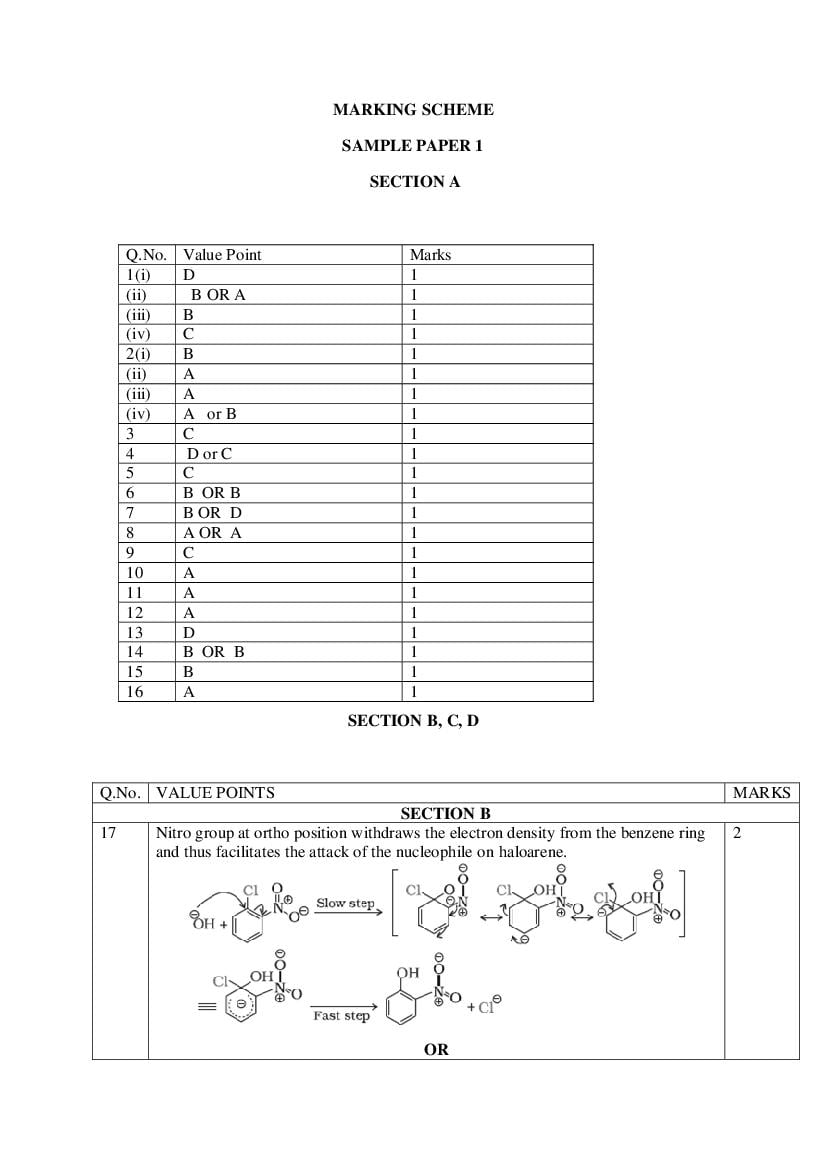
17 Nitro group at ortho position withdraws the electron density from the benzene ring 2
and thus facilitates the attack of the nucleophile on haloarene.
OR
Page 2
NaNO2 + HCl Cu2Cl2 1
273 – 278 K
(ii) CH3CH(Br)CH3 alc KOH CH3CH=CH2 HBr, organic peroxide
CH3CH2CH3Br 1
18 ΔTb = Kf m ΔTb = 101.04-100 = 1.04 oC
or m= 1.04 /0.52 = 2 1
Relative lowering of VP = x2 1/2
Relative lowering of VP = n2/n1+n2 1/2
= 2/ 2+55.5 = 2/57.5 = 0.034 atm
19 (i)t2g4eg2 Paramagentic ½, ½
(ii)Dichloridobis(ethane-1,2-diamine)cobalt(III)nitrate 1
OR
(i)Square planar 1
(ii)Cu2+ = 3d9 1 unpaired electron so √ 1(3) = 1.73BM 1
20 Reaction is a complex reaction. 1/2
Order of reaction is 1.5.
Molecularity cannot be 1.5, it has no meaning for this reaction. The reaction occurs
in steps, so it is a complex reaction. 1/2
(ii)units of k are mol-1/2L1/2s-1 1
OR
Ans : let the rate law expression be Rate = k [P]x[Q]y
from the table we know that
Rate 1 = 3.0 x 10-4 = k (0.10)x (0.10)y
Rate 2 = 9.0 x 10-4 = k (0.30)x (0.30)y
Rate 3 = 3.0 x 10-4 = k (0.10)x (0.30)y
Rate 1/ Rate 3 = (1/3)y or 1 = (1/3)y
So y = 0 ½
Rate 2/ Rate 3 = (3)x or 3 = (3)x
So x = 1 ½
Rate = k [P] 1
21 k = 0.693/t1/2
k = 0.693/5730 years-1 ½
t = 2.303 log Co
k Ct ½
let Co = 1 Ct = 3/10 so Co/Ct = 1/ (3/10) = 10/3
t = 2.303 x 5730 log 10 ½
0.693 3
t = 19042 x (1-0.4771) = 9957 years 1
Page 3
½
½
½
½
23 XeF6 1
. Central atom Xe has 8 valence electrons, it forms 6 bonds with F and has
1 lone pair. According to VSEPR theory, presence of 6 bp and 1 lp results in 1
distorted octahedral geometry
24. (a)inverted product will be given by 1 Chlorobutane as it undergoes SN2
reaction. ½+1/2
(b)racemic mixture will be given by 2 chloro-2-methylpropane as it undergoes ½+1/2
SN1 reaction
25 Let no. of Atoms of element P be x
1/2
No. of tetrahedral voids = 2x
No. Of octahedral voids = x
½
Atoms of Q = 1/3 (2x) + x = 5x/3
PxQ5x/3
P3Q5 1
Page 4
26
(i)Due to large surface area and ability to show variable oxidation states 1
(ii)Due to high value of third ionisation enthalpy 1
(iii) Oxidation state of Cr in Cr2O3 is +3 and of CrO is +2. When oxidation number 1
of a metal increases, ionic character decreases so CrO is basic while Cr 2O3 is
amphoteric.
OR
(i) The general trend towards less negative E V values across the series is 1
related to the general increase in the sum of the first and second
ionisation enthalpies.
(ii) The high energy to transform Cu(s) to Cu2+(aq) is not balanced by its 1
hydration
enthalpy.
(iii) The stability of the half-filled d sub-shell in Mn2+ and the completely 1
filled d10 configuration in Zn2+ are related to their more negative Eo V
values
27 (i) Aniline, N-ethylethanamine Etanamine 1
(ii)Ethanamine,ethanol, ethanoic acid 1
(iii) N, N dimethylmethanamine, methanamine, N-methylmethanamine 1
OR
(i) N-methyletahnamine is a secondary amine. When it reacts with 1
benzenesulphonyl chloride, it forms N- Ethyl -N methyl sulphonamide while and
N,N-dimethyl etahnanmine is a tertiary amine it does not react with
benzenesulphonyl chloride.
1
½
(iii)Butan-1-ol
Alcohol forms stronger hydrogen bonds with water than formed by amine due to ½
higher electronegativity of O in alcohol than N in amine
28 We know that d = zM/ Na a3 1/2
For fcc, z=4 therefore d = 4 x M / Na (3.5 x 10 -8)3 g/cm3 1
For bcc, z=2 therefore d’ = 2 x M / Na (3.0 x 10 -8)3 g/cm3 1
d/d’ = 4/(3.5 x 10-8)3 / 2/(3.0 x 10-8)3 = 3.17:1 1/2
29 (i)
CH3 CH2 –COOH (CH2)4- NH2 1
HOOC CH NHOC CH NHOC CH NH2
Page 5
1
HOOC CH NHOC CH NHOC CH NH2
(ii)
1
30 i. Arrange the following in decreasing order of bond dissociation enthalpy 1
I2 < F2 < Br2 < Cl2 ,
ii. Bi does not form pπ-pπ bonds as its atomic orbitals are large and diffuse so
1
effective overlapping is not possible
iii.Due to small size of oxygen, it has greater elecrton electron repulsions 1
SECTION D
31. (i)
(a) 3Cu + 8 HNO3(dilute) → 3Cu(NO3)2 + 2NO + 4H2O 1
(b)
1
1
(ii)‘X’ is Helium
It is used as a diluent for oxygen in modern diving apparatus because of its very 1
low solubility in blood.
It monoatomic having no interatomic forces except weak dispersion forces and has 1
second lowest mass therefore bp is lowest.
OR
(a) H2Te, H2Se, H2S, H2O 1
(b) [Fe (H2O)5 (NO)]2+ 1
(ii) A is chlorine gas 1
Its bleaching action is due to oxidation.
Cl2 + H2O → 2HCl + O , Coloured substance + O → Colourless substance 1
6 NaOH + 3Cl2 → 5NaCl + NaClO3 + 3H2O
1
36
Page 6
A: C CH B: COCH3 C: COOK D: CHI3
1
C CH COCH 3
HgSO4, H2SO4
1
COCH3
CH3COCl, anhy AlCl3
1
COCH3 COOK
KOH , I2 + CHI3
OR
1
1
Page 7
1
1
37
(i) limiting molar conductivity of an electrolyte can be represented as the sum of 1
the individual contributions of the anion and cation of the electrolyte.
(ii) Eocell = Eocathode -Eoanode = 0.34-(-1.66) = 2.00 V
Ecell = Eocell – 0.059 log [Al3+]2 1/2
n [Cu2+]3 1
Here n = 6 ½
Ecell = 2 – 0.059 log [0.15]2
6 [0.025]3 1
= 2 – 0.059/6 ( 2log 0.15 – 3 log 0.025)
= 2 – 0.059/6 (-1.6478 +4.8062) = 2- 0.0311 = 1.9689V
1
OR
(i) MnO4– 1
(ii)(a) Molar conductivity of a solution at a given concentration is the conductance 1
of the volume V of solution containing one mole of electrolyte kept between two
electrodes with area of cross section A and distance of unit length.
(b)Strong electrolyte, For strong electrolytes, Λm increases slowly with dilution 1
( c) Λm = Λm° – A c ½
Therefore Λm° = 150 S cm2 mol–1 1
(d)
1
Page 8
Document Details
| Board / Org | CBSE |
| Exam | Class 12 |
| Type | Marking Scheme |
| Pages | 8 |
| Updated | 30 Apr 2026 |