CBSE Class 12 History Question Paper 2020 Set 61-2-3 Solutions
Finished viewing? Save it for later —
Download CBSE Class 12 History Question Paper 2020 Set 61-2-3 Solutions (PDF · 14 pages)About CBSE Class 12 History Question Paper 2020 Set 61-2-3 Solutions
CBSE Class 12 History Question Paper 2020 Set 61-2-3 Solutions is available here for free download. Published by CBSE for Class 12, this solution can be viewed online or downloaded as a PDF (14 pages). Candidates preparing for Class 12 can use CBSE Class 12 History Question Paper 2020 Set 61-2-3 Solutions to understand the exam pattern, the type of questions asked, and the overall difficulty level.
Frequently Asked Questions
How can I download CBSE Class 12 History Question Paper 2020 Set 61-2-3 Solutions?
Open this page and click the Download button to save CBSE Class 12 History Question Paper 2020 Set 61-2-3 Solutions as a PDF. It is completely free on AglaSem Docs.
Is CBSE Class 12 History Question Paper 2020 Set 61-2-3 Solutions free to download?
Yes. CBSE Class 12 History Question Paper 2020 Set 61-2-3 Solutions can be viewed online and downloaded as a PDF free of cost on AglaSem Docs.
How many pages does CBSE Class 12 History Question Paper 2020 Set 61-2-3 Solutions have?
CBSE Class 12 History Question Paper 2020 Set 61-2-3 Solutions contains 14 pages, which you can read online or download together as a single PDF.
Where can I find more Class 12 study material?
You can find more Class 12 question papers, sample papers, syllabus, and answer keys on AglaSem Docs.
CBSE Class 12 History Question Paper 2020 Set 61-2-3 Solutions – Text
Read the full text of this solution below — useful to quickly search, copy and reference the content online without downloading the PDF.
📄 View text version (14 pages)
Page 1
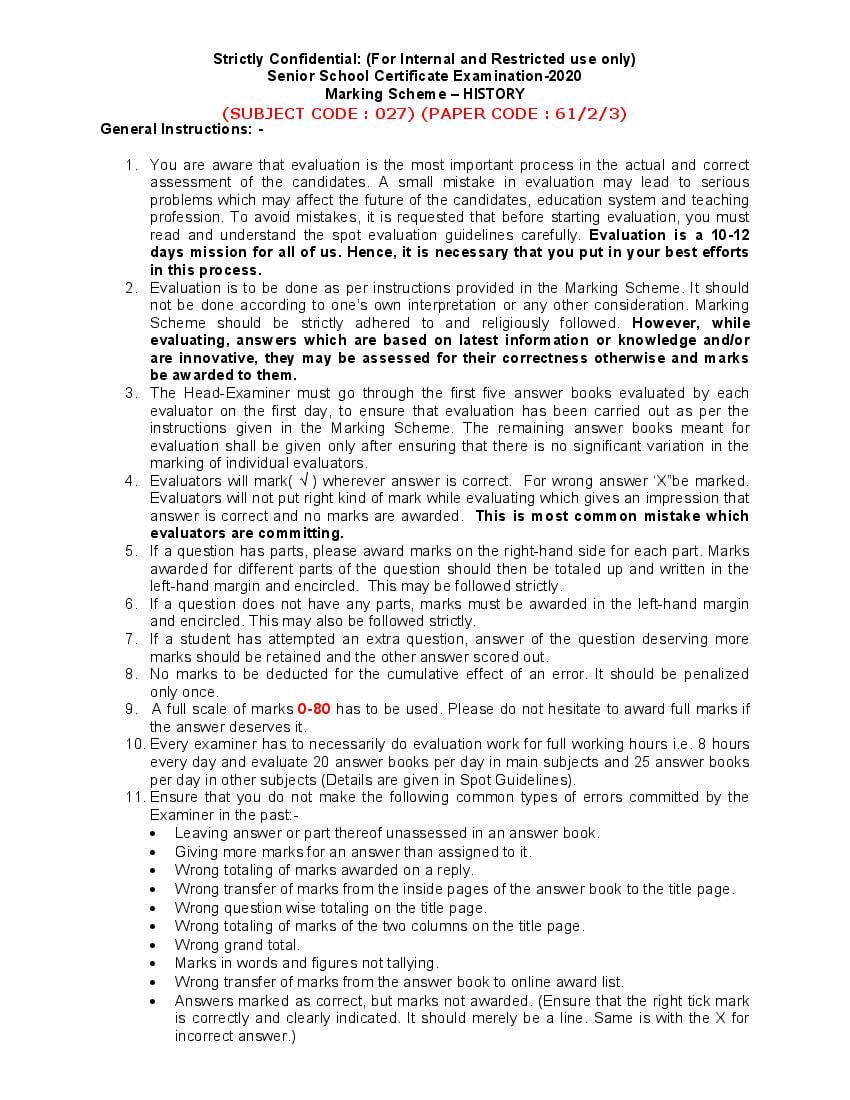
Senior School Certificate Examination-2020
Marking Scheme – HISTORY
(SUBJECT CODE : 027) (PAPER CODE : 61/2/3)
General Instructions: -
1. You are aware that evaluation is the most important process in the actual and correct
assessment of the candidates. A small mistake in evaluation may lead to serious
problems which may affect the future of the candidates, education system and teaching
profession. To avoid mistakes, it is requested that before starting evaluation, you must
read and understand the spot evaluation guidelines carefully. Evaluation is a 10-12
days mission for all of us. Hence, it is necessary that you put in your best efforts
in this process.
2. Evaluation is to be done as per instructions provided in the Marking Scheme. It should
not be done according to one’s own interpretation or any other consideration. Marking
Scheme should be strictly adhered to and religiously followed. However, while
evaluating, answers which are based on latest information or knowledge and/or
are innovative, they may be assessed for their correctness otherwise and marks
be awarded to them.
3. The Head-Examiner must go through the first five answer books evaluated by each
evaluator on the first day, to ensure that evaluation has been carried out as per the
instructions given in the Marking Scheme. The remaining answer books meant for
evaluation shall be given only after ensuring that there is no significant variation in the
marking of individual evaluators.
4. Evaluators will mark( √ ) wherever answer is correct. For wrong answer ‘X”be marked.
Evaluators will not put right kind of mark while evaluating which gives an impression that
answer is correct and no marks are awarded. This is most common mistake which
evaluators are committing.
5. If a question has parts, please award marks on the right-hand side for each part. Marks
awarded for different parts of the question should then be totaled up and written in the
left-hand margin and encircled. This may be followed strictly.
6. If a question does not have any parts, marks must be awarded in the left-hand margin
and encircled. This may also be followed strictly.
7. If a student has attempted an extra question, answer of the question deserving more
marks should be retained and the other answer scored out.
8. No marks to be deducted for the cumulative effect of an error. It should be penalized
only once.
9. A full scale of marks 0-80 has to be used. Please do not hesitate to award full marks if
the answer deserves it.
10. Every examiner has to necessarily do evaluation work for full working hours i.e. 8 hours
every day and evaluate 20 answer books per day in main subjects and 25 answer books
per day in other subjects (Details are given in Spot Guidelines).
11. Ensure that you do not make the following common types of errors committed by the
Examiner in the past:-
Leaving answer or part thereof unassessed in an answer book.
Giving more marks for an answer than assigned to it.
Wrong totaling of marks awarded on a reply.
Wrong transfer of marks from the inside pages of the answer book to the title page.
Wrong question wise totaling on the title page.
Wrong totaling of marks of the two columns on the title page.
Wrong grand total.
Marks in words and figures not tallying.
Wrong transfer of marks from the answer book to online award list.
Answers marked as correct, but marks not awarded. (Ensure that the right tick mark
is correctly and clearly indicated. It should merely be a line. Same is with the X for
incorrect answer.)
Page 2
awarded.
12. While evaluating the answer books if the answer is found to be totally incorrect, it should
be marked as cross (X) and awarded zero (0)Marks.
13. Any unassessed portion, non-carrying over of marks to the title page, or totaling error
detected by the candidate shall damage the prestige of all the personnel engaged in the
evaluation work as also of the Board. Hence, in order to uphold the prestige of all
concerned, it is again reiterated that the instructions be followed meticulously and
judiciously.
14. The Examiners should acquaint themselves with the guidelines given in the Guidelines
for spot Evaluation before starting the actual evaluation.
15. Every Examiner shall also ensure that all the answers are evaluated, marks carried over
to the title page, correctly totaled and written in figures and words.
16. The Board permits candidates to obtain photocopy of the Answer Book on request in an
RTI application and also separately as a part of the re-evaluation process on payment of
the processing charges.
Page 3
CLASS XII A I S S C E-March 2020
CODE NO. 61/2/3
Q.NO. EXPECTED ANSWERS/VALUE POINTS PAGE NO. MARKS
1. C (Nishadas) Pg-61 1
2. The image of Buddha from Mathura Pg-103 1
For visually impaired: Shalabhanjika Pg-101
3. C (I and III) Pg-11 1
4. To display in a museum in France. Pg-83 1
OR
The stupas contained the relics of the Buddha regarded as sacred. Pg-96
5. Boddhisatta is perceived as deeply compassionate being, who Pg-103 1
accumulated merit through his efforts but used this not to attain nibbana
and thereby abandon the world.
6. Vaishanavism is a form of Hinduism within which Vishnu is Pg-104 1
worshipped as the principal deity where as Shaivism is a tradition within
which Shiva is regarded as chief God.
7. Urban centres /Any urban feature Pg-5 1
8. He was a physician to prince Dara Shukoh, the eldest son of Shah Jahan Pg-122 1
9. C (Harihara and Bukka) Pg-171 1
10. B(I,II and III) Pg-173 1
11. D (He had cordial relations with safavids over Qandahar) Pg-230 1
12. Delhi Pg-221 1
13. Gulbadan Begum Pg-243 1
OR
Abdul Hamid Lahori Pg-231
14. Kitab-ul-Hind Pg-117 1
1
Page 4
16. C [Both (A) and (R) are true and (R) is the correct explanation of (A)] Pg-365 1
17. On the recommendation of a committee chaired by Sir Sidney Rowlatt Pg-349 1
the British instituted censorship of the press and permitted detention
without trial.
18. In Awadh Nawab Wajid Ali Shah ,a popular ruler was dethroned so Pg-292 1
people of Awadh hailed Birjis Qadr, the son of Nawab Wajid Ali Shah
as their leader, to raise the standard of revolt against the British.
19. B(III,I,IV,II) Pg- 1
361,364,391,411
20. D ( The ally was free to enter into agreements with other rulers without Pg-296 1
the permission of the British)
SECTION-B
21. The Domestic Architecture of Harappan Cities: Pg-7 3
i. The lower town provides examples of residential buildings.
ii. Many houses were centred on a courtyard, with rooms on all
sides.
iii. The courtyard was probably the centre of activities such as
cooking, weaving etc.
iv. There are no windows on the walls along the ground level.
v. The main entrance does not give a direct view of the interior of
the courtyard.
vi. Every house had bathroom.
vii. Every house was connected to the street drains.
viii. Some houses have remain of staircases to reach a second storey
of the roof.
ix. Many houses had wells.
x. Any other relevant point.
Any three points to be explained
2
Page 5
i. River Tungbhadra was flowing through this region was the main
source of water.
ii. The surrounding landscape is characterized by stunning granite
hills that seem to form a girdle around the city.
iii. A number of small streams were also flowing through this
region.
iv. Embankments were built along these streams to create reservoirs
of varying sizes.
v. Some water reservoirs were also constructed to store water.
vi. Water from Kamalapuram tank, not only irrigated fields nearly
but was also conducted through a channel to the “royal centre”.
vii. One of the most prominent water works is Hiriya canal which
was supplying water for agriculture as well as for drinking
purpose.
Any three points to be explained
23. “For Swaraj, Hindu, Muslim, Parsis and Sikhs will have to unite”: Pg-350 3
Non- cooperation movement:
i. Gandhiji joined hands with the Khilafat Movement.
ii. Hindus and Muslims, could collectively bring an end to colonial
rule.
iii. Common people participated in the movement irrespective of
being Hindu, Muslim, Parsi or Sikh.
iv. Peasants, workers and others acted upon the call to non-
cooperate with colonial rule.
v. Any other relevant point.
Any three points to be explained
24. The circumstances under which the British officials invited Pg-270-271 3
Santhals to settle in the peripheries of Rajmahal hills during the
nineteenth century:
i. Having failed to subdue Paharias the British turned towards
Santhals.
ii. The Santhals appeared to be ideal settlers clearing forests and
ploughing land.
3
Page 6
Rajmahal.
iv. Santhals practiced plough agriculture and became settled
peasants.
v. Any other relevant point.
Any three points to be explained
OR
Economic and social conditions of the Paharias (hill folk) of
Rajmahal hills during the late eighteenth century) Pg-267-269 3
i. The Paharias were hunters , food gatherers and shifting
cultivators, charcoal producers and silk worm rearers.
ii. They lived in huntments within tamrind groves and rested under
shades of mango trees.
iii. Their chiefs maintained the unity of their groups and settled
disputes.
iv. These hill folk regularly raided the plains where settled
agriculturists lived.
v. Paharias grew a variety of pulses and millets for consumption.
vi. From the forests they collected Mahua (a flower) for food , silk
cocoons and resin for sale and wood for charcoal production.
vii. They considered the entire region as their land.
viii. They resists the intrusion of outsiders.
ix. Traders gave a small amount to the hill folk for permission to use
the passes controlled by them.
x. Any other relevant point
Any three points to be explained
SECTION-C
25. Characteristics of Mahajanpadas Pg-29-31 4+4=8
i. Most Mahajanpadas were ruled by kings.
ii. Some known as ganas or sanghas, were oligarchies where power
was shared by a number of men, often collectively called rajas.
iii. Both Mahavira and Buddha belonged to such ganas.
iv. Each Mahajanpada had a capital city which was often fortified.
v. Brahmins laid down the norms for the rulers in texts known as
Dharmasutras.
vi. Rulers were advised to collect taxes and tribute from cultivators,
traders and artisans.
vii. Gradually, some states acquired standing armies and maintained
regular bureaucracies.
viii. Some others continued to depend on militia, recruited more
4
Page 7
ix. Any other relevant point
Any four points to be explained
Magadha as the most powerful Mahajanpada
i. Magadha was a region where agriculture was especially
productive.
ii. Iron-mines were accessible which provided resources for
making tools and weapons.
iii. Elephants, an important component of army was available in the
forests of this region.
iv. Ganga and its tributaries provided water for cheap and
convenient communication.
v. Ambitious and powerful rulers like Bimbisara, Ajatasattu and
Mahapadma Nanda and their policies.
vi. Capitals of Magadha was Rajagaha (house of the king) which
was a fortified settlement located amongst hills. Later capital
was shifted to Pataliputra, on commanding routes of
communication along the Ganga.
Any four points to be explained
OR
Main features of Maurayas Administration
i. There were five major political centres in the empire. They were
Pataliputra, Taxila, Ujjayni, Tosali and Suvarngiri. Pg-32-34 5+3=8
ii. Administrative control was strongest in areas around the capital
and the provincial centres.
iii. Communication along both river and land routes were vital.
iv. Army was an important means for ensuring protection for those
who were on the move.
v. Megasthenes mentions a comitte with six subcomittes for
coordinating military activity.
vi. Ashoka try to hold his empire through propogating Dhamma.
Any five points to be explained
Principles of Ashoka’s Dhamma
i. The principles of Ashoka’s Dhamma were simple and virtually
universally applicable.
5
Page 8
people in the world and the next.
iii. Ashoka inscribed his messages to the subjects on stones or
rocks.
iv. This included respect for elders and generosity towards
Brahmins and those who renounced worldly life.
v. Treating slaves and servants kindly.
vi. Respect for religion and tradition other than one’s own.
vii. Special officers, Known as the dhamma mahamatta, were
appointed to spread the message of Dhamma.
Any three points to be explained
26 The role of women in Agrarian Society during the Mughal India: Pg-206-207 8
i. Women and men had to work shoulder to shoulder in the fields.
ii. Men tilled and ploughed, while women sowed and weeded,
threshed and winnowed the harvest.
iii. Many aspects of production depended on female labour.
iv. A gendered segregation between the home (for women) and the
world( for men) was not possible in this context.
v. Menstruating women, for instance, were not allowed to touch
the plough or the potter’s wheel in Western India or enter the
groves where betel leaves (paan) were grown in Bengal.
vi. Peasant and artisan women worked not only in the fields but
went to the employers houses or to the markets.
vii. Women were the child bearing force.
viii. These children grew up to provide labour.
ix. There was shortage of wives due to high mortality rates among
women, so women were important.
x. The household chores were also looked after by women.
xi. Male headed the house , females acted as mothers, wives and
sisters.
xii. Women had the right to inherit property also.
To be assessed as a whole.
OR
The Land Revenue System of the Mughal Empire:
i. Land revenue was the economic mainstay of the Mughal
Empire. Pg-213 8
ii. Revenue was vital to create an administrative apparatus.
iii. Diwan was responsible for supervising the fiscal system.
iv. Mughal state, first tried to acquire information about agriculture,
than imposed tax.
v. Land revenue consisted at two stages-the first assessment and
than actual collection.
6
Page 9
amount collected.
vii. Amil-guzar was the revenue collector.
viii. Akbar decried that cultivators could pay either in cash or in
kind.
ix. Land was actually measured to assess the revenue.
x. Lands were classified as Polaj, Parauti, Chachar and Banjar.
xi. The land revenue collections were in the form of Kankut, Batai
or Bhaoli, Khet-batai and Lang batai.
xii. Annual records of the revenue was kept.
xiii. Both cultivated and cultivable lands were measured in each
province.
xiv. Forests covered huge areas of the subcontinent and thus
remained unmeasured.
xv. Any other relevant point.
To be assessed as a whole.
27. Changes in the Social Life of the People in Colonial Cities during Pg-329-330 8
18th and 19th Centuries:
i. For Indians, new cities were bewildering places where life
seemed always a flux.
ii. There was dramatic contrast in wealth and poverty.
iii. New transports like buses, trams were available.
iv. Travelling from home to office or factory was a new kind of
experience.
v. The creation of public places, like public parks, theatres
provided exciting new forms of entertainment and interaction.
vi. Within new cities, new social groups were formed.
vii. Old identities of people were no longer important.
viii. All classes of people were migrating to the big cities.
ix. Middle class increased in cities because of the jobs of clerks,
teachers, lawyers etc.
x. New public sphere of debate and discussion emerged.
xi. Social customs, norms and practices came to be questioned.
xii. Cities offered new opportunities for women.
xiii. Middle class women sought to express themselves through
journals and books etc.
xiv. Overtime women became more visible in public.
xv. Labouring poor and working class also developed in cities.
xvi. To minimize costs of living in the city, most male migrants left
their families behind in their village homes.
xvii. Life in the new cities was a struggle for jobs, foods, places to
7
Page 10
xviii. The poor in cities created lively urban culture of their own.
xix. These poor were participants in religious festivals, tamashas and
swangs, which often mocked the pretensions of their masters,
Indian and European.
xvi. Any other relevant point.
To be assessed as a whole
OR
The Process of Census Operation: Pg-321-322 4+4
i. From1881, decennial censuses became a regular feature.
ii. This collection of data is an invaluable source for studying
urbanization in india.
iii. The census operation, was a means by which social data were
converted into convenient statistics about the population.
iv. The census commissioners devised categories for classifying
different sections of the population.
v. The census process was riddled with ambiguity.
vi. Any other relevant point.
Any four points to be explained
The suspicions about Census during Colonial Rule :
i. The categories devised by census commissioners often arbitrary
and failed to capture the fluid and overlapping identities of
people.
ii. People often refused to cooperate or gave evasive answers to the
census officials.
iii. People were suspicious, that these enquires were being
conducted to impose new taxes on them.
iv. Upper caste people were also unwilling to give any information
regarding the women of their household.
v. People were claiming identities that they associated with higher
status.
vi. The figures of mortality and disease were difficult to collect.
vii. Any other relevant point.
Any four points to be explained
28. “Without a shot being fired”
28.1 Examine the causes for the collapse of the administrative
system?
Pg-392 2
i. Partition was in process.
ii. Issue of political governance was in conflict.
8
Page 11
Any two points
28.2 Why could the British officials not take any action to control Pg-392 2
the situation?
i. The British did not know how to handle the situation.
ii. Big dilemma over authority and power.
iii.Britishers were preparing to quit India.
Any two points
28.3 Do you think the role of District Magistrate was justified?
Pg-392 2
Answer could be justified or unjustified.
(views of the student should be taken into consideration)
29. Proper social roles
29.1 Why did Drona refuse to accept Ekalavya as his pupil? Pg-62 2
i.Drona knew the dharma and taught only to the Kuru princess.
ii. Eklavya was a forest dwelling Nishada.
iii.Drona was a Brahman and he taught archery to the Kuru princes
only.
Any two points
29.2 How did Ekalavya acquire the supreme skill of archery?
Pg-62 2
i. Ekalvya, on refusal, returned to the forest.
ii. He prepared an image of Drona out of clay and practiced
intensively in front of it.
iii.He acquired great skill in archery.
Any two points
29.3 Why did Ekalavya introduce himself to the Pandavas as a pupil Pg-62 2
9
Page 12
i. When the Kuru Princes dog began to bark at him ,he got
annoyed.
ii. He shot seven arrows into his mouth.
iii. The Pandavas amazed at this superb display of archery, tracked
him down.
iv. He introduced himself to the Pandavas as pupil of Drona.
Any two points
30. The Pilgrimage Of The Mughal Princess Jahanara-1643
30.1 How did Jahanara exhibit her faith and devotion to the Shaikh? Pg-157 2
i. She performed two cycles of optional prayers.
ii. She did not sleep on a leopard skin at night for several days
iii.She did not extend her feet in the direction of the blessed
sanctuary.
iii. She did not turn her back towards him.
iv. She passed the days beneath the trees.
Any two points
30.2 Why did she consider Dargah as a special place for pilgrimage
and reverence? Pg-157 2
i. Due to her faith and devotion towards Lord.
ii. She was the murid of her Murshid(Guru).
iii. This was the family ritual and tradition.
iv. For seeking blessings
v. Any other relevant point.
Any two points
30.3 How did she pay her obeisance at the Dargah?
10
Page 13
ii. She went bare-footed kissing the ground.
iii. She went round the tomb several times.
iv. She sprayed the finest quality of itar on the perfumed tomb.
v. She had also takes off the rose scarf that she had on her head and
placed it on the top of the blessed tomb.
Any two points
31 See attached filled map 3+3=6
For Visually Impaired Candidates
31.1 Mature Harappan sites (Any Three): 1x3=3
Harappa, Mohenjodaro, Lothal, Nageshwar, Kalibangan, Rakhigarhi,
Banawali, Dholavira, Chanhudaro, Nageshwar, Balakot
OR
Centres of Revolt of 1857(Any Three): 1x3=3
Kanpur, Jhansi, Meerut, Delhi, Azamgarh, Lucknow, Calcutta, Benaras,
Gwalior, Jabalpur, Agra, Awadh
31.2 Centres of National Movement(Any Three): 1x3=3
Champaran, Kheda, Ahmedabad, Benaras, Amritsar, Chauri Chaura,
Lahore, Bardoli, Dandi, Bombay, Karachi
11
Page 14
Document Details
| Board / Org | CBSE |
| Exam | Class 12 |
| Type | Solution |
| Pages | 14 |
| Updated | 22 Jul 2026 |