CBSE Class 12 History Question Paper 2020 Set 61-3-3 Solutions
Finished viewing? Save it for later —
Download CBSE Class 12 History Question Paper 2020 Set 61-3-3 Solutions (PDF · 18 pages)About CBSE Class 12 History Question Paper 2020 Set 61-3-3 Solutions
CBSE Class 12 History Question Paper 2020 Set 61-3-3 Solutions is available here for free download. Published by CBSE for Class 12, this solution can be viewed online or downloaded as a PDF (18 pages). Candidates preparing for Class 12 can use CBSE Class 12 History Question Paper 2020 Set 61-3-3 Solutions to understand the exam pattern, the type of questions asked, and the overall difficulty level.
Frequently Asked Questions
How can I download CBSE Class 12 History Question Paper 2020 Set 61-3-3 Solutions?
Open this page and click the Download button to save CBSE Class 12 History Question Paper 2020 Set 61-3-3 Solutions as a PDF. It is completely free on AglaSem Docs.
Is CBSE Class 12 History Question Paper 2020 Set 61-3-3 Solutions free to download?
Yes. CBSE Class 12 History Question Paper 2020 Set 61-3-3 Solutions can be viewed online and downloaded as a PDF free of cost on AglaSem Docs.
How many pages does CBSE Class 12 History Question Paper 2020 Set 61-3-3 Solutions have?
CBSE Class 12 History Question Paper 2020 Set 61-3-3 Solutions contains 18 pages, which you can read online or download together as a single PDF.
Where can I find more Class 12 study material?
You can find more Class 12 question papers, sample papers, syllabus, and answer keys on AglaSem Docs.
CBSE Class 12 History Question Paper 2020 Set 61-3-3 Solutions – Text
Read the full text of this solution below — useful to quickly search, copy and reference the content online without downloading the PDF.
📄 View text version (18 pages)
Page 1
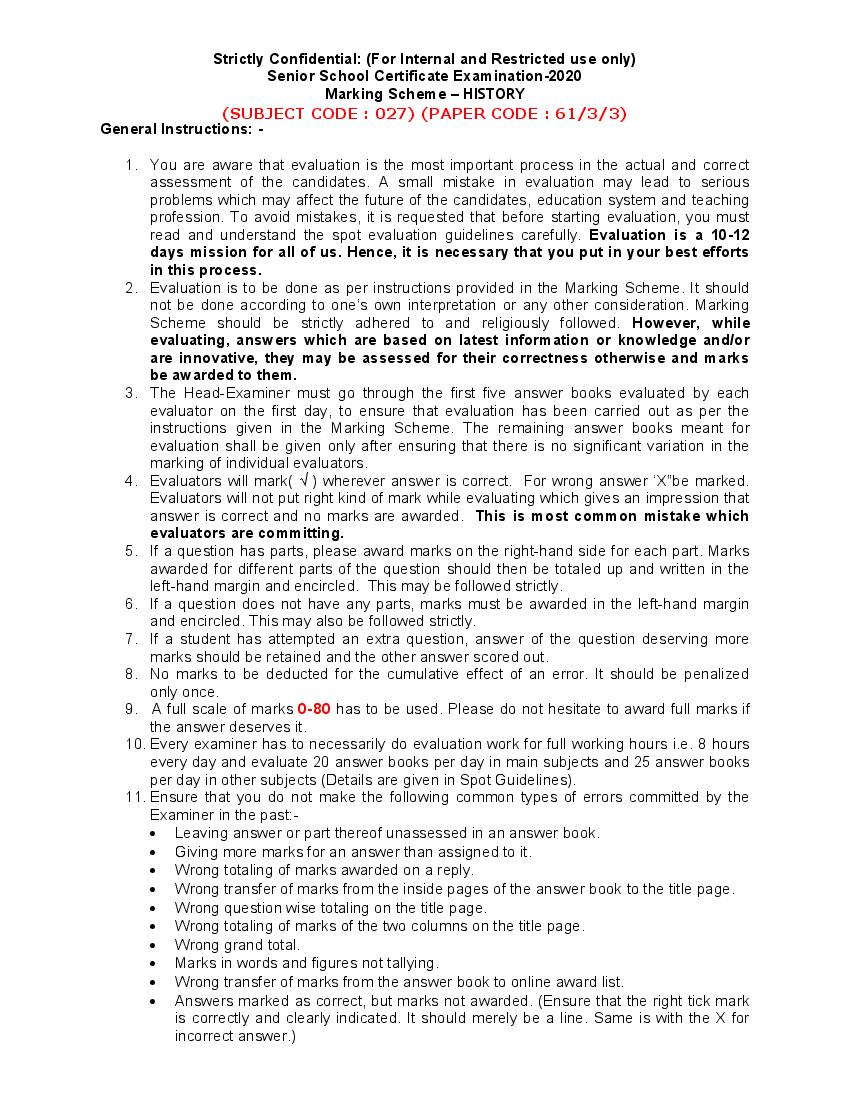
Senior School Certificate Examination-2020
Marking Scheme – HISTORY
(SUBJECT CODE : 027) (PAPER CODE : 61/3/3)
General Instructions: -
1. You are aware that evaluation is the most important process in the actual and correct
assessment of the candidates. A small mistake in evaluation may lead to serious
problems which may affect the future of the candidates, education system and teaching
profession. To avoid mistakes, it is requested that before starting evaluation, you must
read and understand the spot evaluation guidelines carefully. Evaluation is a 10-12
days mission for all of us. Hence, it is necessary that you put in your best efforts
in this process.
2. Evaluation is to be done as per instructions provided in the Marking Scheme. It should
not be done according to one’s own interpretation or any other consideration. Marking
Scheme should be strictly adhered to and religiously followed. However, while
evaluating, answers which are based on latest information or knowledge and/or
are innovative, they may be assessed for their correctness otherwise and marks
be awarded to them.
3. The Head-Examiner must go through the first five answer books evaluated by each
evaluator on the first day, to ensure that evaluation has been carried out as per the
instructions given in the Marking Scheme. The remaining answer books meant for
evaluation shall be given only after ensuring that there is no significant variation in the
marking of individual evaluators.
4. Evaluators will mark( √ ) wherever answer is correct. For wrong answer ‘X”be marked.
Evaluators will not put right kind of mark while evaluating which gives an impression that
answer is correct and no marks are awarded. This is most common mistake which
evaluators are committing.
5. If a question has parts, please award marks on the right-hand side for each part. Marks
awarded for different parts of the question should then be totaled up and written in the
left-hand margin and encircled. This may be followed strictly.
6. If a question does not have any parts, marks must be awarded in the left-hand margin
and encircled. This may also be followed strictly.
7. If a student has attempted an extra question, answer of the question deserving more
marks should be retained and the other answer scored out.
8. No marks to be deducted for the cumulative effect of an error. It should be penalized
only once.
9. A full scale of marks 0-80 has to be used. Please do not hesitate to award full marks if
the answer deserves it.
10. Every examiner has to necessarily do evaluation work for full working hours i.e. 8 hours
every day and evaluate 20 answer books per day in main subjects and 25 answer books
per day in other subjects (Details are given in Spot Guidelines).
11. Ensure that you do not make the following common types of errors committed by the
Examiner in the past:-
Leaving answer or part thereof unassessed in an answer book.
Giving more marks for an answer than assigned to it.
Wrong totaling of marks awarded on a reply.
Wrong transfer of marks from the inside pages of the answer book to the title page.
Wrong question wise totaling on the title page.
Wrong totaling of marks of the two columns on the title page.
Wrong grand total.
Marks in words and figures not tallying.
Wrong transfer of marks from the answer book to online award list.
Answers marked as correct, but marks not awarded. (Ensure that the right tick mark
is correctly and clearly indicated. It should merely be a line. Same is with the X for
incorrect answer.)
Page 2
awarded.
12. While evaluating the answer books if the answer is found to be totally incorrect, it should
be marked as cross (X) and awarded zero (0)Marks.
13. Any unassessed portion, non-carrying over of marks to the title page, or totaling error
detected by the candidate shall damage the prestige of all the personnel engaged in the
evaluation work as also of the Board. Hence, in order to uphold the prestige of all
concerned, it is again reiterated that the instructions be followed meticulously and
judiciously.
14. The Examiners should acquaint themselves with the guidelines given in the Guidelines
for spot Evaluation before starting the actual evaluation.
15. Every Examiner shall also ensure that all the answers are evaluated, marks carried over
to the title page, correctly totaled and written in figures and words.
16. The Board permits candidates to obtain photocopy of the Answer Book on request in an
RTI application and also separately as a part of the re-evaluation process on payment of
the processing charges.
Page 3
CLASS XII A I S S C E-March 2020
CODE NO. 61/3/3
Q.NO. EXPECTED ANSWERS/VALUE POINTS PAGE NO. MARKS
SECTION - A
1. Rajasthan Pg - 2 1
2. Delhi and Daulatabad Pg – 127 1
3. C – IV, I, III, II Pg – 137 1
4. D – Emergence of Mahajanapadas and use of iron. Pg – 84 1
5. D – Scholars understood the value of preservation at site Pg – 98 1
after the fall of Amaravati.
6. C - I, II and III Pg – 108 1
7. Bodhisattas were perceived as deeply compassionate human Pg – 103 1
beings who accumulated merit through their efforts.
OR
Walter Elliot was the Commissioner of Guntur (Andhra
Pradesh) who visited Amaravati and carried away several
sculpture panels to Madras that came to be called Elliot Pg - 98
Marbles.
8. Kailashnatha Temple (Maharashtra) Pg – 107 1
For visually impaired
Krishna Pg – 104
9. Archaeological Survey of India Pg – 20 1
Or
S. N. Roy Pg-20
10. Rihla 1
11. D – Dutch in Bombay Pg – 319 1
12. Mount Abu and Darjeeling Pg – 327 1
13. D, II-IV-I-III Pg – 314 1
14. Neo Gothic Pg – 341 1
1
Page 4
explanation of A.
16. Giovanni Careri Pg – 216 1
17. Lotus Mahal Pg – 181 1
18. Battle of Talikota/ Battle of Rakshasi – Tangadi Pg – 173 1
19. Harihara and Bukka Pg – 171 1
20. The Hazara Rama Temple Pg – 183 1
SECTION - B
21. Distinction between Wives in Mughal Household:
i. Begams –Wives who came from Royal and
Aristocratic families, received huge amount of
cash and Mahr. Higher status and attention was
given to them.
ii. Aghas –Those who were not of noble birth.
iii. Aghacha or Concubines – Occupied lowest
position, received monthly allowance. Could rise
to the position of Begams depending on Ruler’s
will, provided he already did not have four wives.
iv. Love and motherhood played an important role in
elevating aghas and aghachas to the status of
legally wedded wives.
v. Any other relevant point to be explained.
Examine any three features. Pg – 242 3
22. Quit India Movement was undoubtedly a mass
movement.
The movement was launched by Mahatma Gandhi
i. Hundreds of thousands of ordinary Indians joined
together.
ii. Strikes were organized.
2
Page 5
iv. Women actively participated in the movement.
v. Lawyers left courts.
vi. Independent governments were proclaimed. Pg – 363 3
vii. People followed the slogan of Mahatma Gandhi
“Do or Die” and were willing to lay down their
lives for the nation.
viii. Any other relevant point.
Any three points to be explained.
23. Life of PAHARIAS.
i. They lived around the Rajmahal hills.
ii. Did subsistence cultivation.
iii. Practiced shifting cultivation.
iv. They cleared patches of forest for crop cultivation.
v. They sold forest produce.
vi. They were hunters, food gatherers and silk worm
rearers.
vii. They lived in tamarind groves.
viii. They resisted the interference of outsiders to preserve
their identity and survival..
ix. They regularly raided the plains.
x. Traders gave them small amount to use the passes in
the hills. Pg – 268 3
xi. They considered the entire region as their land.
xii. Any other relevant point.
Any three points to be assessed.
24. Many reconstructions of Harappan religion are made on
assumptions which provide parallels with earlier ones.
i. Mother Goddess – Terracotta figurine of women
heavily jewelled with elaborate head-dresses.
ii. Priest King – Seated with one hand on knee
3
Page 6
animals.
iv. Lingas – Conical shaped stone objects.
v. Fire Altars.
vi. Great Bath.
vii. Plant Motifs.
viii. Unicorn
ix. Any other relevant point.
Any three examples to be examined Pg – 23 3
OR
Transformation of Harappan successor Cultures to rural
way of life.
i. Disappearance of artefacts – Weights, seals,
beads and pottery.
ii. Writing, long distance trade, crafts specialization
disappeared.
iii. House construction techniques deteriorated.
iv. Large public structures were no longer
constructed.
v. Decline and abandonment of cities.
vi. The shift from a standardized weighing system to
the use of local weights.
vii. Any other relevant point. Pg - 17 3
Any three examples to be assessed.
SECTION - C
25. Historians considered several elements when they
analyze the Mahabharata.
i. Language – Historians examined texts in
4
Page 7
or Tamil.
ii. Content – Historians classify the content of the
present text under two broad heads –
a. Sections that contain stories designated as
the Narrative.
b. Sections that contain prescriptions about
social norms designated as the Didactic.
This division is by no means water tight. The
didactic section includes stories and narrative
often contains a social message.
iii. Authors –
a. Original story was composed by
Charioteer Bards known as Sutas who
generally accompanied Kshatriya warriors
to the battlefield. Their compositions
were transmitted orally.
b. Brahmans took over the story and
committed it to writing. New kings
wanted their history/ itihasa to be
recorded.
c. Later Mahabharata composed by Sage
Vyasa.
iv. Dates –
a. Historians also try and ascertain the possible
dates of the composition or compilation of the
texts as well as the place where they may
have been composed.
b. Early to fifth century BCE, the Mahabharata
was orally transmitted.
5
Page 8
by the Brahmanas.
d. Between C200 and 200 CE – compositions
were made when Krishna grew in importance.
e. Between C200 to 400 CE large didactic
4x2=8
sections like Manusmriti were added. Pg–72-76
Any four points to be explained.
OR
“Mahabharata is a story based on kinship and social
relations.” Support the statement with examples.
Mahabharata is a story based on kinship and social
relations.
i. Kinfolk – Familial ties based on natural and
blood relations. Historians investigated and
analyzed attitude towards family and kinship.
ii. The idea of Patriliny – Mahabharata reinforced
this idea, feud over land and power was between
Kauravas and Pandavas who belonged to a single
ruling family that of the Kurus.
iii. Types of marriage – Endogamy, Exogamy,
Polygyny and Polyandry system were followed.
iv. Kanyadana or gift of a daughter in marriage was
considered an important religious duty of a
father.
v. Gotras of Women – Women were expected to
give up their father’s gotra and adopt that of their
husband’s on marriage.
vi. Members of the same gotra could not marry.
vii. Each gotra was named after a Vedic seer.
6
Page 9
derived from Gotra of mothers.
ix. Guru Shishya Parampara – The story of Ekalavya
and Dronacharaya .
x. Importance of Mother’s advice – Pandavas
marrying Draupadi after mother’s advice.
However, the advice given by Gandhari to her
son Duryodhana was not followed.
xi. Succession of women – Although ordinary
women had no access to land, Queen Prabhavati
Gupta had rights over land which she donated.
xii. Rules of Dharmasutras and Dharmashastras were
not always followed. For example, Non-
Kshatriyas even Brahmanas became rulers. Like
wise eight forms of marriage were recognized but
only four were considered as good while the
remaining were condemned.
xiii. It is possible that these were followed by those
who did not accept Brahmanical norms. Pg–55-60 8
xiv. Any other relevant point.
Any eight examples to be assessed.
26. Philosophy of Islam.
i. Five principles – called as five pillars of faith.
ii. Belief in one God (Allah) and Prophet Mohammad as
his messenger.
iii. Praying five times a day (Namaz).
iv. Giving Alms/ (Zakat)
v. Fasting during the month of Ramzan.
vi. Performing the pilgrimage to Mecca (Hajj).
vii. Sectarian affiliations as Shias and Sunnis.
viii. Khojahs a branch of Ismailis developed new modes of
7
Page 10
ix. Disseminating ideas derived from the Quran.
x. Ginan or Jnana or knowledge.
xi. Devotional poems in Punjabi, Multani, Sindhi.
xii. Adopted local customs as matriliny and Arab traders
adopted Malayalam.
xiii. Faith exemplified in Mosques. Pg-151 8
xiv. Any other relevant point.
Any eight beliefs to be assessed.
OR
Describe the life and beliefs of Mirabai.
Life and Beliefs of Mirabai.
i. Best known women poet within Bhakti tradition.
ii. Known for her devotional bhajans in praise of Lord
Krishna, which were transmitted orally for centuries.
iii. A Rajput princess who defied traditional role of wife
and mother.
iv. Embraced Krishna as her Lord.
v. Escaped from her palace to live as a wandering Saint.
vi. Composed songs characterized by intense emotions
which are sung even today.
vii. Her Guru was Ravidas, a leather worker.
viii. She opposed the norms of caste society.
ix. She dressed in the white robes of a widow or the Pg- 164, 8
saffron robe of the renouncer. 165
x. Recognized as a source of inspiration for the poor and
low caste people.
xi. Any other relevant point.
Any eight points to be assessed.
8
Page 11
Consequences of partition of India.
i. Administrative division of British India into Pakistan
and India.
ii. Both governments agreed upon division of territories
and assets.
iii. Millions were uprooted and transformed into
refugees.
iv. People lost all their immovable property and movable
assets.
v. People were stripped off their local or regional
culture.
vi. Communal and Stereotype extra territorial loyalties
infused.
vii. Communal hatred led to extreme communal violence
and bloodshed.
viii. Main sufferers were the minorities on both sides.
ix. Women were abducted and raped. Pg- 8
x. Suddenness of partition, people did not know which 380-381,
side of the border they were in or how their lives 395-398
would change.
xi. Any other relevant point.
Any eight points to be assessed.
OR
“Some scholars see partition as a culmination of communal
politics.” Examine the statement with suitable points.
Partition as a culmination of communal policy.
i. British policy of Divide and Rule.
ii. Separate electorate for Muslims in Government of
India Act 1909 and 1919.
9
Page 12
iv. Shuddhi, Tabligh and Tanzim movement.
v. Cow protection movement and Music before mosque.
vi. Hostile feelings between Muslim league and Hindu
Mahasabha.
vii. INC in the 1930s allowed members to join Hindu
Mahasabha but not the Muslim League.
viii. Government of India Act 1935.
ix. 1937 elections widened the gulf. Refusal of Congress
to form a coalition government with the IML in the
United Provinces. .
x. Pakistan Resolution 1940.
xi. Jinnah’s Two Nation theory.
xii. Cripps Mission 1942.
xiii. Cabinet Mission 1946.
xiv. Direct Action Day.
xv. Communal Violence. Pg-381, 8
xvi. Any other relevant point. 384-392
Any eight points to be assessed.
SECTION - D
28. I believe separate electorates will be suicidal to the
minorities.
(28.1) “Some leaders in the Constituent Assembly argued
for the continuation of separate electorates”. Examine
the statement.
a. Members argued for separate electorate system
in the Assembly.
b. Leaders like B. Poker Bahadur pleaded for the
continuation of separate electorates.
c. For harmony and fair representation of
10
Page 13
d. He argued that differences between
communities could be minimized.
e. Any other relevant point.
Any two points. (2)
(28.2) Analyze the perspective of Gobind Ballabh Pant in
opposing the proposal.
a. He opposed the idea of separate electorate and
considered it as suicidal.
b. He argued that minorities would be permanently
isolated and it would make them vulnerable.
c. Any other relevant point.
Any two. (2)
(28.3) Analyse the arguments made on making India a
strong unified nation state.
.
a. In order to build political unity and forge a
nation a strong center was given importance.
b. Assembly members laid emphasis on Pg-418 2+2+2=6
assimilation. Communities could be recognized
as cultural entities and assured cultural rights.
c. In order to become loyal citizens people had to
stop focusing only on community and the self.
d. Any other relative point.
Any two. (2)
11
Page 14
Prabhavati Gupta and the village of Danguna
(29.1) How did queen Prabhavati Gupta try to earn
religious merit?
Prabhavati tried to earn religious merit by
a. She donated lands.
b. She paid respect and homage to the Acharya.
Any other relevant point. (2)
(29.2) Explain the unusual aspect of the Land Grant.
a. Land exempted from soldiers and policemen.
b. Exempt from the obligation to provide animals
and charcoal.
c. Exempt from purchasing fermenting liquors and
digging salt.
d. Exempt from mines and khadira trees.
e. Exempt from the obligation to supply flowers
and milk.
f. Right to hidden treasures and deposits.
g. Exempt from major and minor taxes.
Any other relevant point.
Any two. (2)
(29.3) What does the inscription tell us about the
relationship between state and ordinary people?
Explain.
12
Page 15
range of produce to the king.
b. They would have to obey the state orders.
c. State donated small plots to vast stretches of
land possibly for expanding agricultural land.
d. People did not keep records of transactions.
e. Land grants were also indicative of weakening
political power and rulers wished to win allies to
present a facade of power.
f. Any other relevant point.
Any two (2) Pg – 41 2+2+2=6
30. Irrigating trees and fields.
(30.1) Explain with examples, the sources of irrigation
in Lahore during Mughal period.
a. Wheel irrigation.
b. They make two circles of rope long enough to
suit the depths of the well, fix strips of wood
between them and on these fasten pitchers.
c. At one end of the wheel-axle a second wheel is
fixed and closes to it another on an upright axle.
Any two (2)
(30.2) Which system was used in Agra for irrigating
lands? Explain with examples.
a. People water with buckets.
b. At the well-edge, they set up a fork of wood
having a roller adjusted between the forks, tie a rope to a
large bucket, put the rope over a roller and tie its other end to
the bullock. (2)
Any other relevant point.
13
Page 16
support of the Mughal state?
a. State undertook digging of new canals. (Nahar,
Nala)
b. Repaired old ones like Shahnahar
c. Any other relevant point. (2) Pg – 199 2+2+2=6
SECTION - E
31. Map Based Question 1x6=6
(31.1) See attached filled map.
(31.2) See attached filled map.
For Visually Impaired Candidates in lieu of Q.No. 31:
(31.1) Magadha, Panchala, Taxila, Gandhara, Kuru, Pg- 30 1x3
Ujjayini, Vanga, Anga, Vajji, Vatsa, Malla, Kaushambhi,
Kosala, Kasi, Matsya, Surasena, Assaka, Avanti, Kamboja
Any three
(31.2) Agra, Lahore , Fatehpursikri, Shajahanabad (Delhi) 1x3
Any three
14
Page 17
Page 18
Document Details
| Board / Org | CBSE |
| Exam | Class 12 |
| Type | Solution |
| Pages | 18 |
| Updated | 22 Jul 2026 |