CBSE Class 12 Marking Scheme 2021 for Home Science
Finished viewing? Save it for later —
Download CBSE Class 12 Marking Scheme 2021 for Home Science (PDF · 10 pages)About CBSE Class 12 Marking Scheme 2021 for Home Science
CBSE Class 12 Marking Scheme 2021 for Home Science is available here for free download. Published by CBSE for Class 12, this sample paper can be viewed online or downloaded as a PDF (10 pages). Candidates preparing for Class 12 can use CBSE Class 12 Marking Scheme 2021 for Home Science to understand the exam pattern, the type of questions asked, and the overall difficulty level.
Frequently Asked Questions
How can I download CBSE Class 12 Marking Scheme 2021 for Home Science?
Open this page and click the Download button to save CBSE Class 12 Marking Scheme 2021 for Home Science as a PDF. It is completely free on AglaSem Docs.
Is CBSE Class 12 Marking Scheme 2021 for Home Science free to download?
Yes. CBSE Class 12 Marking Scheme 2021 for Home Science can be viewed online and downloaded as a PDF free of cost on AglaSem Docs.
How many pages does CBSE Class 12 Marking Scheme 2021 for Home Science have?
CBSE Class 12 Marking Scheme 2021 for Home Science contains 10 pages, which you can read online or download together as a single PDF.
Where can I find more Class 12 study material?
You can find more Class 12 question papers, sample papers, syllabus, and answer keys on AglaSem Docs.
CBSE Class 12 Marking Scheme 2021 for Home Science – Text
Read the full text of this sample paper below — useful to quickly search, copy and reference the content online without downloading the PDF.
📄 View text version (10 pages)
Page 1
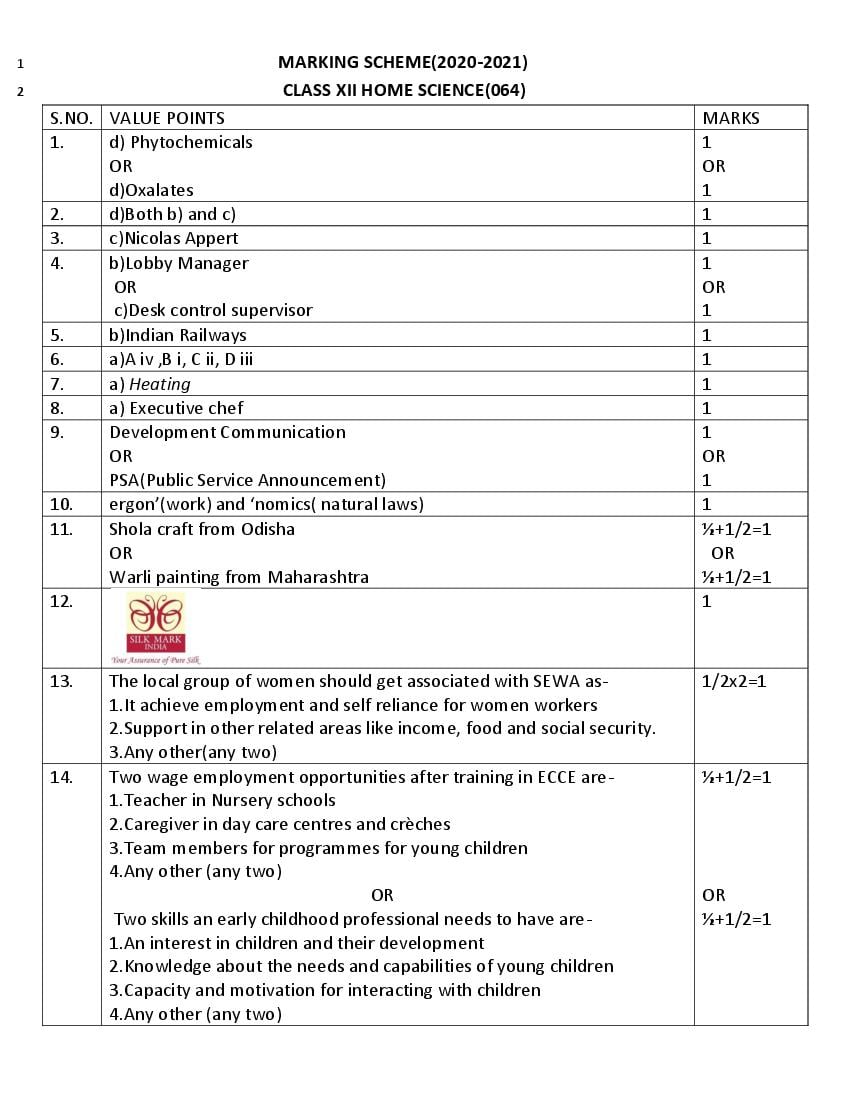
2 CLASS XII HOME SCIENCE(064)
S.NO. VALUE POINTS MARKS
1. d) Phytochemicals 1
OR OR
d)Oxalates 1
2. d)Both b) and c) 1
3. c)Nicolas Appert 1
4. b)Lobby Manager 1
OR OR
c)Desk control supervisor 1
5. b)Indian Railways 1
6. a)A iv ,B i, C ii, D iii 1
7. a) Heating 1
8. a) Executive chef 1
9. Development Communication 1
OR OR
PSA(Public Service Announcement) 1
10. ergon’(work) and ‘nomics( natural laws) 1
11. Shola craft from Odisha ½+1/2=1
OR OR
Warli painting from Maharashtra ½+1/2=1
12. 1
13. The local group of women should get associated with SEWA as- 1/2x2=1
1.It achieve employment and self reliance for women workers
2.Support in other related areas like income, food and social security.
3.Any other(any two)
14. Two wage employment opportunities after training in ECCE are- ½+1/2=1
1.Teacher in Nursery schools
2.Caregiver in day care centres and crèches
3.Team members for programmes for young children
4.Any other (any two)
OR OR
Two skills an early childhood professional needs to have are- ½+1/2=1
1.An interest in children and their development
2.Knowledge about the needs and capabilities of young children
3.Capacity and motivation for interacting with children
4.Any other (any two)
Page 2
16. a)Inadequate dietary intake 1
17. b)Stunting 1
18. d)Protein deficiency is called as marasmus 1
19. b)Intensity 1
20. a)Different in lightness and darkness 1
OR OR
a)Intermediate or Tertiary colours 1
21. c) Value 1
OR OR
c) Tint 1
22. Four ways by which a teacher can create healthy environment in the 1/2x4=2
class-
1.Paying adequate attention to the individual students needs
2.Building a positive work climate
3.Motivating students
4.Being fair and treating all students equally
5.Any other ( any four)
OR 0R
Four personal attributes which should be possessed by an entrepreneur 1/2X4=2
are-
1.Willingness to work hard
2.Knowledge and skills for planning and implementation
3.Having the courage to take calculated risks
4.Ability and preparedness to handle many tasks
simultaneously
5.Any other ( any four)
23 STRATEGIES ADVANTAGES DISADVANTAGES 1+1=2
Diet or food-based 1.Highly cost effective 1.Requires research
strategies 2.Wide coverage 2.Does not lead to
3.Any other (any two) long-term dietary/
behavioural changes
3.Any other (any two)
24. Four stages of Guest Cycle- 1/2x4=2
1. Pre-arrival stage - It include:
quoting rates for a guest and reserving a room
2. Arrival Stage -The guest actually arrives and registers or checks-in.
3. Occupancy - This stage consists of providing various services as per the
guest’s requirements, ensuring security of the guest and coordination of
various guest services.
Page 3
accommodation.
OR OR
Functions of Housekeeping Department are- 1/2X4=2
1.Cleaning of public areas and guestrooms
2.Supply, upkeep of laundry and exchange of various linen
3.Internal flower arrangement and maintenance of external landscape or
garden.
4.Coordination and communication with other departments such as
front office, restaurants, engineering, accounts, etc., through control
desk.
5.Pest control
6.Any other(any four)
25. ICT is a powerful tool of development communication and informing 1/2x4=2
people as-
1.This is an umbrella term that includes computer hardware and
software, digital broadcast and telecommunication technologies.
2.Use of mobile phones has enabled and facilitated the expansion of
markets, social business and public services.
3.Mobile phones have provided a wide range of economic services,
banking and financial transactions, marketing and distribution,
employment and public services.
4.ICT’s are economically, socially and socially transformative.
5.Any other(Any four)
26. Four primary requirements when preparing for a career in the field of 1/2x4=2
care and maintenance of fabrics
1. Knowledge of the material in terms of fiber content, yarn and fabric
production technique,
colour and finishes applied etc.
2. Knowledge of the processes involved.
3. Knowledge of the chemicals and other reagents used in the process
and their effect on the
fabrics.
4. Working knowledge of the machinery requirement and its functioning.
5.Any other(any four)
27. Children’s homes are formed-by the Government for children from 3-18 ½+1.5=2
years who are in state custody for various reasons. ½
Need of three kinds of children’s homes are- 1/2X3=1.5
1. Observation Homes- children stay temporarily till the completion of an
investigation to track down their parents and collect information on
their family background
Page 4
in terms of violation of law, are placed in custodial care
3. Juvenile /Children’s Homes- where children whose families are not
traceable, or are unfit/dead or simply unwilling to take the child back
stay
(Each one explained in 1-2 lines)
28. Three ways to create “Rhythm” in the frock are- 1+1+1=3
1. Repetition of embroidery, laces, buttons, piping, colour etc. at the
neckline, sleeves and hemline of frock.
2. Radiation where eyes move in an organized way from a central point
e.g. gathers in waist, yoke or cuffs etc.
3. Parallelism where elements lie parallel to each other e.g. tucks in a
yoke or knife pleats in a skirt.
Page 5
29. Elderly are vulnerable because - 1+1+1=3
1.vulnerable to diseases/ poor health conditions 1/x2=1
2.Social isolation
3.Financial dependent
4.Sense of burden on others
5.Any other (Any two)
Two programmes operating in our country for elderly people are- 1/x2=1
1.Old age home
2.Respite care homes and continuous care home for elders
3.National old age pension scheme
4.Any other(Any two)
Two skills required to work with organizations running for elderly people 1/2x2=1
are-
1.People skills
2.Administrative skills
3.Any other(Any two)
OR OR
Nehru Yuva Kendras were established- 1+2=3
1.To provides opportunities to students (who have completed their first 1/2X2=1
degree) to involve themselves in programmes of national development.
2.To enable the non-student youth of the rural areas to contribute to
development in the rural areas.
3.Any other(Any two)
Four programmes run under these kendras are-
1.Non-formal education 1/X4=2
2.Social service camps
3.Development of sports
4.Cultural and recreational programmes,
5.Vocational training,
6.Youth leadership training camps
7.Any other (Any four)
30. a)Four factors need to be kept in mind before choosing the process of 2+2=4
washing: a)1/2x4=2
1. Fiber contents
2. Type of yarn
3. Fabric construction techniques
4. Finishes used
5. Any other(Any two)
b)Two types of circulation systems: b)1+1=2
1.Air of relatively low temperature is circulated at high velocity: the air
present in the room enters a drier from under the front panel, passes
Page 6
exhaust and therefore the temperature and humidity of the room stays
normal.
2.Air at high temperature is circulated slowly: In this, after the air enters
the drier and passes over the heat source, it is drawn by a small fan
through perforations at the top of the drier, then downwards through
the clothes and out through the exhaust. Since the movement of the air
in this drier is slow, the relative humidity of the exhausted air is high.
OR OR
In Hospitals- 1X4=4
1.The hospital laundry takes care of hygiene, cleanliness and
disinfection.
2.Many hospitals have started using disposables where there is a threat
of infection, which are then destroyed by burning.
3.Most of the articles in hospitals are of cotton and dyed (in colours
specific to the hospital and department) with dyes which have excellent
wash-fastness.
4.The daily laundry thus emphasises mainly on cleanliness of cotton
materials.
5.Even the ironing and pressing may not be done to perfection.
6.Repair and mending and condemnation of unusable material may or
may not form a part of the services required.
7.The quantum of work, especially for bed linen, is much larger for
hospitals as compared to hotels. The larger hospitals may have to take
care of 1,800-2,000 beds or even more.
In Hospitality sector:
1.Aesthetics and final finish of the articles are the most important.
2.As compared to hospitals the articles here may be of different fibre
contents.
3.Final finishing of laundered goods, i.e., starching, ironing pressing and
correct and perfect folding, are emphasised.
4.They also have to care of guests’ personal laundry when required.
5.The smaller hotels may have link ups with commercial laundries from
outside.
6.The quantum of work, especially for bed linen, is much lesser in hotels.
The big hotels may have up to 400-500 rooms.
(Any other point, Any four differences)
31. Food safety and quality can be ensured through - 3+1=4
1. Good Manufacturing Practices (GMP) 1/2x2=1
ensures that manufacturers produce safe products / help
consumers buy safe products.
Page 7
2. Good Handling Practices indicate a comprehensive approach from the 1/2x2=1
farm to the store or consumer,
in order to identify possible sources of risk and
indicates what steps and procedures are taken to minimise
contamination risk
3. Hazard Analysis Critical Control Point (HACCP)
1/2x2=1
Identify a hazard (biological, chemical and physical )
Assessment of chances of occurrence of hazards during each step
/stage in the food chain
(Any three points)
Two importance of FSSA,2006 are-
1/2x2=1
1.To regulate manufacture, storage ,distribution, sale and import of food
2.To ensure availability of safe and wholesome food for human
consumption
3.Any other(Any two)
32. Four principles given by NCF(2005) to be kept in mind are- 2+2=4
1.Play as the basis for learning 1/2x4=2
2.Art as the basis of education
3.Mix of formal and informal interactions
4.Use of local materials, arts and knowledge
(Any other, any four points)
b)Four facilities must be included in the institution for children are- 1/2x4=2
1.Recreational facilities /play material
2.Safety arrangements
3.Clean drinking water facilities
4.Medical facilities
5.Any other(Any four)
33. Eight knowledge and skills required by a personnel involved in food 1/2x8=4
product development are-
1.Knowledge of food preparation and cooking skills for large scale
food production
2.Knowledge of product specifications and testing it
3.Observing and measuring quality control as per specification
4.Assessment by sensory methods(by testing and tasting produced
foods)
5.Industrial practices and manufacturing systems and their control
6.Labelling of marketable product
7.Packaging of marketable product
8.Hazard Analysis and Critical Control Point(HACCP)
(Any other, Any eight points)
Page 8
1.Nutritionally complete feeds are 1.Through a drip in a vein special 1+1=2
delivered through tubes solutions are given to support
body functions.
2. It is given in cases when the It is given when patient’s gastro
patient’s gastrointestinal tract is intestinal tract is not functioning
functioning well properly.
Objectives of diet therapy are-
(i) formulation of the diet to meet the needs of the patient taking into 1/2x3=1.5
consideration her or his food habits
(ii) modification of the existing diets to ameliorate the disease condition
and to keep it under control
(iii) correction of nutritional deficiencies
(iv) prevention of short-term and long-term complications in case of
chronic diseases
Any other(Any three)
Role of clinical nutritionist are-
1.Provide advice and translate technical information into dietary 1/2x3=1.5
guidelines
2.Plan diets appropriately to meet the nutritional requirements at
various stages of the life cycle
3.Promote health and well-being of patients admitted to hospital or in
outpatient clinics(OPD) as well as in institutional settings.
4.Manage food services in a variety of institutional settings such as old
age homes, schools, orphanages etc.
5.Any other(Any four)
35. Four responsibilities of consumer are- 2+2+1=5
1.Survey the market before buying 1/2x4=2
2.Should read all information given on label, leaflet etc before
purchasing
3.Should buy only what is needed
4.They should read and understand all terms and conditions , especially
the fine print before signing any document.( LIC, credit card)
5.Buy goods with only genuine standard marks.
6.Should take bill after paying taxes and file
7.Any other(Any four)
Four rights of consumer are- 1/2x4=2
1.Right to Safety-To demand safe products and be protected against all
the harmful products
2.Right to Choose-To choose from variety of goods
3.Right to Seek Redressal-To seek justice incase of cheating
Page 9
5.Any other(Any four)
Two features of consumer protection act are- 1/2x2=1
1.It includes both goods and services.
2.Nominal fees for filing before the courts
3.Timely redressal
4.Any other(Any two)
OR OR
Skills required for career in consumer field are- 2.5+2.5=5
1.Knowledge about consumer protection mechanisms and redressal 1/2x5=2.5
agencies
2.Good communication and interpersonal skills
3.Empathetic and understanding attitude
4.Good listener
5.Creative in developing programmes (advertisements, talks, etc.)
6.Writing skills for developing educational material for consumer
education
7.Willingness to help fellow consumers
8.Any other (Any five)
Career opportunities are- 1/2x5=2.5
1. Work in government organizations like
(BIS ) Bureau of Indian Standards,
Directorate of Marketing and Inspection,(Ag MARK )
Ministry of Consumer Affairs in managerial and technical
positions.
2. Work in voluntary consumer organizations( VOICE/CERC) for product
testing to create consumer awareness and publishing of magazines.
3. Work in consumer division of corporate houses that deal with
consumer complaints and suggestions.
4. Work with market research organization in areas of consumer
behavior, product reach, and consumer acceptance of new products,
consumer feedback and suggestion
5. Work in National Consumer Helpline for consumer counselling
6.Any other(Any five)
36. Five stages of fashion cycle are- 1x5=5
1.Introduction of a style: New styles are offered by the designers to the
public. Designs are created by changing the elements such as line,
colour, shape, fabric and other details.
2.Increase in popularity: New fashion may begin to rise in popularity as it
is purchased, worn and seen by many people.
3.Peak of popularity: When a fashion is at the height of its popularity, it
Page 10
adaptations of it at different price levels.
4.Decline in popularity: Eventually so many copies are mass produced
that fashion-conscious people tire of the style and begin to look for
something new.
5.Rejection of a style or Obsolescence: In the last phase of the fashion
cycle, some consumers have already turned to new looks, thus beginning
a new cycle.
3
Document Details
| Board / Org | CBSE |
| Exam | Class 12 |
| Type | Marking Scheme |
| Pages | 10 |
| Updated | 01 May 2026 |