CBSE Class 12 History Question Paper 2020 Set 61-4-1 Solutions
Finished viewing? Save it for later —
Download CBSE Class 12 History Question Paper 2020 Set 61-4-1 Solutions (PDF · 10 pages)About CBSE Class 12 History Question Paper 2020 Set 61-4-1 Solutions
CBSE Class 12 History Question Paper 2020 Set 61-4-1 Solutions is available here for free download. Published by CBSE for Class 12, this solution can be viewed online or downloaded as a PDF (10 pages). Candidates preparing for Class 12 can use CBSE Class 12 History Question Paper 2020 Set 61-4-1 Solutions to understand the exam pattern, the type of questions asked, and the overall difficulty level.
Frequently Asked Questions
How can I download CBSE Class 12 History Question Paper 2020 Set 61-4-1 Solutions?
Open this page and click the Download button to save CBSE Class 12 History Question Paper 2020 Set 61-4-1 Solutions as a PDF. It is completely free on AglaSem Docs.
Is CBSE Class 12 History Question Paper 2020 Set 61-4-1 Solutions free to download?
Yes. CBSE Class 12 History Question Paper 2020 Set 61-4-1 Solutions can be viewed online and downloaded as a PDF free of cost on AglaSem Docs.
How many pages does CBSE Class 12 History Question Paper 2020 Set 61-4-1 Solutions have?
CBSE Class 12 History Question Paper 2020 Set 61-4-1 Solutions contains 10 pages, which you can read online or download together as a single PDF.
Where can I find more Class 12 study material?
You can find more Class 12 question papers, sample papers, syllabus, and answer keys on AglaSem Docs.
CBSE Class 12 History Question Paper 2020 Set 61-4-1 Solutions – Text
Read the full text of this solution below — useful to quickly search, copy and reference the content online without downloading the PDF.
📄 View text version (10 pages)
Page 1
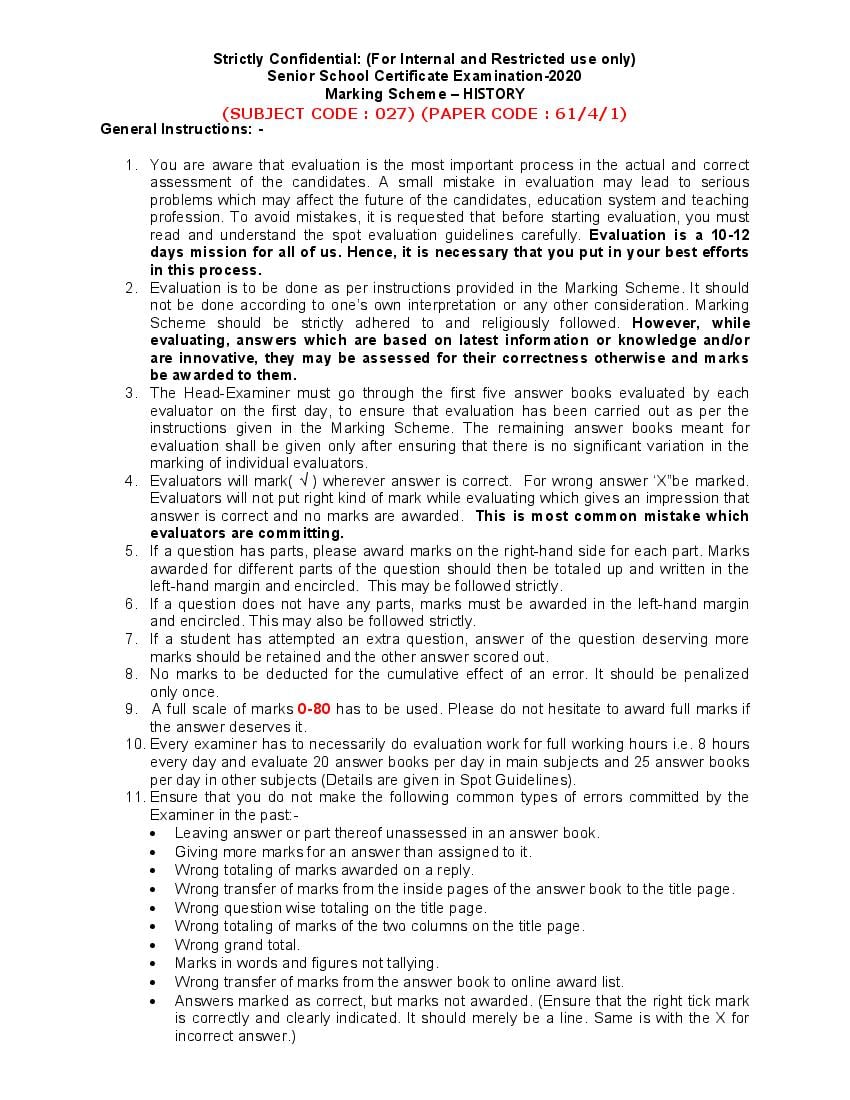
Senior School Certificate Examination-2020
Marking Scheme – HISTORY
(SUBJECT CODE : 027) (PAPER CODE : 61/4/1)
General Instructions: -
1. You are aware that evaluation is the most important process in the actual and correct
assessment of the candidates. A small mistake in evaluation may lead to serious
problems which may affect the future of the candidates, education system and teaching
profession. To avoid mistakes, it is requested that before starting evaluation, you must
read and understand the spot evaluation guidelines carefully. Evaluation is a 10-12
days mission for all of us. Hence, it is necessary that you put in your best efforts
in this process.
2. Evaluation is to be done as per instructions provided in the Marking Scheme. It should
not be done according to one’s own interpretation or any other consideration. Marking
Scheme should be strictly adhered to and religiously followed. However, while
evaluating, answers which are based on latest information or knowledge and/or
are innovative, they may be assessed for their correctness otherwise and marks
be awarded to them.
3. The Head-Examiner must go through the first five answer books evaluated by each
evaluator on the first day, to ensure that evaluation has been carried out as per the
instructions given in the Marking Scheme. The remaining answer books meant for
evaluation shall be given only after ensuring that there is no significant variation in the
marking of individual evaluators.
4. Evaluators will mark( √ ) wherever answer is correct. For wrong answer ‘X”be marked.
Evaluators will not put right kind of mark while evaluating which gives an impression that
answer is correct and no marks are awarded. This is most common mistake which
evaluators are committing.
5. If a question has parts, please award marks on the right-hand side for each part. Marks
awarded for different parts of the question should then be totaled up and written in the
left-hand margin and encircled. This may be followed strictly.
6. If a question does not have any parts, marks must be awarded in the left-hand margin
and encircled. This may also be followed strictly.
7. If a student has attempted an extra question, answer of the question deserving more
marks should be retained and the other answer scored out.
8. No marks to be deducted for the cumulative effect of an error. It should be penalized
only once.
9. A full scale of marks 0-80 has to be used. Please do not hesitate to award full marks if
the answer deserves it.
10. Every examiner has to necessarily do evaluation work for full working hours i.e. 8 hours
every day and evaluate 20 answer books per day in main subjects and 25 answer books
per day in other subjects (Details are given in Spot Guidelines).
11. Ensure that you do not make the following common types of errors committed by the
Examiner in the past:-
Leaving answer or part thereof unassessed in an answer book.
Giving more marks for an answer than assigned to it.
Wrong totaling of marks awarded on a reply.
Wrong transfer of marks from the inside pages of the answer book to the title page.
Wrong question wise totaling on the title page.
Wrong totaling of marks of the two columns on the title page.
Wrong grand total.
Marks in words and figures not tallying.
Wrong transfer of marks from the answer book to online award list.
Answers marked as correct, but marks not awarded. (Ensure that the right tick mark
is correctly and clearly indicated. It should merely be a line. Same is with the X for
incorrect answer.)
Page 2
awarded.
12. While evaluating the answer books if the answer is found to be totally incorrect, it should
be marked as cross (X) and awarded zero (0)Marks.
13. Any unassessed portion, non-carrying over of marks to the title page, or totaling error
detected by the candidate shall damage the prestige of all the personnel engaged in the
evaluation work as also of the Board. Hence, in order to uphold the prestige of all
concerned, it is again reiterated that the instructions be followed meticulously and
judiciously.
14. The Examiners should acquaint themselves with the guidelines given in the Guidelines
for spot Evaluation before starting the actual evaluation.
15. Every Examiner shall also ensure that all the answers are evaluated, marks carried over
to the title page, correctly totaled and written in figures and words.
16. The Board permits candidates to obtain photocopy of the Answer Book on request in an
RTI application and also separately as a part of the re-evaluation process on payment of
the processing charges.
Page 3
CLASS XII
AISSCE, MARCH 2020
CODE NO. Set-61/4/1
Q.NO EXPECTED ANSWERS/ VALUE POINTS PAGE MARK
NO. S
PART- A
1. John Marshall Pg 20 1
2 c- 1,2 & 3 Pg 16 1
3 Sand stone Sculpture of Kushana King (Kanishka) Pg 37 1
For Visually impaired ….Coins/ Sculpture/ Inscriptions/ etc. (Any one)
4 d- He did well being of society through Dhamma. Pg 47 1
5 Kautilya (Chanakya) Pg 32 1
OR
Chandragupta Maurya
6 a- Rajagraha Pg 31 1
7 Gold Coins issued by Kushanas – They were the first rulers to issue gold coins. Pg 45 1
Their gold coins were identical with those issued by Roman and Parthian rulers.
Gold Coins issued by Guptas-Were most spectacular and known for their purity
and used for long distance transactions.
8 a – He was Qazi during Muhammad Bin Tughlaq’s empire Pg 118 1
9 a- Montesquieu Pg 132 1
10 c – (1),(4),(3) and (2) Pg 173 1
11 Jajmani System Pg 205 1
12 d – (i)-b, (ii) – c, (iii) – a, (iv)- d Pg. 1
202,213
13 Mansabdari System Pg 214 1
14 Duarte Barbosa Pg 122 1
15 d- Its data was uniformly collected from all provinces. Pg 220 1
16 a- Thomas Jones Barker Pg 308 1
17 Fort Williams Pg 324 1
OR
Fort St. George
18 a- Both (A) and (R) all correct and (R) is the correct explanation of (A) Pg 339 1
19 a- Wajid Ali Shah was an unpopular ruler. Pg 296 1
20 a- (1) and (2) only Pg 321 1
PART B
21 Principles of classification by archaeologists for piecing together the past
i. Classification in terms of materials such as stone, clay, metal, bone, Ivory
etc.
ii. In terms of functions an artifact is a tool or an ornament.
iii. By investigating the context in which it was found.
iv. Archeologist researched through indirect evidences like traces of cotton at
Harappan site.
v. Archeologist have developed frame of reference in context of place in
cultural sequence and comparison with finds in Mesopotamia.
vi. Any other relevant point
Pg-22 3
Any three points to be justified with examples
OR
1
Page 4
i. Script remains undeciphered till date 3
ii. Longest inscription contain about 26 signs.
iii. It is not alphabetical Pg-15
iv. It has too many signs between 375-400
v. Script was written from right to left.
vi. Any other relevant point
Any three points to be enumerated.
22 Innovations in the Vijaynagar Temple Architecture
i.
Royal Portrait Sculpture displayed in temples.
ii.
Immense scale structures that must have been a mark of imperial
authority
iii. They were exemplified as Raya Gopurams or Royal gateways.
iv. Mandapas or Pavilions
v. Long pillared corridors that often ran around the shrines within the
temple complex.
vi. Carved Pillars.
vii. Any other relevant point
Pg-184 3
Any three points to be described.
23 Reasons for advocacy for strong centre in the Constituent Assembly:
i. To stop communal frenzy.
ii. For well- being of nation.
iii. To mobilize the available economic resources.
iv. To establish proper administration.
v. To defend the country against foreign aggression.
vi. To plan for country’s economic development.
vii. Any other relevant point
Any three points to be explained.
Pg-424 3
24 Ryotwari System and Ryots
i.
The revenue was settled with the ryots.
ii.
The revenue that was demanded was so high which ryots were not able
to pay. They deserted their villages and migrated.
iii. Collectors extracted payment from ryots with utmost severity.
iv. Inability to pay the loan led to seizure of crops and imposition of fine on
the whole village.
v. Ryots borrowed loans from money lenders at high rate of interest.
vi. Ryots got into high debts.
vii. Limitation law, customary laws were violated.
viii. Any other relevant point
Any three points to be explained with examples
Pg 278 3
PART C
25 V.S. Suthankar and reconstruction of Social history
i. Indian Sanskritist V.S. Suthankar tried to prepare critical edition of
Mahabharata.
ii. Collected manuscripts of texts from different parts of the country.
iii. Team compared verses from each manuscript
iv. Published the common verses in 13,000 pages.
2
Page 5
continent
vi. Found regional variations in regional versions
vii. Variations were documented in footnotes and appendices
viii. Variations shaped early and later social history through local ideas and
practices
ix. Issues of social history was explored by historians
x. Initially, it was believed that everything laid in the text was practiced
xi. From the works in Pali, Prakrit and Tamil it was indicated that ideas
contained in normative Sanskrit texts were on the whole recognized as
authoritative.
xii. They were also questioned and rejected
xiii. Examples from Mahabharata like: Families based on kinfolk, the ideal of
patriliny was important and valuable, rules of marriage like polygamy
and polyandry are reflected, Mahabharata reinforced that varna system Pg 54 8
was of divine origin
xiv. Any other relevant point
To be assessed as a whole.
OR
Life of untouchables
i. People outside the system were called as untouchables by the Brahmans.
ii. They were considered impure.
iii. They used to do polluting activities like handling corpses and dead
animals.
iv. Were called as Chandalas.
v. Were placed at the bottom of hierarchy.
vi. Manusmriti laid down the duties of the Chandalas such as: They had to live
outside the village.
vii. They had to use discarded utensils.
viii. Wore clothes of dead and iron ornaments.
ix. They could not walk in villages and cities at night.
x. They had to sound clapper in the streets.
xi. They had to work as executioners and scavengers.
xii. They led the life of degradation
Pg 65-66 8
xiii. Any other relevant point
To be assessed as a whole.
3
Page 6
i. Considered as the cornerstone of the Akbar’s enlightened rule.
ii. All religions and schools of thought had freedom of expression but on
condition not to undermine the authority of state.
iii. Was implemented through state policies.
iv. Composite culture was followed considering Turanis , Afghans , Rajputs
etc.
v. Jaziya and Pilgrimage tax was removed on non -Muslims.
vi. Sul-i-Kul was followed in administration.
vii. Few festivals were celebrated with equal zeal
viii. Marital alliances with non-Muslims
ix. Nobility was recruited from various castes, cultures and ethnicity
x. Ibadat Khana was constructed by Akbar to learn about the views of
different religions
xi. Invitation to Jesuit Mission from Europe
xii. Donation from construction and maintenance of temples
xiii. Harmonious relationships with different ethnic communities
xiv. Members of different communities and ethnic groups were appointed as
imperial officials
xv. Any other relevant point Pg 240- 8
To be evaluated as a whole. 245
OR
Life in Harems
i. Harem was the domestic world of Mughals.
ii. Consisted of the emperor’s wives concubines and relatives.
iii. Polygamy was practiced.
iv. Marital alliances turned into political relationships.
v. Wives from aristocratic families were called as Begums.
vi. Other Wives were Aghas and the Aghachas.
vii. Male and female slaves populated the Mughal household.
viii. Slave eunuchs as guards, servants and agents.
ix. Jahanara , daughter of Shah Jahan designed Chandani Chowk in
Shahajanabad.
x. Conflicts & tensions were common.
xi. Imperial women controlled resources and commissioned buildings - e.g.
Nurjahan controlled financial resources.
xii. Few imperial women became authors of chronicles eg- Gulbadan Begum.
xiii. Any other relevant point
Pg 242-
243 8
To be evaluated as a whole.
27 Reaction of Indians on Non Cooperation Movement
i. Background-Against Rowlatt Act, Jallianwala Bagh Massacre and in
favour of Khilafat Movement. Gandhiji launched Non- Cooperation
Movement.
ii. Hindu and Muslims collectively tried to end colonial laws.
iii. Students stopped going to schools and colleges run by the government.
iv. Lawyers refused to attend law courts.
v. The working class went on strike in many towns and cities
vi. The countryside showed discontentment against British.
vii. Hill tribes in Andhra violated forest laws.
viii. Farmers in Awadh did not pay taxes.
ix. Peasants in Kumaun refused to carry loads for colonial officials.
x. Protest against local leadership.
4
Page 7
xii. Peasants, workers and others interpreted and acted upon the call to non
cooperate with colonial rules in ways best suited to their interests.
xiii. Any other relevant point
To be evaluated as a whole. Pg 350- 8
351
OR
Salt Satyagraha
i. Gandhiji announced a march to break the salt law
ii. Salt law gave the state a monopoly in the manufacture and sale of salt.
iii. The state monopoly on salt was deeply unpopular as in every Indian
household salt was indispensible and the people were forbidden for
making salt even for domestic use.
iv. Gandhiji hoped to mobilize a wider discontent against British rule and
started Dandi March. Once he reached Dandi he broke the salt law.
v. Parallel Salt Marches were organized in other parts of the country.
vi. Peasants breached the colonial forest laws which restricted their access to
forests.
vii. Factory owners went on strike.
viii. Lawyers boycotted British courts.
ix. Students refused to attend educational Institutions and schools run by
government.
x. Indians were arrested.
xi. Gandhiji made a plea to the upper caste to serve untouchables.
xii. Hindus, Muslims, Parsees and Sikhs were told to unite.
xiii. Thousands of Volunteers joined for the cause.
xiv. Many officials resigned from their posts.
xv. Gandhiji’s meetings were attended by all sections of people.
xvi. Women participated in large number.
xvii. Dandi March brought Gandhi to world attention. The March was covered
by European and American press.
xviii. Salt march made British realized that they would have to devolve some
powers to Indians.
xix. Any other relevant point Pg- 348 - 8
To be evaluated as a whole. 350
28 The Therigatha
28.1 Explain the ideas of Punna with two examples.
i. She was against the Brahmanical rituals.
ii. She explained the essence of spirituality lies in eternal bliss.
iii. She laid emphasis on purity of soul.
(Any two points) 2
What justification did the Brahmana give for his daily dip in river?
i. Bathing rituals could prevent evils.
28.2
ii. Anything bad could be washed away by bathing in water.
2
Explain the core of Buddhist Philosophy that is conveyed through their
Gatha.
28.3
i. Buddha condemned caste system and rituals.
ii. Buddha urged people to seek enlightenment through spiritual experience.
iii. The importance paid to conduct and values rather than rituals.
(Any two points) 2 Pg-93 2 +2
+2=6
5
Page 8
29.1 Analyze how Karrikkal Ammiyar had depicted herself different from the
traditional nature of beauty.
a) She shed off her worldly beauty to attain the absolute devotion to lord
Shiva.
b) She described herself as protecting eyes, shrunken stomach, jutting teeth
and lengthy shins. 2
Analyze how this composition of Ammiyar pose a challenge to patriarchal
29.2
norms.
a) She defied patriarchal norms taking fearful image.
b) She rejected socially validated beauty.
c) She criticized the social order.
(Any two points) 2
Analyze any two aspects of renunciation of her social obligations.
29.3
a) Great devotion to lord Shiva and adopted path to extreme asceticism
b) The incompatibility between virtues of women’s virtuosity.
c) She started wandering in the forests which she regarded as the home of lord
Shiva.
(Any two points) 2 Pg-145 2+2+2=
6
30 What “Recovering” Women Meant
30.1 Explain any two reasons of massacre happened during partition of India
a) Communal frenzy
b) Preserving honour
c) Administration could not control riots
d) Any other relevant point
(Any two points) 2
30.2 Why were the social workers and police tracking down the young couple?
a) To recover abducted women so as to rehabilitate them
b) Both belonged to different communities Sikh and Muslim.
2
30.3 Do you think the authorities were right in trying to take back the girl?
Explain reasons to support your answer.
a) The authorities were not supposed to interfere in the personal life of
married couple.
b) Because of their unnecessary interference the girl died. 2 Pg-395 2+2+
2=6
(Views of the students should be taken into consideration)
6
Page 9
6
For Visually Impaired candidates
a) Sacred places of Buddhism(any three places) 1x3=
Nagarjunakonda , Sanchi , Amravati , Lumbini, Bharhut, Bodhgaya, Ajanta. 3
OR
Imperial Mughal cities. (Any three places)
Agra, Lahore, Fatehpur Sikri, Shahjahanabad(Delhi).
Indian National Movement(any three places) 1x3=
b)
Champaran, Kheda, Ahmedabad, Banaras , Amritsar , Chauri Chaura, Lahore, 3
Bardoli , Dandi , Bombay , Karachi
7
Page 10
Document Details
| Board / Org | CBSE |
| Exam | Class 12 |
| Type | Solution |
| Pages | 10 |
| Updated | 22 Jul 2026 |