Finished viewing? Save it for later —
Download CBSE Class 12 Question Paper 2025 Solution Dance (PDF · 25 pages)About CBSE Class 12 Question Paper 2025 Solution Dance
CBSE Class 12 Question Paper 2025 Solution Dance is available here for free download. Published by CBSE for Class 12, this solution can be viewed online or downloaded as a PDF (25 pages). Candidates preparing for Class 12 can use CBSE Class 12 Question Paper 2025 Solution Dance to understand the exam pattern, the type of questions asked, and the overall difficulty level.
Frequently Asked Questions
How can I download CBSE Class 12 Question Paper 2025 Solution Dance?
Open this page and click the Download button to save CBSE Class 12 Question Paper 2025 Solution Dance as a PDF. It is completely free on AglaSem Docs.
Is CBSE Class 12 Question Paper 2025 Solution Dance free to download?
Yes. CBSE Class 12 Question Paper 2025 Solution Dance can be viewed online and downloaded as a PDF free of cost on AglaSem Docs.
How many pages does CBSE Class 12 Question Paper 2025 Solution Dance have?
CBSE Class 12 Question Paper 2025 Solution Dance contains 25 pages, which you can read online or download together as a single PDF.
Where can I find more Class 12 study material?
You can find more Class 12 question papers, sample papers, syllabus, and answer keys on AglaSem Docs.
CBSE Class 12 Question Paper 2025 Solution Dance – Text
Read the full text of this solution below — useful to quickly search, copy and reference the content online without downloading the PDF.
📄 View text version (25 pages)
Page 1
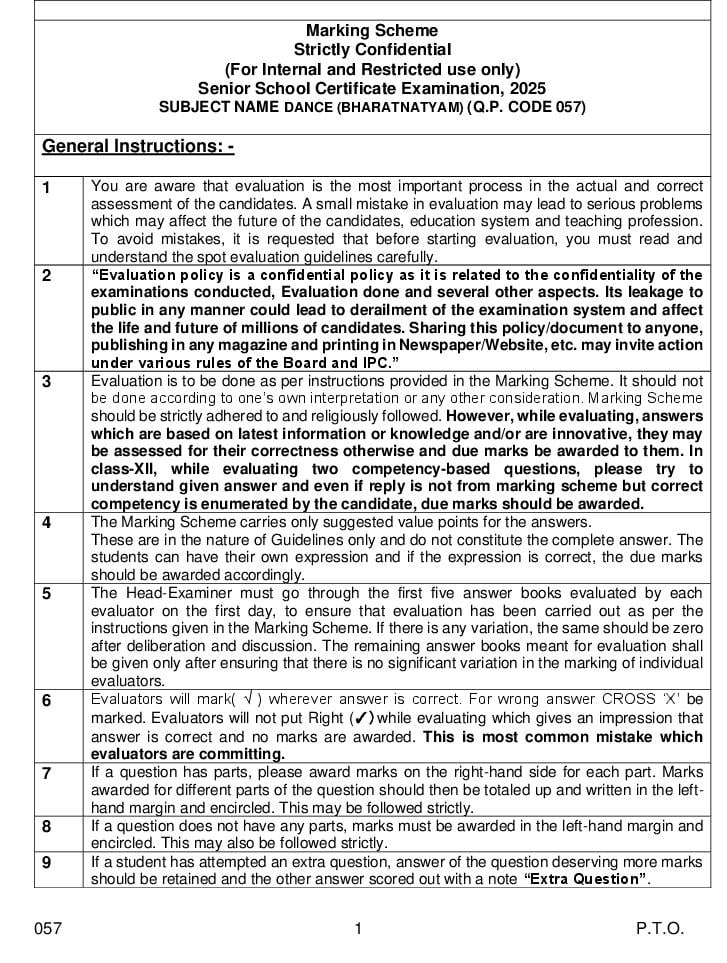
Strictly Confidential
(For Internal and Restricted use only)
Senior School Certificate Examination, 2025
SUBJECT NAME DANCE (BHARATNATYAM) (Q.P. CODE 057)
General Instructions: -
1 You are aware that evaluation is the most important process in the actual and correct
assessment of the candidates. A small mistake in evaluation may lead to serious problems
which may affect the future of the candidates, education system and teaching profession.
To avoid mistakes, it is requested that before starting evaluation, you must read and
understand the spot evaluation guidelines carefully.
2 “Evaluation policy is a confidential policy as it is related to the confidentiality of the
examinations conducted, Evaluation done and several other aspects. Its leakage to
public in any manner could lead to derailment of the examination system and affect
the life and future of millions of candidates. Sharing this policy/document to anyone,
publishing in any magazine and printing in Newspaper/Website, etc. may invite action
under various rules of the Board and IPC.”
3 Evaluation is to be done as per instructions provided in the Marking Scheme. It should not
be done according to one’s own interpretation or any other consideration. Marking Scheme
should be strictly adhered to and religiously followed. However, while evaluating, answers
which are based on latest information or knowledge and/or are innovative, they may
be assessed for their correctness otherwise and due marks be awarded to them. In
class-XII, while evaluating two competency-based questions, please try to
understand given answer and even if reply is not from marking scheme but correct
competency is enumerated by the candidate, due marks should be awarded.
4 The Marking Scheme carries only suggested value points for the answers.
These are in the nature of Guidelines only and do not constitute the complete answer. The
students can have their own expression and if the expression is correct, the due marks
should be awarded accordingly.
5 The Head-Examiner must go through the first five answer books evaluated by each
evaluator on the first day, to ensure that evaluation has been carried out as per the
instructions given in the Marking Scheme. If there is any variation, the same should be zero
after deliberation and discussion. The remaining answer books meant for evaluation shall
be given only after ensuring that there is no significant variation in the marking of individual
evaluators.
6 Evaluators will mark( √ ) wherever answer is correct. For wrong answer CROSS ‘X’ be
marked. Evaluators will not put Right (✓)while evaluating which gives an impression that
answer is correct and no marks are awarded. This is most common mistake which
evaluators are committing.
7 If a question has parts, please award marks on the right-hand side for each part. Marks
awarded for different parts of the question should then be totaled up and written in the left-
hand margin and encircled. This may be followed strictly.
8 If a question does not have any parts, marks must be awarded in the left-hand margin and
encircled. This may also be followed strictly.
9 If a student has attempted an extra question, answer of the question deserving more marks
should be retained and the other answer scored out with a note “Extra Question”.
057 1 P.T.O.
Page 2
once.
11 A full scale of marks __________(example 0 to 80/70/60/50/40/30 marks as given in
Question Paper) has to be used. Please do not hesitate to award full marks if the answer
deserves it.
12 Every examiner has to necessarily do evaluation work for full working hours i.e., 8 hours
every day and evaluate 20 answer books per day in main subjects and 25 answer books
per day in other subjects (Details are given in Spot Guidelines).This is in view of the reduced
syllabus and number of questions in question paper.
13 Ensure that you do not make the following common types of errors committed by the
Examiner in the past:-
● Leaving answer or part thereof unassessed in an answer book.
● Giving more marks for an answer than assigned to it.
● Wrong totaling of marks awarded on an answer.
● Wrong transfer of marks from the inside pages of the answer book to the title page.
● Wrong question wise totaling on the title page.
● Wrong totaling of marks of the two columns on the title page.
● Wrong grand total.
● Marks in words and figures not tallying/not same.
● Wrong transfer of marks from the answer book to online award list.
● Answers marked as correct, but marks not awarded. (Ensure that the right tick mark is
correctly and clearly indicated. It should merely be a line. Same is with the X for
incorrect answer.)
● Half or a part of answer marked correct and the rest as wrong, but no marks awarded.
14 While evaluating the answer books if the answer is found to be totally incorrect, it should be
marked as cross (X) and awarded zero (0)Marks.
15 Any unassessed portion, non-carrying over of marks to the title page, or totaling error
detected by the candidate shall damage the prestige of all the personnel engaged in the
evaluation work as also of the Board. Hence, in order to uphold the prestige of all concerned,
it is again reiterated that the instructions be followed meticulously and judiciously.
16 The Examiners should acquaint themselves with the guidelines given in the “Guidelines for
Spot Evaluation” before starting the actual evaluation.
17 Every Examiner shall also ensure that all the answers are evaluated, marks carried over to
the title page, correctly totaled and written in figures and words.
18 The candidates are entitled to obtain photocopy of the Answer Book on request on payment
of the prescribed processing fee. All Examiners/Additional Head Examiners/Head
Examiners are once again reminded that they must ensure that evaluation is carried out
strictly as per value points for each answer as given in the Marking Scheme.
057 2
Page 3
$
MARKING SCHEME
DANCE (BHARATNATYAM)
SECTION – A
1. (C) Bharata Muni 1
2. (D) Ramayana 1
3. (A) Dhruva Talam 1
4. (B) Oddissi 1
5. (A) Mridangam 1
6. (A) Araimandi 1
7. (C) Lord Krishna 1
8. (B) Devadasi 1
SECTION – B
9. The Pancha Jaatis are – 2
(i) Tishra jaati – Ta ki ta 3
(ii) Chatushra jaati – Ta ka dhi mi 4
(iii) Khanda jaati – Ta ka ta ki ta 5
(iv) Mishra jaati – Ta ki ta ta ka dhi mi 7
(v) Sankeerna jaati – Ta ka dhi mi ta ka ta ki ta 9
OR
(i) Dhruva talam – 1011
(ii) Mathya talam – 101
(iii) Triputa talam – 100
(iv) Rupaka talam – 01
(v) Jhampa talam – 100
(vi) Ata talam – 1100
(vii) Eka talam – 1
057 3 P.T.O.
Page 4
RA stands for Raga
TA stands for Tala
OR
Pataka
Tripataka
Ardhapataka
Kartarimukha
11. The Queens of King Dashratha : 2
Kaushalya
Sumitra
Kaikeyi
OR
The Pancha Pandavas :
Yudhisthira
Bheema
Arjuna
Nakula
Sahadeva
12. Lokadharmi is a very simple way of expression through life oriented or day
today gestures and body language. We can see it in our daily life. 2
OR
Ramayana is written by Maharishi Valmiki.
Mahabharata is written by Maharishi Ved Vyasa.
13. Abhinaya is the art of expression. When the meaning of the words is
expressed with gestures, body stance and facial expression.
The 4 kinds of Abhinaya are –
(i) Angika Abhinaya
(ii) Vachika Abhinaya
(iii) Aharya Abhinaya
(iv) Satvika Abhinaya
057 4
Page 5
An adavu is the step or unit of Bharatanatyam – It has movements of legs,
feet, hands, shoulders, fingers, knees, eyes, neck – the body as a whole
medium.
Tattadavu and Nattadavu are the first two sets of adavus.
SECTION – C
14. The list of Bharatnatyam Margam is – 6
1. Pushpanjali/Kautuvam
2. Alarippu
3. Jatiswaram
4. Shabdam
5. Varnam
6. Padam
7. Keertanam
8. Javali
9. Ashtapadi
10. Thillana
11. Slokam
Varnam is the main item. It is like an exam for the student as it is very
elaborate with equal measure of NRITYA and NRITYA (Abhinaya).
Generally the duration of a Varnam is 30 to 45 minutes. The first half of
the varnam has Jathis and sahityam.
It begins with a Trikala Jathi, that is done in 3 speeds.
The second half of the varnam has Swaram and Sahityam. In most
varnams the theme is that of a Nayika longing for her Nayaka be it
Lord Shiva, Vishnu, Krishna or Kartikeya. The dancer must have enough
physical and mental strength to do justice to this item.
OR
057 5 P.T.O.
Page 6
All Indian classical dance styles have their unique AHARYA, each so
different and yet so beautiful.
The Bharatanatyam costume can be a skirt, saree or a pyjama style with
front fans 1, 2 or 3, blouse, pleated top piece back piece and centre piece.
Temple jewels are used profusely – Talai Saman (Head ornaments)
Jhumki, close necklace, long necklace with pendant, bangles waistbelt and
ghunghroo.
Hair is oiled and braided in a single braid or a knot. A special jewel called
Rakodi adorns the back of the head. Alta is applied on the fingers and toes.
All this adds to the beauty of the dancer as well as the over all presentation.
15. Rukmini Devi saw a performance by two disciples of Guru Shri Meenakshi 6
Sundaram Pillai and was so impressed, that she decided to save this sacred
art form.
She established ‘Kalakshetra’, a temple of Arts at Chennai with the help of
great Vidwans of that time. Her motto was art without fear and Vulgarity.
She emphasized the element of Bhakti or devotion and said that Shringara
should be laced with devotion.
She chose beautiful Tamil and Sanskrit compositions for dance
choreography. She introduced a lot of welcome changes like – choosing
bright, vibrant coloured Kanchi silk sarees for costumes, temple jewelery
with beautiful designs, made place for the musicians on the right side of
the stage, Devasthanam on the left, replaced bag pipe and clarionet with
flute and violin.
She has choreographed 25 amazing dance dramas. Her institution is world
reknown and a seat of excellence for learning Bharatnatyam. With such a
Herculean effort she gave Bharatanatyam a new life.
OR
Java Sathiratvam rekhacha Bhramari Drishti ashramaha. Medha
Shraddha vacho Geetam Patra prana dasha smrutaha.
This sloka is called Patrasya Pranaha and describes the ten qualities that
a dancer should have.
Java – She should be determined.
Sthira – She should be steady or stead fast.
Rekha – She should have neat body movement.
Bhramari – Should be swift with circular movements.
Drishti – She must have good glances/eye movement.
057 6
Page 7
Medha – She should be intelligent.
Shraddha – She should have devotion for her art.
Vacho – She should have good verbal skills.
Geetam – She should understand music well.
All these qualities are essential for a good dancer.
057 7 P.T.O.
Page 8
Strictly Confidential
(For Internal and Restricted use only)
Senior School Certificate Examination, 2025
SUBJECT NAME DANCE KATHAK (Q.P. CODE 82)
General Instructions: -
1 You are aware that evaluation is the most important process in the actual and correct
assessment of the candidates. A small mistake in evaluation may lead to serious problems
which may affect the future of the candidates, education system and teaching profession.
To avoid mistakes, it is requested that before starting evaluation, you must read and
understand the spot evaluation guidelines carefully.
2 “Evaluation policy is a confidential policy as it is related to the confidentiality of the
examinations conducted, Evaluation done and several other aspects. Its’ leakage to
public in any manner could lead to derailment of the examination system and affect
the life and future of millions of candidates. Sharing this policy/document to anyone,
publishing in any magazine and printing in News Paper/Website etc may invite action
under various rules of the Board and IPC.”
3 Evaluation is to be done as per instructions provided in the Marking Scheme. It should not
be done according to one’s own interpretation or any other consideration. Marking Scheme
should be strictly adhered to and religiously followed. However, while evaluating, answers
which are based on latest information or knowledge and/or are innovative, they may
be assessed for their correctness otherwise and due marks be awarded to them. In
class-X, while evaluating two competency-based questions, please try to understand
given answer and even if reply is not from marking scheme but correct competency
is enumerated by the candidate, due marks should be awarded.
4 The Marking scheme carries only suggested value points for the answers
These are in the nature of Guidelines only and do not constitute the complete answer. The
students can have their own expression and if the expression is correct, the due marks
should be awarded accordingly.
5 The Head-Examiner must go through the first five answer books evaluated by each
evaluator on the first day, to ensure that evaluation has been carried out as per the
instructions given in the Marking Scheme. If there is any variation, the same should be zero
after delibration and discussion. The remaining answer books meant for evaluation shall be
given only after ensuring that there is no significant variation in the marking of individual
evaluators.
6 Evaluators will mark( √ ) wherever answer is correct. For wrong answer CROSS ‘X” be
marked. Evaluators will not put right (✓)while evaluating which gives an impression that
answer is correct and no marks are awarded. This is most common mistake which
evaluators are committing.
7 If a question has parts, please award marks on the right-hand side for each part. Marks
awarded for different parts of the question should then be totaled up and written in the left-
hand margin and encircled. This may be followed strictly.
8 If a question does not have any parts, marks must be awarded in the left-hand margin and
encircled. This may also be followed strictly.
9 If a student has attempted an extra question, answer of the question deserving more marks
should be retained and the other answer scored out with a note “Extra Question”.
82 1 P.T.O.
Page 9
once.
11 A full scale of marks __________(example 0 to 80/70/60/50/40/30 marks as given in
Question Paper) has to be used. Please do not hesitate to award full marks if the answer
deserves it.
12 Every examiner has to necessarily do evaluation work for full working hours i.e., 8 hours
every day and evaluate 20 answer books per day in main subjects and 25 answer books
per day in other subjects (Details are given in Spot Guidelines).This is in view of the reduced
syllabus and number of questions in question paper.
13 Ensure that you do not make the following common types of errors committed by the
Examiner in the past:-
● Leaving answer or part thereof unassessed in an answer book.
● Giving more marks for an answer than assigned to it.
● Wrong totaling of marks awarded on an answer.
● Wrong transfer of marks from the inside pages of the answer book to the title page.
● Wrong question wise totaling on the title page.
● Wrong totaling of marks of the two columns on the title page.
● Wrong grand total.
● Marks in words and figures not tallying/not same.
● Wrong transfer of marks from the answer book to online award list.
● Answers marked as correct, but marks not awarded. (Ensure that the right tick mark is
correctly and clearly indicated. It should merely be a line. Same is with the X for
incorrect answer.)
● Half or a part of answer marked correct and the rest as wrong, but no marks awarded.
14 While evaluating the answer books if the answer is found to be totally incorrect, it should be
marked as cross (X) and awarded zero (0)Marks.
15 Any unassessed portion, non-carrying over of marks to the title page, or totaling error
detected by the candidate shall damage the prestige of all the personnel engaged in the
evaluation work as also of the Board. Hence, in order to uphold the prestige of all concerned,
it is again reiterated that the instructions be followed meticulously and judiciously.
16 The Examiners should acquaint themselves with the guidelines given in the “Guidelines for
Spot Evaluation” before starting the actual evaluation.
17 Every Examiner shall also ensure that all the answers are evaluated, marks carried over to
the title page, correctly totaled and written in figures and words.
18 The candidates are entitled to obtain photocopy of the Answer Book on request on payment
of the prescribed processing fee. All Examiners/Additional Head Examiners/Head
Examiners are once again reminded that they must ensure that evaluation is carried out
strictly as per value points for each answer as given in the Marking Scheme.
82 2
Page 10
$
MARKING SCHEME
DANCE KATHAK
SECTION A
1. (C) Kathak 1
2. (D) Charan Giridhar 1
3. (C) 4 1
4. (B) Mohiniattam 1
5. (A) Slow 1
6. (D) Shringar (love) 1
7. (C) Kathanak (story) 1
8. (B) 4 1
SECTION B
9. (a) Aamad – In Kathak it’s the formal term for entrance. The first tukraa that
is performed on stage is known as Aamad. 2
OR
(b) Costume of female Kathak dancer – during Mughal-period, women started
wearing churidar pyjama and gherdar angrakha with dupatta and the
ornaments accordingly with makeup.
10. (a) Theka of Kaharwa – 8 beats 2
1 2 3 4 5 6 7 8
Dha ge na ti na ke dhi na
0
OR
82 3 P.T.O.
Page 11
ending on sam with certain bols of tal.
11. (a) Types of Bhramari – There are seven types of Bhramari as per
Natyashastra – Utplut, Chakra, Garuda, Eka Pada, Kunchita, Akasha
Bhramari. 2
OR
(b) Gatnikas – means gati, chaal (walk) and nikas means – coming out bhava.
12. (a) Knowledge of Lucknow gharana of Kathak and its characteristic regarding
Kathak dance. 2
OR
(b) Odissi dance – is a classical dance form of Odisha. It is sensuous and lyrical
dance form that originated in temples of Odisha. It is considered a dance
of love.
13. (a) Sam – is the first beat of tal and usually denoted by cross (x) and clap. 2
OR
(b) Aspects of Kathak – There are two aspects of Kathak dance that are – first
is its Nritta aspect and second is its Abhinaya aspect.
SECTION C
14. (a) Knowledge of Banaras gharana of Kathak, its lineage and famous dancers.
6
OR
(b) Knowledge of different instruments used in the play of Kathakali dance,
their names and the players.
15. (a) Rasa – knowledge of Rasa, its explanation and different types. 6
OR
(b) Knowledge of classical dance Mohiniattam, its origin, sequence and
instruments used.
82 4
Page 12
Strictly Confidential
(For Internal and Restricted use only)
Senior Secondary School Certificate Examination, 2025
SUBJECT NAME DANCE (KUCHIPUDI) (Theory) (Q.P. CODE 88)
General Instructions: -
1 You are aware that evaluation is the most important process in the actual and correct assessment of
the candidates. A small mistake in evaluation may lead to serious problems which may affect the
future of the candidates, education system and teaching profession. To avoid mistakes, it is requested
that before starting evaluation, you must read and understand the spot evaluation guidelines carefully.
2 “Evaluation policy is a confidential policy as it is related to the confidentiality of the examinations
conducted, Evaluation done and several other aspects. Its’ leakage to public in any manner could lead
to derailment of the examination system and affect the life and future of millions of candidates.
Sharing this policy/document to anyone, publishing in any magazine and printing in
Newspaper/Website, etc. may invite action under various rules of the Board and IPC.”
3 Evaluation is to be done as per instructions provided in the Marking Scheme. It should not be done
according to one’s own interpretation or any other consideration. Marking Scheme should be strictly
adhered to and religiously followed. However, while evaluating, answers which are based on latest
information or knowledge and/or are innovative, they may be assessed for their correctness otherwise
and due marks be awarded to them. In class-XII, while evaluating two competency-based questions,
please try to understand given answer and even if reply is not from marking scheme but correct
competency is enumerated by the candidate, due marks should be awarded.
4 The Marking scheme carries only suggested value points for the answers
These are in the nature of Guidelines only and do not constitute the complete answer. The students
can have their own expression and if the expression is correct, the due marks should be awarded
accordingly.
5 The Head-Examiner must go through the first five answer books evaluated by each evaluator on the
first day, to ensure that evaluation has been carried out as per the instructions given in the Marking
Scheme. If there is any variation, the same should be zero after delibration and discussion. The
remaining answer books meant for evaluation shall be given only after ensuring that there is no
significant variation in the marking of individual evaluators.
6 Evaluators will mark( √ ) wherever answer is correct. For wrong answer CROSS ‘X’ be marked.
Evaluators will not put right (✓)while evaluating which gives an impression that answer is correct
and no marks are awarded. This is most common mistake which evaluators are committing.
7 If a question has parts, please award marks on the right-hand side for each part. Marks awarded for
different parts of the question should then be totaled up and written in the lefthand margin and
encircled. This may be followed strictly.
88 1
Page 13
This may also be followed strictly.
9 If a student has attempted an extra question, answer of the question deserving more
P.T.O.
marks should be retained and the other answer scored out with a note “Extra Question”.
10 No marks to be deducted for the cumulative effect of an error. It should be penalized only once.
11 A full scale of marks __________(example 0 to 80/70/60/50/40/30 marks as given in Question Paper)
has to be used. Please do not hesitate to award full marks if the answer deserves it.
12 Every examiner has to necessarily do evaluation work for full working hours i.e., 8 hours every day
and evaluate 20 answer books per day in main subjects and 25 answer books per day in other subjects
(Details are given in Spot Guidelines).This is in view of the reduced syllabus and number of questions
in question paper.
13 Ensure that you do not make the following common types of errors committed by the Examiner in the
past:-
● Leaving answer or part thereof unassessed in an answer book.
● Giving more marks for an answer than assigned to it.
● Wrong totaling of marks awarded on an answer.
● Wrong transfer of marks from the inside pages of the answer book to the title page.
● Wrong question wise totaling on the title page.
● Wrong totaling of marks of the two columns on the title page.
● Wrong grand total.
● Marks in words and figures not tallying/not same.
● Wrong transfer of marks from the answer book to online award list.
● Answers marked as correct, but marks not awarded. (Ensure that the right tick mark is correctly
and clearly indicated. It should merely be a line. Same is with the X for incorrect answer.)
● Half or a part of answer marked correct and the rest as wrong, but no marks awarded.
14 While evaluating the answer books if the answer is found to be totally incorrect, it should be marked
as cross (X) and awarded zero (0)Marks.
15 Any unassessed portion, non-carrying over of marks to the title page, or totaling error detected by the
candidate shall damage the prestige of all the personnel engaged in the evaluation work as also of the
Board. Hence, in order to uphold the prestige of all concerned, it is again reiterated that the
instructions be followed meticulously and judiciously.
16 The Examiners should acquaint themselves with the guidelines given in the “Guidelines for Spot
Evaluation” before starting the actual evaluation.
17 Every Examiner shall also ensure that all the answers are evaluated, marks carried over to the title
page, correctly totaled and written in figures and words.
18 The candidates are entitled to obtain photocopy of the Answer Book on request on payment of the
prescribed processing fee. All Examiners/Additional Head Examiners/Head Examiners are once
again reminded that they must ensure that evaluation is carried out strictly as per value points for
each answer as given in the Marking Scheme.
88 2
Page 14
$
MARKING SCHEME
DANCE (KUCHIPUDI) (Theory)
SECTION – A
1. (B) Nomad 1
2. (D) Mridangam, Veena, Manjeera 1
3. (A) Nritya 1
4. (D) Kollannalu 1
5. (B) Face 1
6. (D) Bhagvat Mela 1
7. (C) Tandava 1
8. (B) 13 1
SECTION – B
9. (a) Kuchipudi dancers – Lakshmi Narayan Shastri, Raja and Radha Reddy, Chinta Venkata
Ramayya, Vempati Venkata Narayana
Sastri. 2
OR
(b) Abhinaya – is the art of expression in Indian aesthetics. It means leading an audience towards
the expression of a sentiment. 2
10. (a) Tandava- It refers to a powerful,energetic dance style associated with lord shiva charaterised by
sharp,forceful movements and footwork.The term Tandava comes from the Sanskrit language. 2
OR
(b) Lokadharmi – or realistic theatre with natural presentation of
human behaviour. 2
88 3
Page 15
11. (a) Types of Aharya Abhinaya – There are four types of Aharya Abhinaya : make up, costume
and jewellery, environmental
setting and props usage. 2
OR
(b) Krishna Leela Taringini – The composer is Narayana Tirth. 2
12. (a) Sutradhara – is the principal singer and conductor of the play he
recites a sloka explaining the theme and purpose of the play
before the play begins. 2
OR
(b) Nritya – Expressive dance is called Nritya Bhav is related to
Nritya. 2
13. (a) Language – in Kuchipudi dance music is Carnatic music while
the recital in Telugu language. 2
OR
(b) Pravesha Daru – Each actor performs a short dance called Pravesha Daru
accompanied by a short musical piece as the
vocalist describes his or her role. 2
SECTION – C
14. (a) Shabdam – The piece focuses on telling a story while
incorporating jathulu as part of the song knowledge of Shabdam,
its lyrics and the theme. 6
OR
(b) Knowledge of types of Abhinaya – Vachika – communication through verbal
representation of some theme, dialogues etc. Satvika – is a theatrical technique
conveying of emotions and image to an audience through inner emotions – their
explanation. 6
15. (a) Natya – Bharata Muni says that the entire nature of human beings as connected with
the experience of happiness misery, joy and sorrow presented through the process of
Abhinay is – The understanding of Natya. 6
OR
(b) Knowledge of the 33 types of Sanchari Bhava , their names – 6
88 4
Page 16
Strictly Confidential
(For Internal and Restricted use only)
Senior School Certificate Examination, 2025
SUBJECT NAME MANIPURI DANCE (Q.P. CODE 83)
General Instructions: -
1 You are aware that evaluation is the most important process in the actual and correct
assessment of the candidates. A small mistake in evaluation may lead to serious problems
which may affect the future of the candidates, education system and teaching profession.
To avoid mistakes, it is requested that before starting evaluation, you must read and
understand the spot evaluation guidelines carefully.
2 “Evaluation policy is a confidential policy as it is related to the confidentiality of the
examinations conducted, Evaluation done and several other aspects. Its’ leakage to
public in any manner could lead to derailment of the examination system and affect
the life and future of millions of candidates. Sharing this policy/document to
anyone, publishing in any magazine and printing in News Paper/Website etc may
invite action under various rules of the Board and IPC.”
3 Evaluation is to be done as per instructions provided in the Marking Scheme. It should not
be done according to one’s own interpretation or any other consideration. Marking
Scheme should be strictly adhered to and religiously followed. However, while
evaluating, answers which are based on latest information or knowledge and/or are
innovative, they may be assessed for their correctness otherwise and due marks be
awarded to them. In class-X, while evaluating two competency-based questions,
please try to understand given answer and even if reply is not from marking scheme
but correct competency is enumerated by the candidate, due marks should be
awarded.
4 The Marking scheme carries only suggested value points for the answers
These are in the nature of Guidelines only and do not constitute the complete answer. The
students can have their own expression and if the expression is correct, the due marks
should be awarded accordingly.
5 The Head-Examiner must go through the first five answer books evaluated by each
evaluator on the first day, to ensure that evaluation has been carried out as per the
instructions given in the Marking Scheme. If there is any variation, the same should be
zero after delibration and discussion. The remaining answer books meant for evaluation
shall be given only after ensuring that there is no significant variation in the marking of
individual evaluators.
6 Evaluators will mark( √ ) wherever answer is correct. For wrong answer CROSS ‘X” be
marked. Evaluators will not put right (✓)while evaluating which gives an impression that
answer is correct and no marks are awarded. This is most common mistake which
evaluators are committing.
7 If a question has parts, please award marks on the right-hand side for each part. Marks
awarded for different parts of the question should then be totaled up and written in the left-
hand margin and encircled. This may be followed strictly.
8 If a question does not have any parts, marks must be awarded in the left-hand margin and
encircled. This may also be followed strictly.
9 If a student has attempted an extra question, answer of the question deserving more
marks should be retained and the other answer scored out with a note “Extra Question”.
83 1 P.T.O.
Page 17
once.
11 A full scale of marks __________(example 0 to 80/70/60/50/40/30 marks as given in
Question Paper) has to be used. Please do not hesitate to award full marks if the answer
deserves it.
12 Every examiner has to necessarily do evaluation work for full working hours i.e., 8 hours
every day and evaluate 20 answer books per day in main subjects and 25 answer books
per day in other subjects (Details are given in Spot Guidelines).This is in view of the
reduced syllabus and number of questions in question paper.
13 Ensure that you do not make the following common types of errors committed by the
Examiner in the past:-
● Leaving answer or part thereof unassessed in an answer book.
● Giving more marks for an answer than assigned to it.
● Wrong totaling of marks awarded on an answer.
● Wrong transfer of marks from the inside pages of the answer book to the title page.
● Wrong question wise totaling on the title page.
● Wrong totaling of marks of the two columns on the title page.
● Wrong grand total.
● Marks in words and figures not tallying/not same.
● Wrong transfer of marks from the answer book to online award list.
● Answers marked as correct, but marks not awarded. (Ensure that the right tick mark
is correctly and clearly indicated. It should merely be a line. Same is with the X for
incorrect answer.)
● Half or a part of answer marked correct and the rest as wrong, but no marks awarded.
14 While evaluating the answer books if the answer is found to be totally incorrect, it should
be marked as cross (X) and awarded zero (0)Marks.
15 Any unassessed portion, non-carrying over of marks to the title page, or totaling error
detected by the candidate shall damage the prestige of all the personnel engaged in the
evaluation work as also of the Board. Hence, in order to uphold the prestige of all
concerned, it is again reiterated that the instructions be followed meticulously and
judiciously.
16 The Examiners should acquaint themselves with the guidelines given in the “Guidelines
for Spot Evaluation” before starting the actual evaluation.
17 Every Examiner shall also ensure that all the answers are evaluated, marks carried over to
the title page, correctly totaled and written in figures and words.
18 The candidates are entitled to obtain photocopy of the Answer Book on request on
payment of the prescribed processing fee. All Examiners/Additional Head Examiners/Head
Examiners are once again reminded that they must ensure that evaluation is carried out
strictly as per value points for each answer as given in the Marking Scheme.
83 2
Page 18
$
MARKING SCHEME
MANIPURI DANCE
SECTION A 8 Marks
1. (b) Shantiniketan 1
2. (c) Chaotombi Singh 1
3. (a) Lai-Khomba 1
4. (b) Lakshmi 1
5. (a) Yajur Veda 1
6. (a) Sanchari Bhava 1
7. (c) Utsaha 1
8. (b) Natyadharmi 1
SECTION B 8 Marks
9. The dance of women who use the manjira is the Nupipala. They
sometimes accompany men in Nupapala or perform separately. Their
dance is mostly done during spring time. They also perform during Durga
Puja, Jhoolan (Swing festival) 2
OR
Derived from the word ‘Chalan’ and also referred to as ‘Coloma’ Choloms
are structuralised body movements with gestures performed by men in
Natasankeertana. It is accompanied to the songs and music of pung and
kartaal. This consists mostly of tandava moves, depicts bhakti. 2
10. 1. Pankhamba – mythical serpent god. The shape of S of the Pankhamb
a is symbolised in the body movements in the shape of 8.
83 3 P.T.O.
Page 19
OR
Khubek Ishei. They also dance to the Dasavatara ashtapadi. This dance
involves clapping and singing and is performed by women. 2
11. Raga Taba : - It is the 2nd part of Nata Sankirtana that uses Tintala
Macha or Tintala Achauba talas. The tala begins in large misra and
decreases in a different talas upto smallest Nimesha Tanchap. Gaur
Chandrika is sung. 2
OR
Raga Houba : – Played on Pung, it is supposed to hone rhythms like
vyaghra (tiger), Vayu (wind), jhara vristi and chandas. This is an
important part in Natasankeertana. No vocal rendition takes place as it
is done only on Pung. 2
12. Nritta-Non representational dance. Uses gestures of hands, feet and body
but not to convey meaning or emotional expression. Its purpose – to
create aesthetic beauty in dance/dance drama.
Nritya – Representational dance, emotions/story/themes conveyed
through gestural language. 2
OR
Pratyangar are supportive limbs of the body eg – Skandha, Ooru, Griva
etc.
Anga – the main body parts used for expression eg. Shira, Hasta. 2
13. Names of other gaits in Natasankirtana :
Kanga Sajat – Duek gait
Samu Sajat – Elephant’s
Khabrangeak Sajat – Bird – Khanjana
Urok Sajat – Crane
etc. 2
OR
Body positions in Nata Sankirtana
Phipam – Straight without bending/deflection look straight.
83 4
Page 20
Thong Khong aoyangba – gap between heels. If it lowered forming a le.
Thong khony mayaye – gap between feet with bend. Wrist touches thigh.
Thong khony anemba – same as above and elbow touches thighs. 2
SECTION C 12 Marks
14. Satvika bhava consists of involuntary states/reactions of the actor
obtained as a result of concentration in an artistic situation. They also
acompany stayibhava and considered a type of anubhava.
They are basically 8 –Sveda, Sthamba, Ashru, vaivarnya, vepathu,
svarabheda, pralaya, romancha,
Satvika abhivaya is one of the 4 main classification of abhinaya that
deals with mental/psychological states of mind and its expression. It
includes vibhava, anubhava, stayibhava, vyabhichari bhava.
Vibhavas are determinants/ situations that are the causatives that give
rise to stayibhava. Anubhava – resultants – monuments of the body that
help expression emotions through gestures vyabhichari bhavas –
transitent emotions. They are 33 in number. Sthayibhava –
Permanent/dominant bhavas. 8 – Rrati, Haasa, Soka, Krodha, Utsaha,
Bhaya, Juguspa, Vismaya. 6
15. History of Rasalila and its Significance. Raslila dances began to be
performed during the reign of Rajarshi Bhagya Chandra at the end of
18th C. The costume of Raasa appeared to him in a dream. Bhakti rasa
predominates and the narratives and sequences are from Bhagavatha
purana and others like Gita govindam a Govindalila amrita. Rasa
embodies the concept of Krishan worship through Madura bhakti. It
portrays the love of gopis and Radha and the spiritual longing for
Krishna. The first performance of Rasa took place on Karthik purnima in
1779 at the Sri Govindji temple where the Princess Bimbavati performed
the role of Radha.
The dancers perform jagoi around the deity positioned at the middle
which symbolizes the continue of the play of creation in the divine lila of
Krishna. 6
83 5 P.T.O.
Page 21
Feichom – yellow/saffron silk dhoti
Dark velvet choli
Khaon –worn across left and right – torso.
Head gear – Leitreng/ Kajenglei – gold plated ring worn on the crown.
Chura –tuft of peacock feathers on the crown.
girdle around the waist and feet Ghunghur – decorated anklets Sandal
paste applied in fore arms. 6
83 6
Page 22
Strictly Confidential
(For Internal and Restricted use only)
Senior School Certificate Examination, 2025
SUBJECT NAME ODISSI DANCE (Q.P. CODE 87)
General Instructions: -
1 You are aware that evaluation is the most important process in the actual and correct
assessment of the candidates. A small mistake in evaluation may lead to serious problems
which may affect the future of the candidates, education system and teaching profession.
To avoid mistakes, it is requested that before starting evaluation, you must read and
understand the spot evaluation guidelines carefully.
2 “Evaluation policy is a confidential policy as it is related to the confidentiality of the
examinations conducted, Evaluation done and several other aspects. Its’ leakage to
public in any manner could lead to derailment of the examination system and affect
the life and future of millions of candidates. Sharing this policy/document to
anyone, publishing in any magazine and printing in News Paper/Website etc may
invite action under various rules of the Board and IPC.”
3 Evaluation is to be done as per instructions provided in the Marking Scheme. It should not
be done according to one’s own interpretation or any other consideration. Marking
Scheme should be strictly adhered to and religiously followed. However, while
evaluating, answers which are based on latest information or knowledge and/or are
innovative, they may be assessed for their correctness otherwise and due marks be
awarded to them. In class-X, while evaluating two competency-based questions,
please try to understand given answer and even if reply is not from marking scheme
but correct competency is enumerated by the candidate, due marks should be
awarded.
4 The Marking scheme carries only suggested value points for the answers
These are in the nature of Guidelines only and do not constitute the complete answer. The
students can have their own expression and if the expression is correct, the due marks
should be awarded accordingly.
5 The Head-Examiner must go through the first five answer books evaluated by each
evaluator on the first day, to ensure that evaluation has been carried out as per the
instructions given in the Marking Scheme. If there is any variation, the same should be
zero after delibration and discussion. The remaining answer books meant for evaluation
shall be given only after ensuring that there is no significant variation in the marking of
individual evaluators.
6 Evaluators will mark( √ ) wherever answer is correct. For wrong answer CROSS ‘X” be
marked. Evaluators will not put right (✓)while evaluating which gives an impression that
answer is correct and no marks are awarded. This is most common mistake which
evaluators are committing.
7 If a question has parts, please award marks on the right-hand side for each part. Marks
awarded for different parts of the question should then be totaled up and written in the left-
hand margin and encircled. This may be followed strictly.
8 If a question does not have any parts, marks must be awarded in the left-hand margin and
encircled. This may also be followed strictly.
9 If a student has attempted an extra question, answer of the question deserving more
marks should be retained and the other answer scored out with a note “Extra Question”.
87 1 P.T.O.
Page 23
once.
11 A full scale of marks __________(example 0 to 80/70/60/50/40/30 marks as given in
Question Paper) has to be used. Please do not hesitate to award full marks if the answer
deserves it.
12 Every examiner has to necessarily do evaluation work for full working hours i.e., 8 hours
every day and evaluate 20 answer books per day in main subjects and 25 answer books
per day in other subjects (Details are given in Spot Guidelines).This is in view of the
reduced syllabus and number of questions in question paper.
13 Ensure that you do not make the following common types of errors committed by the
Examiner in the past:-
● Leaving answer or part thereof unassessed in an answer book.
● Giving more marks for an answer than assigned to it.
● Wrong totaling of marks awarded on an answer.
● Wrong transfer of marks from the inside pages of the answer book to the title page.
● Wrong question wise totaling on the title page.
● Wrong totaling of marks of the two columns on the title page.
● Wrong grand total.
● Marks in words and figures not tallying/not same.
● Wrong transfer of marks from the answer book to online award list.
● Answers marked as correct, but marks not awarded. (Ensure that the right tick mark
is correctly and clearly indicated. It should merely be a line. Same is with the X for
incorrect answer.)
● Half or a part of answer marked correct and the rest as wrong, but no marks awarded.
14 While evaluating the answer books if the answer is found to be totally incorrect, it should
be marked as cross (X) and awarded zero (0)Marks.
15 Any unassessed portion, non-carrying over of marks to the title page, or totaling error
detected by the candidate shall damage the prestige of all the personnel engaged in the
evaluation work as also of the Board. Hence, in order to uphold the prestige of all
concerned, it is again reiterated that the instructions be followed meticulously and
judiciously.
16 The Examiners should acquaint themselves with the guidelines given in the “Guidelines
for Spot Evaluation” before starting the actual evaluation.
17 Every Examiner shall also ensure that all the answers are evaluated, marks carried over to
the title page, correctly totaled and written in figures and words.
18 The candidates are entitled to obtain photocopy of the Answer Book on request on
payment of the prescribed processing fee. All Examiners/Additional Head Examiners/Head
Examiners are once again reminded that they must ensure that evaluation is carried out
strictly as per value points for each answer as given in the Marking Scheme.
87 2
Page 24
$
MARKING SCHEME
ODISSI DANCE PAPER I
SECTION A
1. c 1
2. Mayurbhanj, Seraikala, Purulia 1
3. b 1
4. c 1
5. (a) Karuna (b) Sringar 1
6. b 1
7. b 1
8. a 1
SECTION B
9. 10 OR 14 2
10. Shringar, Veer, Adbhut, Hasya. 2
OR
Danda Nacha, Rangabati, Daskathiya, Bagha Nach.
11. The speed of a tool is called as Laya. Vilambit, Madhya, Drut. 2
OR
Turi, Mahuri, Dhol, Nagada, Tasa.
87 3 P.T.O.
Page 25
dance and drama. 2
OR
The vigour, masculine dance and done in speed is known as Tandav.
13. A rythmic pattern in Indian Music which remains in the entire musical
composition. 2
OR
Dance that depicts a stylized way of presentation.
SECTION C
14. Abhinaya Chandrika text was written by Maheshwar Mahapatra in
sanskrit language. It deals with the treatise of Odissi dance. It describes
different types of bhangis, charis, Karanyas, folk dances of Odisha.
Aharya of Odissi dance etc. 6
15. Odissi Aharya is based on the Odisha’s Sari worn in dhoti or stiched as
costume. Different kinds of silver ornaments are worn on different parts
of the body. Bengapatiya is worn on waist, haar on neck, balaya and
tayita on hand, mathamani ketakibharana or forehead, pushpachuda and
tahiya on head, Mudi on fingers. 6
OR
Angika Abhinaya deals with the body. to express Bhava and Rasa.
Wachika deals with Vkuta, bols, songs, dialogues etc. to express
abhinaya.
87 4
Document Details
| Board / Org | CBSE |
| Exam | Class 12 |
| Type | Solution |
| Pages | 25 |
| Updated | 29 Aug 2026 |