CBSE Class 12 Marking Scheme 2021 for Kathakali
Finished viewing? Save it for later —
Download CBSE Class 12 Marking Scheme 2021 for Kathakali (PDF · 6 pages)About CBSE Class 12 Marking Scheme 2021 for Kathakali
CBSE Class 12 Marking Scheme 2021 for Kathakali is available here for free download. Published by CBSE for Class 12, this sample paper can be viewed online or downloaded as a PDF (6 pages). Candidates preparing for Class 12 can use CBSE Class 12 Marking Scheme 2021 for Kathakali to understand the exam pattern, the type of questions asked, and the overall difficulty level.
Frequently Asked Questions
How can I download CBSE Class 12 Marking Scheme 2021 for Kathakali?
Open this page and click the Download button to save CBSE Class 12 Marking Scheme 2021 for Kathakali as a PDF. It is completely free on AglaSem Docs.
Is CBSE Class 12 Marking Scheme 2021 for Kathakali free to download?
Yes. CBSE Class 12 Marking Scheme 2021 for Kathakali can be viewed online and downloaded as a PDF free of cost on AglaSem Docs.
How many pages does CBSE Class 12 Marking Scheme 2021 for Kathakali have?
CBSE Class 12 Marking Scheme 2021 for Kathakali contains 6 pages, which you can read online or download together as a single PDF.
Where can I find more Class 12 study material?
You can find more Class 12 question papers, sample papers, syllabus, and answer keys on AglaSem Docs.
CBSE Class 12 Marking Scheme 2021 for Kathakali – Text
Read the full text of this sample paper below — useful to quickly search, copy and reference the content online without downloading the PDF.
📄 View text version (6 pages)
Page 1
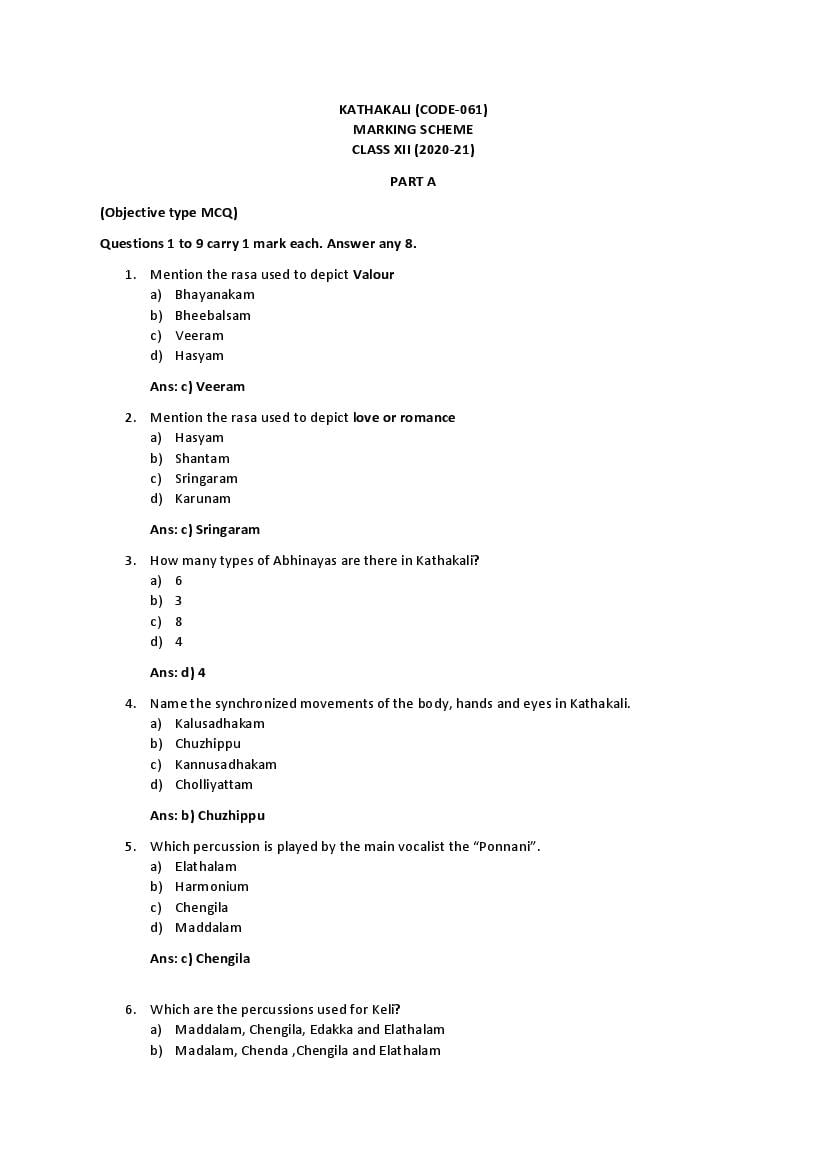
MARKING SCHEME
CLASS XII (2020-21)
PART A
(Objective type MCQ)
Questions 1 to 9 carry 1 mark each. Answer any 8.
1. Mention the rasa used to depict Valour
a) Bhayanakam
b) Bheebalsam
c) Veeram
d) Hasyam
Ans: c) Veeram
2. Mention the rasa used to depict love or romance
a) Hasyam
b) Shantam
c) Sringaram
d) Karunam
Ans: c) Sringaram
3. How many types of Abhinayas are there in Kathakali?
a) 6
b) 3
c) 8
d) 4
Ans: d) 4
4. Name the synchronized movements of the body, hands and eyes in Kathakali.
a) Kalusadhakam
b) Chuzhippu
c) Kannusadhakam
d) Cholliyattam
Ans: b) Chuzhippu
5. Which percussion is played by the main vocalist the “Ponnani”.
a) Elathalam
b) Harmonium
c) Chengila
d) Maddalam
Ans: c) Chengila
6. Which are the percussions used for Keli?
a) Maddalam, Chengila, Edakka and Elathalam
b) Madalam, Chenda ,Chengila and Elathalam
Page 2
d) Elathalam, Edakka, Chengila and Harmonium
Ans: b) Madalam, Chenda ,Chengila and Elathalam
7. Kathakali concludes with the prayer dance _________.
a) Thodayam
b) Keli
c) Dhanasi
d) Melappadam
Ans: c) Dhanasi
8. Narrative text which serve various purposes such as connecting two different scenes or
describing the actions of a character are known as ___________.
a) Kalasham
b) Dandakams
c) Chuzhippu
d) Ilakiyattam
Ans: b) Dandakams
9. How many types of chuzhippu are there?
a) 5
b) 6
c) 8
d) 7
Ans: d) 7
Questions 10 to 13 carry 2 marks each. Answer any 2.
10. Match the following:
a) Keechakavadham Vayaskara Aryan Moos
b) Duryodhanavadham KottayathThampuran
c) Kalyanasaugandhikam UnnayiWarrier
d) Nalacharitham IrayimmanThambi
a) Keechakavadham - IrayimmanThambi
b) Duryodhanavadham - Vayaskara Aryan Moos
c) Kalyanasaugandhikam - KottayathThampuran
d) Nalacharitham - UnnayiWarrier
11. Match the following:
a) Shringaram Juguptsa
b) Bheebalsam Shokam
c) Karunam Haasam
d) Hasyam Rathi
Page 3
b) Bheebalsam - Juguptsa
c) Karunam - Shokam
d) Haasyam - Haasam
12. Which hand gesture is used to depict a beautiful lady
a) Mukuram in the left hand and katakam in the right hand
b) Mushti in the left hand and Mukuram in the Right hand
c) Mukuram in the right hand and Katakam in the left hand
d) Mukuram in the left hand and mushti in the right hand
Ans: c) Mukuram in the right hand and Katakam in the left hand
13. Which are the hand gestures used to depict Sun
a) Pathaka in both hands
b) Hamsapaksham in both hands
c) Pathaka in right hand and hamsapaksham in left hand
d) Anjali in both hands
Ans: a) Pathaka in both hands
Question 14 carry 3 marks.
14. “Thodayam is the ritualistic performance in Kathakali”
i) Who is the composer of the text for Thodayam?
a) Kottayam Thamburan
b) KottarakkaraThamburan
c) Mukunda Raja
d) Vallathol Narayana menon
Ans: a) Kottayam Thampuran
ii) Which is the thaalam not used in Thodayam:
a) Adantha
b) Tripuda
c) Chamba
d) None of the above
Ans: d) None of the above
iii) Which percussion is not used in Thodayam?
a) Maddalam
b) Edakka
c) Chenda
d) Elathalam
Ans: c) Chenda
PART B
(Descriptive Questions)
Page 4
15. How many types of characters are there in kathakali? Which are they?
Ans: There are 5 types of characters in Kathakali, namely,
i) Pacha
ii) Kathi
iii) Kari
iv) Thadi
v) Minukku
16. What do you mean by Anga, Upanga and Prathyanga
Anga means the main parts of the body – head, hands, chest, flanks, waistor hips,
feet.
Upanga means the finer subtler parts of the body- Fingers, eyes, eyelids, eyebrows,
nose, lips, cheeks, and chin.
Prathyanga means the subordinate parts of the body – the shoulder blades, arms,
back, belly, thighs and shanks.
Questions 17 and 18 carry 3 marks each
17. Distinguish between:
i) Samyutha mudras and Asamyutha mudras
ii) Lokadharmi and Natyadharmi
i) Samyutha mudras are those where the same gestures are used in both hands to
depict an idea. Asamyutha mudras are those gestures made with only one hand.
ii) Lokadharmi is the realistic or imitative style of acting. Whereas Natyadharmi is the
highly stylized method of acting.
18. Write the difference between Sthayi bhava and Sanchari bhava.
Ans: Sthayibhava refers to “permanent moods”. It can be termed as the origin of bhava from
which Rasa is originated. Emotions that are stable and universal can be termed as Sthayi
bhava or constant feelings.
Sancharibhavas are light, fleeting emotions that appear and disappear in quick succession
and serve to strengthen the Sthayi bhava or permanent emotion in a song.
Sanchari bhavas are the auxiliary sentiments and situations which help in better
understanding the main subject of the representation of narrative and poetic elaborations
through dance.
Sanchari bhava means improvisation or explanation. These are transitory emotional feelings
that differ from situations to situation. They will not have a constant nature.
Question 19 and 20 carry 5 marks. Answer any one.
19. What are the four types of Abhinayas in Kathakali? Briefly explain.
Ans: The four types of Abhinayas in Kathakali are;
Page 5
It has greater prominence. The entire drama is enacted through the body. The actor
interprets the drama through the hand gestures, body movements and facial
expressions. The entire body which include the three parts :Anga, upanga and
Prathyanga are used by the actor to convey the ideas. There are 24 basic hand
gestures acquired from Hasta Lakshana Deepika, are used in different ways -
Samyutha (double handed), Asamyutha (single handed), Misra mudras (different
gestures in both the hands).
Satvika Abhinaya – The art of acting the inner emotions
It depicts the inner emotional and mental states and psychological communication. It
is the subtle, expressive, and internal elements of acting. This is done by using the
facial expressions especially through the eyes. Kathakali is heavily indebted to
Koodiyatam for its Satvika abhinaya. Satvika abhinaya includes Navarasas, Satvika
bhavas, sthayi bhavas and sanchari bhavas.
Aharya Abhinaya – The art of Acting through makeup and costumes
In kathakliAharya abhinaya is taken seriously. The elaborate makeup and costumes
require several hours of preparation. The makeup and costumes in Kathakali are
remarkable for their intricate stylisation. The makeup is used to transform the actor
into a God or a demon. Costumes are very dramatic and this ponderous costumes is
to exaggerate even the slightest tilt of the body. Different colour costumes are used
to depict and differentiate the characters. The ornaments and headgears too are
different for different characters. The different headgears used are Krishnamudi,
Kireetam (Keshabharam), Vattamudi, Kattalamudi, Kuttichamaram, Naradamudi etc.
Vachika Abhinaya – The art of Dialogue and Musical Accompaniment
Music in Kathakali is stage music as distinct from chamber music of the concert hall.
In kathakali, the vachika abhinaya, the verbal element of the performance or the
rendition of the text of the dramas, is not performed by the actor- dancers. Two
singers accompanied by the percussion ensemble, provide the text as well as support
the mood of the drama through the art of music, both vocal and instrumental. The
dramatic purpose of the music is to support the bhaavas enacted by the actor
dancers and to give the audience the emotional import of the attakatha. The lead
singer, the ponnani plays Chengila, and the second singer, the shingidi plays the
elathalam.
20. Write briefly, the influence of the art forms Mutiyettu, Kootiyattam, and Kalaripayattu on
Kathakali.
Influence of Mutiyettu on kathakali: Kathakali is indebted to Mutiyettu for many of its
preliminaries, ritual elements, makeup & costuming, staging, stage properties and dramatic
techniques. Preliminaries such as Keli, the lighting of the Kalaripayattu on the stage, the
Thodayam( a ritual dance) and the Purappad ( an invocatory dance) are also part of Kathakali
performance. Mutiyettu make-up has influenced Kathakali in terms of ingredients and
materials certain application techniques and rituals. The use of Chayilyam, manayola, mashi
and chutti are fundamental to the make-up of Kathakali. The headgear used by the character
Danavendra in Mutiyettu resembles the Kireedam in Kathakali. Common to both dramatic
Page 6
characters such as roaring, shrieking and shrill laughter, is also common to both dramatic
forms. The “Thiranokku” of powerful and aggressive characters is an integral dramatic
convention in Mutiyettu as well as in Kathakali. The percussions like chenda, chengila and
elathalam are also common for both Mutiyettu and Kathakali. The theme of Mutiyettu is
always the victory of good over evil. Many of the Kathakali attakathas have the same
universal theme.
Influence of Kootiyattam on Kathakali: Kathakali is indebted to Kootiyattam for many
elements of make-up, costumes, themes, training and acting techniques, gestural language,
and staging. The stylized make-up and costumes of Kootiyattam and Kathakali share certain
elements. Both Kathakali and Kootiyattam follow the same categorization of characters –
Pacha, Kathi, Kari, Thadi, Pazhupp and Minukku. Kathakali is fully indebted to Kootiyattam in
the training of upanga – for eyes, eyelids, eyebrows, cheeks, lips, and breath control. The
properties on the stage are the same; the lamp, the curtain, the wooden stool, torches and
tellipodi are used in both dramatic forms.
Influence of Kalaripayattu on Kathakali: The place where Kathakali training is held is called
“Kalari” as well as kalarippayattu. The basic body exercise or meyyurappu of Kathakali are a
modified form of meyyurappu of Kalaripayattu. The oil massage i.e. uzhichil, has also been
adopted by Kathakali from the material at form Kalaripayattu. The basic postures are the
same for both the art forms with slight modification made for the dance drama. Some of the
steps and movements of Kathakali are modifications of the “Adavu” of Kalaripayattu. In
kathakali there are many battle scenes that are directly influenced by the material art form.
“Mallayudham”in kathakali has been directly derived from the “Meypayattu”ofKalaripayattu.
Document Details
| Board / Org | CBSE |
| Exam | Class 12 |
| Type | Marking Scheme |
| Pages | 6 |
| Updated | 30 Apr 2026 |