MAHA SET 2015 Question Paper 3 Home Science Paper - Ii
Finished viewing? Save it for later —
Download MAHA SET 2015 Question Paper 3 Home Science Paper - Ii (PDF · 20 pages)About MAHA SET 2015 Question Paper 3 Home Science Paper - Ii
MAHA SET 2015 Question Paper 3 Home Science Paper - Ii is available here for free download. Published by Maharashtra Exams for MAHA SET, this question paper can be viewed online or downloaded as a PDF (20 pages). Candidates preparing for MAHA SET can use MAHA SET 2015 Question Paper 3 Home Science Paper - Ii to understand the exam pattern, the type of questions asked, and the overall difficulty level.
Frequently Asked Questions
How can I download MAHA SET 2015 Question Paper 3 Home Science Paper - Ii?
Open this page and click the Download button to save MAHA SET 2015 Question Paper 3 Home Science Paper - Ii as a PDF. It is completely free on AglaSem Docs.
Is MAHA SET 2015 Question Paper 3 Home Science Paper - Ii free to download?
Yes. MAHA SET 2015 Question Paper 3 Home Science Paper - Ii can be viewed online and downloaded as a PDF free of cost on AglaSem Docs.
How many pages does MAHA SET 2015 Question Paper 3 Home Science Paper - Ii have?
MAHA SET 2015 Question Paper 3 Home Science Paper - Ii contains 20 pages, which you can read online or download together as a single PDF.
Where can I find more MAHA SET study material?
You can find more MAHA SET question papers, sample papers, syllabus, and answer keys on AglaSem Docs.
MAHA SET 2015 Question Paper 3 Home Science Paper - Ii – Text
Read the full text of this question paper below — useful to quickly search, copy and reference the content online without downloading the PDF.
📄 View text version (20 pages)
Page 1
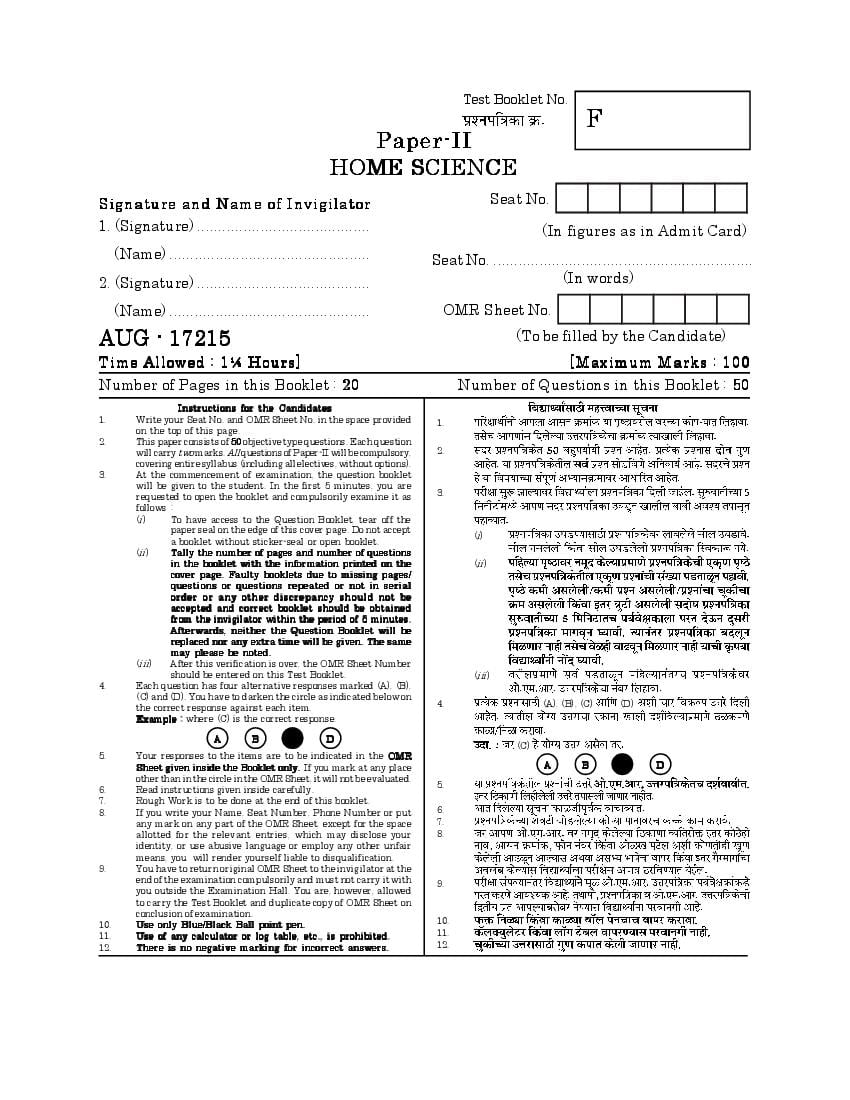
F
HOME SCIENCE
Signature and Name of Invigilator Seat No.
1. (Signature) ......................................... (In figures as in Admit Card)
(Name) ................................................ Seat No. ..............................................................
2. (Signature) ......................................... (In words)
(Name) ................................................ OMR Sheet No.
AUG - 17215 (To be filled by the Candidate)
Time Allowed : 1¼ Hours] [Maximum Marks : 100
Number of Pages in this Booklet : 20 Number of Questions in this Booklet : 50
Instructions for the Candidates
1. Write your Seat No. and OMR Sheet No. in the space provided 1.
on the top of this page.
2. This paper consists of 50 objective type questions. Each question
will carry two marks. All questions of Paper-II will be compulsory, 2.
covering entire syllabus (including all electives, without options).
3. At the commencement of examination, the question booklet
will be given to the student. In the first 5 minutes, you are
requested to open the booklet and compulsorily examine it as 3.
follows :
(i) To have access to the Question Booklet, tear off the
paper seal on the edge of this cover page. Do not accept
(i)
a booklet without sticker-seal or open booklet.
(ii) Tally the number of pages and number of questions
in the booklet with the information printed on the (ii)
cover page. Faulty booklets due to missing pages/
questions or questions repeated or not in serial
o rder or any other discre pancy should not be
accepted and correct booklet should be obtained
from the invigilator within the period of 5 minutes.
Afterwards, neither the Question Booklet will be
replaced nor any extra time will be given. The same
may please be noted.
(iii) After this verification is over, the OMR Sheet Number
should be entered on this Test Booklet. (iii)
4. Each question has four alternative responses marked (A), (B),
(C) and (D). You have to darken the circle as indicated below on
the correct response against each item. 4. (A), (B), (C) (D)
Example : where (C) is the correct response.
A B D
(C)
5. Your responses to the items are to be indicated in the OMR
Sheet given inside the Booklet only. If you mark at any place A B D
other than in the circle in the OMR Sheet, it will not be evaluated.
5.
6. Read instructions given inside carefully.
7. Rough Work is to be done at the end of this booklet.
8. If you write your Name, Seat Number, Phone Number or put 6.
any mark on any part of the OMR Sheet, except for the space 7.
allotted for the relevant entries, which may disclose your 8.
identity, or use abusive language or employ any other unfair
means, you will render yourself liable to disqualification.
9. You have to return original OMR Sheet to the invigilator at the
end of the examination compulsorily and must not carry it with 9.
you outside the Examination Hall. You are, however, allowed
to carry the Test Booklet and duplicate copy of OMR Sheet on
conclusion of examination.
10. Use only Blue/Black Ball point pen. 10.
11. Use of any calculator or log table, etc., is prohibited. 11.
12. There is no negative marking for incorrect answers. 12.
Page 2
Page 3
Paper II
II
Time Allowed : 75 Minutes] [Maximum Marks : 100
Note : This Paper contains Fifty (50) multiple choice questions. Each question
carries Two (2) marks. Attempt All questions.
(50) (2)
1. Dispersion of a liquid in liquid is 1.
known as :
(A) Sol (A)
(B) Gel (B)
(C) Emulsion (C)
(D) Foam (D)
2. Neural tube defects may be due to 2.
deficiency of :
(A) Folic Acid (A)
(B) B12
(B) Vitamin B12
(C)
(C) Iron
(D)
(D) Calcium
3 [P.T.O.
Page 4
absorption of calcium ?
(A) Vitamin A (A)
(B) Vitamin D (B)
(C) Vitamin E (C)
(D) Vitamin K (D)
4. Establishment whose sales figures
4.
just cover their variables and fixed
costs are said :
(A) to have breakeven
(A)
(B) to have minimal profit
(B)
(C) to have minimal loss
(C)
(D) to have about 1% between
profit and loss (D) 1%
5. With reference to metabolism TEF 5.
stands for :
(A) Trans-essential fatty acids (A)
(B) Timed eating factor (B)
(C) Total energy for feeding (C)
(D) Thermic effect of food (D)
4
Page 5
(A) 7th August
(A) 7
(B) 7th December
(B) 7
(C) 7th March
(C) 7
(D) 7th April
(D) 7
7. ARF stands for : 7.
(A) Amylose rich food (A)
(B) Amylopectin rich food (B)
(C) Amylase rich food (C)
(D) Antioxidant rich food (D)
8. Spirulina acts as : 8.
(A) Oxidising agent (A)
(B) Emulsifying agent (B)
(C)
(C) Antioxidant
(D)
(D) Stabilising agent
5 [P.T.O.
Page 6
measuring fat loss ?
(A) Weighing scale (A)
(B) Tape measures (B)
(C) Skin fold calipers (C)
(D) Bioelectric impedance (D)
10. ........................ temperature proves 10.
‘danger zone’ for foods.
(A) 4 to 50°C (A) 4 50°C
(B) 5 to 62°C (B) 5 62°C
(C) 5 to 63°F (C) 5 63°F
(D) 6 to 73°C (D) 6 73°C
11. .................... presence gives 11.
antioxidant property to tea.
(A) Isoflavons (A)
(B) Quercitin (B)
(C) Catechins
(C)
(D) Resveritol
(D)
6
Page 7
approximately :
(A) 600 mg of tryptophan (A) 600
(B) 625 mg of tryptophan (B) 625
(C) 650 mg of tryptophan (C) 650
(D) 575 mg of tryptophan (D) 575
13. Dried milk stored for a long time 13.
turns brown due to :
(A) Enzymatic reaction (A)
(B) Oxidation (B)
(C) Caramelization (C)
(D) Millard reaction (D)
14. Which of the following foods are 14.
cariostatic ?
(A) Cheese (A)
(B) Biscuits (B)
(C) Raisins (C)
(D) Milk (D)
7 [P.T.O.
Page 8
brief time in youths is known as :
(A) Fad
(A)
(B) Classic
(B)
(C) Fashion
(C)
(D) Chic
(D)
16. The filaments of silks held together 16.
by a gummy substance is called :
(A) Keratin (A)
(B) Seracin (B)
(C) Lycine (C)
(D) Casein (D)
17. The tex of the yarn is : 17.
(A) wt. in gms per 9000 meters (A) 9000
(B) wt. in gms per 1000 meters (B) 1000
(C) wt. in pounds per 840 yards (C) 840
(D) wt. in pounds per 560 yards (D) 560
8
Page 9
can be tested by rubbing, using :
(A) Fade-o-meter (A)
(B) Elemendrof tester (B)
(C) Crock meter (C)
(D) Scott tester (D)
19. In drafting, french curve is used to 19.
draw :
(A) Armhole (A)
(B) Dart (B)
(C) Hemline (C)
(D) Grainline (D)
20. Polyester can be dyed with : 20.
(A) Basic dye
(A)
(B) Sulphur dye
(B)
(C) Chrome dye (C)
(D) Disperse dye (D)
9 [P.T.O.
Page 10
(A) Uncut pile (A)
(B) Cut pile (B)
(C) Bedford cord
(C)
(D) Jacquard (D)
22. Which of the following is a type of 22.
sleeve ?
(A)
(A) Princess line
(B)
(B) Eton
(C)
(C) Raglan
(D) Peplum (D)
23. The step of management process 23.
that consists of dividing and
grouping activities and assigning
them to individuals is :
(A)
(A) Controlling
(B)
(B) Planning
(C)
(C) Guidance
(D)
(D) Organising
10
Page 11
on the managerial system is
referred as :
(A) Input (A)
(B) Feedback (B)
(C) Output (C)
(D) Wholeness (D)
25. .............. influences the use of 25.
resources in the first stage of family
life cycle.
(A) Values (A)
(B) Standards (B)
(C) Short-term goals (C)
(D) Long-term goals (D)
11 [P.T.O.
Page 12
decision proves helpful in using
maximum resources.
(A) Economic (A)
(B) Social (B)
(C) Technical (C)
(D) Habitual (D)
27. Inexperience work leads to ............. 27.
fatigue.
(A) Baredom (A)
(B) Frustration (B)
(C) Physiological (C)
(D) Mental (D)
28. The device used to study the types 28.
of motion while performing a task
is :
(A)
(A) Pathway chart
(B)
(B) Operation chart
(C) Process chart (C)
(D) Cyclic graph (D)
12
Page 13
refers to the plan in which :
(A) There are lots of doors and
windows
(A)
(B) There are no walls between
functional areas
(B)
(C) There are glass partitions
(C)
between functional areas
(D)
(D) There is simple open space
around the house
30.
30. The value of the colour can not be
changed by :
(A) Adding white (A)
(B) Adding black
(B)
(C) Increasing pigment concent-
(C)
ration
(D)
(D) Adding an adjacent colour
13 [P.T.O.
Page 14
following the rules of a game.
(A) Parallel
(A)
(B) Co-operative (B)
(C) Solitary (C)
(D) Associative (D)
32. The knowledge of objects continues 32.
to exist even when they are out of
view is :
(A)
(A) Object substitution
(B)
(B) Animism
(C)
(C) Object performance
(D) Object segregation (D)
33. The tendency of heredity to restrict 33.
the development of one or two
characters is :
(A) Canalization
(A)
(B) Genetic environmental
(B)
correlation
(C)
(C) Niche-Picking
(D) Range of reaction (D)
14
Page 15
grade children enter .................. stage.
(A) The preoperational period (A)
(B) The period of initiative Vs. guilt (B)
(C) Concrete operations (C)
(D) The Industry Vs. Inferiority (D)
35. The playground has been selected
35.
as an excellent place for observation
of childrens social behaviour
because :
(A) There is more room for
researchers (A)
(B) It is more natural and less
(B)
restrictive
(C) The children tend to go wild (C)
(D) Researchers are no longer
allowed in classrooms (D)
36. Phenylketonuria is cause of : 36.
(A) Physical handicap (A)
(B) Eye deformities (B)
(C) Mental retard (C)
(D) Muscular dystrophy (D)
15 [P.T.O.
Page 16
the characteristics of :
(A) Middle childhood (A)
(B) Young Adulthood (B)
(C) Early childhood (C)
(D) Adolescence (D)
38. The period of infancy extends from : 38.
(A) Birth to 2 years
(A) 2
(B) Birth to 15 days (B) 15
(C) 3–6 years (C) 3–6
(D) 1–2 years (D) 1–2
39. Educational planning is a ................. 39.
process.
(A) Strenuous (A)
(B)
(B) Cumbersome
(C)
(C) Dynamic
(D)
(D) Complicated
40.
40. Integrated Rural Development
Programme (I.R.D.P.) was started
in :
(A) 1976
(A) June 1976
(B) 1976
(B) March 1976
(C) 1976
(C) August 1976
(D) May 1976 (D) 1976
16
Page 17
where learning takes place
accidentally.
(A) Classroom (A)
(B)
(B) Informal
(C)
(C) Non-formal
(D)
(D) Formal
42. Seeing, hearing and doing occurs 42.
in ...................... .
(A) Radio (A)
(B) Audio-visual aids (B)
(C) Newspaper (C)
(D) Leaflets (D)
43. ................ is most effective in 43.
communicating with a small group
of people.
(A)
(A) Home visit
(B)
(B) Exhibition
(C)
(C) Study tour
(D) Campaign (D)
44. The term ‘Extension Education’ was 44.
first used by ....................... .
(A) Oxford University (A)
(B) Mumbai University (B)
(C) Cambridge University (C)
(D) S.N.D.T. Women’s University (D)
17 [P.T.O.
Page 18
which is :
(A)
(A) Prepared by the teacher
(B)
(B) The students understand the
concept clearly
(C)
(C) Colourful and attracts students
(D) Helpful for teacher to explain (D)
easily
46. Planning of extension programme is 46.
divided into ...................... parts.
(A) 4 (A) 4
(B) 8
(B) 8
(C) 6
(C) 6
(D) 2
(D) 2
47.
47. A study on buying habits of
teenagers is an example of :
(A) Applied research (A)
(B) Ex post facto research (B)
(C) Conceptual research (C)
(D) Fundamental research (D)
48. Dependent variable is one which : 48.
(A) Influences what one is studying (A)
(B)
(B) Interferes with research
variable (C)
(C) Is influenced by some variable
(D)
(D) Is manipulated
18
Page 19
(A) A statistical technique that can
(A)
be used to help equate groups
on specific variables
(B) A statistical technique that can (B)
be used to control sequencing
effect
(C) A statistical technique that (C)
substitutes for random
assignment to groups
(D)
(D) A statistical technique for
adjusting scores of the
independent variable to control
for extraneous variables
50.
50. Which of the following is not an
example of a non-random sampling
technique ?
(A)
(A) purposive
(B)
(B) quota
(C) convenience (C)
(D) cluster (D)
19 [P.T.O.
Page 20
20
Document Details
| Board / Org | Maharashtra Exams |
| Exam | MAHA SET |
| Type | Question Paper |
| Pages | 20 |
| Updated | 30 Apr 2026 |