MAHA SET 2015 Question Paper 3 Philosophy
Finished viewing? Save it for later —
Download MAHA SET 2015 Question Paper 3 Philosophy (PDF · 40 pages)About MAHA SET 2015 Question Paper 3 Philosophy
MAHA SET 2015 Question Paper 3 Philosophy is available here for free download. Published by Maharashtra Exams for MAHA SET, this question paper can be viewed online or downloaded as a PDF (40 pages). Candidates preparing for MAHA SET can use MAHA SET 2015 Question Paper 3 Philosophy to understand the exam pattern, the type of questions asked, and the overall difficulty level.
Frequently Asked Questions
How can I download MAHA SET 2015 Question Paper 3 Philosophy?
Open this page and click the Download button to save MAHA SET 2015 Question Paper 3 Philosophy as a PDF. It is completely free on AglaSem Docs.
Is MAHA SET 2015 Question Paper 3 Philosophy free to download?
Yes. MAHA SET 2015 Question Paper 3 Philosophy can be viewed online and downloaded as a PDF free of cost on AglaSem Docs.
How many pages does MAHA SET 2015 Question Paper 3 Philosophy have?
MAHA SET 2015 Question Paper 3 Philosophy contains 40 pages, which you can read online or download together as a single PDF.
Where can I find more MAHA SET study material?
You can find more MAHA SET question papers, sample papers, syllabus, and answer keys on AglaSem Docs.
MAHA SET 2015 Question Paper 3 Philosophy – Text
Read the full text of this question paper below — useful to quickly search, copy and reference the content online without downloading the PDF.
📄 View text version (40 pages)
Page 1
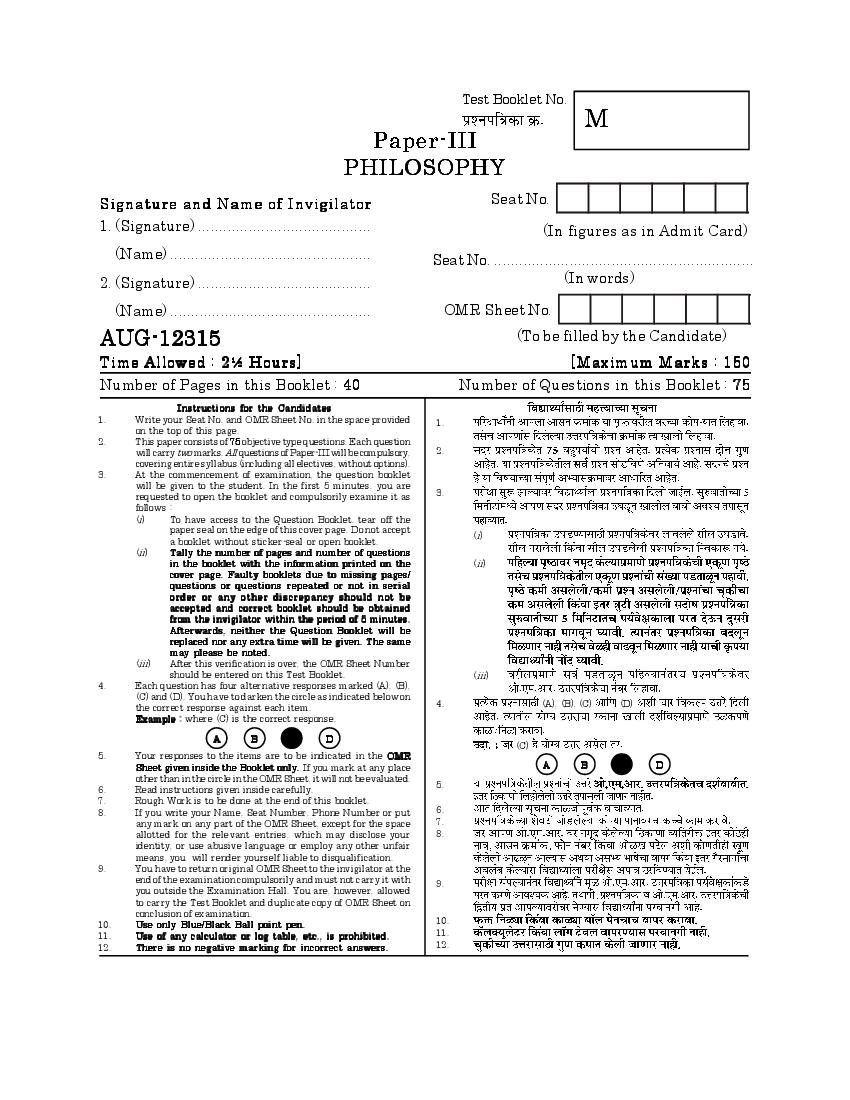
M
PHILOSOPHY
Signature and Name of Invigilator Seat No.
1. (Signature) ......................................... (In figures as in Admit Card)
(Name) ................................................ Seat No. ..............................................................
2. (Signature) ......................................... (In words)
(Name) ................................................ OMR Sheet No.
AUG-12315 (To be filled by the Candidate)
Time Allowed : 2½ Hours] [Maximum Marks : 150
Number of Pages in this Booklet : 40 Number of Questions in this Booklet : 75
Instructions for the Candidates
1. Write your Seat No. and OMR Sheet No. in the space provided 1.
on the top of this page.
2. This paper consists of 75 objective type questions. Each question
will carry two marks. All questions of Paper-III will be compulsory, 2.
covering entire syllabus (including all electives, without options).
3. At the commencement of examination, the question booklet
will be given to the student. In the first 5 minutes, you are
requested to open the booklet and compulsorily examine it as 3.
follows :
(i) To have access to the Question Booklet, tear off the
paper seal on the edge of this cover page. Do not accept
(i)
a booklet without sticker-seal or open booklet.
(ii) Tally the number of pages and number of questions
in the booklet with the information printed on the (ii)
cover page. Faulty booklets due to missing pages/
questions or questions repeated or not in serial
o rder or any other discre pancy should not be
accepted and correct booklet should be obtained
from the invigilator within the period of 5 minutes.
Afterwards, neither the Question Booklet will be
replaced nor any extra time will be given. The same
may please be noted.
(iii) After this verification is over, the OMR Sheet Number
should be entered on this Test Booklet. (iii)
4. Each question has four alternative responses marked (A), (B),
(C) and (D). You have to darken the circle as indicated below on
the correct response against each item. 4. (A), (B), (C) (D)
Example : where (C) is the correct response.
A B D
(C)
5. Your responses to the items are to be indicated in the OMR
Sheet given inside the Booklet only. If you mark at any place A B D
other than in the circle in the OMR Sheet, it will not be evaluated.
5.
6. Read instructions given inside carefully.
7. Rough Work is to be done at the end of this booklet.
8. If you write your Name, Seat Number, Phone Number or put 6.
any mark on any part of the OMR Sheet, except for the space 7.
allotted for the relevant entries, which may disclose your 8.
identity, or use abusive language or employ any other unfair
means, you will render yourself liable to disqualification.
9. You have to return original OMR Sheet to the invigilator at the
end of the examination compulsorily and must not carry it with 9.
you outside the Examination Hall. You are, however, allowed
to carry the Test Booklet and duplicate copy of OMR Sheet on
conclusion of examination.
10. Use only Blue/Black Ball point pen. 10.
11. Use of any calculator or log table, etc., is prohibited. 11.
12. There is no negative marking for incorrect answers. 12.
Page 2
Page 3
Paper III
III
Time Allowed : 2½ Hours] [Maximum Marks : 150
Note : This paper contains Seventy Five (75) multiple choice questions. Each
question carries Two (2) marks. Attempt All questions.
(75) (2)
1. The correct sequence of 1.
Bra hma viha ra s according to
Buddhism is :
(A) Upek sa , Maitri, Mu dita ,
Ka r u n a (A)
(B) Upek sa , Maitri, Ka r u n a
(B)
Mudit a
(C) Maitri, Ka r u n a , Mu dita , (C)
U pek sa
(D) Maitri, Mu dita , Ka r u n a , (D)
U pek sa
2.
2. According to Russell :
(A)
(A) All relations are external
(B)
(B) All relations are internal
(C)
(C) Internal-external division is not
applicable to relations
(D)
(D) Relations are both, internal and
external
3 [P.T.O.
Page 4
G it a means :
(A)
(A) Organizing people
(B)
(B) Trying to attain better world
after death
(C)
(C) Satisfying desires of the people
(D) Behaving the way one expects (D)
people to bahave
4. How many truth-possibilities/rows
4. [(p q) . (q r)] (p r)
will be there in the truth table
of :
[(p q) . (q r)] (p r)
(A) 4
(A) 4
(B) 6
(B) 6
(C) 12
(C) 12
(D) 8 (D) 8
4
Page 5
of use according to :
(A) Bertrand Russell (A)
(B) Wittgenstein
(B)
(C) Dummett
(C)
(D) Strawson
(D)
6. The best as rama for pursuing all
6.
the three pu r u sa r t h a s viz., Artha,
Ka ma and Dharma, was supposed
to be :
(A)
(A) Brahmacharya
(B)
(B) Gr h a st h a
(C) Va n a pr a st h a (C)
(D) Sa m n ya sa (D)
5 [P.T.O.
Page 6
a sentence is :
(A)
(A) Objective
(B)
(B) Mental
(C)
(C) Spiritual
(D)
(D) Subjective
8. Identify the form of the following 8.
argument :
(E N) . (~ L ~ K)
(E N) . (~ L ~ K)
~ N K / ~ E L
~ N K / ~ E L
(A) (M.T.)
(A) Modus Tollens (M.T.)
(B) (C.D.)
(B) Constructive Dilemma (C.D.)
(C) Destructive Dilemma (D.D.) (C) (D.D.)
(D) Disjunctive Syllogism (D.S.) (D) (D.S.)
6
Page 7
Gadamer and Habermas differed on
the role of :
(A) Application (A)
(B) Critique (B)
(C) Universality (C)
(D) Historicity (D)
10. At practical level, Advaita- 10.
Veda n t ia ns accept the following
number of pr a m a n a s :
(A)
(A) Three
(B)
(B) Four
(C)
(C) Five
(D)
(D) Six
7 [P.T.O.
Page 8
and mathematical propositions have
the same status as empirical
ones ?
(A)
(A) Kant
(B)
(B) Mill
(C) Hegel (C)
(D) Ayer (D)
12. According to the Rn a theory we 12.
are indebted by birth, to the
following :
(A)
(A) God, parents and neighbours
(B)
(B) Gods, ancestors and teachers
(C)
(C) God, parents and society
(D)
(D) Gods, nature and living beings
8
Page 9
13.
individual variable and becomes a
proposition when an individual
constant is substituted for individual
variable is known as :
(A)
(A) Proposition
(B)
(B) Propositional function
(C) Universal proposition (C)
(D) General proposition (D)
14. When one perceives a table and has 14.
cognition of the form, “This is a
table”, it is according to Buddhists
a case of :
(A) P r a t ya k sa P r a m a n a (A)
(B) An um a n a P r a m a n a (B)
(C) Sabda P r a m a n a (C)
(D) Vikalp
(D)
9 [P.T.O.
Page 10
different voice’ is upheld by :
(A) Wollstonecraft (A)
(B) Simone de Beauvoir (B)
(C) Okin (C)
(D) Gilligan (D)
16. According to Austin, performatives
16.
can be judged as :
(A) Valid and invalid (A)
(B) True and false (B)
(C) Possible and impossible (C)
(D) Happy and unhappy (D)
10
Page 11
propositional knowledge and know-
how is made by :
(A)
(A) Ryle
(B)
(B) Russell
(C)
(C) Carnap
(D) Ayer (D)
18. The notion of intentionality was 18.
propounded by :
(A) Sartre (A)
(B) Schütz (B)
(C) Heidegger (C)
(D) Brentano (D)
11 [P.T.O.
Page 12
of interpretation and object is :
(A) reference (A)
(B) meaning (B)
(C) cognition (C)
(D) method (D)
20. Quine believes that justification 20.
applies to :
(A)
(A) Individual sentence
(B)
(B) Atomic sentences
(C)
(C) Sets of sentences
(D) Logic of sentences (D)
12
Page 13
is :
(A)
(A) Agape
(B)
(B) Eros
(C)
(C) Motherly love
(D)
(D) Fatherly love
22.
22. “One feature of Justice as fairness
is to think of the parties in the initial
situation as rational and mutually
disinterested.” This can be
attributed to :
(A)
(A) Rawls
(B)
(B) Nussbaum
(C)
(C) Kant
(D)
(D) Dworkin
13 [P.T.O.
Page 14
meaning relation is determined :
(A) only by divine convention
(A)
(B) only by human convention
(B)
(C) in some cases by divine
(C)
convention, in some cases by
human convention
(D) by no conventions, as the (D)
relation is eternal
24. Which of the following does
24.
Descartes know with certainty at
first ?
(A)
(A) The phenomenal self
(B)
(B) The divine self
(C)
(C) The thinking self
(D)
(D) The material self
14
Page 15
between two propositions in modern
predicate logic stands ?
(A) Contradictory
(A)
(B) Contrary
(B)
(C) Sub-contrary
(C)
(D) Subalternation
(D)
26. According to Abh ih it a n va ya va da :
26.
(A) First sentence meaning is
(A)
grasped, then word meaning
(B) First word meaning is grasped,
(B)
then sentence meaning
(C) Both are grasped simultane-
(C)
ously
(D)
(D) Both are grasped in an
irregular sequence
15 [P.T.O.
Page 16
in :
(A)
(A) Dravya, Karma and Vis esa
(B)
(B) Dravya, Gu n a and Abha va
(C)
(C) Dravya, Gu na and Sa m a va ya
(D)
(D) Dravya, Gu n a and Karma
28.
28. Compound propositions are :
(A)
(A) Never truth-functional
(B)
(B) Always truth-functional
(C)
(C) Either truth-functional or non-
truth-functional
(D) Neutral (D)
16
Page 17
rehabilitative approach to
punishment is :
(A)
(A) Oriented to the past
(B)
(B) Oriented to the present
(C)
(C) Oriented to the future
(D)
(D) Oriented to decent
30. According to Jaina darshana, 30.
Triratna consists of the following : (A)
(A) Samyak buddhi, Samyak
bh a va , Samyak caritra
(B)
(B) Samyak drist i , Samyak
jijn a sa , Samyak karma
(C)
(C) Samyak da rs a na , Samyak
jn a n a , Samyak caritra
(D)
(D) Samyak da rs a na , Samyak
karma, Samyak caritra
17 [P.T.O.
Page 18
following theory of error :
(A) Asa t kh ya t i (A)
(B) Vipa r it a kh ya t i (B)
(C) An ya t h a kh ya t i (C)
(D) Akh ya t i (D)
32. The total number of vows prescribed 32.
by Gandhiji for Sa t ya gr a h i are :
(A)
(A) Five
(B)
(B) Nine
(C)
(C) Eleven
(D)
(D) Twenty one
18
Page 19
resembles the past is a part of :
(A) The hypothetico-deductive
(A)
method
(B)
(B) The problem of induction
(C) Cartesian scepticism (C)
(D) Pyrrohnian scepticism (D)
34. “The job of ethical language is ‘to 34.
express feelings’ in the sense of
arousing feeling and to stimulate
action.” This view is held by :
(A) Moore (A)
(B) Hare (B)
(C) Ayer (C)
(D)
(D) Stevenson
19 [P.T.O.
Page 20
35.
with reference to Gandhiji ?
(A) In its negative form Ah im sa (A)
means physical and mental non-
injury to any being
(B) In its positive form, it means (B)
largest love, love for enemy
(C)
(C) The follower of Ahimsa should
be neutral towards his enemy
(D)
(D) Ahimsa consists of truth and
fearlessness
36. From Mill’s utilitarian point of view, 36.
what matters is not the agent’s
personal happiness but :
(A) Whether the action promotes
(A)
perfection
(B) Whether the action promotes
(B)
pleasure
(C) Whether the action minimizes (C)
pain
(D) Whether the action promotes (D)
the greatest happiness of
greatest number
20
Page 21
formulation of Kant’s categorical
imperative ?
(A)
(A) Mean between extremes
(B)
(B) Humanity as an end-in-itself
(C)
(C) The highest good
(D) Divine good (D)
38. “The various excellences of 38.
character are each intermediate
between two vices, one of excess and
the other deficiency.” This statement
can be attributed to : (A)
(A) Parmenides
(B)
(B) Socrates
(C)
(C) Plato
(D) Aristotle (D)
21 [P.T.O.
Page 22
Gandhiji expresses his thoughts
is :
(A) Mu ka n a ya k a (A)
(B) Harijan (B)
(C) Hindustan Times (C)
(D) Young Bharatiya (D)
40. P r a m a n a is defined by Buddhism 40.
as :
(A) Ka r a n a of P ra m a (A)
(B) Ya t h a rt ha anubhava (B)
(C) Sva-para- vya va sa yi-jn a n a (C)
(D) Avisa m va d i jn a n a (D)
22
Page 23
41.
physical objects are :
(A) Metaphysical constructions of
sense data
(A)
(B) Spiritual constructions of sense
data (B)
(C) Logical constructions of sense
(C)
data
(D) Physical constructions of sense (D)
data
42.
42. If hetu exists only in pa k sa (the
case to be proved), neither in
sa pa ksa (similar cases), nor in
vipa k sa (dissimilar cases), the
following h et va bha sa is
(A)
committed :
(A) Sa dh a r a n a -a n a ik a n t ika (B)
(B) Asa dh a r a n a -a n a ik a n t ik a
(C)
(C) Asiddha
(D) Sa t pr a t ipa k sa (D)
23 [P.T.O.
Page 24
differ regarding :
(A) Whom to punish (A)
(B) Why to punish (B)
(C) How to punish (C)
(D) When to punish (D)
44. According to Zarathushtra, God has 44.
these many sacred powers :
(A) Two (A)
(B) Seven (B)
(C) Eight (C)
(D) Six (D)
24
Page 25
personal identity was upheld by :
(A) Hobbes (A)
(B) Locke (B)
(C) Hume
(C)
(D) Kant
(D)
46. Utilitarianism has another
46.
distinguishing character besides
hedonism, namely :
(A)
(A) Teleology
(B)
(B) Deontology
(C)
(C) Biologism
(D)
(D) Altruism
25 [P.T.O.
Page 26
47.
is :
(A) Only a material cause of the (A)
world
(B)
(B) Only an efficient cause of the
world (C)
(C) Both material and efficient
cause of the world
(D) a sa m a va yi cause of the world (D)
48. The p r a st h a n a t ra y i of veda nt a -
48.
system consists of :
(A) U pa n isa da s, Sm r t is a n d
P u ra n a s
(A)
(B) Sa m h it a , Ar a n ya k a and
U pa n isa da s
(B)
(C) Upa n isa da s , Br a h ma su t r a
and the G it a (C)
(D) Br a h ma su t r a , the G it a and
(D)
Bh a gva t apu r a n a
26
Page 27
number of Nabis is :
(A) 26
(A) 26
(B) 28
(B) 28
(C) 27
(C) 27
(D) 25
(D) 25
50. For Husserl the constitution of an 50.
intentional object as an object across
different perceptual acts requires the
following form of consciousness :
(A) Cognitive (A)
(B) Subjective
(B)
(C) Temporal
(C)
(D) Spatial
(D)
27 [P.T.O.
Page 28
has :
(A)
(A) No qualities
(B)
(B) Human-like qualities
(C)
(C) All and only good qualities
(D)
(D) Mostly good qualities but a few
bad qualities
52.
52. According to Hinduism the ultimate
goal of human life is :
(A)
(A) Dharma
(B)
(B) Artha
(C) Ka ma (C)
(D) Moksa (D)
28
Page 29
(A) a property
(A)
(B) an entity
(B)
(C) a concept (C)
(D) a name (D)
54. Prapatti as the path to liberation was 54.
advocated by :
(A)
(A) Ma dh va ca r ya
(B)
(B) N im ba r k a ca r ya
(C)
(C) Va lla bh a ca r ya
(D) Ra m a n u ja ca r ya (D)
29 [P.T.O.
Page 30
determined by :
(A) Composition (A)
(B) Quality (B)
(C) Function (C)
(D) Quantity (D)
56. “Women must always be honoured 56.
and respected by father, brothers,
husband and brother-in-law. Who
desire their welfare.” This statement
is made by :
(A)
(A) Manu
(B) Gandhi (B)
(C) Tilak (C)
(D) Vivekananda
(D)
30
Page 31
57. Who rejects the Enlightenment
prejudice against prejudice ?
(A)
(A) Gadamer
(B) Habermas (B)
(C) Ricoeur (C)
(D) Husserl (D)
58. “We may understand by 58.
metaphysics........the effect to
comprehend the universe, not simply
piecemeal or by fragments but
somehow as a whole.” This
statement can be attributed to :
(A)
(A) Bradley
(B) Aristotle (B)
(C) Aquinas (C)
(D) Schopenhauer (D)
31 [P.T.O.
Page 32
N ya ya -va isesika s recognise these
number of P a da rt h a s : (A)
(A) Five
(B)
(B) Six
(C)
(C) Seven
(D) Eight (D)
60. Total number of Tirthankaras in 60.
Jainism are :
(A)
(A) 21
(B)
(B) 20
(C)
(C) 24
(D)
(D) 18
61. Va lla bh a ca r ya 's path towards 61.
liberation is called :
(A) Ka r m a m a rga (A)
(B) P u st im a r ga (B)
(C) Bh a k t im a r ga (C)
(D) P r a pa t t im a rga (D)
32
Page 33
between :
(A)
(A) Anuyogin-Pratiyogin
(B)
(B) Dravya- Gu na
(C)
(C) J a t i and Vyakti
(D)
(D) Avayava and Avayavi
63.
63. According to Hume, cause and effect
are not related through :
(A) Logical necessity (A)
(B) Constant conjunction (B)
(C) Association of ideas
(C)
(D) Antecedence of events
(D)
33 [P.T.O.
Page 34
by Sa m k h ya is :
(A) Two (A)
(B) Three (B)
(C) Four (C)
(D) Five (D)
65. The relation between two separables 65.
and that between two inseparables
respectively are called in
N ya ya -Va isesika s as :
(A) Tadutpatti and Ta d a tm ya
(A)
(B) Sa m yoga a n d Sa m a va ya
(B)
(C) P r t h a k siddh i and
(C)
Apr th a ksiddhi
(D) Bheda and Abheda
(D)
34
Page 35
argument is determined by its :
(A) Truth of its premises (A)
(B) Truth of its conclusion (B)
(C) Form (C)
(D) Content (D)
67. The subject term of the conclusion 67.
of a categorical syllogism is
called :
(A)
(A) Middle term
(B)
(B) Major term
(C) Minor term (C)
(D) Negative term
(D)
35 [P.T.O.
Page 36
invalidity can belong only to :
(A) deductive arguments (A)
(B) inductive arguments (B)
(C) deductive and inductive (C)
arguments both
(D)
(D) propositions
69. The relation of contradiction exists 69.
between............................
(A) ‘I’ ‘O’
(A) ‘I’ and ‘O’ propositions
(B) ‘A’ ‘E’
(B) ‘A’ and ‘E’ propositions
(C) ‘A’ and ‘I’ propositions (C) ‘A’ ‘I’
(D) ‘E’ and ‘I’ propositions (D) ‘E’ ‘I’
36
Page 37
(A) Neither true nor false (A)
(B) Either true or false (B)
(C) Both true and false (C)
(D) Valid and invalid (D)
71. Existence of Dik can be established
71.
according to N ya ya -Va isesika s on
the basis of :
(A) Perception of things in space (A)
(B) Intuition of spatial distances
(B)
(C) Linguistic usages such as ‘to the
(C)
east’.
(D)
(D) Reference in the Vedas
37 [P.T.O.
Page 38
72. According to Advaita Veda nta , the
(a)
P r a m a na s are :
(b)
(a) Ultimately real
(c)
(b) Empirically real
(d)
(c) Ultimately unreal
(d) Empirically unreal
Codes : (A) (a)
(A) Only (a) is true (B) (b) (c)
(B) Both (b) and (c) are true
(C) (a) (d)
(C) Both (a) and (d) are true
(D) (b)
(D) only (b) is true
73. Buddhists accept the following 73.
classification of a n uma na based on
the kinds of connection between
Hetu and Sa dh ya :
(A) Sva r t ha n um a na and
P a ra rt ha num a na (A)
(B) P u r va va t , Sesa va t and
Sa m a n ya t odr st a (B)
(C) Sa d h a r m ya va t p r a yoga and
Va idh a r m ya va t pr a yoga (C)
(D) Ka rya n u m a n a a n d
Sva bha va nu ma na (D)
38
Page 39
questioned by the following
system :
(A)
(A) Ca rva k a
(B)
(B) Buddhism
(C)
(C) Jainism
(D)
(D) Sa m k h ya
75.
75. According to Jainism, J iva is :
(A)
(A) only eternal
(B) only non-eternal (B)
(C) both eternal and non-eternal (C)
(D) non-existent (D)
39 [P.T.O.
Page 40
40
Document Details
| Board / Org | Maharashtra Exams |
| Exam | MAHA SET |
| Type | Question Paper |
| Pages | 40 |
| Updated | 30 Apr 2026 |