CBSE Class 12 History Question Paper 2019 Set 1
Finished viewing? Save it for later —
Download CBSE Class 12 History Question Paper 2019 Set 1 (PDF · 12 pages)About CBSE Class 12 History Question Paper 2019 Set 1
CBSE Class 12 History Question Paper 2019 Set 1 is available here for free download. Published by CBSE for Class 12, this question paper can be viewed online or downloaded as a PDF (12 pages). Candidates preparing for Class 12 can use CBSE Class 12 History Question Paper 2019 Set 1 to understand the exam pattern, the type of questions asked, and the overall difficulty level.
Frequently Asked Questions
How can I download CBSE Class 12 History Question Paper 2019 Set 1?
Open this page and click the Download button to save CBSE Class 12 History Question Paper 2019 Set 1 as a PDF. It is completely free on AglaSem Docs.
Is CBSE Class 12 History Question Paper 2019 Set 1 free to download?
Yes. CBSE Class 12 History Question Paper 2019 Set 1 can be viewed online and downloaded as a PDF free of cost on AglaSem Docs.
How many pages does CBSE Class 12 History Question Paper 2019 Set 1 have?
CBSE Class 12 History Question Paper 2019 Set 1 contains 12 pages, which you can read online or download together as a single PDF.
Where can I find more Class 12 study material?
You can find more Class 12 question papers, sample papers, syllabus, and answer keys on AglaSem Docs.
CBSE Class 12 History Question Paper 2019 Set 1 – Text
Read the full text of this question paper below — useful to quickly search, copy and reference the content online without downloading the PDF.
📄 View text version (12 pages)
Page 1
.
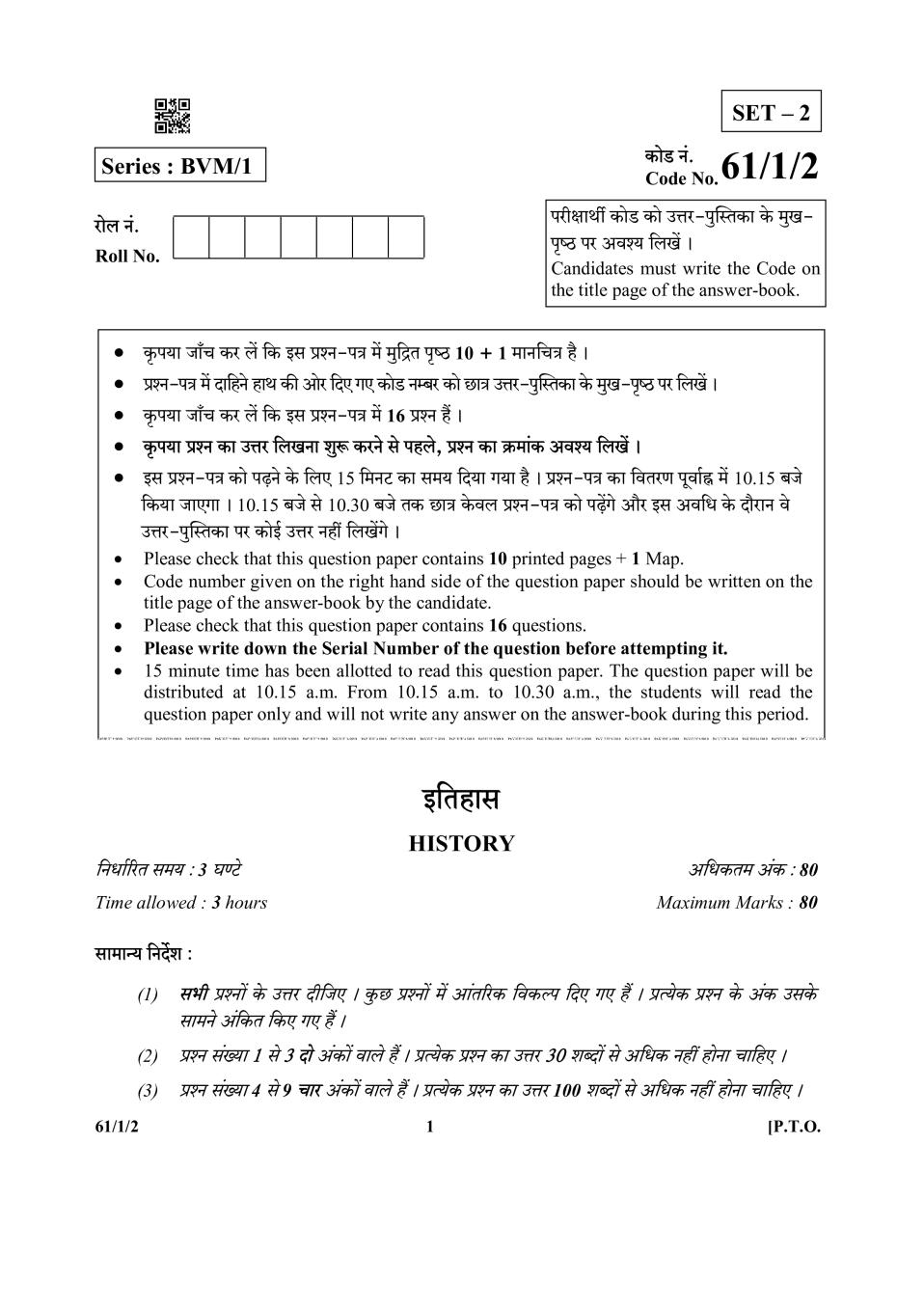
Series : BVM/1 Code No. 61/1/2
. - -
Roll No.
Candidates must write the Code on
the title page of the answer-book.
- 10 + 1
- - -
- 16
,
- 15 - 10.15
10.15 10.30 -
-
Please check that this question paper contains 10 printed pages + 1 Map.
Code number given on the right hand side of the question paper should be written on the
title page of the answer-book by the candidate.
Please check that this question paper contains 16 questions.
Please write down the Serial Number of the question before attempting it.
15 minute time has been allotted to read this question paper. The question paper will be
distributed at 10.15 a.m. From 10.15 a.m. to 10.30 a.m., the students will read the
question paper only and will not write any answer on the answer-book during this period.
HISTORY
: 3 : 80
Time allowed : 3 hours Maximum Marks : 80
:
(1)
(2) 1 3 30
(3) 4 9 100
61/1/2 1 [P.T.O.
Page 2
(5) 13 15
(6) 16 ,
-
General Instructions :
(1) Answer all the questions. Some questions have internal choice. Marks are
indicated against each question.
(2) Answer to question nos. 1 to 3 carrying 2 marks should not exceed 30 words each.
(3) Answer to question nos. 4 to 9 carrying 4 marks should not exceed 100 words
each.
(4) Answer to question nos. 10 to 12 carrying 8 marks should not exceed 350 words each.
(5) Questions Nos. 13 to 15 are source based questions.
(6) Question No. 16 is a Map question that includes identification and location of
significant test items. Attach the map with the answer-book.
–
PART – A
( ) 23=6
(Very Short Answer Type Questions)
1. “ ”
2
“Coinage plays a valuable role in determining certain period of Indian history.” Justify
the statement giving two points.
2. - ‘--’ ? 2
Why is Al-Biruni’s text “Kitab-ul-Hind” considered as a Voluminuous text ?
3.
2
‘ ’
61/1/2 2
Page 3
sixteenth and seventeenth centuries.
OR
State any two characteristic features of the ‘new Black Town’ developed during the
colonial period in Madras.
–
PART – B
( ) 4 6 = 24
(Short Answer Type Questions)
4. /- ,
4
Prove with the help of examples that the Harappans had established their contacts with
Western Asia for purchase/exchange of artifacts.
5. 4
Describe the administrative features of the Mauryan Empire.
6. ‘ ’
4
‘Mahanavami Dibba of Vijaynagara was the centre of elaborate rituals.’ Explain the
statement with suitable examples.
7. ..
? 4
Why did N.G. Ranga urge to interpret minorities in the economic terms in the
Constituent Assembly ? Explain.
8. 4
1857 ?
Analyse the impact of American Civil War on the lives of the Ryots in Deccan
country-side.
OR
Examine why were the religious divisions between Hindus and Muslims hardly
noticeable during the uprising of 1857.
61/1/2 3 [P.T.O.
Page 4
4
“ ”
“Akbar consciously made Persian the leading language of the Mughal Court.” Justify
the statement with the efforts made by him.
OR
“The visible centre of Mughal power was the King’s Court.” Justify the statement with
suitable arguments.
–
PART – C
(Long Answer Questions) 8 3 = 24
10. ‘--’
,
8
Explain how the chronicle ‘Ain-i-Akbari’ is the major source to understand agararian
history of sixteenth and seventeenth centuries. Also, explain the method of irrigation
and technology used during that period.
OR
Explain the role played by Zamindars during sixteenth and seventeenth centuries in
India.
11. 600 .. 600 ‘ ’ ‘
’ 4+4=8
..
Describe the ‘ideal of Patriliny’ and ‘Gendered access to Property’ prevailing during
sixth century B.C.E. to sixth century C.E.
OR
Describe the elements considered by historians to analyse Mahabharata. State the
efforts of V.S. Suthankar and his team for the preparation of the critical edition of
Mahabharata.
61/1/2 4
Page 5
” 8
“
”
“‘Quit India Movement’ was genuinely a mass movement bringing into its ambit
hundreds of thousands of ordinary Indians.” Analyse the statement.
OR
“The worst is over but Indians need to work collectively for the equality of all classes
and creeds.” Substantiate the statement of Gandhiji for bringing communal peace after
the partition of India.
–
PART – D
( ) 7 3 = 21
(Source Based Questions)
13.
2+3+2=7
1940
1940 –
‘ ,
-
, ‘ ’ ,
’
(13.1) 2
(13.2) 3
(13.3) “1940 ” 2
61/1/2 5 [P.T.O.
Page 6
1949 .
‘ ... ()
230 ....
500 .....
....
....
....
’
(13.1) 2
(13.2) 2
(13.3) “ ”
3
Read the following excerpt carefully and answer the questions that follow :
The Muslim League resolution of 1940
The League’s resolution of 1940 demanded :
That geographically contiguous units are demarcated into regions, which should be so
constituted, with such territorial readjustments as may be necessary, that the areas in
which the Muslims are numerically in a majority as in the north-western and eastern
zones of India should be grouped to constitute “Independent States”, in which the
constituent units shall be autonomous and sovereign.
(13.1) Identify the major demands of the Muslim League.
(13.2) Analyse the reasons for the demand of autonomy by the Muslim League.
(13.3) Analyse the distinctive aspects of the Muslim League Resolution of 1940.
OR
61/1/2 6
Page 7
A small basket of grapes
This is what Dr. Khushdeva Singh writes about his experience during one of his visits
to Karachi in 1949 :
My friends took me to a room at the airport where we all sat down and talked...
(and) had lunch together, I had to travel from Karachi to London... at 2.30 am...
At 5.00. p.m. ... I told my friends that they had given me so generously of their time,
I thought it would be too much for them to wait the whole night and suggested they
must spare themselves the trouble. But nobody left until it was dinner time.... Then
they said they were leaving and that I must have a little rest before emplaning. .... I got
up at about 1.45 a.m. and, when I opened the door, I saw that all of them were still
there.... They all accompanied me to the plane, and, before parting, presented me with
a small basket of grapes. I had no words to express my gratitude for the overwhelming
affection with which I was treated and the happiness this stopover had given me.
(13.1) Analyse the attitude of the people of Karachi towards Khushdeva Singh.
(13.2) Express the feelings of Khushdeva Singh at Karachi.
(13.3) “Love is stronger than hate.” Elucidate the statement in the context of this
narrative.
14.
, ,
,
,
.....
(14.1) ? 2
(14.2) 2
(14.3) ? 3
61/1/2 7 [P.T.O.
Page 8
A prayer to Agni
Here are two verses from the Rigveda invoking Agni, the god of fire :
Bring, O strong one, this sacrifice of ours to the gods, O wise one, as a liberal giver.
Bestow on us, O priest, abundant food. Agni, obtain, by sacrificing, mighty wealth for us.
Procure, O Agni, for ever to him who prays to you (the gift of) nourishment, the
wonderful cow, May a son be ours, offspring that continues out line...
Verses such as these were composed in a special kind of Sanskrit, known as Vedic
Sanskrit. They were taught orally to men belonging to priestly families.
(14.1) Why was Vedic Sanskrit significant ?
(14.2) Explain any two Vedic traditions of religious beliefs and practices.
(14.3) Why were sacrifices performed during Vedic Period ?
15.
2+2+3=7
,
?
?
, , , ,
?
(15.1) ? 2
(15.2) - ? 2
(15.3) - ?
3
61/1/2 8
Page 9
The One Lord
Here is a composition attributed to Kabir :
Tell me, brother, how can there be
No one lord of the world but two ?
Who led you so astray ?
God is called by many names :
Names like Allah, Ram, Karim, Keshav, Hari and Hazrat.
Gold may be shaped into rings and bangles.
Isn’t it gold all the same ?
Distinctions are only words we invent....
Kabir says that are both mistaken.
Neither can find the only Ram. One kills the goat, the other cows.
They waste their lives in disputation.
(15.1) How has Kabir laid emphasis on the attainment of oneness with the divine ?
Explain.
(15.2) How do you think the people waste their lives in disputation ?
(15.3) How has the lyrical beauty of his poem made him a figure of inter-religious
harmony ? Explain.
–
PART – E
( ) 2+3=5
(Map Question)
16. (16.1) - ,
2
(a) –
(b) –
– 1857
61/1/2 9 [P.T.O.
Page 10
A, B C
3
(16.1) On the given political outline map of India, locate and label the following
with appropriate symbols :
(a) Agra, a territory under Mughals
OR
Vijaynagara
(b) Champaran, a centre of National Movement
OR
Gwalior – a centre of the Revolt of 1857
(16.2) On the same outline map three places have been marked as A, B, C which
are related to the mature Harappan sites. Identify them and write their
correct names on the lines marked near them.
16 2+3=5
(16.1)
(16.2)
Note : The following questions are for the visually-impaired candidates only in lieu of
Q. No. 16.
(16.1) Mention any two territories under Babur.
OR
Mention any two centres of Indian National Movement.
(16.2) Name any three mature Harappan sites.
61/1/2 10
Page 11
Page 12
Document Details
| Board / Org | CBSE |
| Exam | Class 12 |
| Type | Question Paper |
| Pages | 12 |
| Updated | 09 Jun 2026 |