CBSE Class 12 Chemistry Question Paper 2020 Set 56-1-3
Finished viewing? Save it for later —
Download CBSE Class 12 Chemistry Question Paper 2020 Set 56-1-3 (PDF · 19 pages)About CBSE Class 12 Chemistry Question Paper 2020 Set 56-1-3
CBSE Class 12 Chemistry Question Paper 2020 Set 56-1-3 is available here for free download. Published by CBSE for Class 12, this question paper can be viewed online or downloaded as a PDF (19 pages). Candidates preparing for Class 12 can use CBSE Class 12 Chemistry Question Paper 2020 Set 56-1-3 to understand the exam pattern, the type of questions asked, and the overall difficulty level.
Frequently Asked Questions
How can I download CBSE Class 12 Chemistry Question Paper 2020 Set 56-1-3?
Open this page and click the Download button to save CBSE Class 12 Chemistry Question Paper 2020 Set 56-1-3 as a PDF. It is completely free on AglaSem Docs.
Is CBSE Class 12 Chemistry Question Paper 2020 Set 56-1-3 free to download?
Yes. CBSE Class 12 Chemistry Question Paper 2020 Set 56-1-3 can be viewed online and downloaded as a PDF free of cost on AglaSem Docs.
How many pages does CBSE Class 12 Chemistry Question Paper 2020 Set 56-1-3 have?
CBSE Class 12 Chemistry Question Paper 2020 Set 56-1-3 contains 19 pages, which you can read online or download together as a single PDF.
Where can I find more Class 12 study material?
You can find more Class 12 question papers, sample papers, syllabus, and answer keys on AglaSem Docs.
CBSE Class 12 Chemistry Question Paper 2020 Set 56-1-3 – Text
Read the full text of this question paper below — useful to quickly search, copy and reference the content online without downloading the PDF.
📄 View text version (19 pages)
Page 1
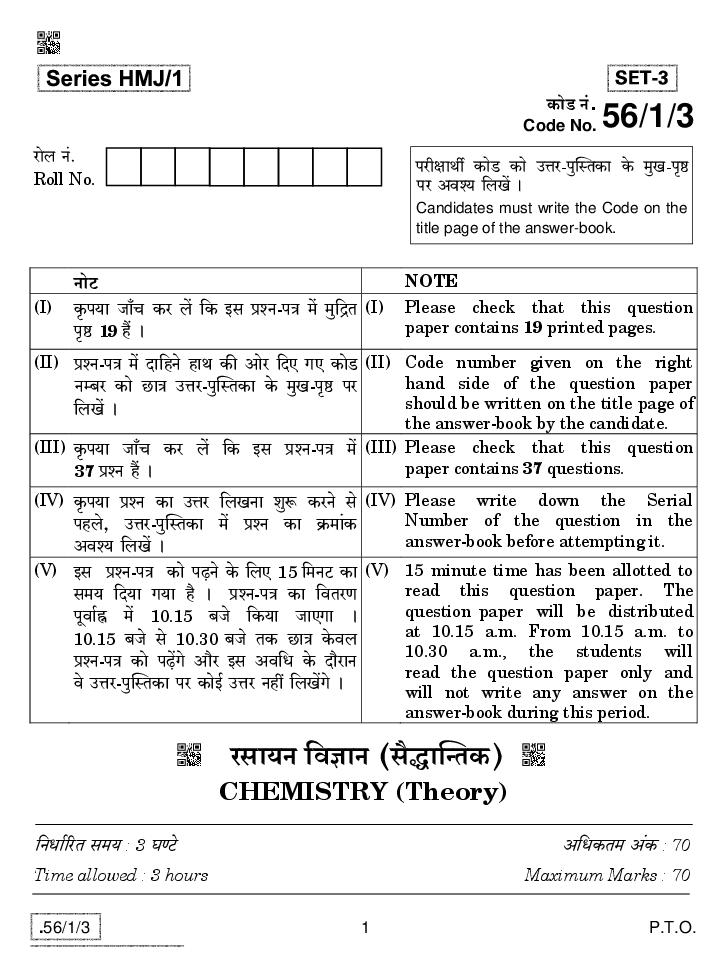
Code No. 56/1/3
amob Z§. narjmWu H$moS >H$mo CÎma-nwpñVH$m Ho$ _wI-n¥ð
Roll No. >na Adí` {bIo§ &
Candidates must write the Code on the
title page of the answer-book.
ZmoQ> NOTE
(I) H¥$n`m Om±M H$a b| {H$ Bg àíZ-nÌ _o§ _w{ÐV (I) Please check that this question
n¥ð> 19 h¢ & paper contains 19 printed pages.
(II) àíZ-nÌ _| Xm{hZo hmW H$s Amoa {XE JE H$moS (II) Code number given on the right
>Zå~a H$mo N>mÌ CÎma-nwpñVH$m Ho$ _wI-n¥ð> na hand side of the question paper
{bI| & should be written on the title page of
the answer-book by the candidate.
(III) H¥$n`m Om±M H$a b| {H$ Bg àíZ-nÌ _| (III) Please check that this question
>37 àíZ h¢ & paper contains 37 questions.
(IV) H¥$n`m àíZ H$m CÎma {bIZm ewê$ H$aZo go (IV) Please write down the Serial
nhbo, CÎma-nwpñVH$m _| àíZ H$m H«$_m§H$ Number of the question in the
Adí` {bI| & answer-book before attempting it.
(V) Bg àíZ-nÌ H$mo n‹T>Zo Ho$ {bE 15 {_ZQ >H$m (V) 15 minute time has been allotted to
g_` {X`m J`m h¡ & àíZ-nÌ H$m {dVaU read this question paper. The
nydm©• _| 10.15 ~Oo {H$`m OmEJm & question paper will be distributed
10.15 ~Oo go 10.30 ~Oo VH$ N>mÌ Ho$db at 10.15 a.m. From 10.15 a.m. to
10.30 a.m., the students will
àíZ-nÌ H$mo n‹T>|Jo Am¡a Bg Ad{Y Ho$ Xm¡amZ read the question paper only and
do CÎma-nwpñVH$m na H$moB© CÎma Zht {bI|Jo & will not write any answer on the
answer-book during this period.
agm`Z {dkmZ (g¡ÕmpÝVH$)
CHEMISTRY (Theory)
{ZYm©[aV g_` : 3 KÊQ>o A{YH$V_ A§H$ : 70
Time allowed : 3 hours Maximum Marks : 70
.56/1/3 1 P.T.O.
Page 2
{ZåZ{b{IV {ZX}em| H$mo ~hþV gmdYmZr go n{‹T>E Am¡a CZH$m g™Vr go nmbZ H$s{OE :
(i) `h àíZ-nÌ Mma IÊS>m| _| {d^m{OV {H$`m J`m h¡ – H$, I, J Ed§ K & Bg àíZ-nÌ _|
37 àíZ h¢ & g^r àíZ A{Zdm`© h¢ &
(ii) IÊS> H$ _| àíZ g§»`m 1 go 20 VH$ A{V bKw-CÎmar` àH$ma Ho$ àíZ h¢, àË`oH$ àíZ 1 A§H$ H$m
h¡ & àË`oH$ àíZ H$m CÎma EH$ eãX `m EH$ dmŠ` _| Xr{OE &
(iii) IÊS> I _| àíZ g§»`m 21 go 27 VH$ bKw-CÎmar` àH$ma Ho$ àíZ h¢, àË`oH$ àíZ 2 A§H$m| H$m
h¡ &
(iv) IÊS> J _| àíZ g§»`m 28 go 34 VH$ XrK©-CÎmar` àH$ma-I Ho$ àíZ h¢, àË`oH$ àíZ 3 A§H$m| H$m
h¡ &
(v) IÊS> K _| àíZ g§»`m 35 go 37 VH$ XrK©-CÎmar` àH$ma-II Ho$ àíZ h¢, àË`oH$ àíZ 5 A§H$m| H$m
h¡ &
(vi) àíZ-nÌ _| H$moB© g_J« {dH$ën Zht h¡ & VWm{n, Xmo-Xmo A§H$m| Ho$ Xmo àíZm| _|, VrZ-VrZ A§H$m| Hoo$
Xmo àíZm| _| VWm nm±M-nm±M A§H$m| Ho$ VrZm| àíZm| _| AmÝV[aH$ {dH$ën {X`m J`m h¡ & Eogo àíZm| _|
go Ho$db EH$ hr {dH$ën H$m CÎma Xr{OE &
(vii) BgHo$ A{V[aº$, Amdí`H$VmZwgma, àË`oH$ IÊS> Am¡a àíZ Ho$ gmW `Wmo{MV {ZX}e {XE JE h¢ &
(viii) Ho$ëHw$boQ>a AWdm bm°J Q>o~b Ho$ à`moJ H$s AZw_{V Zht h¡ &
IÊS> H$
{XE JE AZwÀN>oX H$mo n{‹T>E VWm àíZ g§»`m 1 go 5 Ho$ CÎma Xr{OE : 15=5
EopëH$b h¡bmBS>m| H$s à{VñWmnZ A{^{H«$`m _w»`V`m SN1 AWdm SN2 {H«$`m{d{Y Ûmam
hmoVr h¡ & à{VñWmnZ A{^{H«$`mE± hmoZo Ho$ {bE EopëH$b h¡bmBS> {H$gr ^r {H«$`m{d{Y H$mo
AnZmE±, CZHo$ {bE H$m~©Z h¡bmoOZ Am~ÝY H$s Y«wdUVm hr CÎmaXm`r hmoVr h¡ & SN1
A{^{H«$`mAm| H$m doJ H$m~m}H¡$Q>m`Z Ho$ ñWm{`Ëd na {Z^©a H$aVm h¡ O~{H$ SN2
A{^{H«$`mAm| H$m {Ì{d_{dÝ`mg H$maH$ na & `{X Amapå^H$ nXmW© {H$aob `m¡{JH$ hmo, Vmo
CËnmX `m Vmo à{Vbmo{_V hmoJm AWdm ao{g{_H$ {_lU, Omo EopëH$b h¡bmBS>m| Ûmam AnZmB© JB©
{H«$`m{d{Y Ho$ àH$ma na {Z^©a H$aVm h¡ & B©Wam| H$m HI go {dXbZ ^r {Ì{d_{dÝ`mg H$maH$
Am¡a H$m~m}H¡$Q>m`Z Ho$ ñWm{`Ëd go {Z`pÝÌV hmoVm h¡, Omo Bg ~mV H$m ÚmoVH$ h¡ {H$ H$m~©{ZH$
agm`Z _| `hr Xmo à_wI H$maH$ h¢ Omo h_| ghm`Vm H$aVo h¢ {H$ CËnmX {H$g àH$ma H$m
~ZoJm ?
.56/1/3 2
Page 3
Read the following instructions very carefully and strictly follow them :
(i) This question paper comprises four Sections – A, B, C and D. There are
37 questions in the question paper. All questions are compulsory.
(ii) Section A – Questions no. 1 to 20 are very short answer type questions,
carrying 1 mark each. Answer these questions in one word or one sentence.
(iii) Section B – Questions no. 21 to 27 are short answer type questions, carrying
2 marks each.
(iv) Section C – Questions no. 28 to 34 are long answer type-I questions, carrying
3 marks each.
(v) Section D – Questions no. 35 to 37 are long answer type-II questions, carrying
5 marks each.
(vi) There is no overall choice in the question paper. However, an internal choice
has been provided in 2 questions of two marks, 2 questions of three marks and
all the 3 questions of five marks. You have to attempt only one of the choices in
such questions.
(vii) In addition to this, separate instructions are given with each section and
question, wherever necessary.
(viii) Use of calculators and log tables is not permitted.
SECTION A
Read the given passage and answer the questions number 1 to 5 that follow : 15=5
The substitution reaction of alkyl halide mainly occurs by SN1 or SN2
mechanism. Whatever mechanism alkyl halides follow for the
substitution reaction to occur, the polarity of the carbon halogen bond is
responsible for these substitution reactions. The rate of SN1 reactions are
governed by the stability of carbocation whereas for SN2 reactions steric
factor is the deciding factor. If the starting material is a chiral compound,
we may end up with an inverted product or racemic mixture depending
upon the type of mechanism followed by alkyl halide. Cleavage of ethers
with HI is also governed by steric factor and stability of carbocation,
which indicates that in organic chemistry, these two major factors help
us in deciding the kind of product formed.
.56/1/3 3 P.T.O.
Page 4
g{H«$`) EopëH$b h¡bmBS> SN1 {H«$`m{d{Y go à{VñWmnZ A{^{H«$`m gånÞ H$aVm h¡ &
2. g_Vb-Y«w{dV àH$me Š`m h¡ ?
3. ~ZZo dmbo CËnmXm| H$s g§aMZmE± {b{IE O~ EWm°Šgr~oݵOrZ H$mo HI Ho$ gmW A{^{H«${`V
{H$`m OmVm h¡ &
4. _w»` CËnmX H$s àmJw{º$ H$s{OE O~ 2-~«mo_monoÝQ>oZ, EoëH$mohm°br KOH Ho$ gmW A{^{H«$`m
H$aVm h¡ &
5. CHI3 H$m EH$ Cn`moJ Xr{OE &
àíZ g§»`m 6 go 10 EH$ eãX CÎmar¶ h¢ : 15=5
6. `{X Ðd A Am¡a B Ho$ ŠdWZm§H$ $H«$_e: 140C Am¡a 180C h¢, Vmo Cg Ðd H$s nhMmZ
H$s{OE {OgH$m 90C na dmîn Xm~ {ZåZVa hmoJm &
7. {H$gr An_mO©H$ _| CnpñWV H$m¡Z-gr g§aMZmË_H$ BH$mB© CgH$mo AO¡d{ZåZrH$aUr` ~Zm XoVr
h¡ ?
8. Q>oâbm°Z Ho$ EH$bH$ H$s g§aMZm Xr{OE &
9. bmoho H$s dñVwAm| H$mo gwa{jV aIZo Ho$ {bE qµOH$ VWm {Q>Z _| go {H$gH$s H$moqQ>J ~ohVa h¡ ?
10. Š`m {H$gr A{^{H«$`m H$m doJ pñWam§H$ T na {Z^©a H$aoJm `{X A{^{H«$`m H$s Eact (g{H«$`U
D$Om©) eyÝ` hmo ?
àíZ g§»`m 11 go 15 ~hþ{dH$ënr¶ àíZ h¢ : 15=5
11. {XE JE `m¡{JH$ H$m ghr AmB©.`y.nr.E.gr. Zm_ Š`m h¡ ?
(A) 2,2-S>mB_o{Wbã`yQ>oZm°BH$ Aåb
(B) 2-H$m~m}pŠgb-2-_o{Wbã`yQ>Z
o
(C) 2-Eo{Wb-2-_o{WbàmonoZm°BH$ Aåb
(D) 3-_o{Wbã`yQ>oZ H$m~m}pŠg{bH$ Aåb
.56/1/3 4
Page 5
alkyl halide undergoes substitution reaction by SN1 mechanism.
2. What is plane polarised light ?
3. Write the structures of the products formed when ethoxybenzene is
treated with HI.
4. Predict the major product formed when 2-Bromopentane reacts with
alcoholic KOH.
5. Give one use of CHI3.
Questions number 6 to 10 are one word answers : 15=5
6. Identify which liquid will have lower vapour pressure at 90C if the
boiling points of two liquids A and B are 140C and 180C respectively.
7. Which structural unit present in a detergent makes it non-biodegradable ?
8. Give the structure of the monomer of Teflon.
9. Out of zinc and tin, whose coating is better to protect iron objects ?
10. Will the rate constant of the reaction depend upon T if the Eact
(activation energy) of the reaction is zero ?
Questions number 11 to 15 are multiple choice questions : 15=5
11. What is the correct IUPAC name of the given compound ?
(A) 2,2-Dimethylbutanoic acid
(B) 2-Carboxyl-2-methylbutane
(C) 2-Ethyl-2-methylpropanoic acid
(D) 3-Methylbutane carboxylic acid
.56/1/3 5 P.T.O.
Page 6
(A) d¡ÚwV H$U-g§MbZ na
(B) {dÚwV²-namgaU na
(C) nmañn[aH$ ñH§$XZ na
(D) {Q>ÝS>b à^md na
13. Obr` {db`Z _| {ZåZ{b{IV _| go à~bV_ jma h¡
(A) _o{WbEo_rZ
(B) S>mB_o{WbEo_rZ
(C) Q´>mB_o{WbEo_rZ
(D) Eo{ZbrZ
14. Am`moS>mo\$m°_© narjU {H$gHo$ Ûmam {X`m OmVm h¡ ?
(A) noÝQ>oZ-2-AmoZ
(B) EWoZm°BH$ Aåb
(C) noÝQ>oZ-3-AmoZ
(D) _oWm°Šgr_oWoZ
15. {ZåZ{b{IV g§H«$_U VÎdm| _| go {H$gHo$ Ûmam A{YH$V_ Am°ŠgrH$aU AdñWmE± àX{e©V H$s
OmVr h¢ ?
(A) Sc (Z = 21)
(B) Cr (Z = 24)
(C) Mn (Z = 25)
(D) Fe (Z = 26)
.56/1/3 6
Page 7
(A) Electrophoresis
(B) Electro-osmosis
(C) Mutual coagulation
(D) Tyndall effect
13. Out of the following, the strongest base in aqueous solution is
(A) Methylamine
(B) Dimethylamine
(C) Trimethylamine
(D) Aniline
14. Iodoform test is given by
(A) Pentan-2-one
(B) Ethanoic acid
(C) Pentan-3-one
(D) Methoxymethane
15. Out of the following transition elements, the maximum number of
oxidation states are shown by
(A) Sc (Z = 21)
(B) Cr (Z = 24)
(C) Mn (Z = 25)
(D) Fe (Z = 26)
.56/1/3 7 P.T.O.
Page 8
H$mo H$maU (R) Ûmam A§{H$V {H$`m J`m h¡ & BZ àíZm| Ho$ ghr CÎma ZrMo {XE JE H$mo S>m| (i),
(ii), (iii) Am¡a (iv) _| go MwZH$a Xr{OE : 15=5
(i) A{^H$WZ (A) Am¡a H$maU (R) XmoZm| ghr H$WZ h¢ Am¡a H$maU (R), A{^H$WZ (A)
H$s ghr ì¶m»¶m h¡ &
(ii) A{^H$WZ (A) Am¡a H$maU (R) XmoZm| ghr H$WZ h¢, naÝVw H$maU (R),
A{^H$WZ (A) H$s ghr ì¶m»¶m Zht h¡ &
(iii) A{^H$WZ (A) ghr h¡, naÝVw H$maU (R) µJbV H$WZ h¡ &
(iv) A{^H$WZ (A) µJbV h¡, naÝVw H$maU (R) ghr H$WZ h¡ &
16. A{^H$WZ (A) : A{^{H«$`m H2 + Br2 2HBr _| AmpÊdH$Vm 2 àVrV hmoVr h¡ &
H$maU (R) : Xr hþB© àmW{_H$ A{^{H«$`m _| A{^H$maH$m| Ho$ Xmo AUw ^mJ boVo h¢ &
17. A{^H$WZ (A) : Cnghg§`moOZ `m¡{JH$m| _| C^`X§Vr g§b½Zr Ho$ H$maU ~ÝYZr g_md`dVm
CËnÞ hmoVr h¡ &
H$maU (R) : C^`X§Vr g§b½Zr O¡go NO2 _| Xmo {^Þ XmVm na_mUw N Am¡a O hmoVo h¢ &
18. A{^H$WZ (A) : Au Am¡a Ag H$m {ZîH$f©U CZHo$ A`ñH$m| Ho$ NaCN Ho$ VZw {db`Z Ûmam
{ZjmbZ go {H$`m OmVm h¡ &
H$maU (R) : BZ A`ñH$m| go g§~Õ Aew{Õ`m± NaCN _| Kwb OmVr h¢ &
19. A{^H$WZ (A) : F2 AUw _| F – F Am~ÝY Xþ~©b hmoVm h¡ &
H$maU (R) : F na_mUw H$m AmH$ma N>moQ>m hmoVm h¡ &
20. A{^H$WZ (A) : gyH«$mog EH$ AZnM`r eH©$am h¡ &
H$maU (R) : ½byH$mog VWm \«$ŠQ>moµO Ho$ AnMm`H$ g_yh ½bmBH$mo{g{S>H$ Am~§Y {Z_m©U _|
à`wº$ hmoVo h¢ &
IÊS> I
21. 300 K na `y[a`m (‘moba Ð춑mZ = 60 g/mol) Ho$ 5% {db`Z H$m namgaU Xm~
n[aH${bV H$s{OE & [R = 0·0821 L atm K–1 mol–1] 2
AWdm
.56/1/3 8
Page 9
Assertion (A) and the other labelled Reason (R). Select the correct
answer to these questions from the codes (i), (ii), (iii) and (iv) as given
below : 15=5
(i) Both Assertion (A) and Reason (R) are correct statements, and
Reason (R) is the correct explanation of the Assertion (A).
(ii) Both Assertion (A) and Reason (R) are correct statements, but
Reason (R) is not the correct explanation of the Assertion (A).
(iii) Assertion (A) is correct, but Reason (R) is incorrect statement.
(iv) Assertion (A) is incorrect, but Reason (R) is correct statement.
16. Assertion (A) : The molecularity of the reaction H2 + Br2 2HBr
appears to be 2.
Reason (R) : Two molecules of the reactants are involved in the given
elementary reaction.
17. Assertion (A) : Linkage isomerism arises in coordination compounds
because of ambidentate ligand.
Reason (R) : Ambidentate ligand like NO2 has two different donor
atoms i.e., N and O.
18. Assertion (A) : Au and Ag are extracted by leaching their ores with a dil.
solution of NaCN.
Reason (R) : Impurities associated with these ores dissolve in NaCN.
19. Assertion (A) : F – F bond in F2 molecule is weak.
Reason (R) : F atom is small in size.
20. Assertion (A) : Sucrose is a non-reducing sugar.
Reason (R) : Reducing groups of glucose and fructose are involved in
glycosidic bond formation.
SECTION B
21. For a 5% solution of urea (Molar mass = 60 g/mol), calculate the osmotic
pressure at 300 K. [R = 0·0821 L atm K–1 mol–1] 2
OR
.56/1/3 9 P.T.O.
Page 10
7·5 g Am¡a Xÿgao _| {H$gr nXmW© Z Ho$ 42·75 g, 100 g Ob _| {bE & `h ào{jV {H$`m
J`m {H$ XmoZm| {db`Z EH$g_mZ Vmn na {h_r^yV hþE & Z H$m _moba Ðì`_mZ n[aH${bV
H$s{OE & 2
22. A{^H$maH$ H$s gmÝÐVm Am¡a g_` Ho$ ~rM {XE JE J«m\$ H$m {díbofU H$s{OE & 12=2
(a) A{^{H«$`m H$s H$mo{Q> H$s àmJw{º$ H$s{OE &>
(b) g¡ÕmpÝVH$ Ñ{ï> go Š`m AZ§VH$mb Ho$ ~mX {H$gr A{^H$maH$ H$s gmÝÐVm KQ>H$a eyÝ`
hmo gH$Vr h¡ ? ì`m»`m H$s{OE &
23. {ZåZ{b{IV nXm| H$s n[a^mfm {b{IE : 12=2
(a) àem§VH$
(b) ny{VamoYr
AWdm
gm~wZm| H$s emoYZ {H«$`m g_PmBE & 2
.56/1/3 10
Page 11
mass = 60 g/mol) and the other containing 42·75 g of substance Z in
100 g of water, respectively. It was observed that both the solutions froze
at the same temperature. Calculate the molar mass of Z. 2
22. Analyse the given graph, drawn between concentration of reactant vs.
time. 12=2
(a) Predict the order of reaction.
(b) Theoretically, can the concentration of the reactant reduce to zero
after infinite time ? Explain.
23. Define the following terms : 12=2
(a) Tranquilizers
(b) Antiseptic
OR
Explain the cleansing action of soaps. 2
.56/1/3 11 P.T.O.
Page 12
(a) ã`yZm-N
(b) ZmBbm°Z 6
25. {ZåZ{b{IV AUwAm| H$s AmH¥${V It{ME : 12=2
(a) H2S2O8>
(b) XeF2
26. {ZåZ{b{IV `m¡{JH$m| Ho$ gyÌ Xr{OE : 12=2
(a) noÝQ>mEoå_rZH$m~m}ZoQ>moH$mo~mëQ> (III) ŠbmoamBS> >
(b) nmoQ>¡{e`_ Q>oQ´>mgm`{ZS>mo{ZH¡$boQ> (II)
27. Š`m hmoVm h¡ O~
(a) EogrQ>moZ H$mo Zn(Hg) / gmÝÐ HCl Ho$ gmW A{^{H«${`V {H$`m OmVm h¡, Am¡a
(b) EWoZ¡b H$mo _o{Wb_¡½Zr{e`_ ~«mo_mBS> Ho$ gmW A{^{H«${`V H$aHo$ Ob-AnK{Q>V
{H$`m OmVm h¡ ? 12=2
IÊS> J
28. {ZåZ{b{IV Ho$ H$maU Xr{OE : 13=3
(a) gëâ`yag Aåb EH$ AnMm`H$ h¡ &
(b) âbwAmoarZ Ho$db EH$ Am°ŠgmoAåb ~ZmVr h¡ &
(c) CËH¥$îQ> J¡gm| Ho$ ŠdWZm§H$ He go Rn VH$ ~‹T>Vo h¢ &>
AWdm
{ZåZ{b{IV amgm`{ZH$ A{^{H«$`mAm| H$mo nyU© H$s{OE : 13=3
(a) MnO2 + 4 HCl
(b) XeF6 + KF
(c) I – (aq) + H+ (aq) + O (g) 2
.56/1/3 12
Page 13
12=2
(a) Buna-N
(b) Nylon 6
25. Draw the shape of the following molecules : 12=2
(a) H2S2O8
(b) XeF2
26. Give the formulae of the following compounds : 12=2
(a) Pentaamminecarbonatocobalt (III) chloride
(b) Potassium tetracyanidonickelate (II)
27. What happens when
(a) Acetone is treated with Zn(Hg) / Conc. HCl, and
(b) Ethanal is treated with methylmagnesium bromide and then
hydrolysed ? 12=2
SECTION C
28. Account for the following : 13=3
(a) Sulphurous acid is a reducing agent.
(b) Fluorine forms only one oxoacid.
(c) Boiling point of noble gases increases from He to Rn.
OR
Complete the following chemical reactions : 13=3
(a) MnO2 + 4 HCl
(b) XeF6 + KF
(c) I – (aq) + H+ (aq) + O2 (g)
.56/1/3 13 P.T.O.
Page 14
(‘moba Ð춑mZ = 176 g mol–1) H$s _mÌm (Ðì`_mZ) n[aH${bV H$s{OE {Oggo BgH$m
{h_m§H$ 1·5C H$_ hmo OmE & (Kf = 3·9 K kg mol–1) 3
30. A{^{H«$¶m H$m doJ {H$g àH$ma à^m{dV hmoJm O~
(a) A{^H$maH$ H$m n¥îR>r` joÌ\$b H$_ H$a {X`m OmE,
(b) CËH«$_Ur` A{^{H«$`m _| CËàoaH$ {_bm {X`m OmE, Am¡a
(c) A{^{H«$`m H$m Vmn ~‹T>m {X`m OmE ? 13=3
1
31. {ZåZ{b{IV A{^{H«$`mAm| Ho$ AZwH«$_ _| A Am¡a B H$s g§aMZmE± Xr{OE : 6=3
2
NH3 NaOBr
(a) CH3COOH A B
Fe / HCl NaNO HCl
(b) C6H5NO2 A 2 B
0 –5C
+ CuCN H2O / H
(c) C6H5N2Cl A B
AWdm
(a) {ZåZ{b{IV `wJbm| Ho$ `m¡{JH$m| Ho$ ~rM Amn {d^oX H¡$go H$a|Jo : 12=2
(i) Eo{ZbrZ Am¡a EWoZo_rZ
(ii) Eo{ZbrZ Am¡a N-_o{WbEo{ZbrZ
(b) {ZåZ{b{IV `m¡{JH$m| H$mo CZHo$ ŠdWZm§H$ Ho$ KQ>Vo hþE H«$_ _| ì`dpñWV H$s{OE : 1
ã`yQ>oZm°b, ã`yQ>oZo_rZ, ã`yQ>oZ
32. {ZåZ{b{IV Ho$ {bE {dídgZr` ñnîQ>rH$aU Xr{OE : 13=3
(a) ½byH$mog 2,4-S>r.EZ.nr. narjU Zht XoVm &
(b) DNA Ho$ Xmo aÁOwH$ g_mZ Zht hmoVo, naÝVw EH$-Xÿgao Ho$ nyaH$ hmoVo h¢ &
(c) ñQ>mM© Am¡a gobwbmog XmoZm| _| EH$bH$m| Ho$ ê$n _| ½byH$mog BH$mB© hmoVr h¡ , {\$a ^r do
g§aMZmË_H$ Ñ{îQ> go {^Þ h¢ &
.56/1/3 14
Page 15
dissolved in 75 g of acetic acid, to lower its freezing point by 1·5C.
(Kf = 3·9 K kg mol–1) 3
30. How will the rate of the reaction be affected when
(a) Surface area of the reactant is reduced,
(b) Catalyst is added in a reversible reaction, and
(c) Temperature of the reaction is increased ? 13=3
1
31. Give the structures of A and B in the following sequence of reactions : 6=3
2
NH3 NaOBr
(a) CH3COOH A B
Fe / HCl NaNO HCl
(b) C6H5NO2 A 2 B
0 –5C
CuCN H O / H
C6H5N2Cl A 2
+
(c) B
OR
(a) How will you distinguish between the following pairs of
compounds : 12=2
(i) Aniline and Ethanamine
(ii) Aniline and N-methylaniline
(b) Arrange the following compounds in decreasing order of their
boiling points : 1
Butanol, Butanamine, Butane
32. Give the plausible explanation for the following : 13=3
(a) Glucose doesn’t give 2,4-DNP test.
(b) The two strands in DNA are not identical but are complementary.
(c) Starch and cellulose both contain glucose unit as monomer, yet
they are structurally different.
.56/1/3 15 P.T.O.
Page 16
(a) \o$Z ßbdZ àH«$_ _| NaCN H$s &
(b) Zr Ho$ YmVwH$_© _| I2 H$s &
(c) Fe Ho$ YmVwH$_© _| MyZm-nËWa H$s &
34. {ZåZ{b{IV Ho$ AmYma na ^m¡{VH$ A{YemofU Am¡a agmodemofU _| {d^oX H$s{OE :
(a) AmH$f©U ~b,
(b) Vmn, Am¡a
(c) A{YemofU H$s EÝW¡ënr & 13=3
IÊS> K
35. (a) {ZåZ{b{IV Ho$ H$maU {b{IE : 13=3
(i) H$m°na (I) `m¡{JH$ g\o$X hmoVo h¢ O~{H$ H$m°na (II) `m¡{JH$ a§JrZ hmoVo h¢ &
(ii) H«$mo_oQ> AnZm a§J Aåbr` {db`Z _| n[ad{V©V H$a XoVo h¢ &
(iii) Zn, Cd, Hg d-ãbm°H$ VÎd Vmo _mZo OmVo h¢ naÝVw g§H«$_U VÎd Zht &
(b) Co Am¡a Co2+ Ho$ BboŠQ´>m°{ZH$ {dÝ`mg {bIH$a Co2+ (Z = 27) Ho$ {bE
àMH«$U-_mÌ AmKyU© n[aH${bV H$s{OE & 2
AWdm
(a) b¡ÝWoZm°`S>m| Am¡a EopŠQ>Zm°`S>m| Ho$ _Ü` A§Va Ho$ VrZ {~ÝXþ Xr{OE & 3
(b) H$maU XoVo hþE EH$ na_mUw/Am`Z N>m±{Q>E Omo nyN>m J`m JwUY_© Xem©Vm hmo : 12=2
(i) Sc3+ AWdm Cr3+ (à{VMwå~H$s` ì`dhma Xem©Vm h¡)
(ii) Cr AWdm Cu (Cƒ JbZm§H$ Am¡a ŠdWZm§H$)
36. (a) t-ã`y{Q>b EoëH$mohm°b Am¡a n-ã`yQ>oZm°b _| go H$m¡Z-gm Aåb CËào[aV {ZO©bZ Vrd«Vm go
XoJm Am¡a Š`m| ? 2
.56/1/3 16
Page 17
(a) NaCN in froth floatation process.
(b) I2 in the metallurgy of Zr.
(c) Limestone in the metallurgy of Fe.
34. Distinguish between physisorption and chemisorption on the basis of
(a) Force of attraction,
(b) Temperature, and
(c) Enthalpy of adsorption. 13=3
SECTION D
35. (a) Account for the following : 13=3
(i) Copper (I) compounds are white whereas Copper (II)
compounds are coloured.
(ii) Chromates change their colour when kept in an acidic
solution.
(iii) Zn, Cd, Hg are considered as d-block elements but not as
transition elements.
(b) Calculate the spin-only moment of Co2+ (Z = 27) by writing the
electronic configuration of Co and Co2+. 2
OR
(a) Give three points of difference between lanthanoids and actinoids. 3
(b) Give reason and select one atom/ion which will exhibit asked
property : 12=2
(i) Sc3+ or Cr3+ (Exhibit diamagnetic behaviour)
(ii) Cr or Cu (High melting and boiling point)
36. (a) Out of t-butyl alcohol and n-butanol, which one will undergo acid
catalyzed dehydration faster and why ? 2
.56/1/3 17 P.T.O.
Page 18
(i) µ\$sZm°b go g¡{b{gbEopëS>hmBS>
(ii) t-ã`y{Q>bŠbmoamBS> go t-ã`y{Q>b E{Wb B©Wa
(iii) àmonrZ go àmonoZm°b
AWdm
(a) EWrZ go EWoZm°b ~ZZo H$s {H«$`m{d{Y Xr{OE & 2
(b) {ZåZ{b{IV ê$nm§VaU gånÞ H$aZo Ho$ {bE A{^H$_©H$ H$s àmJw{º$ H$s{OE : 13=3
(i) µ\$sZm°b go ~oݵOmo{ŠdZmoZ
(ii) Eo{Zgmob go p-~«mo_moEo{Zgmob
(iii) µ\$sZm°b go 2,4,6-Q´>mB~«mo_moµ\$sZm°b
37. (a) A{^{H«$¶m
Zn (s) + Cu2+ (aq) Zn2+ (aq) + Cu (s)
Ho$ {bE G n[aH${bV H$s{OE & 3
{X`m J`m h¡ : Zn2+/Zn Ho$ {bE E = – 0·76 V
Cu2+/Cu Ho$ {bE E = + 0·34 V
R = 8·314 JK–1 mol–1
F = 96500 C mol–1.
(b) BªYZ gobm| Ho$ Xmo bm^ Xr{OE & 2
AWdm
(a) {ZåZ{b{IV `wJbm| _| go, H$maU g{hV Cg EH$ H$s àmJw{º$ H$s{OE Omo {dÚwV² Ymam
H$s A{YH$ _mÌm Ho$ MmbZ H$s AZw_{V XoVm h¡ : 3
(i) 30C na Mm±Xr H$m Vma AWdm 60C na Mm±Xr H$m Vma &
(ii) 0·1 M CH3COOH {db`Z AWdm 1 M CH3COOH {db`Z &
(iii) 20C na KCl {db`Z AWdm 50C na KCl {db`Z &
(b) {dÚwV²-amgm`{ZH$ gob Am¡a {dÚwV²-AnKQ>Zr gob Ho$ _Ü` A§Va Ho$ Xmo {~ÝXþ Xr{OE & 2
.56/1/3 18
Page 19
(i) Phenol to Salicylaldehyde
(ii) t-butylchloride to t-butyl ethyl ether
(iii) Propene to Propanol
OR
(a) Give the mechanism for the formation of ethanol from ethene. 2
(b) Predict the reagent for carrying out the following conversions : 13=3
(i) Phenol to benzoquinone
(ii) Anisole to p-bromoanisole
(iii) Phenol to 2,4,6-tribromophenol
37. (a) Calculate G for the reaction
Zn (s) + Cu2+ (aq) Zn2+ (aq) + Cu (s). 3
Given : E for Zn2+/Zn = – 0·76 V and
E for Cu2+/Cu = + 0·34 V
R = 8·314 JK–1 mol–1
F = 96500 C mol–1.
(b) Give two advantages of fuel cells. 2
OR
(a) Out of the following pairs, predict with reason which pair will
allow greater conduction of electricity : 3
(i) Silver wire at 30C or silver wire at 60C.
(ii) 0·1 M CH3COOH solution or 1 M CH3COOH solution.
(iii) KCl solution at 20C or KCl solution at 50C.
(b) Give two points of differences between electrochemical and
electrolytic cells. 2
.56/1/3 19 P.T.O.
Document Details
| Board / Org | CBSE |
| Exam | Class 12 |
| Type | Question Paper |
| Pages | 19 |
| Updated | 22 Jul 2026 |