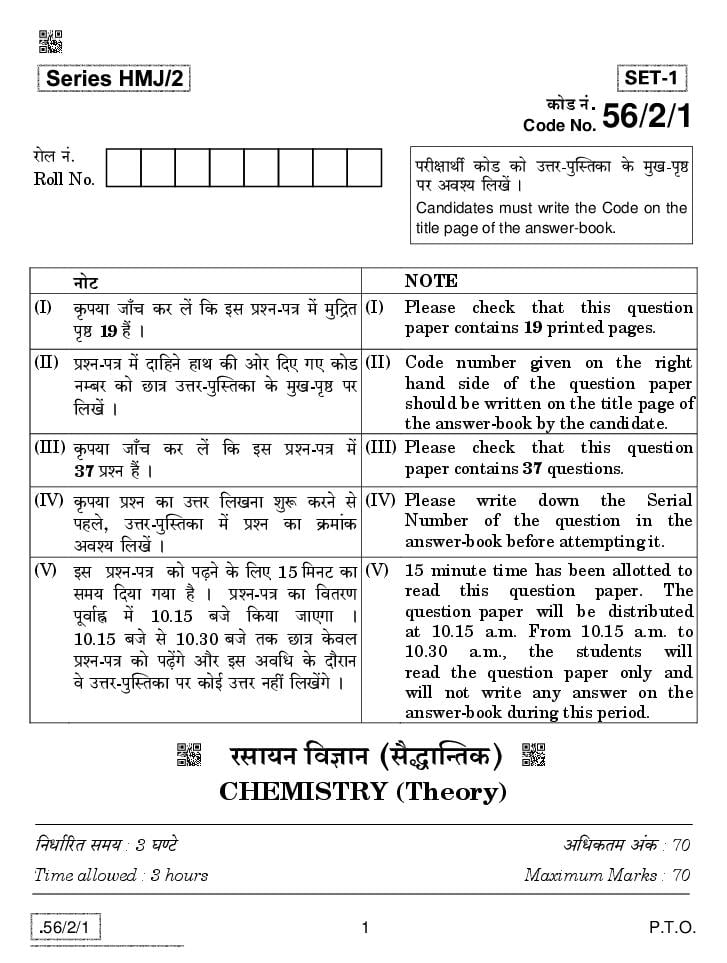
CBSE Class 12 Chemistry Question Paper 2020 Set 56-2-1
Finished viewing? Save it for later —
Download CBSE Class 12 Chemistry Question Paper 2020 Set 56-2-1 (PDF · 19 pages)About CBSE Class 12 Chemistry Question Paper 2020 Set 56-2-1
CBSE Class 12 Chemistry Question Paper 2020 Set 56-2-1 is available here for free download. Published by CBSE for Class 12, this question paper can be viewed online or downloaded as a PDF (19 pages). Candidates preparing for Class 12 can use CBSE Class 12 Chemistry Question Paper 2020 Set 56-2-1 to understand the exam pattern, the type of questions asked, and the overall difficulty level.
Frequently Asked Questions
How can I download CBSE Class 12 Chemistry Question Paper 2020 Set 56-2-1?
Open this page and click the Download button to save CBSE Class 12 Chemistry Question Paper 2020 Set 56-2-1 as a PDF. It is completely free on AglaSem Docs.
Is CBSE Class 12 Chemistry Question Paper 2020 Set 56-2-1 free to download?
Yes. CBSE Class 12 Chemistry Question Paper 2020 Set 56-2-1 can be viewed online and downloaded as a PDF free of cost on AglaSem Docs.
How many pages does CBSE Class 12 Chemistry Question Paper 2020 Set 56-2-1 have?
CBSE Class 12 Chemistry Question Paper 2020 Set 56-2-1 contains 19 pages, which you can read online or download together as a single PDF.
Where can I find more Class 12 study material?
You can find more Class 12 question papers, sample papers, syllabus, and answer keys on AglaSem Docs.
CBSE Class 12 Chemistry Question Paper 2020 Set 56-2-1 – Text
Read the full text of this question paper below — useful to quickly search, copy and reference the content online without downloading the PDF.
📄 View text version (19 pages)
Page 1
Code No. 56/2/1
amob Z§. narjmWu H$moS >H$mo CÎma-nwpñVH$m Ho$ _wI-n¥ð
Roll No. >na Adí` {bIo§ &
Candidates must write the Code on the
title page of the answer-book.
ZmoQ> NOTE
(I) H¥$n`m Om±M H$a b| {H$ Bg àíZ-nÌ _o§ _w{ÐV (I) Please check that this question
n¥ð> 19 h¢ & paper contains 19 printed pages.
(II) àíZ-nÌ _| Xm{hZo hmW H$s Amoa {XE JE H$moS (II) Code number given on the right
>Zå~a H$mo N>mÌ CÎma-nwpñVH$m Ho$ _wI-n¥ð> na hand side of the question paper
{bI| & should be written on the title page of
the answer-book by the candidate.
(III) H¥$n`m Om±M H$a b| {H$ Bg àíZ-nÌ _| (III) Please check that this question
>37 àíZ h¢ & paper contains 37 questions.
(IV) H¥$n`m àíZ H$m CÎma {bIZm ewê$ H$aZo go (IV) Please write down the Serial
nhbo, CÎma-nwpñVH$m _| àíZ H$m H«$_m§H$ Number of the question in the
Adí` {bI| & answer-book before attempting it.
(V) Bg àíZ-nÌ H$mo n‹T>Zo Ho$ {bE 15 {_ZQ >H$m (V) 15 minute time has been allotted to
g_` {X`m J`m h¡ & àíZ-nÌ H$m {dVaU read this question paper. The
nydm©• _| 10.15 ~Oo {H$`m OmEJm & question paper will be distributed
10.15 ~Oo go 10.30 ~Oo VH$ N>mÌ Ho$db at 10.15 a.m. From 10.15 a.m. to
10.30 a.m., the students will
àíZ-nÌ H$mo n‹T>|Jo Am¡a Bg Ad{Y Ho$ Xm¡amZ read the question paper only and
do CÎma-nwpñVH$m na H$moB© CÎma Zht {bI|Jo & will not write any answer on the
answer-book during this period.
agm`Z {dkmZ (g¡ÕmpÝVH$)
CHEMISTRY (Theory)
{ZYm©[aV g_` : 3 KÊQ>o A{YH$V_ A§H$ : 70
Time allowed : 3 hours Maximum Marks : 70
.56/2/1 1 P.T.O.
Page 2
{ZåZ{b{IV {ZX}em| H$mo ~hþV gmdYmZr go n{‹T>E Am¡a CZH$m g™Vr go nmbZ H$s{OE :
(i) `h àíZ-nÌ Mma IÊS>m| _| {d^m{OV {H$`m J`m h¡ – H$, I, J Ed§ K & Bg àíZ-nÌ _|
37 àíZ h¢ & g^r àíZ A{Zdm`© h¢ &
(ii) IÊS> H$ _| àíZ g§»`m 1 go 20 VH$ A{V bKw-CÎmar` àH$ma Ho$ àíZ h¢, àË`oH$ àíZ 1 A§H$ H$m
h¡ & àË`oH$ àíZ H$m CÎma EH$ eãX `m EH$ dmŠ` _| Xr{OE &
(iii) IÊS> I _| àíZ g§»`m 21 go 27 VH$ bKw-CÎmar` àH$ma Ho$ àíZ h¢, àË`oH$ àíZ 2 A§H$m| H$m
h¡ &
(iv) IÊS> J _| àíZ g§»`m 28 go 34 VH$ XrK©-CÎmar` àH$ma-I Ho$ àíZ h¢, àË`oH$ àíZ 3 A§H$m| H$m
h¡ &
(v) IÊS> K _| àíZ g§»`m 35 go 37 VH$ XrK©-CÎmar` àH$ma-II Ho$ àíZ h¢, àË`oH$ àíZ 5 A§H$m| H$m
h¡ &
(vi) àíZ-nÌ _| H$moB© g_J« {dH$ën Zht h¡ & VWm{n, Xmo-Xmo A§H$m| Ho$ Xmo àíZm| _|, VrZ-VrZ A§H$m| Hoo$
Xmo àíZm| _| VWm nm±M-nm±M A§H$m| Ho$ VrZm| àíZm| _| AmÝV[aH$ {dH$ën {X`m J`m h¡ & Eogo àíZm| _|
go Ho$db EH$ hr {dH$ën H$m CÎma Xr{OE &
(vii) BgHo$ A{V[aº$, Amdí`H$VmZwgma, àË`oH$ IÊS> Am¡a àíZ Ho$ gmW `Wmo{MV {ZX}e {XE JE h¢ &
(viii) Ho$ëHw$boQ>a AWdm bm°J Q>o~b Ho$ à`moJ H$s AZw_{V Zht h¡ &
IÊS> H$
{XE JE AZwÀN>oX H$mo n{‹T>E VWm àíZ g§»`m 1 go 5 Ho$ CÎma Xr{OE : 15=5
à~b àH$ma Ho$ ¶m¡{JH$ O¡go Eo‘rZmo Aåb, hm°‘m}Z, V§{ÌH$m-g§MmaH$, S>r.EZ.E., EoëHo$bm°BS>,
a§OH$ Am{X ‘| Eo‘rZ A{^bjH$s` g‘yh dmbo H$m~©{ZH$ ¶m¡{JH$ CnpñWV hmoVo h¢ & Am¡fY
{OZH$m ‘mZdm| na eara{H«$¶mË‘H$ à^md hmoVm h¡ O¡go {ZH$moQ>rZ, ‘m°’$s©Z, H$moS>rZ Ed§ hramoBZ,
Am{X ‘| ^r Eo‘rZmo g‘yh {H$gr Z {H$gr ê$n ‘| hmoVm h¡ & ZmBQ´>moOZ na EH$mH$s Bbo³Q´>m°Z ¶w½‘
H$s CnpñW{V Ho$ H$maU Eo‘rZ jmaH$s¶ hmoVo h¢ & H$m~©{ZH$ T>m±Mo ‘| ZmBQ´>moOZ H$m ¶moJ Eo‘rZ Am¡a
Eo‘mBS> AUwAm| Ho$ Xmo dJm] H$m {Z‘m©U H$aVm h¡ & agm¶Z {dkmZ Ho$ N>mÌ hmoZo Ho$ ZmVo, h‘|
ZmBQ´>moOZ H$s gd©Vmo‘wIr àH¥${V H$s gamhZm H$aZr Mm{hE &
1. Eo_rZmo Aåb Š`m h¢ ?
2. Eo‘rZmo Aåb C^¶Y‘u ³¶m| hmoVo h¢ ?
3. Aåbr¶ Am¡a jmaH$s¶ Eo‘rZmo Aåb ‘| EH$ A§Va Xr{OE &
4. Amdí¶H$ Eo‘rZmo Aåb ³¶m h¢ ?
5. O~ EH$ Eo‘rZmo Aåb H$m H$m~m}p³gb {gam Xÿgao Eo‘rZmo Aåb Ho$ Eo‘rZmo {gao Ho$ gmW
g§K{ZV hmoVm h¡ Vmo ~ZZo dmbo Am~ÝY H$m Zm‘ {b{IE &
.56/2/1 2
Page 3
Read the following instructions very carefully and strictly follow them :
(i) This question paper comprises four Sections – A, B, C and D. There are
37 questions in the question paper. All questions are compulsory.
(ii) Section A – Questions no. 1 to 20 are very short answer type questions,
carrying 1 mark each. Answer these questions in one word or one sentence.
(iii) Section B – Questions no. 21 to 27 are short answer type questions, carrying
2 marks each.
(iv) Section C – Questions no. 28 to 34 are long answer type-I questions, carrying
3 marks each.
(v) Section D – Questions no. 35 to 37 are long answer type-II questions, carrying
5 marks each.
(vi) There is no overall choice in the question paper. However, an internal choice
has been provided in 2 questions of two marks, 2 questions of three marks and
all the 3 questions of five marks. You have to attempt only one of the choices in
such questions.
(vii) In addition to this, separate instructions are given with each section and
question, wherever necessary.
(viii) Use of calculators and log tables is not permitted.
SECTION A
Read the given passage and answer the questions number 1 to 5 that follow : 15=5
Organic compounds containing amine as functional group are present in
a vivid variety of compounds, namely amino acids, hormones,
neurotransmitters, DNA, alkaloids, dyes, etc. Drugs including nicotine,
morphine, codeine and heroin, etc. which have physiological effects on
humans also contain amino group in one form or another. Amines are
basic because of the presence of lone pair of electrons on nitrogen.
Addition of nitrogen into an organic framework leads to the formation of
two families of molecules, namely amines and amides. As chemistry
students, we must appreciate the versatility of nitrogen.
1. What are amino acids ?
2. Why are amino acids amphoteric ?
3. Give one point of difference between acidic and basic amino acid.
4. What are essential amino acids ?
5. Name the linkage formed when carboxyl end of one amino acid condenses
with amino end of other amino acid.
.56/2/1 3 P.T.O.
Page 4
6. ¶{X A¶ñH$ {H$gr Cn¶w³V {dbm¶H$ ‘| {dbo¶ hmo, Vmo CgHo$ gÁOrH$aU ‘| à¶w³V àH«$‘ H$m
Zm‘ {b{IE &
7. {H$gr EH$ YmVw H$m CXmhaU Xr{OE {OgH$m emoYZ AmgdZ {d{Y Ûmam {H$¶m Om gHo$ &
8. g§Hw$b [Co(NH3)5 NO2]Cl2 Ûmam {H$g àH$ma H$s g‘md¶dVm Xem©B© OmVr h¡ ?
9. H$moB© H$m~©{ZH$ ¶m¡{JH$ {g{bH$m Oob H$s gVh na A{Yemo{fV h¡ & H$m~©{ZH$ ¶m¡{JH$ H$mo
{g{bH$m Oob go hQ>mZo Ho$ àH«$‘ H$m Zm‘ {b{IE &
10. {H$gr A{^{H«$¶m H$s Hw$b H$mo{Q> H$m n[aH$bZ H$s{OE {OgHo$ doJ {Z¶‘ 춧OH$ H$s {ZåZ
àH$ma àmJw{³V H$s JB© :
doJ = k[NO]3 / 2 [O2 ]1/ 2
àíZ g§»`m 11 go 15 ~hþ{dH$ënr¶ àíZ h¢ : 15=5
11. ½byH$mog C6H12O6 (‘moba Ð춑mZ : 180 g/‘mob) Ho$ 50 mL Obr¶ {db¶Z ‘|
6·02 1022 AUw CnpñWV h¢ & {db¶Z H$s gm§ÐVm hmoJr
(A) 0·1 M
(B) 0·2 M
(C) 1·0 M
(D) 2·0 M
12. ¶{X {H$gr Bbo³Q´>moS> H$m ‘mZH$ Bbo³Q´>moS> {d^d eyݶ go A{YH$ hmo, Vmo h‘ {ZîH$f© {ZH$mb
gH$Vo h¢ {H$ BgH$m
(A) AnM{¶V ê$n hmBS´>moOZ J¡g H$s VwbZm ‘| A{YH$ ñWm¶r h¡ &
(B) Am°³grH¥$V ê$n hmBS´>moOZ J¡g H$s VwbZm ‘| A{YH$ ñWm¶r h¡ &
(C) AnM{¶V Am¡a Am°³grH¥$V ê$n g‘mZ ê$n go ñWm¶r h¢ &
(D) AnM{¶V ê$n hmBS´>moOZ J¡g go H$‘ ñWm¶r h¡ &
13. Co3+ (na‘mUw H«$‘m§H$ = 27) ‘| CnpñWV Hw$b A¶wp½‘V Bbo³Q´>m°Zm| H$s g§»¶m h¡
(A) 2
(B) 7
(C) 3
(D) 5
.56/2/1 4
Page 5
6. Name the process used for the benefaction of ores if the ore is soluble in
some suitable solvent.
7. Give an example of a metal which can be purified by the process of
distillation.
8. What type of isomerism is shown by the complex [Co(NH3)5 NO2] Cl2 ?
9. An organic compound is adsorbed on the surface of silica gel. Name the
process of removing the organic compound from silica gel.
10. Calculate the overall order of the reaction whose rate law expression was
predicted as :
3 /2 1/ 2
Rate = k[NO] [O 2 ] .
Questions number 11 to 15 are multiple choice questions : 15=5
11. 50 mL of an aqueous solution of glucose C6H12O6 (Molar mass :
180 g/mol) contains 6·02 1022 molecules. The concentration of the
solution will be
(A) 0·1 M
(B) 0·2 M
(C) 1·0 M
(D) 2·0 M
12. If the standard electrode potential of an electrode is greater than zero,
then we can infer that its
(A) reduced form is more stable compared to hydrogen gas.
(B) oxidised form is more stable compared to hydrogen gas.
(C) reduced and oxidised forms are equally stable.
(D) reduced form is less stable than the hydrogen gas.
13. Total number of unpaired electrons present in Co3+ (Atomic number = 27)
is
(A) 2
(B) 7
(C) 3
(D) 5
.56/2/1 5 P.T.O.
Page 6
(A) do amgm¶{ZH$ Ñ{îQ> go A{^{H«$¶merb h¢ &
(B) do A˶ÝV H$R>moa h¢ &
(C) do YmpËdH$ MmbH$Vm ~ZmE aIVo h¢ &
(D) CZHo$ JbZm§H$ CÀM hmoVo h¢ &
15.
(A) tert-ã¶y{Q>b EoëH$mohm°b
(B) 2,2-S>mB‘o{WbàmonoZm°b
(C) 2-‘o{Wbã¶yQ>oZ-2-Am°b
(D) 3-‘o{Wbã¶yQ>oZ-3-Am°b
àíZ g§»`m 16 go 20 Ho$ {bE, Xmo H$WZ {XE JE h¢ {OZ_| EH$ H$mo A{^H$WZ (A) VWm Xÿgao
H$mo H$maU (R) Ûmam A§{H$V {H$`m J`m h¡ & BZ àíZm| Ho$ ghr CÎma ZrMo {XE JE H$mo S>m| (i),
(ii), (iii) Am¡a (iv) _| go MwZH$a Xr{OE : 15=5
(i) A{^H$WZ (A) Am¡a H$maU (R) XmoZm| ghr H$WZ h¢ Am¡a H$maU (R), A{^H$WZ (A)
H$s ghr ì¶m»¶m h¡ &
(ii) A{^H$WZ (A) Am¡a H$maU (R) XmoZm| ghr H$WZ h¢, naÝVw H$maU (R),
A{^H$WZ (A) H$s ghr ì¶m»¶m Zht h¡ &
(iii) A{^H$WZ (A) ghr h¡, naÝVw H$maU (R) µJbV H$WZ h¡ &
(iv) A{^H$WZ (A) µJbV h¡, naÝVw H$maU (R) ghr H$WZ h¡ &
16. A{^H$WZ (A) : EopëH$b h¡bmBS>m| Ho$ ³dWZm§H$ {ZåZ H«$‘ ‘| KQ>Vo h¢ :
R-I > R-Br > R-Cl > R-F
H$maU (R) : h¡bmoOZ na‘mUw Ho$ AmH$ma ‘| d¥{Õ Ho$ gmW dmÝS>a dmëg ~b KQ>Vo h¢ &
17. A{^H$WZ (A) : {ZåZ àMH«$U MVwî’$bH$s¶ g§Hw$b {dabo hr XoIo OmVo h¢ &
H$maU (R) : H$jH$m| H$s {dnmQ>Z D$Om©E± BVZr A{YH$ Zht hmoVr h¢ Omo ¶w½‘Z Ho$ {bE
~mܶ H$a| &
18. A{^H$WZ (A) : Eoë~y{‘Z EH$ Jmo{bH$mH$ma àmoQ>rZ h¡ &
H$maU (R) : nm°{bnoßQ>mBS> H$s ûm¥§Ibm Hw§$S>br ~ZmH$a EH$ grYr ûm¥§Ibm ~Zm XoVr h¡ &
.56/2/1 6
Page 7
(A) They are chemically reactive.
(B) They are very hard.
(C) They retain metallic conductivity.
(D) They have high melting point.
15.
(A) tert-butyl alcohol
(B) 2,2-Dimethylpropanol
(C) 2-Methylbutan-2-ol
(D) 3-Methylbutan-3-ol
For questions number 16 to 20, two statements are given one labelled
Assertion (A) and the other labelled Reason (R). Select the correct
answer to these questions from the codes (i), (ii), (iii) and (iv) as given
below : 15=5
(i) Both assertion (A) and reason (R) are correct statements, and
reason (R) is the correct explanation of the assertion (A).
(ii) Both assertion (A) and reason (R) are correct statements, but
reason (R) is not the correct explanation of the assertion (A).
(iii) Assertion (A) is correct, but reason (R) is incorrect statement.
(iv) Assertion (A) is incorrect, but reason (R) is correct statement.
16. Assertion (A) : Boiling points of alkyl halides decrease in the order
R-I > R-Br > R-Cl > R-F.
Reason (R) : Van der Waals forces decrease with increase in the size of
halogen atom.
17. Assertion (A) : Low spin tetrahedral complexes are rarely observed.
Reason (R) : The orbital splitting energies are not sufficiently large to
forcing pairing.
18. Assertion (A) : Albumin is a globular protein.
Reason (R) : Polypeptide chain coils around to give a straight chain.
.56/2/1 7 P.T.O.
Page 8
H$maU (R) : Ja‘ H$aZo na, ~hþbH$s¶ ûm§¥Ibm bå~r Am¡a grYr ûm§¥Ibm ~Z OmVr h¡ &
20. A{^H$WZ (A) : p-ZmBQ´>moµ\$sZm°b H$s Anojm o-ZmBQ´>moµ\$sZm°b Xþ~©b Aåb h¡ &
H$maU (R) : Am§VaAmpÊdH$ (A§V:AUwH$) hmBS´>moOZ Am~ÝY Am°Wm} g‘md¶d H$mo n¡am
g‘md¶d H$s Anojm Xþ~©b H$a XoVm h¡ &
IÊS> I
21. {ZåZ{b{IV Ho$ ‘ܶ EH$-EH$ A§Va Xr{OE : 12=2
(a) àem§VH$ Am¡a nr‹S>mhmar
(b) ny{VamoYr Am¡a {dg§H«$m‘r (amoJmUwZmer)
AWdm
amgm¶{ZH$ g§KQ>Z Ho$ AmYma na YZm¶Zr Am¡a G Um¶Zr An‘mO©H$m| ‘| A§Va ñnîQ> H$s{OE &
à˶oH$ dJ© H$m EH$-EH$ CXmhaU ^r Xr{OE & 2
22. {ZåZ{b{IV Ho$ {bE H$maU Xr{OE : 12=2
(a) EoëH$mohm°b ‘| Am~ÝY H$moU MVwî’$bH$s¶ H$moU go Oam-gm H$‘ hmoVm
h¡ &
(b) CH3OH ‘| C – OH Am~ÝY bå~mB© µ\$sZm°b ‘| C – OH Am~ÝY bå~mB© go
Oam-gr A{YH$ hmoVr h¡ &
23. {ZåZ{b{IV amgm¶{ZH$ g‘rH$aUm| H$mo nyU© Ed§ gÝVw{bV H$s{OE : 2
(a) MnO 4 H2O I
(b) MnO 4 H I
24. A{YemofU g‘Vmnr H$s n[a^mfm {b{IE & {H$gr R>mog A{YemofH$ Ho$ BH$mB© Ð춑mZ Ûmam
EH$ {ZpíMV Vmn na A{Yemo{fV J¡g H$s ‘mÌm Ed§ Xm~ Ho$ ‘ܶ EH$ AmZw^{dH$ g§~§Y
Xr{OE & 2
AWdm
AmH$ma-daUmË‘H$ CËàoaU H$mo n[a^m{fV H$s{OE & Cg àH«$‘ H$m Zm‘ {b{IE {OgHo$ Ûmam
EoëH$mohm°bm| H$mo grYo hr J¡gmobrZ ‘| n[ad{V©V H$a {X¶m OmVm h¡ Am¡a {d{^Þ àH$ma Ho$
hmBS´>moH$m~©Z ~ZVo h¢ & 2
.56/2/1 8
Page 9
Reason (R) : On heating, polymeric chain becomes a long and straight
chain.
20. Assertion (A) : o-nitrophenol is a weaker acid than p-nitrophenol.
Reason (R) : Intramolecular hydrogen bonding makes ortho isomer
weaker than para isomer.
SECTION B
21. Give one point of difference between the following : 12=2
(a) Tranquilizers and Analgesics
(b) Antiseptics and Disinfectants
OR
Differentiate on the basis of chemical composition between cationic and
anionic detergents. Also give one example of each category. 2
22. Give reasons for the following : 12=2
(a) Bond angle in alcohol is slightly less than the tetrahedral
angle.
(b) C – OH bond length in CH3OH is slightly more than the C – OH
bond length in phenol.
23. Complete and balance the following chemical equations : 2
(a) MnO 4 H2O I
(b) MnO 4 H I
24. Define adsorption isotherm. Give the empirical relationship between the
quantity of gas adsorbed by unit mass of solid absorbent and pressure at
a particular temperature. 2
OR
Define shape-selective catalysis. Name the process by which alcohols
convert directly into gasoline and give a variety of hydrocarbons. 2
.56/2/1 9 P.T.O.
Page 10
àW‘ H$mo{Q> H$s h¡ & doJ {Z¶‘ Xr{OE & Am¡gV doJ Am¡a VmËj{UH$ doJ Ho$ ~rM EH$ A§Va
^r Xr{OE & 2
26. {H$gr {dÚwV²-amgm¶{ZH$ gob
Mg (s) + Ag+ (aq) Ag (s) + Mg2+ (aq)
Ho$ {bE gob {Zê$nU Xr{OE & 25C na Cn`w©³V gob Ho$ {bE ZoÝñQ>© g‘rH$aU ^r
{b{IE & 2
27. {ZåZ{b{IV pñW{V¶m| ‘| {db¶Z ‘| {dbo¶ H$s AdñWm H$s àmJw{³V H$s{OE : 2
(a) O~ ‘i’ EH$ go A{YH$ nm¶m J¶m &
(b) O~ ‘i’ EH$ go H$‘ nm¶m J¶m &
IÊS> J
28. {ZåZ{b{IV ~hþbH$m| Ho$ EH$bH$m| H$s g§aMZmE± Xr{OE : 13=3
(a) Q>oâbm°Z
(b) p½bßQ>b
(c) ZmBbm°Z-6
AWdm
{ZåZ{b{IV ~hþbH$m| Ho$ EH$bH$m| Ho$ Zm‘ {b{IE : 13=3
.56/2/1 10
Page 11
the rate law. Also give one point of difference between average rate and
instantaneous rate. 2
26. For an electrochemical cell
Mg (s) + Ag+ (aq) Ag (s) + Mg2+ (aq),
give the cell representation. Also write the Nernst equation for the above
cell at 25C. 2
27. Predict the state of the solute in the solution in the following situations : 2
(a) When ‘i’ is found to be more than one.
(b) When ‘i’ is found to be less than one.
SECTION C
28. Give the structures of the monomers of the following polymers : 13=3
(a) Teflon
(b) Glyptal
(c) Nylon-6
OR
Write the names of monomers of the following polymers : 13=3
.56/2/1 11 P.T.O.
Page 12
(a) EWoZo‘rZ H$s VwbZm ‘| Eo{ZbrZ Xþ~©b jma h¡ &
(b) Eo{ZbrZ ’«$sS>ob-H«$mâQ²>g A{^{H«$¶m àX{e©V Zht H$aVr &
(c) J¡{~«Eb W¡{b‘mBS> g§íbofU Ûmam Ho$db Eo{b’¡${Q>H$ àmW{‘H$ Eo‘rZm| H$m {daMZ
{H$¶m Om gH$Vm h¡ &
30. {ZåZ{b{IV ¶m¡{JH$m| Ho$ à˶oH$ g‘wÀM¶ H$mo nyN>o JE {dñWmnZ H$s A{^{H«$¶merbVm Ho$
1
Amamohr H«$‘ ‘| ì¶dpñWV H$s{OE Am¡a H$maU XoVo hþE CÎma H$s nw{ï> H$s{OE : 1 2=3
2
(a) 1-~«mo‘moã¶yQ>oZ, 2-~«mo‘moã¶yQ>oZ, 2-~«mo‘mo-2-‘o{WbàmonoZ (SN1 A{^{H«$¶m)
(b) 1-~«mo‘moã¶yQ>oZ, 2-~«mo‘moã¶yQ>oZ, 2-~«mo‘mo-2-‘o{WbàmonoZ (SN2 A{^{H«$¶m)
31. (a) K4[Mn(CN)6] H$m AmB©.¶y.nr.E.gr. Zm‘ VWm t2g Am¡a eg Ho$ nXm| ‘| Ho$ÝÐr¶ YmVw
na‘mUw H$m Bbo³Q´>m°{ZH$ {dݶmg Xr{OE &
(b) ‘H$sboQ> à^md’ go ³¶m A{^àm¶ h¡ ? EH$ CXmhaU Xr{OE & 2+1=3
AWdm
{ZåZ{b{IV g§Hw$bm| Ho$ g§H$aU Ed§ Mwå~H$s¶ ì¶dhma {b{IE : 3
(i) [Fe(CN)6]4–
(ii) [CoF6]3–
(iii) [Ni(CO)4]
[ na_mUw H«$_m§H$ : Fe = 26, Co = 27, Ni = 28]
32. ~m°³gmBQ> go Eobw{‘Zm Ho$ {ZjmbZ go g§~§Õ amgm¶{ZH$ A{^{H«$¶mE± Xr{OE & 3
33. 2 10–3 M ‘oWoZm°BH$ Aåb H$s MmbH$Vm 8 10–5 S cm–1 h¡ & ¶{X ‘oWoZm°BH$ Aåb Ho$
{bE H$m ‘mZ 404 S cm2 mol–1 hmo, Vmo BgH$s ‘moba MmbH$Vm Am¡a {d¶moOZ ‘mÌm
n[aH${bV H$s{OE & 3
34. 600 g Ob ‘| 31 g E{WbrZ ½bmBH$m°b (‘moba Ð춑mZ = 62 g mol–1) KmobH$a à{V{h‘
{db¶Z ~Zm¶m J¶m & {db¶Z H$m {h‘m§H$ n[aH${bV H$s{OE & 3
(Ob Ho$ {bE Kf = 1·86 K kg mol–1)
.56/2/1 12
Page 13
(a) Aniline is a weaker base compared to ethanamine.
(b) Aniline does not undergo Friedel-Crafts reaction.
(c) Only aliphatic primary amines can be prepared by Gabriel
Phthalimide synthesis.
30. Justify and arrange the following compounds of each set in increasing
1
order of reactivity towards the asked displacement : 1 2=3
2
(a) 1-Bromobutane, 2-Bromobutane, 2-Bromo-2-Methylpropane
(SN1 reaction)
(b) 1-Bromobutane, 2-Bromobutane, 2-Bromo-2-Methylpropane
(SN2 reaction)
31. (a) Give the IUPAC name and electronic configuration of central metal
atom in terms of t2g and eg of K4[Mn(CN)6].
(b) What is meant by ‘Chelate effect’ ? Give an example. 2+1=3
OR
Write the hybridisation and magnetic characters of the following
complexes : 3
4–
(i) [Fe(CN)6]
(ii) [CoF6]3–
(iii) [Ni(CO)4]
[Atomic number : Fe = 26, Co = 27, Ni = 28]
32. Give the chemical reactions involved in the leaching of alumina from
bauxite. 3
33. Conductivity of 2 10–3 M methanoic acid is 8 10–5 S cm–1. Calculate
its molar conductivity and degree of dissociation if for methanoic
–1
acid is 404 S cm2 mol . 3
34. An antifreeze solution is prepared by dissolving 31 g of ethylene glycol
(Molar mass = 62 g mol–1) in 600 g of water. Calculate the freezing point
of the solution. (Kf for water = 1·86 K kg mol–1) 3
.56/2/1 13 P.T.O.
Page 14
35. (a) {H$gr A{^{H«$¶m R P Ho$ {bE {dem Zo R H$s gmÝÐVm Ed§ g‘¶ Ho$ ‘ܶ EH$
J«m’$ ItMm & Bg J«m’$ Ho$ AmYma na {ZåZ{b{IV àíZm| Ho$ CÎma Xr{OE :
(i) A{^{H«$¶m H$s H$mo{Q> H$s àmJw{³V H$s{OE &
(ii) dH«$ H$m T>mb ³¶m B§{JV H$aVm h¡ ?
(iii) doJ pñWam§H$ H$s BH$mB© ³¶m h¡ ? 13=3
(b) EH$ àW‘ H$mo{Q> H$s A{^{H«$¶m ‘| 25% {d¶moOZ hmoZo ‘| 25 {‘ZQ> bJVo h¢ &
t1/2 H$s JUZm H$s{OE & 2
[{X`m J`m h¡ : log 2 = 0·3010, log 3 = 0·4771, log 4 = 0·6021]
AWdm
(a) {H$gr àW‘ H$mo{Q> H$s A{^{H«$¶m Ho$ {bE doJ pñWam§H$ 60 s–1 h¡ & A{^H$maH$ H$mo
AnZr àmapå^H$ gmÝÐVm go KQ> H$a 1 dm± ^mJ ah OmZo ‘| {H$VZm g‘¶ bJoJm ? 3
16
(b) {H$gr amgm`{ZH$ A{^{H«$¶m Ho$ doJ H$mo à^m{dV H$aZo dmbo Xmo H$maH$m| H$mo {b{IE & 1
(c) g§KÅ>m| Ho$ à^mdr g§KÅ>> hmoZo Ho$ {bE Xmo n[apñW{V¶m± {b{IE & 1
.56/2/1 14
Page 15
35. (a) Visha plotted a graph between concentration of R and time for a
reaction R P. On the basis of this graph, answer the following
questions :
(i) Predict the order of reaction.
(ii) What does the slope of the line indicate ?
(iii) What are the units of rate constant ? 13=3
(b) A first order reaction takes 25 minutes for 25% decomposition.
Calculate t1/2. 2
[Given : log 2 = 0·3010, log 3 = 0·4771, log 4 = 0·6021]
OR
(a) The rate constant for a first order reaction is 60 s–1. How much
time will it take to reduce the initial concentration of the reactant
1 th
to its value ? 3
16
(b) Write two factors that affect the rate of a chemical reaction. 1
(c) Write two conditions for the collisions to be effective collisions. 1
.56/2/1 15 P.T.O.
Page 16
MyZo Ho$ nmZr H$mo Xÿ{Y¶m H$a XoVr h¡ & gë’$mBS> A¶ñH$m| Ho$ ^O©Z go ^r ‘B’ CËnm{XV hmoVr
h¡ & V2O5 H$s CnpñW{V ‘| ‘B’ Am°³grH¥$V hmoH$a ‘C’ XoVr h¡ VWm ‘C’ H$s CÀM bpãY Ho$
{bE H$‘ Vmn Am¡a CÀM Xm~ Cn¶w³V pñW{V¶m± h¢ & ‘C’, H2SO4 ‘| Ademo{fV hmoH$a ‘D’
XoVr h¡ & VËníMmV² ‘D’ H$m VZwH$aU H$aZo na A˶{YH$ ‘hÎdnyU© ¶m¡{JH$ ‘E’ àmßV hmoVm h¡ &
CÚmoJ ‘| ‘E’ {d{^Þ ¶m¡{JH$m| Ho$ {Z‘m©U Ho$ {bE ì`mnH$ ê$n go CÎmaXm¶r h¡ & ‘E’ gmÝÐ
AdñWm ‘| Cu YmVw go A{^{H«$¶m H$aHo$ ¶m¡{JH$ ‘F’ XoVm h¡ & Bg dU©Z go
1
(a) ‘A’ go ‘F’ H$s g§aMZmE± ñnîQ> H$s{OE & 6=3
2
(b) ‘E’ Ho$ ‘F’ ‘| n[adV©Z Ho$ {bE g§Vw{bV amgm¶{ZH$ g‘rH$aU {b{IE & 1
(c) ‘E’ Ho$ CZ Xmo ‘hÎdnyU© H$m¶m] H$mo {b{IE {OZH$s amgm¶{ZH$ CÚmoJ ‘| ^y{‘H$m hmoVr
1
h¡ & 2=1
2
AWdm
(a) {ZåZ{b{IV àojUm| Ho$ {bE H$maU Xr{OE : 13=3
(i) h¡bmoOZ à~b Am°³grH$maH$ h¢ &
(ii) CËH¥$îQ> J¡gm| Ho$ ³dWZm§H$ A˶{YH$ {ZåZ hmoVo h¢ &
(iii) O Am¡a Cl H$s {dÚwV²-G$UmË‘H$Vm bJ^J EH$ g‘mZ hmoVr h¡ {’$a ^r
Am°³grOZ H Am~ÝY ~ZmVm h¡ O~{H$ Cl Zht &
(b) {ZåZ{b{IV amgm¶{ZH$ g‘rH$aUm| H$mo nyU© Ed§ gÝVw{bV H$s{OE : 12=2
(i) NaOH + Cl2
(R>§S>m VWm VZw)
–
(ii) I (aq) + H2O (l) + O3 (g)
37. (a) EH$ H$m~©{ZH$ ¶m¡{JH$ ‘A’ {OgH$m AmpÊdH$ gyÌ C5H10O h¡, G$UmË‘H$
Q>m°boÝg narjU XoVm h¡, ³br‘oÝgZ AnM¶Z go n-noÝQ>oZ ~ZmVm h¡ naÝVw Am¶moS>mo’$m°‘©
narjU Zht XoVm & ‘A’ H$s nhMmZ H$s{OE VWm g^r gå~Õ A{^{H«$¶mE± Xr{OE & 1+1=2
(b) {ZåZ{b{IV ê$nmÝVaU gånÞ H$s{OE : 12=2
(i) àmonoZm°BH$ Aåb go 2-~«mo‘moàmonoZm°BH$ Aåb
(ii) ~oݵOm°¶b ³bmoamBS> go ~oݵOp¡ ëS>hmBS>
.56/2/1 16
Page 17
to form a gas ‘B’ which turns lime water milky. ‘B’ is also produced by
roasting of sulphide ores. ‘B’ undergoes oxidation in the presence of V 2O5
to give ‘C’ and to carry out this oxidation low temperature and high
pressure is mandatory to get a good yield of ‘C’. ‘C’ is then absorbed in
H2SO4 to give ‘D’. ‘D’ is then diluted to give a very important compound
‘E’. ‘E’ is largely responsible for the manufacture of variety of compounds
in industry. ‘E’ in concentrated form, when combined with Cu metal,
gives compound ‘F’.
From this description
1
(a) Elucidate the structure of ‘A’ to ‘F’. 6=3
2
(b) Give a balanced chemical equation for the conversion of ‘E’ to ‘F’. 1
1
(c) Give two important functions of ‘E’ in the chemical industry. 2=1
2
OR
(a) Give reasons for the following observations : 13=3
(i) Halogens are strong oxidising agents.
(ii) Noble gases have very low boiling points.
(iii) O and Cl have nearly same electronegativity, yet oxygen
forms H bond while Cl doesn’t.
(b) Complete and balance the following chemical equations : 12=2
(i) NaOH + Cl2
(cold + dil.)
–
(ii) I (aq) + H2O (l) + O3 (g)
37. (a) An organic compound ‘A’ having molecular formula C5H10O gives
negative Tollens’ test, forms n-pentane on Clemmensen reduction
but doesn’t give iodoform test. Identify ‘A’ and give all the
reactions involved. 1+1=2
(b) Carry out the following conversions : 12=2
(i) Propanoic acid to 2-Bromopropanoic acid
(ii) Benzoyl chloride to benzaldehyde
.56/2/1 17 P.T.O.
Page 18
AWdm
(a) {ZåZ{b{IV A{^{H«$¶mAm| Ho$ AZwH«$‘ H$mo nyU© H$s{OE :
1
(i) (A) go (D) H$s nhMmZ H$s{OE & 4=2
2
(ii) (A) H$m AmB©.¶y.nr.E.gr. Zm‘ {b{IE & 1
(b) Amn (i) EWoZm°b Am¡a àmonoZmoZ, VWm (ii) ~oݵOm°BH$ Aåb Am¡a µ\$sZm°b Ho$ ~rM H¡$go
{d^oX H$a|Jo ? 2
.56/2/1 18
Page 19
acetaldehyde ? 1
OR
(a) Complete the following sequence of reactions :
1
(i) Identify (A) to (D). 4=2
2
(ii) Give the IUPAC name of (A). 1
(b) How can you distinguish between : 2
(i) Ethanol and Propanone, and
(ii) Benzoic acid and Phenol ?
.56/2/1 19 P.T.O.
Document Details
| Board / Org | CBSE |
| Exam | Class 12 |
| Type | Question Paper |
| Pages | 19 |
| Updated | 22 Jul 2026 |