CBSE Class 12 Question Paper 2025 Solution Business Administration
Finished viewing? Save it for later —
Download CBSE Class 12 Question Paper 2025 Solution Business Administration (PDF · 12 pages)About CBSE Class 12 Question Paper 2025 Solution Business Administration
CBSE Class 12 Question Paper 2025 Solution Business Administration is available here for free download. Published by CBSE for Class 12, this solution can be viewed online or downloaded as a PDF (12 pages). Candidates preparing for Class 12 can use CBSE Class 12 Question Paper 2025 Solution Business Administration to understand the exam pattern, the type of questions asked, and the overall difficulty level.
Frequently Asked Questions
How can I download CBSE Class 12 Question Paper 2025 Solution Business Administration?
Open this page and click the Download button to save CBSE Class 12 Question Paper 2025 Solution Business Administration as a PDF. It is completely free on AglaSem Docs.
Is CBSE Class 12 Question Paper 2025 Solution Business Administration free to download?
Yes. CBSE Class 12 Question Paper 2025 Solution Business Administration can be viewed online and downloaded as a PDF free of cost on AglaSem Docs.
How many pages does CBSE Class 12 Question Paper 2025 Solution Business Administration have?
CBSE Class 12 Question Paper 2025 Solution Business Administration contains 12 pages, which you can read online or download together as a single PDF.
Where can I find more Class 12 study material?
You can find more Class 12 question papers, sample papers, syllabus, and answer keys on AglaSem Docs.
CBSE Class 12 Question Paper 2025 Solution Business Administration – Text
Read the full text of this solution below — useful to quickly search, copy and reference the content online without downloading the PDF.
📄 View text version (12 pages)
Page 1
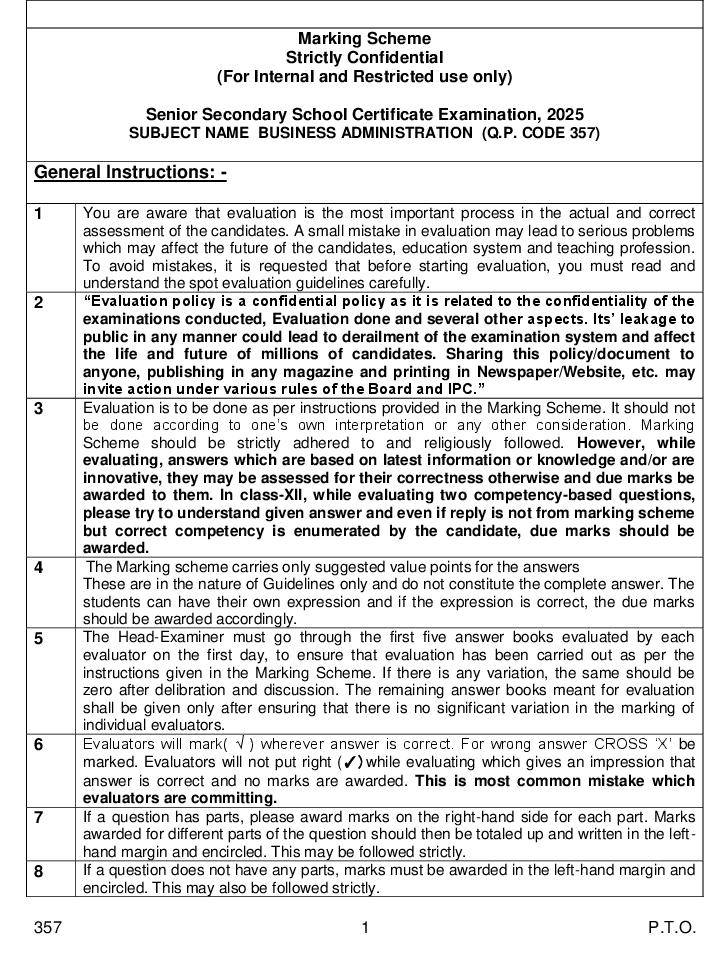
Strictly Confidential
(For Internal and Restricted use only)
Senior Secondary School Certificate Examination, 2025
SUBJECT NAME BUSINESS ADMINISTRATION (Q.P. CODE 357)
General Instructions: -
1 You are aware that evaluation is the most important process in the actual and correct
assessment of the candidates. A small mistake in evaluation may lead to serious problems
which may affect the future of the candidates, education system and teaching profession.
To avoid mistakes, it is requested that before starting evaluation, you must read and
understand the spot evaluation guidelines carefully.
2 “Evaluation policy is a confidential policy as it is related to the confidentiality of the
examinations conducted, Evaluation done and several other aspects. Its’ leakage to
public in any manner could lead to derailment of the examination system and affect
the life and future of millions of candidates. Sharing this policy/document to
anyone, publishing in any magazine and printing in Newspaper/Website, etc. may
invite action under various rules of the Board and IPC.”
3 Evaluation is to be done as per instructions provided in the Marking Scheme. It should not
be done according to one’s own interpretation or any other consideration. Marking
Scheme should be strictly adhered to and religiously followed. However, while
evaluating, answers which are based on latest information or knowledge and/or are
innovative, they may be assessed for their correctness otherwise and due marks be
awarded to them. In class-XII, while evaluating two competency-based questions,
please try to understand given answer and even if reply is not from marking scheme
but correct competency is enumerated by the candidate, due marks should be
awarded.
4 The Marking scheme carries only suggested value points for the answers
These are in the nature of Guidelines only and do not constitute the complete answer. The
students can have their own expression and if the expression is correct, the due marks
should be awarded accordingly.
5 The Head-Examiner must go through the first five answer books evaluated by each
evaluator on the first day, to ensure that evaluation has been carried out as per the
instructions given in the Marking Scheme. If there is any variation, the same should be
zero after delibration and discussion. The remaining answer books meant for evaluation
shall be given only after ensuring that there is no significant variation in the marking of
individual evaluators.
6 Evaluators will mark( √ ) wherever answer is correct. For wrong answer CROSS ‘X’ be
marked. Evaluators will not put right (✓)while evaluating which gives an impression that
answer is correct and no marks are awarded. This is most common mistake which
evaluators are committing.
7 If a question has parts, please award marks on the right-hand side for each part. Marks
awarded for different parts of the question should then be totaled up and written in the left-
hand margin and encircled. This may be followed strictly.
8 If a question does not have any parts, marks must be awarded in the left-hand margin and
encircled. This may also be followed strictly.
357 1 P.T.O.
Page 2
marks should be retained and the other answer scored out with a note “Extra Question”.
10 No marks to be deducted for the cumulative effect of an error. It should be penalized only
once.
11 A full scale of marks __________(example 0 to 80/70/60/50/40/30 marks as given in
Question Paper) has to be used. Please do not hesitate to award full marks if the answer
deserves it.
12 Every examiner has to necessarily do evaluation work for full working hours i.e., 8 hours
every day and evaluate 20 answer books per day in main subjects and 25 answer books
per day in other subjects (Details are given in Spot Guidelines).This is in view of the
reduced syllabus and number of questions in question paper.
13 Ensure that you do not make the following common types of errors committed by the
Examiner in the past:-
● Leaving answer or part thereof unassessed in an answer book.
● Giving more marks for an answer than assigned to it.
● Wrong totaling of marks awarded on an answer.
● Wrong transfer of marks from the inside pages of the answer book to the title page.
● Wrong question wise totaling on the title page.
● Wrong totaling of marks of the two columns on the title page.
● Wrong grand total.
● Marks in words and figures not tallying/not same.
● Wrong transfer of marks from the answer book to online award list.
● Answers marked as correct, but marks not awarded. (Ensure that the right tick mark
is correctly and clearly indicated. It should merely be a line. Same is with the X for
incorrect answer.)
● Half or a part of answer marked correct and the rest as wrong, but no marks awarded.
14 While evaluating the answer books if the answer is found to be totally incorrect, it should
be marked as cross (X) and awarded zero (0)Marks.
15 Any unassessed portion, non-carrying over of marks to the title page, or totaling error
detected by the candidate shall damage the prestige of all the personnel engaged in the
evaluation work as also of the Board. Hence, in order to uphold the prestige of all
concerned, it is again reiterated that the instructions be followed meticulously and
judiciously.
16 The Examiners should acquaint themselves with the guidelines given in the “Guidelines
for Spot Evaluation” before starting the actual evaluation.
17 Every Examiner shall also ensure that all the answers are evaluated, marks carried over to
the title page, correctly totaled and written in figures and words.
18 The candidates are entitled to obtain photocopy of the Answer Book on request on
payment of the prescribed processing fee. All Examiners/Additional Head Examiners/Head
Examiners are once again reminded that they must ensure that evaluation is carried out
strictly as per value points for each answer as given in the Marking Scheme.
357 2
Page 3
$
MARKING SCHEME
BUSINESS ADMINISTRATION
SECTION A
OBJECTIVE TYPE QUESTIONS
Q. No. QUESTION Source Material Unit/ Page no. Marks
(NCERT/PSSCIVE Chap. of source
/CBSE Study Material) No. material
1. Answer any 4 out of the given 6 questions on Employability Skills. 4
1=4
(i) Accurate Employability Unit 1 2 1
Skills-Books XII
(ii) Energy Efficiency Services Employability Unit 5 115 1
Limited Skills-Books XII
(iii) (D) Spreadsheet Employability Unit 3 3 1
Skills-Books XII
(iv) (B) Extroverts Employability Unit 2 33 1
Skills-Books XII
(v) (C) Market entry regulations Employability Unit 4 92 1
Skills-Books XII
(vi) Any one of the following : Employability Unit 2 25-26 1
Skills-Books XII
• Physical exercise and fresh
air
• Healthy diet
• Organise academic life
• Adequate sleep
• Holidays with family and
friends
2. Answer any 5 out of the given 7 questions. 5
1=5
357 3 P.T.O.
Page 4
knowledge and skills Material
(ii) (C) It doesn’t incite fear in the
CBSE Study Unit 4 6 1
minds of people Material
(iii) (C) An academic discipline CBSE Study Unit 1 8 1
Material
(iv) (B) Process CBSE Study Unit 5 10 1
Material
(v) (D) Philanthropic CBSE Study Unit 7 5 1
Material
(vi) (C) feedback CBSE Study Unit 6 2 1
Material
(vii) (A) Divisional Structure CBSE Study Unit 3 8 1
Material
3. Answer any 6 out of the given 7 questions. 6
1=6
(i) (B) determination of objectivesCBSE Study Unit 1 9 1
Material
(ii) (C) Eliminate the unnecessary CBSE Study Unit 2 9 1
diversities in production Material
(iii) An institutional leader CBSE Study Unit 6 4-5 1
influences his team on account Material
of the stature or position he
holds in the organisation. He is
able to command respect due to
his position in the enterprise.
(iv) (A) Brand differentiation CBSE Study Unit 7 8 1
Material
(v) (C) Security issues CBSE Study Unit 8 12 1
Material
(vi) Human resource department CBSE Study Unit 3 10 1
Material
(vii) (D) Non-verbal communication CBSE Study Unit 4 8 1
Material
4. Answer any 5 out of the given 6 questions. 5
1=5
(i) Middle level CBSE Study Unit 1 12 1
Material
(ii) (B) Functional foremanship CBSE Study Unit 2 10 1
Material
357 4
Page 5
Material
• Status
• Praise
• Group incentives
• Participation and
involvement
• Opportunity for Growth
• Suggestion system
(iv) Digital marketing is promotion CBSE Study Unit 8 7 1
of products and services using Material
digital channels to reach
consumers
(v) (A) Facilitates discipline and CBSE Study Unit 3 15 1
order Material
(vi) (D) Empathy CBSE Study Unit 6 7 1
Material
5. Answer any 5 out of the given 6 questions. 5
1=5
(i) (B) Strategy CBSE Study Unit 3 5 1
Material
(ii) (D) Equity CBSE Study Unit 2 14 1
Material
(iii) (C) Provide effective leadership CBSE Study Unit 4 3 1
Material
(iv) (B) Management requires CBSE Study Unit 1 15 1
Technical skills, Material
Adminstration requires
Conceptual Skills
(v) (A) Providing fair returns CBSE Study Unit 7 6 1
Material
(vi) (C) Job enrichment CBSE Study Unit 5 17 1
Material
6. Answer any 5 out of the given 6 questions. 5
1=5
(i) (B) Neo-Classical Approach CBSE Study Unit 2 15 1
Material
(ii) Induction and Orientation CBSE Study Unit 3 10 1
Material
357 5 P.T.O.
Page 6
Material
(iv) (B) Communicating, Receiving CBSE Study Unit 8 4 1
Material
(v) (D) To keep machine and tools CBSE Study Unit 2 10 1
in proper working conditions Material
(vi) Taking remedial action CBSE Study Unit 3 16 1
Material
SECTION B
SUBJECTIVE TYPE QUESTIONS
Q. QUESTION Source Material Unit/ Page no. Marks
No. (NCERT/PSSCIVE Chap. of source
/CBSE Study No. material
Material)
Answer any 3 out of the given 5 questions on Employability Skills in 20 – 30 3
words each. 2=6
7. Maintaining an eye contact with the Employability Unit 1 4 2
person you are talking to sends a Skills-Books XII
signal to the speaker that “Yes, I am
talking to you or listening to you”.
Avoiding eye contact could mean that
you do not want to listen to the
person speaking to you
8. Eco tour guide, Eco Tourism Operator Employability Unit 5 116 2
Skills-Books XII
9. Professional entrepreneurs - Such an Employability Unit 4 83 2
entrepreneur starts a business, Skills-Books XII
nurtures it and makes it reach a
point of self-sustenance. Once the
project reaches that point, the
entrepreneur sells the business and
starts a new one, and then, follows
the same cycle.
10. 1. LibreOffice Impress Employability Unit 3 63-64 2
2. Microsoft Office – PowerPoint Skills-Books XII
357 6
Page 7
4. Google Slides
5. Apple Keynote
Any Four...
11. • Openness Employability Unit 2 33-34 2
• Consciousness Skills-Books XII
• Extraversion
• Agreeableness
• Neuroticism
Answer any 3 out of the given 5 questions in 20 – 30 words each. 3
2=6
12. Harmony, Not Discord – Taylor CBSE Study Unit 2 8-9 2
believed that the interest of employer Material
& employees should be fully
harmonized so as to secure mutual
understanding between them. There
should be no conflict between
managers & workers. It is the
combined efforts of management & its
employees that helps a company to
achieve its goals effectively &
efficiently
13. (i) This style permits quick decision- CBSE Study Unit 6 9 2
making due to centralisation of Material
power.
(ii) Organisations can hire less
skilled people at lower levels.
(iii) The style may prove constructive
when higher speed is needed in
certain processes.
(iv) It can be motivating and
satisfying for the leader who
dictates terms.
14. This type of organization structure is CBSE Study Unit 3 8 2
formed by grouping together all Material
357 7 P.T.O.
Page 8
and putting each department under
one head. Functional structure leads
to specialization. It promotes
efficiency and results in increased
profits. It is suitable to organization
where operations require high degree
of specialization.
15. A persuasive leader possesses CBSE Study Unit 6 5 2
alluring personality that enable him Material
to encourage the team members for
getting the work done. Persuasion is
the ability to convince others to
change their actions, decisions,
opinions or thinking. Persuasive
leaders are generally friendly, polite,
trustworthy and knowledgeable. They
are loved and trusted by their group
members.
16. Motivation Inspiration CBSE Study Unit 5 18-19 2
1. Motivation is Inspiration is Material
external as internal as it
the individual comes from
is persuaded within the
by someone individual.
else.
2. The The
encouragement encouragement
comes from and ideas
someone else come from the
by offering individual
rewards both itself.
of financial
and non
financial
nature
3. Motivation is Inspiration
a short lived stays for long
357 8
Page 9
lasts as long
as the reward
is there.
4. Motivation is Inspiration is
self oriented service
as the oriented as
outcomes the outcomes
matter to the matter to
individual those who are
being served.
It promotes
partnership
5. Motivation is Inspiration is
competitive collaborative
by nature. by nature
Answer any 2 out of the given 3 questions in 30 – 50 words each. 2
3=6
17. Stability of Tenure – Management CBSE Study Unit 2 14 1+2=3
must implement practices which Material
encourage long term commitment of
employees. Time is required for an
employee to get used to new work and
succeed in doing it well. Instability of
tenure can affect the organizations
growth. Fayol believed that the
employee turnover should be
minimized for maximum development
of the organization.
18. Advantages of informal CBSE Study Unit 4 7 3
communication Material
• Informal communication helps the
“Open door policy” and makes
people more confident and
forthcoming with their ideas and
creativity.
• Informal communication does not
incite fear into peoples mind
• Informal talks encourage people
to share their problems.
19. Reinforcement theory is the process CBSE Study Unit 5 12 3
357 9 P.T.O.
Page 10
controlling the consequences of the
behaviour. The theory is based upon
“law of effect” which means an
individual tends to repeat behaviour
which is rewarded while the
behaviour which gives punishment is
not repeated. They learn from the
past and thus develop patterns of
behaviour to regulate the future
consequences. This approach is called
operant conditioning. This theory
was propagated by B. F. Skinner.
Application of operant conditioning
is called Organisational behaviour
modification whereby the managers
focus on positive rewards to elicit
desirable behaviour.
Answer any 3 out of the given 5 questions in 50 – 80 words each. 34=1
2
20. Social responsibility of business is CBSE Study Unit 7 6 4
important from the following point of Material
view.
1. From employees’ point of view :
with the help of companies
employment and healthy working
condition, social responsibility of
business is important for
employees.
2. From Customer point of view :
under social responsibility,
business follows ethical practice
and manufacture the product
which is as per expected quality
and reasonable price.
3. From government point of view :
when business pay regular taxes,
follow the norms of government
then it is consider as social
responsibility of business which
is duly fulfill by it.
357 10
Page 11
business need to work in society,
some importance of social
responsibility is also define from
society point of view. The
business provide good product,
try to maintain clean
environment, provide
opportunity to participate to
business as well as work for the
overall development of society,
these are the some example of it.
21. (a) Controlling CBSE Study Unit 3 3, 16 1+1+2
(b) Measurement of performance Material =4
(c) • Comparison of actual and
standard performance
• Taking remedial action
(with explanation..)
22. # Finance & Accounting CBSE Study Unit 8 7-8 4
# Human Resource Management Material
# Marketing
# Sales
(with explanation)
23. Significance of Leadership : CBSE Study Unit 6 3-4 4
• Motivating the employees Material
• Facilitating the process of change
• Building team spirit
• Confidence
• Maintaining Discipline
(with explanation’s..)
24. (a) Top level Management CBSE Study Unit 1 11,9 1+3=4
(b) Importance of management Material
• Determination of objectives
• Achievement of the objectives
• Efficient use of resources
357 11 P.T.O.
Page 12
• Personal objectives
• Economic development
• Creates dynamic organisation
(Any three with explanation...)
357 12
Document Details
| Board / Org | CBSE |
| Exam | Class 12 |
| Type | Solution |
| Pages | 12 |
| Updated | 24 Sep 2026 |