CBSE Class 12 Chemistry Question Paper 2020 Set 56-3-3
Finished viewing? Save it for later —
Download CBSE Class 12 Chemistry Question Paper 2020 Set 56-3-3 (PDF · 19 pages)About CBSE Class 12 Chemistry Question Paper 2020 Set 56-3-3
CBSE Class 12 Chemistry Question Paper 2020 Set 56-3-3 is available here for free download. Published by CBSE for Class 12, this question paper can be viewed online or downloaded as a PDF (19 pages). Candidates preparing for Class 12 can use CBSE Class 12 Chemistry Question Paper 2020 Set 56-3-3 to understand the exam pattern, the type of questions asked, and the overall difficulty level.
Frequently Asked Questions
How can I download CBSE Class 12 Chemistry Question Paper 2020 Set 56-3-3?
Open this page and click the Download button to save CBSE Class 12 Chemistry Question Paper 2020 Set 56-3-3 as a PDF. It is completely free on AglaSem Docs.
Is CBSE Class 12 Chemistry Question Paper 2020 Set 56-3-3 free to download?
Yes. CBSE Class 12 Chemistry Question Paper 2020 Set 56-3-3 can be viewed online and downloaded as a PDF free of cost on AglaSem Docs.
How many pages does CBSE Class 12 Chemistry Question Paper 2020 Set 56-3-3 have?
CBSE Class 12 Chemistry Question Paper 2020 Set 56-3-3 contains 19 pages, which you can read online or download together as a single PDF.
Where can I find more Class 12 study material?
You can find more Class 12 question papers, sample papers, syllabus, and answer keys on AglaSem Docs.
CBSE Class 12 Chemistry Question Paper 2020 Set 56-3-3 – Text
Read the full text of this question paper below — useful to quickly search, copy and reference the content online without downloading the PDF.
📄 View text version (19 pages)
Page 1
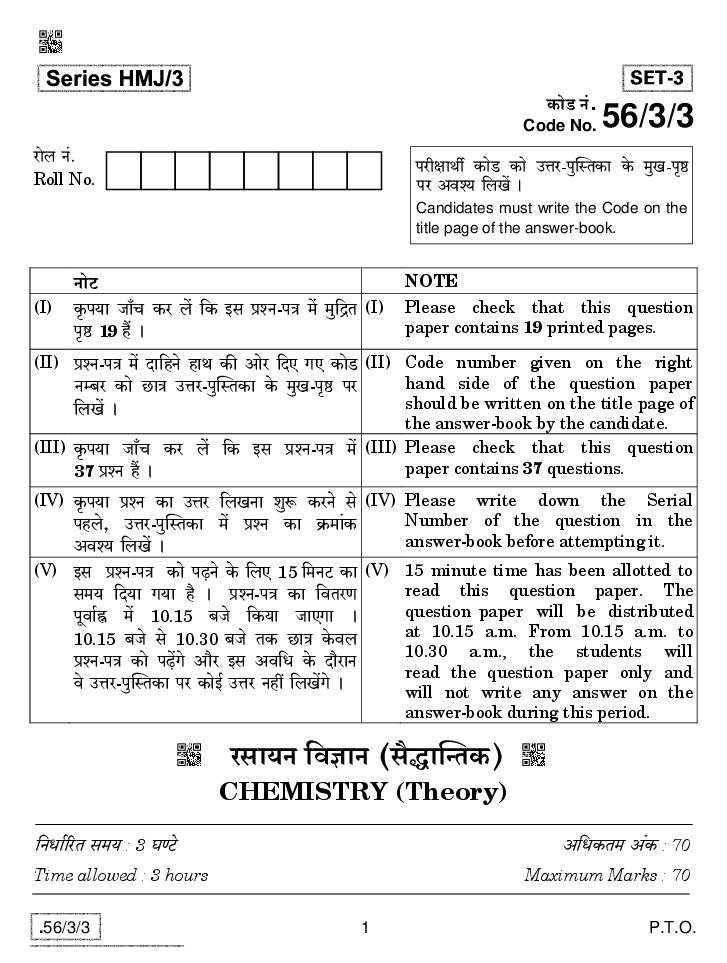
Code No. 56/3/3
amob Z§. narjmWu H$moS >H$mo CÎma-nwpñVH$m Ho$ _wI-n¥ð
Roll No. >na Adí` {bIo§ &
Candidates must write the Code on the
title page of the answer-book.
ZmoQ> NOTE
(I) H¥$n`m Om±M H$a b| {H$ Bg àíZ-nÌ _o§ _w{ÐV (I) Please check that this question
n¥ð> 19 h¢ & paper contains 19 printed pages.
(II) àíZ-nÌ _| Xm{hZo hmW H$s Amoa {XE JE H$moS (II) Code number given on the right
>Zå~a H$mo N>mÌ CÎma-nwpñVH$m Ho$ _wI-n¥ð> na hand side of the question paper
{bI| & should be written on the title page of
the answer-book by the candidate.
(III) H¥$n`m Om±M H$a b| {H$ Bg àíZ-nÌ _| (III) Please check that this question
>37 àíZ h¢ & paper contains 37 questions.
(IV) H¥$n`m àíZ H$m CÎma {bIZm ewê$ H$aZo go (IV) Please write down the Serial
nhbo, CÎma-nwpñVH$m _| àíZ H$m H«$_m§H$ Number of the question in the
Adí` {bI| & answer-book before attempting it.
(V) Bg àíZ-nÌ H$mo n‹T>Zo Ho$ {bE 15 {_ZQ >H$m (V) 15 minute time has been allotted to
g_` {X`m J`m h¡ & àíZ-nÌ H$m {dVaU read this question paper. The
nydm©• _| 10.15 ~Oo {H$`m OmEJm & question paper will be distributed
10.15 ~Oo go 10.30 ~Oo VH$ N>mÌ Ho$db at 10.15 a.m. From 10.15 a.m. to
10.30 a.m., the students will
àíZ-nÌ H$mo n‹T>|Jo Am¡a Bg Ad{Y Ho$ Xm¡amZ read the question paper only and
do CÎma-nwpñVH$m na H$moB© CÎma Zht {bI|Jo & will not write any answer on the
answer-book during this period.
agm`Z {dkmZ (g¡ÕmpÝVH$)
CHEMISTRY (Theory)
{ZYm©[aV g_` : 3 KÊQ>o A{YH$V_ A§H$ : 70
Time allowed : 3 hours Maximum Marks : 70
.56/3/3 1 P.T.O.
Page 2
{ZåZ{b{IV {ZX}em| H$mo ~hþV gmdYmZr go n{‹T>E Am¡a CZH$m g™Vr go nmbZ H$s{OE :
(i) `h àíZ-nÌ Mma IÊS>m| _| {d^m{OV {H$`m J`m h¡ – H$, I, J Ed§ K & Bg àíZ-nÌ _|
37 àíZ h¢ & g^r àíZ A{Zdm`© h¢ &
(ii) IÊS> H$ _| àíZ g§»`m 1 go 20 VH$ A{V bKw-CÎmar` àH$ma Ho$ àíZ h¢, àË`oH$ àíZ 1 A§H$ H$m
h¡ & àË`oH$ àíZ H$m CÎma EH$ eãX `m EH$ dmŠ` _| Xr{OE &
(iii) IÊS> I _| àíZ g§»`m 21 go 27 VH$ bKw-CÎmar` àH$ma Ho$ àíZ h¢, àË`oH$ àíZ 2 A§H$m| H$m
h¡ &
(iv) IÊS> J _| àíZ g§»`m 28 go 34 VH$ XrK©-CÎmar` àH$ma-I Ho$ àíZ h¢, àË`oH$ àíZ 3 A§H$m| H$m
h¡ &
(v) IÊS> K _| àíZ g§»`m 35 go 37 VH$ XrK©-CÎmar` àH$ma-II Ho$ àíZ h¢, àË`oH$ àíZ 5 A§H$m| H$m
h¡ &
(vi) àíZ-nÌ _| H$moB© g_J« {dH$ën Zht h¡ & VWm{n, Xmo-Xmo A§H$m| Ho$ Xmo àíZm| _|, VrZ-VrZ A§H$m| Hoo$
Xmo àíZm| _| VWm nm±M-nm±M A§H$m| Ho$ VrZm| àíZm| _| AmÝV[aH$ {dH$ën {X`m J`m h¡ & Eogo àíZm| _|
go Ho$db EH$ hr {dH$ën H$m CÎma Xr{OE &
(vii) BgHo$ A{V[aº$, Amdí`H$VmZwgma, àË`oH$ IÊS> Am¡a àíZ Ho$ gmW `Wmo{MV {ZX}e {XE JE h¢ &
(viii) Ho$ëHw$boQ>a AWdm bm°J Q>o~b Ho$ à`moJ H$s AZw_{V Zht h¡ &
IÊS> H$
{XE JE AZwÀN>oX H$mo n{‹T>E VWm àíZ g§»`m 1 go 5 Ho$ CÎma Xr{OE : 15=5
AmdV© gmaUr Ho$ d-ãbm°H$ ‘| dJ© 3 go 12 Ho$ VÎd AmVo h¢ Omo g§H«$‘U VÎdm| Ho$ ê$n ‘| OmZo
OmVo h¢ & gm‘mݶ ê$n go BZ VÎdm| H$m Bbo³Q´>m°{ZH$ {dݶmg (n – 1) d1–10 ns1–2 h¡ & BZ
na‘mUwAm| Ho$ Cnm§{V‘ D$Om© ñVa Ho$ d-H$jH$m| ‘| Bbo³Q´>m°Z ^ao OmVo h¢ VWm Bg àH$ma
g§H«$‘U YmVwAm| H$s VrZ n§{³V¶m± AWm©V² 3d, 4d d 5d loUr àmßV hmoVr h¢ & VWm{n Zn, Cd
Am¡a Hg H$mo g§H«$‘U VÎd Zht ‘mZm OmVm h¡ & g§H«$‘U VÎd Hw$N> A{^bmj{UH$ JwU Xem©Vo
h¢ O¡go n[adV©Zr` Am°³grH$aU AdñWmE±, g§Hw$b {Z‘m©U, a§JrZ Am¶Zm| Am¡a {‘lmVwAm| H$m
~ZZm, CËàoaH$s¶ g{H«$¶Vm Am{X & g§H«$‘U YmVwE± (Zn, Cd Am¡a Hg Ho$ AndmXm| Ho$ gmW)
H$R>moa hmoVr h¢ Am¡a BZHo$ JbZm§H$ CÀM hmoVo h¢ &
.56/3/3 2
Page 3
Read the following instructions very carefully and strictly follow them :
(i) This question paper comprises four Sections – A, B, C and D. There are
37 questions in the question paper. All questions are compulsory.
(ii) Section A – Questions no. 1 to 20 are very short answer type questions,
carrying 1 mark each. Answer these questions in one word or one sentence.
(iii) Section B – Questions no. 21 to 27 are short answer type questions, carrying
2 marks each.
(iv) Section C – Questions no. 28 to 34 are long answer type-I questions, carrying
3 marks each.
(v) Section D – Questions no. 35 to 37 are long answer type-II questions, carrying
5 marks each.
(vi) There is no overall choice in the question paper. However, an internal choice
has been provided in 2 questions of two marks, 2 questions of three marks and
all the 3 questions of five marks. You have to attempt only one of the choices in
such questions.
(vii) In addition to this, separate instructions are given with each section and
question, wherever necessary.
(viii) Use of calculators and log tables is not permitted.
SECTION A
Read the given passage and answer the questions number 1 to 5 that follow : 15=5
The d-block of the periodic table contains the elements of the groups
3 – 12 and are known as transition elements. In general, the electronic
configuration of these elements is (n – 1) d1–10 ns1–2. The d-orbitals of the
penultimate energy level in their atoms receive electrons giving rise to
the three rows of the transition metals i.e., 3d, 4d and 5d series.
However, Zn, Cd and Hg are not regarded as transition elements.
Transition elements exhibit certain characteristic properties like variable
oxidation states, complex formation, formation of coloured ions and
alloys, catalytic activity, etc. Transition metals are hard (except Zn, Cd
and Hg) and have a high melting point.
.56/3/3 3 P.T.O.
Page 4
2. 3d loUr H$m H$m¡Z-gm g§H«$_U YmVw n[adV©Zr¶ Am°³grH$aU AdñWmE± Zht Xem©Vm h¡ ?
3. g§H«$‘U YmVwE± Am¡a CZHo$ ¶m¡{JH$ CËàoaH$s¶ g{H«$¶Vm ³¶m| Xem©Vo h¢ ?
4. g§H«$‘U YmVwAm| Ho$ JbZm§H$ CÀM ³¶m| hmoVo h¢ ?
5. Obr¶ {db¶Z ‘| Cu2+ Am¶Z a§JrZ ³¶m| hmoVm h¡ O~{H$ Zn2+ Am¶Z a§JhrZ hmoVm h¡ &
àíZ g§»`m 6 go 10 EH$ eãX CÎmar¶ h¢ : 15=5
6. O~ ~oݵOrZ S>mBEµOmo{Z¶‘ ³bmoamBS> H$mo KI Ho$ gmW A{^H¥$V {H$¶m OmVm h¡ Vmo {Z{‘©V
CËnmX H$m Zm‘ {b{IE &
7.
8. g§Hw$b [Ag(CN)2]– go Ag àmßV H$aZo Ho$ {bE à¶w³V AnMm¶H$ H$m Zm‘ {b{IE &
9. Cg {dQ>m{‘Z H$m Zm‘ {b{IE {OgH$s hrZVm go ‘amo‹S> (convulsions) n‹S>Vo h¢ &
10. {ZåZ{b{IV ¶m¡{JH$m| ‘| go CZHo$ {M{H$Ëgr¶ JwUm| Ho$ AmYma na {df‘ ¶m¡{JH$ H$m M¶Z
H$s{OE :
B³d¡{Zb, ë¶y{‘Zb, ~mBWm¶moZb, goH$moZb
àíZ g§»`m 11 go 15 ~hþ{dH$ënr¶ àíZ h¢ : 15=5
11. BªYZ gob ‘|
(A) amgm¶{ZH$ D$Om©, d¡ÚwV D$Om© ‘| n[ad{V©V hmoVr h¡ &
(B) BªYZ H$s XhZ D$Om© H$mo amgm¶{ZH$ D$Om© ‘| n[ad{V©V {H$¶m OmVm h¡ &
(C) BªYZ H$s XhZ D$Om© H$mo d¡ÚwV D$Om© ‘| n[ad{V©V {H$¶m OmVm h¡ &
(D) d¡ÚwV D$Om© H$mo amgm¶{ZH$ D$Om© ‘| n[ad{V©V {H$¶m OmVm h¡ &
12. ewîH$ b¡³bm§eo gob ‘| H¡$WmoS> hmoVm h¡
(A) qOH$ nmÌ
(B) MnO2
(C) J«¡’$mBQ> N>‹S>
(D) NH4Cl
.56/3/3 4
Page 5
2. Which transition metal of 3d series does not show variable oxidation
states ?
3. Why do transition metals and their compounds show catalytic activity ?
4. Why are melting points of transition metals high ?
5. Why is Cu2+ ion coloured while Zn2+ ion is colourless in aqueous
solution ?
Questions number 6 to 10 are one word answers : 15=5
6. Write the name of the product when benzene diazonium chloride is
treated with KI.
7.
8. Name the reducing agent used to obtain Ag from [Ag(CN)2]– complex.
9. Name the vitamin whose deficiency causes convulsions.
10. Pick out the odd one from among the following compounds on the basis of
their medicinal properties :
Equanil, Luminal, Bithional, Seconal
Questions number 11 to 15 are multiple choice questions : 15=5
11. In fuel cell
(A) chemical energy is converted to electrical energy.
(B) energy of combustion of fuel is converted to chemical energy.
(C) energy of combustion of fuel is converted to electrical energy.
(D) electrical energy is converted to chemical energy.
12. In a Leclanche dry cell, the cathode is
(A) Zn container
(B) MnO2
(C) Graphite rod
(D) NH4Cl
.56/3/3 5 P.T.O.
Page 6
hmoJm O~ A{^H$maH$ H$s àmapå^H$ gmÝÐVm h¡
(A) 1 10–2 M
(B) 1M
(C) 10 M
(D) 0·1 M
14. O~ {H$gr d4 g§Hw$b Ho$ {bE o > P hmo Vmo {H«$ñQ>b joÌ {gÕmÝV Ho$ AmYma na BgH$m
Bbo³Q´>m°{ZH$ {dݶmg h¡
(A) t2g3 eg1
(B) t2g2 eg2
(C) t2g1 eg3
(D) t2g4 eg0
15. {ZåZ{b{IV ‘| go H$m¡Z-gm AZnM`r eH©$am h¡ ?
(A) gyH«$mog
(B) ‘mëQ>mog
(C) ½byH$mog
(D) b¡³Q>mog
àíZ g§»`m 16 go 20 Ho$ {bE, Xmo H$WZ {XE JE h¢ {OZ_| EH$ H$mo A{^H$WZ (A) VWm Xÿgao
H$mo H$maU (R) Ûmam A§{H$V {H$`m J`m h¡ & BZ àíZm| Ho$ ghr CÎma ZrMo {XE JE H$mo S>m| (i),
(ii), (iii) Am¡a (iv) _| go MwZH$a Xr{OE : 15=5
(i) A{^H$WZ (A) Am¡a H$maU (R) XmoZm| ghr H$WZ h¢ Am¡a H$maU (R), A{^H$WZ (A)
H$s ghr ì¶m»¶m h¡ &
(ii) A{^H$WZ (A) Am¡a H$maU (R) XmoZm| ghr H$WZ h¢, naÝVw H$maU (R),
A{^H$WZ (A) H$s ghr ì¶m»¶m Zht h¡ &
(iii) A{^H$WZ (A) ghr h¡, naÝVw H$maU (R) µJbV H$WZ h¡ &
(iv) A{^H$WZ (A) µJbV h¡, naÝVw H$maU (R) ghr H$WZ h¡ &
16. A{^H$WZ (A) : AZmXe© {db¶Z pñWa³dmWr {‘lU ~ZmVo h¢ &
H$maU (R) : A{YH$V‘ ³dWZm§H$s pñWa³dmWr, G UmË‘H$ {dMbZ Xem©Zo dmbo {db¶Z
go ~ZVo h¢ &
.56/3/3 6
Page 7
reaction when the initial concentration of the reactant is
(A) 1 10–2 M
(B) 1M
(C) 10 M
(D) 0·1 M
14. On the basis of crystal field theory, electronic configuration of d4 complex
when o > P is
(A) t2g3 eg1
(B) t2g2 eg2
(C) t2g1 eg3
(D) t2g4 eg0
15. Which of the following is a non-reducing sugar ?
(A) Sucrose
(B) Maltose
(C) Glucose
(D) Lactose
For questions number 16 to 20, two statements are given one labelled
Assertion (A) and the other labelled Reason (R). Select the correct
answer to these questions from the codes (i), (ii), (iii) and (iv) as given
below : 15=5
(i) Both Assertion (A) and Reason (R) are correct statements, and
Reason (R) is the correct explanation of the Assertion (A).
(ii) Both Assertion (A) and Reason (R) are correct statements, but
Reason (R) is not the correct explanation of the Assertion (A).
(iii) Assertion (A) is correct, but Reason (R) is incorrect statement.
(iv) Assertion (A) is incorrect, but Reason (R) is correct statement.
16. Assertion (A) : Non-ideal solutions form azeotropic mixture.
Reason (R) : Maximum boiling azeotropes are formed by a solution
showing negative deviation.
.56/3/3 7 P.T.O.
Page 8
H$maU (R) : g§Hw$b [Cr(H2O)3 Cl3] H$m Am¶ZZ Zht hmoVm &
18. A{^H$WZ (A) : gmÝÐVm KQ>Zo Ho$ gmW {dÚwV²-AnKQ>ç H$s MmbH$Vm KQ>Vr h¡ &
H$maU (R) : VZwH$aU H$aZo na à{V BH$mB© Am¶VZ ‘| Am¶Zm| H$s g§»¶m ~‹T>Vr h¡ &
19. A{^H$WZ (A) : EopëS>hmBS>m| H$s Anojm H$sQ>moZm| H$s A{^{H«$¶merbVm A{YH$ hmoVr h¡ &
H$maU (R) : EopëS>hmBS>m| H$s VwbZm ‘| H$sQ>moZm| ‘| H$m~m}{Zb H$m~©Z H$‘ Bbo³Q´>m°ZamJr
hmoVm h¡ &
20. A{^H$WZ (A) : EoëH$mohm°bm| ‘| C – O – H Am~ÝY H$moU MVwî’$bH$s¶ H$moU go Oam gm
H$‘ hmoVm h¡ &
H$maU (R) : Am°³grOZ na Xmo EH$mH$s Bbo³Q´>m°Z ¶w½‘ Ho$ ~rM à{VH$fu AÝV:{H«$¶m Ho$
H$maU hmoVm h¡ &
IÊS> I
21. {ZåZ{b{IV H$s ^y{‘H$m {b{IE :
(i) Eobw{‘{Z¶‘ Ho$ {ZîH$f©U ‘| NaAlF4 H$s 1
(ii) Ni Ho$ emoYZ ‘| CO H$s 1
AWdm
~m°³gmBQ> A¶ñH$ Ho$ {ZjmbZ Ûmam ewÕ Eobw{‘Zm àmßV H$aZo go gå~Õ amgm¶{ZH$ g‘rH$aU|
{b{IE & 2
22. ^m¡{VH$ A{YemofU Am¡a agmoemofU Ho$ ~rM Xmo AÝVa {b{IE & 2
AWdm
à˶oH$ Ho$ {bE Cn¶w³V CXmhaU g{hV {ZåZ{b{IV nXm| H$mo n[a^m{fV H$s{OE : 2
(i) ghMmar H$mobm°BS>
(ii) O/W B‘ëeZ (nm¶g)
.56/3/3 8
Page 9
with AgNO3 solution.
Reason (R) : The complex [Cr(H2O)3 Cl3] is non-ionizable.
18. Assertion (A) : Conductivity of an electrolyte decreases with decrease in
concentration.
Reason (R) : Number of ions per unit volume increases on dilution.
19. Assertion (A) : Reactivity of ketones is more than aldehydes.
Reason (R) : The carbonyl carbon of ketones is less electrophilic as
compared to aldehydes.
20. Assertion (A) : The C – O – H bond angle in alcohols is slightly less than
the tetrahedral angle.
Reason (R) : This is due to the repulsive interaction between the two
lone electron pairs on oxygen.
SECTION B
21. Write the role of the following :
(i) NaAlF4 in the extraction of Aluminium 1
(ii) CO in the refining of Ni 1
OR
Write the chemical equations involved in the leaching of bauxite ore to
prepare pure alumina. 2
22. Write two differences between physisorption and chemisorption. 2
OR
Define the following terms with a suitable example of each : 2
(i) Associated colloids
(ii) O/W emulsion
.56/3/3 9 P.T.O.
Page 10
A + 3B 2C
‘|, C Ho$ ~ZZo H$m doJ 2·5 10–4 mol L–1 s–1 h¡ &
n[aH${bV H$s{OE :
(i) A{^{H«$¶m H$m doJ, Am¡a
(ii) B Ho$ bwßV hmoZo H$m doJ & 2
24. à˶oH$ Ho$ {bE Cn¶w³V CXmhaU XoH$a {ZåZ{b{IV nXm| H$s n[a^mfm {b{IE : 2
(i) nr‹S>mhmar
(ii) YZm¶Zr An‘mO©H$
25. (a) Amn H¡$go àX{e©V H$a gH$Vo h¢ {H$ g§Hw$b [Co(NH3)5 Cl] SO4 Ed§
[Co(NH3)5 SO4] Cl Am¶ZZ g‘md¶d h¢ ?
(b) AmB ¶y nr E gr ‘mZXÊS> H$m à¶moJ H$aVo hþE {ZåZ{b{IV g§Hw$b H$m gyÌ {b{IE : 2
nmoQ>¡{e¶‘ Q´>mBAm°³g¡boQ>moH«$mo‘oQ> (III)
26. (a) Amn D-½byH$mog Ho$ noÝQ>mEogrQ>oQ> ‘| EopëS>hmBS> g‘yh H$s AZwnpñW{V H$s ì¶m»¶m
H¡$go H$a gH$Vo h¢ ?
(b) RNA ‘| CnpñWV jmaH$m| Ho$ Zm‘ {b{IE & BZ‘| go H$m¡Z -gm DNA ‘| Zht hmoVm
h¡ ? 2
27. {ZåZ{b{IV A{^{H«$¶m Ho$ CËnmXm| H$mo {b{IE :
6 XeF4 + 12 H2O
³¶m ¶h A{^{H«$¶m Ag‘mZwnmVZ A{^{H«$¶m h¡ ? AnZo CÎma Ho$ g‘W©Z ‘| H$maU Xr{OE & 2
.56/3/3 10
Page 11
A + 3B 2C,
the rate of formation of C is 2·5 10–4 mol L–1 s–1.
Calculate the
(i) rate of reaction, and
(ii) rate of disappearance of B. 2
24. Define the following terms with a suitable example of each : 2
(i) Analgesics
(ii) Cationic detergent
25. (a) How can you show that complexes [Co(NH3)5 Cl] SO4 and
[Co(NH3)5 SO4] Cl are ionization isomers ?
(b) Write the formula of the following complex using IUPAC norms : 2
Potassium trioxalatochromate (III)
26. (a) How can you explain the absence of an aldehyde group in the
pentaacetate of D-glucose ?
(b) Name the bases present in RNA. Which one of these is not present
in DNA ? 2
27. Write the products of the following reaction :
6 XeF4 + 12 H2O
Is this reaction a disproportionation reaction ? Give reasons in support of
your answer. 2
.56/3/3 11 P.T.O.
Page 12
28. (a) {ZåZ{b{IV A{^{H«$¶m H$s {H«$¶m{d{Y {b{IE :
H
2 CH3CH2OH CH3CH2OCH2CH3 + H2O
413 K
(b) ³¶y‘rZ go µ\$sZm°b H$m {daMZ {b{IE & 2+1=3
AWdm
Amn {ZåZ{b{IV n[adV©Z H¡$go gånÞ H$a|Jo : 3
(i) gmo{S>¶‘ ’$sZm°³gmBS> go o-hmBS´>mo³gr~oݵOmoBH$ Aåb
(ii) EogrQ>moZ go àmonrZ
(iii) µ\$sZm°b go ³bmoamo~oݵOrZ
29. {ZåZ{b{IV A{^{H«$¶mAm| Ho$ ‘w»¶ CËnmX/CËnmXm| H$mo {b{IE : 3
30. 298 K na Xr JB© A{^{H«$¶m Ho$ {bE A{YH$V‘ H$m¶© Am¡a log Kc n[aH${bV H$s{OE : 3
Ni (s) + 2 Ag+ (aq) Ni2+ (aq) + 2 Ag (s)
{X¶m J`m h¡ :
Eo 2 = – 0·25 V, Eo = + 0·80 V
Ni / Ni Ag / Ag
1 F = 96500 C mol–1
.56/3/3 12
Page 13
28. (a) Write the mechanism of the following reaction :
H
2 CH3CH2OH CH3CH2OCH2CH3 + H2O
413 K
(b) Write the preparation of phenol from cumene. 2+1=3
OR
How can you convert the following : 3
(i) Sodium phenoxide to o-hydroxybenzoic acid
(ii) Acetone to propene
(iii) Phenol to chlorobenzene
29. Write the major product(s) of the following reactions : 3
30. Calculate the maximum work and log Kc for the given reaction at 298 K : 3
Ni (s) + 2 Ag+ (aq) Ni2+ (aq) + 2 Ag (s)
Given :
Eo 2 = – 0·25 V, Eo = + 0·80 V
Ni / Ni Ag / Ag
1 F = 96500 C mol–1
.56/3/3 13 P.T.O.
Page 14
H$m ‘mZ n[aH${bV H$s{OE & {H$VZo g‘¶ ‘| A{^{H«$¶m 90% nyU© hmoJr ? 3
[ {X`m J`m h¡ : log 2 = 0·3010, log 3 = 0·4771, log 4 = 0·6021, log 5 = 0·6771,
log 6 = 0·7782]
32. {ZåZ{b{IV ~hþbH$m| ‘| EH$bH$m| Ho$ Zm‘ Am¡a g§aMZmE± {b{IE : 3
(i) {ZAmoàrZ
(ii) ‘ob¡‘rZ-’$m°‘}pëS>hmBS> ~hþbH$
(iii) Q>oâbm°Z
33. à˶oH$ Ho$ {bE Cn¶w³V CXmhaU XoH$a Ðd{damJr Am¡a ÐdamJr gm°b H$mo n[a^m{fV H$s{OE &
Ðd{damJr gm°b H$s VwbZm ‘| ÐdamJr gm°b H$m ñH§$XZ H${R>Z ³¶m| hmoVm h¡ ? 3
AWdm
{ZåZ{b{IV nXm| H$mo n[a^m{fV H$s{OE : 3
(i) AmH$ma-daUmË‘H$ CËàoaU
(ii) H«$mâQ> Vmn
(iii) noßQ>Z (noßQ>mBµOoeZ)
34. {Z{‘©V CËnmXm| H$mo {b{IE O~ (CH3)3 C – CHO {ZåZ{b{IV A{^H$‘©H$m| Ho$ gmW
A{^{H«$¶m H$aVm h¡ : 3
(i) VZw NaOH H$s CnpñW{V ‘| CH3COCH3
(ii) HCN
(iii) gmÝÐ NaOH
IÊS> K
35. (a) H$maU Xr{OE : 3
(i) ¶Ú{n NH2 g‘yh Bbo³Q´>m°ZamJr à{VñWmnZ A{^{H«$¶mAm| ‘| Am°Wm} Ed§
n¡am {ZX}eH$ hmoVm h¡ {’$a ^r Eo{ZbrZ ZmBQ´>moH$aU Ûmam ¶WoîQ> _mÌm ‘|
‘oQ>m-ZmBQ´>moEo{ZbrZ XoVr h¡ &
(ii) Obr¶ {db¶Z ‘| (CH3)3 N H$s Anojm (CH3)2 NH A{YH$ jmaH$s¶
hmoVm h¡ &
(iii) ewÕ àmW{‘H$ Eo‘rZm| Ho$ {daMZ Ho$ {bE EopëH$b h¡bmBS>m| H$m
Eo‘moZr-AnKQ>Z EH$ AÀN>r {d{Y Zht h¡ &
.56/3/3 14
Page 15
of rate constant (k). In what time will the reaction be 90% completed ? 3
[Given : log 2 = 0·3010, log 3 = 0·4771, log 4 = 0·6021, log 5 = 0·6771,
log 6 = 0·7782]
32. Write the names and structures of the monomers in the following
polymers : 3
(i) Neoprene
(ii) Melamine-formaldehyde polymer
(iii) Teflon
33. Define Lyophobic and Lyophilic sol with a suitable example of each. Why
is coagulation of Lyophilic sol difficult as compared to Lyophobic sol ? 3
OR
Define the following terms : 3
(i) Shape-selective catalysis
(ii) Kraft temperature
(iii) Peptization
34. Write the products formed when (CH3)3 C – CHO reacts with the
following reagents : 3
(i) CH3COCH3 in the presence of dilute NaOH
(ii) HCN
(iii) Conc. NaOH
SECTION D
35. (a) Give reasons : 3
(i) Although – NH2 group is o/p directing in electrophilic
substitution reactions, yet aniline, on nitration gives good
yield of m-nitroaniline.
(ii) (CH3)2 NH is more basic than (CH3)3 N in an aqueous
solution.
(iii) Ammonolysis of alkyl halides is not a good method to
prepare pure primary amines.
.56/3/3 15 P.T.O.
Page 16
(i) CH3CH2NH2 Am¡a (CH3CH2)2 NH
(ii) Eo{ZbrZ Am¡a CH3NH2
AWdm
(a) {ZåZ{b{IV A{^{H«$¶mAm| ‘| A Am¡a B H$s g§aMZmE± {b{IE :
CuCN H O /H
(i) C6H5 N 2 Cl– A 2 B 1
NH3 NaOBr
(ii) CH3COOH A B 1
(b) ‘o{Wb Eo_rZ H$s ~oݵOm°¶b ³bmoamBS> Ho$ gmW amgm¶{ZH$ A{^{H«$¶m {b{IE Am¡a
àmßV CËnmX H$m AmB ¶y nr E gr Zm‘ {b{IE & 1+1
(c) {ZåZ{b{IV H$mo CZHo$ pKb ‘mZm| Ho$ ~‹T>Vo hþE H«$‘ ‘| ì¶dpñWV H$s{OE : 1
C6H5NH2, NH3, C2H5NH2, (C2H5)2 NH
36. (a) {H$gr {db¶Z ‘| 5·85 g NaCl (‘moba Ð춑mZ = 58·5 g mol–1) à{V brQ>a
{db¶Z {dÚ‘mZ h¡ & BgH$m 27C na namgaU Xm~ 4·75 dm¶w‘§S>b (atm) h¡ & Bg
{db¶Z ‘| NaCl H$s {d¶moOZ ‘mÌm n[aH${bV H$s{OE & 3
({X¶m J`m h¡ : R = 0·082 L atm K–1 mol–1)
(b) hoZar {Z¶‘ {b{IE & JmoVmImoam| Ûmam à¶w³V dm¶w H$mo hr{b¶‘ go VZwH$aU H$aHo$
Q>¡ÝH$m| ‘| ³¶m| ^am OmVm h¡ ? 1+1
AWdm
(a) F – CH2 – COOH (‘moba Ð춑mZ = 78 g mol–1) Ho$ 19·5 g H$mo 500 g Ob
‘| KmobZo na {h‘m§H$ ‘| 1C H$m AdZ‘Z XoIm J¶m & F – CH2 – COOH H$s
{d¶moOZ ‘mÌm n[aH${bV H$s{OE & 3
[ {X¶m J`m h¡ : Ob Ho$ {bE Kf = 1·86 K kg mol–1]
(b) H$maU Xr{OE :
(i) 0·1 M KCl H$m ³dWZm§H$ 0·1 M ½byH$mog H$s VwbZm ‘| CÀMVa hmoVm h¡ & 1
(ii) bdU {‘bmZo na ‘m§g A{YH$ g‘¶ VH$ n[aa{jV ahVm h¡ & 1
.56/3/3 16
Page 17
(i) CH3CH2NH2 and (CH3CH2)2 NH
(ii) Aniline and CH3NH2
OR
(a) Write the structures of A and B in the following reactions :
CuCN H O /H
(i) C6H5 N 2 Cl– A 2 B 1
NH3 NaOBr
(ii) CH3COOH A B 1
(b) Write the chemical reaction of methyl amine with benzoyl chloride
and write the IUPAC name of the product obtained. 1+1
(c) Arrange the following in the increasing order of their pKb values : 1
C6H5NH2, NH3, C2H5NH2, (C2H5)2 NH
36. (a) A solution contains 5·85 g NaCl (Molar mass = 58·5 g mol–1) per
litre of solution. It has an osmotic pressure of 4·75 atm at 27C.
Calculate the degree of dissociation of NaCl in this solution. 3
(Given : R = 0·082 L atm K–1 mol–1)
(b) State Henry’s law. Why is air diluted with helium in the tanks
used by scuba divers ? 1+1
OR
(a) When 19·5 g of F – CH2 – COOH (Molar mass = 78 g mol–1) is
dissolved in 500 g of water, the depression in freezing
point is observed to be 1C. Calculate the degree of dissociation of
F – CH2 – COOH. 3
[Given : Kf for water = 1·86 K kg mol–1]
(b) Give reasons :
(i) 0·1 M KCl has higher boiling point than 0·1 M Glucose. 1
(ii) Meat is preserved for a longer time by salting. 1
.56/3/3 17 P.T.O.
Page 18
(i) µOrZm°Z H$s ^m±{V hr{b¶‘ ¶m¡{JH$ Zht ~ZmVr &
(ii) HOCl H$s Anojm HClO4 à~bVa Aåb h¡ &
(iii) J§YH$ EH$ ~hþna‘mUwH$ R>mog h¡ O~{H$ Am°³grOZ {Ûna‘mUwH$ J¡g h¡ &
(b) ¶h Xem©Zo Ho$ {bE {H$ gmÝÐ H2SO4
(i) Am°³grH$maH$, Ed§
(ii) {ZO©bZ H$_©H$ H$s ^m±{V H$m¶© H$aVm h¡,
à˶oH$ Ho$ {bE CXmhaU Ho$ ê$n _| EH$-EH$ A{^{H«$¶m {b{IE & 2
AWdm
(a) {ZåZ{b{IV Ho$ {bE H$maU Xr{OE :
(i) Cl– Am¶Z H$s Anojm F – Am¶Z H$s Ob¶moOZ EÝW¡ënr A{YH$ hmoVr h¡ & 1
(ii) dJ©-16 Ho$ Am°³gmBS>m| ‘| SO2 EH$ AnMm¶H$ h¡, O~{H$ TeO2 EH$
Am°³grH$maH$ h¡ & 1
(b) F2 H$s Ob Ho$ gmW A{^{H«$¶m {b{IE & Am¶moS>rZ (I2) Ob Ho$ gmW A{^{H«$¶m
³¶m| Zht H$aVr ? 1+1
(c) XeF2 H$s g§aMZm ~ZmBE & 1
.56/3/3 18
Page 19
(i) Helium does not form compounds like Xenon.
(ii) HClO4 is a stronger acid than HOCl.
(iii) Sulphur is a polyatomic solid whereas Oxygen is a diatomic
gas.
(b) Write one reaction as an example of each, to show that
conc. H2SO4 acts as
(i) an oxidising agent, and
(ii) a dehydrating agent. 2
OR
(a) Account for the following :
(i) Hydration enthalpy of F – ion is more than Cl – ion. 1
(ii) SO2 is a reducing agent, whereas TeO2 is an oxidising agent
in group-16 oxides. 1
(b) Write the reaction of F2 with water. Why does I2 not react with
water ? 1+1
(c) Draw the structure of XeF2. 1
.56/3/3 19 P.T.O.
Document Details
| Board / Org | CBSE |
| Exam | Class 12 |
| Type | Question Paper |
| Pages | 19 |
| Updated | 22 Jul 2026 |