CBSE Class 12 Question Paper 2025 Solution Chemistry
Finished viewing? Save it for later —
Download CBSE Class 12 Question Paper 2025 Solution Chemistry (PDF · 17 pages)About CBSE Class 12 Question Paper 2025 Solution Chemistry
CBSE Class 12 Question Paper 2025 Solution Chemistry is available here for free download. Published by CBSE for Class 12, this solution can be viewed online or downloaded as a PDF (17 pages). Candidates preparing for Class 12 can use CBSE Class 12 Question Paper 2025 Solution Chemistry to understand the exam pattern, the type of questions asked, and the overall difficulty level.
Frequently Asked Questions
How can I download CBSE Class 12 Question Paper 2025 Solution Chemistry?
Open this page and click the Download button to save CBSE Class 12 Question Paper 2025 Solution Chemistry as a PDF. It is completely free on AglaSem Docs.
Is CBSE Class 12 Question Paper 2025 Solution Chemistry free to download?
Yes. CBSE Class 12 Question Paper 2025 Solution Chemistry can be viewed online and downloaded as a PDF free of cost on AglaSem Docs.
How many pages does CBSE Class 12 Question Paper 2025 Solution Chemistry have?
CBSE Class 12 Question Paper 2025 Solution Chemistry contains 17 pages, which you can read online or download together as a single PDF.
Where can I find more Class 12 study material?
You can find more Class 12 question papers, sample papers, syllabus, and answer keys on AglaSem Docs.
CBSE Class 12 Question Paper 2025 Solution Chemistry – Text
Read the full text of this solution below — useful to quickly search, copy and reference the content online without downloading the PDF.
📄 View text version (10 pages)
Page 1
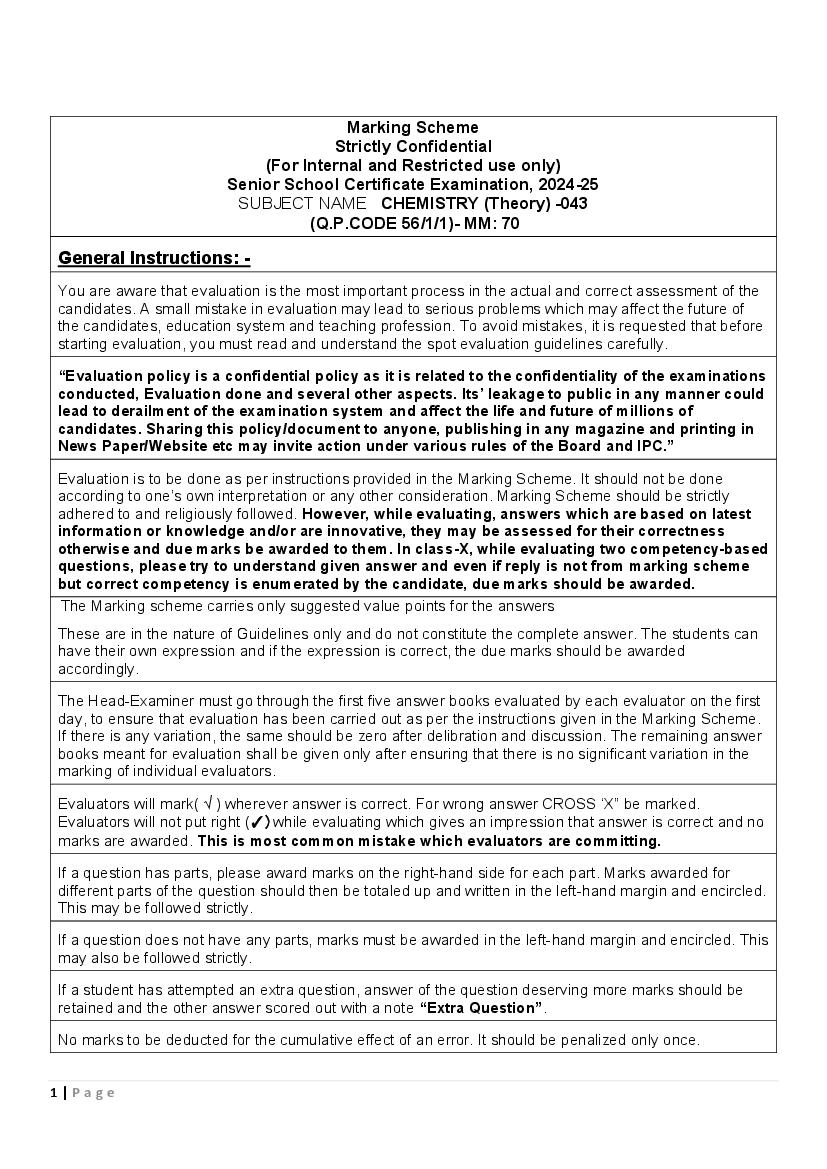
Strictly Confidential
(For Internal and Restricted use only)
Senior School Certificate Examination, 2024-25
SUBJECT NAME CHEMISTRY (Theory) -043
(Q.P.CODE 56/1/1)- MM: 70
General Instructions: -
You are aware that evaluation is the most important process in the actual and correct assessment of the
candidates. A small mistake in evaluation may lead to serious problems which may affect the future of
the candidates, education system and teaching profession. To avoid mistakes, it is requested that before
starting evaluation, you must read and understand the spot evaluation guidelines carefully.
“Evaluation policy is a confidential policy as it is related to the confidentiality of the examinations
conducted, Evaluation done and several other aspects. Its’ leakage to public in any manner could
lead to derailment of the examination system and affect the life and future of millions of
candidates. Sharing this policy/document to anyone, publishing in any magazine and printing in
News Paper/Website etc may invite action under various rules of the Board and IPC.”
Evaluation is to be done as per instructions provided in the Marking Scheme. It should not be done
according to one’s own interpretation or any other consideration. Marking Scheme should be strictly
adhered to and religiously followed. However, while evaluating, answers which are based on latest
information or knowledge and/or are innovative, they may be assessed for their correctness
otherwise and due marks be awarded to them. In class-X, while evaluating two competency-based
questions, please try to understand given answer and even if reply is not from marking scheme
but correct competency is enumerated by the candidate, due marks should be awarded.
The Marking scheme carries only suggested value points for the answers
These are in the nature of Guidelines only and do not constitute the complete answer. The students can
have their own expression and if the expression is correct, the due marks should be awarded
accordingly.
The Head-Examiner must go through the first five answer books evaluated by each evaluator on the first
day, to ensure that evaluation has been carried out as per the instructions given in the Marking Scheme.
If there is any variation, the same should be zero after delibration and discussion. The remaining answer
books meant for evaluation shall be given only after ensuring that there is no significant variation in the
marking of individual evaluators.
Evaluators will mark( √ ) wherever answer is correct. For wrong answer CROSS ‘X” be marked.
Evaluators will not put right (✓)while evaluating which gives an impression that answer is correct and no
marks are awarded. This is most common mistake which evaluators are committing.
If a question has parts, please award marks on the right-hand side for each part. Marks awarded for
different parts of the question should then be totaled up and written in the left-hand margin and encircled.
This may be followed strictly.
If a question does not have any parts, marks must be awarded in the left-hand margin and encircled. This
may also be followed strictly.
If a student has attempted an extra question, answer of the question deserving more marks should be
retained and the other answer scored out with a note “Extra Question”.
No marks to be deducted for the cumulative effect of an error. It should be penalized only once.
1|Page
Page 2
has to be used. Please do not hesitate to award full marks if the answer deserves it.
Every examiner has to necessarily do evaluation work for full working hours i.e., 8 hours every day and
evaluate 20 answer books per day in main subjects and 25 answer books per day in other subjects
(Details are given in Spot Guidelines).This is in view of the reduced syllabus and number of questions in
question paper.
Ensure that you do not make the following common types of errors committed by the Examiner in the
past:-
● Leaving answer or part thereof unassessed in an answer book.
● Giving more marks for an answer than assigned to it.
● Wrong totaling of marks awarded on an answer.
● Wrong transfer of marks from the inside pages of the answer book to the title page.
● Wrong question wise totaling on the title page.
● Wrong totaling of marks of the two columns on the title page.
● Wrong grand total.
● Marks in words and figures not tallying/not same.
● Wrong transfer of marks from the answer book to online award list.
● Answers marked as correct, but marks not awarded. (Ensure that the right tick mark is correctly and
clearly indicated. It should merely be a line. Same is with the X for incorrect answer.)
Half or a part of answer marked correct and the rest as wrong, but no marks awarded.
While evaluating the answer books if the answer is found to be totally incorrect, it should be marked as
cross (X) and awarded zero (0)Marks.
Any unassessed portion, non-carrying over of marks to the title page, or totaling error detected by the
candidate shall damage the prestige of all the personnel engaged in the evaluation work as also of the
Board. Hence, in order to uphold the prestige of all concerned, it is again reiterated that the instructions
be followed meticulously and judiciously.
The Examiners should acquaint themselves with the guidelines given in the “Guidelines for Spot
Evaluation” before starting the actual evaluation.
Every Examiner shall also ensure that all the answers are evaluated, marks carried over to the title page,
correctly totaled and written in figures and words.
The candidates are entitled to obtain photocopy of the Answer Book on request on payment of the
prescribed processing fee. All Examiners/Additional Head Examiners/Head Examiners are once again
reminded that they must ensure that evaluation is carried out strictly as per value points for each answer
as given in the Marking Scheme.
2|Page
Page 3
CHEMISTRY (Theory)- 043
QP CODE 56/1/1 MM: 70
Q. No Value points Mark
SECTION A
1 (A) 1
2 (B) 1
3 (B) 1
4 (D) 1
5 (B) 1
6 (C) 1
7 (C) 1
8 (A) 1
9 (A) 1
10 (D) 1
11 (C) 1
12 (D) 1
13 (A) 1
14 (B) 1
15 (C) 1
16 (B) 1
SECTION B
17 (A) (a) Due to high pressure inside the pressure cooker, higher is the boiling point and 1
faster is the cooking.
(b)
Negative deviation ½
Temperature increases. ½
OR
17 (B)
Same composition in liquid and in vapour phase and boil at a constant temperature. 1
Maximum Boiling Azeotrope ½
68% HNO3 + 32% H2O (Or any other correct example) (Percentage can be ignored) ½
18 1
(a)
(b) 1
19 • Less reactive, 1
• The carbon atom of the carbonyl group of benzaldehyde is less electrophilic than carbon
atom of the carbonyl group present in propanal. / The polarity of the carbonyl group is 1
reduced in benzaldehyde due to resonance.
20 (a) A = CH3CH2CN ; B= CH3CH2 CH2NH2 ½x4
(b) A = C6H5N+2Cl- ;
B=
3|Page
Page 4
1
SECTION C
22 Tb of glucose solution = 100.20°C
Δ Tb =Tb - Tob
= 100.20 o – 100 oC = 0.20 oC or 0.20 K ½
△Tb = Kb .m ½
m = 0.20 = 0.390 mol/kg
0.512
½
1
½
Or -0.725 oC
23 (a) (i) The limiting molar conductivity of an electrolyte can be represented as the sum of the 1
individual contributions of the anion and cation of the electrolyte.
(ii) The amount of chemical reaction which occurs at any electrode during electrolysis by a 1
current is proportional to the quantity of electricity passed through the electrolyte.
(b) ‘X’ is better, as X has more negative electrode potential than Fe / X has more oxidation ½,½
potential than Fe.
24 0.693
t1/2= 𝑘
0.693
k1= 20 = 0.03465 / 3.465 × 10⁻² min-1 ½
0.693 ½
k2= 5 = 0.1386 / 1.386 × 10⁻¹ min-1
½
0.1386 𝐸𝑎 [350−300]
log = ½
0.03465 2.303 ×8.314 [350 ×300]
𝐸𝑎 [50]
log 4 = 19.15 [350 ×300]
Ea = 24209 J mol-1 or 24.209 kJ mol-1 (Deduct ½ mark for no or incorrect unit) 1
4|Page
Page 5
(a) Its high and low .
(b)
Cr
½,½
Cr3+ (d4 to d3) / stable half-filled t2g level
(c) Fully-filled d-orbitals hence no d-d transition / due to the absence of unpaired electron.
1
26. (A) (a)
1
(b)
1
(c)
1
OR
26 (B)
(a)
1
(b)
1
(c)
1
(or any other suitable method of conversion)
27 (a) (CH₃)₂NH < CH₃CH2NH₂ < CH₃CH2OH 1
(b) (i) aromatic halides do not undergo nucleophilic substitution with the anion formed by 1
phthalimide.
(ii)
1
/Due to resonance the lone pair on
nitrogen is less available for donation/ Due to +R effect lone pair of electrons is not easily
available on N of -NH2 group/ Due to -R effect of carbonyl group, electron density on N atom of -
NH2 group decreases.
5|Page
Page 6
Native protein Denatured protein
Three-dimensional structure is intact. Three-dimensional structure is destroyed. 1
Biologically active Biologically inactive
(Or any other one correct difference)
(b) Lactose
(c) Vitamin K 1
1
SECTION D
29 (a) (i) Slowest step. 1
(ii) Series of elementary reactions / Reactions involving two or more steps. 1
(b) Increases with increase in temperature. 1
OR
(b) Molecularity is defined only for elementary reactions whereas order is experimentally
determined hence applicable for both / Because molecularity of each elementary reaction in 1
complex reaction may be different and hence meaningless for overall complex reaction whereas
order of a complex reaction is experimentally determined by the slowest step in its mechanism
and is therefore applicable for both.
(c) 9 times 1
30 (a)
(i)
1
/ 2-Bromophenol and 4-Bromophenol is formed.
(ii)
1
/ 2,4,6-Trinitrophenol / Picric acid is formed.
b)Due to resonance, the lone pair of electrons on oxygen is not easily available for 1
protonation.
c)
Phenol
Due to electron releasing effect (+I effect) of methyl group/ phenoxide ion formed is less stable ½
in cresol. ½
OR
c) 2-Hydroxybenzaldehyde / 2- Hydroxybenzenecarbaldehyde.
1
6|Page
Page 7
31
(A) (a) The cell reaction is
Sn(s)+2H+(aq)→Sn2+(aq)+H2(g) 1
0⋅059 [𝑆𝑛2+ ] 1
ECell = (𝐸 𝑜 𝑐 – 𝐸 𝑜 𝑎 ) - 2
log [𝐻 + ].2
0⋅059 0⋅004
= [(0) − (−0 ⋅ 14)]– 2
𝑙𝑜𝑔 (0⋅02).2
= 0.14 - 0.0295 log 10
= 0.1105 V 1
b) (i) overpotential of O2 1
(ii) Number of ions carrying current per unit volume decreases on dilution 1
OR
31 B) a) At anode:
Pb+SO4−2→PbSO4+2e− ½
At cathode:
PbO2+ SO4−2+4H++2e−→PbSO4+2H2O ½
Overall reaction:
Pb+PbO2+2 SO4−2+4H+ →2PbSO4+2H2O 1
b)
𝟎⋅𝟎𝟓𝟗 [𝑪𝒓𝟑+ ]𝟐
ECell = EoCell - 𝒍𝒐𝒈 [[𝑪𝒓𝟐𝑶𝟕𝟐−] [𝑯+]𝟏𝟒]
𝐧 1
0.059
Ecell = 1.33 – 6 log (10-2)2 /(10-2)( 1 X10⁻⁴ )14 1
0.059
= 1.33 – 6 (54) log 10
= 1.33 – 0.059 x 9
= 1.33 – 0.531
= 0.799 V 1
32 A)a) The orbital splitting energies are not sufficiently large for forcing paring of electrons. 1
b) In the presence of strong field ligand, d7 is converted into more stable d6
configuration / Strong field effect stabilises higher oxidation state. 1
c) Co-ordination isomerism. 1
d) [Ni(H2O)6]2+ has unpaired electrons whereas [Ni(CN)4]2- has no unpaired electron. 1
e) Pentaamminecarbonatocobalt(III) chloride 1
OR
32 B)(a) The higher stability of complexes involving chelating ligands as compare to 1
complexes having non-chelating ligand.
Example: [Co(en)3]3+ (or any other correct example) 1
(b) d2sp3 , diamagnetic 1+1
(c) [Pt (NH3)2 Cl2] 1
7|Page
Page 8
1
1
(ii)
(b) A = (CH3)2CH=CHCH3 / 2-Methylbut-2-ene 1
B = CH3CHO / Ethanal 1
C = CH3COCH3/ Acetone/ Propanone 1
OR
33 A= C3H7COOC4H9 / Butyl butanoate 1
B= C3H7COOH / Butanoic acid ½
C= C4H9OH / Butan-1-ol ½
C3H7COOC4H9+ dil.H2SO4 → C3H7COOH + C4H9OH 1
C4H9OH + Conc. Sulphuric acid + Heat→CH3CH2CH=CH2 1
1
8|Page
Page 9
Page 15
Document Details
| Board / Org | CBSE |
| Exam | Class 12 |
| Type | Solution |
| Pages | 17 |
| Updated | 24 Sep 2026 |