CBSE Class 12 Chemistry Question Paper 2020 Set 56-5-3
Finished viewing? Save it for later —
Download CBSE Class 12 Chemistry Question Paper 2020 Set 56-5-3 (PDF · 16 pages)About CBSE Class 12 Chemistry Question Paper 2020 Set 56-5-3
CBSE Class 12 Chemistry Question Paper 2020 Set 56-5-3 is available here for free download. Published by CBSE for Class 12, this question paper can be viewed online or downloaded as a PDF (16 pages). Candidates preparing for Class 12 can use CBSE Class 12 Chemistry Question Paper 2020 Set 56-5-3 to understand the exam pattern, the type of questions asked, and the overall difficulty level.
Frequently Asked Questions
How can I download CBSE Class 12 Chemistry Question Paper 2020 Set 56-5-3?
Open this page and click the Download button to save CBSE Class 12 Chemistry Question Paper 2020 Set 56-5-3 as a PDF. It is completely free on AglaSem Docs.
Is CBSE Class 12 Chemistry Question Paper 2020 Set 56-5-3 free to download?
Yes. CBSE Class 12 Chemistry Question Paper 2020 Set 56-5-3 can be viewed online and downloaded as a PDF free of cost on AglaSem Docs.
How many pages does CBSE Class 12 Chemistry Question Paper 2020 Set 56-5-3 have?
CBSE Class 12 Chemistry Question Paper 2020 Set 56-5-3 contains 16 pages, which you can read online or download together as a single PDF.
Where can I find more Class 12 study material?
You can find more Class 12 question papers, sample papers, syllabus, and answer keys on AglaSem Docs.
CBSE Class 12 Chemistry Question Paper 2020 Set 56-5-3 – Text
Read the full text of this question paper below — useful to quickly search, copy and reference the content online without downloading the PDF.
📄 View text version (16 pages)
Page 1
OSS/1GRLH/1 .
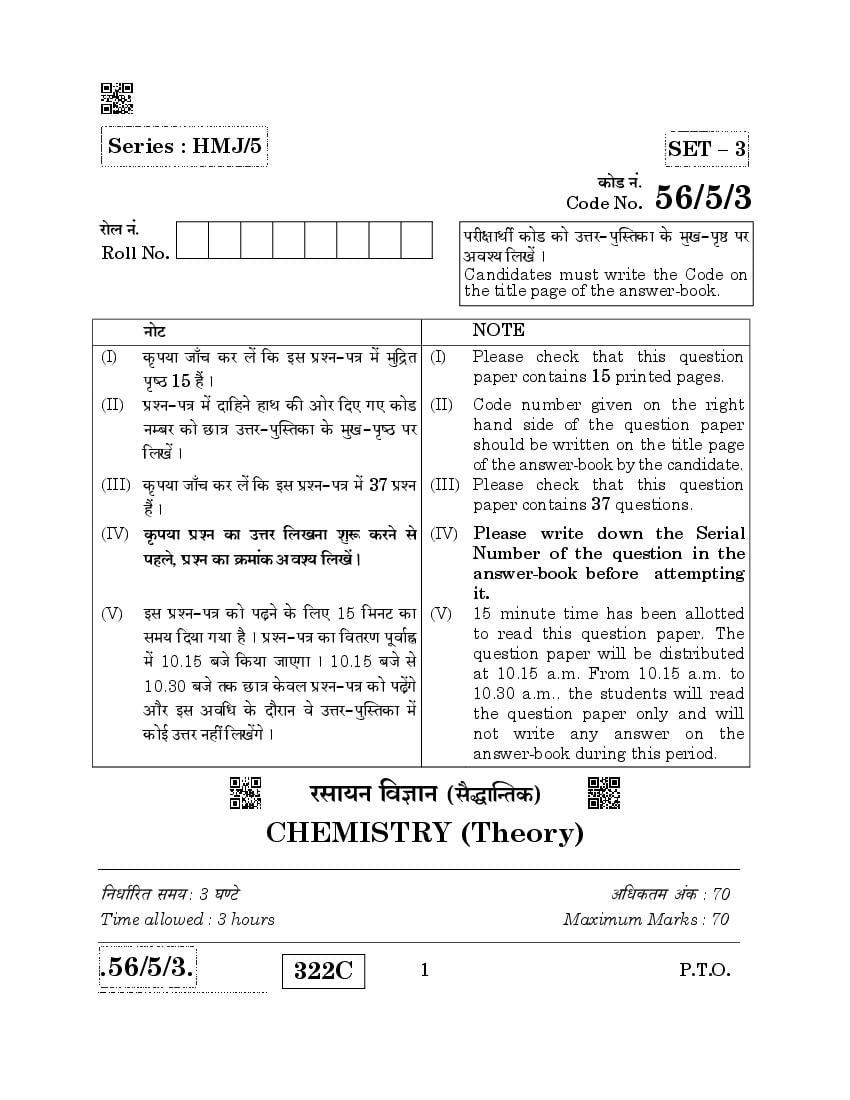
Code No. 56/5/3
. - -
Roll No.
Candidates must write the Code on
the title page of the answer-book.
NOTE
(I) - (I) Please check that this question
15 paper contains 15 printed pages.
(II) - (II) Code number given on the right
- - hand side of the question paper
should be written on the title page
of the answer-book by the candidate.
(III) - 37 (III) Please check that this question
paper contains 37 questions.
(IV) (IV) Please write down the Serial
, Number of the question in the
answer-book before attempting
it.
(V) - 15 (V) 15 minute time has been allotted
- to read this question paper. The
question paper will be distributed
10.15 10.15
at 10.15 a.m. From 10.15 a.m. to
10.30 - 10.30 a.m., the students will read
- the question paper only and will
not write any answer on the
answer-book during this period.
()
CHEMISTRY (Theory)
{ZYm©[aV g‘¶ : 3 KÊQ>o A{YH$V‘ A§H$ : 70
Time allowed : 3 hours Maximum Marks : 70
.56/5/3. 322C 1 P.T.O.
Page 2
(i) - – , ,
(ii) - 37
(iii) - – - 1 20 - , 1
(iv) - – - 21 27 - , 2
(v) - – - 28 34 - -1 , 3
(vi) - – - 35 37 - -2 , 5
(vii) , - , -
-
(viii) , ,
(ix)
.56/5/3. 2
Page 3
Read the following instructions very carefully and strictly follow them :
(i) Question paper comprises four sections – A, B, C and D.
(ii) There are 37 questions in the questions paper. All questions are
compulsory.
(iii) Section – A : Q. No. 1 to 20 are very short answer type questions
carrying one mark each. Answer these questions in one word or one
sentence.
(iv) Section – B : Q. No. 21 to 27 are short answer type questions carrying
two marks each.
(v) Section – C : Q. No. 28 to 34 are long answer type-I questions carrying
three marks each.
(vi) Section – D : Q. No. 35 to 37 are long answer type-II questions carrying
five marks each.
(vii) There is NO overall choice in the question paper. However, an internal
choice has been provided in 2 questions of two marks, 2 questions of
three marks and all the 3 questions of five marks. You have to
attempt only one of the choices in such questions.
(viii) However, separate instructions are given with each section and
question, wherever necessary.
(ix) Use of calculators and log tables is NOT permitted.
.56/5/3. 3 P.T.O.
Page 4
1 5
-
– 1
,
,
, ,
(HX)
XX', XX'3, XX'5 XX7
1. ?
2. ?
3. (HF HI)
4. ?
5. X X ?
6 10 :
6. C5H12 -
7. (CH3)3N (CH3)2NH ?
8. – [Pt(en)2Cl2]2+ – [Pt(en)2Cl2]2+ ?
9.
10. ?
.56/5/3. 4
Page 5
Read the given passage and answer the questions 1 to 5 that follow :
The halogens have the smallest atomic radii in their respective periods.
The atomic radius of fluorine is extremely small. All halogens exhibit – 1
oxidation state. They are strong oxidising agents and have maximum
negative electron gain enthalpy. Among halogens, fluorine shows
anomalous behaviour in many properties. For example electro negativity
and ionisation enthalpy are higher for fluorine than expected whereas
bond dissociation enthalpy, m.p and b.p and electron gain enthalpy are
quite lower than expected. Halogens react with hydrogen to give hydrogen
halides (HX) and combine amongst themselves to form a number of
compounds of the type XX, XX3, XX5 and XX7 called inter-halogens.
1. Why halogens have maximum negative electron gain enthalpy ?
2. Why fluorine shows anomalous behaviour as compared to other halogens ?
3. Arrange the hydrogen halides (HF to HI) in the decreasing order of their
reducing character.
4. Why fluorine is a stronger oxidizing agent than chlorine ?
5. What are the sizes of X and X in the interhalogen compounds ?
Questions 6 to 10 are one word answers :
6. A hydrocarbon C5H12 gives only one monochloride on photochemical
chlorination. Identify the compound.
7. Out of (CH3)3N and (CH3)2NH, which one is more basic in aqueous
solution ?
8. Out of Cis – [Pt(en)2Cl2]2+ and Trans – [Pt(en2)Cl2]2+, which one is
optically active ?
9. Name the method of refining used to obtain semiconductor of very high
purity.
10. Is a homopolymer or copolymer ?
.56/5/3. 5 P.T.O.
Page 6
11. ZnSO4 1 Zn
(a) 3F (b) 2F
(c) 1F (d) 4F
12. Zn ,
(a) EZn2+/Zn = EFe2+/Fe (b) EZn2+/Zn < EFe2+/Fe
(c) EZn2+/Zn > EFe2+/Fe (d)
13.
(a) (b)
(c) (d)
14.
(-O) (III)
(a) [Co(ONO)3 (NH3)3] (b) [Co(NO2)3 (NH3)3]
(c) [Co(ONO2)3 (NH3)3] (d) [Co(NO2) (NH3)3]
15. ?
(a) (b)
(c) (d)
16 20
(A) (A) (R) (R), (A)
(B) (A) (R) (R), (A)
(C) (A) , (R)
(D) (A) , (R)
16. (A) :
(R) : - - ,
-
17. (A) :
(R) :
.56/5/3. 6
Page 7
11. The amount of electricity required to produce one mole of Zn from ZnSO 4
solution will be :
(a) 3F (b) 2F
(c) 1F (d) 4F
12. Zinc is coated over iron to prevent rusting of iron because
(a) EZn2+/Zn = EFe2+/Fe (b) EZn2+/Zn < EFe2+/Fe
(c) EZn2+/Zn > EFe2+/Fe (d) None of these
13. The unit of rate constant depends upon the
(a) molecularity of the reaction.
(b) activation energy of the reaction.
(c) order of the reaction.
(d) temperature of the reaction.
14. The formula of the complex triamminetri(nitrito-O)Cobalt (III) is
(a) [Co(ONO)3 (NH3)3] (b) [Co(NO2)3 (NH3)3]
(c) [Co(ONO2)3 (NH3)3] (d) [Co(NO2) (NH3)3]
15. Which of the following is a disaccharide ?
(a) Glucose (b) Starch
(c) Cellulose (d) Lactose
Questions 16 to 20.
(A) Both Assertion (A) and Reason (R) are correct statements, and
Reason (R) is the correct explanation of the Assertion (A).
(B) Both Assertion (A) and Reason (R) are correct statements, but
Reason (R) is not the correct explanation of the Assertion (A).
(C) Assertion (A) is correct, but Reason (R) is wrong statement.
(D) Assertion (A) is wrong, but Reason (R) is correct statement.
16. Assertion (A) : An ideal solution obeys Henry’s law.
Reason (R) : In an ideal solution, solute-solute as well as solvent-
solvent interactions are similar to solute-solvent
interaction.
17. Assertion (A) : Conductivity of an electrolyte increases with decrease in
concentration.
Reason (R) : Number of ions per unit volume decreases on dilution.
.56/5/3. 7 P.T.O.
Page 8
(R) :
19. (A) :
(R) : ,
20. (A) : C-O-C -
(R) : 20 1 = 20
:
[Fe(CN)6]3–
21. (a)
( : Fe = 26)
(b) ? 1+1=2
22.
(i) HClO4
(ii) XeOF4 1+1=2
23.
(a) NaCN
(b) CO 1+1=2
?
2
24.
(i)
(ii)
1+1=2
.56/5/3. 8
Page 9
nucleophilic addition reactions.
Reason (R) : Ethanal is more sterically hindered.
19. Assertion (A) : Low spin tetrahedral complexes are rarely observed.
Reason (R) : Crystal field splitting energy is less than pairing energy
for tetrahedral complexes.
20. Assertion (A) : The C-O-C bond angle in ethers is slightly less than
tetrahedral angle.
Reason (R) : Due to the repulsive interaction between the two alkyl
groups in ethers. 20 1 = 20
SECTION : B
21. (a) Write the IUPAC name and hybridisation of the complex [Fe(CN)6]3– .
(Given : Atomic number of Fe = 26)
(b) What is the difference between an ambidentate ligand and a
chelating ligand ? 1+1=2
22. Draw the structures of the following :
(i) HClO4
(ii) XeOF4 1+1=2
23. Write the role of
(a) Dilute NaCN in the extraction of Gold.
(b) CO in the extraction of Iron. 1+1=2
OR
How is leaching carried out in the case of low grade copper ores ? Name
the method used for refining of copper metal. 2
24. Identify the monomers in the following polymers :
(i)
(ii)
1+1=2
.56/5/3. 9 P.T.O.
Page 10
?
? 2
26.
? 2
27.
(i)
(ii) 1+1=2
:
28.
(i) H2O2
(ii) 358 K 20% H3PO4 (CH3)3C–OH
(iii) HI 31=3
?
(i) o-
(ii)
(iii) 1+1+1=3
29. A, B, C, D, E F
6½=3
30. AlCl3 0.01 m – 0.068 C
[ Kf = 1.86 K kg mol–1] 3
31. (i) DNA - ?
(ii) D- ?
(iii) ? 1+1+1=3
.56/5/3. 10
Page 11
heterogeneous catalysis ? 2
OR
Define Brownian movement. What is the cause of Brownian movement in
colloidal particles ? How is it responsible for the stability of Colloidal Sol ? 2
26. State Raoult’s law for a solution containing volatile components. What is
the similarity between Raoult’s law and Henry’s law ? 2
27. Define the following terms with a suitable example in each :
(i) Bacteriocidal antibiotics
(ii) Food preservatives. 1+1=2
SECTION : C
28. Give the structures of final products expected from the following reactions :
(i) Hydroboration of propene followed by oxidation with H2O2 in
alkaline medium.
(ii) Dehydration of (CH3)3C–OH by heating it with 20% H3PO4 at 358 K.
(iii) Heating of with HI. 31=3
OR
How can you convert the following ?
(i) Phenol to o-hydroxy benzaldehyde.
(ii) Methanal to ethanol
(iii) Phenol to phenyl ethanoate. 1+1+1=3
29. Identify A, B, C, D, E and F in the following :
6½=3
30. A 0.01 m aqueous solution of AlCl3 freezes at – 0.068 C. Calculate the
percentage of dissociation. [Given : Kf for Water = 1.86 K kg mol–1] 3
31. (i) What are the hydrolysis products of DNA ?
(ii) What happens when D-glucose is treated with Bromine water ?
(iii) What is the effect of denaturation on the structure of proteins ? 1 + 1 + 1 = 3
.56/5/3. 11 P.T.O.
Page 12
, 2A B 2g Cu
? A Zn ?
[ Cu = 63.5 g mol–1, Zn = 65 g mol–1; 1F = 96500 C mol–1] 3
33. 3
(i) (ii) (iii) 1 + 1 + 1 = 3
34.
(i) -
(ii)
(iii) 31=3
:
35. (a)
(i) NaOH CH3CHO
(ii) H2N – NH
NaOH
(iii)
(b)
(i) CH3 – CH = CH – CO – CH3 CH3 – CH2 – CO – CH = CH2
(ii) 3 + (1 + 1) = 5
(a)
CH3
Zn/Hg
(i) C = O
HCl
CH3
NaOH/CaO
(ii)
(a) DIBAL-H
(iii) CH2 = CH – CH2 – CN
(b) H3O+
(b)
CH3COCH3, HCHO, CH3CHO,
(c) 2, 4 – ... 3+1+1=5
.56/5/3. 12
Page 13
and B containing electrolytes ZnSO4 and CuSO4 connected in series, 2 g of
Cu were deposited at the cathode of cell B. How long did the current flow ?
What mass of Zn was deposited at cathode of cell A ?
[Atomic mass : Cu = 63.5 g mol–1, Zn = 65 g mol–1; 1F = 96500 C mol–1] 3
33. Write three differences between lyophobic sol and lyophilic sol. 3
OR
Define the following terms :
(i) Protective colloid (ii) Zeta potential (iii) Emulsifying agent
1+1+1=3
34. Give reasons :
(i) Aniline does not undergo Friedal-Crafts reaction.
(ii) Aromatic primary amines cannot be prepared by Gabriel’s phthalimide
synthesis.
(iii) Aliphatic amines are stronger bases than ammonia. 31=3
SECTION : D
35. (a) Write the products formed when benzaldehyde reacts with the
following reagents :
(i) CH3CHO in presence of dilute NaOH
(ii) H2N – NH
(iii) Conc. NaOH
(b) Distinguish between following :
(i) CH3 – CH = CH – CO – CH3 and CH3 – CH2 – CO – CH = CH2
(ii) Benzaldehyde and Benzoic acid. 3 + (1 + 1) = 5
OR
(a) Write the final products in the following :
CH3
Zn/Hg
(i) C = O
Conc HCl
CH3
NaOH/CaO
(ii)
(a) DIBAL-H
(iii) CH2 = CH – CH2 – CN
(b) H3O+
(b) Arrange the following in the increasing order of their reactivity
towards nucleophilic addition reaction :
CH3COCH3, HCHO, CH3CHO,
(c) Draw the structure of 2, 4 DNP derivative of acetaldehyde. 3+1+1=5
.56/5/3. 13 P.T.O.
Page 14
80% ?
(b)
3+2=5
(a) 50% 300 K 30 320
K 10 (Ea)
(R = 8.314 J K–1 mol–1)
(b)
(c) ?
[ log 2 = 0.3010, log 3 = 0.4771, log 4 = 0.6021, log 5 = 0.6991]
3+1+1=5
37. (a)
(i)
(ii)
(iii) Zn, Cd Hg
(b)
(i) Na2CrO4 Na2Cr2O7
(ii) MnO2 K2MnO4 3+2=5
(a)
(i) Ti3+ Sc3+
(ii) Cr2+
(b)
(c)
2
3 MnO4 + 4H+ 2+2+1=5
___________
.56/5/3. 14
Page 15
value of rate constant. In what time will the reaction be 80%
completed ?
(b) Define order of reaction. Write the condition under which a
bimolecular reaction follows first order kinetics. 3+2=5
OR
(a) A first order reaction is 50% complete in 30 minutes at 300 K and in 10
minutes at 320 K. Calculate activation energy (Ea) for the reaction.
(R = 8.314 J K–1 mol–1)
(b) Write the two conditions for collisions to be effective collisions.
(c) How order of reaction and molecularity differ towards a complex
reaction ?
[Given : log 2 = 0.3010, log 3 = 0.4771, log 4 = 0.6021, log 5 = 0.6991]
3+1+1=5
37. (a) Give reasons :
(i) Transition metals and their compounds show catalytic
activities.
(ii) Separation of a mixture of Lanthanoid elements is difficult.
(iii) Zn, Cd and Hg are soft and have low melting point.
(b) Write the preparation of the following :
(i) Na2Cr2O7 from Na2CrO4
(ii) K2MnO4 from MnO2 3+2=5
OR
(a) Account for the following :
(i) Ti3+ is coloured whereas Sc3+ is colourless in aqueous solution.
(ii) Cr2+ is a strong reducing agent.
(b) Write two similarities between chemistry of lanthanoids and
actinoids.
(c) Complete the following ionic equation :
2
3 MnO4 + 4H+ 2+2+1=5
___________
.56/5/3. 15 P.T.O.
Page 16
Document Details
| Board / Org | CBSE |
| Exam | Class 12 |
| Type | Question Paper |
| Pages | 16 |
| Updated | 22 Jul 2026 |