CBSE Class 12 Chemistry Question Paper 2020 Set 56-B
Finished viewing? Save it for later —
Download CBSE Class 12 Chemistry Question Paper 2020 Set 56-B (PDF · 23 pages)About CBSE Class 12 Chemistry Question Paper 2020 Set 56-B
CBSE Class 12 Chemistry Question Paper 2020 Set 56-B is available here for free download. Published by CBSE for Class 12, this question paper can be viewed online or downloaded as a PDF (23 pages). Candidates preparing for Class 12 can use CBSE Class 12 Chemistry Question Paper 2020 Set 56-B to understand the exam pattern, the type of questions asked, and the overall difficulty level.
Frequently Asked Questions
How can I download CBSE Class 12 Chemistry Question Paper 2020 Set 56-B?
Open this page and click the Download button to save CBSE Class 12 Chemistry Question Paper 2020 Set 56-B as a PDF. It is completely free on AglaSem Docs.
Is CBSE Class 12 Chemistry Question Paper 2020 Set 56-B free to download?
Yes. CBSE Class 12 Chemistry Question Paper 2020 Set 56-B can be viewed online and downloaded as a PDF free of cost on AglaSem Docs.
How many pages does CBSE Class 12 Chemistry Question Paper 2020 Set 56-B have?
CBSE Class 12 Chemistry Question Paper 2020 Set 56-B contains 23 pages, which you can read online or download together as a single PDF.
Where can I find more Class 12 study material?
You can find more Class 12 question papers, sample papers, syllabus, and answer keys on AglaSem Docs.
CBSE Class 12 Chemistry Question Paper 2020 Set 56-B – Text
Read the full text of this question paper below — useful to quickly search, copy and reference the content online without downloading the PDF.
📄 View text version (23 pages)
Page 1
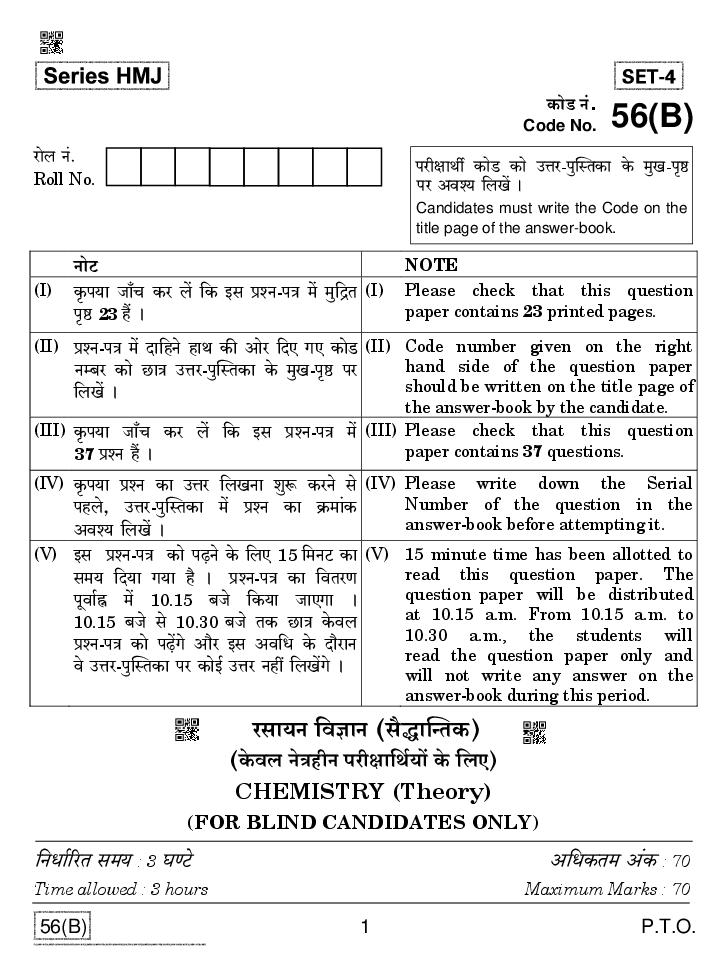
Code No. 56(B)
amob Z§. narjmWu H$moS >H$mo CÎma-nwpñVH$m Ho$ _wI-n¥ð
Roll No. >na Adí` {bIo§ &
Candidates must write the Code on the
title page of the answer-book.
ZmoQ> NOTE
(I) H¥$n`m Om±M H$a b| {H$ Bg àíZ-nÌ _o§ _w{ÐV (I) Please check that this question
n¥ð> 23 h¢ & paper contains 23 printed pages.
(II) àíZ-nÌ _| Xm{hZo hmW H$s Amoa {XE JE H$moS (II) Code number given on the right
>Zå~a H$mo N>mÌ CÎma-nwpñVH$m Ho$ _wI-n¥ð> na hand side of the question paper
{bI| & should be written on the title page of
the answer-book by the candidate.
(III) H¥$n`m Om±M H$a b| {H$ Bg àíZ-nÌ _| (III) Please check that this question
>37 àíZ h¢ & paper contains 37 questions.
(IV) H¥$n`m àíZ H$m CÎma {bIZm ewê$ H$aZo go (IV) Please write down the Serial
nhbo, CÎma-nwpñVH$m _| àíZ H$m H«$_m§H$ Number of the question in the
Adí` {bI| & answer-book before attempting it.
(V) Bg àíZ-nÌ H$mo n‹T>Zo Ho$ {bE 15 {_ZQ >H$m (V) 15 minute time has been allotted to
g_` {X`m J`m h¡ & àíZ-nÌ H$m {dVaU read this question paper. The
nydm©• _| 10.15 ~Oo {H$`m OmEJm & question paper will be distributed
10.15 ~Oo go 10.30 ~Oo VH$ N>mÌ Ho$db at 10.15 a.m. From 10.15 a.m. to
10.30 a.m., the students will
àíZ-nÌ H$mo n‹T>|Jo Am¡a Bg Ad{Y Ho$ Xm¡amZ read the question paper only and
do CÎma-nwpñVH$m na H$moB© CÎma Zht {bI|Jo & will not write any answer on the
answer-book during this period.
agm`Z {dkmZ (g¡ÕmpÝVH$)
(Ho$db ZoÌhrZ narjm{W©`m| Ho$ {bE)
CHEMISTRY (Theory)
(FOR BLIND CANDIDATES ONLY)
{ZYm©[aV g_` : 3 KÊQ>o A{YH$V_ A§H$ : 70
Time allowed : 3 hours Maximum Marks : 70
56(B) 1 P.T.O.
Page 2
{ZåZ{b{IV {ZX}em| H$mo ~hþV gmdYmZr go n{‹T>E Am¡a CZH$m g™Vr go nmbZ H$s{OE :
(i) `h àíZ-nÌ Mma IÊS>m| _| {d^m{OV {H$`m J`m h¡ – H$, I, J Ed§ K & Bg
àíZ-nÌ _| 37 àíZ h¢ & g^r àíZ A{Zdm`© h¢ &
(ii) IÊS> H$ _| àíZ g§»`m 1 go 20 VH$ A{V bKw-CÎmar` àH$ma Ho$ àíZ h¢, àË`oH$ àíZ
1 A§H$ H$m h¡ & àË`oH$ àíZ H$m CÎma EH$ eãX `m EH$ dmŠ` _| Xr{OE &
(iii) IÊS> I _| àíZ g§»`m 21 go 27 VH$ bKw-CÎmar` àH$ma Ho$ àíZ h¢, àË`oH$ àíZ
2 A§H$m| H$m h¡ &
(iv) IÊS> J _| àíZ g§»`m 28 go 34 VH$ XrK©-CÎmar` àH$ma-I Ho$ àíZ h¢, àË`oH$ àíZ
3 A§H$m| H$m h¡ &
(v) IÊS> K _| àíZ g§»`m 35 go 37 VH$ XrK©-CÎmar` àH$ma-II Ho$ àíZ h¢, àË`oH$ àíZ
5 A§H$m| H$m h¡ &
(vi) àíZ-nÌ _| H$moB© g_J« {dH$ën Zht h¡ & VWm{n, Xmo-Xmo A§H$m| Ho$ Xmo àíZm| _|, VrZ-VrZ
A§H$m| Hoo$ Xmo àíZm| _| VWm nm±M-nm±M A§H$m| Ho$ VrZm| àíZm| _| AmÝV[aH$ {dH$ën {X`m
J`m h¡ & Eogo àíZm| _| go Ho$db EH$ hr {dH$ën H$m CÎma Xr{OE &
(vii) BgHo$ A{V[aº$, Amdí`H$VmZwgma, àË`oH$ IÊS> Am¡a àíZ Ho$ gmW `Wmo{MV {ZX}e {XE
JE h¢ &
(viii) Ho$ëHw$boQ>a AWdm bm°J Q>o~b Ho$ à`moJ H$s AZw_{V Zht h¡ &
IÊS> H$
{XE JE AZwÀN>oX H$mo n{‹T>E VWm àíZ g§»`m 1 go 5 Ho$ CÎma Xr{OE : 15=5
1962 ‘| Zrb ~Q>©boQ> Zo AmpÊdH$ Am°³grOZ Am¡a PtF6 H$s A{^{H«$¶m go EH$
g§Hw$b ¶m¡{JH$ H$m {daMZ {H$¶m & V~ CgZo EH$ CËH¥$îQ J¡g Am¡a PtF6 Ho$ ~rM
A{^{H«$¶m Ûmam EH$ bmb a§J H$m ¶m¡{JH$ àmßV {H$¶m & CËH¥$îQ> J¡gm| Ho$
g§¶moOH$Vm H$moe H$m nyU© ^[aV Bbo³Q´>m°{ZH$ {dݶmg hmoVm h¡ Am¡a gm‘mݶ
n[apñW{V¶m| ‘| ¶o EH$na‘mpÊdH$ hmoVr h¢ & BZHo$ ³dWZm§H$ {ZåZ hmoVo h¢ & µOrZm°Z
H$s âbwAmoarZ Ho$ gmW à˶j A{^{H«$¶m Ûmam + 2, + 4 Am¡a + 6 Am°³grH$aU
AdñWmAm| dmbo ¶m¡{JH$ {Z{‘©V hmoVo h¢ & XeF4, Ob Ho$ gmW A˶ÝV Vrd«Vm Ho$
gmW A{^{H«$¶m H$aHo$ XeO3 XoVr h¡ & µOrZm°Z Ho$ ¶m¡{JH$m| H$s Á¶m{‘{V CgHo$
g§¶moOH$Vm H$moe ‘| CnpñWV Hw$b Bbo³Q´>m°Z ¶wJbm| H$s g§»¶m H$mo ܶmZ ‘| aIVo
hþE ì¶wËnÞ H$s Om gH$Vr h¡ &>
56(B) 2
Page 3
Read the following instructions very carefully and strictly follow them :
(i) This question paper comprises four Sections – A, B, C and D.
There are 37 questions in the question paper. All questions are
compulsory.
(ii) Section A – Questions no. 1 to 20 are very short answer type
questions, carrying 1 mark each. Answer these questions in one
word or one sentence.
(iii) Section B – Questions no. 21 to 27 are short answer type questions,
carrying 2 marks each.
(iv) Section C – Questions no. 28 to 34 are long answer type-I
questions, carrying 3 marks each.
(v) Section D – Questions no. 35 to 37 are long answer type-II
questions, carrying 5 marks each.
(vi) There is no overall choice in the question paper. However, an
internal choice has been provided in 2 questions of two marks,
2 questions of three marks and all the 3 questions of five marks.
You have to attempt only one of the choices in such questions.
(vii) In addition to this, separate instructions are given with each section
and question, wherever necessary.
(viii) Use of calculators and log tables is not permitted.
SECTION A
Read the given passage and answer the questions number 1 to 5 that
follow : 15=5
In 1962, Neil Bartlett prepared a complex compound by
reacting molecular oxygen and PtF6. Then he carried out the
reaction between a noble gas and PtF6 and obtained a red
coloured compound. The noble gases have completely filled
electronic configuration in their valence shell and are
monoatomic under normal conditions. They possess low boiling
points. The direct reaction of Xenon with Fluorine leads to a
series of compounds with oxidation states + 2, + 4 and + 6.
XeF4 reacts violently with water to give XeO3. The geometries
of compounds of Xenon can be deduced considering the total
number of electron pairs in the valence shell.
56(B) 3 P.T.O.
Page 4
ào[aV {H$¶m hmoJm ? 1
2. hr{b¶‘ Am¡a µOrZm°Z ‘| go H$m¡Z-gm EH$ AmgmZr go ¶m¡{JH$ ~Zm gH$Vr h¡ Am¡a
³¶m| ? 1
3. ³bmoarZ H$s Anojm âbwAmoarZ H$s Am~ÝY {d¶moOZ EÝW¡ënr H$‘ hmoVr h¡ &
³¶m| ? 1
4. XeF2 Ho$ Ob-AnKQ>Z Ho$ {bE g§Vw{bV amgm¶{ZH$ g‘rH$aU {b{IE & 1
5. {ZAm°Z H$m EH$ Cn¶moJ {b{IE & 1
àíZ g§»¶m 6 go 10 Ho$ CÎma EH$ eãX AWdm EH$ dm³¶ ‘| Xr{OE & 15=5
6. ‘³¶y©ar gob H$m gob {d^d g§nyU© H$m¶© Ad{Y ‘| pñWa ³¶m| ahVm h¡ ? 1
7. H$m°na gë’o$Q> {db¶Z ‘| O~ qµOH$ H$s N>‹S> Sw>~moB© OmVr h¡, Vmo CgH$m Zrbm a§J
Yrao-Yrao {dg{O©V hmo OmVm h¡ & ì¶m»¶m H$s{OE & 1
8. [Pt(NH3)5 Cl] Cl3 H$m AmB©.¶y.nr.E.gr. Zm‘ {b{IE & 1
9. h¡bmoEoarZ ‘| Bbo³Q´>m°ZamJr A{^{H«$¶mE± ‘§X hmoVr h¢ & ³¶m| ? 1
10. Ob ‘| nmoQ>¡{e¶‘ gë’o$Q> Ho$ VZw {db¶Z Ho$ {bE dmÝQ> hm°’$ JwUH$ H$m ‘mZ
{b{IE & 1
56(B) 4
Page 5
Xe and PtF6 ? 1
2. Out of Helium and Xenon, which one can easily form
compounds and why ? 1
3. The bond dissociation enthalpy of Fluorine is less than that of
chlorine. Why ? 1
4. Write the balanced chemical equation for the hydrolysis of
XeF2. 1
5. Give one use of Neon. 1
Questions number 6 to 10 are to be answered in one word or in one
sentence. 15=5
6. Why does the cell potential of a mercury cell remain constant
throughout its life ? 1
7. Why is the blue colour of copper sulphate solution slowly
discharged when a rod of zinc is dipped in it ? 1
8. Write the IUPAC name of [Pt(NH3)5 Cl] Cl3. 1
9. Electrophilic reactions in haloarenes occur slowly. Why ? 1
10. Write the value of the van’t Hoff factor for a dilute solution of
potassium sulphate in water. 1
56(B) 5 P.T.O.
Page 6
11. Cg g§Hw$b Am¶Z H$mo B§{JV H$s{OE Omo Á¶m{‘Vr¶ g‘md¶dVm Xem©Vm h¡ & 1
(A) [Cr(H2O)4 Cl2]+
(B) [Pt(NH3)3 Cl]+
(C) [Co(NH3)6]3+
(D) [Co(CN)5 (NC)]3–
CH3
|
12. gyÌ CH3 – C = CH – COOH Ho$ {bE AmB©.¶y.nr.E.gr. Zm‘ h¡ 1
(A) 2-‘o{Wbã¶yQ>-2-BZm°BH$ Aåb
(B) 3-‘o{Wbã¶yQ>-3-BZm°BH$ Aåb
(C) 3-‘o{Wbã¶yQ>-2-BZm°BH$ Aåb
(D) 2-‘o{Wbã¶yQ>-3-BZm°BH$ Aåb
13. {ZåZ{b{IV ‘| go H$m¡Z-gm S>mBg¡H¡$amBS> h¡ ? 1
(A) ñQ>mM©
(B) ‘mëQ>mog
(C) ’«$³Q>mog
(D) ½byH$mog
56(B) 6
Page 7
11. Indicate the complex ion which shows geometrical isomerism. 1
(A) [Cr(H2O)4 Cl2]+
(B) [Pt(NH3)3 Cl]+
(C) [Co(NH3)6]3+
(D) [Co(CN)5 (NC)]3–
12. The IUPAC name for the formula 1
CH3
|
CH3 – C = CH – COOH is
(A) 2-Methylbut-2-enoic acid
(B) 3-Methylbut-3-enoic acid
(C) 3-Methylbut-2-enoic acid
(D) 2-Methylbut-3-enoic acid
13. Which of the following is a disaccharide ? 1
(A) Starch
(B) Maltose
(C) Fructose
(D) Glucose
56(B) 7 P.T.O.
Page 8
(A) àmoQ>rZ
(B) S>mBݶyp³b`moQ>mBS>
(C) ݶy³brH$ Aåb
(D) hm°‘m}Z
15. {ZåZ{b{IV B dJ© Ho$ {dQ>m{‘Zm| ‘| go H$m¡Z-gm h‘mao eara ‘| ^§S>m[aV hmo gH$Vm
h¡ ? 1
(A) {dQ>m{‘Z B1
(B) {dQ>m{‘Z B2
(C) {dQ>m{‘Z B6
(D) {dQ>m{‘Z B12
àíZ g§»`m 16 go 20 Ho$ {bE, Xmo H$WZ {XE JE h¢ {OZ_| EH$ H$mo A{^H$WZ (A)
VWm Xÿgao H$mo H$maU (R) Ûmam A§{H$V {H$`m J`m h¡ & BZ àíZm| Ho$ ghr CÎma ZrMo
{XE JE H$moS>m| (i), (ii), (iii) Am¡a (iv) _| go MwZH$a Xr{OE : 15=5
(i) A{^H$WZ (A) Am¡a H$maU (R) XmoZm| ghr H$WZ h¢ Am¡a H$maU (R),
A{^H$WZ (A) H$s ghr ì¶m»¶m h¡ &
(ii) A{^H$WZ (A) Am¡a H$maU (R) XmoZm| ghr H$WZ h¢, naÝVw H$maU (R),
A{^H$WZ (A) H$s ghr ì¶m»¶m Zht h¡ &
(iii) A{^H$WZ (A) ghr h¡, naÝVw H$maU (R) µJbV H$WZ h¡ &
(iv) A{^H$WZ (A) µJbV h¡, naÝVw H$maU (R) ghr H$WZ h¡ &
16. A{^H$WZ (A) : {ZH¡$b H$m emoYZ ‘m°ÝS> àH«$‘ Ûmam {H$¶m Om gH$Vm h¡ &
H$maU (R) : Ni(CO)4 EH$ dmînerb ¶m¡{JH$ h¡ Omo 460 K na {dK{Q>V
hmoH$a ewÕ {ZH¡$b XoVm h¡ & 1
56(B) 8
Page 9
(A) Proteins
(B) Dinucleotides
(C) Nucleic acids
(D) Hormones
15. Which of the following B group vitamins can be stored in our
body ? 1
(A) Vitamin B1
(B) Vitamin B2
(C) Vitamin B6
(D) Vitamin B12
For questions number 16 to 20, two statements are given one
labelled Assertion (A) and the other labelled Reason (R).
Select the correct answer to these questions from the codes
(i), (ii), (iii) and (iv) as given below : 15=5
(i) Both Assertion (A) and Reason (R) are correct
statements, and Reason (R) is the correct explanation of
the Assertion (A).
(ii) Both Assertion (A) and Reason (R) are correct
statements, but Reason (R) is not the correct explanation
of the Assertion (A).
(iii) Assertion (A) is correct, but Reason (R) is incorrect
statement.
(iv) Assertion (A) is incorrect, but Reason (R) is correct
statement.
16. Assertion (A) : Nickel can be purified by the Mond process.
Reason (R) : Ni(CO)4 is a volatile compound which
decomposes at 460 K to give pure nickel. 1
56(B) 9 P.T.O.
Page 10
Adjon Zht XoVm h¡ &
H$maU (R) : ³bmoarZ Am¶ZH$mar ‘ÊS>b ‘| CnpñWV Zht h¡ & 1
18. A{^H$WZ (A) : p-H«$sgm°b H$s VwbZm ‘| p-ZmBQ´>mo’$sZm°b EH$ à~bVa Aåb h¡ &
H$maU (R) : àH¥${V _| ZmBQ´>mo (NO2) g‘yh EH$ Bbo³Q´>m°Z {d‘moMH$ g‘yh h¡
O~{H$ – CH3 g‘yh Bbo³Q´>m°Z AnZ¶H$ g‘yh h¡ & 1
19. A{^H$WZ (A) : g^r EopëS>hmBS>| EoëS>mob g§KZZ ‘| ^mJ Zht boVo h¢ &
H$maU (R) : EoëS>mob g§KZZ ‘| jma Ûmam -H na‘mUw Ho$ AnZ¶Z H$a boZo
go H$m~©-G Um¶Z CËnÞ hmoVm h¡ & 1
20. A{^H$WZ (A) : {dQ>m{‘Z D H$mo h‘mao eara ‘| ^§S>m[aV {H$¶m Om gH$Vm h¡ &
H$maU (R) : {dQ>m{‘Z D Ob-{dbo¶ {dQ>m{‘Z h¡ & 1
IÊS>> I
21. ewÕ {dbm¶H$m| H$s VwbZm ‘| Admînerb {dbo¶ dmbo {db¶Zm| H$m ³dWZm§H$
CÀMVa ³¶m| hmoVm h¡ ? ³dWZm§H$ CÞ¶Z EH$ AUwg§»¶ JwUY‘© ³¶m| h¡ ? 2
AWdm
ewîH$ hþE ’$bm| Ed§ gpãµO¶m| H$mo O~ Ob ‘| aIm OmVm h¡, Vmo do Yrao-Yrao ’y$bH$a
‘yb ê$n ‘| dmng Am OmVo h¢ & ³¶m| ? ³¶m Vmn ‘| d¥{Õ Bg àH«$‘ H$s J{V Vrd«
H$a XoJm ? ì¶m»¶m H$s{OE & 2
56(B) 10
Page 11
with silver nitrate solution.
Reason (R) : Chlorine is not present in the ionizing sphere. 1
18. Assertion (A) : p-nitro phenol is a stronger acid than p-cresol.
Reason (R) : NO2 group is an electron releasing group while
– CH3 group is electron withdrawing in nature. 1
19. Assertion (A) : All aldehydes do not take part in aldol
condensation.
Reason (R) : In aldol condensation, carbanion is generated
by the abstraction of -H atom by the base. 1
20. Assertion (A) : Vitamin D can be stored in our body.
Reason (R) : Vitamin D is a water-soluble vitamin. 1
SECTION B
21. Why does a solution containing non-volatile solutes have a
higher boiling point than pure solvents ? Why is elevation in
boiling point a colligative property ? 2
OR
When fruits and vegetables that have dried up are placed in
water, they slowly swell and return to original form. Why ?
Will a temperature increase accelerate the process ? Explain. 2
56(B) 11 P.T.O.
Page 12
AWdm
H$maU Xr{OE :
(a) A{^{H«$¶m H$s nyar Ad{Y ‘| A{^{H«$¶m doJ pñWa Zht ahVm & 1
(b) {H«$ñQ>brH¥$V eH©$am H$s Anojm My{U©V eH©$am Ob ‘| VoOr go Kwb OmVr h¡ & 1
23. {ZåZ{b{IV H$s ^y{‘H$m {b{IE :
(a) H$m°na Ho$ {ZîH$f©U ‘| {g{bH$m H$s 1
(b) bmoho Ho$ {ZîH$f©U ‘| CO H$s 1
24. H$maU Xr{OE :
(a) {dewÕ {db¶Z {Q>ÝS>b à^md Zht Xem©Vo h¢ & 1
(b) AmЩ {’$Q>H$ar H$mo MmoQ> na aJ‹S>Zo go a³V H$m ~hZm éH$ OmVm h¡ & 1
25. àmW{‘H$ EopëH$b h¡bmBS> (A), C4H9Br EoëH$mohm°br KOH Ho$ gmW A{^{H«$¶m
H$aHo$ ¶m¡{JH$ (B) XoVm h¡ & O~ ¶m¡{JH$ (B) H$s HBr Ho$ gmW A{^{H«$¶m H$s JB©
Vmo CgZo (C) {X¶m Omo (A) H$m g‘md¶d h¡ & gmo{S>¶‘ YmVw Ho$ gmW O~ (A) H$s
A{^{H«$¶m H$s JB© Vmo CgZo ¶m¡{JH$ (D), C8H18 {X¶m Omo Cg ¶m¡{JH$ go {^Þ h¡
Omo n-ã¶y{Q>b ~«mo‘mBS> H$s gmo{S>¶‘ YmVw Ho$ gmW A{^{H«$¶m H$aZo na àmßV hþAm &
A, B, C Am¡a D H$s g§aMZmE± {b{IE & 2
26. Amn H¡$go n[ad{V©V H$a|Jo : 1+1=2
(a) µ\$sZm°b H$mo {n{H«$H$ Aåb _|
(b) EoWoZ¡b H$mo àmonoZ-2-Am°b _|
27. {ZåZ{b{IV ~hþbH$m| Ho$ ¶wJbm| Ho$ ~rM EH$ AÝVa Xr{OE :
(a) g‘~hþbH$ Am¡a gh~hþbH$ 1
(b) VmngwKQ>ç ~hþbH$ Am¡a VmnÑ‹T> ~hþbH$ 1
56(B) 12
Page 13
reaction. 2
OR
Give reasons :
(a) The rate of a reaction does not remain constant
throughout the course of reaction. 1
(b) Powdered sugar dissolves in water faster than crystalline
sugar. 1
23. Write the the role of the following :
(a) Silica in the extraction of copper 1
(b) CO in the extraction of iron 1
24. Give reasons :
(a) True solutions do not show Tyndall effect. 1
(b) Bleeding stops by rubbing moist alum on the cut. 1
25. Primary alkyl halide (A), C4H9Br reacted with alcoholic
KOH to give compound (B). Compound (B) when reacted with
HBr gives (C) which is an isomer of (A). When (A) was reacted
with sodium metal it gave a compound (D), C8H18 that was
different from the compound obtained when n-butyl bromide
was reacted with sodium metal. Give the structures of A, B, C
and D. 2
26. How will you convert : 1+1=2
(a) Phenol to Picric acid
(b) Ethanal to Propan-2-ol
27. Give one difference between the following pairs of polymers :
(a) Homopolymers and Copolymers 1
(b) Thermoplastic polymers and Thermosetting polymers 1
56(B) 13 P.T.O.
Page 14
28. H¡$pëg¶‘ ³bmoamBS> (‘moba Ð춑mZ = 111 g mol–1) Ho$ Cg Ð춑mZ H$m
n[aH$bZ H$s{OE, {Ogo 500 g Ob ‘| KmobZo na CgHo$ {h‘m§H$ ‘| 2 K H$s
H$‘r hmo OmE, ¶h ‘mZVo hþE {H$ H¡$pëg¶‘ ³bmoamBS> Ob ‘| nyU©V… {d¶mo{OV hmo
J¶m h¡ & [ Ob Ho$ {bE Kf = 1·86 K kg mol–1 ] 3
AWdm
95 g Ob ‘| 5 g Admînerb {dbo¶ KmobH$a EH$ {db¶Z ~Zm¶m J¶m &
298 K na BgH$m dmîn Xm~ 23·375 mm Hg h¡ & {dbo¶ H$m ‘moba Ð춑mZ
n[aH${bV H$s{OE & [298 K na ewÕ Ob H$m dmîn Xm~ 23·75 mm Hg h¡] 3
29. `{X {H$gr àW‘ H$mo{Q> H$s A{^{H«$¶m ‘| A H$m AY© Am¶w H$mb 2 {‘ZQ> h¡, Vmo
[A]0 H$mo AnZr àmapå^H$ gmÝÐVm Ho$ 10% VH$ nhþ±MZo ‘| {H$VZm g‘¶ bJoJm ? 3
AWdm
EH$ Img A{^{H«$¶m A Ho$ à{V àW‘ H$mo{Q> VWm B Ho$ à{V {ÛVr¶ H$mo{Q> H$s h¡ &
AdH$b doJ g‘rH$aU {b{IE & doJ {H$g àH$ma à^m{dV hmoJm
(a) B H$s gmÝÐVm VrZ JwZr H$aZo na, Am¡a
(b) A VWm B XmoZm| H$s gmÝÐVm XþJwZr H$aZo na ? 1+1+1=3
30. H$maU Xr{OE : 13=3
(a) {H$gr R>mog Ho$ n¥îR> na J¡g H$m A{YemofU gm‘mݶV… EÝQ´>m°nr ‘| H$‘r Ho$
gmW hmoVm h¡, {’$a ^r ¶h ñdV…àd{V©V àH«$‘ h¡ &
(b) g_wwÐ Ho$ Ob Am¡a ZXr Ho$ Ob Ho$ {‘bZ ñWb na S>oëQ>m ~Z OmVm h¡ &
(c) Áda Ho$ Xm¡amZ nmMZ à^m{dV hmo OmVm h¡ &
56(B) 14
Page 15
28. Calculate the amount of calcium chloride (Molar mass =
111 g mol–1) which must be added to 500 g of water to lower its
freezing point by 2 K, assuming calcium chloride is completely
dissociated. [Kf for water = 1·86 K kg mol–1] 3
OR
A solution was prepared by dissolving 5 g of non-volatile
solute in 95 g of water. It has a vapour pressure of
23·375 mm Hg at 298 K. Calculate the molar mass of the
solute. [Vapour pressure of pure water at 298 K is
23·75 mm Hg] 3
29. If half-life period for a first order reaction in A is 2 minutes,
how long will it take [A]0 to reach 10% of its initial
concentration ? 3
OR
A particular reaction is first order in A and second order in B.
Write the differential rate equation. How is the rate affected
when
(a) concentration of B is tripled, and
(b) concentrations of both A and B are doubled ? 1+1+1=3
30. Give reasons : 13=3
(a) Adsorption of a gas on the surface of a solid is generally
accompanied by decrease in entropy, still it is a
spontaneous process.
(b) A delta is formed at the meeting point of sea water and
river water.
(c) Digestion gets affected during fever.
56(B) 15 P.T.O.
Page 16
(iii) ‘| gmÝÐ gëâ¶y[aH$ Aåb {‘bmH$a à˶oH$ H$mo Ja_ {H$¶m J¶m & nhMm{ZE
Cn¶w©³V _| go {H$Z naIZ{b¶m| ‘| {ZåZ{b{IV n[adV©Z ào{jV hm|Jo & amgm¶{ZH$
A{^{H«$¶mAm| Ho$ g_rH$aUm| H$s ghm¶Vm go AnZo CÎma H$m g‘W©Z H$s{OE & 13=3
(a) a§JhrZ J¡g Ho$ CËgO©Z Ho$ gmW nrbo MyU© H$m bwßV hmo OmZm &
(b) H$mbo nXmW© H$m ~ZZm &
(c) ^yao nXmW© H$m ~ZZm Omo VZwH$aU na Zrbm hmo OmVm h¡ &
32. EoëH$sZm| go EoëH$mohm°bm| Ho$ {daMZ H$s {H«$¶m{d{Y {b{IE (Aåb CËào[aV
Ob¶moOZ) & 3
1
33. {ZåZ{b{IV ‘| A Am¡a B H$s g§aMZmE± {b{IE : 6 =3
2
H2 , Pd BaSO4 H2NOH
(a) CH3COCl A B
(i) CO2 PCl 5
(b) CH3MgBr A B
(ii) H3O
(c) NaOH
C6H5COOH
gmoS>m bmB‘
A B
Ja‘
34. (a) {H$g dJ© Ho$ Am¡fY {ZÐmOZH$ Jmo{b¶m| Ho$ ê$n ‘| à¶w³V hmoVo h¢ ?
(b) Am‘me¶ ‘| AåbVm Ho$ H$maU H$mo {Z¶§{ÌV H$aZo Ho$ {bE ³¶m à¶w³V {H$¶m
OmVm h¡ ?
(c) Hw$N> An‘mO©H$m| H$s àH¥${V H$mo AO¡d-{ZåZrH$aUr¶ H$m¡Z ~Zm XoVm h¡ ? 3
56(B) 16
Page 17
each of the three test tubes (i) to (iii) containing cane sugar,
copper turnings and sulphur powder respectively. Identify in
which of the above test tubes the following changes will be
observed. Support your answer with the help of equations of
chemical reactions. 13=3
(a) Disappearance of yellow powder along with evolution of
colourless gas.
(b) Formation of a black substance.
(c) Formation of a brown substance which on dilution
becomes blue.
32. Write the mechanism for the preparation of alcohols from
alkenes (Acid Catalyzed Hydration). 3
1
33. Write the structures of A and B in the following : 6 =3
2
H2 , Pd BaSO4 H2NOH
(a) CH3COCl A B
(i) CO2 PCl 5
(b) CH3MgBr A B
(ii) H3O
NaOH Soda Lime
(c) C6H5COOH A B
Heat
34. (a) What class of drugs are used as sleeping pills ?
(b) What is used to control the cause of acidity in the
stomach ?
(c) What makes some of the detergents non-biodegradable in
nature ? 3
56(B) 17 P.T.O.
Page 18
35. 298 K na {ZåZ{b{IV A{^{H«$¶m Ho$ {bE Eogob Am¡a rGo n[aH${bV
H$s{OE :
A + B2+ (0·001 M) A2+ (0·0001 M) + B
[{X¶m J`m h¡ : Egob = 2·6805 V, 1 F = 96,500 C mol–1,
log 10 = 1] 5
AWdm
(a) 0·05 mol L–1 NaOH {db¶Z Ho$ H$m°b‘ H$m d¡ÚwV² à{VamoY
5·55 103 ohm h¡ & BgH$m ì¶mg 1 cm Ed§ bå~mB© 50 cm h¡ &
BgH$s à{VamoYH$Vm, MmbH$Vm VWm ‘moba MmbH$Vm n[aH${bV H$s{OE &
{X¶m J`m h¡ : = 3·14
(b) H$maU Xr{OE :
(i) {dÚwV² D$Om© CËnmXZ Ho$ {bE D$î‘r¶ g§`§Ìm| H$s Anojm BªYZ gobm|
H$s dar¶Vm Xr OmVr h¡ &
(ii) J¡ëdZrH¥$V nmBn ‘| qµOH$ H$s naV I§{S>V hmoZo Ho$ CnamÝV ^r bmoho ‘|
O§J Zht bJVr & 3+2=5
56(B) 18
Page 19
35. Calculate Eocell and rGo for the following reaction at
298 K :
A + B2+ (0·001 M) A2+ (0·0001 M) + B
[Given : Ecell = 2·6805 V, 1 F = 96,500 C mol–1,
log 10 = 1] 5
OR
(a) The electrical resistance of a column of
0·05 mol L–1 NaOH solution of diameter 1 cm and length
50 cm is 5·55 103 ohms. Calculate the resistivity,
conductivity and molar conductivity. Given : = 3·14
(b) Give reasons :
(i) Fuel cells are preferred for production of electrical
energy than thermal plants.
(ii) Iron does not rust even if zinc coating is broken in a
galvanized pipe. 3+2=5
56(B) 19 P.T.O.
Page 20
(b) {ZåZ{b{IV Ho$ {bE H$maU Xr{OE :
(i) Eop³Q>Zm°¶S>| Am°³grH$aU AdñWmAm| H$m A{YH$ namg Xem©Vr h¢ &
(ii) MnO H$s àH¥${V jmaH$s¶ h¡ O~{H$ Mn2O7 H$s Aåbr¶ h¡ &
(iii) g§H«$‘U YmVwE± a§JrZ ¶m¡{JH$ ~ZmVr h¢ & 2+3=5
AWdm
(a) nmBamobwgmBQ> A`ñH$ (MnO2) go KMnO4 ~ZmZo H$s {d{Y {b{IE &
(b) {ZåZ{b{IV Ho$ {bE H$maU Xr{OE :
(i) g§H«$‘U YmVwE± {‘lmVw ~ZmVr h¢ &
(ii) b¡ÝWoZm¶S> AmHw§$MZ H$s VwbZm ‘| Eop³Q>Zm°¶S> AmHw§$MZ A{YH$ hmoVm
h¡ &
(iii) Mn3+ àH¥${V ‘| à~b Am°³grH$maH$ h¡ O~{H$ Cr2+ à~b
AnMm¶H$ h¡ & 2+3=5
37. C7H7ON AUwgyÌ dmbm H$moB© Eoamo‘¡{Q>H$ ¶m¡{JH$ (A) ZrMo Xem©B© JB© AmZwH«${‘H$
A{^{H«$¶mE± XoVm h¡ & {ZåZ{b{IV A{^{H«$¶mAm| ‘| A, B, C, D Ed§ E H$s
g§aMZmE± {b{IE : 5
AWdm
56(B) 20
Page 21
(b) Account for the following :
(i) Actinoids show a wide range of oxidation states.
(ii) MnO is basic whereas Mn2O7 is acidic in nature.
(iii) Transition metals form coloured compounds. 2+3=5
OR
(a) Write the preparation of KMnO4 from pyrolusite ore
(MnO2).
(b) Account for the following :
(i) Transition metals form alloys.
(ii) Actinoids contraction is greater than lanthanoids
contraction.
(iii) Mn3+ is strongly oxidizing whereas Cr2+ is strongly
reducing in nature. 2+3=5
37. An aromatic compound (A) of molecular formula C7H7ON
undergoes a series of reactions as shown below. Write the
structures of A, B, C, D and E in the following reactions : 5
OR
56(B) 21 P.T.O.
Page 22
Xr{OE :
(i) Eo{ZbrZ Am¡a N-‘o{WbEo{ZbrZ
(ii) Eo{ZbrZ Am¡a E{WbEo‘rZ
(b) {ZåZ{b{IV A{^{H«$¶mAm| ‘| A Am¡a B H$mo nhMm{ZE : 2+3=5
Sn HCl Br2 (Am{Y³¶)
(i) C6H5NO2 A B
HNO2 PCl 5
(ii) CH3NH2 A B
AgCN Sn HCl
(iii) C2H5Cl A B
56(B) 22
Page 23
pairs of compounds :
(i) Aniline and N-methylaniline
(ii) Aniline and Ethylamine
(b) Identify A and B in the following reactions : 2+3=5
Sn HCl Br2 (Excess)
(i) C6H5NO2 A B
HNO2 PCl 5
(ii) CH3NH2 A B
AgCN Sn HCl
(iii) C2H5Cl A B
56(B) 23 P.T.O.
Document Details
| Board / Org | CBSE |
| Exam | Class 12 |
| Type | Question Paper |
| Pages | 23 |
| Updated | 22 Jul 2026 |