PU CET PG 2019 Question Paper LLM
Finished viewing? Save it for later —
Download PU CET PG 2019 Question Paper LLM (PDF · 14 pages)About PU CET PG 2019 Question Paper LLM
PU CET PG 2019 Question Paper LLM is available here for free download. Published by Punjab University for PU CET PG, this question paper can be viewed online or downloaded as a PDF (14 pages). Candidates preparing for PU CET PG can use PU CET PG 2019 Question Paper LLM to understand the exam pattern, the type of questions asked, and the overall difficulty level.
Frequently Asked Questions
How can I download PU CET PG 2019 Question Paper LLM?
Open this page and click the Download button to save PU CET PG 2019 Question Paper LLM as a PDF. It is completely free on AglaSem Docs.
Is PU CET PG 2019 Question Paper LLM free to download?
Yes. PU CET PG 2019 Question Paper LLM can be viewed online and downloaded as a PDF free of cost on AglaSem Docs.
How many pages does PU CET PG 2019 Question Paper LLM have?
PU CET PG 2019 Question Paper LLM contains 14 pages, which you can read online or download together as a single PDF.
Where can I find more PU CET PG study material?
You can find more PU CET PG question papers, sample papers, syllabus, and answer keys on AglaSem Docs.
PU CET PG 2019 Question Paper LLM – Text
Read the full text of this question paper below — useful to quickly search, copy and reference the content online without downloading the PDF.
📄 View text version (14 pages)
Page 1
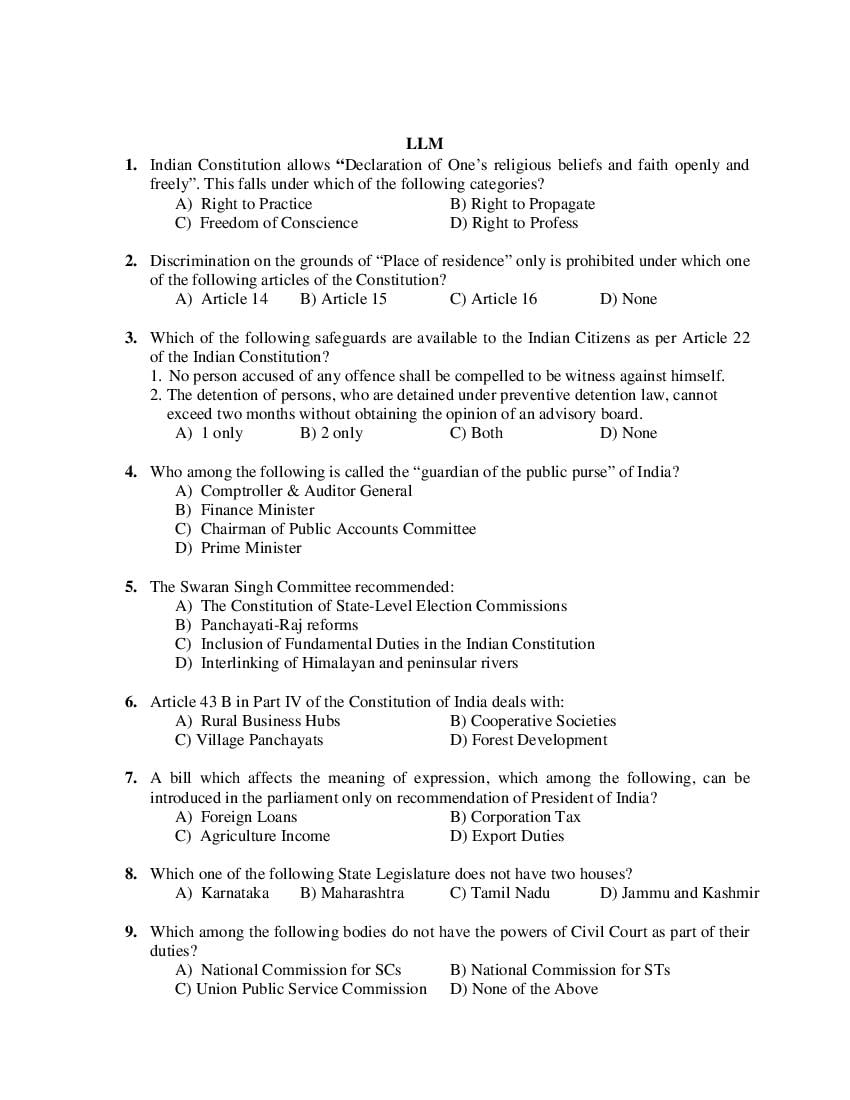
1. Indian Constitution allows “Declaration of One’s religious beliefs and faith openly and
freely”. This falls under which of the following categories?
A) Right to Practice B) Right to Propagate
C) Freedom of Conscience D) Right to Profess
2. Discrimination on the grounds of “Place of residence” only is prohibited under which one
of the following articles of the Constitution?
A) Article 14 B) Article 15 C) Article 16 D) None
3. Which of the following safeguards are available to the Indian Citizens as per Article 22
of the Indian Constitution?
1. No person accused of any offence shall be compelled to be witness against himself.
2. The detention of persons, who are detained under preventive detention law, cannot
exceed two months without obtaining the opinion of an advisory board.
A) 1 only B) 2 only C) Both D) None
4. Who among the following is called the “guardian of the public purse” of India?
A) Comptroller & Auditor General
B) Finance Minister
C) Chairman of Public Accounts Committee
D) Prime Minister
5. The Swaran Singh Committee recommended:
A) The Constitution of State-Level Election Commissions
B) Panchayati-Raj reforms
C) Inclusion of Fundamental Duties in the Indian Constitution
D) Interlinking of Himalayan and peninsular rivers
6. Article 43 B in Part IV of the Constitution of India deals with:
A) Rural Business Hubs B) Cooperative Societies
C) Village Panchayats D) Forest Development
7. A bill which affects the meaning of expression, which among the following, can be
introduced in the parliament only on recommendation of President of India?
A) Foreign Loans B) Corporation Tax
C) Agriculture Income D) Export Duties
8. Which one of the following State Legislature does not have two houses?
A) Karnataka B) Maharashtra C) Tamil Nadu D) Jammu and Kashmir
9. Which among the following bodies do not have the powers of Civil Court as part of their
duties?
A) National Commission for SCs B) National Commission for STs
C) Union Public Service Commission D) None of the Above
Page 2
A) Ministry of Women and Child Development
B) Ministry of Social Justice and Women Empowerment
C) An Autonomous and Independent body
D) Ministry of Minority Affairs
11. In issuing one of the writs, the Supreme Court orders: “the respondent was not entitled to
an office he was holding or a privilege he was exercising” The above declaration can be
identified as which among the following writs?
A) Writ of Prohibition B) Writ of Quo-warranto
C) Writ of Certiorari D) Writ of Habeas Corpus
12. Which of the following schedules can be amended by simple majority of Parliament.
1. Second Schedule.
2. Fifth Schedule.
3. Sixth Schedule
4. Seventh Schedule.
A) 1 only B) 1 & 4 only C) 2 & 3 only D) 1, 2 & 3 only
13. Which among the following is NOT a salient feature of the 73rd Constitutional
Amendment Act?
A) Gram Sabha B) Three Tier System
C) Reservation of Seats D) State Planning Commission
14. Which amendment of the constitution was offered full statehood to Arunachal Pradesh?
A) Fifty-Fifth B) Sixtieth C) Forty-Fourth D) Sixth-Fifth
15. Under the provisions of Article 343 of the Constitution, Hindi was declared the official
language of the Union. But the use of English language was allowed to continue for the
official purpose of the Union for a period of:
A) 20 years B) 15 years C) 25 years D) 10 years
16. Who said that Directive Principle and Fundamental Rights are the conscience of the
Constitution?
A) Bhim Rao Ambedkar B) Granville Austin
C) Jawaharlal Lal Nehru D) Rajendra Prasad
17. Under the constitution of India, which one of the following is not a fundamental duty?
A) To vote in public elections
B) To develop the scientific temper
C) To safeguard public property
D) To abide by the Constitution and respect its ideals
18. The distribution of powers between the Centre and the States in the Indian Constitution is
based on the scheme provided in the:
Page 3
C) Government of India Act, 1935 D) Indian Independence Act, 1947
19. Consider the following official languages of India:
1. Sindhi and Nepali
2. Konkani and Manipuri
3. Bodo and Santhali
4. Santhali and Konkani
5. Dogri and and Maithili
Which of the above languages were added to the 8th Schedule by the 92nd Amendment
Act of 2003?
A) 1 and 2 B) 2 and 3 C) 3 and 5 D) 4 and 5
20. Democracy and Federalism are essential features of our Constitution and basic feature of
its structure. This observation was made in S.R. Bommai vs. Union of India by the Judge.
A) Justice P.B. Sawant B) Justice S.R. Pandyan
C) Justice J.S. Verma D) Justice A.M. Ahmadi
21. The Hon’ble Supreme Court in 2006 decided the constitutional validity of the Act which
seeks to levy sale tax on Inter-State Sales:
A) Bhagatram Rejeev Kumar v. Commissioner of Sales Tax
B) Jindal Stainless Ltd. & another v. State of Haryana and others
C) State of Bihar v. Bihar Chamber of Commerce
D) Jaiprakash Associates Ltd. v State of M.P
22. Necessitas Public Major est Quam latin terms means
A) State necessity is greater than private necessity
B) Public necessity is greater than private necessity
C) Private necessity is greater than state necessity
D) None of above
23. The Constituent assembly while enacting Freedom of Trade, Commerce and Intercourse
took into the consideration
A) Section 90 of Australian Constitution
B) Section 91 of Australian Constitution
C) Section 92 of Australian Constitution
D) Section 93 of Australian Constitution
24. Keshvanand Bharathi v. State of Kerala the Supreme Court declared Second part of
Article ______________ declared invalid.
A) 31 C B) 31 B C) 31 A D) 31
25. Article 300 A was enacted through ______________________ Amendment Act.
A) Forty-second B) Forty-third C) Forty-fourth D) None of these
Page 4
work in
A) Circus B) Match Industry
C) Tobacco Industry D) None of these
27. In the case State of Gujarat v. Hon'ble High Court of Gujarat the matter relating to
fixation of wages with regard to __________ was deliberated.
A) Labourers B) Prisoners C) Child Workers D) None of these
28. ‘Child Labour Rehabilitation-cum-Welfare Fund” was established in the following case:
A) M.C. Mehta v. State of Tamil Nadu & others
B) Bachpan Bachao Andolan v. Union of India
C) P.U.D.R v. Union of India
D) Gurdev Singh v. State of Himachal Pradesh
29. In which year the Traditional Forest Dwellers Act was enacted in India?
A) 2004 B) 2005 C) 2006 D) 2008
30. The Environment Protection Act of 1986 (EPA) came into force soon after which of the
following disaster in India?
A) Bhopal Gas Tragedy B) Oleum Gas Leak
C) Maline Landslide in Pune D) None of these
31. The Kigali agreement was an amendment to which of the following international
conventions aimed at conserving the environment?
A) Montreal Protocol B) Stockholm Convention
C) Bonn Convention D) Kyoto Protocol
32. Which among the following terms of utmost significance in the dynamics of resource
management was coined in the ‘Brundtland Commission Report’?
A) Polluter-Pays Principle B) Sustainable development
C) Inclusive Growth D) Carrying Capacity
33. Which among the following multilateral convention seeks to protect the human health
and environment from Persistant Organic Pollutants (POPs)?
A) Bonn Convention B) Stockholm Convention
C) Rotterdam Convention D) Basel Convention
34. "Bias disqualifies a person from acting as judge" flows fromwhich ofthe following
principle:
A) No one should be the judge in his own
B) Justice must not only be done under dictation
C) Justice should be supposed to be done
D) Justice should not be done under dictation
35. The expression "New Despotism" used by Hewart refers to:
Page 5
C) Rule of law D) Public law
36. What is the meaning of collective rights?
A) Collective rights belong to distinct groups of people
B) Collective rights are those that belong to particular groups as opposed to the
individual members of the group
C) Minority rights are collective rights
D) Collective rights entail a right of the group as such as well as individual rights of
the group's members
37. The Right to Self-determination is ________ generation human right.
A) First B) Second C) Third D) None of these
38. Which of the following is a treaty-based human rights mechanism?
A) The UN Human Rights Committee
B) The UN Human Rights Council
C) The UN Universal Periodic Review
D) The UN special mandates
39. Would a reservation to the definition of torture in the ICCPR be acceptable in
contemporary practice?
A) This is an acceptable reservation if the reserving country's legislation employs a
different definition
B) This is an unacceptable reservation because it contravenes the object and purpose
of the ICCPR
C) This is an unacceptable reservation because the definition of torture in the ICCPR
is consistent with customary international law
D) This is an acceptable reservation because under general international law States
have the right to enter reservations to treaties
40. What is the legal nature of the Universal Declaration of Human Rights (UDHR)?
A) The UDHR is a multilateral treaty
B) The UDHR is a UN General Assembly resolution
C) The UDHR is a UN Security Council resolution
D) The UDHR is a declaration adopted by several States at an international
conference
41. What is the effect of violation of the rule: “Audi Alteram Partem” on an administrative
action?
A) Mere irregularity B) Null and void
C) An illegality D) Voidable
42. In which of the following cases, the Supreme Court held that the principles of natural
justice are applicable to administrative proceedings?
A) M.C. Mehta v. Union of India
Page 6
C) A.K. Kraipak v. Union of India
D) Smt. Indira Nehru Gandhi v. Raj Narain
43. In which of the following cases, the Supreme Court directed closing down and demolition
of shrimp industries in coastal regulation zone and implement the “precautionary
principle” and “the polluter pays principle and held them liable for payment of
compensation for reversing the ecology and compensate the individual for loss suffered?
A) S. Jagannath Vs. Union of India
B) Vellore Citizens Welfare Forum Vs. Union of India
C) M.C. Mehta Vs. Union of India
D) Church of God (Full Gospels) in India Vs. KKR Majestic Colony Welfare
Association
44. The term “environment” under Section 2 (a) of the Environment (Protection) Act, 1986
means
A) Air, Water and Land only
B) Water, Air, Land and interrelationship between air, water, and land only
C) Water, Air, Land, and the interrelationship between water, air and land and
human beings, other living creatures, plants, micro-organism and property
D) None of the above
45. According to Article 233 the appointment of a District Judge shall be done by
A) The President in consultation with the High Court of the State concerned
B) The Governor of the State concerned in consultation with the High Court of the
State concerned
C) The Governor in Consultation with the Chief Justice of India
D) The Collegium of the High Court
46. Which of the following Articles of the Indian Constitution gives the provision of the Post
of Prime Minister of India?
A) Article 73 B) Article 74 C) Article 75 D) Article 74(1)
47. Who defined administrative law as; “Law relating to the Administration It determines the
organisation, powers and duties of administrative authorities”?
A) Sir Ivor Jennings B) A.V. Dicey
C) Kenneth Culp Davis D) Griffith and Strut
48. One is deemed to have placed under suspension is he is detained in custody for a period
exceeding
A) 48 hours B) 24 hours C) 72 hours D) 12 hours
49. When will the order of suspension made or deemed to have been made, not be valid
unless extended? After a period of ___ days
A) 60 days B) 90 days C) 30 days D) 45 days
Page 7
A) Rule 14 of CCS(CCA)Rules B) Rule 3 (1) of CCS(Conduct) Rules
C) Rule 16 of CCS(CCA) Rules D) Rule 11 of CCS(CCA) Rules
51. According to Criminal Law (Amendment) Act, 2013, the right of private defence of the
body extends to the voluntary causing of death or of any other harm to the assistant if the
offence which occasions the exercise of the right is the act of:
A) Stalking B) Voyeurism C) Acid Attack D) None of these
52. Section 34 of IPC:
A) Creates a substantive offence B) Is a rule of evidence
C) Both (A) and (B) D) Neither (A) nor (B)
53. How many types of punishments have been prescribed under the Indian Penal Code:
A) Three B) Six C) Five D) Four
54. Match List I (case) with List II (Subject) and select the correct answer using the codes
given below the lists:
List I (Cases) List II (Subject)
a) K.M. Nanavati vs. State of 1) Criminal Conspiracy
Maharastra
b) Virsa Singh vs. State of Punjab 2) Dacoity
c) Barindra Kumar Ghosh vs. Emperor 3) Murder
d) ShyamBehari vs. State of U.P. 4) Grave and Sudden Provocation
5) Unsoundness of Mind
Codes:
a b c d
A) 4 3 1 2
B) 1 2 5 3
C) 4 2 1 3
D) 1 3 5 2
55. Which of the following is the principle applied in construing a penal Act?
A) If, in any construing the relevant provisions, “there appears any doubt of
ambiguity,” it will be resolved against the person who would be liable to the
penalty
B) If, in any construing the relevant provisions, “there appears any doubt of
ambiguity,” it will be resolved in the favour of the person who would be liable to
the penalty
C) If, in any construing the relevant provisions, “there appears any doubt of
ambiguity,” it will attract life imprisonment
D) If, in any construing the relevant provisions, “there appears any doubt of
ambiguity,” it will attract capital punishment
56. Which of the following statements best expresses the scope of the concept of relevance in
evidence law?
Page 8
incorrect
B) All relevant evidence is admissible
C) Relevant evidence is that which makes the existence of any fact that is of
consequence to the determination of the action more probable or less probable
than it would be without the evidence
D) What is relevant is always a matter of logic and common sense and never a matter
of law
57. A party wants to set aside a judgement under section 44 of the Indian Evidence Act,
1872. In which of the following circumstances can he do so?
A) In case the judgement was passed by a superior Court
B) In case the person challenging is a stranger to the proceedings
C) In case the judgement was a result of gross negligence
D) All of these
58. B, an accused wants to submit carbon copy of the suicide note as secondary evidence.
The original is with the opposite party and he has failed to produce the same. The suicide
was not within the knowledge of the accused prior to the receipt of carbon copy. Which
of the following statements will hold true for the case?
A) The evidence cannot be admitted due to applicability of section 30 of the Indian
Evidence Act
B) The evidence cannot be admitted because it fails to satisfy the requirements of
section 64 of the Indian Evidence Act, 1872
C) The evidence cannot be admitted because it fails to satisfy the requirements of
section 65 of the Indian Evidence Act, 1872
D) The evidence can be admitted as it satisfies the requirements of both section 64
and section 65 of the Indian Evidence Act, 1872
59. Which of the following section of the Indian Evidence Act, 1872 has been amended by
the Criminal Law (Amendment) Act, 2013?
A) Section 32 B) Section 55 C) Section 119 D) Section 124
60. Principle of ‘omnia proesumuntur rite esse acta’ is contained in:
A) Section 78 of Evidence Act B) Section 79 of Evidence Act
C) Section 80 of Evidence Act D) Section 81 of Evidence Act
61. An executive Magistrate is empowered to grant remand under Section 167, CrPC for a
maximum period of
A) 15 days B) 7 days C) 60 days D) 90 days
62. For granting pardon under section 306 of the Code of Criminal Procedure, 1973
A) The witness must not be directly involved in the offence
B) The accused should have been given an opportunity to cross examine the person
getting pardon
C) The person getting pardon need not be in police custody
Page 9
63. _______ can proceed under section 340 of the Code of Criminal Procedure, 1973 and
hold a preliminary enquiry.
I. Civil Court
II. Revenue Court
III. Criminal Court
A) I and II B) II and III C) III and I D) I, II and III
64. If the accused is convicted in a criminal case for an offence under the stature which does
not provide for payment of compensation-
A) The Court cannot award compensation under section 357 of the CrPC and no civil
proceedings are possible
B) The Court cannot award compensation under section 357 of the CrPC, but other
civil remedies are possible
C) The Court can award compensation under section 357 of the CrPC, but the award
will be taken into account in subsequent civil suits
D) The Court can award compensation under section 357 of the CrPC, but the award
will not be taken into account in subsequent civil suits
65. Section 401 of the Code of Criminal Procedure, 1973
I. Allows the Court to convert finding of acquittal into conviction
II. Allows the Court to pardon the convict
III. Does not allow the Court to act suomotu
IV. Is only applicable to High Court
A) I and II B) II and IV C) II, III and IV D) I, II and III
66. What is normative jurisprudence?
A) The evaluation of the law on the basis of criteria for what constitutes good law
B) The study of legal norms
C) The theory that law normalises people
D) The study of what the law is
67. What is a rule according to H.L.A. Hart?
A) A Statement of an accepted standard of behaviour
B) An enforceable command
C) A moral standard
D) All of them
68. What is the place of Justice in Mill’s Utilitarianism?
A) There is no place of justice in any utilitarian theory
B) Always, the social good always prevails and individual liberties are never
absolute
C) Liberties are secure only insofar as they contribute to the sum total of social
satisfaction
D) None of the Above
Page 10
A) Yes, the principles of natural law can change to accommodate
technological/ideological/geopolitical changes (for example, the changing
position of women, decolonisation, the rights of minority groups.
B) Yes, the principles of natural law theory can be deducted from a given legal
system because they are regular occurrences in positive law. As such they change
alongside the system in question.
C) No, they are immutable and eternal
D) All the above
70. The rule of recognition occupies a central position in Hart’s legal positivism because
A) It helps us identify rules – rules are only rules if they are recognised as such
B) It tells us that if one person does not recognise the validity of a law it is not a
law, making voluntary compliance the key element of law
C) It tells us what the basic source of legal authority is in a country
D) None of the above
71. What is Fuller’s position in the Hart-Fuller debate?
A) That positivist criteria are insufficient to distinguish a system of law from a
system of coercion
B) That the ‘separation’ theory (between law and morality) must be oppose
C) That law must refer to external moral standards
D) None of the above
72. Why is it said of Dworkin’s work that it constitutes a third theory of law?
A) Because he agrees with legal positivism and natural law
B) Because he disagrees with legal positivism and natural law
C) Because he occupies a middle ground between legal positivism and natural law
D) All of the them
73. For Austin, laws properly so called include:
A) Constitutional and International law
B) Social rules such as queuing in line
C) Criminal law
D) All of them
74. Jural contradictories are:
A) A right held by A, correlated to a duty owed by B
B) A right held by A precluding B from having a right against A
C) Object of A’s right
D) All of them
75. Sociological jurisprudence sees law as the product of a socially constructed reality. What
does social construction mean?
A) An institutional invention by participants in a society
Page 11
C) A politically biased interpretation of reality
D) None of the above
76. What is the 'Lotus principle'?
A) The so-called Lotus principle is that 'restrictions upon the independence of States
cannot therefore be presumed', or, as it has been construed, 'whatever is not
prohibited is permitted in international law'
B) The so-called Lotus principle is that States are free to choose the Court that they
will submit their disputes
C) The so-called Lotus principle is that States are not prohibited to assert their
enforcement jurisdiction on the high seas
D) The so-called Lotus principle is that customary law derives from the combination
of State practice and opinion juris
77. What is a 'treaty' according to the Vienna Convention on the Law of Treaties (VCLT)?
A) Treaties are all agreements concluded between States, international organizations
and non-State entities (e.g. corporations)
B) Treaties are agreements concluded between States in written form and governed
by international law
C) Treaties are both the written and oral agreements between States
D) Treaties are agreements concluded between States in written form governed either
by international or domestic law
78. Do third States enjoy any fishing rights within the Exclusive Economic Zone of another
State?
A) When the coastal State cannot harvest the 'total allowable catch', the coastal State
is to give other State access to that surplus with priority to be given to developing
and land-locked States
B) Third States may never have access to fisheries within another State's EEZ
C) The coastal State is to give access to fisheries within its EEZ only to neighbouring
States
D) Third States are free to fish within another EEZ, except from certain designated
areas
79. What is the “Optional clause” in the ICJ Statute?
A) Optional clause is the clause in the ICJ Statute, which provides for the applicable
law, according to the intention of the parties
B) Optional clause determines the intention of the parties to accept that the decision
of the Court will be final and binding
C) Optional clause is the declaration deposited by a State, whereby it accepts the
jurisdiction of the Court in respect of international legal disputes in relation to any
other State accepting the same obligation
D) Optional clause is the clause that the parties deposit, which sets out the procedure
of the written and oral pleadings
Page 12
relation to an industry specified in the first schedule where, unless special care is taken,
raw materials used therein or the intermediate or finished products, bye-products, wastes
or effluents thereof would
A) Cause material impairment to the health of the persons engaged in or connected
therewith
B) Result in the pollution of the general environment
C) Neither (A) nor (B)
D) Both (A) and (B)
81. As per the Factories Act, “________”, of a factory means the person who has ultimate
control over the affairs of the factory.
A) Manager B) Owner C) Director D) Occupier
82. In which year was the Employees’ State Insurance Act enacted?
A) 1948 B) 1976 C) 1923 D) 1961
83. Industrial employment standing orders act is applicable in every industrial establishment
where ____ workmen are employed.
A) 200 B) 150 C) 100 D) 50
84. The Hindu Succession Act, 1956 abolishes
A) The doctrine of acquisition of right by birth
B) The doctrine of the right survivorship
C) Both (A) and (B)
D) None of these
85. Presumption that the younger survived the elder under Section 21 of the Hindu
Succession Act, 1956 is a
A) Presumption of fact B) Presumption of fact and law
C) Rebuttable presumption of law D) Irrebuttable presumption of law
86. To mature as a ground of Divorce the ‘Desertion’, under the Hindu Marriage Act, 1955,
must continue for a minimum period of
A) One year B) Two years C) Three years D) None of these
87. In which of its following Report the Law Commission recommended, the “Breakdown
Principle’ to be accepted as the additional ground of Divorce?
A) 70th Report B) 71st Report C) 72nd Report D) None of these
88. If a Muta marriage is not consummated, the wife is entitled to
A) No dower B) One third dower C) Half dower D) Full dower
89. A and B of Srinagar entered into a contract on 1st September, 2006. Can they enforce the
contract?
Page 13
1872
B) No, because Srinagar is not a part of India
C) No, because the Act does not extend to the State of Jammu and Kashmir
D) None of the above
90. A finder of goods
A) Has no responsibility for the goods
B) Is subject to the same responsibility as a bailee
C) Is the owner of the goods
D) None of the above
91. Ex turpi causa non oritur action means
A) From an illegal cause, no action arises
B) From an illegal cause action may arises
C) From an legal cause action may arises
D) From an legal cause action may not arises
92. A contracts with Indian Cricket Board to play for IPL-2 at south Africa. A falls ill and is
advised by doctor to rest. The contract
A) Is Valid B) Is void ab initio
C) Becomes void D) Is voidable at A’s option
93. A loud bass beat that can be heard through an apartment wall (from another apartment) at
midnight can be
A) Conversion
B) Trespass
C) Interference with Contractual relations
D) Nuisance
94. What is meant by the term ‘actionable per se’?
A) Actionable without proof of damage
B) Actionable at the instance of the injured party only
C) Actionable only in the civil courts
D) A tort of strict liability
95. Fill in the gap. Contributory negligence is ______ defense to a criminal charge.
A) Genuine B) Accurate C) Sharp D) No
96. Which of the following is not an essential element for a successful defence of volenti non
fit injuria(voluntary assumption of risk)?
A) An express agreement between the parties
B) Knowledge by the claimant of the precise risk involved
C) Exercise of free choice by the claimant
D) A voluntary acceptance of the risk by the claimant
Page 14
Companies as well as foreign companies.
A) True B) False C) Can’t say D) None of these
98. Under Section 149 of Companies Act, 2013 the minimum number of directors in the
Private Company is
A) 7 B) 15 C) 3 D) 2
99. A public company does not have any restriction regarding the maximum number of
members.
A) True B) False C) Can’t say D) None of these
100. Only fully paid-up shares can be converted into stock.
A) True B) False C) Can’t say D) None of these
x-x-x
Document Details
| Board / Org | Panjab University |
| Exam | PU CET PG |
| Type | Question Paper |
| Pages | 14 |
| Updated | 22 Jul 2026 |