PU CET PG 2019 Question Paper M.Com._Business Economics_
Finished viewing? Save it for later —
Download PU CET PG 2019 Question Paper M.Com._Business Economics_ (PDF · 8 pages)About PU CET PG 2019 Question Paper M.Com._Business Economics_
PU CET PG 2019 Question Paper M.Com._Business Economics_ is available here for free download. Published by Punjab University for PU CET PG, this question paper can be viewed online or downloaded as a PDF (8 pages). Candidates preparing for PU CET PG can use PU CET PG 2019 Question Paper M.Com._Business Economics_ to understand the exam pattern, the type of questions asked, and the overall difficulty level.
Frequently Asked Questions
How can I download PU CET PG 2019 Question Paper M.Com._Business Economics_?
Open this page and click the Download button to save PU CET PG 2019 Question Paper M.Com._Business Economics_ as a PDF. It is completely free on AglaSem Docs.
Is PU CET PG 2019 Question Paper M.Com._Business Economics_ free to download?
Yes. PU CET PG 2019 Question Paper M.Com._Business Economics_ can be viewed online and downloaded as a PDF free of cost on AglaSem Docs.
How many pages does PU CET PG 2019 Question Paper M.Com._Business Economics_ have?
PU CET PG 2019 Question Paper M.Com._Business Economics_ contains 8 pages, which you can read online or download together as a single PDF.
Where can I find more PU CET PG study material?
You can find more PU CET PG question papers, sample papers, syllabus, and answer keys on AglaSem Docs.
PU CET PG 2019 Question Paper M.Com._Business Economics_ – Text
Read the full text of this question paper below — useful to quickly search, copy and reference the content online without downloading the PDF.
📄 View text version (8 pages)
Page 1
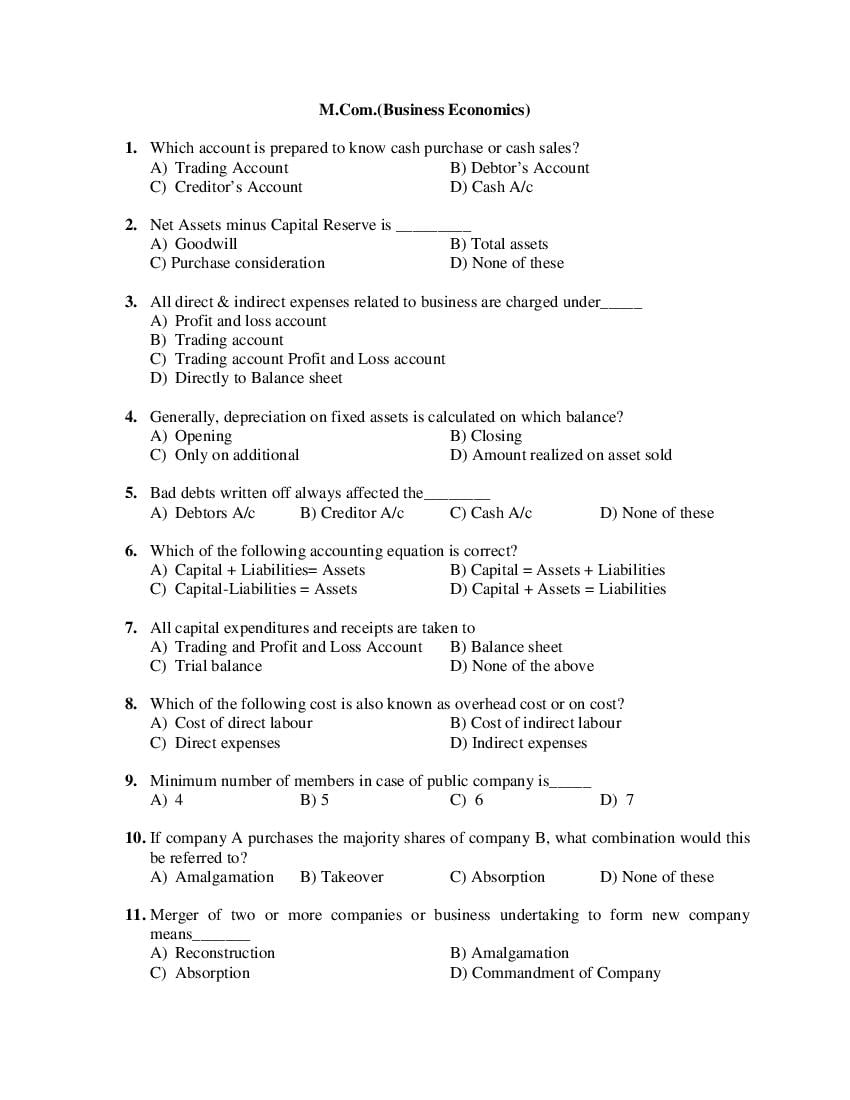
1. Which account is prepared to know cash purchase or cash sales?
A) Trading Account B) Debtor’s Account
C) Creditor’s Account D) Cash A/c
2. Net Assets minus Capital Reserve is _________
A) Goodwill B) Total assets
C) Purchase consideration D) None of these
3. All direct & indirect expenses related to business are charged under_____
A) Profit and loss account
B) Trading account
C) Trading account Profit and Loss account
D) Directly to Balance sheet
4. Generally, depreciation on fixed assets is calculated on which balance?
A) Opening B) Closing
C) Only on additional D) Amount realized on asset sold
5. Bad debts written off always affected the________
A) Debtors A/c B) Creditor A/c C) Cash A/c D) None of these
6. Which of the following accounting equation is correct?
A) Capital + Liabilities= Assets B) Capital = Assets + Liabilities
C) Capital-Liabilities = Assets D) Capital + Assets = Liabilities
7. All capital expenditures and receipts are taken to
A) Trading and Profit and Loss Account B) Balance sheet
C) Trial balance D) None of the above
8. Which of the following cost is also known as overhead cost or on cost?
A) Cost of direct labour B) Cost of indirect labour
C) Direct expenses D) Indirect expenses
9. Minimum number of members in case of public company is_____
A) 4 B) 5 C) 6 D) 7
10. If company A purchases the majority shares of company B, what combination would this
be referred to?
A) Amalgamation B) Takeover C) Absorption D) None of these
11. Merger of two or more companies or business undertaking to form new company
means_______
A) Reconstruction B) Amalgamation
C) Absorption D) Commandment of Company
Page 2
A) Compulsory winding up
B) Voluntary winding up
C) Winding up under the supervision of the court
D) Knowingly winding up
13. Shares received from the new company are recorded at_______
A) Face value B) Average price
C) Market value D) None of the above
14. A Joint Stock Company is managed by the Board of Directors elected by _____
A) Top management B) Shareholders
C) Employees of company D) None of the above
15. Joint Venture is a ______________
A) Personal A/c B) Nominal A/c C) Real A/c D) Memorandum A/c
16. By which act government checks restrictive trade?
A) Industrial Policy Act 1991 B) MRTP Act
C) FEMA act D) None of these
17. Relaxing the restrictions and controls imposed on business and industry means_________
A) Liberalization B) Privatization C) Globalization D) None of the above
18. Privatization of ownership through sale of equity share is called_______
A) Denationalization B) Disinvestment
C) Contracting D) None of these
19. Globalization is the term used to describe process of removal of restriction on______
A) Foreign Trade B) Investment C) Both (A) and (B) D) None of the above
20. Laissez faire policy is adopted in_____
A) Socialist Economic System B) Capitalist Economic system
C) Mixed Economic System D) Socialist Economic System
21. Which of the following is not the objective of Competition Act 2002?
A) Prohibition of abuse of dominant position
B) Prohibition of restrictive trade practices
C) Prohibition of anti-competitive agreement
D) Regulation of combinations
22. FEMA stands for___________
A) Free Export management act B) Foreign Exchange management act
C) Foreign Exchange monitoring act D) Free Export marketing act
23. The concept of small scale industries (SSIs) was brought by the________
Page 3
C) Industrial Policy Statement 1977 D) None of the above
24. What is full form of SWOT?
A) Strengths, Weaknesses, Opportunities and Threats
B) Software Warehousing of Threats
C) Single optimism technique
D) None of these
25. The essential commodities act was passed in the year _____________
A) 1952 B) 1945 C) 1959 D) 1955
26. What is IRDA?
A) Industrial Regulation & Development Authority
B) Insurance Regulatory & Development Authority
C) Indian Regulation Development Authority
D) None of these
27. The heavy industry strategy of the Mahalanobis model was initiated in___
A) First plan B) Second plan C) Third plan D) Fourth plan
28. Phillips curve describes the relationship between________
A) Saving and investment
B) Demand for money and inflation
C) Rate of unemployment and rate of inflation
D) Marginal Tax rate and rate of inflation
29. Which one of the following is called as the Gossen’s first law?
A) Law of indifference B) Law of diminishing utility
C) Law of returns to scale D) Law of variable proportions
30. The terms TRIPS and TRIMS are related to:
A) NAFTA B) SAFTA C) EFTA D) GATT
31. IMF is the result of____________
A) Hawana conference B) Rome conference
C) Bretton woods conference D) Geneva conference
32. When a firm’s average revenue is equal to its average cost, it gets ________.
A) Super profit B) Normal profit C) Sub normal profit D) None of these
33. Under perfect competition, price is determined by the interaction of total demand
and_______
A) Total supply B) Total cost C) Total utility D) Total production
34. The kinked demand curve explains__________
Page 4
C) Price flexibility D) Price rigidity
35. With the introduction of GST, imports will be________
A) More expensive B) More cheaper
C) Neutral with no change D) None of the above
36. The rate of GST as applicable on goods and services are___
A) 0% 5% 12% 16% 28% B) 0% 5% 12% 18% 28%
C) 0% 6% 12% 18% 28% D) 0% 5% 12% 18% 26%
37. GST would not be applicable to_____
A) Alcohol for human consumption B) Petrol
C) Natural gas D) All of these
38. What is cut off turnover limit for compulsory registration under GST?
A) 9 lacs B) 50 lacs
C) Exceeds 20 lacs D) No limit for registration
39. Cost of conversion is equal to___
A) Prime cost plus factory overheads
B) Prime cost plus administrative overheads
C) Direct material plus selling and distribution overheads
D) Direct labour plus factory overheads
40. While preparing the financial statements of an enterprise, the bad debt recovered has to
be shown on the______
A) Debit side of the profit and loss account
B) Credit side of the profit and loss account
C) Debit side of the trading account
D) Assets side of the balance sheet
41. The excess of minimum rent over actual royalties is called _________
A) Short workings B) Interest C) Discount D) Commission
42. Which strategy provides a means for achieving a company’s annual objectives?
A) Functional strategy B) Business strategy
C) Operating strategy D) Strategic choice
43. Which of the following helps a manager identify the opportunities and threats in the
competitive industrial environment?
A) Analyzing the competitive forces B) Market research
C) Market analysis D) Sales analysis
44. Which factor indicates the nature and direction of the economy in which a firm operates?
A) Economic environment B) Gross national product
Page 5
45. A ________ is primarily financed by borrowing of all the stock or assets by a small group
of investors.
A) Merger B) Takeover C) Leveraged buyout D) Consolidation
46. Which of the following factors does not influence the pricing strategy of a firm?
A) Cost B) Market C) Competition D) R&D
47. There are two major ways in which a firm can gain cost advantage. The first is
controlling cost drivers, and the second is _________.
A) Shortening the value chain
B) Technological innovation
C) Introducing cost consciousness in all activities
D) Reconfiguring the value chain
48. MNCs are usually _____________ in nature
A) Oligopolistic B) Perfectly competitive
C) Monopolistic D) Monopoly
49. Law of diminishing marginal rate of substitution is associated with____
A) Hicks B) Keynes C) Slutsky D) Marshall
50. What kind of tax is Goods and Service Tax?
A) Direct Tax
B) Indirect Tax
C) Depends on the type of goods and services
D) None of the above
51. What is the target (in terms of GDP) of Fiscal Deficit for FY 2019-20?
A) 3.1% B) 3.5% C) 3.4% D) 4.4%
52. Which of the following does not comes under the developmental expenditure of India?
A) Expenditure on administrative services
B) Defense expenditure
C) Grants to states
D) Expenditure on social welfare schemes
53. Devaluation of a currency means______
A) Reduction in the internal value of the domestic currency
B) Reduction in the external value of the domestic currency
C) Increment in the internal value of the domestic currency
D) Reduction in the printing of new currency by the RBI
54. Who is the father of green revolution in India?
A) Norman Borlaug B) M.S. Swaminathan
Page 6
55. The pure monopolist obtains equilibrium level of output when____
A) Marginal revenue = marginal cost B) Price = marginal cost
C) Price is the lowest D) Price is the highest
56. Hedging refers to____
A) The acceptance of a foreign exchange risk
B) The covering of a foreign exchange risk
C) Foreign exchange speculation
D) Foreign exchange arbitrage
57. For substitutes, cross elasticity of demand is__________
A) Positive B) Negative C) Zero D) Always less than one
58. The characteristics of monopolistic competition are________
a) Product differentiation
b) Non-price competition
c) Large number of firms and freedom to entry and exit
d) Firms are interdependence
Codes:
A) -a & c are correct
B) -a, b and d are correct
C) -a, b and c are correct
D) -a, c and d are correct
59. Which of the following is true?
a) Indifference curves slope downward from left to right.
b) Indifference curves slope downward from right to left.
c) Indifference curves are convex to the point of origin of the two axes.
d) Indifference curves never intersect each other
Codes:
A) -a, b and c are true.
B) -b, c and d are true.
C) -a, c and d are true.
D) -a and d are true.
60. A demand curve, which is parallel to the horizontal axis, showing quantity, has the price
elasticity equal to____
A) Zero B) Infinity C) Less than one D) One
61. An exceptional demand curve is one that moves_____
A) Upward to the right B) Downward to the right
C) Horizontally D) Upward to the left
62. Chi-square test is used to____
Page 7
B) To test the differences in the means of two samples
C) To test the independence of attributes
D) Both A and C
63. Partial correlation is a type of _____
A) Simple correlation B) Multiple correlation
C) Both (A) & (B) D) None of the above
64. Regression analysis is a measure of
A) Degree and direction of relationship B) Degree of association
C) Cause and effect relationship D) None of the above
65. In probability theories, events which can never occur together are classified as_____
A) Collectively exclusive events B) Mutually exhaustive events
C) Mutually exclusive events D) Collectively exhaustive events
66. Probability of rejecting the null hypothesis when it is true is called___
A) Type-II error B) Type-I error C) Standard error D) None of these
67. Chi-squire test is a ___
A) Parametric Test B) Non- Parametric test
C) Small –sample test D) Large –sample test
68. Who is the ‘lender of the last resort’ in the banking structure of India?
A) State Bank of India B) Reserve Bank of India
C) EXIM Bank of India D) Union Bank of India
69. When was the first five-year plan of India started?
A) 1949 B) 1940 C) 1952 D) 1951
70. In India monetary policy is implemented by___
A) RBI B) The ministry of finance
C) Planning commission D) The parliament
71. The perfect competition is characterized by _____
A) Seller as a price taker B) Firms selling identical products
C) Presence of many firms D) All of these
72. Which market structure indicates the existence of ‘few sellers’?
A) Oligopoly B) Monopoly
C) Monopolistic competition D) Perfect competition
73. Opportunity cost means ___________
A) Cost of a homogenous products B) Cost of the last unit
C) Cost of next best alternative D) Cost of all units produced
Page 8
A) 2004-05 B) 2001-02 C) 2011-12 D)2014-15
75. Which is the correct formula to calculate GDP deflator?
A) Nominal GDP - (minus) Real GDP B) Nominal GDP + Real GDP
C) Nominal GDP/ Real GDP D) Real GDP/ Nominal GDP
x-x-x
Document Details
| Board / Org | Panjab University |
| Exam | PU CET PG |
| Type | Question Paper |
| Pages | 8 |
| Updated | 22 Jul 2026 |