PU CET PG 2019 Question Paper M.Sc. Statistics
Finished viewing? Save it for later —
Download PU CET PG 2019 Question Paper M.Sc. Statistics (PDF · 7 pages)About PU CET PG 2019 Question Paper M.Sc. Statistics
PU CET PG 2019 Question Paper M.Sc. Statistics is available here for free download. Published by Punjab University for PU CET PG, this question paper can be viewed online or downloaded as a PDF (7 pages). Candidates preparing for PU CET PG can use PU CET PG 2019 Question Paper M.Sc. Statistics to understand the exam pattern, the type of questions asked, and the overall difficulty level.
Frequently Asked Questions
How can I download PU CET PG 2019 Question Paper M.Sc. Statistics?
Open this page and click the Download button to save PU CET PG 2019 Question Paper M.Sc. Statistics as a PDF. It is completely free on AglaSem Docs.
Is PU CET PG 2019 Question Paper M.Sc. Statistics free to download?
Yes. PU CET PG 2019 Question Paper M.Sc. Statistics can be viewed online and downloaded as a PDF free of cost on AglaSem Docs.
How many pages does PU CET PG 2019 Question Paper M.Sc. Statistics have?
PU CET PG 2019 Question Paper M.Sc. Statistics contains 7 pages, which you can read online or download together as a single PDF.
Where can I find more PU CET PG study material?
You can find more PU CET PG question papers, sample papers, syllabus, and answer keys on AglaSem Docs.
PU CET PG 2019 Question Paper M.Sc. Statistics – Text
Read the full text of this question paper below — useful to quickly search, copy and reference the content online without downloading the PDF.
📄 View text version (7 pages)
Page 1
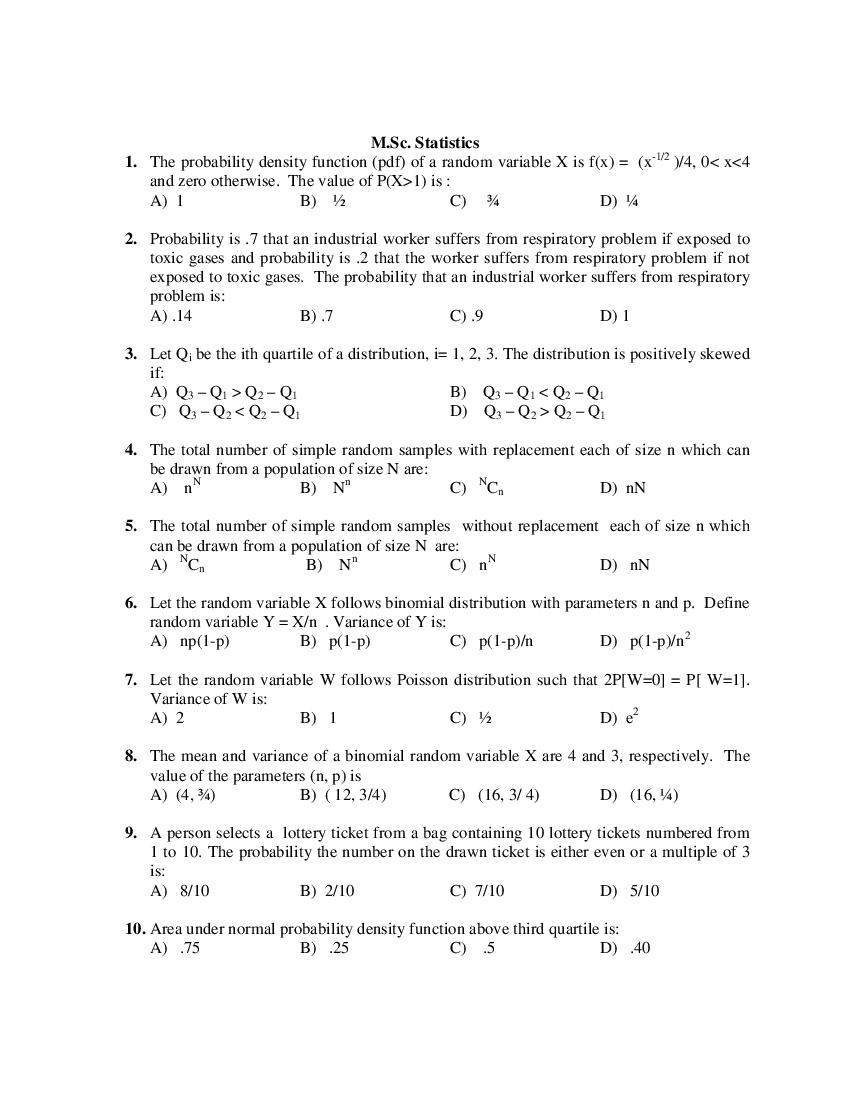
1. The probability density function (pdf) of a random variable X is f(x) = (x-1/2 )/4, 0< x<4
and zero otherwise. The value of P(X>1) is :
A) 1 B) ½ C) ¾ D) ¼
2. Probability is .7 that an industrial worker suffers from respiratory problem if exposed to
toxic gases and probability is .2 that the worker suffers from respiratory problem if not
exposed to toxic gases. The probability that an industrial worker suffers from respiratory
problem is:
A) .14 B) .7 C) .9 D) 1
3. Let Qi be the ith quartile of a distribution, i= 1, 2, 3. The distribution is positively skewed
if:
A) Q3 – Q1 > Q2 – Q1 B) Q3 – Q1 < Q2 – Q1
C) Q3 – Q2 < Q2 – Q1 D) Q3 – Q2 > Q2 – Q1
4. The total number of simple random samples with replacement each of size n which can
be drawn from a population of size N are:
A) nN B) Nn C) NCn D) nN
5. The total number of simple random samples without replacement each of size n which
can be drawn from a population of size N are:
A) NCn B) Nn C) nN D) nN
6. Let the random variable X follows binomial distribution with parameters n and p. Define
random variable Y = X/n . Variance of Y is:
A) np(1-p) B) p(1-p) C) p(1-p)/n D) p(1-p)/n2
7. Let the random variable W follows Poisson distribution such that 2P[W=0] = P[ W=1].
Variance of W is:
A) 2 B) 1 C) ½ D) e2
8. The mean and variance of a binomial random variable X are 4 and 3, respectively. The
value of the parameters (n, p) is
A) (4, ¾) B) ( 12, 3/4) C) (16, 3/ 4) D) (16, ¼)
9. A person selects a lottery ticket from a bag containing 10 lottery tickets numbered from
1 to 10. The probability the number on the drawn ticket is either even or a multiple of 3
is:
A) 8/10 B) 2/10 C) 7/10 D) 5/10
10. Area under normal probability density function above third quartile is:
A) .75 B) .25 C) .5 D) .40
Page 2
containing 2 defective and 4 non defective items. The probability of the event that the
first drawn item is defective and second is non-defective is:
A) 8/36 B) 1/8 C) 7/9 D) 4/15
12. A discrete random variable X takes values -2, -1, 0, 1, 2 with probabilities .2, .1, .4, .1, .2
, respectively. Variance of X is:
A) 1.8 B) 0 C) ½ D) .18
13. Poisson distribution is:
A) Symmetric B) Positively skewed
C) Negatively skewed D) Continuous
The three units, say I, II and III of an industrial organization manufacture identical items
in the proportion 2: 3: 5, respectively. It is also known that the units I, II and III
manufacture 3%, 4% and 10% defective items, respectively. From the entire daily
production of all the three units a person selects one item randomly.
Answer questions 14 and 15 using the above information:
14. The probability that the selected item will be non-defective is:
A) .932 B) .068 C) .17 D) .83
15. If the drawn item was defective, then the probability that it was manufactured by unit III
is:
A) .068 B) .932 C) .204 D) .735
16. Let the random variable X follows normal distribution. The distribution of –X will be:
A) Binomial B) Poisson C) Normal D) Negatively Skewed
17. An unbiased coin and an unbiased die are tossed simultaneously. Probability that the coin
shows head and die shows an even number on upper faces is:
A) 1/12 B) 1 C) 3/4 D) ¼
18. Two unbiased dice are tossed simultaneously. The probability that the sum of numbers on
the upper faces of both dice will be odd is:
A) ¼ B) ¾ C) ½ D) 2/3
19. The probability density function (pdf) of a random variable X is f(x) = 1, 0<x<1.
Variance of X will be:
A) ½ B) 1/12 C) ¾ D) ¼
20. Let bxy and byx be the two regression coefficients in simple linear regression. Then the
relation between Karl Pearson’s correlation coefficient, denoted by r, and these
regression coefficients is:
A) r2 = (bxy/byx)2 B) r2 = (bxybyx)2 C) r = (bxybyx)2 D) r2 = (bxy byx)
Let A and B be two events in the sample space S such that P(A U B) =.7, P(A)= .4 and
P(B) = x. Answer questions 21 and 22 using this information.
Page 3
A) .3 B) ½ C) .28 D) 0
22. The value of x for which A and B are independent is:
A) .3 B) ½ C) ¾ D) ¼
A lot contains 4 defective and 6 Non-defective items. A person selects a simple random
sample of 4 items from the lot. Use this information to answer questions 23 and 24.
23. The probability that the sample contains two defective and two non defective if the items
were drawn with replacement is:
A) .52 B) .0576 C) .3456 D) 3/7
24. The probability that the sample contains two defective and two non defective if the items
were drawn without replacement is:
A) .52 B) .0576 C) .3456 D) 3/7
25. The mean, mode and standard deviation of a distribution are 15, 12 and 3 respectively.
The coefficient of skewness of this distribution is:
A) 1 B) -1 C) 4 D) 5
26. Let the matrix G be such that G= , then G is equal to:
A) B) C) D)
27. The quadratic form xtGx is said to be positive semidefinite when all the eigen values of G
are:
A) Positive B) Negative C) Non-negative D) non-positive
28. The sum of the characteristic roots of the matrix is
A) 13 B) 7 C) -9 D) 15
29. The product of the eigen values of the matrix
A) 5 B) 7 C) 12 D) 4
30. If H = , then Hn is:
A) B) C) D)
31. The extreme value of (x)1/x is:
A) e B) (1/e)e C) ( e)1/e D) 1
32. If f(x) = sinx - x/2 is an increasing function, then the range of x is
Page 4
33. The Jacobean of the transformation x= r cosθ, y = r sinθ is:
A) 1 B) –r C) r D) 1/r
34. The value of over the region R={(x,y): 0<x<1, |y|<x} is:
A) 2/3 B) 0 C) ½ D) 1
35. The value of is:
A) 12 B) 30 C) 15 D) 1/30
36. ) is equal to:
A) 0 B) - C) D)
37. Let f(x,y) = 1/y, then the value of over the region R = {(x,y): 0<x<y,
0<y<1} is:
A) 1 B) ½ C) 2 D) ¾
38. The value of over the region R={(x,y): 0<x, 0<y, x+y <1} is:
A) ½ B) 1 C) 2 D) ¾
π/2
sin x
39. ∫ (sin x )
0
1/ 2
+ (cos x )1 / 2
dx is equal to:
A) 0 B) π/2 C) π/4 D) 1
π
x sin x dx
40. ∫ is equal to :
0 1 + cos 2 x
A) π2/2 B) π2/4 C) ¼ D) π/4
1
log( 1 + x ) dx
41. ∫ is equal to
0 1 + x2
A) (π/8)log2 B) (π/4)log2 C) (π/2)log2 D) log2
π
42. ∫ sin7 x dx is equal to
0
A) 0 B) 16/35 C) 32π/35 D) 32/35
π/2
∫ sin x cos xdx is equal to
4 2
43.
0
A) 1/16 B) 1/32 C) π/32 D) π/4
Page 5
A) ¾ B) 3/8 C) 3/5 D) 3/7
45. The area of the segment cut off from the parabola x2 = 8y by the line x-2y+8 =0 is:
A) 48 B) 120 C) 36 D) 24
1 1− x
46. ∫ ∫ dx dy represents the area of a:
0 0
A) Rectangle B) Triangle C) Square D) Circle
sin −1 x
1
47. ∫ dx is equal to:
0
x
A) π/2 B) log2 C) (π/2)log2 D) -(π/2)log2
π
48. ∫ log sin xdx is equal to:
0
A) –π log2 B) -(π/2)log2 C) (π/2)log2 D) log2
π /6
∫ cos 3θ sin 6θdθ is equal to:
4 3
49.
0
A) 0 B) π/30 C) 8/45 D) 1/15
∞
dx
50. The value of ∫ is :
0 (1+ x )
2 7/2
A) 8/15 B) 8π/15 C) π/15 D) 3π/4
a
dx
51. ∫ is equal to:
0 x + ( a − x ) 2
2 1/ 2
A) π/2 B) π/4 C) a2/4 D) aπ/4
52. Let y = xx . Then dy/dx is:
A) x xx-1 B) xx logx C) xx (logx +1) D) xx+1logx
53. Let y = ax , then dy/dx is:
A) xax-1 B) axloga C) (aloga)/x D) xax-1loga
1 4
54. Let the matrix G = Then the value of G2 -4G -5I is
2 3
A) O B) G-1 C) I D) G
Page 6
A) ∞ B) 1 C) e D) 1/e
56. The value of limx→π/2 (sinx)tanx is:
A) 0 B) 1 C) e D) 1/e
57. The value of limx→0 {(xex – log(1+x))/x2} is:
A) ½ B) 3 C) 1 D) 3/2
58. The value of limx→0 (1/sin x- 1/x) is:
A) ∞ B) 1 C) 0 D) 1/2
59. The slope of the normal at any point θ to the curve x = a(cosθ +θcosθ), y= a(sinθ –θcosθ)
is
A) tanθ B) cotθ C) –tanθ D) –cotθ
60. The value of limx→0 (logx/cotx) is:
A) 1 B) 0 C) 2 D) ½
61. The series 1- 1/ 2 + 1/ 3 - 1 / 4 is
A) Convergent B) Divergent C) Oscillatory D) Both B and C
62. The series 5/2 -7/4 +9/6- 11/8 + ………. is
A) Convergent B) Divergent C) Oscillatory D) Both A and C
63. The series 1+ 1 /22 – 1/32 – 1/42 +1/52 + 1/62 – 1/72 - 1/82 ……. is
A) Convergent B) Divergent C) Oscillatory D) Both B and C
64. The series 1 + x + x2/2 + x3/3 +……… is convergent for:
A) All values of B) x > 0 C) x< 0 D) x< -1
65. The series x – x2/2 + x3/3 - ….. + (-1) nxn/n + …. is convergent for values of x the
interval:
A) (-1, 1) B) |x| >1 C) ( -1, 1 ] D) |x| ≤ 1.
a + 2π
66. The value of ∫ sin nxdx is
2
a
A) 0 B) π C) π/2 D) n/2
a + 2π
67. The value of ∫ sin mx cos mx dx is.
a
A) 0 B) π C) π/2 D) m/2
68. sin( ix) is equal to ( here i = −1)
Page 7
e Z + e−Z
69. For complex number Z = x + i y, if = i , then eZ is equal to
2
A) 1 B) -1 C) i D) –i
70. For complex number Z , the value of tanh-1 z is:
A) log [(1-Z)/(1+z)] B) .5 log [(1-Z)/(1+z)]
C) log [(1+Z)/(1-z)] D) .5 [log {(1+Z)/(1-z)} ]
2
71. For complex number Z = x +iy, the imaginary part of e Z is:
2
D) ei(x+y)
2
A) e i 2 xy B) e ixy C) e ix y
e 2Z
72. The value of ∫ dz , where C: |Z| = 3 is:
C ( Z − 3Z + 2
2
A) 2πi B) 2πie4 C) 2πi (e4 – e2) D) 2πi (e4 +e2)
2+ i
73. The value of ∫ ( Z ) 2 dz along the real axis to 2 and then vertically to 2+i is:
0
A) 5(2-i)/3 B) 14/3 C) 14 + 11i D) (14 + 11i)/3
74. The solution of the differential equation dy/dx +y/x = x2 under the condition that y=1
when x= 1, is:
A) 4xy = x3+3 B) 4xy = x4 +3 C) 4xy = y4+3 D) 4xy = y3 +3
75. The particular integral of the differential equation (D2 +D)y = x2+2x+4 is
(here D =d/dx):
A) (x2/3) +4x B) (x3/3) +4 C) (x3/3 )+4x D) ( x3/3 )+4x2
x-x-x
Document Details
| Board / Org | Panjab University |
| Exam | PU CET PG |
| Type | Question Paper |
| Pages | 7 |
| Updated | 22 Jul 2026 |