CBSE Class 12 Question Paper 2025 Solution Cost Accounting
Finished viewing? Save it for later —
Download CBSE Class 12 Question Paper 2025 Solution Cost Accounting (PDF · 10 pages)About CBSE Class 12 Question Paper 2025 Solution Cost Accounting
CBSE Class 12 Question Paper 2025 Solution Cost Accounting is available here for free download. Published by CBSE for Class 12, this solution can be viewed online or downloaded as a PDF (10 pages). Candidates preparing for Class 12 can use CBSE Class 12 Question Paper 2025 Solution Cost Accounting to understand the exam pattern, the type of questions asked, and the overall difficulty level.
Frequently Asked Questions
How can I download CBSE Class 12 Question Paper 2025 Solution Cost Accounting?
Open this page and click the Download button to save CBSE Class 12 Question Paper 2025 Solution Cost Accounting as a PDF. It is completely free on AglaSem Docs.
Is CBSE Class 12 Question Paper 2025 Solution Cost Accounting free to download?
Yes. CBSE Class 12 Question Paper 2025 Solution Cost Accounting can be viewed online and downloaded as a PDF free of cost on AglaSem Docs.
How many pages does CBSE Class 12 Question Paper 2025 Solution Cost Accounting have?
CBSE Class 12 Question Paper 2025 Solution Cost Accounting contains 10 pages, which you can read online or download together as a single PDF.
Where can I find more Class 12 study material?
You can find more Class 12 question papers, sample papers, syllabus, and answer keys on AglaSem Docs.
CBSE Class 12 Question Paper 2025 Solution Cost Accounting – Text
Read the full text of this solution below — useful to quickly search, copy and reference the content online without downloading the PDF.
📄 View text version (10 pages)
Page 1
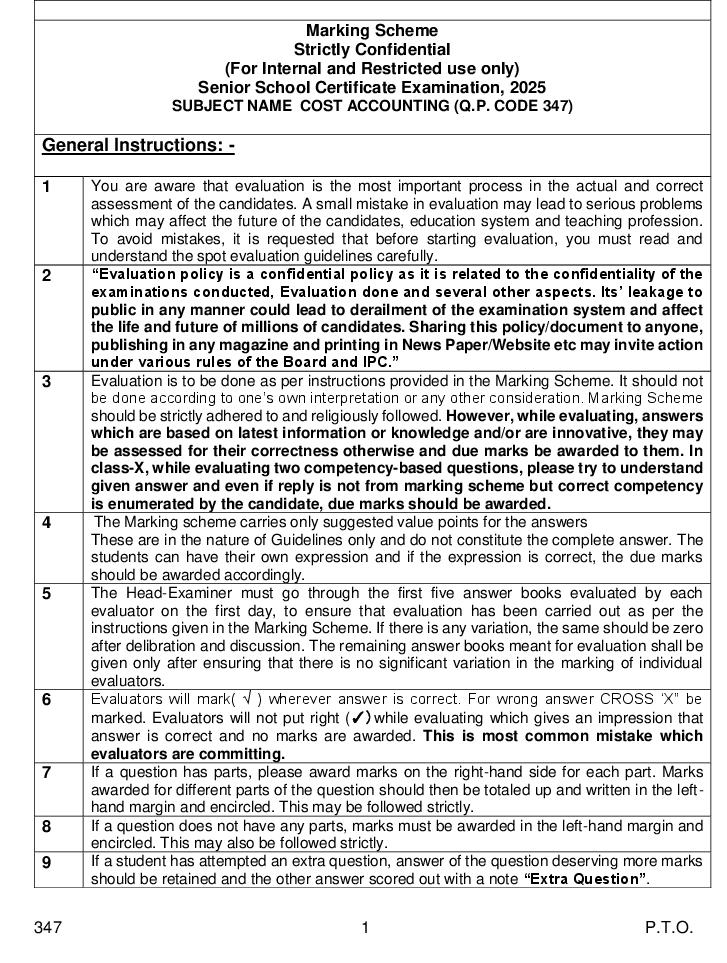
Strictly Confidential
(For Internal and Restricted use only)
Senior School Certificate Examination, 2025
SUBJECT NAME COST ACCOUNTING (Q.P. CODE 347)
General Instructions: -
1 You are aware that evaluation is the most important process in the actual and correct
assessment of the candidates. A small mistake in evaluation may lead to serious problems
which may affect the future of the candidates, education system and teaching profession.
To avoid mistakes, it is requested that before starting evaluation, you must read and
understand the spot evaluation guidelines carefully.
2 “Evaluation policy is a confidential policy as it is related to the confidentiality of the
examinations conducted, Evaluation done and several other aspects. Its’ leakage to
public in any manner could lead to derailment of the examination system and affect
the life and future of millions of candidates. Sharing this policy/document to anyone,
publishing in any magazine and printing in News Paper/Website etc may invite action
under various rules of the Board and IPC.”
3 Evaluation is to be done as per instructions provided in the Marking Scheme. It should not
be done according to one’s own interpretation or any other consideration. Marking Scheme
should be strictly adhered to and religiously followed. However, while evaluating, answers
which are based on latest information or knowledge and/or are innovative, they may
be assessed for their correctness otherwise and due marks be awarded to them. In
class-X, while evaluating two competency-based questions, please try to understand
given answer and even if reply is not from marking scheme but correct competency
is enumerated by the candidate, due marks should be awarded.
4 The Marking scheme carries only suggested value points for the answers
These are in the nature of Guidelines only and do not constitute the complete answer. The
students can have their own expression and if the expression is correct, the due marks
should be awarded accordingly.
5 The Head-Examiner must go through the first five answer books evaluated by each
evaluator on the first day, to ensure that evaluation has been carried out as per the
instructions given in the Marking Scheme. If there is any variation, the same should be zero
after delibration and discussion. The remaining answer books meant for evaluation shall be
given only after ensuring that there is no significant variation in the marking of individual
evaluators.
6 Evaluators will mark( √ ) wherever answer is correct. For wrong answer CROSS ‘X” be
marked. Evaluators will not put right (✓)while evaluating which gives an impression that
answer is correct and no marks are awarded. This is most common mistake which
evaluators are committing.
7 If a question has parts, please award marks on the right-hand side for each part. Marks
awarded for different parts of the question should then be totaled up and written in the left-
hand margin and encircled. This may be followed strictly.
8 If a question does not have any parts, marks must be awarded in the left-hand margin and
encircled. This may also be followed strictly.
9 If a student has attempted an extra question, answer of the question deserving more marks
should be retained and the other answer scored out with a note “Extra Question”.
347 1 P.T.O.
Page 2
once.
11 A full scale of marks __________(example 0 to 80/70/60/50/40/30 marks as given in
Question Paper) has to be used. Please do not hesitate to award full marks if the answer
deserves it.
12 Every examiner has to necessarily do evaluation work for full working hours i.e., 8 hours
every day and evaluate 20 answer books per day in main subjects and 25 answer books
per day in other subjects (Details are given in Spot Guidelines).This is in view of the reduced
syllabus and number of questions in question paper.
13 Ensure that you do not make the following common types of errors committed by the
Examiner in the past:-
● Leaving answer or part thereof unassessed in an answer book.
● Giving more marks for an answer than assigned to it.
● Wrong totaling of marks awarded on an answer.
● Wrong transfer of marks from the inside pages of the answer book to the title page.
● Wrong question wise totaling on the title page.
● Wrong totaling of marks of the two columns on the title page.
● Wrong grand total.
● Marks in words and figures not tallying/not same.
● Wrong transfer of marks from the answer book to online award list.
● Answers marked as correct, but marks not awarded. (Ensure that the right tick mark is
correctly and clearly indicated. It should merely be a line. Same is with the X for
incorrect answer.)
● Half or a part of answer marked correct and the rest as wrong, but no marks awarded.
14 While evaluating the answer books if the answer is found to be totally incorrect, it should be
marked as cross (X) and awarded zero (0)Marks.
15 Any unassessed portion, non-carrying over of marks to the title page, or totaling error
detected by the candidate shall damage the prestige of all the personnel engaged in the
evaluation work as also of the Board. Hence, in order to uphold the prestige of all concerned,
it is again reiterated that the instructions be followed meticulously and judiciously.
16 The Examiners should acquaint themselves with the guidelines given in the “Guidelines for
Spot Evaluation” before starting the actual evaluation.
17 Every Examiner shall also ensure that all the answers are evaluated, marks carried over to
the title page, correctly totaled and written in figures and words.
18 The candidates are entitled to obtain photocopy of the Answer Book on request on payment
of the prescribed processing fee. All Examiners/Additional Head Examiners/Head
Examiners are once again reminded that they must ensure that evaluation is carried out
strictly as per value points for each answer as given in the Marking Scheme.
347 2
Page 3
MARKING SCHEME
COST ACCOUNTING
1. (i) 05 1
(ii) (C) Self Awareness 1
(iii) Obsessive – compulsive personality disorder 1
(iv) = 1
(v) Reusing scrap material, ensuring quality control, waste exchange,
managing e-waste (any one) 1
(vi) (B) initiative 1
2. (i) Production Account/Statement 1
(ii) False 1
(iii) Selling price 1
(iv) (C) Work Cost 1
(v) (D) Estimated Cost Sheet 1
(vi) (A) 1,00,000 + 25,000 – 40,000 = 85,000 1
(vii) (i) Data generated can be used for analysis and cost control by the
management (ii) indicates the profitable or non-profitable jobs (iii)
can be easily fitted into the double entry system. (Any one) 1
3. (i) Economic Order Quantity (EOQ) 1
(ii) False 1
(iii) (B) ₹ 4,000 1
(iv) (B) Pistachios 1
(v) False 1
(vi) Unknown contingencies 1
(vii) A provision in a contract for adjustment of prices quoted and
accepted in the event of specified contingencies. 1
4. (i) Zero/No profit 1
347 3 P.T.O.
Page 4
(iii) Specific, predetermined 1
(iv) By products are secondary products whose value is relatively small
and are incidental to the production of the main product 1
(v) (A) Working Backwards Method 1
(vi)
1
Process Costing Job Costing
Costs are calculated according Costs are computed for
to each process and the cost each job separately which
per unit is the average cost. is the cost unit
5. (i) (A) abnormal gain of 120 kg 1
(ii) Normal output – Actual Output 1
(iii) False 1
(iv) Per meal / Per person / Per dish (anyone) 1
(v) A composite unit refers to both quantum and period of service Eg.
Per tonne – km 1
(vi) Method 1
6. (i) (D) Cost per passenger km 1
(ii) False 1
(iii) (C) debited to financial profit and loss A/c 1
(iv) It is a reconciliation statement which is prepared in the form of an
account. 1
(v) LIFO, FIFO 1
(vi) (C) Work in Progress Ledger 1
7. A complex sentence is one, which consists of two or more coordinate
clauses, joined by a coordinating conjunction.
Example : Unless you make up your mind, nothing can be done. 1+1=2
347 4
Page 5
9. Insert > Shape > Basic > Square 2
10. Having a plan to reach the goal helps the person in knowing one’s role in
running a successful business and pushes everyone associated with it to
work harder. Every entrepreneur wants a successful business. But without
action plan, it may lead to chaotic situation. 2
11. (i) Construction – Building Planner, Architect
(ii) Renewable Energy – Roofer, Solar Panel Installation Technician 1+1
12. (i) Coal Cost (ii) Water Softener Cost
(iii) Labour Cost (iv) Other Overhead Cost (any two) 1+1
13. Abnormal effectives occur when the actual production exceeds the expected
production. The excess of actual production is known as abnormal
effectives. 2
14. Progress advice is prepared to ensure the timely completion of each job.
This indicates the stages of completion of each job. 2
15. In batch costing, whenever a particular products is required, one unit of
such product is not manufactured but a lot of say 500 or 1000 units of such
products are produced. It is lot costing. 2
16. Gross Work Cost = Prime Cost + Factory Overhead 1+1
= ₹ 20,00,000 + ₹ 8,00,000
= ₹ 28,00,000
Factory Cost = Gross Cost + Opening WIP – Closing WIP
= ₹ 28,00,000 + ₹ 20,00,000 – 1,40,000 = ₹ 28,60,000
17. (i) Profit as per any set of books (cost or financial) may be taken as the
base.
347 5 P.T.O.
Page 6
profit shown by the other set of books.
(iii) In case the cause resulted in an increase/decrease in the profit shown
by other sets of book, the amount of such increase/decrease should be
added/subtracted from the profit as per the former set of books, which has
been taken as the base. 3
18. Profit to be credited to P &L A/C
C a s h R e ce iv e d 2
= National Profit ×
W or k ce r t ifie d 3
3, 3 0, 0 0 0 2
= 79, 000 = ₹ 43,450
4, 00, 000 3
National profit is an estimate of the potential profits that could be earned
from a specific contract. 2+1
(2 U P )
19. Economic Batch Quantity =
S
= 2 x 18000 x 220
1250 x 10%
= 251∙71 units = 252 units 3
20. 4
BASIS JOB COSTING CONTRACT COSTING
1.Scope Ideal for small-scale Used for large scale, long
short term projects term projects
2. Common in Found in construction and
Industries manufacturing, civil engineering sectors
services and small
scale construction
3. One financial year Extend beyond one financial
Duration year
347 6
Page 7
Elements and overhead costs extensive overheads sub-
contractor fees and sale costs.
(any four points)
21. M/S _____________ Enterprises 4
COST SHEET
For the year ending 31st March _______
Production (in units) _________
Particulars Total Cost Per Unit
Amt. (₹) Cost (₹)
(A) Purchases during the year
(B) Add : Opening Stock of Raw Material
(C) Less : Closing Stock of Raw Material
(D) Direct Material Consumed (A + B + C)
(E) Direct Labour
(F) Direct Expenses
(G) Prime Cost (D + E + F) xxx xxx
(H) Add : Factory Overheads
(I) Gross Factory/Work Cost (G + H) xxx xxx
(J) Add : Opening w/p
(K) Less : Closing w/p
(L) Factory/Work Cost (I + J - K) xxx xxx
(M) Add : Office Administrative Overheads
(N) Cost of Production/Office Cost (L + M) xxx xxx
(O) Add : Opening Finished Stock
(P) Less : Closing Finished Stock
(Q) Cost of Goods Gold (N + O - P) xxx xxx
Add : Selling & Distribution
(R)
Overheads
(S) Total Cost/Cost of Sales (Q + R) xxx xxx
347 7 P.T.O.
Page 8
Particulars Unit Amt.
Unit Amt. Particulars
To Raw Material 100 250
1,000 4,000 By Normal Loss a/c
To Direct Wages 50 750
6,500 By Abnormal Loss a/c
To Indirect exp. 850 12,750
3,250 By transfer to Next process
1,000 13,750
1,000 13,750
Working Notes:
Particulars Units Cost
Introduced 1000 13,750
Normal loss 100 250
Normal Output 900 13,500
Cost per unit for normal output = 13500
900
= ₹ 15/-
Cost of abnormal loss = 15 x 50 = ₹ 750/-
347 8
Page 9
M/S _____________ Enterprises
Power House Operating Cost Sheet for the year ending ________
Steam produced: 15,000 lbs
Steam used for generation of electricity: 10,000 lbs
Electricity generated: 5000 units
Steam Production Cost : Amt (₹) Cost per unit
Coal cost 10,000
Water cost 150
Wages for coal handling 750
Lubricating oil 50
Repair of boiler 350
Depreciation of boiler 850
Supervisory labour 400
Total steam production cost 12,550 0·836
Electricity Generation Cost :
Cost of steam (0·836 10,000) 8,360
Wages of operator 1,000
Depreciation of generator 900
Repairs 500
Supervision charges 500
Total Cost 11,260 2·252
347 9 P.T.O.
Page 10
Particulars Items (+) Items (–)
Profit as per Costing Account 35,000
Add : Factory indirect expenses over-absorbed 750
(4250 – 3500)
Rent received from own building 2,750
Dividend Received 550
Less : Provisions for doubtful debts 2,000
Directors Remuneration 2,000
Income tax paid 9,250
Depreciation under charged (5450 – 4550) 1400
Administrative o/Hs (3900 – 2450) 1450
16,100
Profit as per financial accounts 22,950
39,050 39,050
******
347 10
Document Details
| Board / Org | CBSE |
| Exam | Class 12 |
| Type | Solution |
| Pages | 10 |
| Updated | 24 Sep 2026 |