CBSE Class 12 Question Paper 2025 Solution Data Science
Finished viewing? Save it for later —
Download CBSE Class 12 Question Paper 2025 Solution Data Science (PDF · 11 pages)About CBSE Class 12 Question Paper 2025 Solution Data Science
CBSE Class 12 Question Paper 2025 Solution Data Science is available here for free download. Published by CBSE for Class 12, this solution can be viewed online or downloaded as a PDF (11 pages). Candidates preparing for Class 12 can use CBSE Class 12 Question Paper 2025 Solution Data Science to understand the exam pattern, the type of questions asked, and the overall difficulty level.
Frequently Asked Questions
How can I download CBSE Class 12 Question Paper 2025 Solution Data Science?
Open this page and click the Download button to save CBSE Class 12 Question Paper 2025 Solution Data Science as a PDF. It is completely free on AglaSem Docs.
Is CBSE Class 12 Question Paper 2025 Solution Data Science free to download?
Yes. CBSE Class 12 Question Paper 2025 Solution Data Science can be viewed online and downloaded as a PDF free of cost on AglaSem Docs.
How many pages does CBSE Class 12 Question Paper 2025 Solution Data Science have?
CBSE Class 12 Question Paper 2025 Solution Data Science contains 11 pages, which you can read online or download together as a single PDF.
Where can I find more Class 12 study material?
You can find more Class 12 question papers, sample papers, syllabus, and answer keys on AglaSem Docs.
CBSE Class 12 Question Paper 2025 Solution Data Science – Text
Read the full text of this solution below — useful to quickly search, copy and reference the content online without downloading the PDF.
📄 View text version (11 pages)
Page 1
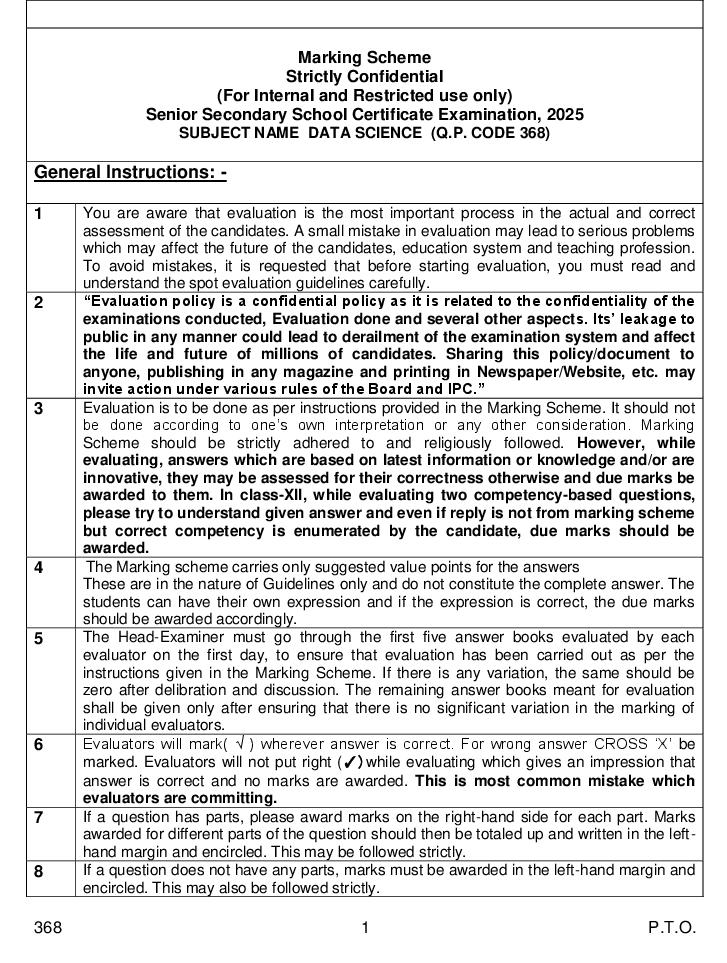
Strictly Confidential
(For Internal and Restricted use only)
Senior Secondary School Certificate Examination, 2025
SUBJECT NAME DATA SCIENCE (Q.P. CODE 368)
General Instructions: -
1 You are aware that evaluation is the most important process in the actual and correct
assessment of the candidates. A small mistake in evaluation may lead to serious problems
which may affect the future of the candidates, education system and teaching profession.
To avoid mistakes, it is requested that before starting evaluation, you must read and
understand the spot evaluation guidelines carefully.
2 “Evaluation policy is a confidential policy as it is related to the confidentiality of the
examinations conducted, Evaluation done and several other aspects. Its’ leakage to
public in any manner could lead to derailment of the examination system and affect
the life and future of millions of candidates. Sharing this policy/document to
anyone, publishing in any magazine and printing in Newspaper/Website, etc. may
invite action under various rules of the Board and IPC.”
3 Evaluation is to be done as per instructions provided in the Marking Scheme. It should not
be done according to one’s own interpretation or any other consideration. Marking
Scheme should be strictly adhered to and religiously followed. However, while
evaluating, answers which are based on latest information or knowledge and/or are
innovative, they may be assessed for their correctness otherwise and due marks be
awarded to them. In class-XII, while evaluating two competency-based questions,
please try to understand given answer and even if reply is not from marking scheme
but correct competency is enumerated by the candidate, due marks should be
awarded.
4 The Marking scheme carries only suggested value points for the answers
These are in the nature of Guidelines only and do not constitute the complete answer. The
students can have their own expression and if the expression is correct, the due marks
should be awarded accordingly.
5 The Head-Examiner must go through the first five answer books evaluated by each
evaluator on the first day, to ensure that evaluation has been carried out as per the
instructions given in the Marking Scheme. If there is any variation, the same should be
zero after delibration and discussion. The remaining answer books meant for evaluation
shall be given only after ensuring that there is no significant variation in the marking of
individual evaluators.
6 Evaluators will mark( √ ) wherever answer is correct. For wrong answer CROSS ‘X’ be
marked. Evaluators will not put right (✓)while evaluating which gives an impression that
answer is correct and no marks are awarded. This is most common mistake which
evaluators are committing.
7 If a question has parts, please award marks on the right-hand side for each part. Marks
awarded for different parts of the question should then be totaled up and written in the left-
hand margin and encircled. This may be followed strictly.
8 If a question does not have any parts, marks must be awarded in the left-hand margin and
encircled. This may also be followed strictly.
368 1 P.T.O.
Page 2
marks should be retained and the other answer scored out with a note “Extra Question”.
10 No marks to be deducted for the cumulative effect of an error. It should be penalized only
once.
11 A full scale of marks __________(example 0 to 80/70/60/50/40/30 marks as given in
Question Paper) has to be used. Please do not hesitate to award full marks if the answer
deserves it.
12 Every examiner has to necessarily do evaluation work for full working hours i.e., 8 hours
every day and evaluate 20 answer books per day in main subjects and 25 answer books
per day in other subjects (Details are given in Spot Guidelines).This is in view of the
reduced syllabus and number of questions in question paper.
13 Ensure that you do not make the following common types of errors committed by the
Examiner in the past:-
● Leaving answer or part thereof unassessed in an answer book.
● Giving more marks for an answer than assigned to it.
● Wrong totaling of marks awarded on an answer.
● Wrong transfer of marks from the inside pages of the answer book to the title page.
● Wrong question wise totaling on the title page.
● Wrong totaling of marks of the two columns on the title page.
● Wrong grand total.
● Marks in words and figures not tallying/not same.
● Wrong transfer of marks from the answer book to online award list.
● Answers marked as correct, but marks not awarded. (Ensure that the right tick mark
is correctly and clearly indicated. It should merely be a line. Same is with the X for
incorrect answer.)
● Half or a part of answer marked correct and the rest as wrong, but no marks awarded.
14 While evaluating the answer books if the answer is found to be totally incorrect, it should
be marked as cross (X) and awarded zero (0)Marks.
15 Any unassessed portion, non-carrying over of marks to the title page, or totaling error
detected by the candidate shall damage the prestige of all the personnel engaged in the
evaluation work as also of the Board. Hence, in order to uphold the prestige of all
concerned, it is again reiterated that the instructions be followed meticulously and
judiciously.
16 The Examiners should acquaint themselves with the guidelines given in the “Guidelines
for Spot Evaluation” before starting the actual evaluation.
17 Every Examiner shall also ensure that all the answers are evaluated, marks carried over to
the title page, correctly totaled and written in figures and words.
18 The candidates are entitled to obtain photocopy of the Answer Book on request on
payment of the prescribed processing fee. All Examiners/Additional Head Examiners/Head
Examiners are once again reminded that they must ensure that evaluation is carried out
strictly as per value points for each answer as given in the Marking Scheme.
368 2
Page 3
MARKING SCHEME
DATA SCIENCE
SECTION A
OBJECTIVE TYPE QUESTIONS
Q. No. Question Source Unit/ Page Marks
Material Ch.No. No.
1. Answer any 4 out of the given 6 questions on Employability skills. 4×1=4
(i) (D) Five Factor Model NCERT 2 33 1
(ii) (C) Unavailability of monetary NCERT 4 91 1
resources on time.
(iii) (C) The manager is writing the report. NCERT 1 18 1
(iv) (C) Ctrl + M NCERT 3 70 1
(v) (C) Intrinsic motivation NCERT 2 24 1
(vi) (B) small-scale NCERT 5 117 1
2. Answer any 5 out of the given 6 questions. 5×1=5
(i) FALSE CBSE- 1 2 1
Microsoft
Student
Handbook
(ii) (A) Univariate Analysis CBSE- 2 9 1
Microsoft
Student
Handbook
(iii) (C) Random Forest Algorithm CBSE- 3 15 1
Microsoft
Student
Handbook
(iv) (C) Lazy learning and CBSE- 4 23 1
non-parametric learning Microsoft
Student
Handbook
368 3 P.T.O.
Page 4
Microsoft
Student
Handbook
(vi) (B) Unsupervised Learning CBSE- 7 44 1
Microsoft
Student
Handbook
3. Answer any 5 out of the given 6 questions. 5×1=5
(i) (A) California Consumer Privacy Act CBSE- 1 3 1
Microsoft
Student
Handbook
(ii) (B) 2 and 3 CBSE- 2 11 1
Microsoft
Student
Handbook
(iii) (C) Mode CBSE- 3 16 1
Microsoft
Student
Handbook
(iv) (B) K-NN struggles to predict the CBSE- 4 24 1
output accurately with an increasing Microsoft
number of input variables. Student
Handbook
(v) (C) A is true, but R is false. CBSE- 5 35 1
Microsoft
Student
Handbook
(vi) True CBSE- 7 45 1
Microsoft
Student
Handbook
4. Answer any 5 out of the given 6 questions. 5×1=5
(i) (A) The right of individuals to control CBSE- 1 2 1
how their personal information is Microsoft
collected and used. Student
Handbook
368 4
Page 5
Microsoft
Student
Handbook
(iii) (D) Objects that are similar tend to CBSE- 4 26 1
be located close to each other. Microsoft
Student
Handbook
(iv) (C) Continuous CBSE- 5 33 1
Microsoft
Student
Handbook
(v) (B) Non-Linear Regression CBSE- 6 41 1
Microsoft
Student
Handbook
(vi) (C) Detecting unusual data points CBSE- 7 44 1
Microsoft
Student
Handbook
5. Answer any 5 out of the given 6 questions. 5×1=5
(i) (B) Children’s CBSE- 1 3 1
Microsoft
Student
Handbook
(ii) (A) Regression trees are suitable for CBSE- 3 16 1
continuous dependent variables, Microsoft
while classification trees are suitable Student
for categorical dependent variables. Handbook
(iii) (A) Cross validation CBSE- 4 25 1
Microsoft
Student
Handbook
(iv) (B) Minimising the Mean Absolute CBSE- 5 34 1
Error (MAE). Microsoft
Student
Handbook
368 5 P.T.O.
Page 6
Microsoft
Student
Handbook
(vi) (B) Expectation-Maximisation CBSE- 7 46 1
Microsoft
Student
Handbook
Section-B
Subjective Type Questions
Q. No. Question Source Unit/ Page Marks
Material Ch.No. No.
Answer any 3 out of the given 5 questions on Employability Skills in
20-30 words each. 3×2=6
6. The words ‘a’, ‘an’ and ‘the’ are NCERT 1 12 2
known as articles.
Example :
The car stopped suddenly because a
cat ran in front of it.
1 mark for the definition
1 mark for example
7. (A) = NCERT 3 50-52 2
(B) =C3*D3
1 mark for each part
8. (A) Dependent Personality Disorder NCERT 2 35-36 2
(B) Narcissistic Personality Disorder
1 mark for each part
9. Use of energy-efficient vehicles and NCERT 5 115 2
alternate fuels like CNG can help
minimize greenhouse gas emissions,
The Government of India’s biofuel
policy, introduced in August 2018,
emphasis increasing ethanol
production from biomass for greener
fuel options. This initiative aims to
reduce greenhouse gas emissions and
promote green jobs. Additionally, the
Energy Efficiency Services Limited
(EESL) launched an electric vehicle
program to foster the adoption of
368 6
Page 7
transport modes, aiming to
revolutionise India’s mobility
landscape and create opportunities in
the automotive sector through skill
training and new market entrants.
2 mark for each answer
10. Hard Work : Essential for NCERT 4 81 2
addressing daily challenges and
seizing opportunities with dedication
beyond office hours.
Decision-Making : Timely decisions
are critical in fast-paced business
environments to capitalize on
opportunities and avoid losses.
Initiative : Proactively initiating
actions to seize opportunities as they
arise.
Risk-taking : Willingness to
embrace risks inherent in business
ventures.
Learning from Experience :
Adapting and improving based on
past mistakes to avoid recurring
errors.
Motivation : Driven by a persistent
desire to achieve goals despite
obstacles.
Self-Confidence : Essential for
leadership, inspiring others, and
overcoming challenges with courage
and enthusiasm.
Any 2 of the above/similar points
1 mark each
Answer any 4 out of the given 6 questions in 20-30 words each. 4×2=8
11. Two ethical guidelines relevant to CBSE- 1 2 2
software development and data Microsoft
management are : Student
Keeping data secure : Ensuring Handbook
368 7 P.T.O.
Page 8
protected from unauthorised access
or breaches.
Creating impartial and robust
machine learning models :
Developing algorithms that do not
discriminate and are resilient
against biases, ensuring fair and
accurate outcomes.
Any 2 of the above/Similar points-1
mark each
12. Univariate Analysis : bar charts, CBSE- 2 8-9 2
histograms, frequency polygons, and Microsoft
pie charts. Student
Bivariate analysis : Scatter plots, Handbook
line charts, and pair plots.
1 mark each for naming any
1 graph/chart
13 Cross Validation is a technique in CBSE- 4 25-26 2
which we reserve a portion of a Microsoft
dataset on which we do not train the Student
model. After the training is over, we Handbook
test the resulting model on this
portion of the data.
2 marks for valid answer
14 The difference between them is as CBSE- 3 16 2
follows : Microsoft
1. Regression trees are used when Student
the dependent variable is Handbook
continuous. Classification trees are
used when the dependent variable
is categorical.
2. In case of a regression tree, the
value of the terminal nodes after
training is the mean of the
observations. Thus, predictions on
unseen data are made using the
mean.
3. In case of a classification tree, the
value or class of the terminal nodes
368 8
Page 9
observations. Thus, predictions on
unseen data are made using the
mode.
2 marks for above two/similar valid
points
15. Mathematically, the Root Mean CBSE- 5 35 2
Square Deviation is the square root Microsoft
of the variance of the residuals. It is Student
used to determine how close the Handbook
observed points are to the model's
predicted values.
2 marks for correct answer
16. The k-means clustering method. This CBSE- 7 45 2
method is a technique that is used to Microsoft
spot clusters of data classes in a Student
dataset. Handbook
2 marks for valid answer
Answer any 3 out of the given 5 questions in 20-30 words each. 3×4=12
17. PDP - Personal Data Protection Bill CBSE- 1 4 4
The Personal Data Protection Bill Microsoft
2019 was tabled in the Indian Student
Parliament by the Ministry of Handbook
Electronics and Information
Technology on 11 December 2019. As
of March 2020, the Bill is being
analysed by a Joint Parliamentary
Committee (JPC) in consultation
with experts and stakeholders. The
Bill covers mechanisms for the
protection of personal data and
proposes the setting up of a Data
Protection Authority of India for it.
1 mark for abbreviation and 3 marks
for explaining PDP
18. Multivariate analysis is a more CBSE- 2 9-10 4
complex form of statistical analysis Microsoft
technique and is used to analyse Student
368 9 P.T.O.
Page 10
set. There are several ways to do a
multivariate analysis, but it depends
on your goals. Some of these methods
include Canonical Correlation
Analysis, Cluster Analysis, contour
plots, and Principal Component
Analysis. Example: In educational
research, multivariate analysis like
multiple regression can reveal how
variables such as study time,
attendance, and extracurricular
activities collectively impact student
exam scores, offering insights into
effective interventions for academic
improvement.
3 marks for valid explanation
1 mark for above/similar example
19. Effective for non-linear trends in CBSE- 3 15-16 4
data where linear models may fail to Microsoft
produce accurate results. Student
Suitable for both classification and Handbook
regression tasks, accommodating
diverse problem types.
Easy to visualise and interpret,
making them accessible even to non-
analytical backgrounds.
Can handle both numerical and
categorical variables without
extensive data preprocessing.
Resilient to outliers and missing
data to a reasonable extent compared
to other modelling techniques.
Decision tree outputs are very easy
to understand even for people from a
non-analytical background.
Any 4 of the above/similar points-1
mark each
20. (A) Non-Linear regression CBSE- 6 41 4
(B) y f(x, ) where x is a vector of Microsoft
independent variables and y is the Student
368 10
Page 11
(C)
1 mark for part A
1 mark for part B
2 marks for part C
21 (A) Clustering refers to the process of CBSE- 7 45 4
dividing entire raw data into several Microsoft
groups such that the data points in Student
one group are similar to other data Handbook
points in the same group but
different from those in other groups.
Clustering techniques apply when
there is no class to be predicted but
rather when the instances are to be
divided into natural groups.
(B) Some of the main clustering
methods are :
Partitioning Clustering
Density-Based Clustering
Distribution Model-Based
Clustering
Hierarchical Clustering
1 mark for definition
1 mark for any correct example
1 mark each for correct clustering
method
368 11 P.T.O.
Document Details
| Board / Org | CBSE |
| Exam | Class 12 |
| Type | Solution |
| Pages | 11 |
| Updated | 24 Sep 2026 |