CBSE Class 12 Geography Question Paper 2019 Set 1 Solutions
Finished viewing? Save it for later —
Download CBSE Class 12 Geography Question Paper 2019 Set 1 Solutions (PDF · 11 pages)About CBSE Class 12 Geography Question Paper 2019 Set 1 Solutions
CBSE Class 12 Geography Question Paper 2019 Set 1 Solutions is available here for free download. Published by CBSE for Class 12, this solution can be viewed online or downloaded as a PDF (11 pages). Candidates preparing for Class 12 can use CBSE Class 12 Geography Question Paper 2019 Set 1 Solutions to understand the exam pattern, the type of questions asked, and the overall difficulty level.
Frequently Asked Questions
How can I download CBSE Class 12 Geography Question Paper 2019 Set 1 Solutions?
Open this page and click the Download button to save CBSE Class 12 Geography Question Paper 2019 Set 1 Solutions as a PDF. It is completely free on AglaSem Docs.
Is CBSE Class 12 Geography Question Paper 2019 Set 1 Solutions free to download?
Yes. CBSE Class 12 Geography Question Paper 2019 Set 1 Solutions can be viewed online and downloaded as a PDF free of cost on AglaSem Docs.
How many pages does CBSE Class 12 Geography Question Paper 2019 Set 1 Solutions have?
CBSE Class 12 Geography Question Paper 2019 Set 1 Solutions contains 11 pages, which you can read online or download together as a single PDF.
Where can I find more Class 12 study material?
You can find more Class 12 question papers, sample papers, syllabus, and answer keys on AglaSem Docs.
CBSE Class 12 Geography Question Paper 2019 Set 1 Solutions – Text
Read the full text of this solution below — useful to quickly search, copy and reference the content online without downloading the PDF.
📄 View text version (11 pages)
Page 1
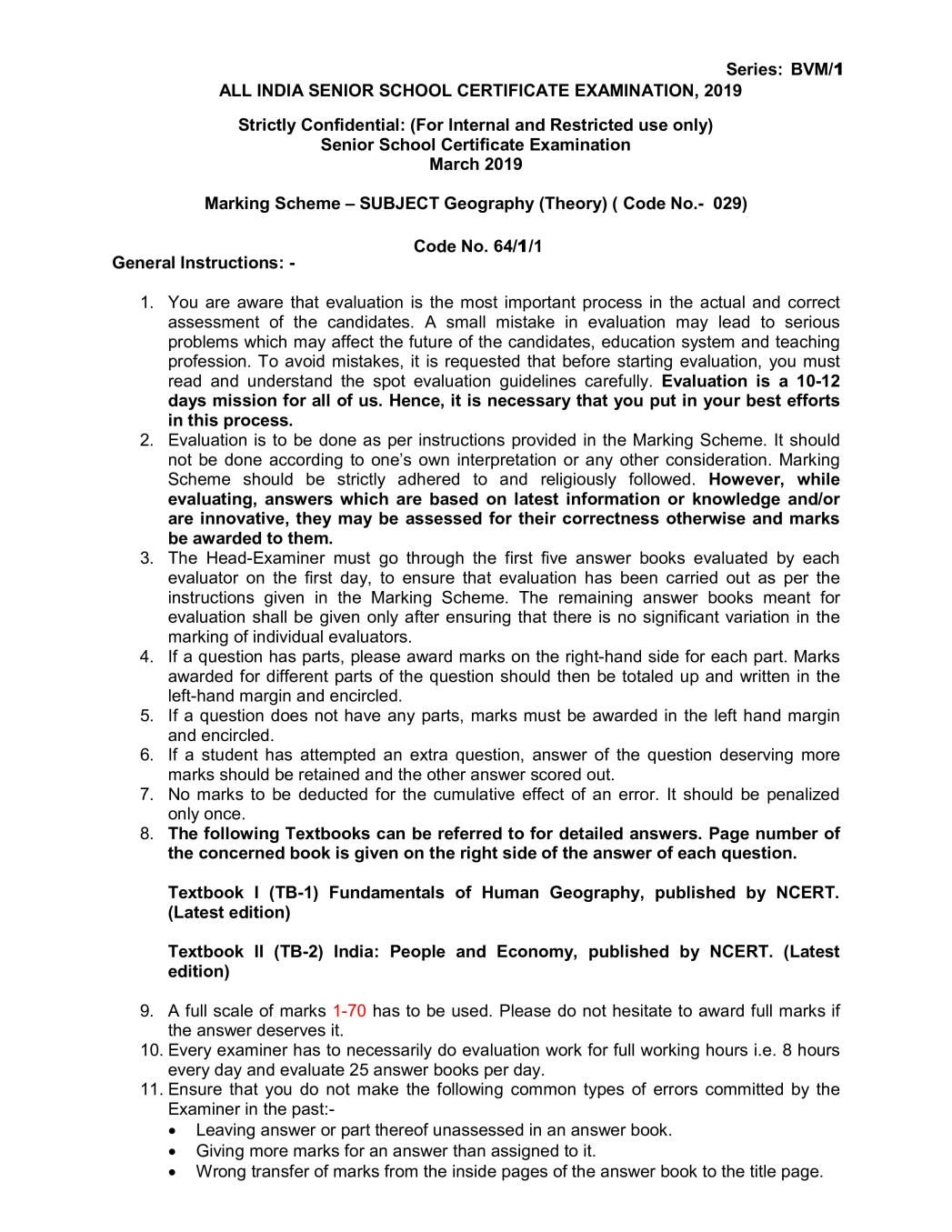
Strictly Confidential: (For Internal and Restricted use only)
Senior School Certificate Examination
March 2019
Marking Scheme – SUBJECT Geography (Theory) ( Code No.- 029)
Code No. 64/1/1
General Instructions: -
1. You are aware that evaluation is the most important process in the actual and correct
assessment of the candidates. A small mistake in evaluation may lead to serious
problems which may affect the future of the candidates, education system and teaching
profession. To avoid mistakes, it is requested that before starting evaluation, you must
read and understand the spot evaluation guidelines carefully. Evaluation is a 10-12
days mission for all of us. Hence, it is necessary that you put in your best efforts
in this process.
2. Evaluation is to be done as per instructions provided in the Marking Scheme. It should
not be done according to one’s own interpretation or any other consideration. Marking
Scheme should be strictly adhered to and religiously followed. However, while
evaluating, answers which are based on latest information or knowledge and/or
are innovative, they may be assessed for their correctness otherwise and marks
be awarded to them.
3. The Head-Examiner must go through the first five answer books evaluated by each
evaluator on the first day, to ensure that evaluation has been carried out as per the
instructions given in the Marking Scheme. The remaining answer books meant for
evaluation shall be given only after ensuring that there is no significant variation in the
marking of individual evaluators.
4. If a question has parts, please award marks on the right-hand side for each part. Marks
awarded for different parts of the question should then be totaled up and written in the
left-hand margin and encircled.
5. If a question does not have any parts, marks must be awarded in the left hand margin
and encircled.
6. If a student has attempted an extra question, answer of the question deserving more
marks should be retained and the other answer scored out.
7. No marks to be deducted for the cumulative effect of an error. It should be penalized
only once.
8. The following Textbooks can be referred to for detailed answers. Page number of
the concerned book is given on the right side of the answer of each question.
Textbook I (TB-1) Fundamentals of Human Geography, published by NCERT.
(Latest edition)
Textbook II (TB-2) India: People and Economy, published by NCERT. (Latest
edition)
9. A full scale of marks 1-70 has to be used. Please do not hesitate to award full marks if
the answer deserves it.
10. Every examiner has to necessarily do evaluation work for full working hours i.e. 8 hours
every day and evaluate 25 answer books per day.
11. Ensure that you do not make the following common types of errors committed by the
Examiner in the past:-
Leaving answer or part thereof unassessed in an answer book.
Giving more marks for an answer than assigned to it.
Wrong transfer of marks from the inside pages of the answer book to the title page.
Page 2
Wrong totaling of marks of the two columns on the title page.
Wrong grand total.
Marks in words and figures not tallying.
Wrong transfer of marks from the answer book to online award list.
Answers marked as correct, but marks not awarded. (Ensure that the right tick mark
is correctly and clearly indicated. It should merely be a line. Same is with the X for
incorrect answer.)
Half or a part of answer marked correct and the rest as wrong, but no marks
awarded.
12. While evaluating the answer books if the answer is found to be totally incorrect, it should
be marked as (X) and awarded zero (0) Marks.
13. Any unassessed portion, non-carrying over of marks to the title page, or totaling error
detected by the candidate shall damage the prestige of all the personnel engaged in the
evaluation work as also of the Board. Hence, in order to uphold the prestige of all
concerned, it is again reiterated that the instructions be followed meticulously and
judiciously.
14. The Examiners should acquaint themselves with the guidelines given in the Guidelines
for spot Evaluation before starting the actual evaluation.
15. Every Examiner shall also ensure that all the answers are evaluated, marks carried over
to the title page, correctly totaled and written in figures and words.
16. The Board permits candidates to obtain photocopy of the Answer Book on request in an
RTI application and also separately as a part of the re-evaluation process on payment of
the processing charges.
Page 3
Subject- Geography (Theory) Subject Code - 029
Code SET 64/1/1
Marking Scheme
Q. Page No. Distribution
Expected Answer/Value Points
No. In TB of marks
SECTION A
1 LITERACY
Literacy is the ability to read, write and to do arithmetic
calculation with understanding. Pg No.-19
OR T.B 1
AGE STRUCTURE
Pg No.-18
Age structure represents the number of people of different
T.B 1
age groups. 1
2. GROWTH & DEVELOPMENT
Growth Development
I. Growth is quantitative I. While development is
value neutral. qualititative change.
II. It may have positive or II. While it is always
negative sign. Positive.
III. It refers to change over III. While it also changes
a period of time. over a period of time. Pg No.- 22
(Any one) T.B 1 1
3. DIGITAL DIVIDE:-
The developed countries are surging forward economically,
politically and socially, while developing countries are
lagging behind economically, politically and socially. The Pg No.-63
T.B 1
difference between these two is called digital divide. 1
4. PROBLEMS OF BARTER SYSTEM
1. Difficulty in searching buyers for one’s excess product.
2. Difficulty in searching the seller of the product, one
need. Pg.No.-81
T.B 1
3. Any other relevant point ½ + ½ =1
(Any two)
5. Males migrate from rural to urban areas in India for
employment.
OR
FEMALE MIGRATION is higher from rural to rural areas
Pg No.-20 1
because of their marriage.
T.B 1
6. IMPORTANCE OF RAIN WATER HARVESTING:-
I. Check the decline in ground water level.
II. Improves the quality of ground water.
Page 4
in coastal areas.
IV. It increases water availability
V. Any other relevant point.
(Any one to be examined)
Pg No.- 67
1
T.B 2
7. URBAN WASTE IS A SERIOUS PROBLEM IN INDIA:-
I. Generation of large quantity of wastes in urban areas
due to overcrowding.
II. No proper disposal of waste material.
Pg. No.-138-139
III. Concentration of industries in and around the urban
T.B 2
areas.
IV. Any other relevant point.
(any one to be explained)
OR
AIR POLLUTION is a serious problem because:-
I. There is a marked increase in emission of toxic gases
into the atmosphere resulting in the pollution of air,
which causes problems in respiratory, nervous and
circulatory systems. Pg. No.- 137 1
II. Any other relevant point.
(any one to be explained)
SECTION B
8. PHYSICAL ENVIRONMENT has been greatly modified by
human beings.
I. The physical environment & socio- cultural
environment created by human beings through
mutual interaction.
II. The physical environment has set the stages for
human beings to act upon it.
III. The humans created houses, roads, parks, industries
etc.
IV. The humans created these items by using resources
provided by nature.
V. Any other relevant point. Pg.No.- 2
(Any three points to be explained) T.B 1 3
9. (9.1) I. Circular pattern
(9.2) I. Circular villages develop around lakes, tanks.
II. Central part remains open and is used for keeping
the animals.
OR
(9.1) I. Star like pattern
(9.2) I. Several roads converge. Pg. No.-94
II. Houses are built along the roads. T.B 1 1+2=3
For VISUALLY IMPAIRED CANDIDATES ONLY-
9. Characteristics of Compact type of settlements:-
Page 5
II. These settlements develop along the river valleys and
in fertile plains.
III. Communities are closely knit & share common
occupations.
Any other relevant point.
( Describe any three)
OR
Characteristics of Dispersed settlements :
I. Houses are spaced far apart.
II. Sometimes interspersed with fields.
III. A place of worship or a market binds the settlement
together. Pg. No. 92 1x3=3
IV. Any other relevant point. T.B 1
(Describe any three)
10. Decadal growth rate in India , 1901-2011
(10.1) 1911-1921
(10.2) Decadal growth has shown the regular downward
trend.
I. 1971-1981
II. 1981-1991
III. 1991-2001 1+1+1=3
IV. 2001-2011
(Any two)
(10.3) Two reasons for the declining trend in the population
growth rate.
I. Increase in the mean age at marriage.
II. Improved quality of life.
III. Improvement in the education of females
IV. Opting family planning programmes.
V. Any other relevant point
(Explain any two)
10.
For Visually impaired candidates
I. Rapid fall in the mortality rate.
II. High fertility rate.
III. Immigration from neighbouring countries.
IV. Improvement in living conditions Pg.No.-5,7 1x3=3
V. Any other relevant point. T.B 2
( Describe any three points)
Page 6
maintained
I. It is true that population grows rapidly but resources
expand marginally.
II. The gap between population growth and resources
expansion widened.
III. Hence there is no parity between population and
resources & it hampers development.
IV. Thus for development there should be at par
between population growth & resources.
V. Any other relevant point. Pg.No.-30 3
( To be justified by explaining any three points) T.B 2
12. Importance of sea routes in handling India’s foreign trade
I. No track needs to be prepared.
II. Huge tonnage of goods can be easily carried through sea
III. Sea route is cheap mode of transport.
IV. India is surrounded by seas from three sides & is bestowed
with a long coast line.
V. Any other relevant point. Pg. No.- 121
( To be describe any three points) T.B 2 3
13. Level of urbanization in India after independence
I. The urban population has increased eleven folds, during 20th
century.
II. Enlargement of urban centres.
III. Emergence of new towns.
IV. The growth rate of urbanization has slowed down.
V. Any other relevant point.
( To be examined by explaining any three points)
OR
Towns flourished since prehistoric times in India:
I. Towns like Harappa & Mohanjodaro were inexistence.
II. Towns continued to flourish in prehistoric period.
III. Prehistoric towns developed along the rivers.
IV. Any other relevant point. Pg.No-34,36 3
T.B 2
( To be examined by explaining any three points)
SECTION C
14. Density of population:
The ratio between the numbers of people to the size of land.
Density of population= Population
Area
Geographical factors
I. Availability of water
II. Land forms
III. Climate
IV. Soils Pg. No.-9,10
(To be elaborated by explaining four points) T.B 1 1+4=5
Page 7
I. It is a primitive subsistence activity.
II. The herder rely on animals for food, clothing, shelter, tools
and transport.
III. They move from one place to another with their livestock,
depending on the amount & quality of pasture and water.
IV. Nomadic community occupies a well identified territory
V. Wide variety of animals kept.
VI. The number of pastoral nomads has been decreasing.
VII. Any other relevant point. Pg. No.-33
( Describe any five points) T.B 1 1 x5 = 5
16. Characteristics of High tech industry:-
I. It is the latest generation of manufacturing activities.
II. These industries are based on research and development.
III. Professional workers make up a large share of the total work
force.
IV. It functions on Robotics and computer aided design.
Pg. No.-52
V. High tech industries are regionally concentrated, self sustained T.B 1
& highly specialized.
VI. Any other relevant point. (Explain any five points) 1x5==5
OR
Modern large scale Industry
Characteristics
I. Specialization of skill/methods of production
II. Mechanization
III. Technological innovation
IV. Organizational structure
V. Stratification of labour force
VI. Any other relevant point.
(Explain any five points) Pg. No.- 45,46
T.B 1
17. Importance of pipelines
I. Pipe lines are used extensively to transport liquid, gasses and
slurry.
II. It is used to transport liquefied coal.
III. In New Zealand, milk is being supplied through pipelines from
farms to factories.
IV. About 17% of all freight per tonne-km is carried through
pipelines in U.S.A
V. Pipelines are used to connect oil wells to refineries and to
ports or domestic markets.
VI. Any other relevant point.
(Analyse any five points)
OR
Factors affecting the development of inland waterways
I. Navigability
II. Continuity in water flow
Pg. No.- 77,78
III. Use of latest transport technology 1x5=5
T.B 1
IV. Any other relevant point.
Page 8
Significance of Rhine inland waterways
I. This water way passes through a rich coal field & prosperous
manufacturing area.
II. Huge tonnage moves along this waterways
III. It is the world’s most heavily used waterways
IV. Any other relevant point.
(Explain any two points) Pg.No.- 75,76
T.B 1 3+2=5
18. Major problems of Indian agriculture - Erratic monsoon & low
Productivity
Erratic monsoon:
I. As irrigation covers only 33% of the cultivated area in India but
poor performance of S.W monsoon adversely affect the supply
of canal water.
II. The rainfall in Rajasthan & other drought prone areas is to
meagre & highly unreliable.
III. The area receiving high annual rainfall experience considerable
fluctuations which makes them vulnerable to both drought &
floods.
IV. Drought is a common phenomenon in the low rainfall areas.
V. Recently flash floods occurred in Maharastra, Gujarat &
Rajasthan.
VI. Any other relevant point.
Low Productivity
I. The field productivity of the crops in the country is
lower than other countries like U.S.A, Russia & Japan.
II. The labour productivity is also low.
III. The productivity in rainfed areas is particularly lower
than irrigated areas.
IV. Any other relevant point. Pg. No.- 56
(To be substantiated by explaining any five points) T.B 2 3+2 = 5
19. Factors that helped in the development of ‘Hugli industrial region’
I. Hugli river provides cheap transport.
II. Kolkata & Haldia ports facilitate export and import.
III. Power available from Damodar valley & coal fields from
Chhota Nagpur region.
IV. Availability of raw materials like jute from nearby areas.
V. Cheap labour available from thickly populated part of Bihar,
eastern Uttar Pradesh & Odisha
VI. Kolkata was well connected with interior parts by railway lines
& road routes.
VII. Examples: Cotton textile, jute textile, paper textile, machinery,
pharmacenticals etc. Pg. No.-100
VIII. Any other relevant point T.B 2
(Explain any five points) 1 x5 = 5
Page 9
Factors that helped in the development of ‘Mumbai Pune industrial
Region’
I. Development started with the location of cotton textile
industry in Mumbai.
II. Moist climate suitable for cotton textile.
III. Suez Canal provided impetus to the growth of Mumbai port.
IV. Hydro electricity was developed in the western Ghat to fulfill
the requirements of this industry.
V. Opening of the Mumbai high petroleum field & erection of
nuclear energy plants added additional pull to this industry.
VI. Example: Engineering goods, petroleum refining ,
petrochemicals, leather, synthetic & plastic goods etc. Pg. No.-100
(Explain any five points) T.B 2
20. India has one of the largest network of road in the world:
I. India has one of the largest network of roads with total length
of over 42 lakh kms.
II. 85% of passengers & 70% freight traffic carried by roads.
III. Roads concentrated in and around urban centres, rural and
remote areas.
IV. Construction of Golden Quadrilateral & North South- East
West corridors.
V. Many super express ways have been built.
VI. Under Pradhan Mantri Sadak Yojna all villages are connected
with all weather roads. Pg. No.-114,115 1x5=5
VII. Any other relevant point. T.B 2
(To be supported by explaining any five points with examples)
21 Refer to map attached :-
For Visually impaired candidates:
21.1. Appalachian Region/ Great lakes region
21.2. Valparaiso
21.3. Sydney
21.4 Paris
21.5. Manila
1x5=5
Q22. Refer to map attached :-
For Visually impaired candidates:
22.`1. Goa
22.2. Karnataka
22.3. Panipat
22.4. Durgapur
22.5. Guwahati
22.6. Paradwip
22.7. Gorakhpur
22.8. Neyveli (any five)
1x5=5
Page 10
Page 11
Document Details
| Board / Org | CBSE |
| Exam | Class 12 |
| Type | Solution |
| Pages | 11 |
| Updated | 09 Jun 2026 |