MAHA SET 2018 Question Paper 2 Chemical Science
Finished viewing? Save it for later —
Download MAHA SET 2018 Question Paper 2 Chemical Science (PDF · 20 pages)About MAHA SET 2018 Question Paper 2 Chemical Science
MAHA SET 2018 Question Paper 2 Chemical Science is available here for free download. Published by Maharashtra Exams for Maharashtra State Eligibility Test, this question paper can be viewed online or downloaded as a PDF (20 pages). Candidates preparing for Maharashtra State Eligibility Test can use MAHA SET 2018 Question Paper 2 Chemical Science to understand the exam pattern, the type of questions asked, and the overall difficulty level.
Frequently Asked Questions
How can I download MAHA SET 2018 Question Paper 2 Chemical Science?
Open this page and click the Download button to save MAHA SET 2018 Question Paper 2 Chemical Science as a PDF. It is completely free on AglaSem Docs.
Is MAHA SET 2018 Question Paper 2 Chemical Science free to download?
Yes. MAHA SET 2018 Question Paper 2 Chemical Science can be viewed online and downloaded as a PDF free of cost on AglaSem Docs.
How many pages does MAHA SET 2018 Question Paper 2 Chemical Science have?
MAHA SET 2018 Question Paper 2 Chemical Science contains 20 pages, which you can read online or download together as a single PDF.
Where can I find more Maharashtra State Eligibility Test study material?
You can find more Maharashtra State Eligibility Test question papers, sample papers, syllabus, and answer keys on AglaSem Docs.
MAHA SET 2018 Question Paper 2 Chemical Science – Text
Read the full text of this question paper below — useful to quickly search, copy and reference the content online without downloading the PDF.
📄 View text version (20 pages)
Page 1
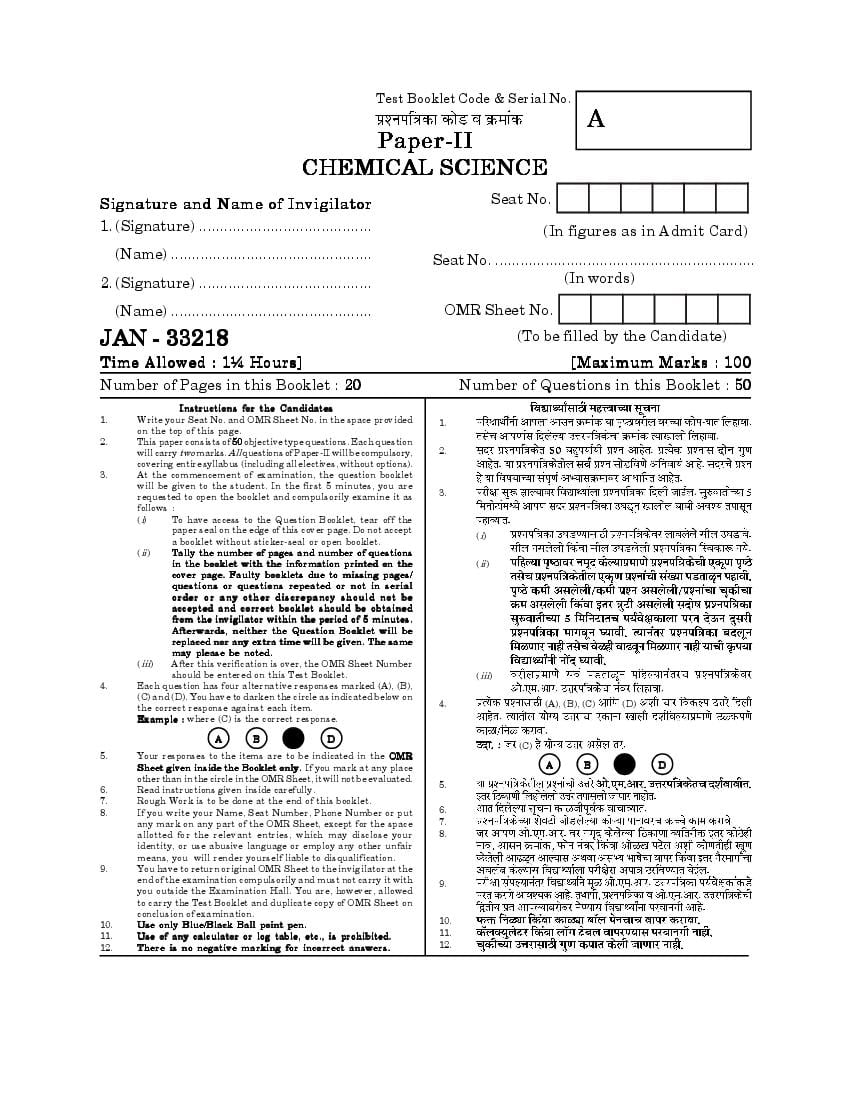
A
CHEMICAL SCIENCE
Signature and Name of Invigilator Seat No.
1. (Signature) ......................................... (In figures as in Admit Card)
(Name) ................................................ Seat No. ..............................................................
2. (Signature) ......................................... (In words)
(Name) ................................................ OMR Sheet No.
JAN - 33218 (To be filled by the Candidate)
Time Allowed : 1¼ Hours] [Maximum Marks : 100
Number of Pages in this Booklet : 20 Number of Questions in this Booklet : 50
Instructions for the Candidates
1. Write your Seat No. and OMR Sheet No. in the space provided 1.
on the top of this page.
2. This paper consists of 50 objective type questions. Each question
will carry two marks. All questions of Paper-II will be compulsory, 2.
covering entire syllabus (including all electives, without options).
3. At the commencement of examination, the question booklet
will be given to the student. In the first 5 minutes, you are
requested to open the booklet and compulsorily examine it as 3.
follows :
(i) To have access to the Question Booklet, tear off the
paper seal on the edge of this cover page. Do not accept
(i)
a booklet without sticker-seal or open booklet.
(ii) Tally the number of pages and number of questions
in the booklet with the information printed on the (ii)
cover page. Faulty booklets due to missing pages/
questions or questions repeated or not in serial
order or any other discre pancy should not be
accepted and correct booklet should be obtained
from the invigilator within the period of 5 minutes.
Afterwards, neither the Question Booklet will be
replaced nor any extra time will be given. The same
may please be noted.
(iii) After this verification is over, the OMR Sheet Number
should be entered on this Test Booklet. (iii)
4. Each question has four alternative responses marked (A), (B),
(C) and (D). You have to darken the circle as indicated below on
the correct response against each item. 4. (A), (B), (C) (D)
Example : where (C) is the correct response.
A B D
(C)
5. Your responses to the items are to be indicated in the OMR
Sheet given inside the Booklet only. If you mark at any place A B D
other than in the circle in the OMR Sheet, it will not be evaluated.
5.
6. Read instructions given inside carefully.
7. Rough Work is to be done at the end of this booklet.
8. If you write your Name, Seat Number, Phone Number or put 6.
any mark on any part of the OMR Sheet, except for the space 7.
allotted for the relevant entries, which may disclose your 8.
identity, or use abusive language or employ any other unfair
means, you will render yourself liable to disqualification.
9. You have to return original OMR Sheet to the invigilator at the
end of the examination compulsorily and must not carry it with 9.
you outside the Examination Hall. You are, however, allowed
to carry the Test Booklet and duplicate copy of OMR Sheet on
conclusion of examination.
10. Use only Blue/Black Ball point pen. 10.
11. Use of any calculator or log table, etc., is prohibited. 11.
12. There is no negative marking for incorrect answers. 12.
Page 2
Page 3
Paper II
Time Allowed : 75 Minutes] [Maximum Marks : 100
Note : This Paper contains Fifty (50) multiple choice questions. Each question
carrying Two (2) marks. Attempt All questions.
1. The number of Metal-Metal bonds in [Re2Cl8]2– is/are :
(A) One (B) Two
(C) Three (D) Four
2. The structure of (NH3)3CrO4 is :
(A) Trigonal bipyramid (B) Pentagonal bipyramid
(C) Square Pyramid (D) Pentagonal Pyramid
3. In gas chromatography, the basis of separation of the components is the
difference in :
(A) Conductivity (B) Molecular Weight
(C) Molarity (D) Partition Coefficient
4. The normality of a solution is determined by four separate titrations, the results
being 0·2041, 0·2049, 0·2039 and 0·2043. The average deviation for the results
is :
(A) 0·0003 (B) 0·2043
(C) 0·0006 (D) 0·0009
5. In the Kroll process Titanium is extracted by reducing TiCl4 with..............
metal.
(A) Barium (B) Magnesium
(C) Aluminum (D) Zinc
6. The X-band EPR spectra of phenyl radical will exhibit.................lines.
(A) 3 (B) 8
(C) 18 (D) 28
3 [P.T.O.
Page 4
symmetry group.
(A) C 5v (B) C 5h
(C) D5d (D) D5h
8. The spin only magnetic moment for a first row transition metal ion with 3F 4
ground state term is :
(A) 3·87 B.M. (B) 4·90 B.M.
(C) 2·83 B.M. (D) 5·92 B.M.
9. Crystal Field Stabilization Energy for a d3 ion in tetrahedral geometry is :
(A) –1·2 (B) –0·8
(C) –0·4 (D) 0·0
10. Which of the following statements is true with respect to 57Fe Mossbauer
spectra of (i) FeSO4·7H2O, (ii) K4[Fe(CN)6], (iii) Na2[Fe(CN)5NO]·2H2O ?
(A) singlet in (i), doublet in (ii) and (iii)
(B) singlet in (ii), doublet in (i) and (iii)
(C) singlet in (i), and (iii), doublet in (ii)
(D) doublet in (i), (ii) and (iii)
11. The geometry of the interhalogen compound BrF 3 is :
(A) Square planar (B) Tetrahedral
(C) Octahedron (D) Trigonal bipyramid
4
Page 5
(A) Triamminechloridocyanidonitrocobalt (III)
(B) Chloridocyanidonitrotriamminecobalt (III)
(C) Cyanidochloridonitrotriamminecobalt (III)
(D) Triamminechloridonitrocyanidocobalt (III)
13. The cation of dichloro bis(ethylenediamine) cobalt (III) belongs to D3 symmetry
is an example of :
(A) Coordination isomerism (B) Optical isomerism
(C) Linkage isomerism (D) Ionization isomerism
14. The 1G term of nd2 configuration can be assigned to :
(A) 45 microstates (B) 9 microstates
(C) 21 microstates (D) 15 microstates
15. The F—N—F bond angle in NF3 is :
(A) 109° 28 (B) 107° 48
(C) 102° 30 (D) 104° 27
16. The correct order of First Ionization energy of group 13 elements is :
(A) B > Tl > Ga > Al > In (B) B > Tl > Al > Ga > In
(C) B > Al > Ga > In > Tl (D) B > Ga > Tl > In > Al
17. The ionophore valinomycin is highly selective for :
(A) K+ (B) Na+
(C) Mg2+ (D) Ca2+
5 [P.T.O.
Page 6
(A) They have empty orbitals
(B) They act as donor ligands
(C) They are all weak field ligands
(D) They decrease the value of 0
19. Number of stereoisomers possible for the compound, CH3CH = CH—CH(OH)CH
= CHCH3 is :
(A) 4 (B) 6
(C) 7 (D) 8
20. The correct order of acidity for the following compounds is :
(A) III > I > II > IV (B) II > III > I > IV
(C) IV > II > I > III (D) III > II > I > IV
6
Page 7
spectrum of the following compound, respectively, are :
(A) 4, 4 (B) 5, 4
(C) 8, 7 (D) 8, 4
22. The major product formed in the following reaction is :
(A) (B)
(C) (D)
7 [P.T.O.
Page 8
1780 cm–1 is :
(A) (B)
(C) (D)
24. Major product of the following reaction is :
(A) (B)
(C) (D)
8
Page 9
(A) 5-Bromo-2-chloroheptane (B) 2-Chloro-5-bromoheptane
(C) 3-Bromo-6-chloroheptane (D) 6-Chloro-3-bromoheptane
26. Number of signals observed in the 1H NMR spectrum is p-tolualdehyde is :
(A) 3 (B) 4
(C) 5 (D) 6
27. The correct absolute configuration for the chiral centers in the following
compound is :
(A) 1S, 4S (B) 1S, 4R
(C) 1R, 4R (D) 1R, 4S
9 [P.T.O.
Page 10
(A)
(B)
(C)
(D)
10
Page 11
compound is :
(A) singlet (B) doublet
(C) triplet (D) AB quartet
30. The correct IUPAC nomenclature of the following compound is :
(A) 2-Nitro-5-carbaldehydo anisole
(B) 2-Methoxy-4-carbaldehydo nitrobenzene
(C) 4-Nitro-5-methoxy benzaldehyde
(D) 3-Methoxy-4-nitro benzaldehyde
11 [P.T.O.
Page 12
(A)
(B)
(C)
(D)
12
Page 13
(A)
(B)
(C)
(D)
13 [P.T.O.
Page 14
(A) (B)
(C) (D)
34. Chiral compound amongst the following is :
(A) (B)
(C) (D)
14
Page 15
mass = 128 g mol–1) and 20 g of benzene (molar mass = 78 g mol–1) is 2·8°C
and that of pure benzene is 5·5°C. The value of the molal freezing point
depression constant of benzene is :
(A) 4·3°C kg mol–1 (B) 4·3°C g mol–1
(C) 4·3°C mol kg–1 (D) 5·1°C mol g–1
36. T h e vapou r pr essu r e of 0·5 M aqu eou s K N O 3 solution is 749·7 torr at 100°C.
The activity of water in this solution at 100°C is :
(A) 0·9218 (B) 1·0023
(C) 1·0230 (D) 0·9864
37. When an ideal kept in a closed container at constant volume was cooled from
50°C to 25°C, it will lead to :
(A) Increase in the numbers of collisions per unit time
(B) Increase in the mean free path of the gas
(C) Increase in the average velocity of the gas
(D) Decrease in the average velocity of the gas
15 [P.T.O.
Page 16
A3 3/2A2
The following concentration Vs. time profiles were obtained. At time tA,
percentage of A3 decomposed is :
(A) 75 (B) 50
(C) 25 (D) 10
39. In the reaction :
Cl 2(g) + 3F2(g) 2ClF3; Hr = – 329 kJ
When the reaction is in equilibrium, which of the following will increase the
amount of ClF3 ?
(I) Increasing the temperature
(II) Increasing the volume of the reactor
(III) Removing Cl2
(IV) Adding F2
(A) I, II and III (B) IV only
(C) I and IV (D) II and IV
40. In the reaction :
ZnO + X + heat Zn + XO
Which element represented by X is industrially used to produce Zn metal ?
(A) Cu (B) C
(C) Hg (D) Pb
16
Page 17
(A) CuO + H2 — Cu + H2O
(B) Fe2O3 + 3CO — 2Fe + 3CO2
(C) 2K + F2 — 2KF
(D) BaCl2 + H2SO4 — BaSO4 + 2HCl
42.
Which of the following statements best describes the flow of electrons in the
above electrochemical cell ?
(A) From Pb electrode to Zn electrode through the Cu wire
(B) From Pb electrode to Zn electrode through the salt bridge
(C) From the Zn electrode to Pb electrode through the salt bridge
(D) From Zn electrode to Pb electrode through Cu wire
43. A radioactive substances has half life of 140 days. The fraction of the substance
that will remain after 2 years and 250 days is :
(A) 1/7 (B) 1/14
(C) 127/128 (D) 1/128
17 [P.T.O.
Page 18
2– 2–
SO3(aq.) H2O SO4(aq.) 2H (aq.)
one needs to :
(A) Add 2H2O to the left side
(B) Add 2e– to the right side
(C) Add 2e– to the left side
(D) Multiply both sides by a factor of 2
45. When a small amount of copper powder is added to ZnSO 4 solution, what
would be the observation ?
(A) Effervesence (B) Precipitation of a white solid
(C) Formation of a blue solution (D) No reaction
46. General acid (A) Base (B) titration curve is represented as follows :
What should be the equation for estimation of pH at point (L) :
1 1
(A) pH = pKw + log [B] (B) pH = pKa + pKw
2 2
1 1
(C) pH = pKa – log [A]initial (D) pH = pKa
2 2
18
Page 19
NaOH(aq) occurs when the molar concentration of NaClO is 0·050 M. The
pH of this solution is about (given pKa of HClO = 7·43; log 0·05 = – 1·301)
(A) 2·63 (B) 3·94
(C) 10·10 (D) 11·36
48. Hydride ion (H–) is :
(A) Not isoelectric with He (B) Bronsted-Lowrry base of H2
(C) Bronsted acid of OH– (D) A Lewis acid
49. The pH of 0·2M HCN(aq.) is (pKa of HCN = 9·31; log10 2 = 0·3010 and
log10 0·2 = – 0·6990) :
(A) 5·0 (B) 9·6
(C) 8·6 (D) 4·3
50. Which of the following is the strongest conjugate base ?
(A) ClCH2COO– (B) Cl·CH2·CH2COO–
(C) CH3COO– (D) Cl2CHCOO–
19 [P.T.O.
Page 20
20
Document Details
| Board / Org | Maharashtra Exams |
| Exam | Maharashtra State Eligibility Test |
| Type | Question Paper |
| Pages | 20 |
| Updated | 30 Apr 2026 |