CBSE Class 12 Question Paper 2025 Solution Early Childhood Care and Education
Finished viewing? Save it for later —
Download CBSE Class 12 Question Paper 2025 Solution Early Childhood Care and Education (PDF · 8 pages)About CBSE Class 12 Question Paper 2025 Solution Early Childhood Care and Education
CBSE Class 12 Question Paper 2025 Solution Early Childhood Care and Education is available here for free download. Published by CBSE for Class 12, this solution can be viewed online or downloaded as a PDF (8 pages). Candidates preparing for Class 12 can use CBSE Class 12 Question Paper 2025 Solution Early Childhood Care and Education to understand the exam pattern, the type of questions asked, and the overall difficulty level.
Frequently Asked Questions
How can I download CBSE Class 12 Question Paper 2025 Solution Early Childhood Care and Education?
Open this page and click the Download button to save CBSE Class 12 Question Paper 2025 Solution Early Childhood Care and Education as a PDF. It is completely free on AglaSem Docs.
Is CBSE Class 12 Question Paper 2025 Solution Early Childhood Care and Education free to download?
Yes. CBSE Class 12 Question Paper 2025 Solution Early Childhood Care and Education can be viewed online and downloaded as a PDF free of cost on AglaSem Docs.
How many pages does CBSE Class 12 Question Paper 2025 Solution Early Childhood Care and Education have?
CBSE Class 12 Question Paper 2025 Solution Early Childhood Care and Education contains 8 pages, which you can read online or download together as a single PDF.
Where can I find more Class 12 study material?
You can find more Class 12 question papers, sample papers, syllabus, and answer keys on AglaSem Docs.
CBSE Class 12 Question Paper 2025 Solution Early Childhood Care and Education – Text
Read the full text of this solution below — useful to quickly search, copy and reference the content online without downloading the PDF.
📄 View text version (8 pages)
Page 1
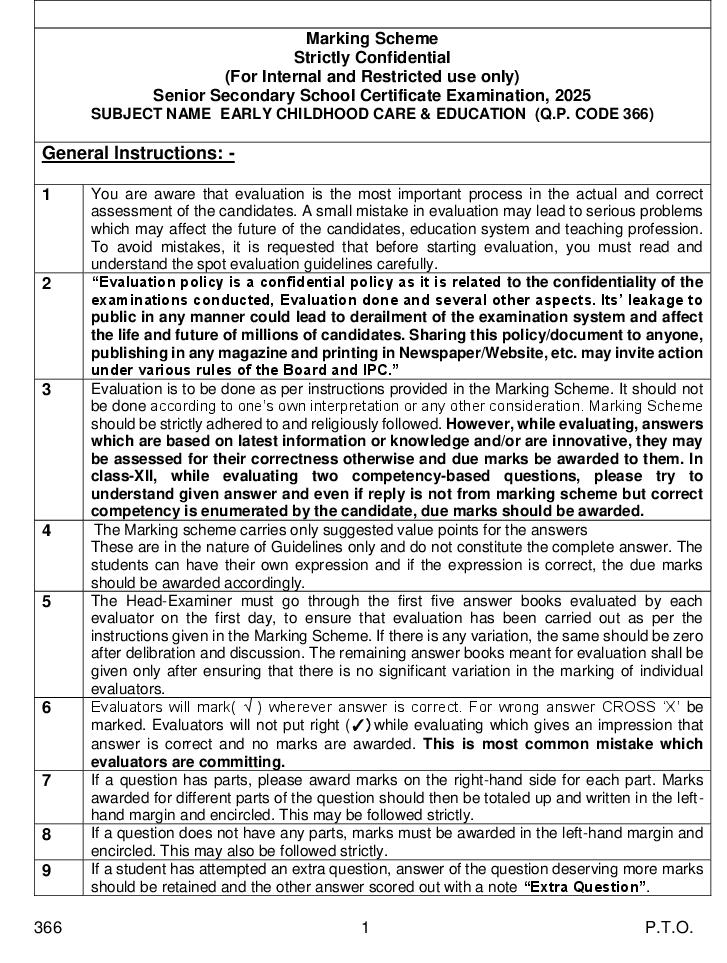
Strictly Confidential
(For Internal and Restricted use only)
Senior Secondary School Certificate Examination, 2025
SUBJECT NAME EARLY CHILDHOOD CARE & EDUCATION (Q.P. CODE 366)
General Instructions: -
1 You are aware that evaluation is the most important process in the actual and correct
assessment of the candidates. A small mistake in evaluation may lead to serious problems
which may affect the future of the candidates, education system and teaching profession.
To avoid mistakes, it is requested that before starting evaluation, you must read and
understand the spot evaluation guidelines carefully.
2 “Evaluation policy is a confidential policy as it is related to the confidentiality of the
examinations conducted, Evaluation done and several other aspects. Its’ leakage to
public in any manner could lead to derailment of the examination system and affect
the life and future of millions of candidates. Sharing this policy/document to anyone,
publishing in any magazine and printing in Newspaper/Website, etc. may invite action
under various rules of the Board and IPC.”
3 Evaluation is to be done as per instructions provided in the Marking Scheme. It should not
be done according to one’s own interpretation or any other consideration. Marking Scheme
should be strictly adhered to and religiously followed. However, while evaluating, answers
which are based on latest information or knowledge and/or are innovative, they may
be assessed for their correctness otherwise and due marks be awarded to them. In
class-XII, while evaluating two competency-based questions, please try to
understand given answer and even if reply is not from marking scheme but correct
competency is enumerated by the candidate, due marks should be awarded.
4 The Marking scheme carries only suggested value points for the answers
These are in the nature of Guidelines only and do not constitute the complete answer. The
students can have their own expression and if the expression is correct, the due marks
should be awarded accordingly.
5 The Head-Examiner must go through the first five answer books evaluated by each
evaluator on the first day, to ensure that evaluation has been carried out as per the
instructions given in the Marking Scheme. If there is any variation, the same should be zero
after delibration and discussion. The remaining answer books meant for evaluation shall be
given only after ensuring that there is no significant variation in the marking of individual
evaluators.
6 Evaluators will mark( √ ) wherever answer is correct. For wrong answer CROSS ‘X’ be
marked. Evaluators will not put right (✓)while evaluating which gives an impression that
answer is correct and no marks are awarded. This is most common mistake which
evaluators are committing.
7 If a question has parts, please award marks on the right-hand side for each part. Marks
awarded for different parts of the question should then be totaled up and written in the left-
hand margin and encircled. This may be followed strictly.
8 If a question does not have any parts, marks must be awarded in the left-hand margin and
encircled. This may also be followed strictly.
9 If a student has attempted an extra question, answer of the question deserving more marks
should be retained and the other answer scored out with a note “Extra Question”.
366 1 P.T.O.
Page 2
once.
11 A full scale of marks __________(example 0 to 80/70/60/50/40/30 marks as given in
Question Paper) has to be used. Please do not hesitate to award full marks if the answer
deserves it.
12 Every examiner has to necessarily do evaluation work for full working hours i.e., 8 hours
every day and evaluate 20 answer books per day in main subjects and 25 answer books
per day in other subjects (Details are given in Spot Guidelines).This is in view of the reduced
syllabus and number of questions in question paper.
13 Ensure that you do not make the following common types of errors committed by the
Examiner in the past:-
● Leaving answer or part thereof unassessed in an answer book.
● Giving more marks for an answer than assigned to it.
● Wrong totaling of marks awarded on an answer.
● Wrong transfer of marks from the inside pages of the answer book to the title page.
● Wrong question wise totaling on the title page.
● Wrong totaling of marks of the two columns on the title page.
● Wrong grand total.
● Marks in words and figures not tallying/not same.
● Wrong transfer of marks from the answer book to online award list.
● Answers marked as correct, but marks not awarded. (Ensure that the right tick mark is
correctly and clearly indicated. It should merely be a line. Same is with the X for
incorrect answer.)
● Half or a part of answer marked correct and the rest as wrong, but no marks awarded.
14 While evaluating the answer books if the answer is found to be totally incorrect, it should be
marked as cross (X) and awarded zero (0)Marks.
15 Any unassessed portion, non-carrying over of marks to the title page, or totaling error
detected by the candidate shall damage the prestige of all the personnel engaged in the
evaluation work as also of the Board. Hence, in order to uphold the prestige of all concerned,
it is again reiterated that the instructions be followed meticulously and judiciously.
16 The Examiners should acquaint themselves with the guidelines given in the “Guidelines for
Spot Evaluation” before starting the actual evaluation.
17 Every Examiner shall also ensure that all the answers are evaluated, marks carried over to
the title page, correctly totaled and written in figures and words.
18 The candidates are entitled to obtain photocopy of the Answer Book on request on payment
of the prescribed processing fee. All Examiners/Additional Head Examiners/Head
Examiners are once again reminded that they must ensure that evaluation is carried out
strictly as per value points for each answer as given in the Marking Scheme.
366 2
Page 3
$
MARKING SCHEME
EARLY CHILDHOOD CARE & EDUCATION
SECTION A
OBJECTIVE TYPE QUESTIONS
1. (i)Active 1
(ii)Extrinsic 1
(iii)Result orientation 1
(iv)Worksheet 1
(v)Start up 1
(vi)Make In India 1
2. (i)(C) Sand and water play 1
(ii)Sight reading 1
(iii)(D)Occupations 1
(iv)Perception – The process where the stimulus is interpreted, recognised and
given a meaning. 1
(v)(C)Reduced degree of empathy 1
(vi)EmotionalIntelligence 1
3. (i)(B)mother’s name 1
(ii)Sriniketan 1
(iii)(B)Sight reading 1
(iv)(D)Acquired Dyscalculia 1
366 3 P.T.O.
Page 4
(vi)Socio-Emotional Development –It is the capability to understand the feelings
and outlooks of others and help a child control his or her behaviour. 1
4. (i)Development of big muscles necessary for running, jumping, climbing stairs.
1
(ii)garden, gardner 1
(iii)(B)Develops friendly skills 1
(iv)(D)Sensation 1
(v)Learning centre – is a selected area within the classroom that provides
students with stimulating and existing experience to practice, enrich and
enhance their learning. 1
(vi)True
1
5. (i)(D)Able to dress independently 1
(ii)Rhymes 1
(iii)The child should experience gradual and progressive growth. Enhancement
of knowledge should begin with the training of instincts, balancing
emotions say reliance, societal cooperation. 1
(iv)sensorymaterial 1
(v)(D)Regulation 1
(vi)(B)Traditional layout 1
SECTION B
SUBJECTIVE TYPE QUESTIONS
6. –Do not let the emotions take over your mind
–Keep away phones and digital devices
– Create a conducive environment to avoid misinterpretations and distractions
366 4
Page 5
with others.
–Allow other persons to finish speaking and then respond. (Any
2) 2
7. Self awareness is understanding one’s own needs, desires, habits, traits,
behaviours and feelings.
Steps towards Self Awarness:
1. Gain greater awarness of one’s emotions.
2. Make a habit of tracking ones feelings.
3. Expand ones practice to areas of life beyond the person’s feelings
2
8. Deleting data from cell : 2
(1) Click on the cell
(2) Press delete key on the keyboard
(3) Text entry in the cell will become blank
9. Environmental Barriers : 2
– Lack of adequate resources or raw material
– Non-availability of skilled labour
– Lack of requisite machinery and other infrastructure
– Unavailability of monetary resources on time
10. Green jobs – is defined as one that helps bring about and maintains
transition to environmentally sustainable forms of production and
consumption sectors in which green jobs are found – Energy, water
conservation, waste management (any 2) 2
11. Right to Participation
Right to freedom of judgement
366 5 P.T.O.
Page 6
Right to information
Right to participation 2
12. Cognitive development relates to the brain and its development.
It is a vital element of holistic development.
It involves problem solving, thinking and understanding of concepts.
By the age of 3 years child’s brain grows to 80% of its adult size .
By the age of 5 years child’s brain grows to 90% of its potential.
Due to brain growth a child is able to absorb and retain more information
at a quicker and easier rate. 2
13. Baladev Bhava Meaning – Worship of the child 2
– Inexpensive learning material made at local level.
– Observing nature indulging in nature walks.
– No formal examination system children had to clear and pass
A phase to step into the next level – Salmandir, Kishore mandir, Vinay
mandir
14. 4 months – can babble, will cry in various ways to express needs.
6 months – Can respond to people with basic sounds, Can pronounce
vowels, Can recognise own name
9 months – Can make basic sounds, can copy the sounds of other people 2
15. –Children get to know about feelings values and cultures of others. 2
– They learn to celebrate diversity together.
– Rhymes and songs provide children expressive vocabulary.
– Introduce them to socially acceptable ways to express feelings.
366 6
Page 7
–as individuals who are curious about their world.
–They have powerful potential to learn from all that surrounds them.
–We should understand them by considering their educational, psychological
and sociological influences.
–We should give exposure to a wide variety of educational opportunities that
encourage self-expression, communication, logical thinking and problem
solving.
17. Cooperative and team play 4
Customized experience
Blended strategy
Flexibility (Explain)
18. Child is at the centre of all instructions and activities. 4
Adults role is that of a facilitator.
– Facilitator must provide opportunities to the child to explore and discover.
Children must feel active, involved and delightful.
–Planned learning outcomes must be achieved through learning by doing or
experiencing.
19. Sensitivity is a mixture of 4
–Self awareness, empathy and awareness of the world.
–It is learning how to be sensitive to emotions of others.
–This helps in developing deep and respectful relationships.
–On development of sensitivity the child is more acceptable towards his own
emotions and emotions of others.
–Child becomes a balanced person.
366 7 P.T.O.
Page 8
consistent over time and may interfere with social relationships,
academic learning, may pose threat for own and others safety. 4
Causing distractions and disruptions of activities.
Reacting to frustration by yelling, dropping to ground,
Refusal to comply to class rules,
Aggression forwards self, others or objects.
21. Electricity safety: 4
–All plug points at a height of 8 feet from the floor.
–No electrical equipment to be kept lying around in the school premises.
–Electrical outlets must have protective caps when outlets are not in use.
–Computer must be checked for electrical shocks.
–No child should be asked to switch ‘on’ or ‘off’ the light, fan or A.C.
(any 4) (any other)
**************************************
366 8
Document Details
| Board / Org | CBSE |
| Exam | Class 12 |
| Type | Solution |
| Pages | 8 |
| Updated | 24 Sep 2026 |