MAHA SET 2015 Question Paper 2 Economics
Finished viewing? Save it for later —
Download MAHA SET 2015 Question Paper 2 Economics (PDF · 24 pages)About MAHA SET 2015 Question Paper 2 Economics
MAHA SET 2015 Question Paper 2 Economics is available here for free download. Published by Maharashtra Exams for MAHA SET, this question paper can be viewed online or downloaded as a PDF (24 pages). Candidates preparing for MAHA SET can use MAHA SET 2015 Question Paper 2 Economics to understand the exam pattern, the type of questions asked, and the overall difficulty level.
Frequently Asked Questions
How can I download MAHA SET 2015 Question Paper 2 Economics?
Open this page and click the Download button to save MAHA SET 2015 Question Paper 2 Economics as a PDF. It is completely free on AglaSem Docs.
Is MAHA SET 2015 Question Paper 2 Economics free to download?
Yes. MAHA SET 2015 Question Paper 2 Economics can be viewed online and downloaded as a PDF free of cost on AglaSem Docs.
How many pages does MAHA SET 2015 Question Paper 2 Economics have?
MAHA SET 2015 Question Paper 2 Economics contains 24 pages, which you can read online or download together as a single PDF.
Where can I find more MAHA SET study material?
You can find more MAHA SET question papers, sample papers, syllabus, and answer keys on AglaSem Docs.
MAHA SET 2015 Question Paper 2 Economics – Text
Read the full text of this question paper below — useful to quickly search, copy and reference the content online without downloading the PDF.
📄 View text version (24 pages)
Page 1
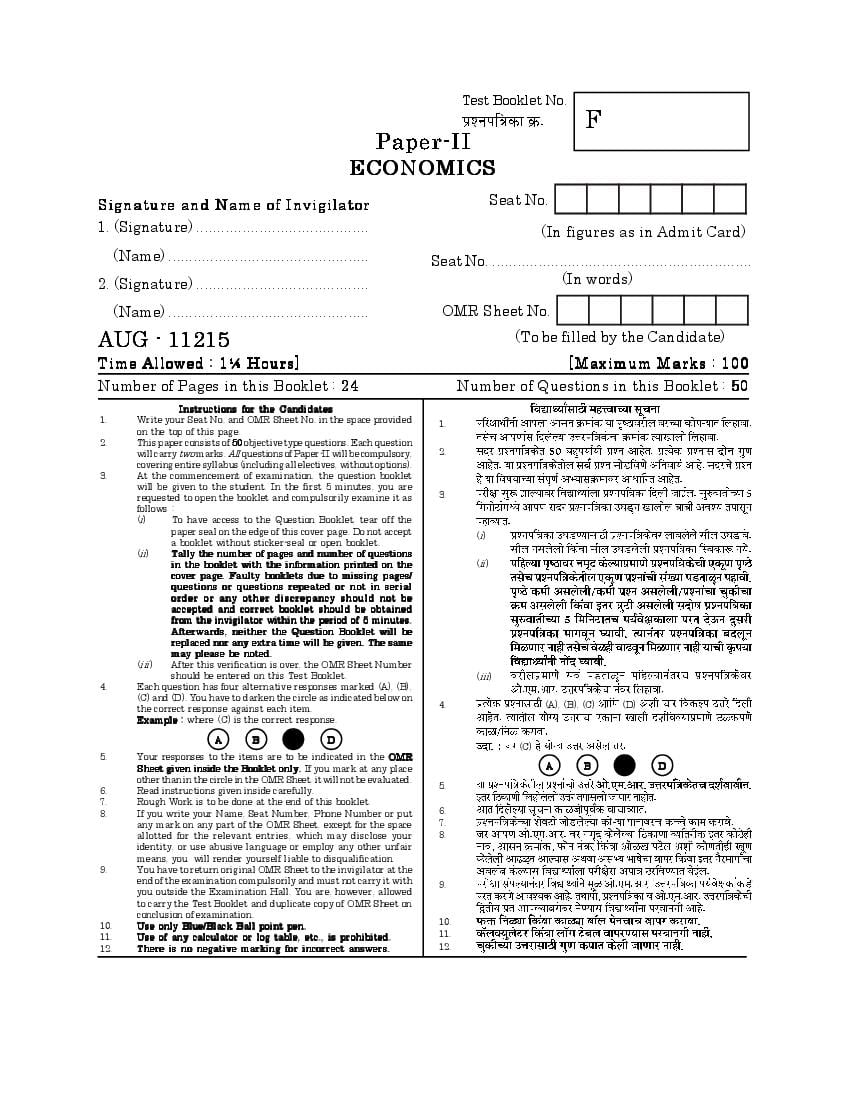
F
ECONOMICS
Signature and Name of Invigilator Seat No.
1. (Signature) ......................................... (In figures as in Admit Card)
(Name) ................................................ Seat No. ..............................................................
2. (Signature) ......................................... (In words)
(Name) ................................................ OMR Sheet No.
AUG - 11215 (To be filled by the Candidate)
Time Allowed : 1¼ Hours] [Maximum Marks : 100
Number of Pages in this Booklet : 24 Number of Questions in this Booklet : 50
Instructions for the Candidates
1. Write your Seat No. and OMR Sheet No. in the space provided 1.
on the top of this page.
2. This paper consists of 50 objective type questions. Each question
will carry two marks. All questions of Paper-II will be compulsory, 2.
covering entire syllabus (including all electives, without options).
3. At the commencement of examination, the question booklet
will be given to the student. In the first 5 minutes, you are
requested to open the booklet and compulsorily examine it as 3.
follows :
(i) To have access to the Question Booklet, tear off the
paper seal on the edge of this cover page. Do not accept (i)
a booklet without sticker-seal or open booklet.
(ii) Tally the number of pages and number of questions
in the booklet with the information printed on the (ii)
cover page. Faulty booklets due to missing pages/
questions or questions repeated or not in serial
o rder or any other discre pancy should not be
accepted and correct booklet should be obtained
from the invigilator within the period of 5 minutes.
Afterwards, neither the Question Booklet will be
replaced nor any extra time will be given. The same
may please be noted.
(iii) After this verification is over, the OMR Sheet Number
should be entered on this Test Booklet. (iii)
4. Each question has four alternative responses marked (A), (B),
(C) and (D). You have to darken the circle as indicated below on
the correct response against each item. 4. (A), (B), (C) (D)
Example : where (C) is the correct response.
A B D
(C)
5. Your responses to the items are to be indicated in the OMR
Sheet given inside the Booklet only. If you mark at any place A B D
other than in the circle in the OMR Sheet, it will not be evaluated.
5.
6. Read instructions given inside carefully.
7. Rough Work is to be done at the end of this booklet.
8. If you write your Name, Seat Number, Phone Number or put 6.
any mark on any part of the OMR Sheet, except for the space 7.
allotted for the relevant entries, which may disclose your 8.
identity, or use abusive language or employ any other unfair
means, you will render yourself liable to disqualification.
9. You have to return original OMR Sheet to the invigilator at the
end of the examination compulsorily and must not carry it with 9.
you outside the Examination Hall. You are, however, allowed
to carry the Test Booklet and duplicate copy of OMR Sheet on
conclusion of examination.
10. Use only Blue/Black Ball point pen. 10.
11. Use of any calculator or log table, etc., is prohibited. 11.
12. There is no negative marking for incorrect answers. 12.
Page 2
Page 3
Paper II
II
Time Allowed : 75 Minutes] [Maximum Marks : 100
Note : This Paper contains Fifty (50) multiple choice questions. Each question
carries Two (2) marks. Attempt All questions.
(50) (2)
1. In case of positive cross-elasticity, 1.
price consumption curve would
be :
(A)
(A) Upward sloping
(B)
(B) Downward sloping
(C)
(C) Horizontal straight line
(D)
(D) Vertical straight line
2. Monetary policy will be more 2.
effective in Keynesian macro-
economic equilibrium if speculative
demand for money responds :
(A)
(A) Weakly to change in interest
rate
(B)
(B) Strongly to change in interest
rate
(C)
(C) Does not respond at all to
interest rate
(D) Only when interest rate is above (D)
a threshold level
3 [P.T.O.
Page 4
(A) Disutility in parting with
(A)
purchasing power
(B) The amount of money paid as
tax (B)
(C) The amount of tax as proportion
of income
(C)
(D) Increase in disposable income
4. The income elasticity of demand for
(D)
imports is equal to :
(A) The marginal propensity to 4.
import
(B) The average propensity to
(A)
import
(B)
(C) The marginal propensity to
import divided by the average (C)
propensity to import
(D) The average propensity to
(D)
import minus the average
propensity to export
4
Page 5
share in gross domestic savings at
present ?
(A)
(A) Public sector
(B)
(B) Government sector
(C)
(C) Private corporate sector
(D)
(D) Domestic sector
6. According to Marx, main source of 6.
capital accumulation under
capitalism is :
(A)
(A) Constant capital
(B)
(B) Variable capital
(C)
(C) Savings by the workers
(D)
(D) Savings by the farmers
7.
7. Arithmetic Mean of deviations is :
(A) 1
(A) 1
(B) –1
(B) –1
(C) 0 (C) 0
(D) (D)
5 [P.T.O.
Page 6
individuals plays an important role
in .............
(A) Transaction demand for money
(B) Quantity theory of money (A)
(C) Precautionary demand for
(B)
money
(C)
(D) Portfolio choice theory of money
9. Which of the following is not an (D)
objective of the National Food
9.
Security Mission ?
(A) Sustainable increase in
production of rice, wheat and (A)
pulses
(B) Restoring soil fertility and
(B)
productivity at individual farm
level
(C) Promoting use of bio-pesticides
(C)
and organic fertilizers
(D) Creation of employment
opportunities (D)
6
Page 7
to .................... .
(A) The entry of private units in (A)
telecommunication sector
(B) The reorganization of Railway (B)
zones
(C)
(C) The reconstruction of RRBs
(D)
(D) The reforms in oil sector
11. Which one of the following is the 11.
correct cause of demographic
dividend in India ?
(A)
(A) Falling dependency ratio
(B)
(B) Increasing urbanization process
(C)
(C) Increasing dependency ratio
(D) Falling birth and death rates (D)
12. Who among the following 12.
economists, developed the ‘Theory of
Circular Causation’ ?
(A)
(A) G. Myrdal
(B)
(B) R. Nurkse
(C) J.R. Hicks (C)
(D) J. Robinson (D)
7 [P.T.O.
Page 8
Commission on Centre-State
Relations ? (A)
(A) Justice R.S. Sarkaria (B)
(B) K.N. Raj (C)
(C) L.K. Jha (D)
(D) Wanchoo 14.
14. The marginal propensity to import
is defined as :
M
(A)
M X
(A)
X X
(B)
X Y
(B)
Y M
(C)
M Y
(C)
Y M
(D)
M Y
(D)
Y 15.
15. Return to human capital is part of
money demand function of :
(A) Baumol (A)
(B) Tobin (B)
(C) Friedman (C)
(D) Keynes (D)
8
Page 9
demand curve for a given good
measures : (A)
(A) Marginal utility (B)
(B) Total utility (C)
(C) Disutility (D)
(D) Marginal cost of production 17.
17. Keynes’s speculative demand for
money suggests that if everybody
expects price of bond to rise
tomorrow, then speculative demand
for money curve will be : (A)
(A) Perfectly inelastic (B)
(B) Unit elastic (C)
(C) Perfectly elastic (D)
(D) Vertical
3
18. C = 20 + Y,
18. If the consumption function is given 4
3
by C = 20 + Y, then the value of
4
multiplier will be.....................
4
(A)
4 3
(A)
3
1
1 (B)
(B) 4
4
(C) 4 (C) 4
(D) 5 (D) 5
9 [P.T.O.
Page 10
associated with kinked demand
curve faced by a firm ?
(A)
(A) Monopoly
(B)
(B) Perfect competition
(C)
(C) Oligopoly
(D)
(D) Monopolistic competition
20.
20. In Keynesian consumption function,
the property shows :
(A) MPC = APC (A) =
(B) MPC < APC
(B) <
(C) MPC > APC
(D) APC = zero
(C) >
21. At present, the number of recognized
central trade union is 12. Which of
the following trade unions continues (D) =
to be largest among all 12 trade 21.
unions in India ?
(A) Hind Mazdoor Sabha (HMS)
(B) Centre for Indian Trade Unions (A) (HMS)
(CITU)
(B) (CITU)
(C) All India Trade Union Congress
(C)
(AITUC)
(AITUC)
(D) Bhartiya Mazdoor Sangh
(BMS) (D) (BMS)
10
Page 11
the sum of squares of observations
is 6000 and their median is 12.
Then the coefficient of skewness will
be :
(A) –2.34
(A) –2.34
(B) +3.34
(B) +3.34
(C) –1.34
(C) –1.34
(D) +2.34
(D) +2.34
23.
23. The development process under
capitalism has been described as
‘Creative destruction’ by :
(A)
(A) Karl Marx
(B)
(B) A.N. Hansen
(C)
(C) R. Luxemburg
(D) J. Schumpeter (D)
24. If buoyancy coefficient of a tax is 24.
greater than unity, it indicates
.................... in the tax structure.
(A) Built in flexibility (A)
(B) Built in stability (B)
(C) Built in elasticity (C)
(D) Built in accountability (D)
11 [P.T.O.
Page 12
welfare is :
(A) Prohibitive tariff (A)
(B) Effective tariff (B)
(C) Optimum tariff (C)
(D) Protective tariff (D)
26.
26. In simple money multiplier formula,
if deposits rise by 100 and the target
increase in money supply is 500,
cash reserve ratio should be ........
(A) 30%
(A) 30%
(B) 50%
(B) 50%
(C) 25%
(C) 25%
(D) 20%
(D) 20%
27.
27. Long-run normal price is that which
is likely to prevail :
(A) All the times
(A)
(B) In market period (B)
(C) In short-run period (C)
(D) In long-run period (D)
12
Page 13
correct answer from the codes given
below :
I
List I
(a)
(a) Inflation-unemployment trade
off (b)
(b) Portfolio balance approach (c)
(c) Multiplier-accelerator inter-
(d)
action
II
(d) Quantity theory of money
(1)
List II
(1) James Tobin (2)
(2) A.W. Phillips (3)
(3) Irving Fisher (4)
(4) Paul Samuelson
Codes :
(a) (b) (c) (d)
(a) (b) (c) (d)
(A) (1) (3) (2) (4)
(A) (1) (3) (2) (4)
(B) (2) (1) (3) (4)
(B) (2) (1) (3) (4)
(C) (1) (2) (4) (3) (C) (1) (2) (4) (3)
(D) (2) (1) (4) (3) (D) (2) (1) (4) (3)
13 [P.T.O.
Page 14
production that the firm neither
hires nor purchases is called :
(A) Social cost
(A)
(B) Opportunity cost
(B)
(C) Economic cost
(C)
(D) Imputed cost
(D)
30. Under Lead Bank Scheme the lead
30.
bank were asked to adopt ..........
(A) Village
(A)
(B) Town
(B)
(C) District
(C)
(D) State
(D)
31. If cov(X, Y) = X Y, then ‘r’ will be
31. cov(X, Y) = X ‘r’
equal to :
(A) 1 (A) 1
(B) 0 (B) 0
(C) –1 (C) –1
(D) (D)
14
Page 15
falls as a result of :
(A) Primary deficit (A)
(B) Fiscal deficit
(B)
(C) Budget deficit
(C)
(D) Revenue deficit
(D)
33. Devaluation can improve the
33.
balance of payments only when the
sum of elasticity of demand for
imports and elasticity of demand for
exports is :
(A) Equal to one (A)
(B) Greater than one (B)
(C) Smaller than one (C)
(D) Zero
(D)
34. Classical investment theory
34.
advocates normally all of the
following, except :
(A)
(A) Perfect competition
(B)
(B) Absence of externalities
(C) A living wage (C)
(D) A state of general equilibrium (D)
15 [P.T.O.
Page 16
grow in proportion to inflation rate,
the long-run Phillips curve will be :
(A) Vertical (A)
(B) Horizontal
(B)
(C) Steeper than short-run curve
(C)
but not vertical
(D) Flatter than short-run curve
(D)
but not vertical
36. Normal profits are considered
36.
as :
(A) Explicit costs
(A)
(B) Implicit costs
(B)
(C) Social costs (C)
(D) Private costs (D)
16
Page 17
in ‘Bharat Nirman Yojana’ ?
(A) Irrigation (A)
(B) Water supply (B)
(C) Education (C)
(D) Telephone (D)
38. Which one of the following 38.
economists stated that the
advancement of international trade
will have adversities to a developing
country ?
(A)
(A) Ricardo
(B)
(B) Adam Smith
(C)
(C) Karl Marx
(D) R. Prebisch (D)
17 [P.T.O.
Page 18
turning point are used in the
business cycle model of :
(A) Hicks (A)
(B) Samuelson (B)
(C) Kaldor
(C)
(D) Goodwin
(D)
40. For perfect complementarity
40.
between X and Y :
(A) MRTSXY
(A) MRTSXY will be zero
(B) MRTS XY MRTSYX
(B) MRTS XY and MRTSYX both
will be zero
(C) MRTSXY will be constant (C) MRTSXY
(D) MRTSYX will be constant (D) MRTSYX
18
Page 19
determination model, to the right of
equilibrium point we have :
(A)
(A) Aggregate demand is more than
aggregate supply
(B)
(B) Aggregate demand is less than
aggregate supply
(C)
(C) Aggregate demand is constant
(D) Aggregate supply is constant (D)
42. The slope of price line is given by 42.
the ......................
(A) Taste and preferences of the
(A)
consumer
(B)
(B) Prices of both the commodities
(C)
(C) Price of commodity X alone
(D) Price of commodity Y alone (D)
19 [P.T.O.
Page 20
of public sector commercial banks at
present ?
(A)
(A) Uttar Pradesh
(B)
(B) Maharashtra
(C)
(C) Karnataka
(D)
(D) Gujarat
44.
44. Lorenz curve is a graphic method
of studying :
(A)
(A) Correlation
(B)
(B) Index numbers
(C)
(C) Averages
(D)
(D) Dispersion
45.
45. The concept of the ‘reserve army of
labour’ is due to :
(A) Karl Marx (A)
(B) David Ricardo (B)
(C) Adam Smith (C)
(D) J.S. Mill (D)
20
Page 21
(A) A good that the public must pay (A)
for
(B) Non-rival in consumption
(B)
(C) More costly than a private
(C)
good
(D)
(D) Paid for by the government
47.
47. Grants from the centre to the states
under the recommendations of
Finance Commission are known as :
(A)
(A) Plan grants
(B)
(B) Development assistance
(C)
(C) Statutory grants
(D)
(D) Discretionary grants
48.
48. Which of the following is true in case
of a positively skewed curve ?
(A) mean has the lowest value (A)
(B) mode has the highest value (B)
(C) mean has the highest value (C)
(D) mode has a value more than (D)
median
21 [P.T.O.
Page 22
constraint line is :
(A) PXQX + PYQY = M (A) PXQX + PYQY = M
(B) PX/M = QX (B) PX/M = QX
(C) PXQX + QX = M (C) PXQX + QX = M
(D) PX + QX = M (D) PX + QX = M
50. Which of the following transactions 50.
is a debit in the Current Account ?
(A) The export of merchandise (A)
(B) The export of services (B)
(C) A gift to a foreigner (C)
(D) A gift from a foreigner (D)
22
Page 23
23 [P.T.O.
Page 24
24
Document Details
| Board / Org | Maharashtra Exams |
| Exam | MAHA SET |
| Type | Question Paper |
| Pages | 24 |
| Updated | 30 Apr 2026 |