CBSE Class 12 Mathematics Question Paper 2020 Set 65-3 Solutions
Finished viewing? Save it for later —
Download CBSE Class 12 Mathematics Question Paper 2020 Set 65-3 Solutions (PDF · 48 pages)About CBSE Class 12 Mathematics Question Paper 2020 Set 65-3 Solutions
CBSE Class 12 Mathematics Question Paper 2020 Set 65-3 Solutions is available here for free download. Published by CBSE for Class 12, this solution can be viewed online or downloaded as a PDF (48 pages). Candidates preparing for Class 12 can use CBSE Class 12 Mathematics Question Paper 2020 Set 65-3 Solutions to understand the exam pattern, the type of questions asked, and the overall difficulty level.
Frequently Asked Questions
How can I download CBSE Class 12 Mathematics Question Paper 2020 Set 65-3 Solutions?
Open this page and click the Download button to save CBSE Class 12 Mathematics Question Paper 2020 Set 65-3 Solutions as a PDF. It is completely free on AglaSem Docs.
Is CBSE Class 12 Mathematics Question Paper 2020 Set 65-3 Solutions free to download?
Yes. CBSE Class 12 Mathematics Question Paper 2020 Set 65-3 Solutions can be viewed online and downloaded as a PDF free of cost on AglaSem Docs.
How many pages does CBSE Class 12 Mathematics Question Paper 2020 Set 65-3 Solutions have?
CBSE Class 12 Mathematics Question Paper 2020 Set 65-3 Solutions contains 48 pages, which you can read online or download together as a single PDF.
Where can I find more Class 12 study material?
You can find more Class 12 question papers, sample papers, syllabus, and answer keys on AglaSem Docs.
CBSE Class 12 Mathematics Question Paper 2020 Set 65-3 Solutions – Text
Read the full text of this solution below — useful to quickly search, copy and reference the content online without downloading the PDF.
📄 View text version (48 pages)
Page 1
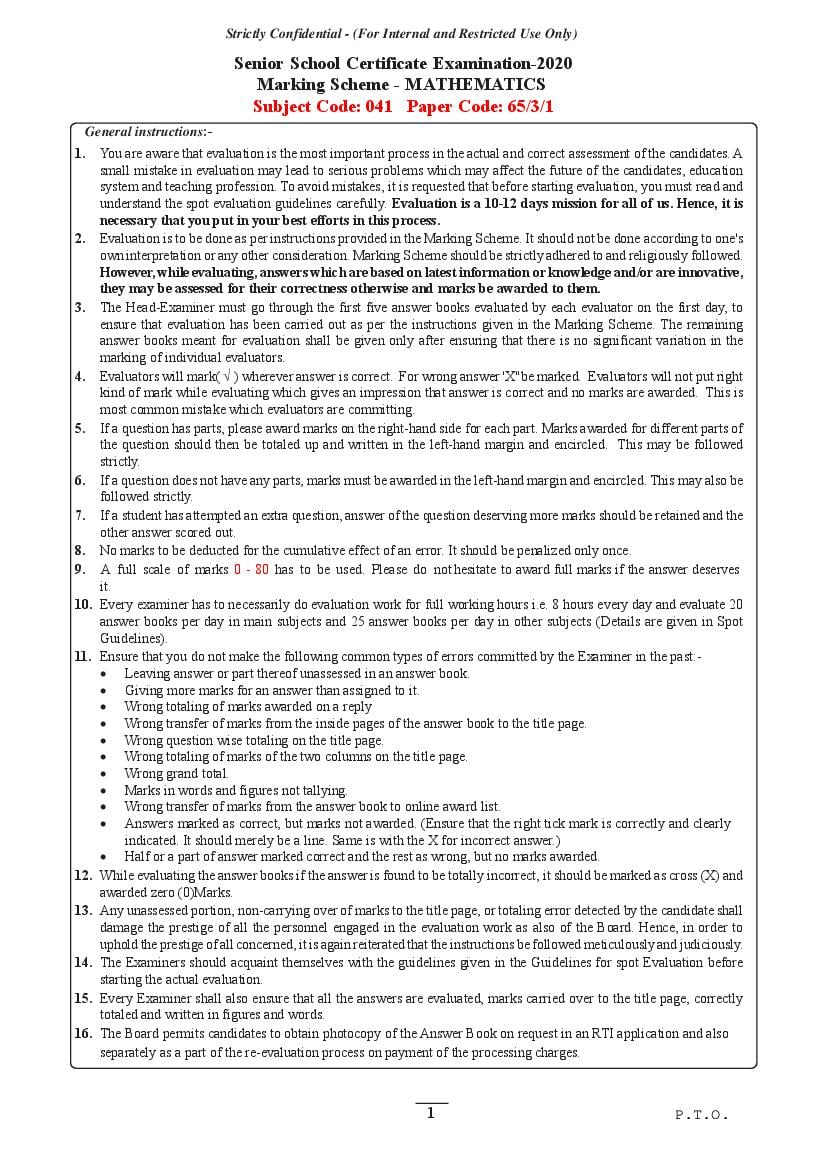
Senior School Certificate Examination-2020
Marking Scheme - MATHEMATICS
Subject Code: 041 Paper Code: 65/3/1
General instructions:-
1. You are aware that evaluation is the most important process in the actual and correct assessment of the candidates. A
small mistake in evaluation may lead to serious problems which may affect the future of the candidates, education
system and teaching profession. To avoid mistakes, it is requested that before starting evaluation, you must read and
understand the spot evaluation guidelines carefully. Evaluation is a 10-12 days mission for all of us. Hence, it is
necessary that you put in your best efforts in this process.
2. Evaluation is to be done as per instructions provided in the Marking Scheme. It should not be done according to one's
own interpretation or any other consideration. Marking Scheme should be strictly adhered to and religiously followed.
However, while evaluating, answers which are based on latest information or knowledge and/or are innovative,
they may be assessed for their correctness otherwise and marks be awarded to them.
3. The Head-Examiner must go through the first five answer books evaluated by each evaluator on the first day, to
ensure that evaluation has been carried out as per the instructions given in the Marking Scheme. The remaining
answer books meant for evaluation shall be given only after ensuring that there is no significant variation in the
marking of individual evaluators.
4. Evaluators will mark( √ ) wherever answer is correct. For wrong answer 'X"be marked. Evaluators will not put right
kind of mark while evaluating which gives an impression that answer is correct and no marks are awarded. This is
most common mistake which evaluators are committing.
5. If a question has parts, please award marks on the right-hand side for each part. Marks awarded for different parts of
the question should then be totaled up and written in the left-hand margin and encircled. This may be followed
strictly.
6. If a question does not have any parts, marks must be awarded in the left-hand margin and encircled. This may also be
followed strictly.
7. If a student has attempted an extra question, answer of the question deserving more marks should be retained and the
other answer scored out.
8. No marks to be deducted for the cumulative effect of an error. It should be penalized only once.
9. A full scale of marks 0 - 80 has to be used. Please do not hesitate to award full marks if the answer deserves
it.
10. Every examiner has to necessarily do evaluation work for full working hours i.e. 8 hours every day and evaluate 20
answer books per day in main subjects and 25 answer books per day in other subjects (Details are given in Spot
Guidelines).
11. Ensure that you do not make the following common types of errors committed by the Examiner in the past:-
• Leaving answer or part thereof unassessed in an answer book.
• Giving more marks for an answer than assigned to it.
• Wrong totaling of marks awarded on a reply
• Wrong transfer of marks from the inside pages of the answer book to the title page.
• Wrong question wise totaling on the title page.
• Wrong totaling of marks of the two columns on the title page.
• Wrong grand total.
• Marks in words and figures not tallying.
• Wrong transfer of marks from the answer book to online award list.
• Answers marked as correct, but marks not awarded. (Ensure that the right tick mark is correctly and clearly
indicated. It should merely be a line. Same is with the X for incorrect answer.)
• Half or a part of answer marked correct and the rest as wrong, but no marks awarded.
12. While evaluating the answer books if the answer is found to be totally incorrect, it should be marked as cross (X) and
awarded zero (0)Marks.
13. Any unassessed portion, non-carrying over of marks to the title page, or totaling error detected by the candidate shall
damage the prestige of all the personnel engaged in the evaluation work as also of the Board. Hence, in order to
uphold the prestige of all concerned, it is again reiterated that the instructions be followed meticulously and judiciously.
14. The Examiners should acquaint themselves with the guidelines given in the Guidelines for spot Evaluation before
starting the actual evaluation.
15. Every Examiner shall also ensure that all the answers are evaluated, marks carried over to the title page, correctly
totaled and written in figures and words.
16. The Board permits candidates to obtain photocopy of the Answer Book on request in an RTI application and also
separately as a part of the re-evaluation process on payment of the processing charges.
1 P.T.O.
Page 2
EXPECTED ANSWER/VALUE POINTS
SECTION – A
Question Numbers 1 to 20 carry 1 mark each.
Question Numbers 1 to 10 are multiple choice type questions.
Select the correct option.
Q.No. Marks
1. If f and g are two functions from R to R defined as f(x) = |x| + x and
g(x) = |x| – x, then f o g(x) for x < 0 is
(A) 4x (B) 2x (C) 0 (D) – 4x
Ans: (D) – 4x 1
2. The principal value of cot
−1
( − 3 ) is
π π 2π 5π
(A) − (B) (C) (D)
6 6 3 6
5π
Ans: (D) 1
6
⎡ −2 0 0 ⎤
⎢ ⎥
3. If A = ⎢ 0 −2 0 ⎥ , then the value of |adj A| is
⎣0 0 −2 ⎦
(A) 64 (B) 16 (C) 0 (D) –8
Ans: (A) 64 1
4. The maximum value of slope of the curve y = –x3 + 3x2 + 12x – 5 is
(A) 15 (B) 12 (C) 9 (D) 0
Ans: (A) 15 1
e x (1 + x)
5. ∫ cos2 ( xex ) dx is equal to
(A) tan ( xe x ) + c (B) cot ( xe x ) + c
(C) cot ( e x ) + c (D) tan ⎡⎣ e x (1 + x) ⎤⎦ + c
Ans: (A) tan ( xe x ) + c 1
2 3
6. The degree of the differential equation x d y = ⎛⎜ x dy − y ⎞⎟
2
dx 2 ⎝ dx ⎠
(A) 1 (B) 2 (C) 3 (D) 6
Ans: (A) 1 1
65/3/1 2
Page 3
ˆ is a unit vector is
1
(A) 0 (B) (C) 1 (D) 3
3
1
Ans: (B) 1
3
8. The coordinates of the foot of the perpendicular drawn from the point
(–2, 8, 7) on the XZ-plane is
(A) (–2, –8, 7) (B) (2, 8, –7) (C) (–2, 0, 7) (D) (0, 8, 0)
Ans: (C) (–2, 0, 7) 1
9. The vector equation of XY-plane is
r r r r r
(A) r . kˆ = 0 (B) r . ˆj = 0 (C) r . ˆi = 0 (D) r . n = 1
r
Ans: (A) r . kˆ = 0 1
10. The feasible region for an LPP is shown below:
Let z = 3x– 4y be the objective function. Minimum of z occurs at
y
(4, 10)
(0, 8) (6, 8)
(6, 5)
x
(0, 0) (5, 0)
(A) (0, 0) (B) (0, 8) (C) (5, 0) (D) (4, 10)
Ans: (B) (0, 8) 1
Fill in the blanks in questions numbers 11 to 15
dy
11. If y = tan–1 x + cot–1 x, x ∈ R, then is equal to __________.
dx
Ans: 0 1
OR
If cos (xy) = k, where k is a constant and xy ≠ nπ, n ∈ Z,
dy
then is equal to _____________.
dx
y
Ans: − 1
x
65/3/1 3
Page 4
{
12. The value of λ so that the function f defined by f(x) = cos x, if
x≤π
x>π
is continuous at x = π is ______
1
Ans: − 1
π
13. The equation of the tangent to the curve y = sec x at the point
(0, 1) is __________.
Ans: y =1 1
14. The area of the parallelogram whose diagonals are 2iˆ and − 3kˆ is
___________ square units.
Ans: 3 1
OR
The value of λ for which the vectors 2iˆ − λ ˆj + kˆ and ˆi + 2ˆj − kˆ
are orthogonal is ________.
1
Ans: 1
2
15. A bag contains 3 black, 4 red and 2 green balls. If three balls are
drawn simultaneously at random, then the probability that the balls
are of different colours is ________
2
Ans: 1
7
Question numbers 16 to 20 are very short answer type questions
16. Construct a 2 × 2 matrix A = [aij ] whose elements are given by aij = |(i)2 – j|.
1
Ans: ⎡ 0 1 ⎤ mark for any two correct = 1
⎢⎣ 3 2 ⎥⎦ 2
17. Differentiate sin
2
( x ) with respect to x.
Ans:
(
sin 2 x ) or sin x cos x 1
2 x x
18. Find the interval in which the function f given by f(x) = 7 – 4x – x2
is strictly increasing.
Ans: f ′(x) = −4 − 2x 1/2
⇒ f(x) is increasing on (–∞, –2) 1/2
65/3/1 4
Page 5
19. Evaluate: ∫ | x | dx .
−2
2 0 2
Ans: ∫ x dx = − ∫ xdx + ∫ xdx = 4 1/2+1/2
−2 −2 0
OR
dx
Find ∫
9 + 4x 2
dx 1 2x
Ans: ∫ 2
= tan −1 +c 1/2+1/2
9 + 4x 6 3
20. An unbiased coin is tossed 4 times. Find the probability of getting
at least one head.
4
⎛ 1 ⎞ 15
Ans: 1 − ⎜ ⎟ = 1/2+1/2
⎝ 2 ⎠ 16
SECTION-B
Question numbers 21 to 26 carry 2 marks each.
−1 −1 π
21. Solve for x: sin 4x + sin 3x = −
2
−1 −1 π
Ans: sin (4x) + sin (3x) = −
2
π
⇒ sin −1 (4x) = − − sin −1 (3x)
2
⎛π ⎞
⇒ 4x = − sin ⎜ + sin −1 3x ⎟
⎝2 ⎠
–1
= – cos (sin 3x) 1
⇒ −4x = 1 − 9x 2 1/2
⇒ 16x2 = 1 – 9x2
⇒ 25x2 = 1
1 1
⇒ x2 = ⇒x=±
25 5
1
As sin −1 4x + sin −1 3x < 0, x ≠ 1/2
5
1
So, x = −
5
65/3/1 5
Page 6
⎛ cos x ⎞ 3π π
Express tan −1 ⎜ ⎟,− < x < in the simplest form.
⎝ 1 − sin x ⎠ 2 2
⎛ ⎛π ⎞ ⎞
⎜ sin ⎜ − x ⎟ ⎟
−1 ⎛ cos x ⎞ −1 ⎝2 ⎠ ⎟
Ans: tan ⎜ ⎟ = tan ⎜ 1
⎝ 1 − sin x ⎠ ⎜ ⎛π ⎞⎟
⎜ 1 − cos ⎜ 2 − x ⎟ ⎟
⎝ ⎝ ⎠⎠
⎡ ⎛ π x ⎞ ⎤
= tan −1 ⎢cot ⎜ − ⎟ ⎥
⎣ ⎝ 4 2 ⎠⎦
⎡ ⎛ π π x ⎞⎤ π x
= tan −1 ⎢ tan ⎜ − + ⎟ ⎥ = + 1
⎣ ⎝ 2 4 2 ⎠⎦ 4 2
⎡ 4 −3⎤
22. Express A = ⎢ ⎥ as a sum of a symmetric and a skew symmetric matrix.
⎣ 2 −1⎦
⎡ 4 −3 ⎤ ⎡4 2⎤
Ans: A = ⎢ ⎥ ⇒ AT = ⎢ ⎥ 1/2
⎣ 2 −1⎦ ⎣ −3 −1⎦
A + A T 1 ⎡ 8 −1 ⎤
P= = ⎢
2 ⎣ −1 −2 ⎥⎦
1/2
2
A − A T 1 ⎡ 0 −5 ⎤
Q= = ⎢
2 ⎣5 0 ⎥⎦
1/2
2
Now, A = P + Q 1/2
1 ⎡8 −6 ⎤ ⎡ 4 −3⎤
P+Q = = =A
2 ⎢⎣ 4 −2 ⎥⎦ ⎢⎣ 2 −1⎥⎦
⎛1⎞ dy
23. If y 2 cos ⎜ ⎟ = a 2 , then find .
⎝x⎠ dx
⎛1⎞
Ans: y 2 cos ⎜ ⎟ = a 2
⎝x⎠
dy ⎛1⎞ ⎛ 1 ⎞⎛ 1 ⎞
Then 2y ·cos ⎜ ⎟ − y 2 sin ⎜ ⎟ ⎜ − 2 ⎟ = 0 1
dx ⎝x⎠ ⎝ x ⎠⎝ x ⎠
⎛ 1 ⎞ dy y2 ⎛1⎞
⇒ 2y·cos ⎜ ⎟ = − 2 sin ⎜ ⎟
⎝ x ⎠ dx x ⎝x⎠
dy y ⎛1⎞
∴ = − 2 tan ⎜ ⎟ 1
dx 2x ⎝x⎠
65/3/1 6
Page 7
24. Show that for any two non-zero vectors a and b , a + b = a − b iff
r r
a and b are perpendicular vectors.
r r r r
Ans: a + b = a − b
r r2 r r2
⇒ a+b = a−b
r r r r r r
⇒ 4 a · b = 0 or a·b = 0 or a ⊥ b 1
r r
Let a ⊥ b
r r
Then a · b = 0
r r2 r2 r2 r r2 r2 r2
Thus, a + b = a + b and a − b = a + b
r r r r
⇒ a+b = a−b 1
OR
Show that the vectors 2iˆ − ˆj + k,
ˆ 3iˆ + 7ˆj + kˆ and 5iˆ + 6ˆj + 2kˆ form the
sides of a right-angled triangle.
r r
ˆ b = 3iˆ + 7ˆj + kˆ and cr = 5iˆ + 6ˆj + 2kˆ
Ans: Let a = 2iˆ − ˆj + k,
r r r
Since c = a + b , three vectors form a triangle. 1
r r
Also, a·b = 0 .
So, triangle is a right angled triangle. 1
25. Find the coordinates of the point where the line through (-1, 1, –8)
and (5, –2, 10) crosses the ZX-plane.
Ans: Let the line segment AB is cut by ZX-plane in the ratio 1 : λ.
So, y-coordinate is zero. 1
−2 + λ
i.e., = 0 i.e. λ = 2
1+ λ
∴ The point of intersection is (1, 0, –2) 1
26. If A and B are two events such that P(A) = 0.4, P(B) = 0.3 and
P(A ∪ B) = 0.6, then find P(B′ ∩ A).
Ans: P(A ∩ B) = P(A) + P(B) − P(A ∪ B) = 0.1 1
P(B′ ∩ A) = P(A) − P(A ∩ B) = 0.3 1
65/3/1 7
Page 8
Question numbers 27 to 32 carry 4 marks each.
27. Show that the function f: (–∞, 0) → (–1, 0) defined by
x
f (x) = , x ∈ (−∞, 0) is one-one and onto.
1+ x
Ans: Let x1 , x 2 ∈ (−∞, 0) such that f (x1 ) = f (x 2 )
x1 x2
i.e., 1+ | x | = 1+ | x |
1 2
x1 x2
⇒ = 1
1 − x1 1 − x 2
⇒ x1 − x1x 2 = x 2 − x1x 2
⇒ x1 = x2
∴ f is one-one. 1
x
Let y ∈ (–1, 0) such that y =
1+ | x |
x
⇒ y=
1− x
y
⇒ x= 1
1+ y
For each y ∈ (–1, 0), there exists x ∈ (–∞, 0),
y
⎛ y ⎞ 1+ y
such that f (x) = f ⎜ ⎟=
⎝ 1+ y ⎠ 1+ y
1+ y
y
1+ y
= =y
y
1−
1+ y
Hence f is onto. 1
OR
Show that the relation R in the set A = {1, 2, 3, 4, 5, 6} given by
R = {(a, b) : |a – b| is divisible by 2} is an equivalence relation.
Ans: Reflexive: a − a = 0 , which is divisible by 2 for all a ∈ A.
∴ (a, a) ∈ R ⇒ R is reflexive. 1
Symmetric: Let (a, b) ∈ R i.e., a − b = 2λ , λ ∈ ω
then b − a = −(a − b) = a − b = 2λ
65/3/1 8
Page 9
Transitive : Let (a, b), (b, c) ∈ R i.e., a − b = 2λ , b − c = 2μ
a − c = (a − b) + (b − c) = ±2λ ± 2μ = ±2(λ + μ )
a − c = 2 λ + μ , which is divisible by 2
⇒ (a, c) ∈ R ⇒ R is transitive. 1
Hence R is an equivalence relation. 1
dy
28. If y = x3(cos x)x + sin–1 x , find .
dx
−1
Ans: Let u = x 3 (cos x) x and v = sin x so that y = u + v
log u = 3log x + x log(cos x) 1/2
1 du 3
⇒ = − x tan x + log cos x 1
u dx x
du ⎡3 ⎤
⇒ = x 3 (cos x) x ⎢ − x tan x + log cos x ⎥ .... (i) 1/2
dx ⎣x ⎦
−1 dv 1
and v = sin x⇒ = ... (ii) 1
dx 2 x 1 − x
dy du dv
= +
dx dx dx
dy ⎡3 ⎤ 1
⇒ = x 3 (cos x) x ⎢ − x tan x + log cos x ⎥ + 1
dx ⎣x ⎦ 2 x − x2
5
29. Evaluate: ∫ (| x | + | x + 1| + | x − 5 |) dx
−1
Ans: If x ∈ [−1, 0] ⇒ f (x) = − x + x + 1 − x + 5 = 6 − x 1
If x ∈ [0,5] ⇒ f (x) = x + x + 1 − x + 5 = x + 6 1
5 0 5
∴ ∫ ( x + x + 1 + x − 5 ) dx = ∫ (6 − x)dx + ∫ (x + 6)dx 1
−1 −1 0
0 5
⎡ (6 − x)2 ⎤ ⎡ (x + 6)2 ⎤
=⎢ ⎥ +⎢ ⎥
⎣ −2 ⎦ −1 ⎣ 2 ⎦ 0
13 85
= + = 49 1
2 2
65/3/1 9
Page 10
dx x 3 + y3
Ans: =
dy x2y
dx dv
Put x = vy ⇒ = v + y· 1
dy dy
dv y3 (v3 + 1)
∴ v+y = 1
dy y3 v 2
dv 1
⇒ y =
dy v 2
dy
⇒ v dv =
2
1
y
Integrating both sides, we get
v3 x3
= log y + c ⇒ 3 = log y + c 1
3 3y
⇒ x 3 = 3y3 log y + 3cy3
31. Solve the following LPP graphically:
Minimise z = 5x + 7y
subject to the constraints
2x + y ≥ 8
x + 2y ≥ 10
x, y ≥ 0
Ans:
1+1
A(0,8)
(0,5)
B(2,4)
(4,0) C(10,0)
5x+7y=38 x+2y=10
2x+y=8
Corner Points Z
1
A (0, 8) 56 1
2
B (2, 4) 38 ← Smallest value
C (10, 0) 50
To verify whether the smallest value of z = 38 is the minimum
value we draw open half plane.
5x + 7y < 38. Since there is no common point with the possible
feasible region except (2, 4).
Hence minimum value of z = 38 at x = 2 and y = 4. 1/2
65/3/1 10
Page 11
biased coin has a 60% chance of showing heads. One of the coins is selected at
random and on tossing it shows tails. What is the probability it was an unbiased
coin?
Ans: Let E1 be the event that unbiased coin is tossed. ⎫
⎪
⎪
E2 be the event that biased coin is tossed. ⎬ 1
⎪
A be the event that coin tossed shows tail ⎪⎭
1 1 1 2
P ( E1 ) = , P ( E 2 ) = , P ( A | E1 ) = , P ( A | E 2 ) = 1
2 2 2 5
P(E1 )·P(A | E1 )
P ( E1 | A ) = 1
P(E1 )·P(A | E1 ) + P(E 2 )·P(A | E 2 )
1 1
×
2 2 5
= =
1 1 1 2 9 1
× + ×
2 2 2 5
OR
The probability distribution of a random variable X, where k is a constant
is given below:
⎧ 0·1, if x=0
⎪⎪k x 2 , if x =1
P(X = x) = ⎨
⎪ k x, if x = 2 or 3
⎪⎩ 0, otherwise
Determine
(a) the value of k
(b) P(x ≤ 2)
(c) Mean of the variable X.
Ans:
xi Pi
0 0.1
(i) ∑ Pi = 1
⇒ 0·1 + 6k = 1
1 k
3
2 2k ⇒ k= 1
20
3 3k (ii) P(x ≤ 2) = 0.1 + 3k
1 9 11 1
= + = 1
10 20 20 2
21
(iii) Mean = ∑ Pi x i = 14k =
1
1
10 2
65/3/1 11
Page 12
Question numbers 33 to 36 carry 6 marks each.
33. Solve the following system of equations by matrix method:
x − y + 2z = 7
2x − y + 3z = 12
3x + 2y − z = 5
Ans: Writing given equations in matrix form
⎡1 −1 2 ⎤ ⎡ x ⎤ ⎡ 7 ⎤
⎢ 2 −1 3 ⎥ ⎢ y ⎥ = ⎢12 ⎥
⎢ ⎥ ⎢ ⎥ ⎢ ⎥
⎢⎣ 3 2 −1⎥⎦ ⎢⎣ z ⎥⎦ ⎢⎣ 5 ⎥⎦
Which is of the form AX = B 1
Here |A| = –2 ≠ 0 1
⎡ −5 3 −1⎤
1 ⎢
A −1
= 11 −7 1 ⎥⎥
−2 ⎢ 2
⎣⎢ 7 −5 1 ⎥⎦
⎡ −5 3 −1⎤ ⎡ 7 ⎤ ⎡ 2 ⎤
1 ⎢
X=A B=−1
⎢ 11 −7 1 ⎥⎥ ⎢⎢12 ⎥⎥ = ⎢⎢ 1 ⎥⎥
∴ −2 1
⎢⎣ 7 −5 1 ⎥⎦ ⎢⎣ 5 ⎥⎦ ⎢⎣ 3 ⎥⎦
⇒ x = 2, y = 1, z = 3 1
OR
Obtain the inverse of the following matrix using elementary operations:
⎡ 2 1 − 3⎤
A = ⎢⎢ −1 −1 4 ⎥⎥
⎢⎣ 3 0 2 ⎥⎦
Ans: Using elementary row transformation,
⎡ 2 1 −3⎤ ⎡1 0 0 ⎤
A = IA ⇒ ⎢⎢ −1 −1 4 ⎥⎥ = ⎢⎢0 1 0 ⎥⎥ ·A
1
⎢⎣ 3 0 2 ⎥⎦ ⎢⎣0 0 1 ⎥⎦
65/3/1 12
Page 13
⎡ 1 0 1 ⎤ ⎡1 1 0 ⎤
⎢ −1 −1 4 ⎥ = ⎢ 0 1 0⎥ A
⎢ ⎥ ⎢ ⎥ [4 marks for correct operations]
⎢⎣ 3 0 2 ⎥⎦ ⎢⎣0 0 1 ⎥⎦
R2 → R2 + R1 , R3 → R3 – 3R1
⎡1 0 1 ⎤ ⎡ 1 1 0 ⎤
⎢0 −1 5 ⎥ = ⎢ 1 2 0 ⎥·A
⎢ ⎥ ⎢ ⎥
⎢⎣0 0 −1⎥⎦ ⎢⎣ −3 −3 1 ⎥⎦
R2 → – R2
⎡1 0 1 ⎤ ⎡ 1 1 0 ⎤
⎢0 1 −5⎥ = ⎢ –1 –2 0 ⎥·A
⎢ ⎥ ⎢ ⎥
⎢⎣0 0 −1⎥⎦ ⎢⎣ −3 −3 1 ⎥⎦
R1 → R1 + R3 , R2 → R2– 5R3
⎡1 0 0 ⎤ ⎡ −2 −2 1 ⎤
⎢ 0 1 0 ⎥ = ⎢14 13 −5⎥·A
⎢ ⎥ ⎢ ⎥
⎣⎢ 0 0 −1⎦⎥ ⎣⎢ −3 −3 1 ⎥⎦
R3 → – R3
⎡1 0 0 ⎤ ⎡ −2 −2 1 ⎤
⎢ 0 1 0 ⎥ = ⎢14 13 −5⎥·A
⎢ ⎥ ⎢ ⎥
⎢⎣ 0 0 1 ⎥⎦ ⎢⎣ 3 3 −1⎥⎦
⎡ −2 −2 1 ⎤
⇒ A
−1
= ⎢⎢14 13 −5⎥⎥ 1
⎢⎣ 3 3 −1⎥⎦
34. Find the points on the curve 9y2 = x2, where the normal to the curve makes
equal intercepts with both the axes. Also find the equation of the normals.
Ans: Equation of given curve, 9y 2 = x 3 ... (i)
dy dy x 2
⇒ 18y = 3x 2 ⇒ = 1/2
dx dx 6y
−6y
Slope of normal = 1/2
x2
6y
− = ±1 (given)
x2
65/3/1 13
Page 14
⇒ y=± ... (ii) 1
6
From (i) & (ii), we get
x4
9· = x 3 ⇒ x 3 (x − 4) = 0 ⇒ x = 0, 4 (x = 0 is rejected)
36
64 8
x = 4, y 2 = ⇒y=± 1
9 3
⎛ 8 ⎞ ⎛ −8 ⎞ 1
Point of contacts are ⎜ 4, ⎟ , ⎜ 4, ⎟ 1
⎝ 3⎠ ⎝ 3 ⎠ 2
⎛ 8⎞ 8
Equation of normal at ⎜ 4, ⎟ is y − = −(x − 4)
⎝ 3 ⎠ 3
⇒ 3x + 3y − 20 = 0 1
⎛ 8⎞ 8
and equation of normal at ⎜ 4, − ⎟ is y + = – (x – 4)
⎝ 3⎠ 3
⇒ 3x + 3y = 20 1/2
{
35. Find the area of the following region using integration: (x, y) : y ≤ | x | + 2, y ≥ x .
2
}
Ans: [Correct figure and shade (2)]
y y = x2
y = x + 2 = x + 2, if x ≥ 0
= − x + 2, if x < 0
Solving, y = x2 and y = x + 2
x2 = x + 2 ⇒ x2 − x − 2 = 0
x
0 2 ⇒ (x − 2)(x + 1) = 0
⇒ x = 2, –1 (x = –1 rejected) 1
⎡2 2 ⎤
Required area = 2 ⎢ ∫ (x + 2)dx − ∫ x dx ⎥
2
1
⎣⎢ 0 0 ⎦⎥
2
⎡ (x + 2) 2 x 3 ⎤
= ⎢ 2
2 − ⎥ 1
⎣ 3 ⎦0
⎡ 8 ⎤ 20
= 2 ⎢6 − ⎥ = sq. units 1
⎣ 3⎦ 3
65/3/1 14
Page 15
Using integration, find the area of a triangle whose vertices are (1,0), (2, 2)
and (3,1).
Ans:
B(2,2)
Equations of AB; y = 2x – 2 [1½ marks for correct equations]
BC; y = 4 – x C(3,1)
1 1
AC; y = x− A(1,0) [1 mark for figure and shade]
2 2
2 3 3
1
Required area = 2 ∫ (x − 1)dx + ∫ (4 − x)dx − 2 ∫ (x − 1)dx
1
1
1 2 1 2
2 3 3
⎡ (x − 1) 2 ⎤ ⎡ (4 − x) 2 ⎤ 1 ⎡ (x − 1) 2 ⎤
= 2⎢ ⎥ −⎢ ⎥ − ⎢ ⎥ 1
⎣ 2 ⎦1 ⎣ 2 ⎦ 2 2 ⎣ 2 ⎦1
3 3
= 1+ − 1 = sq. units 1
2 2
36. Show that the lines
x −2 y−2 z−3 x −2 y−3 z−4
= = and = = intersect.
1 3 1 1 4 2
Also, find the coordinates of the point of intersection. Find the equation of
the plane containing the two lines.
x −2 y−2 z −3
Ans: = = = λ (say)
1 3 1
x −2 y−3 z−4
and = = = μ (say)
1 3 2
Arbitrary points on the lines are
((λ + 2, 3λ + 2, λ + 3) and (μ + 2, 4μ + 3, 2μ + 4)
⇒ λ + 2 = μ + 2, and λ + 3 = 2μ + 4
⇒ λ = μ, solving we get λ = –1, μ = –1 1
λ = –1, μ = –1 satisfying y-coordinates 3λ +2 = 4μ + 3 1
∴ Point of intersection is (1, –1, 2) 1
65/3/1 15
Page 16
x −2 y−2 z−3
1 3 1 =0
1
1 4 2
⇒ 2x − y + z − 5 = 0 1
65/3/1 16
Page 17
Senior School Certificate Examination-2020
Marking Scheme - MATHEMATICS
Subject Code: 041 Paper Code: 65/3/2
General instructions:-
1. You are aware that evaluation is the most important process in the actual and correct assessment of the candidates. A
small mistake in evaluation may lead to serious problems which may affect the future of the candidates, education
system and teaching profession. To avoid mistakes, it is requested that before starting evaluation, you must read and
understand the spot evaluation guidelines carefully. Evaluation is a 10-12 days mission for all of us. Hence, it is
necessary that you put in your best efforts in this process.
2. Evaluation is to be done as per instructions provided in the Marking Scheme. It should not be done according to one's
own interpretation or any other consideration. Marking Scheme should be strictly adhered to and religiously followed.
However, while evaluating, answers which are based on latest information or knowledge and/or are innovative,
they may be assessed for their correctness otherwise and marks be awarded to them.
3. The Head-Examiner must go through the first five answer books evaluated by each evaluator on the first day, to
ensure that evaluation has been carried out as per the instructions given in the Marking Scheme. The remaining
answer books meant for evaluation shall be given only after ensuring that there is no significant variation in the
marking of individual evaluators.
4. Evaluators will mark( √ ) wherever answer is correct. For wrong answer 'X"be marked. Evaluators will not put right
kind of mark while evaluating which gives an impression that answer is correct and no marks are awarded. This is
most common mistake which evaluators are committing.
5. If a question has parts, please award marks on the right-hand side for each part. Marks awarded for different parts of
the question should then be totaled up and written in the left-hand margin and encircled. This may be followed
strictly.
6. If a question does not have any parts, marks must be awarded in the left-hand margin and encircled. This may also be
followed strictly.
7. If a student has attempted an extra question, answer of the question deserving more marks should be retained and the
other answer scored out.
8. No marks to be deducted for the cumulative effect of an error. It should be penalized only once.
9. A full scale of marks 0 - 80 has to be used. Please do not hesitate to award full marks if the answer deserves
it.
10. Every examiner has to necessarily do evaluation work for full working hours i.e. 8 hours every day and evaluate 20
answer books per day in main subjects and 25 answer books per day in other subjects (Details are given in Spot
Guidelines).
11. Ensure that you do not make the following common types of errors committed by the Examiner in the past:-
• Leaving answer or part thereof unassessed in an answer book.
• Giving more marks for an answer than assigned to it.
• Wrong totaling of marks awarded on a reply
• Wrong transfer of marks from the inside pages of the answer book to the title page.
• Wrong question wise totaling on the title page.
• Wrong totaling of marks of the two columns on the title page.
• Wrong grand total.
• Marks in words and figures not tallying.
• Wrong transfer of marks from the answer book to online award list.
• Answers marked as correct, but marks not awarded. (Ensure that the right tick mark is correctly and clearly
indicated. It should merely be a line. Same is with the X for incorrect answer.)
• Half or a part of answer marked correct and the rest as wrong, but no marks awarded.
12. While evaluating the answer books if the answer is found to be totally incorrect, it should be marked as cross (X) and
awarded zero (0)Marks.
13. Any unassessed portion, non-carrying over of marks to the title page, or totaling error detected by the candidate shall
damage the prestige of all the personnel engaged in the evaluation work as also of the Board. Hence, in order to
uphold the prestige of all concerned, it is again reiterated that the instructions be followed meticulously and judiciously.
14. The Examiners should acquaint themselves with the guidelines given in the Guidelines for spot Evaluation before
starting the actual evaluation.
15. Every Examiner shall also ensure that all the answers are evaluated, marks carried over to the title page, correctly
totaled and written in figures and words.
16. The Board permits candidates to obtain photocopy of the Answer Book on request in an RTI application and also
separately as a part of the re-evaluation process on payment of the processing charges.
1 P.T.O.
Page 18
EXPECTED ANSWER/VALUE POINTS
SECTION – A
Question Numbers 1 to 20 carry 1 mark each.
Question Numbers 1 to 10 are multiple choice type questions.
Select the correct option.
Q.No. Marks
1. ( )
The value of p for which p ˆi + ˆj + kˆ is a unit vector is
1
(A) 0 (B) (C) 1 (D) 3
3
1
Ans: (B) 1
3
⎛ −1 7 1⎞
2. ⎜ tan + tan −1 ⎟ is equal to
⎝ 9 8⎠
−1 ⎛ 65 ⎞ −1 ⎛ 63 ⎞ π π
(A) tan ⎜ ⎟ (B) tan ⎜ ⎟ (C) (D)
⎝ 72 ⎠ ⎝ 65 ⎠ 4 2
π
Ans: (C) 1
4
3. The feasible region for an LPP is shown below:
Let z = 3x– 4y be the objective function. Minimum of z occurs at
y
(4, 10)
(0, 8) (6, 8)
(6, 5)
x
(0, 0) (5, 0)
(A) (0, 0) (B) (0, 8) (C) (5, 0) (D) (4, 10)
Ans: (B) (0, 8) 1
4. If f and g are two functions from R to R defined as f(x) = |x| + x and g(x) = |x| – x,
then f o g(x) for x < 0 is
(A) 4x (B) 2x (C) 0 (D) –4x
Ans: (D) –4x 1
65/3/2 2
Page 19
∫ e ⎜⎝
x
5. ⎟ dx is equal to
x ⎠
ex
(A) log ( e log x ) + c
x
(B) +c
x
(C) x log x + ex + c (D) ex log x + c
Ans: (D) ex log x + c 1
6. (
The integrating factor of the differential equation x + 3y
2
) dx
dy
= y is
(A) y (B) –y
1 1
(C) (D) −
y y
1
Ans: (C) 1
y
⎡ −2 0 0 ⎤
⎢ ⎥
7. If A = ⎢ 0 −2 0 ⎥ , then the value of |adj A| is
⎣0 0 −2 ⎦
(A) 64 (B) 16 (C) 0 (D) –8
Ans: (A) 64 1
8. ( )
The distance of the point (2, 3, 4) from the plane r . 3iˆ − 6ˆj + 2kˆ = −11
15
(A) 0 unit (B) 1 unit (C) 2 unit (D) unit
7
Ans: (B) 1 unit 1
9. The maximum value of slope of the curve y = –x3 + 3x2 + 12x – 5 is
(A) 15 (B) 12 (C) 9 (D) 0
Ans: (A) 15 1
10. The vector equation of XY-plane is
r r r r r
(A) r . kˆ = 0 (B) r . ˆj = 0 (C) r . ˆi = 0 (D) r . n = 1
r
Ans: (A) r . kˆ = 0 1
Fill in the blanks in questions numbers 11 to 15
11. The area of the parallelogram whose diagonals are 2iˆ and − 3kˆ is
___________ square units.
Ans: 3 1
65/3/2 3
Page 20
The value of λ for which the vectors 2iˆ − λ ˆj + kˆ and ˆi + 2ˆj − kˆ
are orthogonal is ________.
1
Ans: 1
2
12. A bag contains 3 black, 4 red and 2 green balls. If three balls are
drawn simultaneously at random, then the probability that the balls
are of different colours is ________
2
Ans: 1
7
⎡ 3π ⎤
13. The absolute minimum value of f(x) = 2 sin x in ⎢0, ⎥ is __________.
⎣ 2⎦
Ans: – 2 1
dy
14. If y = tan–1 x + cot–1 x, x ∈ R, then is equal to __________.
dx
Ans: 0 1
OR
If cos (xy) = k, where k is a constant and xy ≠ nπ, n ∈ Z,
dy
then is equal to _____________.
dx
y
Ans: − 1
x
{
λx, if
15. The value of λ so that the function f defined by f(x) = cos x, if
x≤π
x>π
is continuous at x = π is ______
1
Ans: − 1
π
Question numbers 16 to 20 are very short answer type questions
2
16. Evaluate: ∫ | x | dx .
−2
2 0 2
Ans: ∫ x dx = − ∫ xdx + ∫ xdx = 4 1/2+1/2
−2 −2 0
65/3/2 4
Page 21
dx
Find ∫
9 + 4x 2
1 2x
Ans: tan −1 +c 1/2+1/2
6 3
17. Find the interval in which the function f given by f(x) = 7 – 4x – x2
is strictly increasing.
dy
Ans: = −4 − 2x 1/2
dx
⇒ f(x) is increasing on (–∞, –2) 1/2
18. Differentiate sin
2
( x ) with respect to x.
sin x cos x sin 2 x
Ans: OR 1
x 2 x
19. Construct a 2 × 2 matrix A = [aij] whose elements are given by aij = |(i)2 – j|.
⎡0 1 ⎤ 1
Ans: ⎢ ⎥ mark for any two correct = 1
⎣1 2 ⎦ 2
20. A problem is given to three students whose probabilities of solving it are
1 1 1
, and respectively. If the events of solving the problem are independent,
3 4 6
find the probability that at least one of them solves it.
Ans: Required probability = 1 – P (Problem is not solved) 1/2+1/2
2 3 5 7
= 1− × × =
5 4 6 12
SECTION-B
Question numbers 21 to 26 carry 2 marks each.
r r r r r r
21. Show that for any two non-zero vectors a and b , a + b = a − b iff
r r
a and b are perpendicular vectors.
r r r r
Ans: a + b = a − b
r r2 r r2
⇒ a+b = a−b
r r r r r r
⇒ 4 a · b = 0 or a·b = 0 or a ⊥ b 1
r r
Let a ⊥ b
65/3/2 5
Page 22
Then a · b = 0
r r2 r2 r2 r r2 r2 r2
Thus, a + b = a + b and a − b = a + b
r r r r
⇒ a+b = a−b 1
OR
Show that the vectors 2iˆ − ˆj + k,
ˆ 3iˆ + 7ˆj + kˆ and 5iˆ + 6ˆj + 2kˆ form the
sides of a right-angled triangle.
r r
ˆ b = 3iˆ + 7ˆj + kˆ and cr = 5iˆ + 6ˆj + 2kˆ
Ans: Let a = 2iˆ − ˆj + k,
r r r
Since c = a + b , three vectors form a triangle. 1
r r
Also, a·b = 0 .
So, triangle is a right angled triangle. 1
⎡ 1 0⎤ ⎡3 1 ⎤
22. Find (AB) −1 if A = ⎢ ⎥ and B−1 = ⎢ ⎥.
⎣ −4 2 ⎦ ⎣5 2 ⎦
1 ⎡2 0⎤
Ans: A −1 = 1
2 ⎢⎣ 4 1 ⎥⎦
(AB) −1 = B−1A −1
1 ⎡3 1 ⎤ ⎡ 2 0 ⎤
B−1A −1 =
2 ⎢⎣5 2 ⎥⎦ ⎢⎣ 4 1 ⎥⎦
⎡ 1⎤
⎢5 2 ⎥
= ⎢ ⎥ 1
⎣9 1 ⎦
dy π
23. If x = a sec θ, y = b tan θ, then find at θ = ..
dx 3
dx
Ans: = a sec θ tan θ 1/2
dθ
dy
= b sec 2 θ 1/2
dθ
dy b
= sec θ cot θ 1/2
dx a
dy 2b 2 3b
= or
dx θ= π a 3 3a 1/2
3
65/3/2 6
Page 23
P(A ∪ B) = 0.6, then find P(B′ ∩ A).
Ans: P(A ∩ B) = P(A) + P(B) − P(A ∪ B) = 0.1 1
P(B′ ∩ A) = P(A) − P(A ∩ B) = 0.3 1
−1 −1 π
25. Solve for x: sin 4x + sin 3x = −
2
−1 −1 π
Ans: sin (4x) + sin (3x) = −
2
π
⇒ sin −1 (4x) = − − sin −1 (3x)
2
⎛π ⎞
⇒ 4x = − sin ⎜ + sin −1 3x ⎟
⎝2 ⎠
–1
= – cos (sin 3x) 1
⇒ −4x = 1 − 9x 2 1/2
⇒ 16x2 = 1 – 9x2
⇒ 25x2 = 1
1 1
⇒ x2 = ⇒x=±
25 5
1
As sin −1 4x + sin −1 3x < 0, x ≠ 1/2
5
1
So, x = −
5
OR
⎛ cos x ⎞ 3π π
Express tan −1 ⎜ ⎟,− < x < in the simplest form.
⎝ 1 − sin x ⎠ 2 2
⎛ ⎛π ⎞ ⎞
⎜ sin ⎜ − x ⎟ ⎟
Ans: tan −1 ⎛⎜ cos x ⎞⎟ = tan −1 ⎜ ⎝2 ⎠ ⎟ 1
⎝ 1 − sin x ⎠ ⎜ 1 − cos ⎛ π − x ⎞ ⎟
⎜ ⎜ ⎟⎟
⎝ ⎝2 ⎠⎠
−1 ⎡ ⎛ π x ⎞ ⎤
= tan ⎢cot ⎜ − ⎟ ⎥
⎣ ⎝ 4 2 ⎠⎦
⎡ ⎛ π π x ⎞⎤ π x
= tan −1 ⎢ tan ⎜ − + ⎟ ⎥ = + 1
⎣ ⎝ 2 4 2 ⎠⎦ 4 2
65/3/2 7
Page 24
and (5, –2, 10) crosses the ZX-plane.
Ans: Let the line segment AB is cut by ZX-plane in the ratio 1 : λ.
So, y-coordinate is zero. 1
−2 + λ
i.e., = 0 i.e. λ = 2
1+ λ
∴ The point of intersection is (1, 0, –2) 1
SECTION-C
Question numbers 27 to 32 carry 4 marks each.
27. Solve the following LPP graphically:
Minimise z = 5x + 7y
subject to the constraints
2x + y ≥ 8
x + 2y ≥ 10
x, y ≥ 0
Ans: 1+1
A(0,8)
(0,5)
B(2,4)
(4,0) C(10,0)
5x+7y=38 x+2y=10
2x+y=8
Corner Points Z 1
1
A (0, 8) 56 2
B (2, 4) 38 ← Smallest value
C (10, 0) 50
To verify whether the smallest value of z = 38 is the minimum
value we draw open half plane.
5x + 7y < 38. Since there is no common point with the possible
feasible region except (2, 4).
Hence minimum value of z = 38 at x = 2 and y = 4. 1/2
65/3/2 8
Page 25
28. Evaluate : ∫ | x − x | dx
3
−1
2 0 1 2
∫ x − x dx = ∫ (x − x)dx − ∫ (x − x)dx + ∫ (x − x)dx
Ans: 3 3 3 3 2
−1 −1 0 1
0 1 2
⎡ x4 x2 ⎤ ⎡ x4 x2 ⎤ ⎡ x4 x2 ⎤
= ⎢ − ⎥ −⎢ − ⎥ +⎢ − ⎥ 1
⎣4 2 ⎦ −1 ⎣ 4 2 ⎦0 ⎣ 4 2 ⎦1
11
= 1
4
29. A bag contains two coins, one biased and the other unbiased. When tossed, the
biased coin has a 60% chance of showing heads. One of the coins is selected at
random and on tossing it shows tails. What is the probability it was an unbiased
coin?
Ans: Let E1 be the event that unbiased coin is tossed. ⎫
⎪
⎪
E2 be the event that biased coin is tossed. ⎬ 1
⎪
A be the event that coin tossed shows tail ⎪
⎭
1 1 1 2
P ( E1 ) = , P ( E 2 ) = , P ( A | E1 ) = , P ( A | E 2 ) = 1
2 2 2 5
P(E1 )·P(A | E1 )
P ( E1 | A ) = 1
P(E1 )·P(A | E1 ) + P(E 2 )·P(A | E 2 )
1 1
×
2 2 5
= =
1 1 1 2 9 1
× + ×
2 2 2 5
OR
The probability distribution of a random variable X, where k is a constant
is given below:
⎧ 0·1, if x=0
⎪⎪k x 2 , if x =1
P(X = x) = ⎨
⎪ k x, if x = 2 or 3
⎪⎩ 0, otherwise
Determine
(a) the value of k
(b) P(x ≤ 2)
(c) Mean of the variable X.
65/3/2 9
Page 26
xi Pi (i) ∑ Pi = 1
0 0.1 ⇒ 0·1 + 6k = 1
1 k 3
⇒ k= 1
20
2 2k
(ii) P(x ≤ 2) = 0.1 + 3k
3 3k
1 9 11 1
= + = 1
10 20 20 2
21
(iii) Mean = ∑ Pi x i = 14k =
1
1
10 2
30. Find the particular solution of the differential equation
cos y dx + (1 + e–x) sin y dy = 0
π
given that y = when x = 0.
4
dx sin y
Ans: −x
=− dy (Separating variables) 1
1+ e cos y
ex
⇒ ∫ 1 + ex dx = −∫ tan y dy
x
⇒ log e + 1 = log cos y + c 1
π
whern x = 0, y =
4
1
log 2 = log +c
2
3
⇒ c= log 2 1
2
3
∴ log e x + 1 = log cos y + log 2 1
2
−1 ⎛ e + 1 ⎞
x
or y = cos ⎜⎜ ⎟⎟
⎝ 2 2 ⎠
31. Show that the function f : (–∞, 0) → (–1, 0) defined by
x
f (x) = , x ∈ (−∞, 0) is one-one and onto.
1+ x
Ans: Let x1 , x 2 ∈ (−∞, 0) such that f (x1 ) = f (x 2 )
65/3/2 10
Page 27
i.e., 1+ | x | = 1+ | x |
1 2
x1 x2
⇒ = 1
1 − x1 1 − x 2
⇒ x1 − x1x 2 = x 2 − x1x 2
⇒ x1 = x2
∴ f is one-one. 1
x
Let y ∈ (–1, 0) such that y =
1+ | x |
x
⇒ y=
1− x
y
⇒ x= 1
1+ y
For each y ∈ (–1, 0), there exists x ∈ (–∞, 0),
y
⎛ y ⎞ 1+ y
such that f (x) = f ⎜ ⎟=
⎝ 1+ y ⎠ 1+ y
1+ y
y
1+ y
= =y
y
1−
1+ y
Hence f is onto. 1
OR
Show that the relation R in the set A = {1, 2, 3, 4, 5, 6} given by
R = {(a, b) : |a – b| is divisible by 2} is an equivalence relation.
Ans: Reflexive: a − a = 0 , which is divisible by 2 for all a ∈ A.
∴ (a, a) ∈ R ⇒ R is reflexive. 1
Symmetric: Let (a, b) ∈ R i.e., a − b = 2λ , λ ∈ ω
then b − a = −(a − b) = a − b = 2λ
⇒ (b, a) ∈ R ⇒ R is symmetric. 1
Transitive : Let (a, b), (b, c) ∈ R i.e., a − b = 2λ , b − c = 2μ
a − c = (a − b) + (b − c) = ±2λ ± 2μ = ±2(λ + μ )
a − c = 2 λ + μ , which is divisible by 2
⇒ (a, c) ∈ R ⇒ R is transitive. 1
Hence R is an equivalence relation. 1
65/3/2 11
Page 28
32. If y = x3(cos x)x + sin–1 x , find .
dx
−1
Ans: Let u = x 3 (cos x) x and v = sin x so that y = u + v
log u = 3log x + x log(cos x) 1/2
1 du 3
⇒ = − x tan x + log cos x 1
u dx x
du ⎡3 ⎤
⇒ = x 3 (cos x) x ⎢ − x tan x + log cos x ⎥ .... (i) 1/2
dx ⎣x ⎦
−1 dv 1
and v = sin x⇒ = ... (ii) 1
dx 2 x 1 − x
dy du dv
= +
dx dx dx
dy ⎡3 ⎤ 1
⇒ = x 3 (cos x) x ⎢ − x tan x + log cos x ⎥ + 1
dx ⎣x ⎦ 2 x − x2
SECTION-D
Question numbers 33 to 36 carry 6 marks each.
33. Find the points on the curve 9y2 = x2, where the normal to the curve makes
equal intercepts with both the axes. Also find the equation of the normals.
Ans: Equation of given curve, 9y 2 = x 3 ... (i)
dy dy x 2
⇒ 18y = 3x 2 ⇒ = 1/2
dx dx 6y
−6y
Slope of normal = 1/2
x2
6y
− = ±1 (given)
x2
x2
⇒ y=± ... (ii) 1
6
From (i) & (ii), we get
x4
9· = x 3 ⇒ x 3 (x − 4) = 0 ⇒ x = 0, 4 (x = 0 is rejected)
36
64 8
x = 4, y 2 = ⇒y=± 1
9 3
65/3/2 12
Page 29
Point of contacts are ⎜ 4, ⎟ , ⎜ 4, ⎟ 1
⎝ 3⎠ ⎝ 3 ⎠ 2
⎛ 8⎞ 8
Equation of normal at ⎜ 4, ⎟ is y − = −(x − 4)
⎝ 3⎠ 3
⇒ 3x + 3y − 20 = 0 1
⎛ 8⎞ 8
and equation of normal at ⎜ 4, − ⎟ is y + = – (x – 4)
⎝ 3⎠ 3
⇒ 3x + 3y = 20 1/2
34. Show that the lines
x −2 y−2 z−3 x −2 y−3 z−4
= = and = = intersect.
1 3 1 1 4 2
Also, find the coordinates of the point of intersection. Find the equation of
the plane containing the two lines.
x −2 y−2 z −3
Ans: = = = λ (say)
1 3 1
x −2 y−3 z−4
and = = = μ (say)
1 3 2
Arbitrary points on the lines are
(λ + 2, 3λ + 2, λ + 3) and (μ + 2, 4μ + 3, 2μ + 4)
⇒ λ + 2 = μ + 2, and λ + 3 = 2μ + 4
⇒ λ = μ, solving we get λ = –1, μ = –1 1
λ = –1, μ = –1 satisfying y-coordinates 3λ +2 = 4μ + 3 1
∴ Point of intersection is (1, –1, 2) 1
Equation of plane passing through two given lines are 1
x −2 y−2 z−3
1 3 1 =0
1
1 4 2
⇒ 2x − y + z − 5 = 0 1
65/3/2 13
Page 30
3x – y = 0 and x + y = 12.
Ans: [Correct figure and shade (2)]
y
y=3x
3 6 6
Required area = ∫ 3xdx + ∫ (12 − x)dx − ∫ xdx 2
(3,9) y=x 0 3 0
(6,6) 3 6 6
⎡ x2 ⎤ ⎡ x2 ⎤ ⎡ x2 ⎤
3
= ⎢2⎥ ⎢ + 12x − ⎥ −⎢ ⎥ 1
⎣ ⎦0 ⎣ 2 ⎦3 ⎣ 2 ⎦0
x
O (0,0)
x+y+12 27 45
= + − 18 = 18 sq units 1
2 2
OR
Using integration, find the smaller area enclosed by the circle x2 + y2 = 4 and the
line x + y = 2.
Ans: Correct figure 1
(0, 2) 2 2
Required area = ∫ 22 − x 2 dx − ∫ (2 − x)dx 2
0 0
(2, 0)
O 2
⎡ x 4 − x2 ⎤ ⎡ (2 − x) 2 ⎤ 2
−1 x
= ⎢ 2
+ 2sin ⎥ +⎢
2 ⎥ ⎣ 2 ⎦0
⎥ 2
⎢⎣ ⎦0
= (π – 2) sq. units 1
36. Solve the following system of equations by matrix method:
x − y + 2z = 7
2x − y + 3z = 12
3x + 2y − z = 5
Ans: Writing given equations in matrix form
⎡1 −1 2 ⎤ ⎡ x ⎤ ⎡ 7 ⎤
⎢ 2 −1 3 ⎥ ⎢ y ⎥ = ⎢12 ⎥
⎢ ⎥ ⎢ ⎥ ⎢ ⎥
⎣⎢ 3 2 −1⎦⎥ ⎣⎢ z ⎦⎥ ⎣⎢ 5 ⎦⎥
Which is of the form AX = B 1
Here |A| = –2 ≠ 0 1
⎡ −5 3 −1⎤
1 ⎢
A −1
= 11 −7 1 ⎥⎥
−2 ⎢ 2
⎢⎣ 7 −5 1 ⎥⎦
65/3/2 14
Page 31
1 ⎢
X=A B=−1
⎢ 11 −7 1 ⎥⎥ ⎢⎢12 ⎥⎥ = ⎢⎢ 1 ⎥⎥
∴ −2 1
⎢⎣ 7 −5 1 ⎥⎦ ⎢⎣ 5 ⎥⎦ ⎢⎣ 3 ⎥⎦
⇒ x = 2, y = 1, z = 3 1
OR
Obtain the inverse of the following matrix using elementary operations:
⎡ 2 1 − 3⎤
A = ⎢⎢ −1 −1 4 ⎥⎥
⎢⎣ 3 0 2 ⎥⎦
Ans: Using elementary row transformation,
⎡ 2 1 −3⎤ ⎡1 0 0 ⎤
A = IA ⇒ ⎢⎢ −1 −1 4 ⎥⎥ = ⎢⎢0 1 0 ⎥⎥ ·A
1
⎢⎣ 3 0 2 ⎥⎦ ⎢⎣0 0 1 ⎥⎦
Operating R1 → R1 + R2
⎡ 1 0 1 ⎤ ⎡1 1 0 ⎤
⎢ −1 −1 4 ⎥ = ⎢ 0 1 0⎥ A
⎢ ⎥ ⎢ ⎥ [4 marks for correct operations]
⎢⎣ 3 0 2 ⎥⎦ ⎢⎣0 0 1 ⎥⎦
R2 → R2 + R1 , R3 → R3 – 3R1
⎡1 0 1 ⎤ ⎡ 1 1 0 ⎤
⎢0 −1 5 ⎥ = ⎢ 1 2 0 ⎥·A
⎢ ⎥ ⎢ ⎥
⎢⎣0 0 −1⎥⎦ ⎢⎣ −3 −3 1 ⎥⎦
R2 → – R2
⎡1 0 1 ⎤ ⎡ 1 1 0 ⎤
⎢0 1 −5⎥ = ⎢ –1 –2 0 ⎥·A
⎢ ⎥ ⎢ ⎥
⎢⎣0 0 −1⎥⎦ ⎢⎣ −3 −3 1 ⎥⎦
R1 → R1 + R3 , R2 → R2– 5R3
⎡1 0 0 ⎤ ⎡ −2 −2 1 ⎤
⎢ 0 1 0 ⎥ = ⎢14 13 −5⎥·A
⎢ ⎥ ⎢ ⎥
⎢⎣ 0 0 −1⎥⎦ ⎢⎣ −3 −3 1 ⎥⎦
65/3/2 15
Page 32
⎡1 0 0 ⎤ ⎡ −2 −2 1 ⎤
⎢ 0 1 0 ⎥ = ⎢14 13 −5⎥·A
⎢ ⎥ ⎢ ⎥
⎢⎣ 0 0 1 ⎥⎦ ⎢⎣ 3 3 −1⎥⎦
⎡ −2 −2 1 ⎤
⇒ A
−1
= ⎢⎢14 13 −5⎥⎥ 1
⎣⎢ 3 3 −1⎦⎥
65/3/2 16
Page 33
Senior School Certificate Examination-2020
Marking Scheme - MATHEMATICS
Subject Code: 041 Paper Code: 65/3/3
General instructions:-
1. You are aware that evaluation is the most important process in the actual and correct assessment of the candidates. A
small mistake in evaluation may lead to serious problems which may affect the future of the candidates, education
system and teaching profession. To avoid mistakes, it is requested that before starting evaluation, you must read and
understand the spot evaluation guidelines carefully. Evaluation is a 10-12 days mission for all of us. Hence, it is
necessary that you put in your best efforts in this process.
2. Evaluation is to be done as per instructions provided in the Marking Scheme. It should not be done according to one's
own interpretation or any other consideration. Marking Scheme should be strictly adhered to and religiously followed.
However, while evaluating, answers which are based on latest information or knowledge and/or are innovative,
they may be assessed for their correctness otherwise and marks be awarded to them.
3. The Head-Examiner must go through the first five answer books evaluated by each evaluator on the first day, to
ensure that evaluation has been carried out as per the instructions given in the Marking Scheme. The remaining
answer books meant for evaluation shall be given only after ensuring that there is no significant variation in the
marking of individual evaluators.
4. Evaluators will mark( √ ) wherever answer is correct. For wrong answer 'X"be marked. Evaluators will not put right
kind of mark while evaluating which gives an impression that answer is correct and no marks are awarded. This is
most common mistake which evaluators are committing.
5. If a question has parts, please award marks on the right-hand side for each part. Marks awarded for different parts of
the question should then be totaled up and written in the left-hand margin and encircled. This may be followed
strictly.
6. If a question does not have any parts, marks must be awarded in the left-hand margin and encircled. This may also be
followed strictly.
7. If a student has attempted an extra question, answer of the question deserving more marks should be retained and the
other answer scored out.
8. No marks to be deducted for the cumulative effect of an error. It should be penalized only once.
9. A full scale of marks 0 - 80 has to be used. Please do not hesitate to award full marks if the answer deserves
it.
10. Every examiner has to necessarily do evaluation work for full working hours i.e. 8 hours every day and evaluate 20
answer books per day in main subjects and 25 answer books per day in other subjects (Details are given in Spot
Guidelines).
11. Ensure that you do not make the following common types of errors committed by the Examiner in the past:-
• Leaving answer or part thereof unassessed in an answer book.
• Giving more marks for an answer than assigned to it.
• Wrong totaling of marks awarded on a reply
• Wrong transfer of marks from the inside pages of the answer book to the title page.
• Wrong question wise totaling on the title page.
• Wrong totaling of marks of the two columns on the title page.
• Wrong grand total.
• Marks in words and figures not tallying.
• Wrong transfer of marks from the answer book to online award list.
• Answers marked as correct, but marks not awarded. (Ensure that the right tick mark is correctly and clearly
indicated. It should merely be a line. Same is with the X for incorrect answer.)
• Half or a part of answer marked correct and the rest as wrong, but no marks awarded.
12. While evaluating the answer books if the answer is found to be totally incorrect, it should be marked as cross (X) and
awarded zero (0)Marks.
13. Any unassessed portion, non-carrying over of marks to the title page, or totaling error detected by the candidate shall
damage the prestige of all the personnel engaged in the evaluation work as also of the Board. Hence, in order to
uphold the prestige of all concerned, it is again reiterated that the instructions be followed meticulously and judiciously.
14. The Examiners should acquaint themselves with the guidelines given in the Guidelines for spot Evaluation before
starting the actual evaluation.
15. Every Examiner shall also ensure that all the answers are evaluated, marks carried over to the title page, correctly
totaled and written in figures and words.
16. The Board permits candidates to obtain photocopy of the Answer Book on request in an RTI application and also
separately as a part of the re-evaluation process on payment of the processing charges.
1 P.T.O.
Page 34
EXPECTED ANSWER/VALUE POINTS
SECTION – A
Question Numbers 1 to 20 carry 1 mark each.
Question Numbers 1 to 10 are multiple choice type questions.
Select the correct option.
Q.No. Marks
1. The value of p for which p(iˆ + ˆj + k)
ˆ is a unit vector is
1
(A) 0 (B) (C) 1 (D) 3
3
1
Ans: (B) 1
3
⎛ 3 3⎞
2. tan ⎜ sin −1 + tan −1 ⎟ is equal to
⎝ 5 4⎠
7 24 3 3
(A) (B) (C) (D)
24 7 2 4
24
Ans: (B) 1
7
3. The feasible region for an LPP is shown below:
Let z = 3x– 4y be the objective function. Minimum of z occurs at
y
(4, 10)
(0, 8) (6, 8)
(6, 5)
x
(0, 0) (5, 0)
(A) (0, 0) (B) (0, 8) (C) (5, 0) (D) (4, 10)
Ans: (B) (0, 8) 1
4. If f and g are two functions from R to R defined as f (x) = |x| + x and
g(x) = |x| – x, then f o g(x) for x < 0 is
(A) 4x (B) 2x (C) 0 (D) – 4x
Ans: (D) – 4x 1
65/3/3 2
Page 35
5. ∫ x log x dx is equal to
(log x) 2
(A) +c (B) log |log x| + c
2
1
(C) log |x log x| + c (D) log x + c
Ans: (B) log |log x| + c 1
6. The order of the differential equation of the family of circles touching x-axis
at the origin is
(A) 1 (B) 2 (C) 3 (D) 4
Ans: (A) 1 1
⎡ −2 0 0 ⎤
⎢ ⎥
7. If A = ⎢ 0 −2 0 ⎥ , then the value of |adj A| is
⎣0 0 −2 ⎦
(A) 64 (B) 16 (C) 0 (D) –8
Ans: (A) 64 1
8. The image of the point (2, –1, 4) in the YZ-plane is
(A) (0, –1, 4) (B) (–2, –1, 4) (C) (2, 1, – 4) (D) (2, 0, 4)
Ans: (B) (–2, –1, 4) 1
9. The maximum value of slope of the curve y = –x3 + 3x2 + 12x – 5 is
(A) 15 (B) 12 (C) 9 (D) 0
Ans: (A) 15 1
10. The vector equation of XY-plane is
r r r r r
(A) r . kˆ = 0 (B) r . ˆj = 0 (C) r . ˆi = 0 (D) r . n = 1
r
Ans: (A) r . kˆ = 0 1
Fill in the blanks in questions numbers 11 to 15
11. The area of the parallelogram whose diagonals are 2iˆ and − 3kˆ is
___________ square units.
Ans: 3 1
65/3/3 3
Page 36
The value of λ for which the vectors 2iˆ − λ ˆj + kˆ and ˆi + 2ˆj − kˆ
are orthogonal is ________.
1
Ans: 1
2
12. A bag contains 3 black, 4 red and 2 green balls. If three balls are
drawn simultaneously at random, then the probability that the balls
are of different colours is ________
2
Ans: 1
7
13. The minimum value of the function f(x) = |x + 3| – 1 is __________.
Ans: –1 1
dy
14. If y = tan–1 x + cot–1 x, x ∈ R, then is equal to __________.
dx
Ans: 0 1
OR
If cos (xy) = k, where k is a constant and xy ≠ nπ, n ∈ Z,
dy
then is equal to _____________.
dx
y
Ans: − 1
x
15. The value of λ so that the function f defined by f(x) =
{ λx, if
cos x, if
x≤π
x>π
is continuous at x = π is ______
1
Ans: − 1
π
Question numbers 16 to 20 are very short answer type questions.
2
16. Evaluate: ∫ | x | dx .
−2
2 0 2
Ans: ∫ x dx = − ∫ xdx + ∫ xdx = 4 1/2+1/2
−2 −2 0
65/3/3 4
Page 37
dx
Find ∫
9 + 4x 2
dx 1 2x
Ans: ∫ 2
= tan −1 +c 1/2+1/2
9 + 4x 6 3
17. Find the interval in which the function f given by f(x) = 7 – 4x – x2
is strictly increasing.
Ans: f ′(x) = −4 − 2x 1/2
⇒ f(x) is increasing on (–∞, –2) 1/2
18. Differentiate sin
2
( x ) with respect to x.
Ans:
(
sin 2 x ) or sin x cos x 1
2 x x
19. Construct a 2 × 2 matrix A = [aij ] whose elements are given by aij = |(i)2 – j|.
1
Ans: ⎡ 0 1 ⎤ mark for any two correct =1
⎢⎣ 3 2 ⎥⎦ 2
20. A black die and a red die are rolled together. Find the conditional probability of
obtaining a sum greater than 9 given that the black die resulted in a 5.
P(E ∩ F) 1
Ans: P(E | F) = = 1/2+1/2
P(F) 3
SECTION-B
Question numbers 21 to 26 carry 2 marks each.
r r r r r r
21. Show that for any two non-zero vectors a and b , a + b = a − b iff
r r
a and b are perpendicular vectors.
r r r r
Ans: a + b = a − b
r r2 r r2
⇒ a+b = a−b
r r r r r r
⇒ 4 a · b = 0 or a·b = 0 or a ⊥ b 1
r r
Let a ⊥ b
r r
Then a · b = 0
r r2 r2 r2 r r2 r2 r2
Thus, a + b = a + b and a − b = a + b
r r r r
⇒ a+b = a−b 1
65/3/3 5
Page 38
Show that the vectors 2iˆ − ˆj + k,
ˆ 3iˆ + 7ˆj + kˆ and 5iˆ + 6ˆj + 2kˆ form the
sides of a right-angled triangle.
r r
ˆ b = 3iˆ + 7ˆj + kˆ and cr = 5iˆ + 6ˆj + 2kˆ
Ans: Let a = 2iˆ − ˆj + k,
r r r
Since c = a + b , three vectors form a triangle. 1
r r
Also, a·b = 0 .
So, triangle is a right angled triangle. 1
⎡ 1 2⎤ ⎡ 3 4⎤
22. Find the matrix A such that A ⎢ ⎥ = ⎢ −1 6 ⎥ .
⎣ −1 0 ⎦ ⎣ ⎦
−1
⎡ 3 4⎤ ⎡ 1 2⎤
Ans: A = ⎢ ⎥⎢ ⎥ 1/2
⎣ −1 6 ⎦ ⎣ − 1 0 ⎦
1 ⎡ 3 4 ⎤ ⎡ 0 −2 ⎤
=
2 ⎢⎣ −1 6 ⎥⎦ ⎢⎣1 1 ⎥⎦
1
⎡ 2 −1⎤
=⎢ ⎥ 1/2
⎣3 4 ⎦
−1
⎡ x ⎤ dy
23. If y = tan ⎢ ⎥ , |x| < a, then find .
⎣⎢ a − x ⎦⎥
2 2
dx
Ans: Substituting x = a sin θ 1/2
⎛ a sin θ ⎞ −1 x
y = tan −1 ⎜ ⎟ = θ = sin 1
⎝ a cos θ ⎠ a
dy 1 1 1
= · =
dx x2 a a2 − x2
1− 2 1/2
a
24. If A and B are two events such that P(A) = 0.4, P(B) = 0.3 and
P(A ∪ B) = 0.6, then find P(B′ ∩ A).
Ans: P(A ∩ B) = P(A) + P(B) − P(A ∪ B) = 0.1 1
P(B′ ∩ A) = P(A) − P(A ∩ B) = 0.3 1
65/3/3 6
Page 39
25. Solve for x: sin 4x + sin 3x = −
2
−1 −1 π
Ans: sin (4x) + sin (3x) = −
2
π
⇒ sin −1 (4x) = − − sin −1 (3x)
2
⎛π ⎞
⇒ 4x = − sin ⎜ + sin −1 3x ⎟
⎝2 ⎠
= – cos (sin–1 3x) 1
⇒ −4x = 1 − 9x 2 1/2
⇒ 16x2 = 1 – 9x2
⇒ 25x2 = 1
1 1
⇒ x2 = ⇒x=±
25 5
1
As sin −1 4x + sin −1 3x < 0, x ≠ 1/2
5
1
So, x = −
5
OR
⎛ cos x ⎞ 3π π
Express tan −1 ⎜ ⎟,− < x < in the simplest form.
⎝ 1 − sin x ⎠ 2 2
⎛ ⎛π ⎞ ⎞
⎜ sin ⎜ − x ⎟ ⎟
−1 ⎛ cos x ⎞ −1 ⎝2 ⎠ ⎟
Ans: tan ⎜ ⎟ = tan ⎜ 1
⎝ 1 − sin x ⎠ ⎜ 1 − cos ⎛ π − x ⎞ ⎟
⎜ ⎜ ⎟⎟
⎝ ⎝2 ⎠⎠
−1 ⎡ ⎛ π x ⎞⎤
= tan ⎢cot ⎜ − ⎟ ⎥
⎣ ⎝ 4 2 ⎠⎦
⎡ ⎛ π π x ⎞⎤ π x
= tan −1 ⎢ tan ⎜ − + ⎟ ⎥ = + 1
⎣ ⎝ 2 4 2 ⎠⎦ 4 2
26. Find the coordinates of the point where the line through (-1, 1, –8)
and (5, –2, 10) crosses the ZX-plane.
Ans: Let the line segment AB is cut by ZX-plane in the ratio 1 : λ.
So, y-coordinate is zero. 1
−2 + λ
i.e., = 0 i.e. λ = 2
1+ λ
∴ The point of intersection is (1, 0, –2) 1
65/3/3 7
Page 40
Question numbers 27 to 32 carry 4 marks each.
27. Solve the following LPP graphically:
Minimise z = 5x + 7y
subject to the constraints
2x + y ≥ 8
x + 2y ≥ 10
x, y ≥ 0
Ans: 1+1
A(0,8)
(0,5)
B(2,4)
(4,0) C(10,0)
5x+7y=38 x+2y=10
2x+y=8
Corner Points Z
A (0, 8) 56
1
B (2, 4) 38 ← Smallest value 1
2
C (10, 0) 50
To verify whether the smallest value of z = 38 is the minimum
value we draw open half plane.
5x + 7y < 38. Since there is no common point with the possible
feasible region except (2, 4).
Hence minimum value of z = 38 at x = 2 and y = 4. 1/2
3/2
28. Evaluate:
∫ | x sin π x | d x
−1
3/2 1 3/2
Ans: ∫ x sin πx dx = ∫ x sin πxdx − ∫ x sin πxdx 2
−1 −1 1
1 3/2
= 2 ∫ x sin πxdx − ∫ x sin πxdx 1/2
0 1
⎛ − cos πx ⎞ cos πx
∫ x sin π x dx = x ⎜⎝ π
⎟+∫
⎠ π
dx
65/3/3 8
Page 41
= + 2 1
π π
3/2 1 3/2
⎡ − x cos πx sin πx ⎤ ⎡ − x cos πx sin πx ⎤
∴ ∫ x sin πx dx = 2 ⎢⎣ π + π2 ⎥⎦ 0 − ⎢⎣ π + π2 ⎥⎦1
−1
3π + 1
= 1/2
π2
29. A bag contains two coins, one biased and the other unbiased. When tossed, the
biased coin has a 60% chance of showing heads. One of the coins is selected at
random and on tossing it shows tails. What is the probability it was an unbiased
coin?
⎫
Ans: Let E1 be the event that unbiased coin is tossed. ⎪
⎪
E2 be the event that biased coin is tossed. ⎬ 1
⎪
A be the event that coin tossed shows tail ⎪⎭
1 1 1 2
P ( E1 ) = , P ( E 2 ) = , P ( A | E1 ) = , P ( A | E 2 ) = 1
2 2 2 5
P(E1 )·P(A | E1 )
P ( E1 | A ) = 1
P(E1 )·P(A | E1 ) + P(E 2 )·P(A | E 2 )
1 1
×
2 2 5
= =
1 1 1 2 9 1
× + ×
2 2 2 5
OR
The probability distribution of a random variable X, where k is a constant
is given below:
⎧ 0·1, if x=0
⎪⎪k x 2 , if x =1
P(X = x) = ⎨
⎪ k x, if x = 2 or 3
⎪⎩ 0, otherwise
Determine
(a) the value of k
(b) P(x ≤ 2)
(c) Mean of the variable X.
65/3/3 9
Page 42
xi Pi
0 0.1 (i) ∑ Pi = 1
1 k ⇒ 0·1 + 6k = 1
2 2k 3
⇒ k= 1
3 3k 20
(ii) P(x ≤ 2) = 0.1 + 3k
1 9 11 1
= + = 1
10 20 20 2
21
(iii) Mean = ∑ Pi x i = 14k =
1
1
10 2
30. Find the particular solution of the differential equation
dy ⎡ π⎞
+ y sec x = tan x, where x ∈ ⎢ 0, ⎟
dx ⎣ 2⎠
π
given that y = 1, when x = .
4
Ans: I.F. = e ∫
sec xdx
= elog|sec x + tan x| = sec x + tan x 1
∴ y·(sec x + tan x) = ∫ tan x(sec x + tan x)dx 1
= sec x + tan x − x + c 1
π π
When x = , y = 1 we get c = 1/2
4 4
π
y(sec x + tan x) = sec x + tan x − x + 1/2
4
31. Show that the function f: (–∞, 0) → (–1, 0) defined by
x
f (x) = , x ∈ (−∞, 0) is one-one and onto.
1+ x
Ans: Let x1 , x 2 ∈ (−∞, 0) such that f (x1 ) = f (x 2 )
x1 x2
i.e., 1+ | x | = 1+ | x |
1 2
x1 x2
⇒ = 1
1 − x1 1 − x 2
⇒ x1 − x1x 2 = x 2 − x1x 2
65/3/3 10
Page 43
∴ f is one-one. 1
x
Let y ∈ (–1, 0) such that y =
1+ | x |
x
⇒ y=
1− x
y
⇒ x= 1
1+ y
For each y ∈ (–1, 0), there exists x ∈ (–∞, 0),
y
⎛ y ⎞ 1+ y
such that f (x) = f ⎜ ⎟=
⎝ 1+ y ⎠ 1+ y
1+ y
y
1+ y
= =y
y
1−
1+ y
Hence f is onto. 1
OR
Show that the relation R in the set A = {1, 2, 3, 4, 5, 6} given by
R = {(a, b) : |a – b| is divisible by 2} is an equivalence relation.
Ans: Reflexive: a − a = 0 , which is divisible by 2 for all a ∈ A.
∴ (a, a) ∈ R ⇒ R is reflexive. 1
Symmetric: Let (a, b) ∈ R i.e., a − b = 2λ , λ ∈ ω
then b − a = −(a − b) = a − b = 2λ
⇒ (b, a) ∈ R ⇒ R is symmetric. 1
Transitive : Let (a, b), (b, c) ∈ R i.e., a − b = 2λ , b − c = 2μ
a − c = (a − b) + (b − c) = ±2λ ± 2μ = ±2(λ + μ )
a − c = 2 λ + μ , which is divisible by 2
⇒ (a, c) ∈ R ⇒ R is transitive. 1
Hence R is an equivalence relation. 1
65/3/3 11
Page 44
32. If y = x3(cos x)x + sin–1 x , find .
dx
−1
Ans: Let u = x 3 (cos x) x and v = sin x so that y = u + v
log u = 3log x + x log(cos x) 1/2
1 du 3
⇒ = − x tan x + log cos x 1
u dx x
du ⎡3 ⎤
⇒ = x 3 (cos x) x ⎢ − x tan x + log cos x ⎥ .... (i) 1/2
dx ⎣x ⎦
−1 dv 1
and v = sin x⇒ = ... (ii) 1
dx 2 x 1 − x
dy du dv
= +
dx dx dx
dy ⎡3 ⎤ 1
⇒ = x 3 (cos x) x ⎢ − x tan x + log cos x ⎥ + 1
dx ⎣x ⎦ 2 x − x2
SECTION-D
Question numbers 33 to 36 carry 6 marks each.
33. Find the points on the curve 9y2 = x2, where the normal to the curve makes
equal intercepts with both the axes. Also find the equation of the normals.
Ans: Equation of given curve, 9y 2 = x 3 ... (i)
dy dy x 2
⇒ 18y = 3x 2 ⇒ = 1/2
dx dx 6y
−6y
Slope of normal = 1/2
x2
6y
− = ±1 (given)
x2
x2
⇒ y=± ... (ii) 1
6
From (i) & (ii), we get
x4
9· = x 3 ⇒ x 3 (x − 4) = 0 ⇒ x = 0, 4 (x = 0 is rejected)
36
64 8
x = 4, y 2 = ⇒y=± 1
9 3
65/3/3 12
Page 45
Point of contacts are ⎜ 4, ⎟ , ⎜ 4, ⎟ 1
⎝ 3⎠ ⎝ 3 ⎠ 2
⎛ 8⎞ 8
Equation of normal at ⎜ 4, ⎟ is y − = −(x − 4)
⎝ 3⎠ 3
⇒ 3x + 3y − 20 = 0 1
⎛ 8⎞ 8
and equation of normal at ⎜ 4, − ⎟ is y + = – (x – 4)
⎝ 3⎠ 3
⇒ 3x + 3y = 20 1/2
34. Show that the lines
x −2 y−2 z−3 x −2 y−3 z−4
= = and = = intersect.
1 3 1 1 4 2
Also, find the coordinates of the point of intersection. Find the equation of
the plane containing the two lines.
x −2 y−2 z −3
Ans: = = = λ (say)
1 3 1
x −2 y−3 z−4
and = = = μ (say)
1 3 2
Arbitrary points on the lines are
(λ + 2, 3λ + 2, λ + 3) and (μ + 2, 4μ + 3, 2μ + 4)
⇒ λ + 2 = μ + 2, and λ + 3 = 2μ + 4
⇒ λ = μ, solving we get λ = –1, μ = –1 1
λ = –1, μ = –1 satisfying y-coordinates 3λ +2 = 4μ + 3 1
∴ Point of intersection is (1, –1, 2) 1
Equation of plane passing through two given lines are 1
x −2 y−2 z−3
1 3 1 =0
1
1 4 2
⇒ 2x − y + z − 5 = 0 1
65/3/3 13
Page 46
Ans: [Correct figure and shade (2)]
y a
Required area = 2 ∫ 2 a xdx 2
0
a
x ⎡ 2x 3/2 ⎤ 8a 2
O a 4 a = sq.units 2
= ⎢ ⎥
⎣ 3 ⎦0 3
OR
Using integration, find the area of the region bounded by the curves (x – 1)2 + y2 = 1
and x2 + y2 = 1
y
Ans: ⎛1 3⎞ [Correct figure and shade (2)]
⎜⎜ , ⎟⎟
⎝2 2 ⎠
O 1/2 1 x
⎡1/2 1 ⎤
∫ ∫
2
Required area = 2 ⎢ 1 − (x − 1) dx + 1 − x 2 dx ⎥ 2
⎢⎣ 0 1/2 ⎥⎦
1/2 1
⎡ (x − 1) 1 − (x − 1) 2 1 ⎤ ⎡ x 1− x2 1 ⎤
−1 −1
2
= ⎢ ⎢ + sin (x − 1) ⎥ + 2 ⎢ + sin x ⎥ 1
2 2 ⎥ ⎢
⎣
2 2 ⎥⎦
⎣ ⎦0 1/2
⎛ 2π 3⎞
= ⎜⎜ 3 − 2 ⎟⎟ sq. units 1
⎝ ⎠
36. Solve the following system of equations by matrix method:
x − y + 2z = 7
2x − y + 3z = 12
3x + 2y − z = 5
Ans: Writing given equations in matrix form
⎡1 −1 2 ⎤ ⎡ x ⎤ ⎡ 7 ⎤
⎢ 2 −1 3 ⎥ ⎢ y ⎥ = ⎢12 ⎥
⎢ ⎥ ⎢ ⎥ ⎢ ⎥
⎢⎣ 3 2 −1⎥⎦ ⎢⎣ z ⎥⎦ ⎢⎣ 5 ⎥⎦
65/3/3 14
Page 47
Here |A| = –2 ≠ 0 1
⎡ −5 3 −1⎤
1 ⎢
A −1
= 11 −7 1 ⎥⎥
−2 ⎢ 2
⎢⎣ 7 −5 1 ⎥⎦
⎡ −5 3 −1⎤ ⎡ 7 ⎤ ⎡ 2 ⎤
1 ⎢
X=A B=−1
⎢ 11 −7 1 ⎥⎥ ⎢⎢12 ⎥⎥ = ⎢⎢ 1 ⎥⎥
∴ −2 1
⎢⎣ 7 −5 1 ⎥⎦ ⎢⎣ 5 ⎥⎦ ⎢⎣ 3 ⎥⎦
⇒ x = 2, y = 1, z = 3 1
OR
Obtain the inverse of the following matrix using elementary operations:
⎡ 2 1 − 3⎤
A = ⎢⎢ −1 −1 4 ⎥⎥
⎢⎣ 3 0 2 ⎥⎦
Ans: Using elementary row transformation,
⎡ 2 1 −3⎤ ⎡1 0 0 ⎤
A = IA ⇒ ⎢⎢ −1 −1 4 ⎥⎥ = ⎢⎢0 1 0 ⎥⎥ ·A
1
⎢⎣ 3 0 2 ⎥⎦ ⎢⎣0 0 1 ⎥⎦
Operating R1 → R1 + R2
⎡ 1 0 1 ⎤ ⎡1 1 0 ⎤
⎢ −1 −1 4 ⎥ = ⎢ 0 1 0⎥ A
⎢ ⎥ ⎢ ⎥ [4 marks for correct operations]
⎢⎣ 3 0 2 ⎥⎦ ⎢⎣0 0 1 ⎥⎦
R2 → R2 + R1 , R3 → R3 – 3R1
⎡1 0 1 ⎤ ⎡ 1 1 0 ⎤
⎢0 −1 5 ⎥ = ⎢ 1 2 0 ⎥·A
⎢ ⎥ ⎢ ⎥
⎢⎣0 0 −1⎥⎦ ⎢⎣ −3 −3 1 ⎥⎦
R2 → – R2
⎡1 0 1 ⎤ ⎡ 1 1 0 ⎤
⎢0 1 −5⎥ = ⎢ –1 –2 0 ⎥·A
⎢ ⎥ ⎢ ⎥
⎢⎣0 0 −1⎥⎦ ⎢⎣ −3 −3 1 ⎥⎦
65/3/3 15
Page 48
⎡1 0 0 ⎤ ⎡ −2 −2 1 ⎤
⎢ 0 1 0 ⎥ = ⎢14 13 −5⎥·A
⎢ ⎥ ⎢ ⎥
⎢⎣ 0 0 −1⎥⎦ ⎢⎣ −3 −3 1 ⎥⎦
R3 → – R3
⎡1 0 0 ⎤ ⎡ −2 −2 1 ⎤
⎢ 0 1 0 ⎥ = ⎢14 13 −5⎥·A
⎢ ⎥ ⎢ ⎥
⎢⎣ 0 0 1 ⎥⎦ ⎢⎣ 3 3 −1⎥⎦
⎡ −2 −2 1 ⎤
−1 ⎢ ⎥
⇒ A = ⎢14 13 −5⎥ 1
⎣⎢ 3 3 −1⎦⎥
65/3/3 16
Document Details
| Board / Org | CBSE |
| Exam | Class 12 |
| Type | Solution |
| Pages | 48 |
| Updated | 22 Jul 2026 |