CBSE Class 12 Question Paper 2025 Solution Electronics Technology
Finished viewing? Save it for later —
Download CBSE Class 12 Question Paper 2025 Solution Electronics Technology (PDF · 10 pages)About CBSE Class 12 Question Paper 2025 Solution Electronics Technology
CBSE Class 12 Question Paper 2025 Solution Electronics Technology is available here for free download. Published by CBSE for Class 12, this solution can be viewed online or downloaded as a PDF (10 pages). Candidates preparing for Class 12 can use CBSE Class 12 Question Paper 2025 Solution Electronics Technology to understand the exam pattern, the type of questions asked, and the overall difficulty level.
Frequently Asked Questions
How can I download CBSE Class 12 Question Paper 2025 Solution Electronics Technology?
Open this page and click the Download button to save CBSE Class 12 Question Paper 2025 Solution Electronics Technology as a PDF. It is completely free on AglaSem Docs.
Is CBSE Class 12 Question Paper 2025 Solution Electronics Technology free to download?
Yes. CBSE Class 12 Question Paper 2025 Solution Electronics Technology can be viewed online and downloaded as a PDF free of cost on AglaSem Docs.
How many pages does CBSE Class 12 Question Paper 2025 Solution Electronics Technology have?
CBSE Class 12 Question Paper 2025 Solution Electronics Technology contains 10 pages, which you can read online or download together as a single PDF.
Where can I find more Class 12 study material?
You can find more Class 12 question papers, sample papers, syllabus, and answer keys on AglaSem Docs.
CBSE Class 12 Question Paper 2025 Solution Electronics Technology – Text
Read the full text of this solution below — useful to quickly search, copy and reference the content online without downloading the PDF.
📄 View text version (10 pages)
Page 1
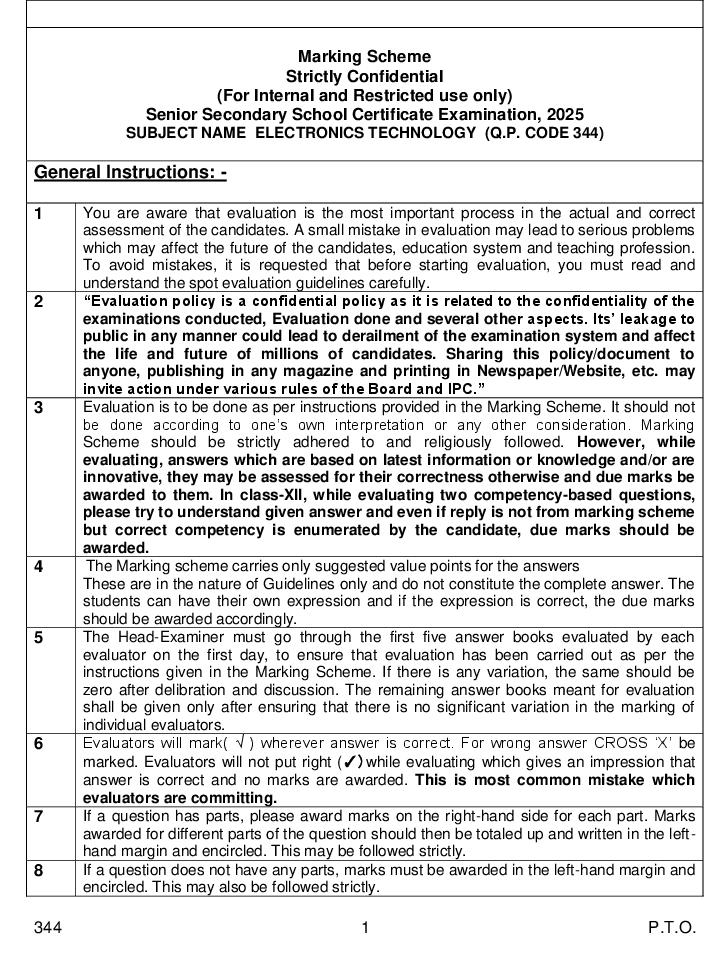
Strictly Confidential
(For Internal and Restricted use only)
Senior Secondary School Certificate Examination, 2025
SUBJECT NAME ELECTRONICS TECHNOLOGY (Q.P. CODE 344)
General Instructions: -
1 You are aware that evaluation is the most important process in the actual and correct
assessment of the candidates. A small mistake in evaluation may lead to serious problems
which may affect the future of the candidates, education system and teaching profession.
To avoid mistakes, it is requested that before starting evaluation, you must read and
understand the spot evaluation guidelines carefully.
2 “Evaluation policy is a confidential policy as it is related to the confidentiality of the
examinations conducted, Evaluation done and several other aspects. Its’ leakage to
public in any manner could lead to derailment of the examination system and affect
the life and future of millions of candidates. Sharing this policy/document to
anyone, publishing in any magazine and printing in Newspaper/Website, etc. may
invite action under various rules of the Board and IPC.”
3 Evaluation is to be done as per instructions provided in the Marking Scheme. It should not
be done according to one’s own interpretation or any other consideration. Marking
Scheme should be strictly adhered to and religiously followed. However, while
evaluating, answers which are based on latest information or knowledge and/or are
innovative, they may be assessed for their correctness otherwise and due marks be
awarded to them. In class-XII, while evaluating two competency-based questions,
please try to understand given answer and even if reply is not from marking scheme
but correct competency is enumerated by the candidate, due marks should be
awarded.
4 The Marking scheme carries only suggested value points for the answers
These are in the nature of Guidelines only and do not constitute the complete answer. The
students can have their own expression and if the expression is correct, the due marks
should be awarded accordingly.
5 The Head-Examiner must go through the first five answer books evaluated by each
evaluator on the first day, to ensure that evaluation has been carried out as per the
instructions given in the Marking Scheme. If there is any variation, the same should be
zero after delibration and discussion. The remaining answer books meant for evaluation
shall be given only after ensuring that there is no significant variation in the marking of
individual evaluators.
6 Evaluators will mark( √ ) wherever answer is correct. For wrong answer CROSS ‘X’ be
marked. Evaluators will not put right (✓)while evaluating which gives an impression that
answer is correct and no marks are awarded. This is most common mistake which
evaluators are committing.
7 If a question has parts, please award marks on the right-hand side for each part. Marks
awarded for different parts of the question should then be totaled up and written in the left-
hand margin and encircled. This may be followed strictly.
8 If a question does not have any parts, marks must be awarded in the left-hand margin and
encircled. This may also be followed strictly.
344 1 P.T.O.
Page 2
marks should be retained and the other answer scored out with a note “Extra Question”.
10 No marks to be deducted for the cumulative effect of an error. It should be penalized only
once.
11 A full scale of marks __________(example 0 to 80/70/60/50/40/30 marks as given in
Question Paper) has to be used. Please do not hesitate to award full marks if the answer
deserves it.
12 Every examiner has to necessarily do evaluation work for full working hours i.e., 8 hours
every day and evaluate 20 answer books per day in main subjects and 25 answer books
per day in other subjects (Details are given in Spot Guidelines).This is in view of the
reduced syllabus and number of questions in question paper.
13 Ensure that you do not make the following common types of errors committed by the
Examiner in the past:-
● Leaving answer or part thereof unassessed in an answer book.
● Giving more marks for an answer than assigned to it.
● Wrong totaling of marks awarded on an answer.
● Wrong transfer of marks from the inside pages of the answer book to the title page.
● Wrong question wise totaling on the title page.
● Wrong totaling of marks of the two columns on the title page.
● Wrong grand total.
● Marks in words and figures not tallying/not same.
● Wrong transfer of marks from the answer book to online award list.
● Answers marked as correct, but marks not awarded. (Ensure that the right tick mark
is correctly and clearly indicated. It should merely be a line. Same is with the X for
incorrect answer.)
● Half or a part of answer marked correct and the rest as wrong, but no marks awarded.
14 While evaluating the answer books if the answer is found to be totally incorrect, it should
be marked as cross (X) and awarded zero (0)Marks.
15 Any unassessed portion, non-carrying over of marks to the title page, or totaling error
detected by the candidate shall damage the prestige of all the personnel engaged in the
evaluation work as also of the Board. Hence, in order to uphold the prestige of all
concerned, it is again reiterated that the instructions be followed meticulously and
judiciously.
16 The Examiners should acquaint themselves with the guidelines given in the “Guidelines
for Spot Evaluation” before starting the actual evaluation.
17 Every Examiner shall also ensure that all the answers are evaluated, marks carried over to
the title page, correctly totaled and written in figures and words.
18 The candidates are entitled to obtain photocopy of the Answer Book on request on
payment of the prescribed processing fee. All Examiners/Additional Head Examiners/Head
Examiners are once again reminded that they must ensure that evaluation is carried out
strictly as per value points for each answer as given in the Marking Scheme.
344 2
Page 3
$
MARKING SCHEME
ELECTRONICS TECHNOLOGY
SECTION A
OBJECTIVE TYPE QUESTIONS
1. Answer any 4 out of the given 6 questions on Employability Skills. 41=4
(i) True 1
(ii) Agreeableness 1
(iii) (A) Feedback 1
(iv) (A) ODF spreadsheet 1
(v) (D) Installing diesel power plant 1
(vi) (D) To be successful, entrepreneurs should be hardworking,
energetic and perseverant. 1
2. Answer any 5 out of the given 7 questions. 5×1=5
(i) True 1
(ii) (D) Laser hazard 1
(iii) (C) COVID 1
(iv) False 1
(v) True 1
(vi) (A) Earth path 1
(vii) (C) At regular intervals of time 1
3. Answer any 6 out of the given 7 questions. 6×1=6
(i) True 1
(ii) (D) Dynamic microphone 1
(iii) (B) Piezoelectric effect 1
344 3 P.T.O.
Page 4
(v) (B) 180 1
(vi) (C) 240 Hz – 25 KHz 1
(vii) (A) They can handle large output power. 1
4. Answer any 5 out of the given 6 questions. 5×1=5
(i) (D) Equaliser 1
(ii) (D) 480 minutes 1
(iii) (C) Multiplexer 1
(iv) True 1
(v) Magnetic tape recording 1
(vi) True 1
5. Answer any 5 out of the given 6 questions. 5×1=5
(i) Cathode ray tube 1
(ii) Audio 1
(iii) (A) TV tuner 1
(iv) (D) Less Aspect (image) ratio 1
(v) Modulation 1
(vi) (B) width : height 1
6. Answer any 5 out of the given 6 questions. 5×1=5
(i) (B) Microwave oven 1
(ii) True 1
(iii) False 1
(iv) (D) 1876 1
(v) (B) Clean drum and scanner head 1
(vi) (B) Toner cartridge 1
SECTION B
344 4
Page 5
Answer any 3 out of the given 5 questions on Employability Skills. Answer each question
in 20 – 30 words. 32=6
7. Developing Good Listening Skills : understanding what is Really being said. 2
(i) Effective Listening Skills.
(ii) Repeat what is said to you....
(iii) Write it down....
(iv) Maintain eye contact and provide non-verbal cues...
(v) Avoid outside distractions...
8. (i) It increases individuals energy and activity. 2
(ii) It directs an individual towards specific goals.
9. Click on the starting cell in the cell range, hold down the mouse button and
drag it till you have selected all the cells you want. Then release the mouse
button. 2
10. Identifying entrepreneurial opportunity, Turning ideas into action,
Feasibility study, Resourcing, Setting up an enterprise. 2
11. (Any four of the following) 2
(i) Reuse, reduce, recycle
(ii) Drive less drive smart
(iii) Buy energy efficient products
(iv) Plant a tree
(v) Replace your light bulbs
Answer any 3 out of the given 5 questions in 20 – 30 words each. 32=6
12. It is the process in which the reception is restricted. Since in cable TV or in
satellite broad casting system a fee based access is granted, so need is to
scramble the unauthorised user. This can be achieved by using conditional
based reception. A condition access is comprises of two main subsystem-one
is scrambler and another is descrambler. Scrambler restricts access with an
encryption key. This key is used at the receiver end by descrambler to get
access to audio and video signal received by receiver. 2
13. Tweeter : It is used for reproduction of highest frequencies. Its design is
difficult because of the nature of high frequency audio wave. A tweeter is
applied form of speaker that is specially designed to respond in high
frequency audio ranges (2kHz-20kHz). It has flat frequency response at high
344 5 P.T.O.
Page 6
in accordance with their application. They are named as soft-dome tweeter,
horn loaded compression tweeter and ribbon tweeter. Soft-dome tweeter is
used in home stereo system where as horn loaded compression tweeter is
used in reproduction of professional sound. In recent time ribbon tweeter are
also used in place of horn loaded compression tweeter because it can handle
larger amount of output power. 2
14. DC Biasing : This is the simplest form of biasing similar to transistor biasing
in which DC through the recording head shifts the working point into the
centre of upper or lower part of the transfer characteristic. This part is fairly
linear because the transfer characteristic is not symmetric in this area, and
the record signal will contain a considerable amount of second order even
harmonics. 2
15. • Scanner is dead 2
• Scanner is not moving
• No scanning image
• Image is not clear
• Scanner does not work
16. Occupational hazards are very closely related with the occupational health. It
occurs commonly because of negligence in safety. If the industrial
organizations follow the standard safety measures that difinitely lead to
decrease in such kind of danger due to various types of hazards. 2
Answer any 2 out of the given 3 questions in 30 – 50 words each. 23=6
17. Loudspeaker : Loudspeaker is invented during the development of the
telephone system in the late 18th century. Invention of electrical amplifiers
makes it practical use of loudspeakers. Initially loudspeakers were used in
radio, motion picture theatre, public address system (PAS) etc. They are
broadly categorized into three groups. 3
(i) Direct radiator : In these type of loudspeaker radiator is directly
coupled with air.
(ii) Horn loudspeaker : In these types of loudspeaker the diaphragm is
coupled with air by means of horn.
(iii) Ionic loudspeaker : In these category of loudspeaker no diaphragm is
used.
18. It is a device used to control the operation of TV receiver from small distance.
We may On/Off, Increase/Decrease the volume and subsequently change the
channel of our choice. We may also alter the brightness and contrast of the
TV receiver as per requirement and convenience. There are two widely used
344 6
Page 7
the infrared. 3
Features of remote control
• Used in infra-red/VHF range.
• Covers 10-15 meters of distance.
• Require pencil battery for operation.
• 15-25 Operation buttons are available (varies according to application).
• Controls all the functions of TV receiver.
19. Some of the causes of failures are listed below : 3
• Wrong choice of components.
• Excessive heat because of lack of cooling.
• Excessive continuous use.
• Sub-standard manufacturing equipments and tools.
• Insufficient testing and inspection.
• Improper packaging.
• Excessive vibration in transport.
• Fluctuation in main supply.
• Poor preventive maintenance.
• Ageing of equipment.
Answer any 3 out of the given 5 questions in 50 – 80 words each. 34=12
20. The first stage of block diagram is sound pick up unit. The function of this
unit is to convert sound waves into desired electrical signals for the next
section. It contains microphone and preamplifier. Microphone converts the
sound waves into electrical signal. Since this electrical signal is very weak, so
it requires amplification. Pre-amplifier is used to amplify this signal with
keeping high signal to noise ratio. The amplifier section further amplifies the
electrical signal. Equaliser unit is used for the processing of the frequency
according to the recording characteristics. The signal is passed through the
power amplifier. Power amplifier amplifies the power of the signal to the
desired level, which drives the stylus unit. The stylus is oscillates on the
rotating disc in accordance with the input electrical signal. It marks lateral
cut on the disc to be recorded. 4
Sound pick up Amplifier unit Equaliser unit
unit
344 7 P.T.O.
Page 8
assembly stylus unit Amplifier
21. Microwave oven works differently from conventional ovens. Conventional
oven cooking procedure includes conduction and radiation, in which a lot of
energy gets wasted. As we know almost every food contains water and it is a
bipolar molecule and when electric field is applied to these water molecules,
it gets aligned according to the electric field applied. Inside a microwave oven
when electric field due to the microwave radiation is applied to the food, the
water molecules in the food gets directed according to the electric field. The
change in the direction of electric field causes the change in the alignment of
water molecules. These changes cause vibration in water molecules and
during this whole process the water molecules collide with each other and
with its surroundings. This leads to generation of heat inside the cooking
food and in this way we get the food cooked. 4
22. • Do not work alone with electricity. A co-worker can be of use in saving
your life in an emergent situation. 4
• If there is fire, do not attempt to pour water. Only use a fire
extinguisher made for electrical fires.
• If the floor is wet, try not to enter that area where electrical equipments
used.
• Fire extinguishers for use of electrical fires will be labeled as a C, BC or
ABC extinguisher.
• Avoid contact with energised electrical circuit assume that they all are
alive.
• During service or repair disconnect the power source.
• Use standard tools while working on electrical devices.
• When working with electrical devices avoid wearing metal watch band,
ringing etc.
• Be sure while working on live electrical circuits yours hands are dry,
wear nonconductive gloves, protective shoes and clothes.
• Try to work by one hand when working on live electrical circuit and
keep other hand away from all conducting materials that may cause
danger.
• If by mistake an individual comes in contact with electrical circuit, do
not touch them try to disconnect the power source.
• Try to avoid use of other person equipment/devices.
344 8
Page 9
that no one gets in contact with them.
• Avoid wearing loose clothes or tying while working on electrical
devices.
23. Moving coil microphone is also know as dynamic microphone. It consists of
cylindrical magnet, voice coil and diaphragm. It works on the principle of
electromagnetic induction. When the incident sound wave strikes on the
diaphragm, it causes diaphragm to vibrate. That results in the movement of
coil in the magnetic field which produces electromagnetic force. Hence, we
get at the output load an electrical signal which is in accordance with the
input sound wave. 4
Merits
• It is highly sensitive microphone.
• It has uniform frequency range.
• Can be used at higher temperature.
• Does not require external source for its operation.
Demerits
• It has low impedance.
Application
• Widely used in public meeting and broadcasting.
24. S.N. Subsection Possible associated problems 4
1 Dish Antenna Weak signal causing poor resolution and poor
audio quality.
No sound but picture is received.
No picture but sound is received.
Noisy signal received.
Poor colour resolution.
2 Head end Improper distribution.
subsection Distribution line does not get the desired signal.
Channel missing.
Cable TV software problem.
3 Distribution line Weak signals at amplifier output. Improper
amplifier distribution.
Subsection No signal at the output.
Hum in output of any particular channel.
344 9 P.T.O.
Page 10
4 Cable/setup box No signal received by the end user.
subsection Desired channel not received by the end user.
Discontinuity in signal flow in the cable system.
5 End user Receiver is not working.
No picture.
No sound.
Picture rolling.
Remote controlling device is not working.
6 Trunking line No signal to any particular user.
No signal at a particular distribution route.
No signal at all cable roots.
Ghost image on end user.
344 10
Document Details
| Board / Org | CBSE |
| Exam | Class 12 |
| Type | Solution |
| Pages | 10 |
| Updated | 24 Sep 2026 |