CBSE Class 12 Sample Paper 2022 for Maths Term 1
Finished viewing? Save it for later —
Download CBSE Class 12 Sample Paper 2022 for Maths Term 1 (PDF · 8 pages)About CBSE Class 12 Sample Paper 2022 for Maths Term 1
CBSE Class 12 Sample Paper 2022 for Maths Term 1 is available here for free download. Published by CBSE for Class 12, this sample paper can be viewed online or downloaded as a PDF (8 pages). Candidates preparing for Class 12 can use CBSE Class 12 Sample Paper 2022 for Maths Term 1 to understand the exam pattern, the type of questions asked, and the overall difficulty level.
Frequently Asked Questions
How can I download CBSE Class 12 Sample Paper 2022 for Maths Term 1?
Open this page and click the Download button to save CBSE Class 12 Sample Paper 2022 for Maths Term 1 as a PDF. It is completely free on AglaSem Docs.
Is CBSE Class 12 Sample Paper 2022 for Maths Term 1 free to download?
Yes. CBSE Class 12 Sample Paper 2022 for Maths Term 1 can be viewed online and downloaded as a PDF free of cost on AglaSem Docs.
How many pages does CBSE Class 12 Sample Paper 2022 for Maths Term 1 have?
CBSE Class 12 Sample Paper 2022 for Maths Term 1 contains 8 pages, which you can read online or download together as a single PDF.
Where can I find more Class 12 study material?
You can find more Class 12 question papers, sample papers, syllabus, and answer keys on AglaSem Docs.
CBSE Class 12 Sample Paper 2022 for Maths Term 1 – Text
Read the full text of this sample paper below — useful to quickly search, copy and reference the content online without downloading the PDF.
📄 View text version (8 pages)
Page 1
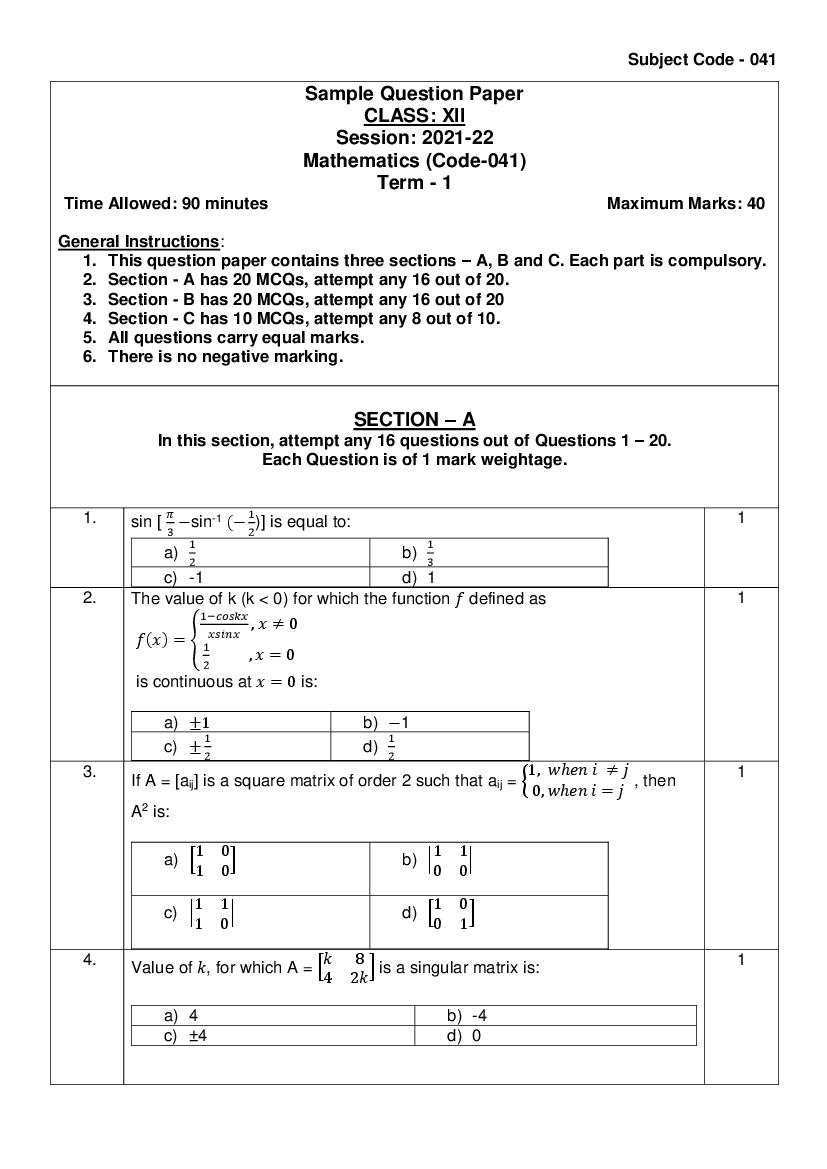
Sample Question Paper
CLASS: XII
Session: 2021-22
Mathematics (Code-041)
Term - 1
Time Allowed: 90 minutes Maximum Marks: 40
General Instructions:
1. This question paper contains three sections – A, B and C. Each part is compulsory.
2. Section - A has 20 MCQs, attempt any 16 out of 20.
3. Section - B has 20 MCQs, attempt any 16 out of 20
4. Section - C has 10 MCQs, attempt any 8 out of 10.
5. All questions carry equal marks.
6. There is no negative marking.
SECTION – A
In this section, attempt any 16 questions out of Questions 1 – 20.
Each Question is of 1 mark weightage.
1. 𝜋 1 1
sin [ 3 −sin-1 (− 2)] is equal to:
1 1
a) 2 b) 3
c) -1 d) 1
2. The value of k (k < 0) for which the function 𝑓 defined as 1
1−𝑐𝑜𝑠𝑘𝑥
,𝑥 ≠ 0
𝑓 (𝑥 ) = { 1𝑥𝑠𝑖𝑛𝑥
,𝑥 = 0
2
is continuous at 𝑥 = 0 is:
a) ±1 b) −1
1 1
c) ± 2 d) 2
3. 1, 𝑤ℎ𝑒𝑛 𝑖 ≠ 𝑗 1
If A = [aij] is a square matrix of order 2 such that aij = { , then
0, 𝑤ℎ𝑒𝑛 𝑖 = 𝑗
A2 is:
1 0 1 1
a) [ ] b) | |
1 0 0 0
1 1 1 0
c) | | d) [ ]
1 0 0 1
4. 𝑘 8] 1
Value of 𝑘, for which A = [ is a singular matrix is:
4 2𝑘
a) 4 b) -4
c) ±4 d) 0
Page 2
increasing:
a) (– ∞, 2) ∪ (2, ∞) b) (2, ∞)
c) (−∞, 2) d) (– ∞, 2]∪ (2, ∞)
6. Given that A is a square matrix of order 3 and | A | = - 4, then | adj A | is 1
equal to:
a) -4 b) 4
c) -16 d) 16
7. A relation R in set A = {1,2,3} is defined as R = {(1, 1), (1, 2), (2, 2), (3, 3)}. 1
Which of the following ordered pair in R shall be removed to make it an
equivalence relation in A?
a) (1, 1) b) (1, 2)
c) (2, 2) d) (3, 3)
8. 2𝑎 + 𝑏 𝑎 − 2𝑏 4 −3 1
If [ ]=[ ], then value of a + b – c + 2d is:
5𝑐 − 𝑑 4𝑐 + 3𝑑 11 24
a) 8 b) 10
c) 4 d) –8
9. 1 1
The point at which the normal to the curve y = 𝑥 + 𝑥, x > 0 is perpendicular to
the line 3x – 4y – 7 = 0 is:
a) (2, 5/2) b) (±2, 5/2)
c) (- 1/2, 5/2) d) (1/2, 5/2)
-1
10. sin (tan x), where |x| < 1, is equal to: 1
𝑥 1
a) √1−𝑥 2 b) √1−𝑥 2
1 𝑥
c) √1+𝑥 2 d) √1+𝑥 2
11. Let the relation R in the set A = {x ∈ Z : 0 ≤ x ≤ 12}, given by R = {(a, b) : |a – 1
b| is a multiple of 4}. Then [1], the equivalence class containing 1, is:
a) {1, 5, 9} b) {0, 1, 2, 5}
c) 𝜙 d) A
12. 𝑑𝑦 1
If ex + ey = ex+y , then 𝑑𝑥 is:
a) e y - x b) e x + y
c) – e y - x d) 2 e x - y
Page 3
order of matrix C = 5A +3B is:
a) 3×5 b) 5×3
c) 3×3 d) 5×5
14. 𝑑2 𝑦 1
If y = 5 cos x – 3 sin x, then 𝑑𝑥 2 is equal to:
a) - y b) y
c) 25y d) 9y
15. 2 5], 1
For matrix A =[ (𝑎𝑑𝑗𝐴)′ is equal to:
−11 7
−2 −5] 7 5]
a) [ b) [
11 −7 11 2
7 11 7 −5]
c) [ ] d) [
−5 2 11 2
16. 𝑥2 𝑦2 1
The points on the curve 9 + 16 = 1 at which the tangents are parallel to y-
axis are:
a) (0,±4) b) (±4,0)
c) (±3,0) d) (0, ±3)
17. Given that A = [𝑎𝑖𝑗 ] is a square matrix of order 3×3 and |A| = −7, then the 1
value of ∑3𝑖=1 𝑎𝑖2 𝐴𝑖2 , where 𝐴𝑖𝑗 denotes the cofactor of element 𝑎𝑖𝑗 is:
a) 7 b) -7
c) 0 d) 49
18. 𝑑𝑦 1
If y = log(cos 𝑒 𝑥 ), then 𝑑𝑥 is:
a) cos 𝑒 𝑥−1 b) 𝑒 −𝑥 cos 𝑒 𝑥
c) 𝑒 𝑥 sin 𝑒 𝑥 d) − 𝑒 𝑥 tan 𝑒 𝑥
19. Based on the given shaded region as the feasible region in the graph, at 1
which point(s) is the objective function Z = 3x + 9y maximum?
a) Point B b) Point C
c) Point D d) every point on the line
segment CD
Page 4
20. The least value of the function 𝑓(𝑥 ) = 2𝑐𝑜𝑠𝑥 + 𝑥 in the closed interval [0,2 ] 1
is:
𝜋
a) 2 b) 6 + √3
𝜋
c) d) The least value does not
2
exist.
SECTION – B
In this section, attempt any 16 questions out of the Questions 21 - 40.
Each Question is of 1 mark weightage.
21. The function 𝑓: R⟶R defined as 𝑓(𝑥 ) = 𝑥 3 is: 1
a) One-on but not onto b) Not one-one but onto
c) Neither one-one nor onto d) One-one and onto
22. 𝑑2 𝑦 𝜋 1
If x = a sec 𝜃, y = b tan 𝜃, then 𝑑𝑥 2 at 𝜃 = 6 is:
−3√3𝑏 −2√3𝑏
a) b)
𝑎2 𝑎
−3√3𝑏 −𝑏
c) d) 3 3𝑎2
𝑎 √
23. In the given graph, the feasible region for a LPP is 1
shaded.
The objective function Z = 2x – 3y, will be minimum
at:
a) (4, 10) b) (6, 8)
c) (0, 8) d) (6, 5)
24. 2 1 1 1
The derivative of sin (2𝑥√1 − 𝑥 ) w.r.t sin-1x,
-1
− 2<𝑥< , is:
√ √2
𝜋
a) 2 b) 2 − 2
𝜋
c) d) −2
2
25. 1
1 −1 0 2 2 −4
If A = [2 3 4] and B = [−4 2 −4], then:
0 1 2 2 −1 5
a) A-1 = B b) A-1 = 6B
c) B-1 = B 1
d) B-1 = 6A
Page 5
a) Strictly increasing in (−∞, −2) and strictly decreasing in ( −2, ∞)
b) Strictly decreasing in ( −2, 3)
c) Strictly decreasing in (−∞, 3) and strictly increasing in (3, ∞)
d) Strictly decreasing in (−∞, −2) ∪ (3, ∞)
27. √1+𝑐𝑜𝑠𝑥+√1−𝑐𝑜𝑠𝑥
Simplest form of tan-1 ( 1+𝑐𝑜𝑠𝑥− 1−𝑐𝑜𝑠𝑥) , 𝜋 < 𝑥 < 2 is:
3𝜋 1
√ √
𝜋 𝑥 3𝜋 𝑥
a) 4 − 2 b) −2
2
𝑥 𝑥
c) − 2 d) 𝜋 − 2
28. Given that A is a non-singular matrix of order 3 such that A2 = 2A, then value 1
of |2A| is:
a) 4 b) 8
c) 64 d) 16
29. The value of 𝑏 for which the function 𝑓(𝑥 ) = 𝑥 + 𝑐𝑜𝑠𝑥 + 𝑏 is strictly 1
decreasing over R is:
a) 𝑏 < 1 b) No value of b exists
c) 𝑏 ≤ 1 d) 𝑏 ≥ 1
30. Let R be the relation in the set N given by R = {(a, b) : a = b – 2, b > 6}, then: 1
a) (2,4) ∈ R b) (3,8) ∈ R
c) (6,8) ∈ R d) (8,7) ∈ R
𝑥
31. ,𝑥 < 0 1
The point(s), at which the function f given by 𝑓(𝑥) ={ |𝑥|
−1, 𝑥 ≥ 0
is continuous, is/are:
a) 𝑥𝜖R b) 𝑥 = 0
c) 𝑥𝜖 R –{0} d) 𝑥 = −1and 1
32. 0 2 0 3𝑎 1
If A = [ ] and 𝑘A = [ ], then the values of 𝑘, 𝑎 and 𝑏 respectively
3 −4 2𝑏 24
are:
Page 6
c) −6, 4, 9 d) −6, 12, 18
33. A linear programming problem is as follows: 1
𝑀𝑖𝑛𝑖𝑚𝑖𝑧𝑒 𝑍 = 30𝑥 + 50𝑦
subject to the constraints,
3𝑥 + 5𝑦 ≥ 15
2𝑥 + 3𝑦 ≤ 18
𝑥 ≥ 0, 𝑦 ≥ 0
In the feasible region, the minimum value of Z occurs at
a) a unique point b) no point
c) infinitely many points d) two points only
34. The area of a trapezium is defined by function 𝑓 and given by 𝑓 (𝑥 ) = (10 + 1
𝑥)√100 − 𝑥 2 , then the area when it is maximised is:
a) 75𝑐𝑚2 b) 7√3𝑐𝑚2
c) 75√3𝑐𝑚2 d) 5𝑐𝑚2
35. If A is square matrix such that A2 = A, then (I + A)³ – 7 A is equal to: 1
a) A b) I + A
c) I − A d) I
36. If tan-1 x = y, then: 1
−𝜋 𝜋
a) −1 < y < 1 b) ≤y ≤ 2
2
−𝜋 𝜋 −𝜋 𝜋
c) <y < 2 d) y 𝜖{ 2 , 2 }
2
37. Let A = {1, 2, 3}, B = {4, 5, 6, 7} and let 𝑓 = {(1, 4), (2, 5), (3, 6)} be a function 1
from A to B. Based on the given information, 𝑓 is best defined as:
a) Surjective function b) Injective function
c) Bijective function d) function
38. 3 1 1
For A = [ ], then 14A-1 is given by:
−1 2
2 −1 4 −2
a) 14 [ ] b) [ ]
1 3 2 6
2 −1 −3 −1
c) 2 [ ] d) 2[ ]
1 −3 1 −2
39. The point(s) on the curve y = x 3 – 11x + 5 at which the tangent is y = x – 11 1
is/are:
a) (-2,19) b) (2, - 9)
c) (±2, 19) d) (-2, 19) and (2, -9)
40. 𝛼 𝛽 1
Given that A = [ ]and A2 = 3I, then:
𝛾 −𝛼
Page 7
c) 3 − 𝛼 2 − 𝛽𝛾 = 0 d) 3 + 𝛼 2 + 𝛽𝛾 = 0
SECTION – C
In this section, attempt any 8 questions.
Each question is of 1-mark weightage.
Questions 46-50 are based on a Case-Study.
41. For an objective function 𝑍 = 𝑎𝑥 + 𝑏𝑦, where 𝑎, 𝑏 > 0; the corner points of 1
the feasible region determined by a set of constraints (linear inequalities) are
(0, 20), (10, 10), (30, 30) and (0, 40). The condition on a and b such that the
maximum Z occurs at both the points (30, 30) and (0, 40) is:
a) 𝑏 − 3𝑎 = 0 b) 𝑎 = 3𝑏
c) 𝑎 + 2𝑏 = 0 d) 2𝑎 − 𝑏 = 0
42. For which value of m is the line y = mx + 1 a tangent to the curve y 2 = 4x? 1
1
a) 2 b) 1
c) 2 d) 3
1
43. The maximum value of [𝑥(𝑥 − 1) + 1]3 , 0≤ 𝑥 ≤ 1 is: 1
1
a) 0 b) 2
c) 1 3 1
d) √3
44. In a linear programming problem, the constraints on the decision variables x 1
and y are 𝑥 − 3𝑦 ≥ 0, 𝑦 ≥ 0, 0 ≤ 𝑥 ≤ 3. The feasible region
a) is not in the first b) is bounded in the first
quadrant quadrant
c) is unbounded in the d) does not exist
first quadrant
45. 1 sinα 1 1
Let A = [−sinα 1 sinα], where 0 ≤ α ≤ 2π, then:
−1 −sinα 1
a) |A|=0 b) |A| 𝜖(2, ∞)
c) |A| 𝜖(2,4) d) |A| 𝜖[2,4]
CASE STUDY
The fuel cost per hour for running a train is proportional
to the square of the speed it generates in km per hour. If
the fuel costs ₹ 48 per hour at speed 16 km per hour
and the fixed charges to run the train amount to ₹
1200 per hour.
Assume the speed of the train as 𝑣 km/h.
Page 8
46. Given that the fuel cost per hour is 𝑘 times the square of the speed the train 1
generates in km/h, the value of 𝑘 is:
16 1
a) 3 b) 3
c) 3 3
d) 16
47. If the train has travelled a distance of 500km, then the total cost of running 1
the train is given by function:
15 600000 375 600000
a) 𝑣+ b) 𝑣+
16 𝑣 4 𝑣
5 150000 3 6000
c) 16 𝑣 2 + d) 16 𝑣 + 𝑣
𝑣
48. The most economical speed to run the train is: 1
a) 18km/h b) 5km/h
c) 80km/h d) 40km/h
49. The fuel cost for the train to travel 500km at the most economical speed is: 1
a) ₹ 3750 b) ₹ 750
c) ₹ 7500 d) ₹ 75000
50. The total cost of the train to travel 500km at the most economical speed is: 1
a) ₹ 3750 b) ₹ 75000
c) ₹ 7500 d) ₹ 15000
---------------------------
Document Details
| Board / Org | CBSE |
| Exam | Class 12 |
| Type | Sample Paper |
| Pages | 8 |
| Updated | 30 Apr 2026 |