CBSE Class 12 Physical Education Question Paper 2020 Set 1 Solutions
Finished viewing? Save it for later —
Download CBSE Class 12 Physical Education Question Paper 2020 Set 1 Solutions (PDF · 11 pages)About CBSE Class 12 Physical Education Question Paper 2020 Set 1 Solutions
CBSE Class 12 Physical Education Question Paper 2020 Set 1 Solutions is available here for free download. Published by CBSE for Class 12, this solution can be viewed online or downloaded as a PDF (11 pages). Candidates preparing for Class 12 can use CBSE Class 12 Physical Education Question Paper 2020 Set 1 Solutions to understand the exam pattern, the type of questions asked, and the overall difficulty level.
Frequently Asked Questions
How can I download CBSE Class 12 Physical Education Question Paper 2020 Set 1 Solutions?
Open this page and click the Download button to save CBSE Class 12 Physical Education Question Paper 2020 Set 1 Solutions as a PDF. It is completely free on AglaSem Docs.
Is CBSE Class 12 Physical Education Question Paper 2020 Set 1 Solutions free to download?
Yes. CBSE Class 12 Physical Education Question Paper 2020 Set 1 Solutions can be viewed online and downloaded as a PDF free of cost on AglaSem Docs.
How many pages does CBSE Class 12 Physical Education Question Paper 2020 Set 1 Solutions have?
CBSE Class 12 Physical Education Question Paper 2020 Set 1 Solutions contains 11 pages, which you can read online or download together as a single PDF.
Where can I find more Class 12 study material?
You can find more Class 12 question papers, sample papers, syllabus, and answer keys on AglaSem Docs.
CBSE Class 12 Physical Education Question Paper 2020 Set 1 Solutions – Text
Read the full text of this solution below — useful to quickly search, copy and reference the content online without downloading the PDF.
📄 View text version (11 pages)
Page 1
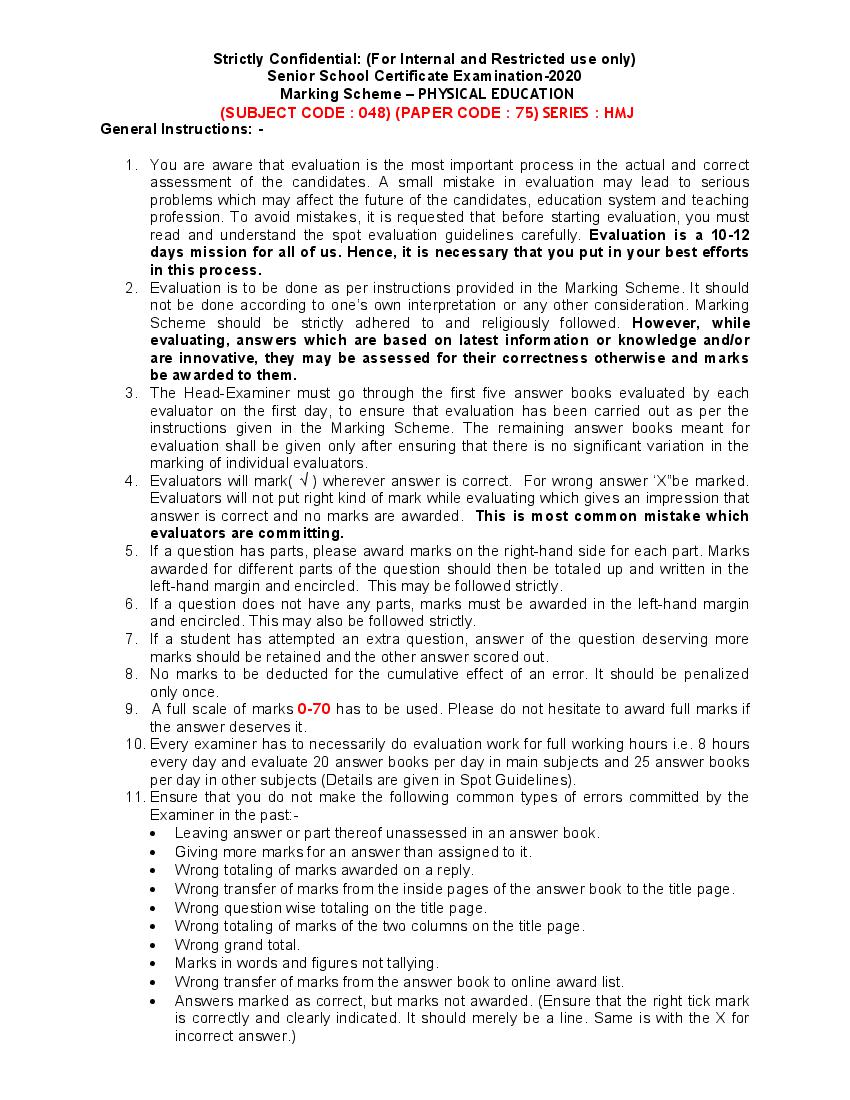
Senior School Certificate Examination-2020
Marking Scheme – PHYSICAL EDUCATION
(SUBJECT CODE : 048) (PAPER CODE : 75) SERIES : HMJ
General Instructions: -
1. You are aware that evaluation is the most important process in the actual and correct
assessment of the candidates. A small mistake in evaluation may lead to serious
problems which may affect the future of the candidates, education system and teaching
profession. To avoid mistakes, it is requested that before starting evaluation, you must
read and understand the spot evaluation guidelines carefully. Evaluation is a 10-12
days mission for all of us. Hence, it is necessary that you put in your best efforts
in this process.
2. Evaluation is to be done as per instructions provided in the Marking Scheme. It should
not be done according to one’s own interpretation or any other consideration. Marking
Scheme should be strictly adhered to and religiously followed. However, while
evaluating, answers which are based on latest information or knowledge and/or
are innovative, they may be assessed for their correctness otherwise and marks
be awarded to them.
3. The Head-Examiner must go through the first five answer books evaluated by each
evaluator on the first day, to ensure that evaluation has been carried out as per the
instructions given in the Marking Scheme. The remaining answer books meant for
evaluation shall be given only after ensuring that there is no significant variation in the
marking of individual evaluators.
4. Evaluators will mark( √ ) wherever answer is correct. For wrong answer ‘X”be marked.
Evaluators will not put right kind of mark while evaluating which gives an impression that
answer is correct and no marks are awarded. This is most common mistake which
evaluators are committing.
5. If a question has parts, please award marks on the right-hand side for each part. Marks
awarded for different parts of the question should then be totaled up and written in the
left-hand margin and encircled. This may be followed strictly.
6. If a question does not have any parts, marks must be awarded in the left-hand margin
and encircled. This may also be followed strictly.
7. If a student has attempted an extra question, answer of the question deserving more
marks should be retained and the other answer scored out.
8. No marks to be deducted for the cumulative effect of an error. It should be penalized
only once.
9. A full scale of marks 0-70 has to be used. Please do not hesitate to award full marks if
the answer deserves it.
10. Every examiner has to necessarily do evaluation work for full working hours i.e. 8 hours
every day and evaluate 20 answer books per day in main subjects and 25 answer books
per day in other subjects (Details are given in Spot Guidelines).
11. Ensure that you do not make the following common types of errors committed by the
Examiner in the past:-
Leaving answer or part thereof unassessed in an answer book.
Giving more marks for an answer than assigned to it.
Wrong totaling of marks awarded on a reply.
Wrong transfer of marks from the inside pages of the answer book to the title page.
Wrong question wise totaling on the title page.
Wrong totaling of marks of the two columns on the title page.
Wrong grand total.
Marks in words and figures not tallying.
Wrong transfer of marks from the answer book to online award list.
Answers marked as correct, but marks not awarded. (Ensure that the right tick mark
is correctly and clearly indicated. It should merely be a line. Same is with the X for
incorrect answer.)
Page 2
awarded.
12. While evaluating the answer books if the answer is found to be totally incorrect, it should
be marked as cross (X) and awarded zero (0)Marks.
13. Any unassessed portion, non-carrying over of marks to the title page, or totaling error
detected by the candidate shall damage the prestige of all the personnel engaged in the
evaluation work as also of the Board. Hence, in order to uphold the prestige of all
concerned, it is again reiterated that the instructions be followed meticulously and
judiciously.
14. The Examiners should acquaint themselves with the guidelines given in the Guidelines
for spot Evaluation before starting the actual evaluation.
15. Every Examiner shall also ensure that all the answers are evaluated, marks carried over
to the title page, correctly totaled and written in figures and words.
16. The Board permits candidates to obtain photocopy of the Answer Book on request in an
RTI application and also separately as a part of the re-evaluation process on payment of
the processing charges.
Page 3
SERIES : HMJ
Q.No ANSWER MARKS TOTAL
DISTRIBU
TION
SECTION A
1. The competitions organised outside the boundary wall of an 1 1
institution are called :
Ans: (C)Extramural
2. League tournament is also known as : 1 1
Ans: (C)Round Robin
3. Match List I with List II : 1 1
Ans: (A) i iv ii iii
4. The main sources of protein are : 1 1
Ans: (A)Fish, meat and eggs
5 Which one of the following asanas can be performed 1 1
immediately after the meals?
Ans: (D) Vajrasana
6. Which one of the following asanas is not a remedial asana for 1 1
treating obesity?
Ans: (B) Tadasana
7. Cognitive disability is a broad term that includes : 1 1
Ans: (A) Intellectual disability
(OR )
SPD means
(B)Sensory Processing Disorder
8. ADHD means : 1 1
Ans: (B) Attention Deficit Hyperactivity Disorder
9. Abnormal curve of the spine at the front is called : 1 1
Ans: (C) Lordosis
10. In bow-legs, there is/are : 1 1
Ans: (A)wide gap between the knees
11. The weight of medicine balls for girls and boys in a Barrow 1 1
test is respectively :
Ans: Option (A) Should have been 1 and 3Kgs instead of
pounds. Since the correct option is not given – full marks
to be given if the question is attempted.
12. Rockport test is used to measure : 1 1
Ans: (A) Endurance
(OR)
Sit and reach test is conducted to measures:
(A) Flexibility
13. Sprain is an injury of the : 1 1
Ans: (B) Ligament
(OR)
Laceration is a_________________
(A) Irregular cut on skin
2
Page 4
called :
Ans: (B) Oxygen uptake
15. Acceleration of an object will increase as the net force 1 1
increases, depending on its :
Ans: (B) Mass
16. Friction always acts __________the motion of an object. 1 1
Ans: (C) Opposite to
17. Endomorphic, Mesomorphic and Ectomorphic are types of : 1 1
Ans: (C) Personalities
(OR)
Traits like insight, imagination, receptivity towards new ideas
are involved with:
(A) Openness
18. The source of intrinsic motivation is : 1 1
Ans: (C) Self
19. While exercising on a multigym, the type of muscular 1 1
contraction that occurs is :
Ans: (C) Isokinetic
20. Resistance ability against fatigue is called : 1 1
Ans: (C) Endurance
SECTION B
21. List down the nutritive components of diet and explain 3
any one.
Ans: The nutritive components of diet are Proteins,
Carbohydrates, Fats, Vitamins and Minerals 1
Vitamins: Vitamin is an organic molecule required in small
quantities for the proper functioning of metabolism.
Vitamins can protect us from various diseases.
Deficiency causes diseases like Scurvy, Rickets, night
blindness etc. Vitamins are classified as water soluble and
fat soluble Vitamins.
2
Water soluble vitamins - Vitamin B and Vitamin C
Fat soluble vitamins – Vitamin A, vitamin D, vitamin E,
vitamin K.
Some sources of vitamins are green leafy vegetables, fruits,
milk, egg, meat etc.
(Explain any 1 nutrient)
(OR)
What do you understand by ‘non-nutritive components’?
Elucidate any four non-nutritive components of diet.
Ans: Non-nutritive components are compounds absorbed
from food but do not provide energy in form of calories, but 1
are important for transportation, Intestinal function, flavour
etc.
Non-nutritive components are:
Fiber and Roughage, water, plant compounds, flavor (½x4)
compounds, colour compounds, preservatives, pesticides,
Artificial sweeteners.
3
Page 5
Ans:
- Run for fun
- Run for specific cause
- sports day
- Run for Awareness
Health Run: Health runs are organized by health or sports
departments to ameliorate the standard of health in a
community. It can also be combined with fund raising for
charity. There is no age limit in health runs and the distance
of the course is fixed according to age and the need to attract
crowd.
Run for Unity: Such a run is organized with a specific
purpose, i.e., to show unity and peace among the people of
different religion. Its purpose may be national and
international integration and brotherhood.
(Explain any 2 programmes)
23. Explain the procedure and benefits of any one asana 1½ +1½ 3
used to cure diabetes.
Ans:Asanas recommended for diabetes are:
Paschimottasana, Pawanmuktasana, Ardhmatseyendrasana
and Bhujangasana
Bhujangasana( Cobra pose)
Procedure- From prone- lying position, place your hands
underneath your shoulder, keeping elbow close to the body,
start rising the upper part of the body with support of hands
while looking up.
Benefits – makes vertebral column flexible
- decrease obesity
- improves blood circulation
- cures digestive problems
- cures diseases of liver and disorders of urinary bladder
- strengthens muscles of hand
(procedure and any 3 benefits on 2 Asanas listed)
24 What do you understand by the term disability? Explain 1 3
any four disability etiquettes.
Ans: -A disability is a physical or mental condition that limits
a person‘s senses, movements and activities.
-Permanent condition that restricts everyday activities.
-A state in which a person is incapable of doing any type of
work or certain tasks or actions is termed as disability.
Disability Etiquettes:
- talk directly
offer to shake their hands even if they have limited use of (½x4)
their arms
- ask before you help
- listen to them patiently and carefully
- inform before leaving
- do not lean or play with the wheel chair or any other
4
Page 6
(Any one definition and any 4 relevant etiquettes)
25 Define motor development and list down the factors 3
affecting it.
Motor development is the physical growth and strengthening 1
of a child’s bones, muscles and the ability to adapt and
control over various movements.
Motor development fall into two categories, namely Gross
motor and Fine motor development.
Factors affecting Motor development are:
A. Heredity / Genetics
B. Environment
C. Nutrition
D. Physical activities 2
E. Opportunities
F. Postural deformities
G. Sensory Impairment
H. Obesity, etc. (list any 4)
26. Explain the purpose and procedure of any two batteries 1½ +1½ 3
for the Motor Fitness Test.
Ans:-Motor fitness Test
50m Dash/Sprint
600m Run/ walk
Sit and reach test
Partial curl up
Push-ups (boys)
Modified push-ups (girls)
Standing broad jump.
Shuttle run (4x10m)
Standing Broad Jump:
Purpose- this test is administered to measure explosive
power of legs
Procedure: The student stands behind a line marked on the
ground with feet slightly apart and execute a jump using both
foot take-off and landing. Three trials are given and the
distance is measured.
(Explain any 2 tests from the list)
(OR)
How is cardiovascular fitness measured with the help of
‘Harvard Step Test’? Explain
Purpose:- To measure cardiovascular fitness 3 3
Equipment:- A bench or box 20”h height for male or
16”height for female, stop watch.
Administration:- A tester/teacher gives a demonstration of
the stepping- up Style to be followed by the subjects during
the test.
2. After the command ‘Go’ the stop watch is started and
student/ athlete step – up and down for five minute at the rate
of 30 steps per minute.
3. The stop watch is stopped after 5 min and athlete is asked
5
Page 7
4. The heart – rate is measured between1 to1.5 min, after
finishing the exercise.
5. The same is repeated after 2 to 2.5 minutes and 3 to 3.5
minutes.
The pulse of all the 3 half minute counts are recorded to get
the fitness index.
Computation of fitness index score =
𝟏𝟎𝟎 𝒙 𝒕𝒆𝒔𝒕𝒅𝒖𝒓𝒂𝒕𝒊𝒐𝒏𝒊𝒏𝒔𝒆𝒄𝒐𝒏𝒅𝒔
𝟐𝒙𝒔𝒖𝒎𝒐𝒇𝒉𝒆𝒂𝒓𝒕𝒃𝒆𝒂𝒕𝒔𝒊𝒏𝒓𝒆𝒄𝒐𝒗𝒆𝒓𝒚𝒑𝒆𝒓𝒊𝒐𝒅𝒔
27. Define speed and explain any one method to develop it. 3
Ans:-speed:- Ability to cover maximum distance in minimum
time. Or ability to produce the greatest possible impulse at 1
the shortest possible time.
Methods to develop speed.
1. Acceleration run:
2. Pace run
Acceleration runs: In this method, athlete tries to attain top
speed as fast as possible. When an athlete sprints, she/he
does not start running at maximal speed. It is attained
through gradual increment. The athlete runs for a specific
distance, starting at zero speed and the working towards 2
maximal velocity during the course of running. The sprinter
actually starts accelerating after the first 30 Mts. Or about 4
to 6 seconds. Accelerated runs are repeated with sufficient
intervals in between. Repetition may vary according to the
capacity and limitation of an athlete.
(Explain any one method)
28. Discuss in detail about any two movements of the body. 1½ +1½ 3
Ans:- Types of Movements:
1. Flexion
2. Extension
3. Adduction
4. Abduction
5. Circumduction
Flexion: - take place when the angle decreases between the
two bones attached to the joint, e.g. flexion of knee joint.
Extension: - Is the opposite of flexion. Extension occurs
when the angle between the two bones increases e.g.
extension of knee joint
(Explain any two)
29. What do you understand by the term Exercise 1+2 3
Adherence?
Ans:-Exercise Adherence refers to maintaining a systematic
approach to prolonged period of time following the initial
adaption phase. Exercise adherence reflects about continued
participation of an individual in exercise training programme.
Exercise is any bodily activity that enhances or maintains
physical fitness and overall health as well as wellness. It
6
Page 8
efficiently.
(OR)
What are the types of aggression? 1 +1 +1
Ans: Hostile Aggression: A reactive aggression accompanied
with anger with intension of inflicting/ causing harm either
physical or psychological.
Instrumental Aggression: A channeled aggression
accompanied by anger intends to hurt in order to achieve the
goal. Mostly found in contact sports.
Assertive Aggression: Intention is to establish dominance
than to harm the opponent. It is goal oriented and use of
legitimate force.
30. Differentiate between Isometric and Isotonic exercises. 1x3 3
Ans:-
Isometric Exercises Isotonic Exercises
-Movements are not visible. -Movements are visible.
-Length of the exercising -Length of the exercising
muscles doesn’t change. muscles change.
-less muscular endurance -more muscular endurance
-develop strength at specific - develop uniform strength
place - develop flexibility along
-develop strength with strength.
-recovery from fatigue is -recovery from fatigue is
slow. fast.
e.g. pushing a wall e.g. Free hand exercises
(Any 3 difference)
SECTION C
31. Discuss in detail the different types of coordinative 1x5 5
ability.
Ans:- coordinative abilities
1. Orientation ability
2. Coupling ability
3. Balance ability
4. Reaction ability
5. Rhythm ability
6. Adaption ability
7. Differentiation ability
Coupling ability: ability to combine movements of different
body parts for performing perfect movements.
(explain any 5 types)
(OR)
What are knockout tournaments? Draw a knockout
fixture for19 teams, mentioning all the steps involved 1+2+2 5
Knock out tournament is a type of elimination tournament,
where the loser of each match is eliminated from the
tournament. .
No. of teams -19
Number of matches N-1 = 19-1 = 18
𝑁+1 20
No of teams in U/H = 2 = 10
2
7
Page 9
No of teams in L/H = 2 = 9
2
No of Rounds 5 rounds
No of byes = next power of 2 – N = 32-19 =13
𝑁𝐵−1 13−1
No of byes in U/H – = 2 =6
2
𝑁𝐵+1 13+1
No of byes in L/H – = =7
2 2
1 - Bye
4
2 - Bye
12
3 - Bye
5
4
1
5
16
6
2
7
6
8 - Bye
13
9 - Bye
7
10 - Bye
18
11 - Bye
8
12 - Bye
14
13 - Bye
9
14
3
15
17
16 - Bye
10
17 - Bye
15
18 - Bye
11
19– Bye
32. Write short notes on OCD and ODD. 2½ 5
OCD- obsessive compulsive disorder is a mental disorder in
which a person feels the need to perform a certain routine
repeatedly or has certain unwanted thoughts of fear that
causes them to perform rituals/routines repeatedly.
Symptoms of obsession- (1) a fear of harm to oneself or
8
Page 10
mistakes etc.
Common compulsions (1) constant praying (2) bathing or
washing hands several times (3) checking things over and
over again etc.
Cause of OCD: could be hereditary, chemical imbalance in
the brain, stress and anxiety can worsen OCD.
ODD- oppositional defiant disorder is defined as “a pattern of
angry/irritable mood, argumentative/defiant behavior or 2½
vindictiveness” found in children and adolescents.
Symptoms of ODD: - often losing temper- blame others-
refuse to comply- resentment and revengeful attitude – angry
and irritable mood – uncooperative and hostile – upset others
Cause of ODD: - Biological/genetic factors – physical factors
– psychological factors – Enviormental factors.
33. What are the effects of exercising on the cardio- 1x5 5
respiratory system? Explain
Ans:- Short term effects of exercise
1. Increase heart rate
2. Increase is blood pressure
3. Increase stroke volume
4. Rate of respiration increases
Long term effect of exercise
1. Increase in cardiac out put
2. Depth in respiration increases.
3. Aerobic capacity increase.
4. Increase in tidal volume.
5. Increase in vital capacity.
6. Delay in second wind
(Explain any 5 points)
What do you understand by the female athlete triad? 5
34. Explain the symptoms and causes of any one of them.
Ans:- Female athlete triad:- It is the syndrome common in
female which consists of osteoporosis (weak bones ), 1
Amenorrhea ( absence of menstrual periods), eating
disorders.
Osteoporosis Symptoms:
1. Fatigue.
2. Weight loss. 2
3. Pain in bones and joints
4. Lack in bone strength
5. Stress fracture
Osteoporosis Causes;
1. Insufficient calcium in diet 2
2. Amenorrhea
3. Eating disorders
4. Poor nutrition
5. Sedentary life style
(Explain any two from each)
9
Page 11
Explain Newton’s laws of motion and their application in
sports.
Ans:-Application of Newton’s law
Newton’s first law of motion –The law of inertia: A body at
rest tends to remain at rest. A body in motion tends to 5
continue in motion with consistent speed and in the same
direction unless acted upon by an outside force. E.g. A
hockey ball hit by a player will move with the same speed in
same direction until it is diverted by some obstruction on the
floor or stopped by an opponent, which will be the external
force.
Newton’s Second low of motion -The Law of Acceleration
Newton’s second law states that acceleration is produced
when a force acts on a mass. The greater the mass of the
object being accelerated, the more force is needed to
accelerate that object and inversely proportional to the mass.
The equation F= ma. For example, to throw a 4-kilogram
shot-put as far as a 3-kilogram shot-put, the force applied
must be greater.
Newton third Law of Motion-The Law of Action and
Reaction: Newton’s third law of motion states that for every
force that is exerted on a body there is an equal and opposite
reaction.
A Swimmer propels herself through the water by pushing the
water backwards in exerting the force. Her hands pushing the
water allows her to move. (Explain law with suitable
example)
10
Document Details
| Board / Org | CBSE |
| Exam | Class 12 |
| Type | Solution |
| Pages | 11 |
| Updated | 22 Jul 2026 |