CBSE Class 12 Economics Question Paper 2020 Set 58-1-3
Finished viewing? Save it for later —
Download CBSE Class 12 Economics Question Paper 2020 Set 58-1-3 (PDF · 15 pages)About CBSE Class 12 Economics Question Paper 2020 Set 58-1-3
CBSE Class 12 Economics Question Paper 2020 Set 58-1-3 is available here for free download. Published by CBSE for Class 12, this question paper can be viewed online or downloaded as a PDF (15 pages). Candidates preparing for Class 12 can use CBSE Class 12 Economics Question Paper 2020 Set 58-1-3 to understand the exam pattern, the type of questions asked, and the overall difficulty level.
Frequently Asked Questions
How can I download CBSE Class 12 Economics Question Paper 2020 Set 58-1-3?
Open this page and click the Download button to save CBSE Class 12 Economics Question Paper 2020 Set 58-1-3 as a PDF. It is completely free on AglaSem Docs.
Is CBSE Class 12 Economics Question Paper 2020 Set 58-1-3 free to download?
Yes. CBSE Class 12 Economics Question Paper 2020 Set 58-1-3 can be viewed online and downloaded as a PDF free of cost on AglaSem Docs.
How many pages does CBSE Class 12 Economics Question Paper 2020 Set 58-1-3 have?
CBSE Class 12 Economics Question Paper 2020 Set 58-1-3 contains 15 pages, which you can read online or download together as a single PDF.
Where can I find more Class 12 study material?
You can find more Class 12 question papers, sample papers, syllabus, and answer keys on AglaSem Docs.
CBSE Class 12 Economics Question Paper 2020 Set 58-1-3 – Text
Read the full text of this question paper below — useful to quickly search, copy and reference the content online without downloading the PDF.
📄 View text version (15 pages)
Page 1
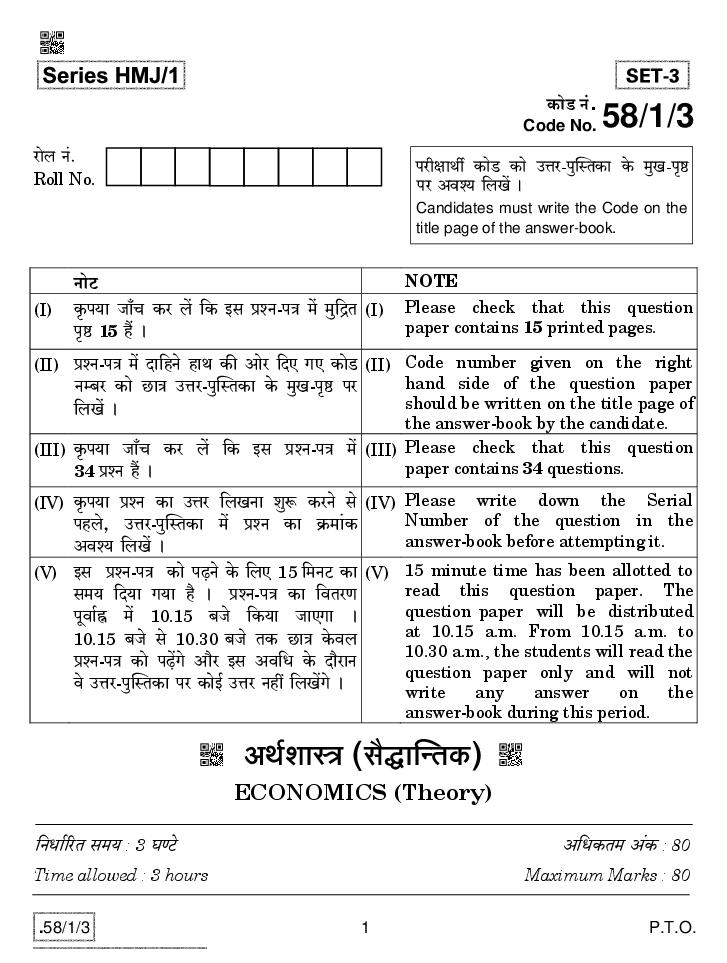
Code No. 58/1/3
amob Z§. narjmWu H$moS >H$mo CÎma-nwpñVH$m Ho$ _wI-n¥ð
Roll No. >na Adí` {bIo§ &
Candidates must write the Code on the
title page of the answer-book.
ZmoQ> NOTE
(I) H¥$n`m Om±M H$a b| {H$ Bg àíZ-nÌ _o§ _w{ÐV (I) Please check that this question
n¥ð> 15 h¢ & paper contains 15 printed pages.
(II) àíZ-nÌ _| Xm{hZo hmW H$s Amoa {XE JE H$moS (II) Code number given on the right
>Zå~a H$mo N>mÌ CÎma-nwpñVH$m Ho$ _wI-n¥ð> na hand side of the question paper
{bI| & should be written on the title page of
the answer-book by the candidate.
(III) H¥$n`m Om±M H$a b| {H$ Bg àíZ-nÌ _| (III) Please check that this question
>34 àíZ h¢ & paper contains 34 questions.
(IV) H¥$n`m àíZ H$m CÎma {bIZm ewê$ H$aZo go (IV) Please write down the Serial
nhbo, CÎma-nwpñVH$m _| àíZ H$m H«$_m§H$ Number of the question in the
Adí` {bI| & answer-book before attempting it.
(V) Bg àíZ-nÌ H$mo n‹T>Zo Ho$ {bE 15 {_ZQ >H$m (V) 15 minute time has been allotted to
g_` {X`m J`m h¡ & àíZ-nÌ H$m {dVaU read this question paper. The
nydm©• _| 10.15 ~Oo {H$`m OmEJm & question paper will be distributed
10.15 ~Oo go 10.30 ~Oo VH$ N>mÌ Ho$db at 10.15 a.m. From 10.15 a.m. to
10.30 a.m., the students will read the
àíZ-nÌ H$mo n‹T>|Jo Am¡a Bg Ad{Y Ho$ Xm¡amZ question paper only and will not
do CÎma-nwpñVH$m na H$moB© CÎma Zht {bI|Jo & write any answer on the
answer-book during this period.
AW©emñÌ (g¡ÕmpÝVH$)
ECONOMICS (Theory)
{ZYm©[aV g_` : 3 KÊQ>o A{YH$V_ A§H$ : 80
Time allowed : 3 hours Maximum Marks : 80
.58/1/3 1 P.T.O.
Page 2
{ZåZ{b{IV {ZX}em| H$mo ~hþV gmdYmZr go n{‹T>E Am¡a CZH$m g™Vr go nmbZ H$s{OE :
(i) Bg àíZ-nÌ ‘| Xmo IÊS> h¢ H$ Am¡a I & g^r àíZ A{Zdm¶© h¢ &
(ii) àíZ g§»¶m 1 go 10 Am¡a 18 go 27 A{V bKw-CÎmar¶ àH$ma Ho$ àíZ h¢, à˶oH$ àíZ 1 A§H$
H$m h¡ & BZH$m CÎma EH$ eãX ¶m EH$ dm³¶ ‘| Xr{OE &
(iii) àíZ g§»¶m 11 Am¡a 12 Am¡a 28 Am¡a 29 bKw-CÎmar¶ àH$ma Ho$ àíZ h¢, à˶oH$ àíZ
3 A§H$m| H$m h¡ & BZH$m CÎma bJ^J 60 go 80 eãXm| ‘| Xr{OE &
(iv) àíZ g§»¶m 13 go 15 Am¡a 30 go 32 ^r bKw-CÎmar¶ àH$ma Ho$ àíZ h¢, à˶oH$ àíZ
4 A§H$m| H$m h¡ & BZH$m CÎma bJ^J 80 go 100 eãXm| ‘| Xr{OE &
(v) àíZ g§»¶m 16 Am¡a 17 Am¡a 33 Am¡a 34 XrK©-CÎmar¶ àH$ma Ho$ àíZ h¢, à˶oH$ àíZ
6 A§H$m| H$m h¡ & BZH$m CÎma bJ^J 100 go 150 eãXm| ‘| Xr{OE &
(vi) CÎma g§{jßV VWm q~Xþdma hmoZo Mm{hE Am¡a gmW hr Cn`w©³V eãX gr‘m H$m ¶Wmg§^d nmbZ
H$s{OE &
(vii) àíZ-nÌ ‘| H$moB© g‘J« {dH$ën Zht h¡ & VWm{n, EH$-EH$ A§H$ dmbo Xmo àíZm| ‘|, VrZ-VrZ
A§H$m| dmbo Xmo àíZm| ‘|, Mma-Mma A§H$m| dmbo Xmo àíZm| ‘| Am¡a N>…-N>… A§H$m| dmbo Xmo àíZm|
‘| Am§V[aH$ {dH$ën {XE JE h¢ & Eogo àíZm| ‘| Ho$db EH$ hr {dH$ën H$m CÎma Xr{OE &
(viii) BgHo$ A{V[a³V, Amdí¶H$VmZwgma, à˶oH$ IÊS> Am¡a àíZ Ho$ gmW ¶Wmo{MV {ZX}e {XE JE
h¢ &
IÊS> H$
(g_{îQ> AW©emñÌ)
1. amOñd KmQ>o H$m AZw_mZ ________ gyÌ go bJm`m Om gH$Vm h¡ &
(ghr gyÌ Ûmam [aŠV ñWmZ H$s ny{V© H$s{OE) 1
2. C„oI H$s{OE {H$ {ZåZ{b{IV H$WZ gË` h¡ `m AgË` :
‘‘H$sÝg Ho$ {gÕm§VmZwgma EH$ AW©ì`dñWm _|, nyU© amoµOJma H$s pñW{V H$^r _m¡OyX Zht hmo
gH$Vr &’’ 1
.58/1/3 2
Page 3
Read the following instructions very carefully and strictly follow them :
(i) This question paper comprises two sections A and B. All questions are
compulsory.
(ii) Question numbers 1 – 10 and 18 – 27 are very short-answer questions
carrying 1 mark each. They are required to be answered in one word or
one sentence each.
(iii) Question numbers 11 – 12 and 28 – 29 are short-answer questions
carrying 3 marks each. Answers to them should not normally exceed
60 – 80 words each.
(iv) Question numbers 13 – 15 and 30 – 32 are also short-answer questions
carrying 4 marks each. Answers to them should not normally exceed
80 – 100 words each.
(v) Question numbers 16 – 17 and 33 – 34 are long answer questions carrying
6 marks each. Answers to them should not normally exceed
100 – 150 words each.
(vi) Answers should be brief and to the point. Also the above word limit be
adhered to as far as possible.
(vii) There is no overall choice. However, an internal choice has been provided
in 2 questions of one mark, 2 questions of three marks, 2 questions of four
marks and 2 questions of six marks. Only one of the choices in such
questions have to be attempted.
(viii) In addition to this, separate instructions are given with each section and
question, wherever necessary.
SECTION A
(Macro Economics)
1. Revenue Deficit can be estimated using the formula ________ .
(Fill in the blank with correct formula) 1
2. State whether the following statement is true or false :
‘‘As per Keynesian theory in an economy, full employment can never
exist.’’ 1
.58/1/3 3 P.T.O.
Page 4
Zht hmo gH$Vm h¡ &
(ghr {dH$ën H$m M`Z H$s{OE) 1
(A) eyÝ`
(B) BH$mB© (1)
(C) EH$ go A{YH$
(D) EH$ go H$_
4. C„oI H$s{OE {H$ {ZåZ{b{IV H$WZ gË` h¡ `m AgË` :
‘‘Ano{jV AàMbZ H$mo _yë`õmg _| em{_b {H$`m OmVm h¡ &’’ 1
5. à^mdr _m±J H$mo n[a^m{fV H$aVo h¢ ________ &
(C{MV n[a^mfm Ûmam [aŠV ñWmZ H$s ny{V© H$s{OE) 1
6. AW©ì`dñWm _| _wÐm Amny{V© H$mo {Z`§{ÌV H$aZo Ho$ {bE, Ho$ÝÐr` ~¢H$ ________ gH$Vm h¡ &
(ghr {dH$ën H$m M`Z H$s{OE) 1
(A) Iwbo ~mµOma _| à{V^y{V`m± IarX
(B) Iwbo ~mµOma _| à{V^y{V`m± ~oM
(C) ZµH$X Ama{jV AZwnmV H$_ H$a
(D) aonmo Xa H$_ H$a
7. C„oI H$s{OE {H$ {ZåZ{b{IV H$WZ gË` h¡ `m AgË` :
‘‘gaH$mar ~OQ> _m¡{ÐH$ Zr{V H$m EH$ _hÎdnyU© gmYZ h¡ &’’ 1
AWdm
{d{Zdoe gaH$ma H$s EH$ ________ (ny±OrJV/amOñd) àm{ßV h¡ &
(ghr {dH$ën H$m M`Z H$s{OE) 1
8. ________ VWm ________ _wÐm Amny{V© Ho$ Xmo KQ>H$ h¢ &
(ghr CÎma Ûmam [aŠV ñWmZm| H$s ny{V© H$s{OE) 1
9. ‘Mmby ImVo Ho$ KmQ>o’ H$m AW© {b{IE & 1
10. ________ {dXoer _wÐm H$s _m±J Ho$ g~go _hÎdnyU© òmoVm| _| go EH$ h¡ &
(ghr CÎma Ûmam [aŠV ñWmZ H$s ny{V© H$s{OE) 1
.58/1/3 4
Page 5
Propensity to Consume can never be ________.
(Choose the correct alternative) 1
(A) zero
(B) unity (1)
(C) more than one
(D) less than one
4. State whether the following statement is true or false :
‘‘Expected obsolescence is included in depreciation.’’ 1
5. Effective demand is defined as ________.
(Fill in the blank with the suitable definition) 1
6. In order to control the money supply in the economy, the Central Bank
may ________.
(Choose the correct alternative) 1
(A) buy securities in the open market
(B) sell securities in the open market
(C) reduce cash reserve ratio
(D) reduce repo rate
7. State whether the following statement is true or false :
‘‘Government Budget is an important monetary policy instrument.’’ 1
OR
Disinvestment is a ________ (capital/revenue) receipt of the government.
(Choose the correct alternative) 1
8. Two components of money supply are ________ and ________.
(Fill in the blanks with correct answers) 1
9. State the meaning of ‘Current Account Deficit’. 1
10. ________ is one of the most important sources of demand for foreign
currency. (Fill in the blank with the correct answer) 1
.58/1/3 5 P.T.O.
Page 6
H$WZ H$m _mÝ` VH$m] g{hV g_W©Z AWdm I§S>Z H$s{OE & 3
12. ‘‘A§{V_ dñVwAm| Ho$ A§VJ©V Ho$db do dñVwE± em{_b hmoVr h¢, Omo {H$ J¥hñWm| Ûmam Cn^moJ
H$s OmVr h¢ &’’ {XE JE H$WZ H$m _mÝ` H$maU Ûmam g_W©Z AWdm I§S>Z H$s{OE & 3
AWdm
‘‘Am` H$m dVw©b àdmh {gÕm§V Bg nyd©YmaUm na AmYm[aV h¡ {H$ EH$ ì`{º$ Ûmam {H$`m J`m
ì`` Xÿgao H$s Am` ~ZVr h¡ &’’ {XE JE H$WZ H$m dU©Z H$s{OE & 3
13. ‘‘ì`mnma gwJ_Vm gyMH$m§H$ _| ^maV ~‹S>r N>bm±J bJm ahm h¡, BgHo$ \$bñdê$n H$B© ~hþamîQ´>r`
H$ån{Z`m± (MNC) AnZo CËnmXZ AmYma H$mo ^maV _| ñWmZm§V[aV H$a ahr h¢ &’’
Cn`w©ŠV H$WZ Ho$ AmbmoH$ _|, {dXoer _wÐm Ho$ àdmh Am¡a ^maVr` AW©ì`dñWm na BgHo$
g§^m{dV à^md na {Q>ßnUr H$s{OE & 4
14. EH$ H$mën{ZH$ g§»`mË_H$ CXmhaU H$m à`moJ H$aVo hþE, dm{UpÁ`H$ ~¢H$ Ûmam gmI {Z_m©U
H$s à{H«$`m H$s ì`m»`m H$s{OE & 4
AWdm
‘‘Ho$ÝÐr` ~¢H$ gaH$ma Ho$ ~¢H$a H$m H$m`© H$aVm h¡ &’’ {XE JE H$WZ H$m {dñVma go dU©Z
H$s{OE & 4
15. (a) ny±OrJV ì`` VWm amOñd ì`` Ho$ ~rM A§Va ñnîQ> H$s{OE &
(b) ‘H$a’ H$mo n[a^m{fV H$s{OE & 3+1
16. gwZm_m§{H$V AmaoI H$m à`moJ H$aVo hþE Xem©BE {H$ {H$g àH$ma ~MV dH«$ go Cn^moJ dH«$
àmßV {H$`m Om gH$Vm h¡ & 6
Ñ{îQ>~m{YV N>mÌm| Ho$ {bE :
(a) `{X ~MV \$bZ S = (–) 10 + 0·2Y h¡, Vmo {XE JE ~MV \$bZ go Cn^moJ
\$bZ {H$g àH$ma àmßV {H$`m Om gH$Vm h¡ ?
(b) Am¡gV ~MV àd¥{Îm VWm gr_m§V ~MV àd¥{Îm _| A§Va ñnîQ> H$s{OE & 3+3
.58/1/3 6
Page 7
equal.’’ Defend or refute the given statement with valid reasons. 3
12. ‘‘Final goods include only those goods which are consumed by the
households.’’ Defend or refute the given statement with valid reason. 3
OR
‘‘Circular flow principle is based on the assumption that one’s
expenditure will become other’s income.’’ Explain the given statement. 3
13. ‘‘India is taking huge leaps in the index of Ease of Doing Business, as a
result many MNCs are shifting their production base to India.’’
In the light of the above statement, comment upon the flow of foreign
exchange and its likely impact on the Indian Economy. 4
14. Using a hypothetical numerical example, explain the process of credit
creation by a commercial bank. 4
OR
‘‘Central Bank acts as the banker to the government.’’ Elaborate the
given statement. 4
15. (a) Distinguish between Capital Expenditure and Revenue
Expenditure.
(b) Define ‘Tax’. 3+1
16. Using a well-labelled diagram, show how Consumption curve can be
derived from Saving curve. 6
For Visually Impaired Candidates :
(a) If the Saving function is S = (–) 10 + 0·2Y, how can Consumption
function be derived from the given Saving function ?
(b) Distinguish between Average Propensity to Save and Marginal
Propensity to Save. 3+3
.58/1/3 7 P.T.O.
Page 8
H«$.g§. _X| am{e
(< H$amo‹S> _|)
(i) {~H«$s 400
(ii) gmYZ bmJV na {Zdb _yë` d¥{Õ (NVAFC) 200
(iii) AZwXmZ (gpãgS>r/ghm{`H$s/AZwd¥{Îm) 10
(iv) ñQ>m°H$ _| n[adV©Z ?
(v) _yë`õmg 40
(vi) _Ü`dVu Cn^moJ 100
(b) dmñV{dH$ gH$b Kaoby CËnmX H$mo n[a^m{fV H$s{OE & 2
AWdm
(a) ‘g§n{Îm Am¡a CÚ_erbVm go Am`’ Ho$ VrZ KQ>H$m| na g§jon _| MMm© H$s{OE & 3
(b) ‘~møVmE±’ Š`m hmoVr h¢ ? Cn`wŠV CXmhaUm| g{hV BgHo$ àH$ma {b{IE & 3
IÊS> I
(^maVr` AW©ì`dñWm H$m {dH$mg)
18. H$mbmZwH«${_H$ H«$_ _| {ZåZ{b{IV KQ>ZmAm| H$mo ì`dpñWV H$s{OE VWm {XE JE {dH$ënm| _|
go ghr CÎma H$m M`Z H$s{OE : 1
(i) MrZr OZdmXr JUamÁ` H$s ñWmnZm
(ii) nm{H$ñVmZ H$m {Z_m©U
(iii) ^maV H$s àW_ n§Mdfu` `moOZm
(iv) MrZ H$s àW_ n§Mdfu` `moOZm
{dH$ën :
(A) (i), (iv), (ii), (iii)
(B) (iii), (ii), (i), (iv)
(C) (ii), (i), (iii), (iv)
(D) (iv), (iii), (ii), (i)
.58/1/3 8
Page 9
Amount
S. No. Items
(in < Crores)
(i) Sales 400
(ii) Net Value Added at Factor Cost (NVAFC) 200
(iii) Subsidies 10
(iv) Change in Stock ?
(v) Depreciation 40
(vi) Intermediate Consumption 100
(b) Define Real Gross Domestic Product. 2
OR
(a) Discuss briefly the three components of ‘Income from Property and
Entrepreneurship’. 3
(b) What are ‘externalities’ ? State its types with suitable examples. 3
SECTION B
(Indian Economic Development)
18. Arrange the following events in chronological order and choose the
correct answer from the given alternatives : 1
(i) Establishment of People’s Republic of China
(ii) Creation of Pakistan
(iii) First Five-Year Plan of India
(iv) First Five-Year Plan of China
Alternatives :
(A) (i), (iv), (ii), (iii)
(B) (iii), (ii), (i), (iv)
(C) (ii), (i), (iii), (iv)
(D) (iv), (iii), (ii), (i)
.58/1/3 9 P.T.O.
Page 10
VoµOr go d¥{Õ gw{ZpíMV H$aZm Wm & (ghr {dH$ën H$m M`Z H$s{OE) 1
20. ^maV {ZåZ{b{IV _| go {H$g joÌr`/d¡pídH$ Am{W©H$ g_yh H$m gXñ` Zht h¡ ?
(ghr {dH$ën H$m M`Z H$s{OE) 1
(A) `yamo{n`Z g§K
(B) BRICS ({~«Šg)
(C) G-20
(D) SAARC (gmH©$)
AWdm
nm{H$ñVmZ Zo df© ___________ _| AnZo Am{W©H$ gwYmam| H$s ewéAmV H$s Wr &
(ghr {dH$ën H$m M`Z H$s{OE) 1
(A) 1974
(B) 1976
(C) 1978
(D) 1988
21. ~VmBE {H$ {ZåZ{b{IV H$WZ gË` h¡ `m AgË` :
‘‘{dJV Hw$N> XeH$m| _|, ^maV _| àmW{_H$ joÌ Zo gdm©{YH$ amoµOJma Ho$ Adga CËnÞ {H$E
h¢ &’’ 1
22. ^maV H$s àW_ gmV n§Mdfu` `moOZmAm| _| ^maV gaH$ma Ûmam ________ Zr{V H$m AZwJ_Z
Kaoby CÚmoJm| Ho$ g§ajU Ho$ {bE {H$`m J`m Wm &
(ghr CÎma Ûmam [aº$ ñWmZ H$s ny{V© H$s{OE) 1
23. ‘ñdU© H«$m§{V’ H$m AW© {b{IE & 1
24. ________ {díd ì`mnma g§JR>Z (WTO) H$s nyd©dVu g§ñWm Wr &
(ghr {dH$ën H$m M`Z H$s{OE) 1
(A) A§Vam©îQ´>r` nwZ{Z©_m©U Am¡a {dH$mg ~¢H$ (IBRD)
(B) A§Vam©îQ´>r` _wÐm H$mof (IMF)
(C) ^maVr` [aµOd© ~¢H$ (RBI)
(D) ì`mnma Am¡a gr_m ewëH$ _hmg§{Y (GATT)
25. ~VmBE {H$ {ZåZ{b{IV H$WZ gË` h¡ AWdm AgË` :
‘‘ñd`§ ghm`Vm g_yh A{VbKw gmI g§JR>Z Ho$ CXmhaU h¢ &’’ 1
26. 1991 _| ^maV _| Am{W©H$ gwYmam| H$mo H$m`m©pÝdV H$aZo Ho$ {H$gr EH$ n[aUm_ H$m CëboI
H$s{OE & 1
27. O¡{dH$ IoVr Ho$ {H$gr EH$ bm^ H$m C„oI H$s{OE & 1
.58/1/3 10
Page 11
________ (primary/secondary/tertiary) sector in China.
(Choose the correct alternative) 1
20. India is not a member of which of the following regional/global economic
grouping ?
(Choose the correct alternative) 1
(A) European Union
(B) BRICS
(C) G-20
(D) SAARC
OR
Pakistan introduced its economic reforms in the year ____________ .
(Choose the correct alternative) 1
(A) 1974
(B) 1976
(C) 1978
(D) 1988
21. State whether the following statement is true or false :
‘‘In the past few decades, primary sector has created maximum jobs in
India.’’ 1
22. During India’s first seven five-year plans, the Government of India
adopted ________ policy to protect domestic industries.
(Fill up the blank with correct answer) 1
23. State the meaning of ‘Golden Revolution’. 1
24. ________ was the predecessor organisation to World Trade Organisation
(WTO). (Choose the correct alternative) 1
(A) International Bank for Reconstruction and Development (IBRD)
(B) International Monetary Fund (IMF)
(C) Reserve Bank of India (RBI)
(D) General Agreement on Tariffs and Trade (GATT)
25. State whether the following statement is true or false :
‘‘Self-Help Groups (SHGs) are an example of a microcredit organisation.’’ 1
26. State any one outcome of implementation of Economic Reforms in India
in 1991. 1
27. Mention any one advantage of Organic farming. 1
.58/1/3 11 P.T.O.
Page 12
Xoe> OZg§»`m H$s dm{f©H$ d¥{Õ qbJmZwnmV
Xa (2015) (à{V hOma nwéf)
^maV 1·2% 929
MrZ 0·5% 941
òmoV : {díd {dH$mg g§Ho$VH$, 2015
29. ‘‘_mZd ny±Or {Z_m©U ZdmoËWmZ, Am{dîH$ma VWm VH$ZrH$s gwYmam| H$mo OÝ_ XoVm h¡ &’’ Š`m
Amn {XE JE H$WZ go gh_V h¢ ? _mÝ` VH$m]$ g{hV AnZo CÎma H$m g_W©Z H$s{OE & 3
AWdm
^maV _| J«m_rU {dH$mg H$s à{H«$`m _| J«m_rU ~¢qH$J ì`dñWm H$s ^y{_H$m H$m
AmbmoMZmË_H$ _yë`m§H$Z H$s{OE & 3
30. {ZåZ{b{IV _| go {H$Ýht Xmo H$mo n[a^m{fV H$s{OE : 2+2
(a) n`m©daU H$s Ademofr j_Vm
(b) n`m©daU H$s YmaU j_Vm
(c) µJar~r aoIm (H¡$bmoar _mZm| Ho$ nXm| _|)
31. ‘‘^maV H$mo àm`… {díd H$m ‘~mø àmnU J§Vì`’ H$hm OmVm h¡ &’’ ^maV H$mo {XE JE Bg Zm_
Ho$ _w»` H$maUm| H$s MMm© H$s{OE & 4
AWdm
Am`mV à{VñWmnZ H$m AW© {b{IE & ñnîQ> H$s{OE {H$ Am`mV à{VñWmnZ {H$g àH$ma
Kaoby CÚmoJm| H$mo g§ajU àXmZ H$a gH$Vm h¡ & 4
32. (a) Am¡n{Zdo{eH$ H$mb _| ^maV H$s amîQ´>r` Am` H$m AmH$bZ H$aZo dmbo {H$gr EH$
à_wI AW©emñÌr Ho$ Zm_ H$m CëboI H$s{OE &
(b) Am¡n{Zdo{eH$ H$mb _| ^maVr` H¥${f H$s J{VhrZVm Ho$ {H$Ýht Xmo H$maUm| H$s MMm©
H$s{OE & 1+3
.58/1/3 12
Page 13
reasons : 3
Annual Growth Rate of Gender Ratio
Country
Population (2015) (Per thousand males)
India 1·2% 929
China 0·5% 941
Source : World Development Indicators, 2015
29. ‘‘Human Capital Formation gives birth to innovation, invention and
technological improvements.’’ Do you agree with the given statement ?
Support your answer with valid arguments. 3
OR
Critically evaluate the role of rural banking system in the process of
rural development in India. 3
30. Define any two of the following : 2+2
(a) Absorptive Capacity of Environment
(b) Carrying Capacity of Environment
(c) Poverty Line (in terms of Calorific values)
31. ‘‘India is often called as outsourcing destination of the world.’’ Discuss the
prime reasons for this name given to India. 4
OR
State the meaning of import substitution. Explain how import
substitution can protect the domestic industry. 4
32. (a) Name any one prominent economist who estimated India’s
National Income during the Colonial period.
(b) Discuss any two causes of India’s agricultural stagnation during
the Colonial period. 1+3
.58/1/3 13 P.T.O.
Page 14
àUm{b`m| (ISM) Ho$ Zm_m| H$m CëboI H$s{OE & 3
(b) ^maV _| H$m`© ~b Ho$ joÌr` {dVaU _| hmb H$s àd¥{Îm`m| H$m {díbofU H$s{OE : 3
amoµOJma nÕ{V H$s àd¥{Îm`m± (joÌdma), 1993 – 2012 (à{VeV _|)
joÌH$ 1993 94 1999 2000 2011 2012
àmW{_H$ 64 60.4 48.9
{ÛVr`H$ 16 15.8 24.3
godm 20 23.8 26.8
34. (a) ‘amoJ d¡pídH$ _ma (GBD)’ H$m Š`m VmËn`© h¡ ?
(b) {H$Ýht Xmo g_ñ`mAm| H$s MMm© H$s{OE, {OZH$m gm_Zm ^maVr` {dÚwV² joÌH$ Ûmam
{H$`m Om ahm h¡ & 2+4
AWdm
^maVr` ñdV§ÌVm go A~ VH$ H$m`m©pÝdV {H$E JE µJar~r CÝ_ybZ H$m`©H«$_m| Ho$ n[aUm_m| H$m
AmbmoMZmË_H$ narjU H$s{OE & 6
.58/1/3 14
Page 15
AYUSH scheme of the Government of India. 3
(b) Analyse the recent trends in sectoral distribution of workforce in
India : 3
Trends in Employment Pattern (Sector-wise), 1993 – 2012 (in %)
Sector 1993 94 1999 2000 2011 2012
Primary 64 60.4 48.9
Secondary 16 15.8 24.3
Services 20 23.8 26.8
34. (a) What is meant by ‘Global Burden of Disease’ ?
(b) Discuss any two problems faced by power sector in India. 2+4
OR
Critically examine the results of Poverty Alleviation Programmes
implemented in India since independence. 6
.58/1/3 15 P.T.O.
Document Details
| Board / Org | CBSE |
| Exam | Class 12 |
| Type | Question Paper |
| Pages | 15 |
| Updated | 22 Jul 2026 |