CBSE Class 12 Economics Question Paper 2020 Set 58-2-3
Finished viewing? Save it for later —
Download CBSE Class 12 Economics Question Paper 2020 Set 58-2-3 (PDF · 19 pages)About CBSE Class 12 Economics Question Paper 2020 Set 58-2-3
CBSE Class 12 Economics Question Paper 2020 Set 58-2-3 is available here for free download. Published by CBSE for Class 12, this question paper can be viewed online or downloaded as a PDF (19 pages). Candidates preparing for Class 12 can use CBSE Class 12 Economics Question Paper 2020 Set 58-2-3 to understand the exam pattern, the type of questions asked, and the overall difficulty level.
Frequently Asked Questions
How can I download CBSE Class 12 Economics Question Paper 2020 Set 58-2-3?
Open this page and click the Download button to save CBSE Class 12 Economics Question Paper 2020 Set 58-2-3 as a PDF. It is completely free on AglaSem Docs.
Is CBSE Class 12 Economics Question Paper 2020 Set 58-2-3 free to download?
Yes. CBSE Class 12 Economics Question Paper 2020 Set 58-2-3 can be viewed online and downloaded as a PDF free of cost on AglaSem Docs.
How many pages does CBSE Class 12 Economics Question Paper 2020 Set 58-2-3 have?
CBSE Class 12 Economics Question Paper 2020 Set 58-2-3 contains 19 pages, which you can read online or download together as a single PDF.
Where can I find more Class 12 study material?
You can find more Class 12 question papers, sample papers, syllabus, and answer keys on AglaSem Docs.
CBSE Class 12 Economics Question Paper 2020 Set 58-2-3 – Text
Read the full text of this question paper below — useful to quickly search, copy and reference the content online without downloading the PDF.
📄 View text version (19 pages)
Page 1
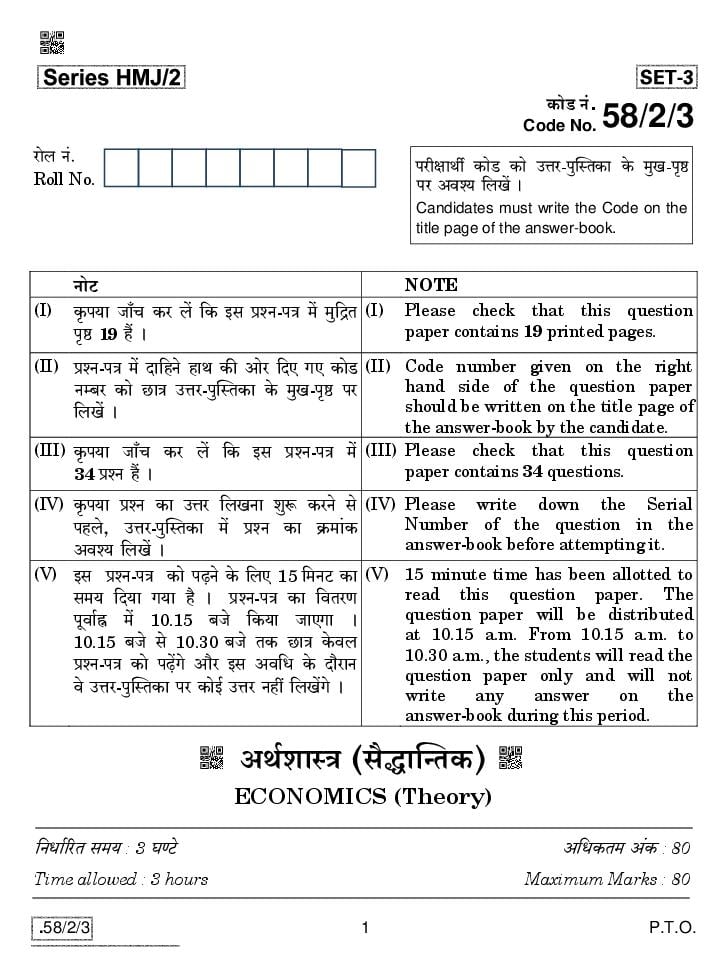
Code No. 58/2/3
amob Z§. narjmWu H$moS >H$mo CÎma-nwpñVH$m Ho$ _wI-n¥ð
Roll No. >na Adí` {bIo§ &
Candidates must write the Code on the
title page of the answer-book.
ZmoQ> NOTE
(I) H¥$n`m Om±M H$a b| {H$ Bg àíZ-nÌ _o§ _w{ÐV (I) Please check that this question
n¥ð> 19 h¢ & paper contains 19 printed pages.
(II) àíZ-nÌ _| Xm{hZo hmW H$s Amoa {XE JE H$moS (II) Code number given on the right
>Zå~a H$mo N>mÌ CÎma-nwpñVH$m Ho$ _wI-n¥ð> na hand side of the question paper
{bI| & should be written on the title page of
the answer-book by the candidate.
(III) H¥$n`m Om±M H$a b| {H$ Bg àíZ-nÌ _| (III) Please check that this question
>34 àíZ h¢ & paper contains 34 questions.
(IV) H¥$n`m àíZ H$m CÎma {bIZm ewê$ H$aZo go (IV) Please write down the Serial
nhbo, CÎma-nwpñVH$m _| àíZ H$m H«$_m§H$ Number of the question in the
Adí` {bI| & answer-book before attempting it.
(V) Bg àíZ-nÌ H$mo n‹T>Zo Ho$ {bE 15 {_ZQ >H$m (V) 15 minute time has been allotted to
g_` {X`m J`m h¡ & àíZ-nÌ H$m {dVaU read this question paper. The
nydm©• _| 10.15 ~Oo {H$`m OmEJm & question paper will be distributed
10.15 ~Oo go 10.30 ~Oo VH$ N>mÌ Ho$db at 10.15 a.m. From 10.15 a.m. to
10.30 a.m., the students will read the
àíZ-nÌ H$mo n‹T>|Jo Am¡a Bg Ad{Y Ho$ Xm¡amZ question paper only and will not
do CÎma-nwpñVH$m na H$moB© CÎma Zht {bI|Jo & write any answer on the
answer-book during this period.
AW©emñÌ (g¡ÕmpÝVH$)
ECONOMICS (Theory)
{ZYm©[aV g_` : 3 KÊQ>o A{YH$V_ A§H$ : 80
Time allowed : 3 hours Maximum Marks : 80
.58/2/3 1 P.T.O.
Page 2
{ZåZ{b{IV {ZX}em| H$mo ~hþV gmdYmZr go n{‹T>E Am¡a CZH$m g™Vr go nmbZ H$s{OE :
(i) Bg àíZ-nÌ ‘| Xmo IÊS> h¢ H$ Am¡a I & g^r àíZ A{Zdm¶© h¢ &
(ii) àíZ g§»¶m 1 go 10 Am¡a 18 go 27 A{V bKw-CÎmar¶ àH$ma Ho$ àíZ h¢, à˶oH$ àíZ 1 A§H$
H$m h¡ & BZH$m CÎma EH$ eãX ¶m EH$ dm³¶ ‘| Xr{OE &
(iii) àíZ g§»¶m 11 Am¡a 12 Am¡a 28 Am¡a 29 bKw-CÎmar¶ àH$ma Ho$ àíZ h¢, à˶oH$ àíZ
3 A§H$m| H$m h¡ & BZH$m CÎma bJ^J 60 go 80 eãXm| ‘| Xr{OE &
(iv) àíZ g§»¶m 13 go 15 Am¡a 30 go 32 ^r bKw-CÎmar¶ àH$ma Ho$ àíZ h¢, à˶oH$ àíZ
4 A§H$m| H$m h¡ & BZH$m CÎma bJ^J 80 go 100 eãXm| ‘| Xr{OE &
(v) àíZ g§»¶m 16 Am¡a 17 Am¡a 33 Am¡a 34 XrK©-CÎmar¶ àH$ma Ho$ àíZ h¢, à˶oH$ àíZ
6 A§H$m| H$m h¡ & BZH$m CÎma bJ^J 100 go 150 eãXm| ‘| Xr{OE &
(vi) CÎma g§{jßV VWm q~Xþdma hmoZo Mm{hE Am¡a gmW hr Cn`w©³V eãX gr‘m H$m ¶Wmg§^d nmbZ
H$s{OE &
(vii) àíZ-nÌ _| H$moB© g‘J« {dH$ën Zht h¡ & VWm{n, EH$-EH$ A§H$ dmbo Xmo àíZm| ‘|, VrZ-VrZ
A§H$m| dmbo Xmo àíZm| ‘|, Mma-Mma A§H$m| dmbo Xmo àíZm| ‘| Am¡a N>…-N>… A§H$m| dmbo Xmo àíZm|
‘| Am§V[aH$ {dH$ën {XE JE h¢ & Eogo àíZm| ‘| Ho$db EH$ hr {dH$ën H$m CÎma Xr{OE &
(viii) BgHo$ A{V[a³V, Amdí¶H$VmZwgma, à˶oH$ IÊS> Am¡a àíZ Ho$ gmW ¶Wmo{MV {ZX}e {XE JE
h¢ &
IÊS> H$
(g_{îQ> AW©emñÌ)
1. ajm ‘Xm| na hmoZo dmbm gaH$mar 춶, gaH$mar ~OQ> H$m _________ 춶 H$m EH$ àH$ma
h¡ & (ghr CÎma Ûmam [a³V ñWmZ H$s ny{V© H$s{OE) 1
2. CëboI H$s{OE {H$ {ZåZ{b{IV H$WZ g˶ h¡ ¶m Ag˶ : 1
‘‘_wÐmñ\$s{V H$mo H$‘ H$aZo Ho$ {bE, Ho$ÝÐr¶ ~¢H$ H$mo ZµH$X Ama{jV AZwnmV (CRR) H$mo H$‘
H$aZm Mm{hE &’’
3. g‘J« Amny{V© go AmnH$m ³¶m VmËn¶© h¡ ? 1
.58/2/3 2
Page 3
Read the following instructions very carefully and strictly follow them :
(i) This question paper comprises two sections A and B. All questions are
compulsory.
(ii) Question numbers 1 – 10 and 18 – 27 are very short-answer questions
carrying 1 mark each. They are required to be answered in one word or
one sentence each.
(iii) Question numbers 11 – 12 and 28 – 29 are short-answer questions
carrying 3 marks each. Answers to them should not normally exceed
60 – 80 words each.
(iv) Question numbers 13 – 15 and 30 – 32 are also short-answer questions
carrying 4 marks each. Answers to them should not normally exceed
80 – 100 words each.
(v) Question numbers 16 – 17 and 33 – 34 are long answer questions carrying
6 marks each. Answers to them should not normally exceed
100 – 150 words each.
(vi) Answers should be brief and to the point. Also the above word limit be
adhered to as far as possible.
(vii) There is no overall choice. However, an internal choice has been provided
in 2 questions of one mark, 2 questions of three marks, 2 questions of four
marks and 2 questions of six marks. Only one of the choices in such
questions have to be attempted.
(viii) In addition to this, separate instructions are given with each section and
question, wherever necessary.
SECTION A
(Macro Economics)
1. Government expenditure incurred on defence items is a type of _________
expenditure in the Government Budget.
(Fill in the blank with correct answer) 1
2. State whether the following statement is true or false : 1
‘‘To reduce inflation, the Central Bank should reduce Cash Reserve Ratio
(CRR).’’
3. What do you mean by Aggregate Supply ? 1
.58/2/3 3 P.T.O.
Page 4
(ghr CÎma Ûmam [a³V ñWmZ H$s ny{V© H$s{OE)
5. µJ¡a-H$a AmJ‘ (amOñd) àm{ßV¶m| Ho$ H$moB© Xmo CXmhaU Xr{OE & 1
6. ¶{X gaH$ma {H$gr ñWmZ na EH$ Z¶m AñnVmb ñWm{nV H$aVr h¡, Vmo Cg na {H$¶m OmZo
dmbm 춶 gaH$mar ~OQ> H$m _________ 춶 H$m EH$ àH$ma h¡ &
(ghr CÎma Ûmam [a³V ñWmZ H$s ny{V© H$s{OE) 1
7. EH$ J¥hñW Ûmam H«$¶ H$s JB© H$ma EH$ _________ h¡ & 1
(ghr {dH$ën H$m M¶Z H$s{OE)
(A) EH$b Cn¶moJ ny±OrJV dñVw
(B) EH$b Cn¶moJ Cn^moº$m dñVw
(C) {Q>H$mD$ Cn^moº$m dñVw
(D) AY©-{Q>H$mD$ Cn^moº$m dñVw
AWdm
{ZåZ{b{IV ‘| go H$m¡Z-gm gyÌ gH$b amîQ´>r¶ CËnmX (GNP) Adñ’$s{VH$ H$mo Xem©Vm h¡ ? 1
(ghr {dH$ën H$m M¶Z H$s{OE)
_m¡{ÐH$ GNP
(A) 100
dmñV{dH$ GNP
dmñV{dH$ GNP
(B) 100
_m¡{ÐH$ GNP
dmñV{dH$ GNP
(C) 100
_wÐmñ\$s{V H$s Xa _| n[adV©Z
_wÐmñ\$s{V H$s Xa _| n[adV©Z
(D) 100
dmñV{dH$ GNP
.58/2/3 4
Page 5
(Fill in the blank with correct answer)
5. Give any two examples of non-tax revenue receipts. 1
6. If the Government establishes a new hospital, this expenditure incurred
in the Government Budget will be a type of _________ expenditure.
(Fill in the blank with correct answer) 1
7. A car purchased by a household is a _________ . 1
(Choose the correct alternative)
(A) single use capital good
(B) single use consumer good
(C) durable consumer good
(D) semi-durable consumer good
OR
GNP deflator is represented by which of the following formulae ? 1
(Choose the correct alternative)
Nominal GNP
(A) 100
Real GNP
Real GNP
(B) 100
Nominal GNP
Real GNP
(C) 100
Change in Rate of Inflation
Change in Rate of Inflation
(D) 100
Real GNP
.58/2/3 5 P.T.O.
Page 6
< 600 H$amo‹S> hmo OmVr h¡ & n[aUm‘V…, Cn^moJ 춶 < 400 H$amo‹S> go ~‹T> H$a
< 500 H$amo‹S> hmo OmVm h¡ & Bg n[apñW{V ‘| gr‘m§V Cn^moJ àd¥{Îm H$m ‘mZ _________
hmoJm & (ghr {dH$ën H$m M¶Z H$s{OE) 1
(A) 0·8
(B) 0·4
(C) 1·0
(D) 0·6
9. ‘{dXoem| go àmßV XmZ’ ^wJVmZ g§VwbZ ImVo Ho$ _________ (O‘m/Zm‘o) nj ‘| XO© {H$¶m
OmEJm & (ghr CÎma Ûmam [aº$ ñWmZ H$s ny{V© H$s{OE) 1
10. ¶{X {H$gr AW©ì¶dñWm H$s gånyU© A{V[a³V Am¶ H$m Cn^moJ {H$¶m OmVm h¡, Vmo {Zdoe
JwUH$ H$m ‘yë¶ _________ hmoJm & (ghr {dH$ën H$m M¶Z H$s{OE) 1
(A) eyݶ (0)
(B) An[a^m{fV ()
(C) EH$ (1)
(D) Xg (10)
11. ‘‘gH$b Kaoby CËnmX (GDP) {H$gr Xoe> H$s AW©ì¶dñWm Ho$ Am{W©H$ H$ë¶mU H$m gdm}Îm_
gyMH$ Zht h¡ &’’ {XE JE H$WZ H$m _mÝ` H$maUm| g{hV g‘W©Z AWdm I§S>Z H$s{OE & 3
12. ¶{X EH$ AW©ì¶dñWm ‘| :
gr‘m§V Cn^moJ àd¥{Îm (MPC) = 0·8
àma§{^H$ {Zdoe ‘| n[adV©Z (I) = < 4,000 H$amo‹S> hmo
{ZåZ{b{IV Ho$ ‘yë¶ kmV H$s{OE : 3
(a) {Zdoe JwUH$ (K)
(b) A§{V‘ Am¶ ‘| n[adV©Z (Y)
AWdm
¶{X g‘J« Amny{V© (AS) H$s VwbZm ‘| g‘J« _m±J (AD) A{YH$ hmo, Vmo Cg n[apñW{V ‘|
g‘m¶moOZ V§Ì H$s H$m¶©àUmbr H$s MMm© H$s{OE & 3
.58/2/3 6
Page 7
< 600 crores. As a result, the consumption expenditure rises from
< 400 crores to < 500 crores. Marginal propensity to consume in such a
case would be _________ . (Choose the correct alternative) 1
(A) 0·8
(B) 0·4
(C) 1·0
(D) 0·6
9. ‘Charity from Abroad’ will be recorded on _________ (credit/debit) side of
the Balance of Payment accounts.
(Fill in the blank with correct answer) 1
10. If the entire additional income of an economy is consumed, the value of
investment multiplier will be _________ . (Choose the correct alternative) 1
(A) zero (0)
(B) not defined ()
(C) one (1)
(D) ten (10)
11. ‘‘Gross Domestic Product (GDP) is not the best indicator of the economic
welfare of a country.’’ Defend or refute the given statement with valid
reasons. 3
12. If in an economy :
Marginal Propensity to Consume (MPC) = 0·8
Change in initial investment (I) = < 4,000 crores 3
Find the value of the following :
(a) Investment multiplier (K)
(b) Change in final income (Y)
OR
Discuss the working of the adjustment mechanism if, Aggregate Demand
(AD) is greater than Aggregate Supply (AS). 3
.58/2/3 7 P.T.O.
Page 8
gH$Vm &’’ {XE JE H$WZ H$m g‘W©Z AWdm I§S>Z H$s{OE & 4
14. ‘‘{nN>bo EH$ ‘mh ‘| A‘o[aH$s S>m°ba (US $) ‘| 0·75 n¡go à{V S>m°ba (p/$) H$s CN>mb XO©
hþB© h¡; ¶h n[apñW{V AbJ-AbJ àH$ma Ho$ ì¶mnm[a¶m| ({Z`m©VH$m| VWm Am`mVH$m|) Ho$ {bE
‘wñHw$amhQ> ¶m CXmgr bm gH$Vr h¡ &’’ {XE JE H$WZ H$m Am¡{M˶ {gÕ H$s{OE & 4
15. Ho$ÝÐr¶ ~¢H$ {H$g àH$ma aonmo aoQ> H$s ghm¶Vm go gmI {Z¶§{ÌV H$aVm h¡ ? ì¶m»¶m H$s{OE & 4
AWdm
^maVr` [aµOd© ~¢H$ Ûmam, gmI {Z`§ÌU _| aIZo Ho$ {bE Cn`moJ {H$E OmZo dmbo {H$Ýht Xmo
gmYZm| H$s {dñVma go {ddoMZm H$s{OE & 4
16. EH$ H$mën{ZH$ AW©ì¶dñWm Ho$ {ZåZ{b{IV Am±H$‹S>m| Ho$ Cn¶moJ go, {XE JE dfm] Ho$ {bE
dmñV{dH$ gH$b Kaoby CËnmX (GDP) H$s JUZm d VwbZm H$s{OE : 6
df© 2015 – 16 2016 – 17
‘m¡{ÐH$ GDP Xa 8% 9%
GDP Adñ’$s{VH$ 160 150
AWdm
(a) ‘‘EH$ Xmo-joÌH$ AW©ì¶dñWm ‘| Am¶ H$m dVw©b àdmh Bg ñd¶§{gÕ (axiom) na
AmYm[aV h¡ {H$ {H$gr EH$ H$m 춶 Xÿgao H$s Am¶ hmoVr h¡ &’’ _mÝ` VH$m] g{hV AnZo
CÎma H$m g_W©Z H$s{OE &
(b) ‘CËnmXZ Ho$ ‘y붒 VWm ‘‘yë¶ d¥{Õ’ ‘| A§Va ñnîQ> H$s{OE & 4+2
.58/2/3 8
Page 9
the existence of revenue deficit.’’ Defend or refute the given statement. 4
14. ‘‘US dollar has recorded a jump of 0·75 paise per dollar (p/$) in the last
one month; this situation might bring smiles and sorrows to different
types of traders (exporters and importers).’’ Justify the given statement. 4
15. How does the Central Bank control the credit with the help of Repo
Rate ? 4
OR
Elaborate any two instruments of credit control, exercised by the Reserve
Bank of India. 4
16. Using the following data of an imaginary economy, calculate and compare
the Real Gross Domestic Product (GDP) for the given years : 6
Year 2015 – 16 2016 – 17
Nominal GDP Rate 8% 9%
GDP deflator 160 150
OR
(a) ‘‘Circular flow of income in a two-sector economy is based on the
axiom that one’s expenditure is other’s income.’’ Support your
answer with valid reasons.
(b) Distinguish between ‘value of output’ and ‘value added’. 4+2
.58/2/3 9 P.T.O.
Page 10
{H$Ýht Xmo amOH$mofr¶ Cnm`m| H$m C„oI d MMm© H$s{OE & 6
Ñ{îQ>~m{YV N>mÌm| Ho$ {bE :
Adñ’$s{V A§Vamb H$m ³¶m AW© h¡ ? Adñ\$s{V A§Vamb H$s n[apñW{V Ho$ g‘mYmZ Ho$ {bE
{H$Ýht Xmo amOH$mofr¶ Cnm¶m| H$m C„oI d MMm© H$s{OE & 6
IÊS> I
(^maVr¶ AW©ì¶dñWm H$m {dH$mg)
18. _________ D$Om© Ho$ ì¶mdgm{¶H$ òmoV H$m EH$ CXmhaU h¡ & 1
(ghr {dH$ën H$m M¶Z H$s{OE)
(A) ObmD$ bH$‹S>r
(B) H$mo¶bm
(C) H¥${f H$m Hy$‹S>m-H$Mam
(D) gyIr Jmo~a Ho$ Cnbo
19. ^maV H$s àW‘ gmV n§Mdfu¶ ¶moOZmAm| ‘| _________ Zr{V H$m AZwJ‘Z Kaoby CÚmoJm| Ho$
g§ajU Ho$ {bE {H$¶m J¶m Wm & (ghr CÎma Ûmam [a³V ñWmZ H$s ny{V© H$s{OE) 1
.58/2/3 10
Page 11
any two fiscal measures to correct the situation. 6
For Visually Impaired Candidates :
What is meant by deflationary gap ? State and discuss any two fiscal
measures to correct the situation of deflationary gap. 6
SECTION B
(Indian Economic Development)
18. __________ is an example of a commercial source of energy. 1
(Choose the correct alternative)
(A) Firewood
(B) Coal
(C) Agricultural waste
(D) Dried dung cakes
19. ___________ policy was implemented in the first seven five-year plans of
India, to protect domestic industries. 1
(Fill in the blank with the correct answer)
.58/2/3 11 P.T.O.
Page 12
Ho$ ghr AZwH«$‘ H$s nhMmZ H$s{OE : 1
H$m°b‘ I H$m°b‘ II
a. {díd ì`mnma g§JR>Z (WTO) (i) ^wJVmZ g§VwbZ H$s g‘ñ¶m H$mo hb H$aZo
Ho$ {bE AënH$mbrZ G$U àXmZ H$aVm h¡ &
b. ^maVr` [aµOd© ~¢H$ (RBI) (ii) EH$ ~hþnjr¶ ì¶mnma dmVm© {ZH$m¶ h¡ &
c. A§Vam©îQ´>r` _wÐm H$mof (IMF) (iii) nwZ{Z©‘m©U Am¡a {dH$mg Ho$ {bE G$U XoZo H$s
gw{dYm àXmZ H$aVm h¡ &
d. A§Vam©îQ´>r` nwZ{Z©_m©U Am¡a (iv) ^maV H$m Ho$ÝÐr¶ ~¢H$ h¡ &
{dH$mg ~¢H$ (IBRD)
{ZåZ{b{IV _| go ghr {dH$ën H$m M`Z H$s{OE :
(A) a-(ii), b-(i), c-(iii), d-(iv)
(B) a-(ii), b-(iv), c-(iii), d-(i)
(C) a-(ii), b-(iii), c-(iv), d-(i)
(D) a-(ii), b-(iv), c-(i), d-(iii)
21. ‘mAmo Zo ‘J«oQ> brn ’$m°adS>©’ H$s ewéAmV df© _________ ‘| H$s Wr & 1
(ghr {dH$ën H$m M¶Z H$s{OE)
(A) 1951
(B) 1955
(C) 1958
(D) 1962
22. ^maV ‘| J«m‘rU {dÎmnmofU Ho$ {bE erf© g§ñWm H$m Zm‘ {b{IE & 1
23. CëboI H$s{OE {H$ {ZåZ{b{IV H$WZ g˶ h¡ AWdm Ag˶ : 1
‘‘^y{‘ gr‘m {ZYm©aU H$m AW© h¡ {H$gr ì¶{³V Ho$ {bE ^y{‘-YmaU H$s ݶyZV‘ gr‘m {ZYm©[aV
H$aZm h¡ &’’
24. {H$gr EH$ ‘hmaËZ H$ånZr H$m Zm‘ {b{IE & 1
.58/2/3 12
Page 13
given in Column I with their respective functions in Column II : 1
Column I Column II
a. WTO (i) provides short-term loans to solve
the Balance of Payments problem.
b. RBI (ii) is a multilateral trade negotiating
body.
c. IMF (iii) facilitates lending for reconstruction
and development.
d. IBRD (iv) is the Central Bank of India.
Choose the correct alternative from the following :
(A) a-(ii), b-(i), c-(iii), d-(iv)
(B) a-(ii), b-(iv), c-(iii), d-(i)
(C) a-(ii), b-(iii), c-(iv), d-(i)
(D) a-(ii), b-(iv), c-(i), d-(iii)
21. Mao initiated the ‘Great Leap Forward’ in the year ___________ . 1
(Choose the correct alternative)
(A) 1951
(B) 1955
(C) 1958
(D) 1962
22. Name the apex institution for rural financing in India. 1
23. State whether the following statement is true or false : 1
‘‘Land ceiling means fixing the minimum limit of land holding for an
individual.’’
24. Name any one Maharatna company. 1
.58/2/3 13 P.T.O.
Page 14
VWm A{Zdm¶© H$a Xr Wr & (ghr {dH$ën H$m M¶Z H$s{OE) 1
(A) 2001
(B) 2009
(C) 2003
(D) 2007
AWdm
{ZåZ{b{IV ‘| go H$m¡Z-gm g§JR>Z ^maV ‘| ñdmñ϶ joÌ H$mo {Z¶§{ÌV H$aVm h¡ ? 1
(ghr {dH$ën H$m M¶Z H$s{OE)
(A) ICMR
(B) UGC
(C) AICTE
(D) RBI
26. O¡{dH$ IoVr Ho$ {H$gr EH$ bm^ H$m CëboI H$s{OE & 1
27. CëboI H$s{OE {H$ {ZåZ{b{IV H$WZ g˶ h¡ AWdm Ag˶ : 1
‘‘nm{H$ñVmZ H$s VwbZm ‘|, ^maV ‘| µJar~r aoIm go ZrMo ahZo dmbo bmoJm| H$m AZwnmV A{YH$
h¡ &’’
28. ‘‘^maV gaH$ma Zo hmb hr ‘| ~‹T>Vr hþB© hm{Z¶m| Ho$ H$maU MTNL VWm BSNL Ho$ {db¶
H$s KmofUm H$s h¡ &’’ ^maV gaH$ma Ûmam CR>mE JE H$X_m| H$m Am¡{M˶ {gÕ H$s{OE & 3
29. ‘‘^maV ‘| {~Obr (e{º$) joÌ H$mo H$B© à_wI MwZm¡{V¶m| H$m gm‘Zm H$aZm n‹S>Vm h¡ &’’ {XE
JE H$WZ H$s _mÝ` VH$m] g{hV MMm© H$s{OE & 3
AWdm
‘‘1964 – 66 Ho$ {ejm Am¶moJ H$s {gµ\$m[aem| H$mo bmJy H$aZo ‘| ^maV Ag’$b ahm h¡ &’’
{XE JE H$WZ Ho$ g‘W©Z ‘| _mÝ` VH©$ àñVwV H$s{OE & 3
.58/2/3 14
Page 15
compulsory for all children between 6 – 14 years. 1
(Choose the correct alternative)
(A) 2001
(B) 2009
(C) 2003
(D) 2007
OR
Which one of the following organisations regulates the health sector in
India ? (Choose the correct alternative) 1
(A) ICMR
(B) UGC
(C) AICTE
(D) RBI
26. Mention any one advantage of Organic farming. 1
27. State whether the following statement is true or false : 1
‘‘Proportion of people living below poverty line is more in India as
compared to Pakistan.’’
28. ‘‘Recently the Government of India has decided to merge MTNL and
BSNL on account of rising losses.’’ Justify the steps taken by the
Government of India. 3
29. ‘‘Power sector in India has major challenges to face.’’ Discuss the given
statement with valid reasons. 3
OR
‘‘India has failed to implement the recommendations of Education
Commission of 1964 – 66.’’ Give valid arguments in support of the given
statement. 3
.58/2/3 15 P.T.O.
Page 16
~XbZo ‘| ‘hÎdnyU© ^y{‘H$m {Z^mB© h¡ & 4
AWdm
‘‘{dXoer ‘wÐm ^§S>ma H$s ~MV d AmË‘-{Z^©aVm Ho$ Xmohao CÔoí¶m| Ho$ gmW ^maV ‘|
Am¶mV à{V~§Y bJmE JE Wo &’’ ‘mݶ VH$m] g{hV {XE JE H$WZ H$m Am¡{M˶ {gÕ
H$s{OE & 4
31. ñdV§ÌVm H$s nyd©-g§Ü¶m na, ^maV Ho$ {dXoer ì¶mnma Zr{V H$s {H$Ýht Xmo ‘w»¶ {deofVmAm| na
{Q>ßnUr H$s{OE & 4
32. d¡Y H$maUm| Ho$ gmW, ^maV Am¡a MrZ Ho$ {XE JE Am±H$‹S>m| H$s VwbZm d {díbofU H$s{OE : 4
OZg§»`m H$s dm{f©H$ d¥{Õ Xa qbJmZwnmV
Xoe>
(2015) (à{V hOma nwéf)
^maV 1·2% 929
MrZ 0·5% 941
òmoV : {díd {dH$mg g§Ho$VH$, 2015
33. {ZåZ{b{IV H$mo n[a^m{fV H$s{OE : 6
(a) ñd{U©‘ H«$m§{V
(b) n`m©daU H$s YmaU j‘Vm
(c) µJar~r aoIm
(d) OrdZ-à˶mem
.58/2/3 16
Page 17
significant role in transforming Indian agriculture. 4
OR
‘‘Import restrictions were imposed in India with the dual objective to save
foreign exchange reserves and to be self-sufficient.’’ Justify the given
statement with valid arguments. 4
31. Comment upon any two salient features of the foreign trade policy of
India, on the eve of Independence. 4
32. Compare and analyse the given data of India and China with valid
reasons : 4
Sex ratio
Annual growth rate of (per
Country
population (2015) thousand
males)
India 1·2% 929
China 0·5% 941
Source : World Development Indicators, 2015
33. Define the following : 6
(a) Golden Revolution
(b) Carrying Capacity of Environment
(c) Poverty Line
(d) Life Expectancy
.58/2/3 17 P.T.O.
Page 18
(b) l{‘H$-OZg§»¶m AZwnmV H$s n[a^mfm {b{IE & 4+2
AWdm
^maV _| ñdV§ÌVm go A~ VH$ H$m`m©pÝdV {H$E JE µJar~r CÝ_ybZ H$m`©H«$_m| Ho$ n[aUm_m| H$m
AmbmoMZmË_H$ narjU H$s{OE & 6
.58/2/3 18
Page 19
(b) Define the worker-population ratio. 4+2
OR
Critically examine the results of Poverty Alleviation Programmes
implemented in India since independence. 6
.58/2/3 19 P.T.O.
Document Details
| Board / Org | CBSE |
| Exam | Class 12 |
| Type | Question Paper |
| Pages | 19 |
| Updated | 22 Jul 2026 |