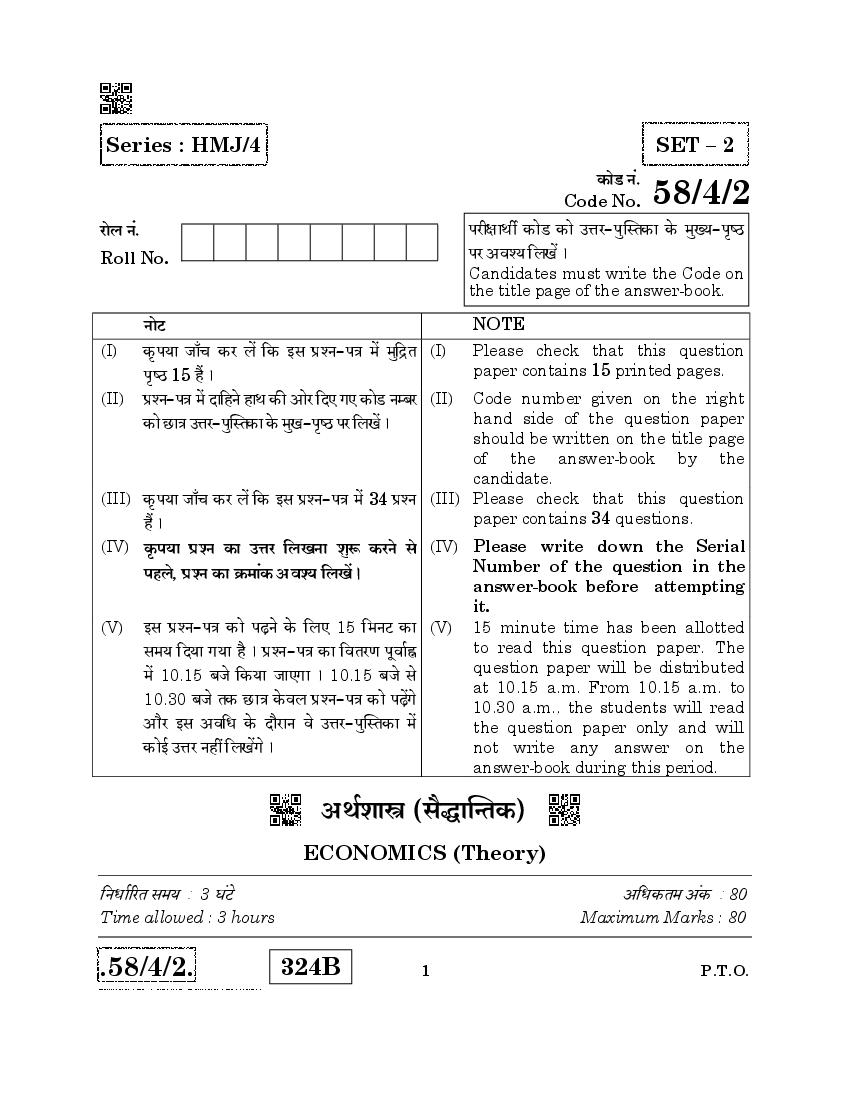
CBSE Class 12 Economics Question Paper 2020 Set 58-4-2
Finished viewing? Save it for later —
Download CBSE Class 12 Economics Question Paper 2020 Set 58-4-2 (PDF · 16 pages)About CBSE Class 12 Economics Question Paper 2020 Set 58-4-2
CBSE Class 12 Economics Question Paper 2020 Set 58-4-2 is available here for free download. Published by CBSE for Class 12, this question paper can be viewed online or downloaded as a PDF (16 pages). Candidates preparing for Class 12 can use CBSE Class 12 Economics Question Paper 2020 Set 58-4-2 to understand the exam pattern, the type of questions asked, and the overall difficulty level.
Frequently Asked Questions
How can I download CBSE Class 12 Economics Question Paper 2020 Set 58-4-2?
Open this page and click the Download button to save CBSE Class 12 Economics Question Paper 2020 Set 58-4-2 as a PDF. It is completely free on AglaSem Docs.
Is CBSE Class 12 Economics Question Paper 2020 Set 58-4-2 free to download?
Yes. CBSE Class 12 Economics Question Paper 2020 Set 58-4-2 can be viewed online and downloaded as a PDF free of cost on AglaSem Docs.
How many pages does CBSE Class 12 Economics Question Paper 2020 Set 58-4-2 have?
CBSE Class 12 Economics Question Paper 2020 Set 58-4-2 contains 16 pages, which you can read online or download together as a single PDF.
Where can I find more Class 12 study material?
You can find more Class 12 question papers, sample papers, syllabus, and answer keys on AglaSem Docs.
CBSE Class 12 Economics Question Paper 2020 Set 58-4-2 – Text
Read the full text of this question paper below — useful to quickly search, copy and reference the content online without downloading the PDF.
📄 View text version (16 pages)
Page 1
.
Code No. 58/4/2
. - -
Roll No.
Candidates must write the Code on
the title page of the answer-book.
NOTE
(I) - (I) Please check that this question
15 paper contains 15 printed pages.
(II) - (II) Code number given on the right
- - hand side of the question paper
should be written on the title page
of the answer-book by the
candidate.
(III) - 34 (III) Please check that this question
paper contains 34 questions.
(IV) (IV) Please write down the Serial
, Number of the question in the
answer-book before attempting
it.
(V) - 15 (V) 15 minute time has been allotted
- to read this question paper. The
question paper will be distributed
10.15 10.15
at 10.15 a.m. From 10.15 a.m. to
10.30 - 10.30 a.m., the students will read
- the question paper only and will
not write any answer on the
answer-book during this period.
()
ECONOMICS (Theory)
: 3 : 80
Time allowed : 3 hours Maximum Marks : 80
.58/4/2. 324B 1 P.T.O.
Page 2
(i) - –
(ii) 1 10 18 27 - , 1
(iii) 11 12 28 29 - , 3
60 80
(iv) 13 15 30 32 - , 4
80 100
(v) 16 17 33 34 , 6
100 150
(vi)
(vii) - , - , -
, - -
(viii) , ,
–
( )
1. , :
‘ ’ 1
2. _______ _______
( ) 1
_______
( )
() ()
() () 1
.58/4/2. 2
Page 3
Read the following instructions very carefully and strictly follow them :
(i) Question paper comprises two Sections – A and B. All questions are
compulsory.
(ii) Question number 1 – 10 and 18 – 27 are very short-answer questions
carrying 1 mark each. They are required to be answered in one word or
one sentence each.
(iii) Question number 11 – 12 and 28 – 29 are short-answer questions
carrying 3 marks each. Answers to them should not normally exceed
60 – 80 words each.
(iv) Question number 13 – 15 and 30 – 32 are also short-answer questions
carrying 4 marks each. Answers to them should not normally exceed
80 – 100 words each.
(v) Question number 16 – 17 and 33 – 34 are long answer questions
carrying 6 marks each. Answers to them should not normally exceed
100 – 150 words each.
(vi) Answer should be brief and to the point also the above word limit be
adhered to as far as possible.
(vii) There is no overall choice. However, an internal choice has been
provided in 2 questions of one mark, 2 questions of three marks,
2 questions of four marks and 2 questions of six marks. Only one of
the choices in such questions have to be attempted.
(viii) In addition to this, separate instructions are given with each section
and question, wherever necessary.
SECTION – A
(Macro-economics)
1. State, whether the given statement is true or false :
‘Unexpected obsolescence is a component of depreciation.’ 1
2. Two components of money supply are _____ and _____.
(Fill up the blank with correct answer). 1
OR
The main aim of monetary policy is _____.
(Choose the correct alternative)
(a) to bring price stability in the economy.
(b) employment generation in the country.
(c) to increase trade surplus.
(d) to generate greater tax revenue. 1
.58/4/2. 3 P.T.O.
Page 4
, (MPC) ? (
)
() 0.80 () 0.20
() 0.10 () 0.90 1
4. , ______ (/)
( ) 1
5. , ` 2,000 ________ (/)
( ) 1
6. , :
“ , 1
7. _______
( )
()
()
() -
() - 1
8. - () 1
9. ‘ ’ 1
10. 1
11. “ , ()
”
GDP ,
3
.58/4/2. 4
Page 5
` 40,000 to ` 48,000. In this situation, what will be the value of Marginal
Propensity to Consume (MPC) ?
(Choose the correct alternative.)
(a) 0.80 (b) 0.20
(c) 0.10 (d) 0.90 1
4. Loans offered by commercial banks ______ (increase/decrease) the money
supply in the economy.
(Fill up the blank with correct alternative.) 1
5. ` 2,000 note lying in wallet of Rohini, a student is an example of ______
(stock/flow) variable.
(Fill up the blank with correct alternative.) 1
6. State, whether the given statement is true or false :
‘Expenditure on Ujjwala Yojana launched by the Government is an
example of capital expenditure.’ 1
7. The sum of factor payments is equal to _______.
(Choose the correct alternative.)
(a) Domestic Income
(b) National Income
(c) Per Capita Real Income
(d) Per Capita Nominal Income. 1
8. Define inventory (stock). 1
9. Give any one example of ‘debt creating capital receipts’ in the Government
Budget. 1
10. Define intermediate consumption. 1
11. “Management of a water polluting oil refinery says that the it (oil
refinery) ensures welfare through its contribution to Gross Domestic
Product.”
Defend or refute the argument of management with respect to GDP as a
welfare measure of the economy. 3
.58/4/2. 5 P.T.O.
Page 6
.. (` )
(i) 800
(ii) 200
(iii) 30
(iv) 20
(v) 50
(vi) 50 3
3
13. ‘ , ’ 4
, ‘ ’ 4
14. , (AD)
(AS) , 1+3
15. ‘ ’ 4
16. ,
(i)
(ii) -
(iii) ‘ ’
()
23=6
() , 3
() (CAD) (CAS) 3
.58/4/2. 6
Page 7
S. No. Particulars Amount (in ` crores)
(i) Value of Output 800
(ii) Intermediate Consumption 200
(iii) Indirect taxes 30
(iv) Depreciation 20
(v) Subsidies 50
(vi) Purchase of machinery 50 3
OR
State the three components of Income from Property and Entrepreneurship. 3
13. Explain the function of Central Bank as ‘Banker, Agent and Advisor’ of
the Government. 4
OR
Elaborate, how does a Central Bank stabilize money supply through ‘Bank
Rate’. 4
14. Define effective demand. Discuss how, effective demand can be restored
if ex-ante Aggregate Demand (AD) is less than ex-ante Aggregate
Supply (AS). 1+3
15. Elaborate the objective of ‘allocation of resources’ in the Government
Budget. 4
16. State, giving valid reasons whether the following statements are true or
false :
(i) Trade deficit is always a great cause of worry for an economy.
(ii) Depreciation of currency has same effect on exports as devaluation of
currency.
(iii) ‘Indians investing in assets abroad’ will be recorded under debit
side of capital account in Balance of Payments. 23=6
OR
(a) Explain, what can be the likely impact of depreciation of the home
currency on imports to the country. 3
(b) Distinguish between Current Account Deficit (CAD) and Current
Account Surplus (CAS). 3
.58/4/2. 7 P.T.O.
Page 8
:
..
(i) – ` 200
(A)
(ii)
(MPC) 0.70
(iii) ` 1,000
() , 3
(i) , ? 1½
(ii) B ? 1½
() (i)
(ii) ? 1+2
–
( )
18. ‘ ’ ?
( )
() ()
() () 1
19. ________ (WTO) 1995
( ) 1
.58/4/2. 8
Page 9
equilibrium or not.
Sr. Particulars Amount
No.
(i) Autonomous Consumption &
Investment Expenditure (Ā) ` 200 crores
(ii) Marginal Propensity to Consume (MPC) 0.70
(iii) National Income ` 1,000 crores 3
(b) Answer the following questions based on the figure given below :
(i) At which level of income, Average Propensity to Consume will
be equal to one and why ? 1½
(ii) What is the significance of saving curve above the point B. 1½
For Visually Impaired Candidates only :
(b) (i) Define Autonomous consumption.
(ii) What is the significance of dis-savings ? 1+2
SECTION – B
(Indian Economic Development)
18. Which of the following countries adopted ‘One Child Policy’ as a measure
to control population ?
(Choose the correct alternative.)
(a) India (b) China
(c) Pakistan (d) Russia 1
19. World Trade Organisation (WTO) was established in 1995, as a successor
organisation to _______. (Fill up the blank with correct answer) 1
.58/4/2. 9 P.T.O.
Page 10
21. _______ ,
( ) 1
22. , _________ (//)
( ) 1
23. ‘ ’ (GLF) _______
( )
() ()
() () 1
24. ?
( )
() ()
() () 1
25. 1
26. ________ ( )
() 1978 () 1980
() 1988 () 1991 1
.58/4/2. 10
Page 11
21. _______ policy followed in first seven five year plans of India, aimed at
substituting imports with domestic production.
(Fill up the blank with correct answer) 1
22. In the past few decades _________ (primary/secondary/tertiary) sector has
created maximum jobs opportunities in India.
(Fill up the blank with correct answer) 1
23. The main aim of ‘Great Leap Forward’ (GLF) in China was to ensure
rapid increase of _______.
(Choose the correct alternative)
(a) agriculture (b) industries
(c) services (d) exports 1
24. Which of the following is not a benefit of organic farming ?
(Choose the correct alternative.)
(a) Cheaper inputs
(b) Attractive returns on investment
(c) Greater import possibilities
(d) Higher nutritional value 1
25. Define disguised unemployment. 1
26. Introduction of Economic Reforms in China took place in the year
_________. (Choose the correct alternative.)
(a) 1978 (b) 1980
(c) 1988 (d) 1991 1
.58/4/2. 11 P.T.O.
Page 12
“ (IBRD) ” 1
1
28. :
(2015) ( )
1.2% 929
0.5% 941
, 2015. 3
29. “ ”
3
“ , ”
? 3
30.
(i)
(ii) 4
31. () AYUSH ()
() - 3+1
32. 4
‘’
4
.58/4/2. 12
Page 13
“World Bank is also known as International Bank for Registration and
Delimitation (IBRD).” 1
OR
Define Marketed Surplus. 1
28. Compare and analyse the given data of India and China, with valid reasons :
Country Annual Growth rate Gender Ratio (Per
of population (2015) thousand males)
India 1.2% 929
China 0.5% 941
Source : World Development Indicators, 2015. 3
29. “Rapid increase in economic growth surely trickles down to the people
under the absolutely poor category.”
Defend or refute the given statement with valid argument. 3
OR
“Human Capital Formation gives birth to innovation, invention and
technological improvements.”
Do you agree with the given statement ? Support your answer with valid
arguments. 3
30. Distinguish between :
(i) Tariff and non-tariff Barriers,
(ii) Bilateral and multilateral trade. 4
31. (a) State the names of six Indian Systems of Medicines (ISM) under
AYUSH scheme of the Government of India.
(b) Name any two non-conventional sources of energy. 3+1
32. Discuss briefly, any two salient features of India’s pre-independence
occupational structure. 4
OR
Discuss briefly the rationale behind choosing ‘self-reliance’ as a planning
objective for Indian economy. 4
.58/4/2. 13 P.T.O.
Page 14
()
() 1972-2012 (% )
1972-73 1983 1993-94 1999-2000 2011-2012
74.3 68.6 64 60.4 48.9
10.9 11.5 16 15.8 24.3
14.8 16.9 20 23.8 26.8
100.0 100.0 100.0 100.0 100.0 3
() “ -
”
- ?
() “
”
3, 3
34. () 3
() 3
____________
.58/4/2. 14
Page 15
(b) Analyse the trends in sectoral distribution of work force in India on
the basis of data :
Trends in Employment Pattern
(Sector-wise), 1972-2012 (in %)
Sector 1972-73 1983 1993-94 1999-2000 2011-2012
Primary 74.3 68.6 64 60.4 48.9
Secondary 10.9 11.5 16 15.8 24.3
Services 14.8 16.9 20 23.8 26.8
Total : 100.0 100.0 100.0 100.0 100.0 3
OR
(a) “The Prime Minister urged to increase the rural income by
increasing non-farm activities.”
Explain how non-farm activities can lead to rise in income of people
in rural sector.
(b) “Indian health system needs the increased dose of public expenditure
to cure itself.”
Defend or refute the given statement with valid arguments. 3, 3
34. (a) State and discuss any two environmental concerns faced by India in
the present times. 3
(b) Discuss the importance of credit in rural development. 3
____________
.58/4/2. 15 P.T.O.
Page 16
Document Details
| Board / Org | CBSE |
| Exam | Class 12 |
| Type | Question Paper |
| Pages | 16 |
| Updated | 22 Jul 2026 |