NIOS Class 10 Syllabus 2023 Social Science
Finished viewing? Save it for later —
Download NIOS Class 10 Syllabus 2023 Social Science (PDF · 4 pages)About NIOS Class 10 Syllabus 2023 Social Science
NIOS Class 10 Syllabus 2023 Social Science is available here for free download. Published by NIOS for National Institute of Open Schooling Class 10, this syllabus can be viewed online or downloaded as a PDF (4 pages). Candidates preparing for National Institute of Open Schooling Class 10 can use NIOS Class 10 Syllabus 2023 Social Science to understand the exam pattern, the type of questions asked, and the overall difficulty level.
Frequently Asked Questions
How can I download NIOS Class 10 Syllabus 2023 Social Science?
Open this page and click the Download button to save NIOS Class 10 Syllabus 2023 Social Science as a PDF. It is completely free on AglaSem Docs.
Is NIOS Class 10 Syllabus 2023 Social Science free to download?
Yes. NIOS Class 10 Syllabus 2023 Social Science can be viewed online and downloaded as a PDF free of cost on AglaSem Docs.
How many pages does NIOS Class 10 Syllabus 2023 Social Science have?
NIOS Class 10 Syllabus 2023 Social Science contains 4 pages, which you can read online or download together as a single PDF.
Where can I find more National Institute of Open Schooling Class 10 study material?
You can find more National Institute of Open Schooling Class 10 question papers, sample papers, syllabus, and answer keys on AglaSem Docs.
NIOS Class 10 Syllabus 2023 Social Science – Text
Read the full text of this syllabus below — useful to quickly search, copy and reference the content online without downloading the PDF.
📄 View text version (4 pages)
Page 1
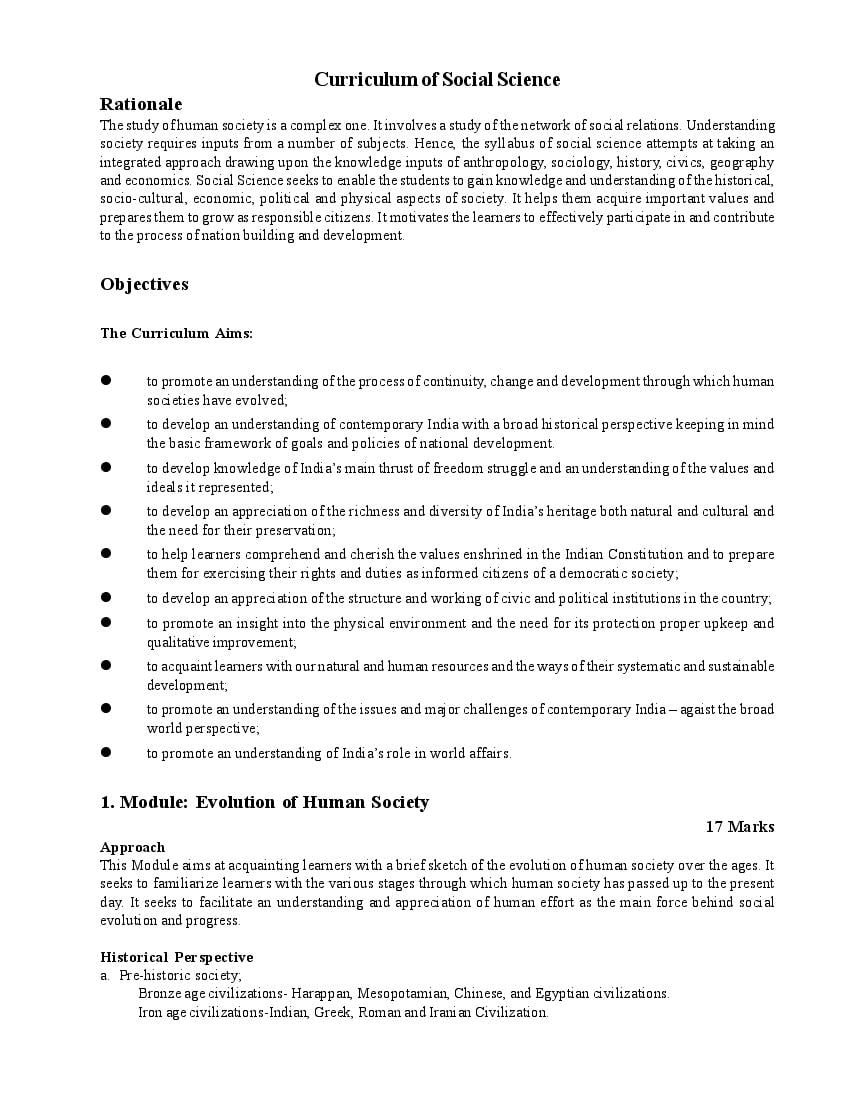
Rationale
The study of human society is a complex one. It involves a study of the network of social relations. Understanding
society requires inputs from a number of subjects. Hence, the syllabus of social science attempts at taking an
integrated approach drawing upon the knowledge inputs of anthropology, sociology, history, civics, geography
and economics. Social Science seeks to enable the students to gain knowledge and understanding of the historical,
socio-cultural, economic, political and physical aspects of society. It helps them acquire important values and
prepares them to grow as responsible citizens. It motivates the learners to effectively participate in and contribute
to the process of nation building and development.
Objectives
The Curriculum Aims:
z to promote an understanding of the process of continuity, change and development through which human
societies have evolved;
z to develop an understanding of contemporary India with a broad historical perspective keeping in mind
the basic framework of goals and policies of national development.
z to develop knowledge of India’s main thrust of freedom struggle and an understanding of the values and
ideals it represented;
z to develop an appreciation of the richness and diversity of India’s heritage both natural and cultural and
the need for their preservation;
z to help learners comprehend and cherish the values enshrined in the Indian Constitution and to prepare
them for exercising their rights and duties as informed citizens of a democratic society;
z to develop an appreciation of the structure and working of civic and political institutions in the country;
z to promote an insight into the physical environment and the need for its protection proper upkeep and
qualitative improvement;
z to acquaint learners with our natural and human resources and the ways of their systematic and sustainable
development;
z to promote an understanding of the issues and major challenges of contemporary India – agaist the broad
world perspective;
z to promote an understanding of India’s role in world affairs.
1. Module: Evolution of Human Society
17 Marks
Approach
This Module aims at acquainting learners with a brief sketch of the evolution of human society over the ages. It
seeks to familiarize learners with the various stages through which human society has passed up to the present
day. It seeks to facilitate an understanding and appreciation of human effort as the main force behind social
evolution and progress.
Historical Perspective
a. Pre-historic society;
Bronze age civilizations- Harappan, Mesopotamian, Chinese, and Egyptian civilizations.
Iron age civilizations-Indian, Greek, Roman and Iranian Civilization.
Page 2
c. Beginning of the modern age- Rise of modern science, Industrial revolution, American, French and Russian
revolutions, and Movement for Democracy.
d. Colonialism in Asia and Africa.
e. The First World War, League of Nations, rise of Fascism and Nazism, Second World War, the United
Nations.
Contemporary World
Issues in World Order (since 1945) and emerging global village.
2. Module: India: Natural Environment, Resources and Development
Approach: The unit is designed to acquaint the learner with the inter-relationship between environment resources
and development. This unit enables the learners to understand the basic elements of environment and its dynamism.
It will also highlight the maintaining of ecological balance on the earth, so that the total life, of which human is but
a part continues to exist and flourish on the earth.
This unit is also designed to acquaint the learner with the concept of natural resource base in its totality and
scientific development on a sustainable basis. This module will mainly discuss about various natural and man-
made resources, their distribution, utilization, and need for conservation and management. The module is to be
developed with reference to India.
1. Physiography-location, relief, structure, major physiographic units;
2. Drainage; Role of rivers in the economy; Pollution of rivers and its control.
3. Climate: Factors influencing climate; Monsoon-Its characteristics. Distribution of Rainfall and
Temperature; Formation of seasons; Climate and Human Life
4. Vegetation and wild life of India
5. Soil and Water Resources: land as a resource, soil formation, types and distribution: changing land – use
pattern: land degradation and conservation measures. Water resources- sources, distribution, utilisation,
multi-purpose projects, and water scarcity, need for conservation and management, water harvesting.
6. Mineral and Power Resources: Types of Minerals, Distribution, Use and Economic Importance of
Minerals, Conservation. Power Resources L Types of Power resources – conventional and Non-
conventional, Distribution and Utilisation, and Conservation.
7. Agriculture: Types of Farming, Major Crops, Cropping Patter, Technological and Institutional Reforms;
Their Impact; Contribution of Agriculture of National Economy-Employment and Output, Food Security,
Impact of Globalisation.
8. Manufacturing Industries: Types, spatial distribution and contribution of Industries to the national economy.
3. Module: India : People, Society and Culture
12 Marks
Approach: This module aims to help learners understand the physical and cultural diversities of the country and
their underlying unity. The physical diversities include landform, climate, soil, vegetation and wild life. Cultural
aspects include the meaning of culture especially in the context of India, cultural diversity and its relationship
with the physical environment. It emphasises the richness of the countries heritage, both natural and cultural and
the need to preserve it for future generations.
Page 3
class, kinship, and religion.
2. Culture- cultural heritage
Meaning of culture, factors influencing cultures, different components of culture – Tradition, aesthetics, art,
architecture, literature, science and technology, beliefs and practices, religion, unity in diversity.
Heritage: Natural and Cultural; Preserving Heritage: need, and measures for their preservation.
4. Module: India’s Struggle for Freedom
Approach: This module aims at acquainting learners with the history of the nationalist movement in India. It
seeks to emphasize the unique socio-cultural routes of India’s freedom struggle. It focuses on the monumental
sacrifices of the freedom fighters from different regions of the country. It also seeks to familiarize the learners
with visions of a radically reformed social order.
1. Establishment of British rule in India and its impact
2. Religious and social reform movements;
3. Indian National Movement (1857-1927): towards an organised movement for freedom.
4. Indian National Movement (1927-1947): towards a mass struggle-participation of diverse sections of the
Indian society.
5. Module: Citizen, State and the Constitution
Approach: This module has been designed to emphasis the importance of good citizens, their rights and duties.
It is observed that people always talk about their rights but they hardly talk about their duties. Thus, stress will be
given on Fundamental Duties and Directive Principles of State Policy. The module seeks to highlight the philosophy
of the constitution. This module is also designed to enable learners to appreciate the need for active participation
of the citizen in the successful functioning of a democracy.
1. Framing of the Constitution;
2. Preamble and features of the Constitution
3. Citizenship
4. Fundamental Rights
a. Meaning of Fundamental Rights and its significance
b. Provisions of the constitution regarding Fundamental Rights
5. Human Rights - National Human Rights Commission (NHRC) and State Human Rights Commission
(SHRC)
6. Fundamental Duties
a. Meaning of Fundamental Duties and relationship between Rights and Duties
b. Provisions of the Constitution regarding Fundamental Duties.
7. Directive Principles of State Policy
a. Meaning of Directive Principles of State Policy
b. The constitutional provisions regarding Directive Principles of State Policy and its significance.
Page 4
Approach: This unit seeks to acquaint the learners with the different levels of governments- Local, State and
Central. At the local level three institutions are included- Panchayati Raj, Municipal administration and District
administration. This will be followed by the two successive levels of governments- State and Union governments.
1. Local Government and Field Administration
a. Panchayati Raj System
b. Municipal administration and
c. District administration
2. State Government
a.Governor
b.Chief Minister and Council of Ministers
c.State Legislature
d.High Courts
e.State Secretariat
3. Union Government
a) President
b) Prime Minister and Council of Ministers
c) Supreme Court
d) Central Secretariat
4. People’s Participation in the Democratic Process
a) Political parties and pressure groups/interest groups
b) Public opinion, electoral processes and universal adult franchise
7. Module: Contemporary India : Issues and Challenges
Approach: This unit seeks to identify the Political, Social and Economic challenges facing within and outside of
the country. The learner should be made aware of the nation’s problems and be able to suggest ways for
removing them.
1. National Integration and Secularism
2. Social Justice and Economic Justice
3. Empowerment of Women and Equality of Opportunity
4. Education and Health for All
5. Environment and its qualitative improvement
6. India and the world peace.
Document Details
| Board / Org | NIOS |
| Exam | National Institute of Open Schooling Class 10 |
| Type | Syllabus |
| Pages | 4 |
| Updated | 22 Jul 2026 |