CBSE Class 12 Question Paper 2025 Solution Entrepreneurship
Finished viewing? Save it for later —
Download CBSE Class 12 Question Paper 2025 Solution Entrepreneurship (PDF · 12 pages)About CBSE Class 12 Question Paper 2025 Solution Entrepreneurship
CBSE Class 12 Question Paper 2025 Solution Entrepreneurship is available here for free download. Published by CBSE for Class 12, this solution can be viewed online or downloaded as a PDF (12 pages). Candidates preparing for Class 12 can use CBSE Class 12 Question Paper 2025 Solution Entrepreneurship to understand the exam pattern, the type of questions asked, and the overall difficulty level.
Frequently Asked Questions
How can I download CBSE Class 12 Question Paper 2025 Solution Entrepreneurship?
Open this page and click the Download button to save CBSE Class 12 Question Paper 2025 Solution Entrepreneurship as a PDF. It is completely free on AglaSem Docs.
Is CBSE Class 12 Question Paper 2025 Solution Entrepreneurship free to download?
Yes. CBSE Class 12 Question Paper 2025 Solution Entrepreneurship can be viewed online and downloaded as a PDF free of cost on AglaSem Docs.
How many pages does CBSE Class 12 Question Paper 2025 Solution Entrepreneurship have?
CBSE Class 12 Question Paper 2025 Solution Entrepreneurship contains 12 pages, which you can read online or download together as a single PDF.
Where can I find more Class 12 study material?
You can find more Class 12 question papers, sample papers, syllabus, and answer keys on AglaSem Docs.
CBSE Class 12 Question Paper 2025 Solution Entrepreneurship – Text
Read the full text of this solution below — useful to quickly search, copy and reference the content online without downloading the PDF.
📄 View text version (12 pages)
Page 1
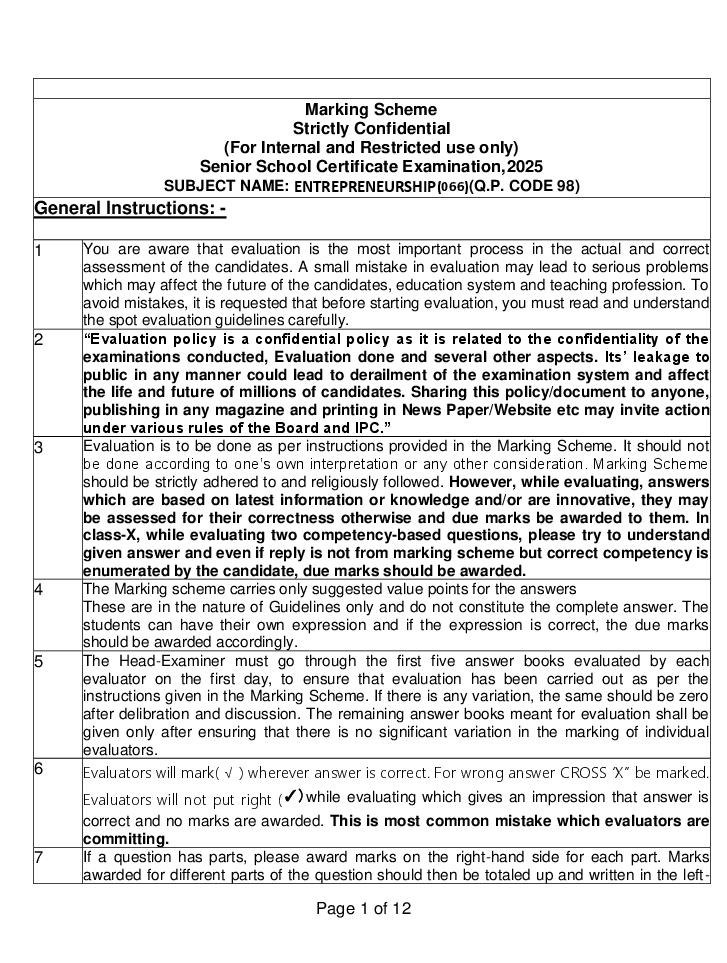
Strictly Confidential
(For Internal and Restricted use only)
Senior School Certificate Examination,2025
SUBJECT NAME: ENTREPRENEURSHIP(066)(Q.P. CODE 98)
General Instructions: -
1 You are aware that evaluation is the most important process in the actual and correct
assessment of the candidates. A small mistake in evaluation may lead to serious problems
which may affect the future of the candidates, education system and teaching profession. To
avoid mistakes, it is requested that before starting evaluation, you must read and understand
the spot evaluation guidelines carefully.
2 “Evaluation policy is a confidential policy as it is related to the confidentiality of the
examinations conducted, Evaluation done and several other aspects. Its’ leakage to
public in any manner could lead to derailment of the examination system and affect
the life and future of millions of candidates. Sharing this policy/document to anyone,
publishing in any magazine and printing in News Paper/Website etc may invite action
under various rules of the Board and IPC.”
3 Evaluation is to be done as per instructions provided in the Marking Scheme. It should not
be done according to one’s own interpretation or any other consideration. Marking Scheme
should be strictly adhered to and religiously followed. However, while evaluating, answers
which are based on latest information or knowledge and/or are innovative, they may
be assessed for their correctness otherwise and due marks be awarded to them. In
class-X, while evaluating two competency-based questions, please try to understand
given answer and even if reply is not from marking scheme but correct competency is
enumerated by the candidate, due marks should be awarded.
4 The Marking scheme carries only suggested value points for the answers
These are in the nature of Guidelines only and do not constitute the complete answer. The
students can have their own expression and if the expression is correct, the due marks
should be awarded accordingly.
5 The Head-Examiner must go through the first five answer books evaluated by each
evaluator on the first day, to ensure that evaluation has been carried out as per the
instructions given in the Marking Scheme. If there is any variation, the same should be zero
after delibration and discussion. The remaining answer books meant for evaluation shall be
given only after ensuring that there is no significant variation in the marking of individual
evaluators.
6 Evaluators will mark( √ ) wherever answer is correct. For wrong answer CROSS ‘X” be marked.
Evaluators will not put right (✓)while evaluating which gives an impression that answer is
correct and no marks are awarded. This is most common mistake which evaluators are
committing.
7 If a question has parts, please award marks on the right-hand side for each part. Marks
awarded for different parts of the question should then be totaled up and written in the left-
Page 1 of 12
Page 2
8 If a question does not have any parts, marks must be awarded in the left-hand margin and
encircled. This may also be followed strictly.
9 If a student has attempted an extra question, answer of the question deserving more marks
should be retained and the other answer scored out with a note “Extra Question”.
10 No marks to be deducted for the cumulative effect of an error. It should be penalized only
once.
11 A full scale of marks 70 has to be used. Please do not hesitate to award full marks if the
answer deserves it.
12 Every examiner has to necessarily do evaluation work for full working hours i.e., 8 hours
every day and evaluate 20 answer books per day in main subjects and 25 answer books per
day in other subjects (Details are given in Spot Guidelines).This is in view of the reduced
syllabus and number of questions in question paper.
13 Ensure that you do not make the following common types of errors committed by the
Examiner in the past:-
● Leaving answer or part thereof unassessed in an answer book.
● Giving more marks for an answer than assigned to it.
● Wrong totaling of marks awarded on an answer.
● Wrong transfer of marks from the inside pages of the answer book to the title page.
● Wrong question wise totaling on the title page.
● Wrong totaling of marks of the two columns on the title page.
● Wrong grand total.
● Marks in words and figures not tallying/not same.
● Wrong transfer of marks from the answer book to online award list.
● Answers marked as correct, but marks not awarded. (Ensure that the right tick mark
is correctly and clearly indicated. It should merely be a line. Same is with the X for incorrect
answer.)
● Half or a part of answer marked correct and the rest as wrong, but no marks
awarded.
14 While evaluating the answer books if the answer is found to be totally incorrect, it should be
marked as cross (X) and awarded zero (0)Marks.
15 Any un assessed portion, non-carrying over of marks to the title page, or totaling error
detected by the candidate shall damage the prestige of all the personnel engaged in the
evaluation work as also of the Board. Hence, in order to uphold the prestige of all
concerned, it is again reiterated that the instructions be followed meticulously and
judiciously.
16 The Examiners should acquaint themselves with the guidelines given in the “Guidelines for
spot Evaluation” before starting the actual evaluation.
17 Every Examiner shall also ensure that all the answers are evaluated, marks carried over to
the title page, correctly totaled and written in figures and words.
18 The candidates are entitled to obtain photocopy of the Answer Book on request on payment
of the prescribed processing fee. All Examiners/Additional Head Examiners/Head Examiners
are once again reminded that they must ensure that evaluation is carried out strictly as per
value points for each answer as given in the Marking Scheme.
Page 2 of 12
Page 3
MARKING SCHEME
ENTREPRENEURSHIP
A.No. Answers Marks
1 (C) Mutual agency 1
2 (B) Existing products or Services-Based ideas 1
3 (D) Creaming pricing 1
4 (A) Logo 1
For Visually Impaired Candidates
(D) Advertising
5 (D) Sole Proprietorship 1
6 (C) a business enterprise 1
7 (B) (1)-(ii), (2)-(iii), (3)-(i), (4)-(iv) 1
8 (D) Zero-Level Channel 1
9 (A) (i) only 1
10 (C) Trademark 1
11 (B) Vertical Merger 1
12 (B) General Introduction 1
13 (C) Assertion (A) is true, but Reason (R) is false 1
14 (C) Total Capital Invested 1
15 (B) Short-term investment 1
16 (C) Private Placement 1
17 (B) Reverse 1
18 (D) Stock Keeping Unit (SKU) code, Obsolescence 1
Page 3 of 12
Page 4
19 (a) Business opportunity can be described as an economic idea which can be 1 2
implemented to create a business enterprise and earn profits. +
Elements of Business opportunity: (½×2)
(Any two) =1
– Assured market scope
– An attractive and acceptable rate of return on investment
– Practicability of the idea
– Competence of the entrepreneur to encash it
– Potential of future growth
OR
(b) The Sources which lead to the emergence of basic ideas. 2
(½×4)
(Any four) =2
(i) Problems: When a problem exists, an idea leads to a solution to resolve
that problem, which emerges as a business opportunity.
(ii) Change: A change in social, legal, technological aspects etc. leads to
new opportunities to start a business.
(iii) Inventions: New products or services lead to new business
opportunities.
(iv) Competition: Competition often results in emergence of new and better
ideas that result in new business opportunities.
(v) Innovation: Creating new things of value as well as new and creative
processes that add value to the existing products or services.
20 (a)Environmental factor: Sensitisation of entrepreneurs to cope up with 1 2
rapid changes
(b)Sensitivity to environmental factors is crucial because of following +
reasons-
(Any one)
(i) Identification of opportunities to get first mover advantage: By ½ for
headi
keeping in touch with the changes in the external environment, an enterprise
ng +
can identify opportunities and find strategies to capitalise on the ½ for
opportunities at the earliest. expla
(ii)Formulation of strategies and policies: It helps in identifying threats and natio
opportunities in the market. These can serve as the basis of formulation of n
strategies to counter threats and capitalise on opportunities in the market.
(iii)Tapping useful resources: If the company has a thorough knowledge of
the external environment, it can tap raw materials, technology and even
financial resources from the market at economical prices, at the right time.
Page 4 of 12
Page 5
the external environment is necessary to take timely action to deal with
threats and avail opportunities for the purpose of improvement in the
performance of the firm.
(v)Image building: If a company is sensitive to the external environment, it
will come out with new products and services to meet the requirements of the
customers. This would build the image or reputation of the firm in the eyes
of the general public.
21 No, Deepa cannot transfer her share in favour of her son Deepak, without the 2 2
consent of the other partners, Guddi and Vani.
The reason is as per the Partnership Act no partner can sell or transfer his
share to anybody else without the consent of the other partners.
This is reflected in the feature - ‘Restriction on transfer of share’ which is
highlighted in the above case.
OR
Yes, Aruna’s personal property can be called upon to pay her business debts. 2 2
The reason is that a sole proprietor is responsible for all losses arising from
business and in case the business assets are insufficient to pay off liabilities,
they will have to sell their personal property.
This is reflected in the feature - ‘Unlimited liability’ which is highlighted in
the above case.
22 Method used by Sujit to spot the trend is Read trends. ½+ 2
Read Trends: ½=
Entrepreneurs regularly read the leading publications and websites affecting 1
their business. Publications include industry publications, trade association
sites, major newspapers, key business magazines, thought leaders and +
influential bloggers. They scan information from a wide variety of sources
from international news on down to niche bloggers focused on specific
aspects of their industry.
Other ways are-
(Any Two) ½+
1. Talk trends ½ =1
2. Watch trends
3. Think trends
(Note: Full marks to be awarded if the candidate has only mentioned the
heading)
Page 5 of 12
Page 6
oral narrative that is meant to trigger discussion and interest potential
investors in reading the written presentation, i.e. the executive summary and
a few key graphs showing financial trends and key decision making
benchmark.
24 (a) 1+ 2
(i) The given cash conversion cycle is of Trading business 1
(ii) Cash Conversion Cycle for Manufacturing Business
For visually impaired candidates
(a)Gross working capital= sum of all current assets
2 2
= cash+ debtors + stock
=20,000+3,50,000+80,000
=₹ 4,50,000
OR
(b) ABC Analysis technique of Inventory control:
In ABC analysis, a company reviews its inventory and sorts all Stock
2 2
Keeping Unit (SKU) codes into three categories, called “A”, “B” and “C”
items.
The typical break-down might look like this:
“A” inventory :20% of SKUs, 80% of value
“B” inventory : 30% of SKUs, 15% of value
“C” inventory : 50% of SKUs, 5% of value
“A” inventory are tightly controlled, the company pays close attention to
current demands and forecasts for future demands.
“B” inventory are also watched closely but the company reviews its ordering
strategy less often.
“C” inventory are less expensive, the company can order them in bulk and
exercise minimal control.
Page 6 of 12
Page 7
25 (a) Internal Expansion ½ 3
Internal expansion results from the gradual increase in the activities of the +
concern. The concern may expand its present production capacity by adding
more machines or by replacing old machines with the new machines with 1
higher productive capacity. +
The internal expansion can also be undertaken by taking up the production of
more units or by entering new fields on the production and marketing sides.
(b)External Expansion
External expansion refers to business combination where two or more 1 ½
concerns combine and expand their business activities. In the process of
combination, two or more units engage in similar business or related process
or stages. Sometimes stages of the same business join with a view to carry on
their activities or shape their policies on common basis some other or in
coordination for mutual benefit or maximum profits.
The combination may be among competing units or units engaged in
different processes. After combination, the constituted firm pursues some
common objectives or goals.
26 (a) Next three other elements of Innovation process are : 1x3 3
1. Resource organization: Obtaining the required resources, materials, =3
technology, human or capital resources.
2. Implementation: Applying the resources in order to accomplish the plans
and delivering results.
3. Commercial application: The provision of value to customers, reward
employees, and satisfy the stake holders.
OR
(b) Next steps followed are:
1. Illumination: In the period of illumination the idea re-surfaces in realistic ½ + 1 3
way and entrepreneur comes out with a viable plan to give a practical shape
by collecting raw-material, arranging funds, policy–making for
implementation of idea. +
2. Verification: This stage is also called the validation or testing stage. This ½ + 1
is where the idea is verified to prove that it has value. This is the most
difficult phase of creativity as obstacles begin to appear. This is the
developing stage in which knowledge is developed into application.
(Since there are only two steps after the Incubation stage in the given
question, full marks to be awarded to the above mentioned two steps.)
Page 7 of 12
Page 8
(b) Advantages of Cost Plus Pricing Strategy :
(Any Two) +
1. Company knows exactly the amount of expenditure that has been incurred
on making a product and therefore they can add profit margin accordingly 1 + 1
which helps in achieving the desired revenue for a firm.
2. It is the simplest method to decide the price for a product because one has
just to add up all the cost and then add profit which you want to earn which
will give the price for a product.
3. Since the company is using its own data for deciding cost which makes it
easier for a company to evaluate the reasons for escalations in expenses and
therefore it can take corrective action immediately.
28 (a) Considerations related to PRODUCT while selecting the channel of 1 x 3 3
distribution are: =3
(Any three)
1. Unit value of the product: When the product is very costly it is best to
use a short distribution channel.
On the other hand, for less costly products long distribution channel is used.
2. Standardised or customized product: To sell standardised products long
channel of distribution is used.
For customised products face-to-face interaction between the manufacturer
and the consumer is essential, so for these direct sales is a good option.
3. Perishability: For highly perishable products minimum middlemen or no
middlemen channel is used.
On the contrary, a long channel of distribution can be selected for durable
goods.
4. Technical nature: If a product is of technical nature, it is better to supply
it directly to the consumer.
OR
(b) Above-the-line promotion strategy 3 3
Above-the-line promotions use mass media methods. This type of promotion
focuses on advertising to a large audience. It includes conventional media
like print, online, television and cinema advertising.
Above-the-line activities include advertisements in the press, online banner
advertisements, advertisements on billboards and use their website.
Making a message memorable to a large audience is not always easy. It is
difficult to tailor a promotion to a specific group of consumers, as it is
viewed by a mass audience with different tastes and needs. This promotion
strategy is also very expensive.
Page 8 of 12
Page 9
√ formula
𝑪
+
P = Cost of placing order = ₹100 ½ mark for
D= Annual demand in units = 40,000 charts calculation
C = Carrying cost / Holding cost of carrying
= 20% of purchase cost cost
+
= 20/100 x 10
1 mark for
=₹2 working of
EOQ
EOQ = +
√𝟐 𝑿 𝟏𝟎𝟎 𝑿 𝟒𝟎,𝟎𝟎𝟎 ½ mark for
𝟐
final answer)
=√4000000 =3
=2,000 units/ chart papers
Section D
30 (a) Component of Business Plan discussed - Production Plan 1 5
+
(b) Objective of component identified- Picturizing ahead every step in
a long series of separate operations, each step to be taken in the right 1½
place of the right degree, and at the right time and each operation to +
be done at maximum efficiency.
(c) Points that are needed to be described in this component of the
business plan, if the manufacturing is to be done out in whole by
‘Bharat Ltd’. are: (½x5)
(i) the physical plant layout =2½
(ii) the machinery and equipment required to perform the
manufacturing operations
(iii) raw materials and suppliers’ names, addresses, terms and
conditions
(iv) cost of manufacturing
(v) any future capital equipment required etc.
31 (a) Meaning- Franchising is an arrangement whereby the manufacturer or 1 5
sole distributor of a trademarked product or service gives exclusive rights of
local distribution to independent retailers in return for their payment of +
royalties and conformance to standardized operating procedures.
Main components of a Franchise agreement are:
(i) Contract Explanation: It is the part of the agreement that outlines the (1×4)
type of relationship a franchisee is entering with the franchisor. =4
(ii) Operations Manual: It outlines the legal guidelines that the franchisee
Page 9 of 12
Page 10
content remains confidential.
(iii) Proprietary Statements: This statement specifies the usage of the
franchise name, marketing, advertising procedures, and the franchisee’s
contribution to national advertising.
(iv) Ongoing Site Maintenance: It specifies maintenance requirements,
timeframes, and necessary upgrades for the franchise location.
OR
(b) Forms of Synergy:
1. Operating Synergy: It refers to cost savings through economies of scale 2 ½ 5
or increased sales and profits, leading to overall growth of the firm. +
2. Financial Synergy: It results from financial factors like lower taxes, 2 ½
higher debt capacity, or better use of idle cash. When a firm with losses or
unabsorbed depreciation merges with a profitable firm, the combined firm
can offset losses against profits, creating a tax shield.
(Note: Since there are only two forms of synergy, full marks may be
awarded if both forms of synergy are explained correctly)
32 Macro Environmental Factors: (1× 5) 5
(i) Technological: “It invested in research and development to adopt new
technology _____________”.
(ii) Political: “The government was stable for the last many
years____________”.
(iii) Legal: “The company complied with health and safety
regulations___________”.
(iv) Economic: “Since the disposable income of the people in rural areas was
low____________”
(v) Ecological: “The company ensures that its production causes minimum
environmental damage_____________”
(Note: ½ mark for identifying heading and ½ mark for quoting the relevant
line)
Page 10 of 12
Page 11
Type of Juice Mango Orange Guava
(Per Litre) (Per Litre) (Per Litre)
Selling price 150 135 100
⟨₹⟩ (A)
Variable cost 80 65 60
⟨₹⟩ (B)
1 mark for
Contribution 70 70 40 Contributio
margin (A-B) n margin
Sales Mix 20% 40% 40% +
Percentage
1 mark for
weighted
Weighted 70 x 20/100 70 x 40/100 40 x 40/100
Average
Average = 14 = 28 = 16 Contributio
Contribution n Margin
Margin +
1 mark for
(a) Total weighted average Contribution Margin (Per Unit) total
= 14 +28 +16 weighted
= ₹ 58 Average
Contributio
n Margin
(b)Break-even point (in units) = +
Fixed Cost/ Total Weighted Average Contribution Margin 1 mark for
= 1,76,000/ 58 BEP
=3,034.48 Litres formula
(in units)
Mango = 3034.48 x 20/100 =606.89 Litres +
Orange = 3034.48 x 40/100 =1213.79 Litres
Guava = 3034.48x 40/100 =1213.79 Litres
(c) Break Even Point (in₹) = Break-even point in units X selling price 1 mark for
BEP
Mango BEP (in ₹)= 606.89 x 150 = ₹ 91,033.50 formula (in
rupees)
Orange BEP (in ₹) = 1213.79 x 135 = ₹ 1,63, 861.65
Guava BEP (in ₹) = 1213.79 x 100 = ₹ 1,21,379
(Note: Full marks may be awarded if all related formulas are given and the
student solves the question UPTO total weighted average contribution
margin correctly)
Page 11 of 12
Page 12
(i) Type of capital- Venture Capital +
(ii) The three stages of early-stage financing that require venture capital
are as follows: 1½
1. Seed Capital Finance -This is the capital required at the pre- x 3=
commercialization stage of research. The entrepreneur must convince the 4½
investor (VC) if the idea is worth, while the investor evaluates its technical
and economic feasibility.
2. Pre-Start up and startup capital - If the idea qualifies for further
investment, it moves to the start-up stage. The entrepreneur presents a
business plan to the VC firm, and a management team is formed. If the
company has a board of directors, a representative from the VC firm takes a
seat.
3. Second-Round Financing- At this stage, the idea has turned into a
product that is being produced and sold. The business faces competition and
aims to secure market share. The entrepreneur, at this stage, needs assistance
from the Venture Capitalist for expansion, modernization, and diversification
so that the economies of scale and stability could be attained.
OR
(b)
(i) Angel Investors 1 5
(ii)Features of Angel Investors:
(Any Four) +
1. Most angel investors are current or retired executives, business owners or 1x4
high net worth individuals who have the knowledge, expertise, and funds that =4
help start-ups match up to industry standards.
2.Angel investors bear extremely high risk and are usually subject to dilution
from future investment rounds. They expect a very high return on
investment.
3. Apart from investing funds, most angel investors provide proactive advice,
guidance, industry connections and mentor start-ups in its early days.
4. Their objective is to create great companies by providing value creation,
and simultaneously helping investors realize a high return on investments.
5. They have a sharp inclination to keep abreast of current developments in a
particular business arena, mentoring another generation of entrepreneurs by
making use of their vast experience.
Page 12 of 12
Document Details
| Board / Org | CBSE |
| Exam | Class 12 |
| Type | Solution |
| Pages | 12 |
| Updated | 24 Sep 2026 |