CBSE Class 12 Question Paper 2025 Solution Fashion Studies
Finished viewing? Save it for later —
Download CBSE Class 12 Question Paper 2025 Solution Fashion Studies (PDF · 13 pages)About CBSE Class 12 Question Paper 2025 Solution Fashion Studies
CBSE Class 12 Question Paper 2025 Solution Fashion Studies is available here for free download. Published by CBSE for Class 12, this solution can be viewed online or downloaded as a PDF (13 pages). Candidates preparing for Class 12 can use CBSE Class 12 Question Paper 2025 Solution Fashion Studies to understand the exam pattern, the type of questions asked, and the overall difficulty level.
Frequently Asked Questions
How can I download CBSE Class 12 Question Paper 2025 Solution Fashion Studies?
Open this page and click the Download button to save CBSE Class 12 Question Paper 2025 Solution Fashion Studies as a PDF. It is completely free on AglaSem Docs.
Is CBSE Class 12 Question Paper 2025 Solution Fashion Studies free to download?
Yes. CBSE Class 12 Question Paper 2025 Solution Fashion Studies can be viewed online and downloaded as a PDF free of cost on AglaSem Docs.
How many pages does CBSE Class 12 Question Paper 2025 Solution Fashion Studies have?
CBSE Class 12 Question Paper 2025 Solution Fashion Studies contains 13 pages, which you can read online or download together as a single PDF.
Where can I find more Class 12 study material?
You can find more Class 12 question papers, sample papers, syllabus, and answer keys on AglaSem Docs.
CBSE Class 12 Question Paper 2025 Solution Fashion Studies – Text
Read the full text of this solution below — useful to quickly search, copy and reference the content online without downloading the PDF.
📄 View text version (13 pages)
Page 1
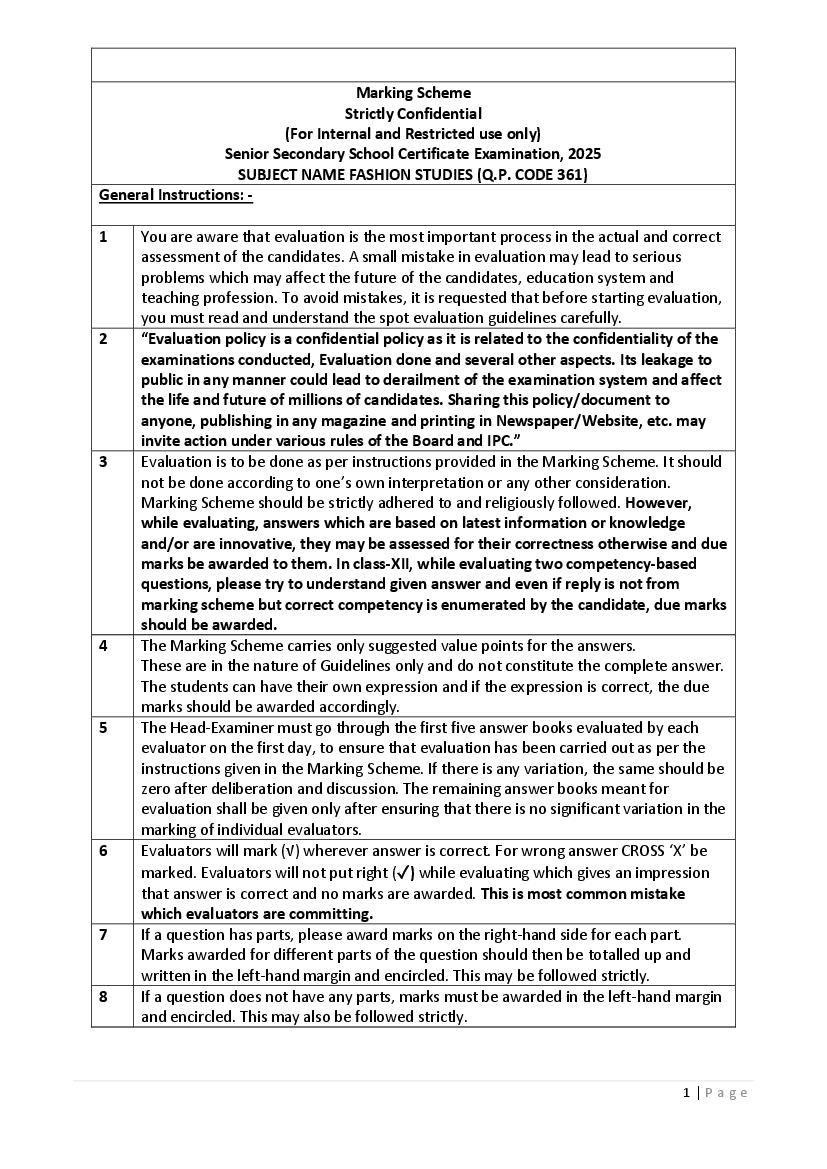
Strictly Confidential
(For Internal and Restricted use only)
Senior Secondary School Certificate Examination, 2025
SUBJECT NAME FASHION STUDIES (Q.P. CODE 361)
General Instructions: -
1 You are aware that evaluation is the most important process in the actual and correct
assessment of the candidates. A small mistake in evaluation may lead to serious
problems which may affect the future of the candidates, education system and
teaching profession. To avoid mistakes, it is requested that before starting evaluation,
you must read and understand the spot evaluation guidelines carefully.
2 “Evaluation policy is a confidential policy as it is related to the confidentiality of the
examinations conducted, Evaluation done and several other aspects. Its leakage to
public in any manner could lead to derailment of the examination system and affect
the life and future of millions of candidates. Sharing this policy/document to
anyone, publishing in any magazine and printing in Newspaper/Website, etc. may
invite action under various rules of the Board and IPC.”
3 Evaluation is to be done as per instructions provided in the Marking Scheme. It should
not be done according to one’s own interpretation or any other consideration.
Marking Scheme should be strictly adhered to and religiously followed. However,
while evaluating, answers which are based on latest information or knowledge
and/or are innovative, they may be assessed for their correctness otherwise and due
marks be awarded to them. In class-XII, while evaluating two competency-based
questions, please try to understand given answer and even if reply is not from
marking scheme but correct competency is enumerated by the candidate, due marks
should be awarded.
4 The Marking Scheme carries only suggested value points for the answers.
These are in the nature of Guidelines only and do not constitute the complete answer.
The students can have their own expression and if the expression is correct, the due
marks should be awarded accordingly.
5 The Head-Examiner must go through the first five answer books evaluated by each
evaluator on the first day, to ensure that evaluation has been carried out as per the
instructions given in the Marking Scheme. If there is any variation, the same should be
zero after deliberation and discussion. The remaining answer books meant for
evaluation shall be given only after ensuring that there is no significant variation in the
marking of individual evaluators.
6 Evaluators will mark (√) wherever answer is correct. For wrong answer CROSS ‘X’ be
marked. Evaluators will not put right (✓) while evaluating which gives an impression
that answer is correct and no marks are awarded. This is most common mistake
which evaluators are committing.
7 If a question has parts, please award marks on the right-hand side for each part.
Marks awarded for different parts of the question should then be totalled up and
written in the left-hand margin and encircled. This may be followed strictly.
8 If a question does not have any parts, marks must be awarded in the left-hand margin
and encircled. This may also be followed strictly.
1|Page
Page 2
marks should be retained and the other answer scored out with a note “Extra
Question”.
10 No marks to be deducted for the cumulative effect of an error. It should be penalized
only once.
11 A full scale of marks __60___(example 0 to 80/70/60/50/40/30 marks as given in
Question Paper) has to be used. Please do not hesitate to award full marks if the
answer deserves it.
12 Every examiner has to necessarily do evaluation work for full working hours i.e., 8
hours every day and evaluate 20 answer books per day in main subjects and 25
answer books per day in other subjects (Details are given in Spot Guidelines).This is in
view of the reduced syllabus and number of questions in question paper.
13 Ensure that you do not make the following common types of errors committed by the
Examiner in the past: -
Leaving answer or part thereof unassessed in an answer book.
Giving more marks for an answer than assigned to it.
Wrong totalling of marks awarded on an answer.
Wrong transfer of marks from the inside pages of the answer book to the title
page.
Wrong question wise totalling on the title page.
Wrong totalling of marks of the two columns on the title page.
Wrong grand total.
Marks in words and figures not tallying/not same.
Wrong transfer of marks from the answer book to online award list.
Answers marked as correct, but marks not awarded. (Ensure that the right tick
mark is correctly and clearly indicated. It should merely be a line. Same is with
the X for incorrect answer.)
Half or a part of answer marked correct and the rest as wrong, but no marks
awarded.
14 While evaluating the answer books if the answer is found to be totally incorrect, it
should be marked as cross (X) and awarded zero (0)Marks.
15 Any unassessed portion, non-carrying over of marks to the title page, or totaling error
detected by the candidate shall damage the prestige of all the personnel engaged in
the evaluation work as also of the Board. Hence, in order to uphold the prestige of all
concerned, it is again reiterated that the instructions be followed meticulously and
judiciously.
16 The Examiners should acquaint themselves with the guidelines given in the
“Guidelines for Spot Evaluation” before starting the actual evaluation.
17 Every Examiner shall also ensure that all the answers are evaluated, marks carried
over to the title page, correctly totalled and written in figures and words.
18 The candidates are entitled to obtain photocopy of the Answer Book on request on
payment of the prescribed processing fee. All Examiners/Additional Head
Examiners/Head Examiners are once again reminded that they must ensure that
evaluation is carried out strictly as per value points for each answer as given in the
Marking Scheme.
2|Page
Page 3
CLASS XII - CBSE 2024-2025
MARKING SCHEME
SECTION A – OBJECTIVE TYPE QUESTIONS
Q.1 Answer any 4 out of the given 6 questions on Employability Skills 41=4
i. QUESTION: Define the term ‘Paragraph’. 1
It’s a series of sentences that are organized and coherent, and are all related to a
single topic./ Group of sentences form a paragraph, having a common idea.
ii. QUESTION: The new biofuel policy was announced by the Govt. of India on which 1
date?
(A) 10th August, 2018
(B) 11th August, 2019
(C) 21st August, 2018
(D) 29th August, 2019
(A) 10th August, 2018
iii. QUESTION: Define the term ‘Cell’. 1
A cell is formed by the intersection of a row and a column. It has a unique address.
iv. QUESTION: List two presentation softwares. ½+½=1
LibreOffice Impress, Microsoft PowerPoint, OpenOffice Impress, Google slides,
Apple Keynote – office softwares. (Any TWO)
v. QUESTION: Define ‘External Motivation’. 1
It occurs when we feel driven by outside forces, performing an activity either to
obtain a reward or to avoid punishment. (Any other relevant answer)
vi. QUESTION: What is ‘Goal-Setting’? 1
It refers to establishing short or long term objectives, usually along with
incorporating deadlines and quantifiable measures to indicate if they have been
achieved. (Any other relevant answer)
Q.2 Answer any 5 out of the given 7 questions : 51=5
i. QUESTION: Which of the following defines the term ‘Mastication’? 1
(A) Scrapping of leather
(B) Chewing of leather
(C) Rubbing of animal fat
(D) Washing of leather
(B) Chewing of leather
3|Page
Page 4
The lengthwise finished edges of a woven fabric. (self-edge of a fabric) (Any other
relevant answer)
iii. QUESTION: What are the characteristics of ‘True-Bias’? 1
Characteristics of true bias are: Maximum stretch, flexibility and elasticity. (Any one)
/It is cut at an angle of 45 degree from lengthwise grain/ selvedge of a fabric, used
for curved/round necklines (Any other relevant answer)
iv. QUESTION: Which tool is used for transferring markings from pattern to the fabric? 1
Tracing wheel/ tailor’s chalk / Tracing paper/Thread tracing (Any ONE)
v. QUESTION: What kind of fabric is used for Test fitting? 1
Unbleached cotton fabric called Muslin/ Malmal/ any plain weave fabric like poplin.
(Any ONE)
vi. QUESTION: Why are trims applied? 1
Trims are applied to add functional and decorative details to a garment/ to make
garment attractive/to increase aesthetic appeal/to increase saleability.
vii. QUESTION: What do you understand by ‘Pret-a-Porter’? 1
Ready to wear garments/ RTW/Off the rack/ Off the peg (Any one)
Q.3 Answer any 6 out of the given 7 questions 6X1=6
i. QUESTION: Define the term ‘Neck-Line-Edge’. 1
Edge/part of the collar that is stitched/attached to the neckline.
ii. QUESTION: What is ‘Heat-Setting’? 1
Moulding of thermoplastic/ manmade synthetic fabrics in interesting designs and
variations using controlled temperature and pressure.
iii. QUESTION: Name two Internationally Famous Indian Designers. 1
Sabyasachi Mukherjee, Manish Malhotra, Rahul Mishra, Ritu Kumar, Rohit Bal, etc.
(Any other relevant answer)
iv. QUESTION: The head size of a small child is ________ of his height. 1
1/5th
v. QUESTION: ________ is the amount of suppression taken between the dart legs. 1
Dart Intake
vi. QUESTION: __________ is the clothing size for short slender woman. 1
Petite
4|Page
Page 5
Vermillion and Crimson Sindoor AND Mangalsutra
Q.4 Answer any 5 out of the given 6 questions : 5X1=5
i. QUESTION: __________ costume are fitted/moulded to the body contours. 1
Sheath costumes
ii. QUESTION: ________ is the oldest pattern making method and is considered to be a 1
creative approach.
Draping method
iii. QUESTION: How is Apex measurement taken? 1
ANSWER: ½ mark if
Apex is the highest point of the bust. It is measured from the CF to the high bust part of
point keeping the tape parallel to the floor. OR answer is
Apex is measured by taking the measurement from shoulder neck point to the apex right
point.
iv. QUESTION: Trendy mini length dresses were created by fashion designer ________. 1
Mary Quant
v. QUESTION: Define ‘Formal-Wear’ for men. 1
It is worn during formal occasions related to the office or for a specific formal
occasion. Men’s suit with tie/ Oxford button down shirt with formal trousers.
vi. QUESTION: Give two examples of Natural fibres. 1
Cotton / Wool / Silk / Linen / Jute, etc. (Any other relevant answer)
Q.5 Answer any 5 out of the given 6 questions : 5X1=5
i. QUESTION: Name the costume-designer of the film ‘Gandhi’. 1
Bhanu Athaiya
ii. QUESTION: Define ‘Slash and Spread’ method. 1
Pattern/sloper is slashed/cut on the desired line and as the old dart or excess is
closed.
iii. QUESTION: ________ collar stands around the neck. 1
Stand collar /Mandarin collar / Chinese collar
iv. QUESTION: In 18th century _________ was named The Minister for Fashion in 1
France.
Rose Bertin
v. QUESTION: The placket is a __________ in a garment section. 1
ANSWER: Finished opening
5|Page
Page 6
fabrics.
Tearing, AND firmly woven fabrics.
Q.6 Answer any 5 out of the given 6 questions : 51=5
i. QUESTION: Why are plackets made in double layers? 1
It is done to give support and strength to placket fabric to bear the stress caused by
fasteners.
ii. QUESTION: _________ shirt for men is half sleeved, loose, airy and made with large 1
floral print in bright coloured cotton fabrics.
Hawaiian Shirt /casual shirt
iii. QUESTION: How will you calculate the length of a continuous placket? 1
Length = Double the length of the finished placket opening + 1 extra.
iv. QUESTION: Define the term ‘Ease’. 1
Ease is the amount of roominess/fullness/comfortable fit/aesthetic fit in a garment.
It is the difference between the measurements of body of wearer and
measurements of the garment.
v. QUESTION: For sleeveless garment, go _________ up on ________ level. ½+½=1
½ “ up on arm-pit level.
vi. QUESTION: Elaborate the term ‘Kaunakes’. 1
Ankle-length, wrap-around, unisex skirt tied at the waist with the excess waistband
hanging loosely at the back forming an animal tail like structure worn by the
Sumerians.
6|Page
Page 7
Answer any 3 out of the given 5 questions on Employability skills : 3X2=6
Q.7 QUESTION: Give any four functions of an entrepreneur. ½ X4=2
Identifying entrepreneurial opportunity (Any four)
Turning ideas into action
Feasibility study
Resourcing
Setting up an enterprise
Managing the enterprise
Growth and development
Boosts morale and leadership skills
Clearly defines objectives and goals
Improves processes and procedures
Improves organizational productivity
Enables better communication
Diminishes misunderstanding and judgements
Cultivates problem solving skills
Incites creativity and innovation
Breaks barriers with the team
Urges self-awareness of one’s own and team’s strength and weaknesses
(ANY FOUR)
Q.8 QUESTION: Write down the steps to print a worksheet. ½ X4=2
Click File Print / Clrt +P
Print dialog box will appear
Select the printer the range to be printed and number of copies
Click the print button
Q.9 QUESTION: Write down the traits of ‘Paranoid’ and ‘anti-social personality disorder’. 1+1=2
Paranoid: Paranoid personality disorder is characterized by distrust for others,
including friends, family members and partners. People with such a disorder mostly
hold grudges against others.
Anti-Social Personality Disorder: People with antisocial personality disorder disregard
social rules and obligations. They are irritating and aggressive, and act impulsively.
They tend to lack guilt and fail to learn from experience. They may lie, steal or abuse,
and may also get addicted to alcohol or drugs.
Q.10 QUESTION: What is meant by ‘Green-Jobs’? Give any two examples of Green Job. 1+½+½=2
Green jobs help protect and restore the environment/ sustainable
development. It promotes the usage of eco-friendly raw materials and
conserves energy.
Two Examples: Energy auditors /Sustainability officer /Solar/wind energy
engineers. (Any other relevant answer)
7|Page
Page 8
Noun, Pronoun, Adjective, Verb, Adverb, Articles, Preposition, Conjunction and
Interjection. (Any two)
Answer any 3 out of the given 5 questions in 20-30 words each 3X2=6
Q.12 QUESTION: Explain two advantages of flat pattern method. 1+1=2
Any two advantages:
(i) Includes ease – allows body to perform variety of normal body movements.
(ii) Logical and easy to understand.
(iii) Brings consistency to both size and fit of mass-produced garments.
(iv) Fastest and most efficient method.
Q.13 QUESTION: What is a General Sizing System? The sizing system for women’s apparel 1+1=2
is based on which measurements?
Sizing systems is a measurement chart by measuring large cross-section of
the population. It is generally developed by the government or
standardization organizations.
Sizing system considers the following measurements for women’s apparel.
Bust measurement for upper garments, hip girth for lower garment and
height.
Q.14 QUESTION: State the role of Fashion Design Council of India. Why was Lakme India 1+1=2
Fashion Week started?
FDCI - provided designers an organized platform for discussion and decision-
making pertaining to the business. It organizes bi-annual Fashion weeks for
ready to wear, Couture Week, Men’s fashion week.
Lakme india Fashion Wek Started in 2000 in Mumbai, provided several
designers with the opportunity to showcase their creations.
Q.15 QUESTION: Explain the term ‘Knock offs’ 2
Knock offs are cheap copies/duplicate copies/replicas/mass-manufactured
garments copied from upmarket brands.
Products produced at low cost and in large quantities to keep per unit cost
low. They are inexpensive for the masses.
Q.16 QUESTION: What are the two factors influencing selection of fabric for interfacing? 1+1=2
It should complement and reinforce the garment fabric without
overpowering it.
Though the two fabrics need not be identical in content, they should have
same care requirements.
8|Page
Page 9
Q.17 QUESTION: What is the criteria for designing clothes for infants and toddlers? 1½+1½=3
Infants:
Their weight, head size (1/5th of height) and age are the major criteria for selecting a
garment. Fabrics like flannel, cottons, jersey knits, polar fleece are selected for
infants, which are very soft in feel so as to provide comfort to the soft, supple and
sensitive skin of the child. Pastel colours with polka dots, cartoon characters, and
nursery prints are preferred. Trims such as Velcro, snap buttons, and ribbon ties are
often used in children garments as they are easy to handle. (Any three)
Toddlers:
At this age the child develops basic motor skills and becomes physically more active.
Looking at their energy and rapidly growing body, the fabrics preferred for their
garments should be easy to maintain. Cambric, poplin, corduroy, denim, jersey knits
in summer and polar fleece in winter are suitable. Bright colour palette for printed
fabrics with stripes, polka dots and popular themes like cartoon characters, as well as
woven gingham checks are very popular for toddler‘s clothing. (Any three)
Q.18 QUESTION: When is a garment considered out of balance? Give three reasons. 1X3=3
When it is cut off-grain
It hangs unevenly
If the line of the garment does not follow the line of the body
Poor posture or lack of symmetry in wearer’s body. (Any three)
Q.19 QUESTION: Briefly explain the three methods of marking on fabrics. 1X3=3
Three Methods of Marking:
Tracing paper and wheel
Using a tracing paper and wheel is a fast method that works best on plain,
opaque fabrics. It is less satisfactory for multi-coloured fabrics, and not
recommended for sheers, marking shows through to the right side. It is
preferred to other methods for its convenience, but the wheel can rip tissue,
thus limiting the reusability of a pattern. While tracing, keep a cardboard
under the fabric to prevent marring of the surface beneath. Use serrated
wheel for most fabrics, smooth wheel for those that are delicate, hard to
mark, or napped. The fabric folded with wrong sides together, so that both
layers can be marked simultaneously using double–faced paper or two
sheets back to back. With fabric right sides together, layers are marked one
at a time. Only dots are registered, but these can be connected, if desired,
after the pattern is removed.
Tailors chalk
Tailor’s chalk is also a quick marking device. For this use ruler and chalk,
regular or wax type. The first tends to rub off easily; the wax type is more
durable, but cannot be removed from some fabrics.
Thread tracing
Thread Tracing is done on fabrics which are delicate and slippery to mark the
seam allowances, grain, dart, centre front, centre back, waist etc. it is to be
done on right side of the fabric. It has an advantage that it does not leave
marks and is very effective for jackets dark colour fabrics
Answer any 3 out of the given 5 questions in 50-80 words each 3X4=12
9|Page
Page 10
spread method? Explain the steps with neat and labelled diagram. 2 marks
ANSWER: for
Take two dart or one dart basic block diagram
Slash the new dart position i.e. the side seam dart. and
Fold and close the waist dart. 2 marks
Trace the new pattern on separate sheet for steps
OR
10 | P a g e
Page 11
women’s wear.
1. Dresses: Variations in dresses may be achieved through manipulation of
waist line (Empire line, low waist, normal waist), silhouette (e.g. shift, flare,
fit and flare, princess) length (e.g. above knee. knee level, below knee, calf
level, ankle level), necklines, sleeves. pockets etc. Empire line dresses,
Princess dresses, shift dresses are some of the examples of dress variations.
These design variations created with these elements will determine the
ultimate fit of the dress.
2. Blouse: Blouses cover the upper half of a women ‘s body. Different styles in
blouses can be achieved through variations in bodice, collar, sleeves and
placket.
3. Skirts: Skirts cover the lower half of a women ‘s body. Different styles of
skirts such as straight, flared, gathered, pleated, tiered, panelled can be
achieved by pattern variations.
4. Trouser: Trousers also called Pants, are bifurcated garments for lower half of
the body. Some styles of trousers are Straight leg, Capri, Bell bottom/ Flared,
riding pants also called Jodhpurs.
5. Kurta Salwar: This is a paired ensemble worn widely in India. The Kurta
covers the upper half of the body and the salwar which is a bifurcated
garment covers the lower half. Some of the variations in kurta styling are
kalidar, kurta with yoke, A- line and straight kurta. Similarly, the Patiala
salwar is a variation of the basic salwar. Kalidar kurta, kurta with yoke, plain
kurta. Basic Salwar, churidar, Patiala salwar.
6. Sari Blouse: Sari blouses are stitched tops worn with saris. There can be
several design and pattern variations of the sari blouse which can be Plain or
choli cut. (Any four)
Q.22 QUESTION: Explain the steps of construction of a bias stip. 1X4=4
1. First, find the true bias of the fabric by folding fabric with lengthwise grain
parallel to the crosswise grain.
2. The fold edge is the true bias cut at 45-degree angle.
3. After locating the true bias, draw the width and the number of strips needed
for the required length and then cut it.
4. If the bias strip is not long enough to complete a continuous sewing step.
Adequate number of strips must be joined before starting to sew bias
binding or facing.
5. Now place the cut out bias strips at right angles, with the right side facing
right side.
6. Stitch bias strips with a ¼ seam allowance at angles. Continue to join bias
strips as needed for the desired length. Press all seams open and snip
extended points. (Any four)
11 | P a g e
Page 12
neat and labelled diagrams. 2 marks
ANSWER: for
Take a one dart skirt sloper, and draw a slash line as illustrated (fig.2). Slash the line diagram
and close a part of the waist dart, so that the ease is shifted to the hem. Add 1” - 1
and
½” on the side seam at hem line for A-line shape in the skirt as illustrated. Blend till
the hip level for both front and back and also blend the hem line. 2 marks
for steps
Q.24 QUESTION: Discuss the costume worn by men and women in ancient Greek 1X4=4
civilization.
Classical Greek costumes were based on two principles:
The first was that a unisex rectangular piece of cloth woven in varying sizes was the
basis of all draped styles, be it a tunic or a cloak.
The second was that this cloth was always draped around the body according to
certain norms but not cut or shaped. There were vast possibilities of drapes that
could arise out of this rectangular fabric is seen in the examples of architectural
draping at different temples.
OR
Greek costume for men-
CHITON: The basic costume was the Chiton, a rectangle of cloth usually wool. It
formed a tunic fastened on the left shoulder leaving the right arm free or on both
shoulders. This could be worn with one or two belts at the waist. Without a belt this
tunic hung loosely and served as a night garment. When lengthened, it became a
12 | P a g e
Page 13
Indian shawl.
HIMATION: Another male garment was the enveloping cloak called Himation made of
a single large (6’ x 9’) piece of cloth, swathed around the body without fixed
fastenings. This cloak was versatile in its draped style:
It could be worn alone, baring the right arm, shoulder and upper chest
It could also wrap the wearer up to the chin covering the arms and the head.
It could be used as a blanket at night.
Greek costume for women-
PEPLOS: Peplos which was essentially a rectangular shawl with a fibula or brooch/
decorative pin on the shoulder and was usually open on one side. This open peplos
was usually not belted at the waist. Greek women also wore the closed peplos by
seaming the two free edges of the fabric together.
(Any four points)
13 | P a g e
Document Details
| Board / Org | CBSE |
| Exam | Class 12 |
| Type | Solution |
| Pages | 13 |
| Updated | 24 Sep 2026 |