Class 11 Sample Paper 2022 Solution Biology Term 2
Finished viewing? Save it for later —
Download Class 11 Sample Paper 2022 Solution Biology Term 2 (PDF · 5 pages)About Class 11 Sample Paper 2022 Solution Biology Term 2
Class 11 Sample Paper 2022 Solution Biology Term 2 is available here for free download. Published by AglaSem for Class 11, this sample paper can be viewed online or downloaded as a PDF (5 pages). Candidates preparing for Class 11 can use Class 11 Sample Paper 2022 Solution Biology Term 2 to understand the exam pattern, the type of questions asked, and the overall difficulty level.
Frequently Asked Questions
How can I download Class 11 Sample Paper 2022 Solution Biology Term 2?
Open this page and click the Download button to save Class 11 Sample Paper 2022 Solution Biology Term 2 as a PDF. It is completely free on AglaSem Docs.
Is Class 11 Sample Paper 2022 Solution Biology Term 2 free to download?
Yes. Class 11 Sample Paper 2022 Solution Biology Term 2 can be viewed online and downloaded as a PDF free of cost on AglaSem Docs.
How many pages does Class 11 Sample Paper 2022 Solution Biology Term 2 have?
Class 11 Sample Paper 2022 Solution Biology Term 2 contains 5 pages, which you can read online or download together as a single PDF.
Where can I find more Class 11 study material?
You can find more Class 11 question papers, sample papers, syllabus, and answer keys on AglaSem Docs.
Class 11 Sample Paper 2022 Solution Biology Term 2 – Text
Read the full text of this sample paper below — useful to quickly search, copy and reference the content online without downloading the PDF.
📄 View text version (5 pages)
Page 1
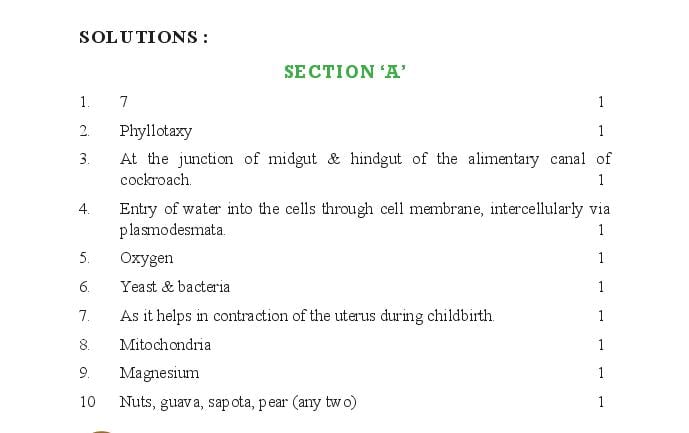
SECTION ‘A’
1. 7 1
2. Phyllotaxy 1
3. At the junction of midgut & hindgut of the alimentary canal of
cockroach. 1
4. Entry of water into the cells through cell membrane, intercellularly via
plasmodesmata. 1
5. Oxygen 1
6. Yeast & bacteria 1
7. As it helps in contraction of the uterus during childbirth. 1
8. Mitochondria 1
9. Magnesium 1
10 Nuts, guava, sapota, pear (any two) 1
Page 2
12. d
13. b
14. b
15. (i) a (ii) b (iii) d (iv) b (v) a (any four) 1+1+1+1
16. (i) a (ii) d (iii) d (iv) d (v) c (any four) 1+1+1+1
SECTION ‘B’
17. (i) Storage/Assimilatory roots (ii) Pneumatophores (iii) Prop roots
(iv) Stilt roots (0.5 marks each).
18. Refer to NCERT Biology class XI page no. 305 fig. 20.2 diagram
0.5 mark; 3 correct labelling. 0.5 mark each
19. (i) (c) (ii) (a) (iii) (b) (iv) (d) 0.5 mark each
20. (a) As Bryophytes can live in soil but are dependent on water for sexual
reproduction. 1
(b) Algal plantbodies do not have a well differentiated body, showing root,
stem or leaf. 1
Or
Refer to NCERT Biology class XI page no. 34 fig. 3.2 (c) diagram 0.5
mark; 3 correct labelling. 1.5 mark
21. As water comes out of the cell, which is exosmosis. This causes a decrease
in the volume of the cell. 1+1
22. (a) Haemocoel; (b) Nephridia; (c) Cnidoblasts; (d) Hermaphrodites
0.5 mark each
23. Ratio of the volume of CO2 evolved to the volume of O2 consumed in
respiration. R.Q. for fats is less than 1. 1+1
24. Ammonia, urea and uric acid. Ammonia is most toxic. 0.5 mark each
25. (a) These tissues are made up of more than one type of cells.
(b) Xylem helps to conduct water and minerals from roots to other parts
of the plant. Phloem helps to transport food from leaves to other parts of
the plants. 1+1
Page 3
26. (a) This is decapitation, which causes removal of APICAL Dominance,
and results in the growth of lateral buds. As auxin from the tip of the shoot
is removed with decapitation.
(b) Plants for which flowering is either quantitatively or qualitatively
dependent on exposure to low temperature. 1+1+1
27.
S.No. Monera Protista
1. It includes unicellular prokaryotes It includes unicellular eukaryotes
2. Membrane bound cell organelles Membrane bound cell organelles
absent present
3. Shows fermentation and aerobic Respiration is aerobic and is
respiration dependent on mitochondria
4. Classified into archaebacteria, Classified into Chrysophytes, Di-
Eubacteria and PPLO noflagellates, Euglenoids, Slime
Example : Nostoc moulds and Protozoans.
Example : Euglena
(b) Lichens 2+1
28. Acoelomates: Body cavity absent e.g, Platyhelminthes.
Pseudocoelomates : No true coelom as mesoderm is scattered in pouches
between ectoderm and endoderm e.g, Aschelminthes.
Coelomates : Have true body cavity, which is lined by mesoderm e.g,
Annelids, Arthropods. for diag. refer to NCERT Biology class XI page
No. 48 fig. 4.3 1+1+1
29. Neutral solutes movement : through passive diffusion, without energy
expenditure. 1
Polar molecules movement, across the membrane is different. It's
Facilitated Diffusion. 1
Which can be through symport, antiport or uniport method. 1
Or
Centromere : Primary constriction in every chromosome. 0.5
Classification : Metacentric : middle centromere; 0.5
Page 4
Acrocentric : centromere situated close to the end of chromosome 0.5
Telocentric : Has terminal centromere 0.5
for diagram refer to NCERT Biology class XI page 139 fig. 8.12 0.5
30.
S.No. Dicot stem Monocot stem
1. It is differentiated into epidermis, There is no such differentiation
cortex, endodermis, pericycle and
stellar system.
2. Hypodermal ring is collenchyma- Hypodermal ring is sclerenchy-
tous matous
3. Vascular bundles are arranged in a Vascular bundles are scattered
ring
4. Open vascular bundle Closed vascular bundle
5. Bundle sheath absent Bundle sheath present
6. Phloem parenchyma is present Phloem parenchyma is absent
Or Write any other appropriate point. 0.5 × 6=3
SECTION ‘D’
31. Meiosis -I Prophase-I 1+1+1+1+1
Leptotene: condensation of chromosomes.
Zygotene: synapsis between homologous chromosomes.
Pachytene : crossing over between non sister chromatids.
Diplotene : dissolution of synaptonemal complex.
Diakinesis : full condensation and terminalization of chiasmata.
Or
Mitosis is equational, as daughter cells receive equal no. of chromosomes,
as were present in the parent cell. Its four phases are – prophase, anaphase,
mataphase and telophase.
For brief description refer to NCERT Biology class XI page no. 164-166 or
points to remember of Cell cycle and cell division of support material.
1+1+1+1+1
Page 5
page no. 263 & 264 or points to remember of Digestion and absorption of
support material.
Or
(i) To prevent backflow of blood in auricles, by the closure of bicuspid
and tricuspid valves. 1.5
(ii) So as to pump the blood further around the body, and against high
pressure, compared with the right ventricle. 1.5
(iii) SA node being self-excitatory, initiate a wave of contraction in the
heart. 2
33. (a) Non cyclic photophosphorylation : Two photosystems are working in
a zigzag way looking like Z shaped, PSII connected to PSI via an electron
transport system. (Z SCHEME). It results in the formation of ATP &
NADPH + H+.
It's non cyclic as electrons are not returning back to PSII, one they reach
PSI. 3
(b) Refer to NCERT Biology class XI page no. 212 2
Or
Description refer to NCERT Biology class XI page no. 218 and diagram
on page no. 219 fig. 13.9. Two examples maize and sorghum or any two
correct examples. 2+2+1
****
Document Details
| Board / Org | Aglasem |
| Exam | Class 11 |
| Type | Solution |
| Pages | 5 |
| Updated | 22 Jul 2026 |