Class 11 Sample Paper 2022 Chemistry Term 2
Finished viewing? Save it for later —
Download Class 11 Sample Paper 2022 Chemistry Term 2 (PDF · 10 pages)About Class 11 Sample Paper 2022 Chemistry Term 2
Class 11 Sample Paper 2022 Chemistry Term 2 is available here for free download. Published by AglaSem for Class 11, this sample paper can be viewed online or downloaded as a PDF (10 pages). Candidates preparing for Class 11 can use Class 11 Sample Paper 2022 Chemistry Term 2 to understand the exam pattern, the type of questions asked, and the overall difficulty level.
Frequently Asked Questions
How can I download Class 11 Sample Paper 2022 Chemistry Term 2?
Open this page and click the Download button to save Class 11 Sample Paper 2022 Chemistry Term 2 as a PDF. It is completely free on AglaSem Docs.
Is Class 11 Sample Paper 2022 Chemistry Term 2 free to download?
Yes. Class 11 Sample Paper 2022 Chemistry Term 2 can be viewed online and downloaded as a PDF free of cost on AglaSem Docs.
How many pages does Class 11 Sample Paper 2022 Chemistry Term 2 have?
Class 11 Sample Paper 2022 Chemistry Term 2 contains 10 pages, which you can read online or download together as a single PDF.
Where can I find more Class 11 study material?
You can find more Class 11 question papers, sample papers, syllabus, and answer keys on AglaSem Docs.
Class 11 Sample Paper 2022 Chemistry Term 2 – Text
Read the full text of this sample paper below — useful to quickly search, copy and reference the content online without downloading the PDF.
📄 View text version (10 pages)
Page 1
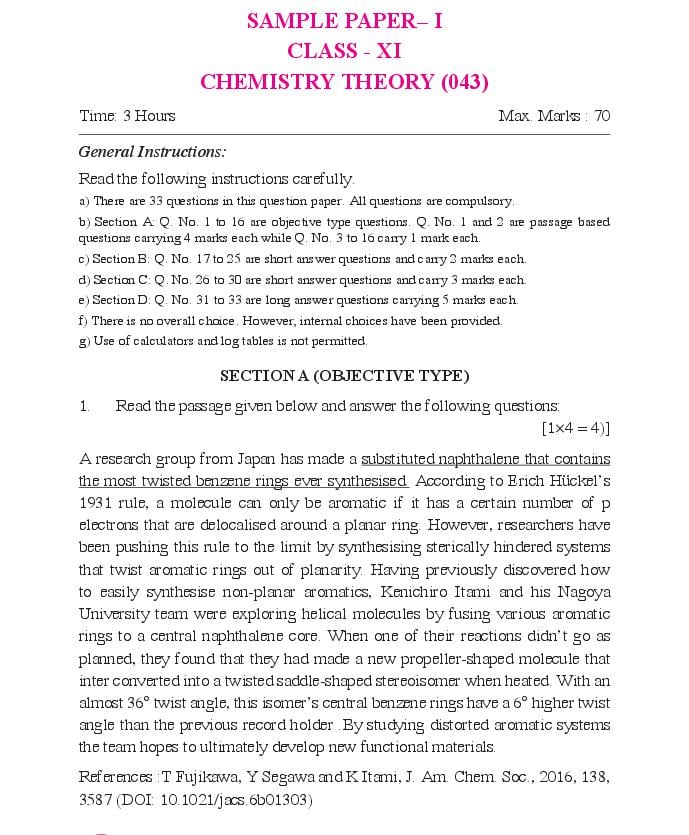
CLASS - XI
CHEMISTRY THEORY (043)
Time: 3 Hours Max. Marks : 70
General Instructions:
Read the following instructions carefully.
a) There are 33 questions in this question paper. All questions are compulsory.
b) Section A: Q. No. 1 to 16 are objective type questions. Q. No. 1 and 2 are passage based
questions carrying 4 marks each while Q. No. 3 to 16 carry 1 mark each.
c) Section B: Q. No. 17 to 25 are short answer questions and carry 2 marks each.
d) Section C: Q. No. 26 to 30 are short answer questions and carry 3 marks each.
e) Section D: Q. No. 31 to 33 are long answer questions carrying 5 marks each.
f) There is no overall choice. However, internal choices have been provided.
g) Use of calculators and log tables is not permitted.
SECTION A (OBJECTIVE TYPE)
1. Read the passage given below and answer the following questions:
[1×4 = 4)]
A research group from Japan has made a substituted naphthalene that contains
the most twisted benzene rings ever synthesised. According to Erich Hückel’s
1931 rule, a molecule can only be aromatic if it has a certain number of p
electrons that are delocalised around a planar ring. However, researchers have
been pushing this rule to the limit by synthesising sterically hindered systems
that twist aromatic rings out of planarity. Having previously discovered how
to easily synthesise non-planar aromatics, Kenichiro Itami and his Nagoya
University team were exploring helical molecules by fusing various aromatic
rings to a central naphthalene core. When one of their reactions didn’t go as
planned, they found that they had made a new propeller-shaped molecule that
inter converted into a twisted saddle-shaped stereoisomer when heated. With an
almost 36° twist angle, this isomer’s central benzene rings have a 6° higher twist
angle than the previous record holder .By studying distorted aromatic systems
the team hopes to ultimately develop new functional materials.
References :T Fujikawa, Y Segawa and K Itami, J. Am. Chem. Soc., 2016, 138,
3587 (DOI: 10.1021/jacs.6b01303)
Page 2
appropriate answer:
(I) Among the following molecule the one which is not aromatic is
A) B) C) D)
(II) Which of the following molecule is Non-Aromatic
A) B) C) D)
OR
Which of the following molecule is Aromatic in nature
A) B) C) D)
(III) Condition not required for the molecule to be aromatic is
A) 4n+2 electrons B) Cyclic
C) Conjugated system D) Planar
(IV) The compound Cyclooctadecanonaene nature is
A) Aromatic B) Anitaromatic
C) Non-Aromatic D) Cannot be predicted
Page 3
(1x4=4)
Ronald J. Gillespie Sir Ronald Sydney Nyholm.
The Valence Shell Electron Pair Repulsion Theory :Sidgwick and Powell in 1940,
proposed a simple theory based on the repulsive interactions of the electron pairs in
the valence shell of the atoms. It was further developed and redefined by Nyholm and
Gillespie( 1957) and they put forward the concept of important difference of lone pair
and the bonding pairs of electrons. While the lone pairs are localized on the central
atom, each bonded pair is shared between two atoms. In the molecule the bond pair,
lone pairs (if any)will occupy such position around the central atom to obtained a
minimum repulsion energy states. These repulsions effects result in deviation from
idealized shapes and alteration in bond angles in molecules
In these questions (Q. No V-VIII , a statement of assertion followed by a
statement of reason is given. Choose the correct answer out of the following
choices.
a) Assertion and reason both are correct statements and reason is correct
explanation for assertion.
b) Assertion and reason both are correct statements but reason is not correct
explanation for assertion.
c) Assertion is correct statement but reason is wrong statement.
d) Assertion is wrong statement but reason is correct statement.
(V) Assertion : The shape of NH3 is pyramidal
Reason : NH3 contain one lone pair and three bond pair.
(VI) Assertion :The XeF4 molecule is tetrahedral in nature
Reason :The XeF4 molecule has F-Xe-F bond angle as 900
(VII) Assertion : The central bond angle in Water is less than that of Methane.
Reason : Water molecule contain Hydrogen bonding but Methane do not.
Page 4
Reason : The XeF 6 molecule has zero lone pair and 6 bond pair.
OR
-
Assertion : The shape of I3 is linear
-
Reason : The lone pairs occupy the equatorial position in I3 .
Following questions (No. 3 -11) are multiple choice questions carrying 1 mark each
3. Which of the following option has incorrect UNIT
S.No PARAMETER UNIT
1 Frequency Hz
2 Wavelength cm-1
3 Energy eV
4 Wave number cm-1
A) Frequency B) Wavelength
C) Energy D) Wave number
4. Which of the following group has +R effect and –I effect
A) –CH3 B) –H
+
C) –NH3 D) –F
OR
Among the following group, the group having highest priority in IUPAC
nomenclature scheme is :
A) –F B) –OCH3
C) –CH3 D) –COOH
5. The correction factor ‘a’ in Vander Waal equation stands for
A) Volume B) Pressure
C) Temperature D) Moles
6. Which of the following molecule has coordinate bond
A) CH4. B) H2O
C) CO2 D) NH4+
Page 5
Which molecule has zero dipole moment?
A) AMMONIA (NH3) B) WATER
C) CO2 D) CHCl3
7. Which of the following form is most stable for Butane
A) Fully Staggered B) Staggered
C) Eclipsed D) Fully Eclipsed
OR
IUPAC name of product formed by oxidation using heated alkaline KMnO4 followed
by acidification of 1,2 Dimethylbenzene is
A) 1,2 DihydroxyBenzene B) 1,2 Diethylbezene
C) Benzene 1,2 Dicarboxylic Acid D) 2-MethylBenzoic Acid
8. Which of the following element has highest electronegativity
A) I B) Br
C) Cl D) F
OR
Which block element forms the Ionic bond type compounds mainly
A) ‘s’ B) ‘p’
C) ‘d’ D) ‘f’
9. Which of the compound is not used to remove permanent hardness
A) Lime B) Na2CO3
C) CALGON D) ZEOLITE
10. Select the incorrect statement for the Benzene structure
A) C-C bond length is 139 pm
B) electron is delocalized above and below the benzene ring
C) All the carbon atom are ‘sp’ hybridised
D) All C-H bond are in the same plane.
11. Which of the following is heavier in weight
A) 2g He B) 22.4 L at STP- He
C) 20 moles H2 D) 10 Moles N2
Page 6
statement of reason is given. Choose the correct answer out of the following
choices.
a) Assertion and reason both are correct statements and reason is correct explanation
for assertion.
b) Assertion and reason both are correct statements but reason is not correct
explanation for assertion.
c) Assertion is correct statement but reason is wrong statement.
d) Assertion is wrong statement but reason is correct statement.
12. Assertion : Benzene is Non-Aromatic compound
Reason : Compound which follows Huckel’s rule are Aromatic in nature
13. Assertion : Boric acid is a weak acid
Reason : It releases its H+ with difficulty.
14. Assertion : NH3 is a Lewis Base
Reason : NH3 molecule is pyramidal in shape.
OR
Assertion: CO molecule can act as poisonous gas
Reason : CO molecule can bind with metal
15. Assertion: Cis-But-2-ene is more polar than Trans-But-2-ene.
Reason :Trans-But-2-ene has higher melting point than Cis-2-But-2-ene.
16. Assertion : CH4 can be prepared by Kolbe’s electrolytic process
Reason : Even number alkane can be prepared in Kolbe’s Electrolytic process
generally.
SECTION-B
The following questions, Q.No. 17 – 25 are short answer type and carry 2 marks
each.
17. Answer the following :
a) Draw the Newman and Sawhorse structure of Butan-2-ol
b) Illustrate with the help of one chemical test how you will distinguish between
ethene and ethane
Page 7
Explain the following :
(i) Kolbe’s Electrolysis
(ii) Wurtz Reaction
18. (i) Arrange the following type of radiations in increasing order of frequency
Radiation from microwave oven, Amber light from traffic signal, Cosmic rays from
outer space, X- Ray, Radiation from FM radio
(ii) How many electrons in an atom of Na (Z=11) have n=2,l=1,ml=0,ms=+1/2
19. Answer the following :
(i) Draw the shape of (a) ClF3 (b) XeF4
(ii) Why He2 does not exist, give reason based on Molecular Orbital Theory
OR
(i)Explain why O2 is paramagnetic on the basis of Molecular Orbital Theory. (ii)Why
H2O is liquid but H2S is gas.
20. The uncertainity in the momentum of a particle is 2.5x10⁻¹⁴ gcms-1, with what
accuracy can its position be determined ? (h=6.25x10⁻²⁷ gcm2s-1)
OR
What will be the wavelength of the emitted radiations when an electron jumps from a
third orbit to a first orbit in a hydrogen atom ? Rydberg constant,R=109677 cm-1.
21. The molar heats of combustions of C2H2(g), C(Graphite) and H2(g) are 310.62kcal,
94.05 kcal and 68.32 kcal respectively. Calculate the standard heat of formation of
C2H2(g).
22. Explain with the help of reactions how the presence of ‘N’ can be detected by
‘Lassaigne’s Test’
23. Balance the following redox reaction by ion-electron or oxidation number method.
- -
MnO4 (aq.) + I (aq.)→ MnO2(s) + I2(s) ( Basic medium)
24. Explain the following reaction with the help of suitable example
A) Hydrogenation of Alkene
B) Dehalogenation Reaction
25. Explain the effect of following on the reaction N2(gas) + 3H2(gas) 2NH3(gas)
(a) Addition of HCl(gas)
(b) Addition of NH3 gas
Page 8
Q.No. 26-30 are Short Answer Type II carrying 3 mark each.
26. Arrange the following :
(a) CaH2,BeH2 and TiH2 in order of increasing electrical conductance
(b) LiH, NaH and CsH in order of increasing ionic character
(c) H-H,D-D and F-F in order of increasing bond dissociation enthalpy.
OR
Arrange the following :
(a) F, Cl, Br, I in order of increasing electronegativity
(b) Al3+, Mg2+, Na+, F- in order of increasing ionic size.
(c) Be, B, C, N , O in order of increasing ionization potential.
27. Arrange the following in increasing order of property specified:
(a) CH2=CH2, CH3CH=CH2, CH3CH=CHCH3 in order of increasing rate of reaction
with HBr.
(b) Cl3CCOOH,Cl2CHCOOH,ClCH2COOH in increasing order of acidic strength.
(c) 1-MethylBenzene, Anisole, Acetophenone increasing rate of Electrophilic
Aromatic chlorination subsitition reaction.
OR
A hydrocarbon ‘A’, adds one mole of hydrogen in presence of Platinum catalyst to
form n-Hexane. When ‘A’ is oxidized vigorously with KMnO4, a single carboxylic
acid containing three carbon atoms is isolated. Give the structure of A and write the
reaction involved.
28. At a certain temperature the equilibrium constant (K) is 16 for the reaction
SO2(g) + NO2(g). SO3(g) + NO(g)
If the container contain 1M concentration of each component initially, then
what is the concentration of SO2 at the equilibrium.
29. Which of the following compound will shows geometrical isomerism. Write the
‘cis’ and ‘trans’ form (if exist) for the compound.
a) Propene b) But-2-ene c) 1, 2 Dichloroethene
Page 9
(a) Magnesium is burnt in air
(b) Quick lime is heated with silica
(c) Calcium Nitrate is heated
SECTION-D
Q.No. 31 to 33 are long answer type carrying 5 marks each.
31. (a) Explain the hybridization in PCl5. Why PCl5 has two types of bond
length. (2+3)
(b) Calcium burns in nitrogen to produce a white powder which dissolves in sufficient
water to produce a gas (A) and an alkaline solution. The solution on exposure to air
produces a thin solid layer of (B) on the surface. Identify the compound ‘A’ and ‘B’
OR
(i) Answer the following questions: (2+3)
(a) Which one BCl3 or TlCl3 is more stable and why ?
(b) Why Zn, Cd & Hg are not referred as transition elements ?
(ii) When a metal ‘X’ is treated with sodium hydroxide, a white precipitate [A] is
obtained, which is soluble in excess of NaOH to give soluble complex [B].Compound
[A] is soluble in dilute HCl to form compound [C]. The compound [A] when heated
strongly gives [D], which is used to extract metal. Identify [X], [A],[B],[C] and [D].
Write suitable equations to support their identities.
32. One mole of a hydrocarbon [A] reacts with 1 mole of bromine giving a dibromo
compound[B], C5H10Br2. Compound [A] on treatment with cold dilute alkaline
KMnO4 solution forms a compound,[C] C5H12O2. On Ozonolysis, [A] gives
equimolar quantities of CH3COCH3- propanone and ethanal –CH3CHO.Deduce the
structure of [A] and write the corresponding reactions. (5)
OR
Give answer of following :
(i) (a) Give the stability order of the following carbocation :
(CH3)3C+, (CH3)2HC+, (CH3) H2C+, CH3+
(b) Out of Benzene, m- Dinitrobenzene ,toluene which will undergoes nitration most
easily and why ? (ii) Explain the Markovnikov Rule with the help of one example and
relevant mechanism.
Page 10
(b)A compound containing sodium ,sulphur,hydrogen and oxygen gave the following
results on analysis : Na= 14.28%, S=9.92 %, H=6.20%. Calculate the molecular
formula of the anhydrous compound. If Hydrogen and Oxygen are present in the form
of water of crystallization only, what is the structure of the crystalline salt ?(Molecular
Weight of Crystalline Salt =322) (1+4)
OR
(a) Define Enthalpy of formation with one example.
(b) Calculate the C-C bond energy from the following data :
2C(Graphite) + 3H2(g)→C2H6(g), ΔH= -84.67kJ ------equation-1
C(Graphite)→C(gas), ΔH=716.7 kJ -------equation-2
H2(gas)→2H(gas), ΔH= 435.9 kJ ---------equation-3
Assume C-H bond energy is 416 kJ (1+4)
ANSWER
1. I-D,II-C Or C III-D IV-A
2. V-A,VI-D, VII-B,VIII-C Or A
3. B
4. D or D
5. B
6. D or C
7. A or C
8. D or A
9. A
10. C
11. D
12. D
Document Details
| Board / Org | Aglasem |
| Exam | Class 11 |
| Type | Sample Paper |
| Pages | 10 |
| Updated | 22 Jul 2026 |