Class 11 Sample Paper 2022 Biology Term 2
Finished viewing? Save it for later —
Download Class 11 Sample Paper 2022 Biology Term 2 (PDF · 8 pages)About Class 11 Sample Paper 2022 Biology Term 2
Class 11 Sample Paper 2022 Biology Term 2 is available here for free download. Published by AglaSem for Class 11, this sample paper can be viewed online or downloaded as a PDF (8 pages). Candidates preparing for Class 11 can use Class 11 Sample Paper 2022 Biology Term 2 to understand the exam pattern, the type of questions asked, and the overall difficulty level.
Frequently Asked Questions
How can I download Class 11 Sample Paper 2022 Biology Term 2?
Open this page and click the Download button to save Class 11 Sample Paper 2022 Biology Term 2 as a PDF. It is completely free on AglaSem Docs.
Is Class 11 Sample Paper 2022 Biology Term 2 free to download?
Yes. Class 11 Sample Paper 2022 Biology Term 2 can be viewed online and downloaded as a PDF free of cost on AglaSem Docs.
How many pages does Class 11 Sample Paper 2022 Biology Term 2 have?
Class 11 Sample Paper 2022 Biology Term 2 contains 8 pages, which you can read online or download together as a single PDF.
Where can I find more Class 11 study material?
You can find more Class 11 question papers, sample papers, syllabus, and answer keys on AglaSem Docs.
Class 11 Sample Paper 2022 Biology Term 2 – Text
Read the full text of this sample paper below — useful to quickly search, copy and reference the content online without downloading the PDF.
📄 View text version (8 pages)
Page 1
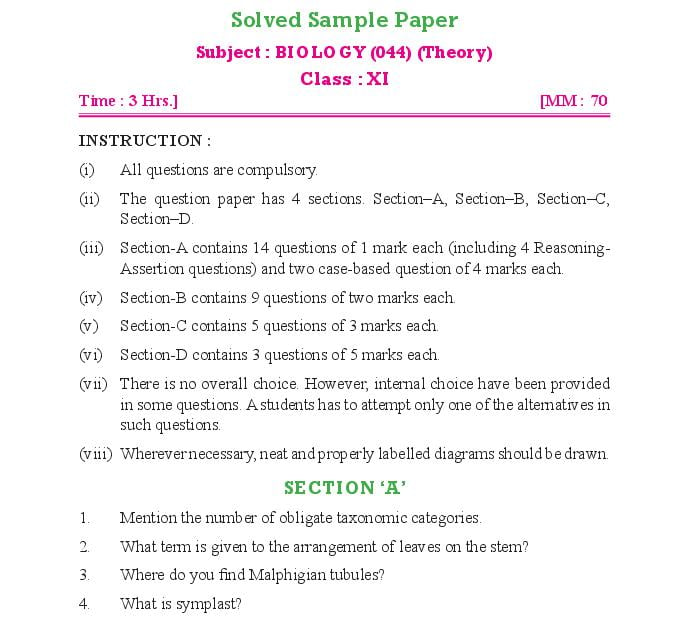
Subject : BIOLOGY (044) (Theory)
Class : XI
Time : 3 Hrs.] [MM : 70
INSTRUCTION :
(i) All questions are compulsory.
(ii) The question paper has 4 sections. Section–A, Section–B, Section–C,
Section–D.
(iii) Section-A contains 14 questions of 1 mark each (including 4 Reasoning-
Assertion questions) and two case-based question of 4 marks each.
(iv) Section-B contains 9 questions of two marks each.
(v) Section-C contains 5 questions of 3 marks each.
(vi) Section-D contains 3 questions of 5 marks each.
(vii) There is no overall choice. However, internal choice have been provided
in some questions. A students has to attempt only one of the alternatives in
such questions.
(viii) Wherever necessary, neat and properly labelled diagrams should be drawn.
SECTION ‘A’
1. Mention the number of obligate taxonomic categories.
2. What term is given to the arrangement of leaves on the stem?
3. Where do you find Malphigian tubules?
4. What is symplast?
Page 2
respiration.
6. Give two examples of anaerobes.
7. Why is Oxytocin called "birth hormone"?
8. In which organelle does Kreb's cycle occur n the living cells?
9. Name the mineral element that forms the core constituent of the ring
structure of chlorophyll.
10. Give two examples of fruits having sclereids.
11. Assertion : In Lily flower, Perianth is a term used when calyx and corolla
are not distinct.
Reason : Calyx and Corolla are the reproductive parts of a flower.
(a) Both assertion & reason are true, and the reason is the correct
explanation of the assertion.
(b) Both assertion and reason are true, but the reason is not the correct
explanation of the assertion.
(c) Assertion is true but reason is false.
(d) Both the assertion & reason are false.
12. Assertion : Tendons attach one bone to another bone.
Reason : Ligaments attach skeletal muscles to bones.
(a) Both assertion & reason are true, and the reason is the correct
explanation of the assertion.
(b) Both assertion and reason are true, but the reason is not the correct
explanation of the assertion.
(c) Assertion is true but reason is false.
(d) Both the assertion & reason are false.
13. Assertion : Metabolism refers to the sum total of chemical reactions,
(catabolism + anabolism) that occur within living organisms.
Reason : Metabolic reactions occur simultaneously inside living
organisms.
(a) Both assertion & reason are true, and the reason is the correct
explanation of the assertion.
Page 3
explanation of the assertion.
(c) Assertion is true but reason is false.
(d) Both the assertion & reason are false.
14. Assertion : The enzyme Nitrogenase is a Mo-Fe protein and catalyses the
conversion of atmospheric nitrogen into ammonia.
Reason : The enzyme nitrogenase is highly sensitive to the molecular
oxygen.
(a) Both assertion & reason are true, and the reason is the correct
explanation of the assertion.
(b) Both assertion and reason are true, but the reason is not the correct
explanation of the assertion.
(c) Assertion is true but reason is false.
(d) Both the assertion & reason are false.
15. Read the following and answer any four questions from 15 (i) to 15 (v)
given below :
Lipids are water insoluble. They could be simple fatty acids, which has
a carboxyl group attached to a 'R' group. Fatty acids could be saturated
(having only single bonds) or unsaturated (with one or more double or
triple bonds). Another simple lipid is Glycerol, which is Trihydroxy
propane. Simple lipids are made up of both Glycerol and Fatty acids, in
which three molecules of fatty acids are esterified with one molecule of
glycerol (Triglycerides). They are also called Fats and oils depending upon
their melting point. Oils have lower melting points which depend upon the
chain length and degree of unsaturation. Fatty acids could be essential or
non-essential. Fatty acids like alpha-linolenic acid (Omega-3 fatty acid)
and Linolenic acid (Omega-6 fatty acid), which our body requires for
good health but cannot be prepared by it and must be taken from diet are
called essential Fatty acids.
(i) Triglycerides are formed by joining of :
(a) One Glycerol and three fatty acids through ester bonds.
(b) Three Glycerol and one fatty acid through peptide bonds.
Page 4
(d) Three Glycerol and one fatty acid through phosphodiester
bonds.
(ii) The melting point of fatty acids depends upon chain length and_____
(a) Shape of fatty acids
(b) Degree of unsaturation
(c) Charge on alpha carbon
(d) All the three
(iii) Find the incorrect statement about the biological functions of lipids:
(a) Storage form of fuel
(b) Acts as carrier for absorption of fat soluble vitamins
(c) Structural component of membranes
(d) Exhibit catalytic activity
(iv) Liquid form of triglycerides at ordinary temperature is called :
(a) Solids
(b) Oils
(c) Fats
(d) None of these
(v) Assertion : Omega-3 fatty acid comes under the category of essential
fatty acid.
Reason : This is because our body requires them but cannot
synthesise them for good health. They need to be taken in the form of our
diet.
16. Read the following and answer any four questions from 16 (i) to 16 (v)
given below :
Eyes are the organs of sight. They are located in sockets of skull called
orbits. They are covered by three walls layers. External layer is called
Sclera, it anterior portion forms cornea. Middle layer is choroid, in the
anterior part it becomes thick to form a ciliary body. Ciliary body continues
Page 5
crystalline biconvex lens, which is held in place by the ligaments of the
ciliary body. In front of the lens, the aperture surrounded by the iris is
called pupil. The diameter of the pupil is regulated by the muscles of iris.
The innermost layer is the retina which contains ganglion cells, bipolar
cells and photoreceptor cells. There are two types of photoreceptors,
namely rods and cones.
(i) The transparent lens in the human eye held in its place by :
(a) Ligaments attached to the ciliary body
(b) Ligaments of iris
(c) Smooth muscles of iris
(d) Smooth muscles of ciliary body
(ii) Coloured portion of eye which decides our eye colour and controls
the amount of light reaching the retina is called :
(a) Cornea
(b) Pupil
(c) Retina
(d) Iris
(iii) The eye lens is :
(a) Concave
(b) Convex
(c) Biconcave
(d) Biconved
(iv) The innermost and the most delicate layer of the eyeball where the
photoreceptors are located is :
(a) Choroid
(b) Sclera
(c) Cornea
(d) Retina
Page 6
(a) It consists of enucleated cells
(b) It is a non-living layer
(c) It has no blood supply
(d) Its cells are least penetrable by bacteria
SECTION ‘B’
17. Identify and name the following types of root modifications :
(i) Roots performing the function of photosynthesis
(ii) Roots come above the surface of the soil to absorb air
(iii) The pillar-like roots developed from lateral branches for providing
mechanical support
(iv) Roots coming out of the lower nodes of the stem and provide support
to the plant.
18. Draw a well labelled diagram of a sarcomere.
19. Match the following :
Column – I Column–II
(i) Pineal gland (a) regulates metabolism
(ii) 3 Hormone (b) regulates skin colour
(iii) MSH (c) regulates diurnal (24 hours) rhythm
(iv) Insulin (d) regulates blood sugar level
20. (a) Why are bryophytes called amphibians of the plant kingdom?
(b) Why is the plant body of an alga called a thallus?
Or
Draw a well labelled diagram of sporophyte and gametophyte of Funaria.
21. Why do plant cells get plasmolysed when placed in hypertonic solution?
22. Give one word scientific term for the following :
(a) Blood filled cavity in Arthropods
(b) Excretory organs of an annelid
Page 7
(d) Individual animals bearing organs of both sexes.
23. Define R.Q? What is its value for fats?
24. Name the three common nitrogenous waste materials in vertebrates.
Which of these is the most toxic?
25. (a) Why are xylem and phloem called complex tissues?
(b) Distinguish between xylem and phloem on the basis of their function.
SECTION ‘C’
26. (a) In botanical gardens and tea gardens, gardeners trim the plants
regularly so that they remain bushy. Does this practice have any
scientific explanation?
(b) Define Vernalization?
27. (a) Tabulate four major differences between Monera and Protista.
(b) Name a composite organism, which is a pollution indicator and
made up of an algal and a fungal component.
28. Describe the three types of coelom found in various living organisms with
the help of well labelled diagrams. Also mention one example of each
category.
29. How do neutral solutes move across the plasma membrane? Can the polar
molecules also move across it in the same way? If not, then how are these
transported across the membrane.
Or
What is a centromere? How the position of the centromere forms the basis
of classification of chromosomes. Support your answer with a diagram
showing the position of centromere on the different types of chromosomes.
30. Tabulate six differences between dicot stem and monocot stem.
SECTION ‘D’
31. Explain the five phases of Prophase – I of Meiosis–I.
Or
Why mitosis is called equational division? Give a short account of its four
Page 8
canal.
Or
Give reason for the following :
(a) There is a slight gap between auricular systole and ventricular
systole.
(b) Left ventricle has a thicker wall than right ventricle
(c) SA node is a called a pacemaker of the heart.
33. (a) Explain non-cyclic photophosphorylation. Why is it called so?
(b) Give two difference between cyclic and non-cyclic
photophosphorylation.
Or
Describe the C4 pathway with the help of a suitable diagram. Give two
examples of plants showing this cycle.
Document Details
| Board / Org | AglaSem |
| Exam | Class 11 |
| Type | Sample Paper |
| Pages | 8 |
| Updated | 22 Jul 2026 |