CBSE Class 12 Question Paper 2025 Solution Food Production
Finished viewing? Save it for later —
Download CBSE Class 12 Question Paper 2025 Solution Food Production (PDF · 11 pages)About CBSE Class 12 Question Paper 2025 Solution Food Production
CBSE Class 12 Question Paper 2025 Solution Food Production is available here for free download. Published by CBSE for Class 12, this solution can be viewed online or downloaded as a PDF (11 pages). Candidates preparing for Class 12 can use CBSE Class 12 Question Paper 2025 Solution Food Production to understand the exam pattern, the type of questions asked, and the overall difficulty level.
Frequently Asked Questions
How can I download CBSE Class 12 Question Paper 2025 Solution Food Production?
Open this page and click the Download button to save CBSE Class 12 Question Paper 2025 Solution Food Production as a PDF. It is completely free on AglaSem Docs.
Is CBSE Class 12 Question Paper 2025 Solution Food Production free to download?
Yes. CBSE Class 12 Question Paper 2025 Solution Food Production can be viewed online and downloaded as a PDF free of cost on AglaSem Docs.
How many pages does CBSE Class 12 Question Paper 2025 Solution Food Production have?
CBSE Class 12 Question Paper 2025 Solution Food Production contains 11 pages, which you can read online or download together as a single PDF.
Where can I find more Class 12 study material?
You can find more Class 12 question papers, sample papers, syllabus, and answer keys on AglaSem Docs.
CBSE Class 12 Question Paper 2025 Solution Food Production – Text
Read the full text of this solution below — useful to quickly search, copy and reference the content online without downloading the PDF.
📄 View text version (11 pages)
Page 1
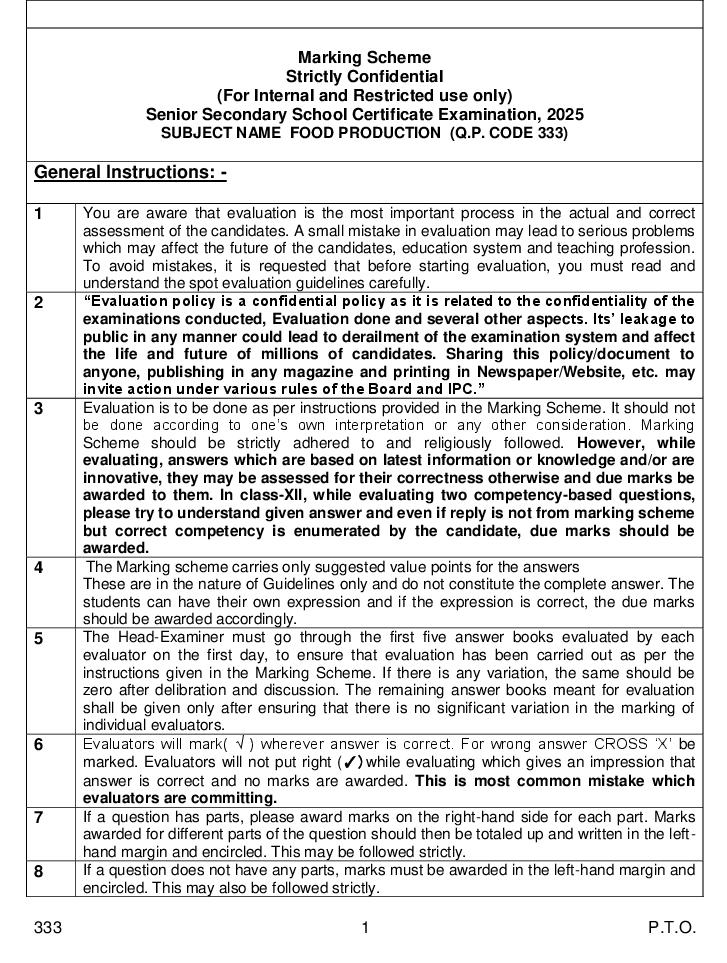
Strictly Confidential
(For Internal and Restricted use only)
Senior Secondary School Certificate Examination, 2025
SUBJECT NAME FOOD PRODUCTION (Q.P. CODE 333)
General Instructions: -
1 You are aware that evaluation is the most important process in the actual and correct
assessment of the candidates. A small mistake in evaluation may lead to serious problems
which may affect the future of the candidates, education system and teaching profession.
To avoid mistakes, it is requested that before starting evaluation, you must read and
understand the spot evaluation guidelines carefully.
2 “Evaluation policy is a confidential policy as it is related to the confidentiality of the
examinations conducted, Evaluation done and several other aspects. Its’ leakage to
public in any manner could lead to derailment of the examination system and affect
the life and future of millions of candidates. Sharing this policy/document to
anyone, publishing in any magazine and printing in Newspaper/Website, etc. may
invite action under various rules of the Board and IPC.”
3 Evaluation is to be done as per instructions provided in the Marking Scheme. It should not
be done according to one’s own interpretation or any other consideration. Marking
Scheme should be strictly adhered to and religiously followed. However, while
evaluating, answers which are based on latest information or knowledge and/or are
innovative, they may be assessed for their correctness otherwise and due marks be
awarded to them. In class-XII, while evaluating two competency-based questions,
please try to understand given answer and even if reply is not from marking scheme
but correct competency is enumerated by the candidate, due marks should be
awarded.
4 The Marking scheme carries only suggested value points for the answers
These are in the nature of Guidelines only and do not constitute the complete answer. The
students can have their own expression and if the expression is correct, the due marks
should be awarded accordingly.
5 The Head-Examiner must go through the first five answer books evaluated by each
evaluator on the first day, to ensure that evaluation has been carried out as per the
instructions given in the Marking Scheme. If there is any variation, the same should be
zero after delibration and discussion. The remaining answer books meant for evaluation
shall be given only after ensuring that there is no significant variation in the marking of
individual evaluators.
6 Evaluators will mark( √ ) wherever answer is correct. For wrong answer CROSS ‘X’ be
marked. Evaluators will not put right (✓)while evaluating which gives an impression that
answer is correct and no marks are awarded. This is most common mistake which
evaluators are committing.
7 If a question has parts, please award marks on the right-hand side for each part. Marks
awarded for different parts of the question should then be totaled up and written in the left-
hand margin and encircled. This may be followed strictly.
8 If a question does not have any parts, marks must be awarded in the left-hand margin and
encircled. This may also be followed strictly.
333 1 P.T.O.
Page 2
marks should be retained and the other answer scored out with a note “Extra Question”.
10 No marks to be deducted for the cumulative effect of an error. It should be penalized only
once.
11 A full scale of marks __________(example 0 to 80/70/60/50/40/30 marks as given in
Question Paper) has to be used. Please do not hesitate to award full marks if the answer
deserves it.
12 Every examiner has to necessarily do evaluation work for full working hours i.e., 8 hours
every day and evaluate 20 answer books per day in main subjects and 25 answer books
per day in other subjects (Details are given in Spot Guidelines).This is in view of the
reduced syllabus and number of questions in question paper.
13 Ensure that you do not make the following common types of errors committed by the
Examiner in the past:-
● Leaving answer or part thereof unassessed in an answer book.
● Giving more marks for an answer than assigned to it.
● Wrong totaling of marks awarded on an answer.
● Wrong transfer of marks from the inside pages of the answer book to the title page.
● Wrong question wise totaling on the title page.
● Wrong totaling of marks of the two columns on the title page.
● Wrong grand total.
● Marks in words and figures not tallying/not same.
● Wrong transfer of marks from the answer book to online award list.
● Answers marked as correct, but marks not awarded. (Ensure that the right tick mark
is correctly and clearly indicated. It should merely be a line. Same is with the X for
incorrect answer.)
● Half or a part of answer marked correct and the rest as wrong, but no marks awarded.
14 While evaluating the answer books if the answer is found to be totally incorrect, it should
be marked as cross (X) and awarded zero (0)Marks.
15 Any unassessed portion, non-carrying over of marks to the title page, or totaling error
detected by the candidate shall damage the prestige of all the personnel engaged in the
evaluation work as also of the Board. Hence, in order to uphold the prestige of all
concerned, it is again reiterated that the instructions be followed meticulously and
judiciously.
16 The Examiners should acquaint themselves with the guidelines given in the “Guidelines
for Spot Evaluation” before starting the actual evaluation.
17 Every Examiner shall also ensure that all the answers are evaluated, marks carried over to
the title page, correctly totaled and written in figures and words.
18 The candidates are entitled to obtain photocopy of the Answer Book on request on
payment of the prescribed processing fee. All Examiners/Additional Head Examiners/Head
Examiners are once again reminded that they must ensure that evaluation is carried out
strictly as per value points for each answer as given in the Marking Scheme.
333 2
Page 3
$
MARKING SCHEME
FOOD PRODUCTION
SECTION A
OBJECTIVE TYPE QUESTIONS
1. Answer any 4 out of the given 6 questions on Employability Skills. 41=4
(i) (C) Tune 1
(ii) (D) OCPD (obsessive-compulsive personality disorder) 1
(iii) (A) Cell 1
(iv) (B) open-minded 1
(v) (C) Krishi Vigyan Kendras 1
(vi) (A) Timely 1
2. Answer any 5 out of the given 7 questions. 5×1=5
(i) (D) Boiled onion paste 1
(ii) (C) Andhra Pradesh 1
(iii) (A) Avial 1
(iv) (B) Convenience products 1
(v) (D) Granulated sugar 1
(vi) (A) 1-(ii), 2-(iv), 3-(iii), 4-(i) 1
(vii) (C) Soup, starter, main course, dessert 1
3. Answer any 6 out of the given 7 questions. 6×1=6
(i) (B) Upma 1
(ii) (D) Breakfast 1
333 3 P.T.O.
Page 4
(iv) (A) Brown gravy 1
(v) (B) Ker 1
(vi) (D) Including saturated fats 1
(vii) (C) Leave Travel Concession 1
4. Answer any 5 out of the given 6 questions. 5×1=5
(i) (A) Bhakarwadi 1
(ii) (B) Direct material cost 1
(iii) (D) Water 1
(iv) (A) Farsan 1
(v) (C) Apricot 1
(vi) (C) Lactose 1
5. Answer any 5 out of the given 6 questions. 5×1=5
(i) (B) Dabeli 1
(ii) (B) 20 minutes 1
(iii) (A) Himachal Pradesh 1
(iv) (D) Ada 1
(v) (C) Portion size of accompaniments can be ignored. 1
(vi) (B) Mustard seeds 1
6. Answer any 5 out of the given 6 questions. 5×1=5
(i) (A) Udipi Vada 1
(ii) (D) Thermopolium 1
(iii) (B) Amti 1
(iv) (A) Tin 1
(v) (D) Almonds 1
(vi) (C) 1-(ii), 2-(iii), 3-(iv), 4-(i) 1
333 4
Page 5
SUBJECTIVE TYPE QUESTIONS
Answer any 3 out of the given 5 questions on Employability Skills. Answer each
question in 20 – 30 words. 32=6
4=2
1
7. The various factors that affect active listening are as follows :
2
(i) Eye contact
(ii) Gestures
(iii) Avoiding distractions
(iv) Giving feedback
8. (i) Practising yoga, meditation and deep breathing exercises help
improve blood circulation and relax the body. 12=2
(ii) Taking a walk or playing in the part helps one to get lot of fresh
air, which helps in becoming more active.
9. A worksheet is a collection of cells in the form of a grid (a network of
lines that intersect each other). A workbook is a spreadsheet that has
one or more worksheets. 12=2
4=2
1
10. Characteristics of entrepreneurship :
2
(i) It is an economic activity done to create, develop and maintain a
profit oriented organisation.
(ii) It begins with identifying an opportunity as a potential to sell and
make profit in the market.
(iii) It deals with optimisation in utilisation of resources.
(iv) It is the ability of an enterprise and an entrepreneur to take risks.
4=2
1
11. Four benefits of green jobs :
2
(i) Limiting greenhouse gas emissions
(ii) Minimising waste and pollution
(iii) Protecting and restoring ecosystems
(iv) Preventing hazardous climate change
333 5 P.T.O.
Page 6
12. Khaman – It is prepared with a fermented batter of grain flour with
spices and steamed. It may be tempered and soaked in lemon sugar
syrup. It is fluffier than dhokla. 12=2
Dhokla – It is made with a fermented batter of rice and split chickpeas
and is steamed. It is denser than khaman.
13. Base of Kadhai gravy – Chopped onions and tomatoes. 11=1
2=1
1
Two case points while making brown gravy –
2
(i) Add sauteed chunks of onion and capsicum near serving time to
let them remain slightly crisp.
(ii) Tomatoes used for preparation of gravy should be red and not too
sour.
14. (a) Bhapa doi – Baked yogurt is a hung curd blended with milk and
condensed milk and baked with a water bath in the oven or
steamed on the stove top. It is an important part of sweet dish is
the Bengali weddings and special occasions. 12=2
(b) Patishapta – It is a traditional Bengali sweet which is made with
thin pancakes made out of refined flour/rice flour or semolina. A
mixture of grated coconut, khoya and jaggery is then filled in the
pancakes and rolled into cylindrical shape.
15. A fined menu offers the same dishes everyday and this is usually
adopted in the restaurants and other establishments where the
customers keep changing and the dishes in the menu offer different
variety. 12=2
Cyclic menu is the type of menu where the dishes are repeated
periodically for each week/month. Generally all hostel menus, Railway
catering are of this type.
16. Cross contamination is the transfer of bacteria from contaminated
source to an uncontaminated food. 1
2=1
1
Two ways –
2
(i) Hands
333 6
Page 7
equipment
(iii) droplets of moisture during sneezing and coughing
(iv) drops of liquid from contaminated food
(Any two)
Answer any 2 out of the given 3 questions in 30 – 50 words each. 23=6
3=1
1 1
17. Three advantages of cost accounting :
2 2
(i) Cost determination – Cost accounting helps in identifying all
expenses incurred to produce a product and determination of total
cost of production.
(ii) Helping is cost reduction – The application of various cost
accounting techniques helps in achieving the objective of
organization to reduce cost.
(iii) Determination of selling price – Cost accounting is quite useful for
price fixation.
(iv) Cost comparison – Cost comparison helps in cost control.
Comparisons can be made in respect of costs of jobs, processes or
cost centres. (Any three)
3=1
1 1
Importance of cost accounting :
2 2
(i) Control of direct and indirect cost
(ii) Measuring efficiency and fixing responsibility
(iii) Budgeting
(iv) Price determination
(v) Curtailment of loss during the off season
(vi) Expansion
(vii) Arriving at derisions (Any three)
3=1
1 1
18. Three major ingredients :
2 2
(i) Cash crop – teak, cotton, jute
(ii) Assam famous for tea plantation
(iii) Fish – Mest fish is from river Brahmputra
(iv) Bamboo shoots
(v) Betel nut – Popularly exported
333 7 P.T.O.
Page 8
(vii) Rice – A large variety of rice is grown
(viii) Fruits – Orange, pineapple, papaya, apple, jackfruit, litchis,
banana
(Any three)
3=1
1 1
Three dishes from North Eastern States :
2 2
(i) Khar – The main ingredient of this unique dish are raw papaya
and pulses. Pork is added that has a crisp outer and soft inside.
Bamboo shoots are also added. It is eaten with steamed rice.
(ii) Pitha – A snack that is eaten sweet for breakfast and satted ones
are coated in light butter and tea. Rice mixed with light spices
and salt/sugar is moulded into thin tubes and stuffed inside a
hollow stem of bamboo. It is then fried/roasted/barbequed inside
the hollow bamboo stem and this gives the pitha an exotic flavor.
(iii) Sanipau – It is a traditional snack which is prepared with rice
porridge which is served with freshly pasted coriander leaves,
spring onions, crushed black pepper, finely powdered rice and
zesty fish sauce.
6=3
1
19. Six precautions for proper disposal :
2
(i) Waste water should be drained off immediately.
(ii) All the water from the wash up area have a separate drainpipe as
most of the fat and oil goes out of the kitchen from that pipe.
(iii) Choking of drains should be monitored frequently.
(iv) Hot water helps in draining off extra fat or oil in the pipe.
(v) Open drains in the kitchen should have stainless steel grill cover
to restrict large pieces of food to go in the drain pipe.
(vi) All the sinks fitted in the kitchen or washup areas should have a
mesh to restrict pieces of food, vegetable, meat and other foreign
material from going into the drain.
333 8
Page 9
20. Advantages Disadvantages 14=4
1. Reduce meat time 1. Cooking time is sometimes
preparation increased for thawing or baking
2. No need to plan, buy or store 2. Lack of freshness vegetables
ingredients separately and fruits
3. Less wastage 3. Typically high in calories fats,
saturated fats, sugar and salt
4. Cost efficient for mass 4. Cost per serving may be
production and preparation higher than home made
5. Faster presentation and 5. Harder to control fat, salt and
easier cleanup sugar levels
(Any four)
4=2
1
21. Factors contribute to soft cookies :
2
(i) High proportion of liquid in the mix.
(ii) Low sugar and fat.
(iii) Honey molasses or coin syrup included in the formulas.
(iv) Under baking
(v) Large size or thick shape, so they retain moisture.
(vi) Proper storage. (Any four)
4=2
1
Factors contribute to crispy cookies :
2
(i) Low proportion of liquid in the mix.
(ii) High sugar and fat content.
(iii) Baking long enough to evaporate moisture.
(iv) Small size or thin shape, so the cookies dries.
(v) Proper storage (Any four)
22. Four points to be kept in mind while planning menu : 14=4
1. Type : (a) Asser the type of meal required
(b) Asser the type of kitchen and cooks required
(c) Asses the type of restaurant and its capacity
2. Supplies : (a) Seasonal Supplies
333 9 P.T.O.
Page 10
3. Balance : (a) Light dishes to heavy dishes
(b) Vary the seasoning, flavouring and presentation
4. Food value : Use such methods of cooking that will preserve the
natural nutritive property in row material.
5. Language : (a) Choose a language which is clearly understood.
(b) Proper spellings of the dish
6. Meal Time : (a) The time when meal is served.
(b) Breakfast should be more nutritive and energy
giving.
(Any four)
23. (a) Dal Amritsari – Split black gram and chana dal cooked together
and tempered. 12=2
Dal Makhani – Whole black gram dal is cooked with onion,
tomato puree and spices to a creamy texture.
(b) Kakori kebab – It is made from lamb meat clear of any sinews,
minced with fat and kidney, seasoned with numerous spices and
skewered and cooked on coal. 12=2
Murar ke kebab – The lotus stem is cleaned, boiled and roasted. It
is mixed with other vegetables, spices etc. shaped as kebabs and
shallow or deep fried.
24.
Total Material Cost OR Food Cost:
Opening Stock: - Rs. 2500
Add: Fresh indents/purchase: Rs.15000
Rs. 17500
Less: Closing stock: Rs. 1500
Rs. 16000
Less:
Food consumed by staff Rs. 800
Rs. 15200
333 10
Page 11
Food served to guests Rs. 500
Rs. 14700
Hence, Total material or food cost= Rs. 14700
Material (Food Cost) percentage to net sales= Total Material Cost X 100
Total Sale
= 14700 X 100
70,000
=21 %
333 11 P.T.O.
Document Details
| Board / Org | CBSE |
| Exam | Class 12 |
| Type | Solution |
| Pages | 11 |
| Updated | 24 Sep 2026 |