CBSE Class 12 Question Paper 2025 Solution Food Nutrition and Dietetics
Finished viewing? Save it for later —
Download CBSE Class 12 Question Paper 2025 Solution Food Nutrition and Dietetics (PDF · 12 pages)About CBSE Class 12 Question Paper 2025 Solution Food Nutrition and Dietetics
CBSE Class 12 Question Paper 2025 Solution Food Nutrition and Dietetics is available here for free download. Published by CBSE for Class 12, this solution can be viewed online or downloaded as a PDF (12 pages). Candidates preparing for Class 12 can use CBSE Class 12 Question Paper 2025 Solution Food Nutrition and Dietetics to understand the exam pattern, the type of questions asked, and the overall difficulty level.
Frequently Asked Questions
How can I download CBSE Class 12 Question Paper 2025 Solution Food Nutrition and Dietetics?
Open this page and click the Download button to save CBSE Class 12 Question Paper 2025 Solution Food Nutrition and Dietetics as a PDF. It is completely free on AglaSem Docs.
Is CBSE Class 12 Question Paper 2025 Solution Food Nutrition and Dietetics free to download?
Yes. CBSE Class 12 Question Paper 2025 Solution Food Nutrition and Dietetics can be viewed online and downloaded as a PDF free of cost on AglaSem Docs.
How many pages does CBSE Class 12 Question Paper 2025 Solution Food Nutrition and Dietetics have?
CBSE Class 12 Question Paper 2025 Solution Food Nutrition and Dietetics contains 12 pages, which you can read online or download together as a single PDF.
Where can I find more Class 12 study material?
You can find more Class 12 question papers, sample papers, syllabus, and answer keys on AglaSem Docs.
CBSE Class 12 Question Paper 2025 Solution Food Nutrition and Dietetics – Text
Read the full text of this solution below — useful to quickly search, copy and reference the content online without downloading the PDF.
📄 View text version (12 pages)
Page 1
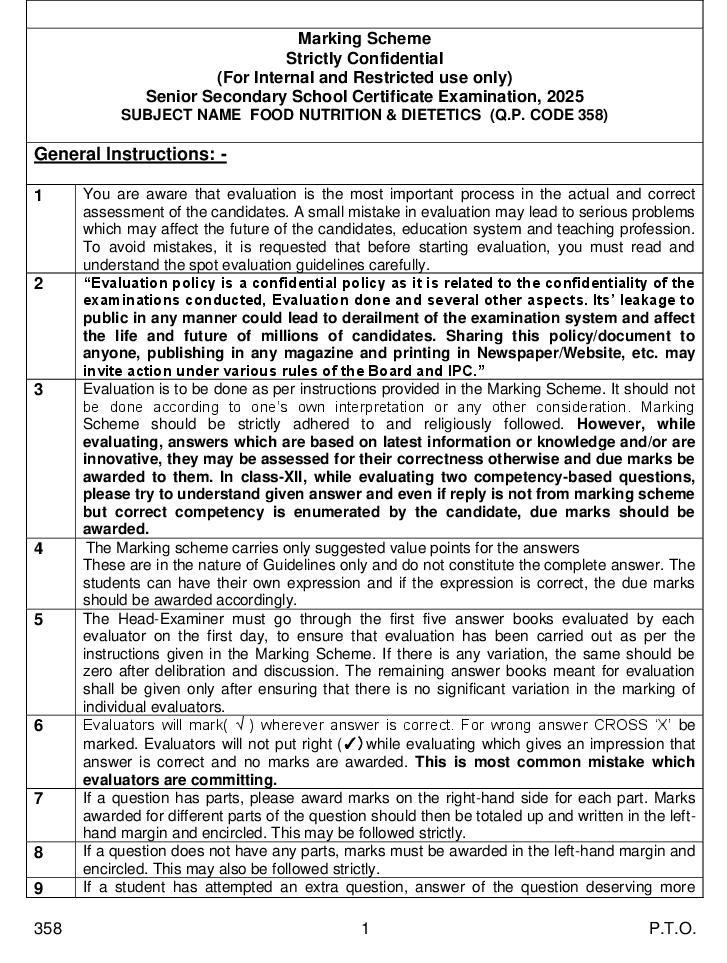
Strictly Confidential
(For Internal and Restricted use only)
Senior Secondary School Certificate Examination, 2025
SUBJECT NAME FOOD NUTRITION & DIETETICS (Q.P. CODE 358)
General Instructions: -
1 You are aware that evaluation is the most important process in the actual and correct
assessment of the candidates. A small mistake in evaluation may lead to serious problems
which may affect the future of the candidates, education system and teaching profession.
To avoid mistakes, it is requested that before starting evaluation, you must read and
understand the spot evaluation guidelines carefully.
2 “Evaluation policy is a confidential policy as it is related to the confidentiality of the
examinations conducted, Evaluation done and several other aspects. Its’ leakage to
public in any manner could lead to derailment of the examination system and affect
the life and future of millions of candidates. Sharing this policy/document to
anyone, publishing in any magazine and printing in Newspaper/Website, etc. may
invite action under various rules of the Board and IPC.”
3 Evaluation is to be done as per instructions provided in the Marking Scheme. It should not
be done according to one’s own interpretation or any other consideration. Marking
Scheme should be strictly adhered to and religiously followed. However, while
evaluating, answers which are based on latest information or knowledge and/or are
innovative, they may be assessed for their correctness otherwise and due marks be
awarded to them. In class-XII, while evaluating two competency-based questions,
please try to understand given answer and even if reply is not from marking scheme
but correct competency is enumerated by the candidate, due marks should be
awarded.
4 The Marking scheme carries only suggested value points for the answers
These are in the nature of Guidelines only and do not constitute the complete answer. The
students can have their own expression and if the expression is correct, the due marks
should be awarded accordingly.
5 The Head-Examiner must go through the first five answer books evaluated by each
evaluator on the first day, to ensure that evaluation has been carried out as per the
instructions given in the Marking Scheme. If there is any variation, the same should be
zero after delibration and discussion. The remaining answer books meant for evaluation
shall be given only after ensuring that there is no significant variation in the marking of
individual evaluators.
6 Evaluators will mark( √ ) wherever answer is correct. For wrong answer CROSS ‘X’ be
marked. Evaluators will not put right (✓)while evaluating which gives an impression that
answer is correct and no marks are awarded. This is most common mistake which
evaluators are committing.
7 If a question has parts, please award marks on the right-hand side for each part. Marks
awarded for different parts of the question should then be totaled up and written in the left-
hand margin and encircled. This may be followed strictly.
8 If a question does not have any parts, marks must be awarded in the left-hand margin and
encircled. This may also be followed strictly.
9 If a student has attempted an extra question, answer of the question deserving more
358 1 P.T.O.
Page 2
10 No marks to be deducted for the cumulative effect of an error. It should be penalized only
once.
11 A full scale of marks __________(example 0 to 80/70/60/50/40/30 marks as given in
Question Paper) has to be used. Please do not hesitate to award full marks if the answer
deserves it.
12 Every examiner has to necessarily do evaluation work for full working hours i.e., 8 hours
every day and evaluate 20 answer books per day in main subjects and 25 answer books
per day in other subjects (Details are given in Spot Guidelines).This is in view of the
reduced syllabus and number of questions in question paper.
13 Ensure that you do not make the following common types of errors committed by the
Examiner in the past:-
● Leaving answer or part thereof unassessed in an answer book.
● Giving more marks for an answer than assigned to it.
● Wrong totaling of marks awarded on an answer.
● Wrong transfer of marks from the inside pages of the answer book to the title page.
● Wrong question wise totaling on the title page.
● Wrong totaling of marks of the two columns on the title page.
● Wrong grand total.
● Marks in words and figures not tallying/not same.
● Wrong transfer of marks from the answer book to online award list.
● Answers marked as correct, but marks not awarded. (Ensure that the right tick mark
is correctly and clearly indicated. It should merely be a line. Same is with the X for
incorrect answer.)
● Half or a part of answer marked correct and the rest as wrong, but no marks awarded.
14 While evaluating the answer books if the answer is found to be totally incorrect, it should
be marked as cross (X) and awarded zero (0)Marks.
15 Any unassessed portion, non-carrying over of marks to the title page, or totaling error
detected by the candidate shall damage the prestige of all the personnel engaged in the
evaluation work as also of the Board. Hence, in order to uphold the prestige of all
concerned, it is again reiterated that the instructions be followed meticulously and
judiciously.
16 The Examiners should acquaint themselves with the guidelines given in the “Guidelines
for Spot Evaluation” before starting the actual evaluation.
17 Every Examiner shall also ensure that all the answers are evaluated, marks carried over to
the title page, correctly totaled and written in figures and words.
18 The candidates are entitled to obtain photocopy of the Answer Book on request on
payment of the prescribed processing fee. All Examiners/Additional Head Examiners/Head
Examiners are once again reminded that they must ensure that evaluation is carried out
strictly as per value points for each answer as given in the Marking Scheme.
358 2
Page 3
$
MARKING SCHEME
FOOD NUTRITION & DIETETICS
SECTION A
OBJECTIVE TYPE QUESTIONS
1. Answer any 4 out of the given 6 questions on Employability Skills. 41=4
(i) Communication is a two-way process through which information
or message is exchanged between individuals using language,
signs, symbols or behaviour. 1
Employability Skills Study Material (Unit 1, Pg. 01)
(ii) Paranoid personality disorder. (Unit 2, Pg. 35) 1
(iii) A spreadsheet is an electronic document, which has rows and
columns. It is used to store data in a systematic way and do
calculations. (Unit 3, Pg. 39) 1
(iv) Entrepreneurship is the act of setting up and running a business
and taking risk in order to earn profits. (Unit 4, Pg. 87) 1
(v) A green collar worker is one who is employed in the
environmental sectors of the economy. (Unit 4, Pg. 112) 1
(vi) For Cut – Ctrl + X 1
Paste – Ctrl + V (Unit 3, Pg. 53)
2. Answer any 5 out of the given 7 questions. 5×1=5
(i) Two special feeding methods are : 1
• Enteral feeding
• Parenteral feeding
CBSE Study Material (Unit 1, Pg. 13)
(ii) BMI (Body Mass Index) (Unit 2, Pg. 55) 1
358 3 P.T.O.
Page 4
Rice water with salt & Lassi with salt
Dal water with salt (Unit 2, Pg. 46)
(iv) Non-modifiable risk factors for hypertension : 1
(a) Family history
(b) Aging/Increased age (Unit 3, Pg. 74)
(v) Hemolytic jaundice is also called as neonatal jaundice as it is
common in newborn babies. (Unit 3, Pg. 103) 1
(vi) Hygiene is the most important factor in order to prevent food
illness. So, it is very important for food handlers to follow the
high standards of food hygiene. (Unit 4, Pg. 121) 1
(vii) (a) Strict domestic and personal hygiene. 1
(b) Vaccine is available for immunization against typhoid.
(Unit 4, Pg. 126)
3. Answer any 6 out of the given 7 questions. 6×1=6
True/False
(i) False, Dietary recommendations are given by ICMR. 1
(Unit 1, Pg. 8)
(ii) True, Overweight is a BMI greater than or equal to 25. 1
(Unit 2, Pg. 55)
(iii) False, HACCP is the food safety management system to
determine significant hazards. (Unit 4, Pg. 119) 1
(iv) False, Diastolic pressure is the minimum pressure in the
arteries. (Unit 3, Pg. 71) 1
(v) False, Pesticides on fruits and vegetables are the examples of
chemical hazards. (Unit 4, Pg. 120) 1
(vi) False, Type I diabetes is an autoimmune disease. 1
(Unit 3, Pg. 83)
(vii) True, Hygiene is the most important factor in order to prevent
food illness. (Unit 4, Pg. 121) 1
358 4
Page 5
(i) A therapeutic diet is a qualitative / quantitative modification of
a normal regular diet to suit the changing nutritional needs of
patient. (Unit 1, Pg. 7) 1
(ii) Blanching is done usually in fruits and vegetables, is scalded in
boiling water or oil and removed after a brief time interval and
finally plunged into iced water. (Unit 1, Pg. 25) 1
(iii) (a) Encourage to take healthy, nourished and balanced diet. 1
(b) Ensure patients to consume six smaller meals per day.
(Unit 2, Pg. 38)
(iv) (a) Free from pathogenic bacteria 1
(b) Contains dissolved salts and minerals. (Unit 4, Pg. 132)
(v) (a) Strange eating habits such as avoiding meals, monitoring
every bite of food. 1
(b) Delayed puberty or amenorrhoea. (Unit 2, Pg. 49)
(vi) The condition when insulin is not efficiently used by the body is
called insulin resistance. (Unit 3, Pg. 82) 1
5. Answer any 5 out of the given 6 questions. 5×1=5
Assertion (a) and Reason (r) based questions.
(A) Both (a) and (r) are true and (r) is the correct explanation of (a).
(B) Both (a) and (r) are true and (r) is not the correct explanation of (a).
(C) (a) is true, but (r) is false.
(D) (a) is false, but (r) is true.
(i) (A) (Unit 1, Pg. 13) 1
(ii) (D) (Unit 2, Pg. 32) 1
(iii) (C) (Unit 2, Pg. 47) 1
(iv) (A) (Unit 3, Pg. 81) 1
(v) (A) (Unit 2, Pg. 29) 1
(vi) (B) (Unit 4, Pg. 127) 1
358 5 P.T.O.
Page 6
Multiple Choice Questions :
(i) (C) Low protein diet (Unit 1, Pg. 12) 1
(ii) (B) Eggs (Unit 1, Pg. 24) 1
(iii) (A) Less than 110 mg/dl (Unit 3, Pg. 82) 1
(iv) (C) Bland diet (Unit 1, Pg. 12) 1
(v) (B) 2006 (Unit 4, Pg. 136) 1
(vi) (C) Make food appealing. (Unit 4, Pg. 121) 1
SECTION B
SUBJECTIVE TYPE QUESTIONS
Answer any 3 out of the given 5 questions on Employability Skills. Answer each
question in 20 – 30 words. 32=6
1 1 1 1
7. Receiving, Understanding, Remembering, Evaluating, Responding + + +
2 2 2 2
Employability Study Material (Unit 1, Pg. 5)
8. • Stay positive 2
• Talk to friends and family for comfort
• Practise meditation and yoga
• Maintain an accomplishment sheet and enter even small
achievements. (Unit 2, Pg. 26)
9. Click on insert → Select image → An insert image dialog box appears
→ Browse through folders and select image you want to use → Click on
open. (Unit 3, Pg. 75) 2
10. • Increase the efficiency of energy and material. 2
• Reduce greenhouse gas emissions.
• Control waste and pollution.
• Protect and restore ecosystems. (Unit 5, Pg. 114)
358 6
Page 7
• Lack of adequate resources or raw material.
• Non-availability of skilled labour.
Personal barriers :
• Self-doubt
• Finding suitable team (Unit 4, Pg. 91)
Answer any 3 out of the given 5 questions in 20 – 30 words each. 32=6
12. Types of diet (Unit 1, Pg. 7, 10) 2
Normal / Regular diet Modified / Hospital diet
Liquid Soft diet Bland diet
Full liquid (Fruit juice) (Khichdi dalia) (Boiled vegetables)
Clear liquid (Strained juices)
13. • Increase in the basal metabolic rate (BMR). 2
• Decreased stores of adipose (fat) tissue and decreased glycogen
stores.
• Increased catabolism.
• Accelerated loss of fluid from the body. (Unit 2, Pg. 31)
14. Anorexia Nervosa : 2
• An intense fear of weight gain or becoming fat despite the
individual’s underweight status.
• Profound weight loss
• Dieting and avoiding meals
Bulimia Nervosa :
• Purging (self-induced vomiting) after meals.
• Frequent fluctuations in weight.
• Eating a large amount of food in a short time. (Unit 2, Pg. 48)
358 7 P.T.O.
Page 8
supply blood to the heart muscles, as a result blood cannot flow
freely to heart, the individual can experience chest pain and heart
attack. High BP can cause the heart muscle to weaken and work
less efficiently. 2
(b) Damage to brain : Brain requires constant supply of blood as it
carries nourishing food to the brain. There can be a temporary
disruption of blood supply to the brain, caused by artery blockage
or blood clot. Which can arise from high blood pressure.
(Unit 3, Pg. 72)
16. Medication alone cannot treat diabetes. Diabetics require day-to-day
knowledge of nutrition, exercise, medication, glucose monitoring, etc.
Diabetes education means enriching people with knowledge and
providing tools crucial for making them active partners in the diabetes
management team. 2
People with diabetes need to be educated regarding : The nature of
disease, the possibility of development of short term and long term
complications. (Unit 3, Pg. 92)
Answer any 2 out of the given 3 questions in 30 – 50 words each. 23=6
17. Malnutrition is an impairment of health resulting from a deficiency or
lack of food/nutrients or an imbalance of nutrients in the diet. 3
Under nutrition Infection
Decreased Impaired absorption
immune function Altered Gut Lumen
Mucosal Injury
(Unit 1, Pg. 16)
18. Dietary recommendation or counselling for TB patient 3
Do’s :
(i) Include whole cereals and millets.
(ii) High energy, protein drink and beverages.
358 8
Page 9
meat or fish.
(iv) Nuts and oil seeds
(v) Seasonal fruits and vegetables (like citrus fruits and green leafy
vegetables)
Don’ts
(i) Limit refined foods.
(ii) Strongly flavored vegetables.
(iii) Excess fat.
(iv) Acidic and spicy food such as pickles. (Unit 2, Pg. 39)
19. Diarrhea can be life-threatening because if a person is suffering from
diarrhea the stool will have high water content. It results into loss of
high amount of fluid and a high amount of electrolytes (sodium,
potassium); this is called dehydration. 3
The consequences of diarrhea/dehydration is the highest cause of
illness and death especially in children. (Unit 2, Pg. 43)
Answer any 3 out of the given 5 questions in 50 – 80 words each. 34=12
20. • Cooking enhances the taste 4
• It kills many microorganisms and makes the food safe to be
consumed.
• Destroy anti-nutritional factors, and enhances the availability of
nutrients.
• Cooking makes food palatable, attractive and colourful.
(i) Pressure cooking : In this method, food is cooked under pressure
and with the increase in pressure the temperature also increases.
Thus the food is cooked fast. Pressure cooking is a type of
steaming only in which water is boiled under high pressure.
Advantages :
• It reduces cooking time
• Fuel efficiency increases
• Nutrient loss is less
• Flavor and aroma of the food are retained
358 9 P.T.O.
Page 10
cooking, it combines steam which is generated while food is
cooked. Cake, bread, biscuits, pizza are all baked food.
Advantages :
• Texture and flavour of food are improved.
• Food items are cooked uniformly in an oven.
• Disadvantages for baking oven is required.
Methods of Cooking
Dry heat methods Moist heat methods
Baking Boiling
Roasting Steaming
Toasting Blanching
Frying Pressure cooking
(Unit 1, Pg. 21, 22)
21. (a) Diabetes Mellitus is a condition when the blood glucose level
is too high than the normal level (fasting < 110 mg/dl and
PP < 140 mg/dl) (Unit 3, Pg. 81) 1
(b) Obesity reduces the sensitivity of tissues to insulin action in the
utilization of glucose. Central obesity is known to increase insulin
resistance. (Unit 3, Pg. 86) 1
(c) Symptoms : 2
• Polydipsia (Increased thirst)
• Polyuria (Frequent urination)
• Polyphagia (Increased hunger)
• Extreme fatigue
• Weight loss (Unit 3, Pg. 87)
Laboratory Investigations : 1+1+2=4
(i) Blood Plasma Glucose test during fasting and after 2 hours
of meal. Fasting Plasma Glucose value more than or equal
to 126 mg/dl and Plasma Glucose level 2-hours post meal
more than or equal to 200 mg/dl is diagnosed as diabetes.
(ii) HbA1c (Glycosylated Haemoglobin) In case of diabetics,
HbA1c value increases over 6% of the total haemoglobin.
(Unit 3, Pg. 83)
358 10
Page 11
waist circumference is classified as central obesity.
(Unit 2, Pg. 56) 1
(b) The prevention of overweight and obesity in children and
adolescents should be considered a high priority. It is a serious
problem and has to be a multifaceted approach to create an
environment that supports a healthy lifestyle.
Behavioural modifications to prevent obesity : 3
• Promote an active lifestyle 1+3=4
• Limit television viewing
• Restrict the intake of unhealthy, energy-dense, packed or
processed snacks, refined foods
• Restrict the intake of sugar-sweetened soft drinks, fruit
juices or carbonated drinks
• Promote intake of fruits and vegetables
• Improving sleep
• Reducing stress (Unit 2, Pg. 62)
The home environment too is another important setting in
preventing obesity. Parents can play a crucial role.
23. A sample menu (providing 1700 – 1800 kcal) for Hypertension patient. 4
• Early morning : 1 cup tea / coffee (pepared with skim milk and
1 tsp sugar only) or Lime Juice (in water with
honey) / Coconut water + 2 biscuits
• Breakfast : Toned milk (1 glass) Poha / Upma Dalia
(1 Bowl) or Bread with Egg or Ragi idli
(2 piece) or Chapati (1) with vegetable and fruit
(1)
• Mid-Morning : Fruit chaat (1 Bowl) or Coconut water / Lime
juice or soup (mix veg / tomato)
• Lunch : Chapati (1) + Rice (1 Bowl) + Dal (1 Bowl) or 1
medium size piece of Chicken or fish in gravy.
Salad with sprouts.
• Evening Snack : 1 cup tea / coffee (prepared with skim milk and
1 tsp sugar) or Lime Juice (1 glass). High fiber
biscuits (2) or Roasted Channa / Sprouts Salad.
358 11 P.T.O.
Page 12
(Paneer 150 gm / meat / Chicken gravy) Veg
(1 Bowl), Card (1 Bowl), Veg Salad with spouts
• Bed time : Milk (1 cup) without sugar (Unit 3, Pg. 77)
Note : Use minimum salt in cooking and avoid table salt.
24. (a) Cholera is referred to an acute infection of the small intestine
that causes severe watery diarrhea, which can lead to
dehydration. 1
(b) Causative agent of Cholera – Vibrio Cholerae. 1
(c) Cholera spreads through contaminated food and water and feces
of diseased person is also the source of contamination. 2
Dehydration is the most common manifestation of choleara. Bacteria
multiply rapidly in the large intestine. Bacterial toxin penetrates
intestinal wall and toxin prevents intestine from absorbing water and
food. (Unit 4, Pg. 122) 1+1+2=4
358 12
Document Details
| Board / Org | CBSE |
| Exam | Class 12 |
| Type | Solution |
| Pages | 12 |
| Updated | 24 Sep 2026 |