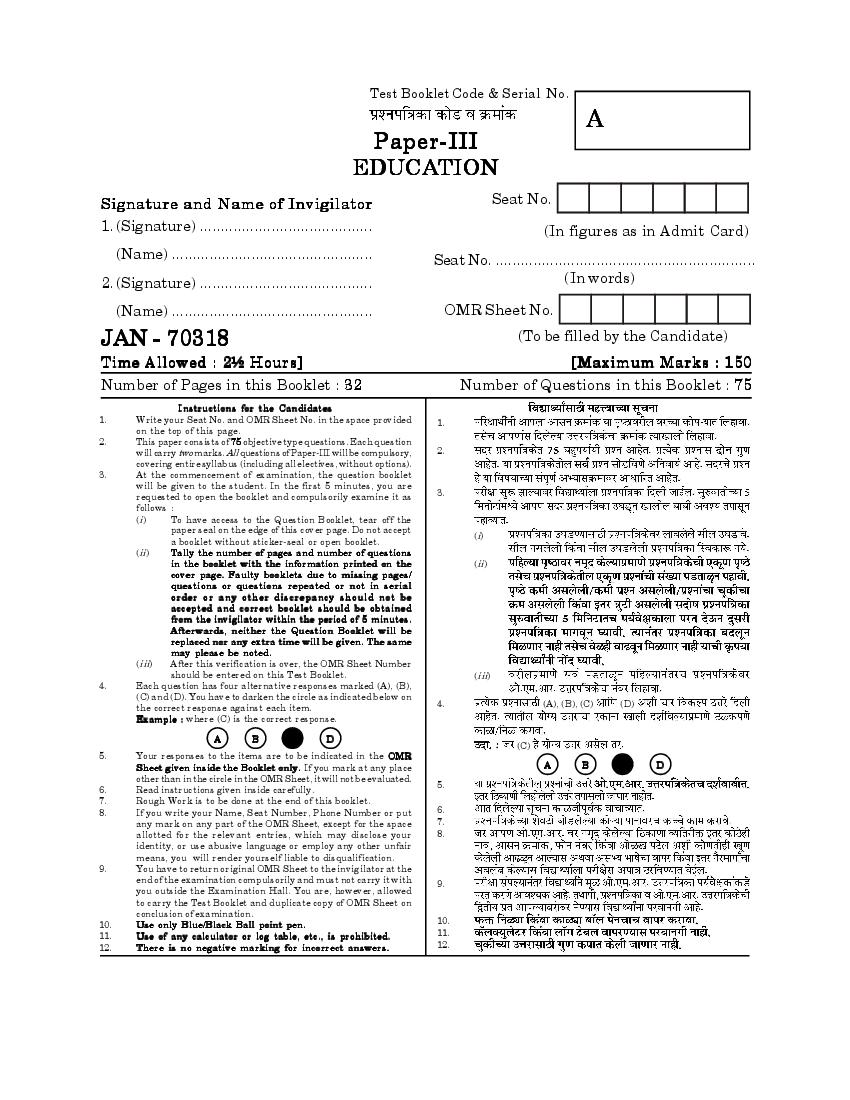
MAHA SET 2018 Question Paper 3 Education
Finished viewing? Save it for later —
Download MAHA SET 2018 Question Paper 3 Education (PDF · 32 pages)About MAHA SET 2018 Question Paper 3 Education
MAHA SET 2018 Question Paper 3 Education is available here for free download. Published by Maharashtra Exams for MAHA SET, this question paper can be viewed online or downloaded as a PDF (32 pages). Candidates preparing for MAHA SET can use MAHA SET 2018 Question Paper 3 Education to understand the exam pattern, the type of questions asked, and the overall difficulty level.
Frequently Asked Questions
How can I download MAHA SET 2018 Question Paper 3 Education?
Open this page and click the Download button to save MAHA SET 2018 Question Paper 3 Education as a PDF. It is completely free on AglaSem Docs.
Is MAHA SET 2018 Question Paper 3 Education free to download?
Yes. MAHA SET 2018 Question Paper 3 Education can be viewed online and downloaded as a PDF free of cost on AglaSem Docs.
How many pages does MAHA SET 2018 Question Paper 3 Education have?
MAHA SET 2018 Question Paper 3 Education contains 32 pages, which you can read online or download together as a single PDF.
Where can I find more MAHA SET study material?
You can find more MAHA SET question papers, sample papers, syllabus, and answer keys on AglaSem Docs.
MAHA SET 2018 Question Paper 3 Education – Text
Read the full text of this question paper below — useful to quickly search, copy and reference the content online without downloading the PDF.
📄 View text version (32 pages)
Page 1
A
Paper-III
EDUCATION
Signature and Name of Invigilator Seat No.
1. (Signature) ......................................... (In figures as in Admit Card)
(Name) ................................................ Seat No. ..............................................................
2. (Signature) ......................................... (In words)
(Name) ................................................ OMR Sheet No.
JAN - 70318 (To be filled by the Candidate)
Time Allowed : 2½ Hours] [Maximum Marks : 150
Number of Pages in this Booklet : 32 Number of Questions in this Booklet : 75
Instructions for the Candidates
1. Write your Seat No. and OMR Sheet No. in the space provided 1.
on the top of this page.
2. This paper consists of 75 objective type questions. Each question
will carry two marks. All questions of Paper-III will be compulsory, 2.
covering entire syllabus (including all electives, without options).
3. At the commencement of examination, the question booklet
will be given to the student. In the first 5 minutes, you are
requested to open the booklet and compulsorily examine it as 3.
follows :
(i) To have access to the Question Booklet, tear off the
paper seal on the edge of this cover page. Do not accept
(i)
a booklet without sticker-seal or open booklet.
(ii) Tally the number of pages and number of questions
in the booklet with the information printed on the (ii)
cover page. Faulty booklets due to missing pages/
questions or questions repeated or not in serial
o rder or any other discre pancy should not be
accepted and correct booklet should be obtained
from the invigilator within the period of 5 minutes.
Afterwards, neither the Question Booklet will be
replaced nor any extra time will be given. The same
may please be noted.
(iii) After this verification is over, the OMR Sheet Number
should be entered on this Test Booklet. (iii)
4. Each question has four alternative responses marked (A), (B),
(C) and (D). You have to darken the circle as indicated below on
the correct response against each item. 4. (A), (B), (C) (D)
Example : where (C) is the correct response.
A B D
(C)
5. Your responses to the items are to be indicated in the OMR
Sheet given inside the Booklet only. If you mark at any place A B D
other than in the circle in the OMR Sheet, it will not be evaluated.
5.
6. Read instructions given inside carefully.
7. Rough Work is to be done at the end of this booklet.
8. If you write your Name, Seat Number, Phone Number or put 6.
any mark on any part of the OMR Sheet, except for the space 7.
allotted for the relevant entries, which may disclose your 8.
identity, or use abusive language or employ any other unfair
means, you will render yourself liable to disqualification.
9. You have to return original OMR Sheet to the invigilator at the
end of the examination compulsorily and must not carry it with 9.
you outside the Examination Hall. You are, however, allowed
to carry the Test Booklet and duplicate copy of OMR Sheet on
conclusion of examination.
10. Use only Blue/Black Ball point pen. 10.
11. Use of any calculator or log table, etc., is prohibited. 11.
12. There is no negative marking for incorrect answers. 12.
Page 2
Page 3
Paper III
III
Time Allowed : 2½ Hours] [Maximum Marks : 150
Note : This paper contains Seventy five (75) multiple choice questions. Each question
carrying Two (2) marks. Attempt All questions.
(75) (2)
1.
1. ....................... is not a form of
naturalism.
(A)
(A) Mechanical
(B) Scientific (B)
(C) Physical (C)
(D) Biological (D)
2. One who view the man as a sujbect 2.
and condemn all attempts to
objectify him :
(A)
(A) Realists
(B)
(B) Idealists
(C) Existentialists (C)
(D) Pragmatists (D)
3 [P.T.O.
Page 4
in the universal mind ?
(A) Naturalism (A)
(B) Pragmatism (B)
(C) Idealism (C)
(D) Realism (D)
4. According to Sri Aurobindo by 4.
which way we achieve realization of
sublime truth ?
(A)
(A) Strict discipline
(B)
(B) Holistic vision
(C)
(C) Insight thinking
(D)
(D) Yogabhyas
5.
5. Gandhiji’s curriculum is not related
to ....................... .
(A) Core-curriculum (A)
(B) Craft centred curriculum (B)
(C) Activity centred curriculum (C)
(D) Correlated curriculum (D)
4
Page 5
(A) Social mobility (A)
(B) Change in education system (B)
(C) Change in government (C)
(D) Social progress (D)
7. Equal educational opportunity is a 7.
principle derived from .......... .
(A) Educational sociology (A)
(B) Sociology of education (B)
(C) Economics of education (C)
(D) History of education (D)
8. Stratification in society is based on 8.
......................... .
(A) Power, property and prestige
(A)
(B) Culture, caste and class
(B)
(C) Education earning and
(C)
empowerment
(D) Motivation, mobility and (D)
material
5 [P.T.O.
Page 6
to another is known as ................. .
(A) Social status
(A)
(B) Social control
(B)
(C) Social change
(C)
(D) Social mobility (D)
10. The community influences the
10.
....................... .
(A) Education curriculum of the
school (A)
(B) Educational objectives of the
school (B)
(C) Educational practices of the (C)
school
(D) All of the above (D)
11. According to Piaget’s developmental 11.
theory, in ........................ stage child
can learns that symbols represent
something else.
(A)
(A) Sensori-motor
(B) Pre-operational (B)
(C) Concrete operational (C)
(D) Formal operational (D)
6
Page 7
of growth and development.
(A) Principle of continuity (A)
(B) Principle of motivation (B)
(C) Principle of integration (C)
(D) Principle of interrelation (D)
13. ..................... is higher type of thinking 13.
process.
(A) Problem solving (A)
(B) Critical thinking (B)
(C) Reasoning (C)
(D) Reflective thinking (D)
14. ............................ spent a number of 14.
years in counting the words which
were used in popular magazines,
children’s books etc.
(A)
(A) E.I. Thorndike and I. Lorge
(B)
(B) E.I. Thorndike and Pavlov
(C)
(C) E.I. Thorndike and Skinner
(D) E.I. Thorndike and M. Lord (D)
7 [P.T.O.
Page 8
will tend to be average height. This
statement is related to law of
...................... of heredity.
(A)
(A) Similarity
(B)
(B) Variation
(C) Regression (C)
(D) Contrast (D)
16. ........................ primary mental ability 16.
is not included in Thurstone’s
multifactor intelligence theory.
(A) Verbal
(A)
(B) Perceptual
(B)
(C) Musical
(C)
(D) Spatial
(D)
17. Suraj is trying to solve the 17.
mathematical example but he can’t
solve it. Suddenly he get clue and
solve the example. This is ..................
type of learning.
(A) Logical (A)
(B) Insight (B)
(C) Discovery (C)
(D) Co-operative
(D)
8
Page 9
was propagated by ....................... in
his learning theory.
(A)
(A) Tolman
(B)
(B) Skinner
(C)
(C) Thorndike
(D) Hull (D)
19. The greatest contribution of Hull’s 19.
theory is ....................... .
(A) Strength of the drive
(A)
(B) Habit strength
(B)
(C) Linking the learning to the
needs of the children (C)
(D) The incentive motivation (D)
20. Priya apply the values taught in a 20.
classroom at daily life purposely and
faithfully. This behaviour is related
to .......................theory of transfer of
learning.
(A)
(A) Thorndike’s
(B) Judd’s (B)
(C) Bagley’s (C)
(D) Locke’s (D)
9 [P.T.O.
Page 10
classifed all human being into
certain biological types according to
their physical structure.
(A)
(A) Kretschmer
(B)
(B) Sheldon
(C) Jung (C)
(D) Allport (D)
22. Every personality is the end-product 22.
of this process of ....................... .
(A) Learning and motivation
(A)
(B) Learning and acquisition
(B)
(C) Heredity and motivation
(C)
(D) Environment and motivation
(D)
23. According to Cattell, curiosity and
23.
dependability are the examples of
.................... type of trait.
(A) Common
(A)
(B) Unique (B)
(C) Surface (C)
(D) Source (D)
10
Page 11
that ‘Mental hygiene is a science’.
(A) Crow and Crow (A)
(B) Drever (B)
(C) D.B. Klein (C)
(D) Shaffer (D)
25. Rahul always says to his friend that 25.
he is intimately acquainted with the
district education officers. Here
.................. defence mechanism was
used by Rahul.
(A)
(A) Delusion
(B)
(B) Rationalization
(C) Projection (C)
(D) Identification (D)
26. There is no freedom to the individual 26.
in ........................ type of counselling.
(A) Direct counselling (A)
(B) Non-directive counselling (B)
(C) Group counselling (C)
(D) Individual counselling
(D)
11 [P.T.O.
Page 12
This step is useful for guidance of
........................... .
(A) Slow learners (A)
(B) Backward class learners (B)
(C) Gifted children (C)
(D) Problem children (D)
28. Neha got less marks than her 28. S.S.C.
expectations in the S.S.C.
examination. “She states that this
is because the examiners did not
check the papers properly”. This is
an example of ....................... Defence
Mechanism.
(A)
(A) Projection
(B)
(B) Negativism
(C)
(C) Suppression
(D)
(D) Rationalization
12
Page 13
tool of guidance.
(A) Non-standardized (A)
(B) Standardized (B)
(C) Objective (C)
(D) Appropriate (D)
30. The selection of an appropriate 30.
person in an appropriate place is
called ...................... .
(A)
(A) Placement
(B)
(B) Follow-up
(C)
(C) Guidance
(D) Counselling (D)
31. Researchers use non-probabilistic 31.
sample because ...................... .
(A) Probabilistic sampling is costly (A)
(B) It is a simple and quick method
(B)
(C) It provides freedom for
(C)
continuous representative
selection
(D)
(D) Many a time basic data
necessary for probabilistic (data)
sample is not available
13 [P.T.O.
Page 14
the sample is :
Sample size
(A)
Population size (A)
Population size
(B) (B)
Sample size
Population size + Sample size
(C) (C)
Population size
Population size (D)
(D) Population size + Sample size
33. Sampling interval for systematic 33.
sampling is calculated by the (sampling interval)
formula :
Poputlation size
(A)
Desired sample size
(A)
Sample size
(B)
Population size (B)
Population size – Sample size
(C) (C)
2 2
Population size + Sample size
(D) (D)
2 2
14
Page 15
to random sampling technique ?
(A) Systematic sampling (A)
(B) Cluster sampling (B)
(C) Proportional stratified sampling (C)
(D) Purposive sampling (D)
35. Of late ‘random number tables’ are 35.
not in use for sample selection
because :
(A) It is difficult to compute with
(A)
tables
(B) Non-availability of tables
(B)
(C) It is easy to do with computers
(C)
(D) Tables do not provide accurate
(D)
numbers
15 [P.T.O.
Page 16
using same objectives, design and (data)
tool but with independently selected
sample units from same target
population. The comprehensive
report of three researchers is
called :
(A)
(A) Team work
(B)
(B) Cross-sectional study
(C)
(C) Cohort study
(D) Collective study (D)
37. Major drawback of mailed 37.
questionnaire survey is :
(A) Time consumption in collecting
data
(A)
(B) No response from sample unit
(B)
(C) Illegible handwriting in
(C)
questionnaire
(D) Authenticity of data (D)
16
Page 17
approach do not use inferential
statistics to test hypotheses about a
larger population of interest.
(A) Associational research (A)
(B) Non-experimental (B)
(C) Experimental (C)
(D) Descriptive (D)
39. W h i ch on e of t h e fol l ow i n g i s not 39.
the characteristic of historical
research ?
(A)
(A) It is not completely objective
(B)
(B) Purpose is to understand
sequence of events and to
reason out
(C)
(C) Providing meaning to events
(D) (asumptions)
(D) Validate assumptions with
representative data (data)
40. If the research problem requires to 40.
........................., one needs to
undertake quantitative research.
(A) Learn about views of (A)
individuals
(B)
(B) Assess a process overtime
(C) Obtain detailed information
(C)
about few people
(information)
(D) Measure variables
(D)
17 [P.T.O.
Page 18
first recommended by .............in
India.
(A) Hunter Commission (A)
(B) Seargent Commission (B)
(C) Radhakrishnan Commission (C)
(D) Kothari Commission (D)
42. Indian education requires rapid 42.
vocational expansion to ................. .
(A) Reduce enrolment in general
(A)
education system
(B) Reduce importance of white
collared jobs (B)
(C) Provide skilled manpower
(C)
(D) Provide cheap labour to
(D)
industry
18
Page 19
policy to ...................... .
(A) encourage degree colleges to
(A)
integrate vocational course as
option
(B) start independent vocational
(B)
courses
(C) +2
(C) confine vocationalization at +2
level
(D)
(D) introduce vocational course in
every degree course
44. The ‘Equivalency Theory’ of distance 44.
education is given by .................... .
(A) Keegan (A)
(B) Holmberg (B)
(C) Moore (C)
(D) Peters (D)
45. From the following which is not an 45.
important feature of Distance
Education System ?
(A)
(A) Study material
(B)
(B) Electronic media
(C) Assignments (C)
(D) Classrooms (D)
19 [P.T.O.
Page 20
major steps of curriculum
development are :
(A)
(A) Objectives – learning
experience – organization –
evaluation – outcomes
(B)
(B) Educational purpose – teaching
methods – course outline –
evaluation (C)
(C) Objectives – syllabus – teaching-
learning – examination
(D)
(D) Objectives – content – teaching
– evaluation
47. Which one of the following is not the 47.
external criteria for curriculum
evaluation ?
(A)
(A) Placement and admission
demand (B)
(B) Job satisfaction and employer’s
(employer)
satisfaction
(C)
(C) Employer’s satisfaction and
placement
(D) Expert opinion and institutional (D)
infrastructure
20
Page 21
48.
curricular evaluation does not
advocate :
(A) Field traits of course materials
(A)
(B) Interacting with learner
(B)
together
(C)
(C) Gather opinions by external
group on course development
(D) Pre-product evaluation to meet (D)
the curricular goals
49. Choice based credit system 49.
curriculum provides scope for :
(A) Analyse theory practicals
separately and evaluate (A)
(B) Integrate theory and practicum
as a unit of valuation
(B)
(C) Provide more importance to
practicals and less to theory
component (C)
(D) Provide more importance to the
theoretical component than (D)
practical
21 [P.T.O.
Page 22
the curriculum ?
(A) Design (A)
(B) Evaluation (B)
(C) Teaching-learning experiences (C)
(D) Abilities (D)
51. From the following .................... is not 51.
a principle of good supervision.
(A) respect individuality of teacher
(A)
(B) hold back praise of teacher
(B)
(C) not confine to four walls of the
school (C)
(D) impartial observation of facts (D)
52. The basic purpose of supervision is 52.
....................... .
(A)
(A) Organize the working of school
(B) Operate the school (B)
(C) Improvement in the working of
(C)
school
(D)
(D) Direct the working of the school
22
Page 23
indifferent to the organization and
work are called ........................ .
(A)
(A) Autocrat
(B)
(B) Deserter
(C)
(C) Compromiser
(D) Missionary (D)
54. From the following ................... is not 54.
a feature of administration.
(A)
(A) Plan
(B)
(B) Stimulate
(C) Diagnose (C)
(D) Inspect
(D)
55. Decision-making is a step in
55.
........................ .
(A) Planning
(A)
(B) Organizing
(B)
(C) Evaluating (C)
(D) Executing (D)
23 [P.T.O.
Page 24
his students, then evaluation
process starts from ......................... .
(A) Fix the teaching objectives
(A)
(B) Select the evaluation tool
(B)
(C) Fix the evaluation questions
(C)
(D) Fix the type of questions for
evaluation (D)
57. ....................... criteria is observed 57.
more in the test in which objective
questions are included.
(A) Validity (A)
(B) Reliability (B)
(C) Adequacy (C)
(D) Utility (D)
58. If an attitude scale development is
58.
characterised by simple procedure,
involves less time and work, yet
provide good reliability, the method
will be .................... .
(A) Thurstone’s method of paired
comparison
(B) Thurstone and Chave’s method (A)
of equal appearing intervals
(B)
(C) Likert’s method of summated
rating (C)
(D) Gutman’s scalogram method (D)
24
Page 25
his research. The interpretation
process of test was so difficult that’s
why he faced problems. This
experience of Sandeep about test
because of ..................... criterion
weakness.
(A) Discrimination power (A)
(B) Adequacy (B)
(C) Usability (C)
(D) Validity (D)
60. Interchange the questions in 60.
between two tests prepared by Anil.
Then their is no change in the
nature of two tests. So ...................
method was used by Anil for testing
of reliability of the tests.
(A) Test-retest (A)
(B) Parallel forms (B)
(C) Split half (C)
(D) Rational-equivalence (D)
25 [P.T.O.
Page 26
we use in teaching and learning
for its effectiveness is called
.......................... .
(A)
(A) Educational technology
(B)
(B) Technology of education
(C)
(C) Technology in education
(D) Instructional technology (D)
62. The correct sequence in system 62.
approach in school education is as
follows :
(A)
(A) Input – process – diagnostic test
– feedback – output
(B)
(B) Input – diagnostic test – process
– feedback – output
(C)
(C) Input – counselling – process –
testing – output
(D) Input – process – counselling – (D)
feedback – output
26
Page 27
sender and receiver is
communication.’ This definition of
communication is given by
.................... . (A)
(A) Shanon and Weaver
(B)
(B) Schramm
(C)
(C) Newcomb
(D) Miller (D)
64. If we want to see the eligibility of 64.
the candidate for specific job, then
we have to use ......................... test.
(A) Criterion-referenced
(A)
(B) Norm-referenced (B)
(C) Achievement (C)
(D) Diagnostic (D)
65. Programmed learning is based on 65.
...................... theory of learning.
(A) Pavlov’s (A)
(B) Hull’s (B)
(C) Thorndike’s (C)
(D) Skinner’s (D)
27 [P.T.O.
Page 28
classroom. Nikhil may be
........................ .
(A) Learning disabled (A)
(B) Mentally retarded (B)
(C) Hyperactive (C)
(D) Inattentive (D)
67. Vrunda unnecessarily speaks very 67.
fast. The reason is that she has
................. problem.
(A)
(A) hearing
(B)
(B) speaking
(C)
(C) learning disability
(D) mental retardedness (D)
68. The method of using ‘hand 68.
movements’ for explaining verbal
concepts to the hearing impaired
students is called ....................... .
(A)
(A) Finger spell
(B)
(B) Cued speech method
(C)
(C) Action method
(D) Complete communication (D)
method
28
Page 29
old child whose IQ is less than 24
is being ..................... .
(A) entirely dependent on others for
movement (A)
(B) able to understand what is told (B)
by others
(C)
(C) able to adjust socially
(D) entirely independent in reading (D)
70. The behaviour asking questions 70.
continuously is primararily seen in
.................... students.
(A) mentally retarded (A)
(B) visually impaired (B)
(C) gifted (C)
(D)
(D) learning disabled
29 [P.T.O.
Page 30
aim of refresher course ?
(A)
(A) To give information about
teaching profession (B)
(B) To introduce new ideas
(C)
(C) To introduce new methods and
techniques of teaching
(D) To update the knowledge (D)
72. ...................... should be used for 72.
admission of teacher education
courses.
(A)
(A) Interest inventory
(B)
(B) Intelligence test
(C) Aptitude test (C)
(D) Achievement test (D)
73. Which of the following is not the
73.
device for modification of teacher
behaviour ?
(A)
(A) Simulated social skill teaching
(B)
(B) Micro-teaching
(C)
(C) Interaction analysis
(D)
(D) Character development
30
Page 31
channel on television exclusively for
education.’ This recommendation
was given by ......................... .
(A) Ram Murti Committee (A)
(B) National Education Policy (1986) (B)
(C) National Curriculum Frame-
(C)
work-2005
(D)
(D) National Curriculum Frame-
work for Teacher Education-2009
75. In Flander’s observation matrix 75.
when we observe more tallies in
(1, 1), (2, 2) ............ (10, 10) cells. This
shows ................... .
(A)
(A) Teacher’s continuous activity
(B)
(B) Students continuons activity
(C) Silence in the class (C)
(D) Noise in the class (D)
31 [P.T.O.
Page 32
32
Document Details
| Board / Org | Maharashtra Exams |
| Exam | MAHA SET |
| Type | Question Paper |
| Pages | 32 |
| Updated | 30 Apr 2026 |