CBSE Class 12 Sample Paper 2022 for Geography Term 1
Finished viewing? Save it for later —
Download CBSE Class 12 Sample Paper 2022 for Geography Term 1 (PDF · 16 pages)About CBSE Class 12 Sample Paper 2022 for Geography Term 1
CBSE Class 12 Sample Paper 2022 for Geography Term 1 is available here for free download. Published by CBSE for Class 12, this sample paper can be viewed online or downloaded as a PDF (16 pages). Candidates preparing for Class 12 can use CBSE Class 12 Sample Paper 2022 for Geography Term 1 to understand the exam pattern, the type of questions asked, and the overall difficulty level.
Frequently Asked Questions
How can I download CBSE Class 12 Sample Paper 2022 for Geography Term 1?
Open this page and click the Download button to save CBSE Class 12 Sample Paper 2022 for Geography Term 1 as a PDF. It is completely free on AglaSem Docs.
Is CBSE Class 12 Sample Paper 2022 for Geography Term 1 free to download?
Yes. CBSE Class 12 Sample Paper 2022 for Geography Term 1 can be viewed online and downloaded as a PDF free of cost on AglaSem Docs.
How many pages does CBSE Class 12 Sample Paper 2022 for Geography Term 1 have?
CBSE Class 12 Sample Paper 2022 for Geography Term 1 contains 16 pages, which you can read online or download together as a single PDF.
Where can I find more Class 12 study material?
You can find more Class 12 question papers, sample papers, syllabus, and answer keys on AglaSem Docs.
CBSE Class 12 Sample Paper 2022 for Geography Term 1 – Text
Read the full text of this sample paper below — useful to quickly search, copy and reference the content online without downloading the PDF.
📄 View text version (16 pages)
Page 1
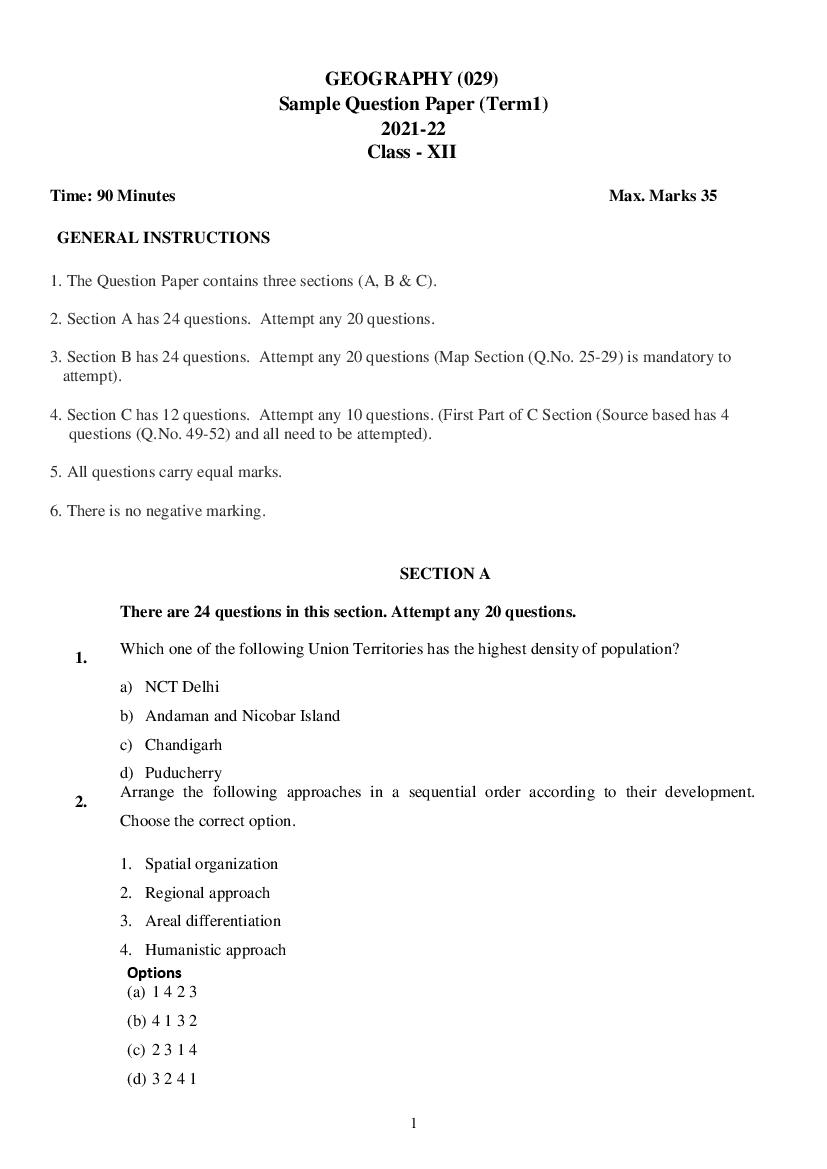
Sample Question Paper (Term1)
2021-22
Class - XII
Time: 90 Minutes Max. Marks 35
GENERAL INSTRUCTIONS
1. The Question Paper contains three sections (A, B & C).
2. Section A has 24 questions. Attempt any 20 questions.
3. Section B has 24 questions. Attempt any 20 questions (Map Section (Q.No. 25-29) is mandatory to
attempt).
4. Section C has 12 questions. Attempt any 10 questions. (First Part of C Section (Source based has 4
questions (Q.No. 49-52) and all need to be attempted).
5. All questions carry equal marks.
6. There is no negative marking.
SECTION A
There are 24 questions in this section. Attempt any 20 questions.
Which one of the following Union Territories has the highest density of population?
1.
a) NCT Delhi
b) Andaman and Nicobar Island
c) Chandigarh
d) Puducherry
Arrange the following approaches in a sequential order according to their development.
2.
Choose the correct option.
1. Spatial organization
2. Regional approach
3. Areal differentiation
4. Humanistic approach
Options
(a) 1 4 2 3
(b) 4 1 3 2
(c) 2 3 1 4
(d) 3 2 4 1
1
Page 2
3.
a) Clustered Settlements
b) Semi-Clustered Settlements
c) Dispersed Settlements
d) Hamleted Settlements
4.
Which of the following programs sponsored by central government aims at enabling the rural
population to conserve water for drinking, irrigation, fisheries and afforestation?
a) Arvary Pani Sansad
b) Haryali
c) Neeru-Meeru
d) Narmada bachao
Population of India according to Occupation can be categorized into:
5.
a) Main workers, Marginal workers, Non workers
b) Marginal workers, Household industrial workers, Non workers
c) Agricultural labourers, Marginal workers, Non workers
d) Cultivators, Main workers, Marginal workers
6. Who among the following developed the concept of ‘human development’?
a) Ellen C. Semple
b) Dr Mahbub-ul-haq
c) Kanwar Sen
d) Griffith Tailor
Which one of the following is not a plantation crop?
7.
a) Coffee
b) Sugarcane
c) Rubber
d) Wheat
Which of the following best describes ‘development’?
8.
a) An increase in size
b) A constant in size
c) A positive change in quality
d) A simple change in quality
2
Page 3
Which of the following programme is launched by the present Union Government for the
cleaning of river Ganga?
a) Ganga Action Plan
b) Namami Gange
c) Ganga Namami Action Plan
d) Ganga Cleaning Mission
Which of the following mainly is not an industrial city?
10.
a. Bhilai b. Durgapur
c. Chandigarh d. Barauni
11. Which one of the following is not a method of mining?
a) Shaft mining
b) Opencast mining
c) Underground mining
d) Refining
According to census 2011, which of the following depicts the percentage of
12.
the level of urbanization in India?
a) 31.16 %
b) 28 %
c) 33.16 %
d) 26 %
13. According to Census of India, migration is enumerated on which of the following basis?
a) Place of Origin
b) Place of residence
c) Place of Origin as well as Place of Residence
d) Place of Birth
14. Through which of the following, functional relations establish between rural and urban
areas?
a) Through the means of transport and communications
b) Through the supply of raw material
c) Through the exchange of finished products in rural areas
d) Through the consumption of products produced in rural areas
3
Page 4
a) Downs
b) Campos
c) Fazendas
d) Pampas
Who among the following is related to ‘capability approach’?
16.
a) Dr Mahbub-ul-haq
b) Prof Amartya Sen
c) Malthus
d) Ratzel
Which of the following areas of our country are deficient in rainfall and are drought
17.
prone?
a) North- eastern states
b) Deccan Plateau
c) Gangetic Plain
d) Brahmaputra valley
18. Which of the following colonial super power had monopoly over sugarcane plantation in Indonesia?
a) British
b) French
c) Dutch
d) Americans
Which of the following is a good example of Fort town?
19.
a) Jaipur
b) Banaras
c) Mathura
d) Rameshwaram
20.
Which one of the following concepts is related to Naturalization of Humans?
a) Environmental Determinism
b) Possiblism
c) Humanism
d) Neo-Determinism
Which one of the following is the main feature of rural settlement?
21.
4
Page 5
b) Derive economic needs from secondary activities
c) Derive economic needs from tertiary activities
d) Derive economic needs from quaternary activities
Which of the following sectors has used the highest percentage of total water in India?
22.
a) Domestic
b) Commerce
c) Agriculture
d) Industry
Who among the following has introduced the concept of Neo-determinism?
23.
a) Ratzel
b) Griffith Taylor
c) Allen c.Semple
d) Paul Vidal de la Blache
Which of the following attributes has not been adversely affected by Age and Skill selective
24.
migration?
a) Downfall in working population in rural areas
b) The whole burden of agricultural work has to be borne by the old population in
rural areas.
c) Only old people and women are left behind in the place of origin
d) Balance in age and sex composition
SECTION B
(There are 24 questions in this section. Attempt any 20 questions.)
Question no. 25-29 are based on map and are mandatory to attempt. ( Visually Impaired
students will also attempt MCQs )
5
Page 6
a). Algeria
b).Sudan
c). Egypt
d). South Africa
26. Which one of the followings is a region of commercial grain farming practiced in Europe?
a) Pampas
b) Steppes
c) Downs
d) Prairies
Which one of the following is a region of North America practicing subsistence gathering?
27.
a) Great Lake
b) Prairies
c) North Canada
d) Mexico
Which of the following terminal stations connect Trans-Canadian Railway?
28.
a) Halifax and Vancouver
b) New York and San Francisco
c) Halifax and Montreal
d)Calgary and Vancouver
29. Which of the following is the most heavily used inland waterway of the world?
a) Suez Canal
6
Page 7
c) Rhine Waterway
d) Volga Waterway
Question no. 30-48 (Attempt any 15)
Consider the following statements and choose the correct option from the given options-
30.
1. Population grown rapidly during the sixteenth and seventeenth century.
2. Expansion of world trade during sixteenth and seventeenth century is an important
cause of it.
Options:
a) Only 1 is correct.
b) Only 2 is correct
c) Both the statements are incorrect
d) Both statements are correct and statement 2 correctly explains the statement
Which of the following pair is not correctly matched
31.
PILLARS OF HUMAN DEVELOPENT - INDICATORS
a) Equity -making equal access to opportunities available to everybody
b) Sustainability -Continuity in the availability of opportunities
c) Productivity -Resources must be used keeping in mind the future
d) Empowerment-To have the power to make choices
”Each community occupies a well-identified territory as a matter of tradition”.
32.
Above mentioned line is an important characteristic of which of the following activity?
a) Subsistence agriculture
b) Nomadic herding
c) Plantation agriculture
d) Collective farming
33. Which of the following statement is not true regarding the ‘Smart City Mission’?
a) To promote cities that provide core infrastructure, a clean and sustainable
environment and give a decent quality of life to its citizens
b) To apply smart solutions to infrastructure and services in order to make them
better
c) Use of fewer resources, providing cheaper services and focus on sustainable and
inclusive development.
d) Increase in unemployment
7
Page 8
Which of the following is NOT an environmental consequence of migration? 1
a) Unplanned growth of urban settlement
b) Mixing of diverse culture
c) Depletion of ground water
d) Exploitation of natural resource
In Himalayan regions which of the following tribes are linked with the activity of
35.
Transhumance?
a. Bheels b. Gonds
c. Bakarwals d. Santhals
Match the column I with Column II and choose the correct options with the help of given
36.
Codes.
COLUMN I COLUMN II
(CITIES) (FUNCTIONAL SPECIFICATION)
I. Ambala 1. Mining town
II. Mughal Sarai 2. Transport town
III. Ankaleshwar 3. Educational town
IV. Aligarh 4.Garrison town
V. Shimla 5. Commercial town
VI .Saharanpur 6. Tourist town
CODES-
I II III IV V VI
a. 1 2 3 4 5 6
b. 4 2 1 3 6 5
c. 6 5 4 3 2 1
d. 2 1 4 3 5 6
This age was marked by use of computers and sophisticated statistical tools. Laws of physics were often
37.
applied to map and analyze. Select the correct option.
a) Regional analysis
b) Quantitative revolution
c) Areal Differentiation
d) Spatial organization
8
Page 9
38.
inter-state migration?
a) Urban to rural
b) Urban to urban
c) Rural to rural
d) Rural to urban
39. Which of the following column is not matched correctly?
ACTIVITY CHARACTERISTICS
a) Truck farming Growing of vegetables
b) Factory farming Rearing of poultry and cattle
c) Market gardening Growing of flowers
d) Viticulture Rearing of fish
Consider the following features and choose the correct title after associating them.
40.
1. More often such a pattern may also result from segregation or fragmentation
of large compact village.
2. The land- owning and dominant community occupies the central part of the main
village whereas people of lower strata of society and menial workers settle on the
outer flanks of the village.
3. They are found in Gujarat plains and some parts of Rajasthan.
OPTIONS-
a) Hamleted Settlement
b) Semi-clustered or fragmented
c) Clustered Settlements
d) Isolated Settlements
Consider the following and choose the correct answer from the given options-
41.
I. Work participation rate tend to be higher in the areas of lower levels of
economic development.
II. Number of manual workers are needed to perform the subsistence or
near subsistence economic activities
Options-
a) Only statement I is correct
9
Page 10
c) Only statement II is correct
d) Both the statements are incorrect
Consider the following statements and choose the correct option for the same:
42.
I. Grape cultivation is the specialty of the Mediterranean agriculture.
II. Wines are produced from high quality grapes and the inferior grapes are dried
into raisins and Currants.
Options;
a) Only 1 is correct
b) Both 1 and 2 are correct
c) Only 2 is correct
d) Both are incorrect
Match the column I with column II and choose the correct answer with the help of given
43.
Codes.
COLUMN I (RIVERS) COLUMN II (POLLUTED PLACE)
I Yamuna 1. Hyderabad
II Kali 2. Kanpur and Varanasi
III Gomati 3. Ahmedabad
IV Sabarmati 4. Lucknow
V Ganga 5. Muzaffar Nagar
VI Musi 6. Delhi and Etawah
Codes-
I II III IV V VI
a. 6 5 4 3 2 1
b. 1 2 3 4 5 6
c. 6 5 3 4 1 2
d. 2 3 1 5 4 6
44. In the year 2015, a policy was formulated for the adolescents to give them proper
guidance and the better development of their talent. Select the correct answer.
10
Page 11
b) Universalisation of education
c) Rejuvenation of schools
d) National Youth Policy
Which of the following pairs is not matched correctly?
45.
CITIES BASIS OF DEVELOPMENT
a) Prayag (Allahabad) - On religious and cultural basis
b) Lucknow - Based on the remnants of ancient cities
c) Kolkata - On cultural basis
d) Mumbai - In the form of commercial port
Match the column I with column II and choose the correct answer with the help of given
46.
Codes-
COLUMN I (CITIES) COLUMN II (TYPES OF CITIES)
I . Jamshedpur 1.Summer resort
II. Bhuvaneshwar 2. Satellite town
III. Ghaziabad 3. Industrial town
IV Mussoorie 4. Commercial port
V Goa 5. Administrative town
CODES-
I II III IV V
a. 1 2 3 4 5
b. 3 5 2 1 4
c. 5 4 3 2 1
d. 3 5 4 2 1
Consider and evaluate the following statements than choose correct options for them
47.
from the given options.
1. Many species now have become extinct or endangered due to illegal hunting.
2. The early hunters used primitive tools made of stones, twigs or arrows so the
number of animals killed were limited.
11
Page 12
a) Only statement 1 is correct
b) Only statement 2 is correct
c) Both statements 1 and 2 are correct
d) Both statements are incorrect
Make correct pairs of the following two columns and select the correct
48.
option.
Period Approach
1. Early colonial period (a) Exploration & Description
2.Late 1950’s to the late 1960’s (b) Regional Analysis
3. Later colonial period (c) Aerial Differentiation
4. 1930’s through the inter-war period (d) Spatial Organization
Options
(A) 1. (a) 2. (d) 3. (b) 4. (c)
(B) 1. (d) 2. (a) 3. (c) 4. (b)
(C) 1. (b) 2. (c) 3. (d) 4. (a)
(D) 1. (a) 2. (b) 3. (c) 4. (d)
SECTION C
SOURCE BASED QUESTIONS
Question number 49 to 52 are compulsory to attempt
Jal Kranti Abhiyan (2015-16)
Water is a recyclable resource but its availability is limited and the gap between supply and demand will
be widening over time. Climate change at the global scale will be creating water stress conditions in
many regions of the world. India has a unique situation of high population growth and rapid economic
development with high water demand. The Jal Kranti Abhiyan launched by the Government of India in
2015–16 with an aim to ensure water security through per capita availability of water in the country.
People in different regions of India had practised the traditional knowledge of water conservation and
management to ensure water availability. The Jal Kranti Abhiyan aims at involving local bodies, NGOs
and cititzens, at large, in creating awareness regarding its objectives.
The following activities have been proposed under the Jal Kranti Abhiyan: 1. Selection of one water
stressed village in each 672 districts of the country to create a ‘Jal Gram’. 2. Ídentification of
12
Page 13
(North), Karnataka, Telangana, Tamil Nadu (South), Rajasthan, Gujarat (West), Odisha (East),
Meghalaya (North-East). 3. Abatement of pollution: • Water conservation and artificial recharge. •
Reducing groundwater pollution. • Construction of Arsenic-free wells in selected areas of the country. 4.
Creating mass awareness through social media, radio, TV, print media, poster and essay writing
competitions in schools. Jal Kranti Abhiyan is designed to provide livelihood and food security through
water security.
Present day world is experiencing acute water paucity due to:
49.
a). Climate Change
b). Industrial Pollution
c). Rising Sea level
d). Forest Depletion
Which of the following is not a characteristic feature of Model Command Area in India?
50.
a) Water conservation and artificial recharge
b) Reducing groundwater pollution
c) Construction of Arsenic-free wells in selected areas of the country
d) Not concerned with food security and livelihood of the people
The Objective of the Jal Kranti Abhiyan is achieved through:.
51.
a).Using traditional know how
b). Adopting modern technology
c). Mixing modern technology with traditional knowledge
d). Outsource to some other organization
The main aim of The Jal Kranti Abhiyan is to ensure water security through-----.
52.
a). Creating Jal Grams
B). Reducing ground water pollution
C). Per capita availability of water
D). Construction of arsenic free wells
GRAPH BASED QUESTION
Attempt any 3 questions from the following questions 53-56
Study the given graph carefully and answer the following questions:
13
Page 14
53.
a) Birth Rate – Death Rate
b) Death Rate + Birth Rate
c) Growth Rate - Birth Rate
d) Birth Rate + Migration
54. What does the transition from high fluctuating stage to low fluctuating stage indicate?
a) Shift from Urban Industrial economy to Rural Agrarian economy
b) Shift from Rural Agrarian economy to Urban Industrial economy
c) Low Birth and Death Rate to High Birth and Death Rate
d) Migration from Urban to Rural areas
55.
From the given graph, what condition can you infer about the developing countries?
a) High Birth Rate and High Death Rate
b) Low Birth rate and Low Death rate
c) High Birth Rate and Low Death Rate
d) Low Birth Rate and High Death Rate
In which stage of Demographic Transition, population explosion took place-
56.
a) Stage I
b) Stage II
c) Stage III
d) Post Stage III
For Visually Impaired Candidates In lieu of Q No. 53-56 (Graph Based Question)
14
Page 15
Theory?
a) People have a lot of buffer stock as food security.
b) People reproduce more to compensate for the deaths due to epidemics.
c) People are highly educated at this stage.
d) There is technological advancement in all fields.
Q.54. What led to decline in Mortality rate in the Second stage of Demographic Transition
Theory?
a) Due to improvement in Sanitation and Health conditions.
b) Due to insufficient supply of food grain that led to starvation.
c) Due to widespread illiteracy all over the world.
d) Due to unfavorable sex ratio prevailing in developing countries.
Q.55. Why does fertility rate show a declining trend in the third stage of Demographic Transition
Theory?
a) This is because human beings are not able to adjust their fertility.
b) Literacy rates show a downward trend all over the world.
c) The population becomes urbanized and has high technical knowhow.
d) There is acute food shortage in countries with a high Human Development Index.
Q.56. In which stage of Demographic Transition, population explosion took place-
a) Stage I
b) Stage II
c) Stage III
d) Post Stage III
DATA BASED QUESTIONS
Attempt any 3 questions from the following questions 57-60
15
Page 16
a. 1931
b. 1921
c. 1911
d. 1941
What was the highest recorded growth rate of population in India?
58. a. 24.66
b. 24.80
c. 23.85
d. 21.54
Which year has recorded the highest growth of population in India in terms of absolute numbers?
59.
a. 2001
b. 2011
c. 1991
d. 1981
How much population increase has been registered between the census years 1911 to census year 2011?
60.
a. 900789600
b. 182307640
c. 181583094
d. 971797095
16
Document Details
| Board / Org | CBSE |
| Exam | Class 12 |
| Type | Sample Paper |
| Pages | 16 |
| Updated | 30 Apr 2026 |