MAHA SET 2015 Question Paper 3 Psychology
Finished viewing? Save it for later —
Download MAHA SET 2015 Question Paper 3 Psychology (PDF · 27 pages)About MAHA SET 2015 Question Paper 3 Psychology
MAHA SET 2015 Question Paper 3 Psychology is available here for free download. Published by Maharashtra Exams for MAHA SET, this question paper can be viewed online or downloaded as a PDF (27 pages). Candidates preparing for MAHA SET can use MAHA SET 2015 Question Paper 3 Psychology to understand the exam pattern, the type of questions asked, and the overall difficulty level.
Frequently Asked Questions
How can I download MAHA SET 2015 Question Paper 3 Psychology?
Open this page and click the Download button to save MAHA SET 2015 Question Paper 3 Psychology as a PDF. It is completely free on AglaSem Docs.
Is MAHA SET 2015 Question Paper 3 Psychology free to download?
Yes. MAHA SET 2015 Question Paper 3 Psychology can be viewed online and downloaded as a PDF free of cost on AglaSem Docs.
How many pages does MAHA SET 2015 Question Paper 3 Psychology have?
MAHA SET 2015 Question Paper 3 Psychology contains 27 pages, which you can read online or download together as a single PDF.
Where can I find more MAHA SET study material?
You can find more MAHA SET question papers, sample papers, syllabus, and answer keys on AglaSem Docs.
MAHA SET 2015 Question Paper 3 Psychology – Text
Read the full text of this question paper below — useful to quickly search, copy and reference the content online without downloading the PDF.
📄 View text version (48 pages)
Page 1
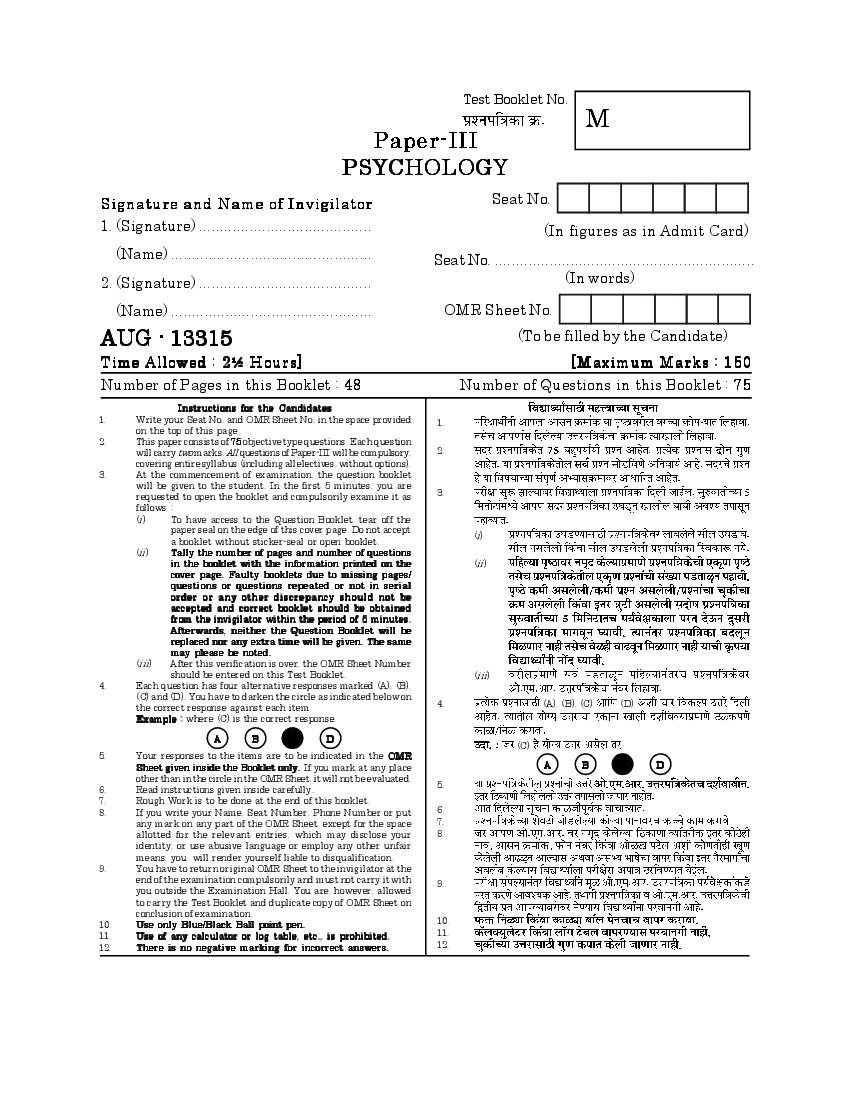
M
PSYCHOLOGY
Signature and Name of Invigilator Seat No.
1. (Signature) ......................................... (In figures as in Admit Card)
(Name) ................................................ Seat No. ..............................................................
2. (Signature) ......................................... (In words)
(Name) ................................................ OMR Sheet No.
AUG - 13315 (To be filled by the Candidate)
Time Allowed : 2½ Hours] [Maximum Marks : 150
Number of Pages in this Booklet : 48 Number of Questions in this Booklet : 75
Instructions for the Candidates
1. Write your Seat No. and OMR Sheet No. in the space provided 1.
on the top of this page.
2. This paper consists of 75 objective type questions. Each question
will carry two marks. All questions of Paper-III will be compulsory, 2.
covering entire syllabus (including all electives, without options).
3. At the commencement of examination, the question booklet
will be given to the student. In the first 5 minutes, you are
requested to open the booklet and compulsorily examine it as 3.
follows :
(i) To have access to the Question Booklet, tear off the
paper seal on the edge of this cover page. Do not accept
(i)
a booklet without sticker-seal or open booklet.
(ii) Tally the number of pages and number of questions
in the booklet with the information printed on the (ii)
cover page. Faulty booklets due to missing pages/
questions or questions repeated or not in serial
o rder or any other discre pancy should not be
accepted and correct booklet should be obtained
from the invigilator within the period of 5 minutes.
Afterwards, neither the Question Booklet will be
replaced nor any extra time will be given. The same
may please be noted.
(iii) After this verification is over, the OMR Sheet Number
should be entered on this Test Booklet. (iii)
4. Each question has four alternative responses marked (A), (B),
(C) and (D). You have to darken the circle as indicated below on
the correct response against each item. 4. (A), (B), (C) (D)
Example : where (C) is the correct response.
A B D
(C)
5. Your responses to the items are to be indicated in the OMR
Sheet given inside the Booklet only. If you mark at any place A B D
other than in the circle in the OMR Sheet, it will not be evaluated.
5.
6. Read instructions given inside carefully.
7. Rough Work is to be done at the end of this booklet.
8. If you write your Name, Seat Number, Phone Number or put 6.
any mark on any part of the OMR Sheet, except for the space 7.
allotted for the relevant entries, which may disclose your 8.
identity, or use abusive language or employ any other unfair
means, you will render yourself liable to disqualification.
9. You have to return original OMR Sheet to the invigilator at the
end of the examination compulsorily and must not carry it with 9.
you outside the Examination Hall. You are, however, allowed
to carry the Test Booklet and duplicate copy of OMR Sheet on
conclusion of examination.
10. Use only Blue/Black Ball point pen. 10.
11. Use of any calculator or log table, etc., is prohibited. 11.
12. There is no negative marking for incorrect answers. 12.
Page 2
Page 3
Paper III
III
Time Allowed : 2½ Hours] [Maximum Marks : 150
Note : This Question Paper contains Seventy Five (75) multiple choice questions,
each question carries Two (2) marks. Attempt All questions.
(75) (2)
1. The concept of ‘unconditional 1.
positive regard’ is emphasised in .... .
(A) Person-centered therapy (A)
(B) Behaviour therapy
(B)
(C) Psychodynamic therapy
(D) Rational emotive therapy (C)
2. Language differences between the (D)
males and females may not be just
2.
the product of genetics, but also of
the environment. According to the
proponants of this views, what could
be the cause of females having
relatively better language skills
compared to males ?
(A)
(A) Brains of males and females are
different
(B) Males are not equipped to learn (B)
language at the same pace as
are females
(C) Females receive more (C)
encouragement for verbal skills
than do males
(D) Females listen to language (D)
more intently when in the womb
3 [P.T.O.
Page 4
3.
topper in the class, Manisha became
the topper. She considered that ‘to
be a topper’ is of unique
achievement in academics. This is
best explained by :
(A) Social cognitive theory of
learning
(A)
(B) Theory of internal locus of
control
(B)
(C) Theory of vicarious learning
(C)
(D) Active learning theory of
Vigotsky
(D)
4. According to Fiedler’s theory,
relationship oriented leader will 4.
be effective under the conditions,
where :
(A) good member relations, (A)
structured task and low position
power is there
(B) poor member relations, (B)
structured task and high
position power is there
(C) good member relations, (C)
unstructured task and low
position power is there
(D) poor member relations, (D)
unstructured task, and low
position power is there
4
Page 5
(A) Psychosis (A)
(B) Dissociation (B)
(C) Panic (C)
(D) Sleep disorder
(D)
6. Which of the following staining
6.
techniques are widely used while
studying Physiological Psychology ?
(1) Golgi stains
(1)
(2) Broca stains
(2)
(3) Horseradish Peroxide Method
(3)
(HPM)
(4)
(4) Chronoscopy Method (CM)
Choose the correct code :
(A) (1), (2) and (4) only (A) (1), (2) (4)
(B) (2), (3) and (4) only (B) (2), (3) (4)
(C) (1) and (3) only (C) (1) (3)
(D) (3) and (4) only (D) (3) (4)
5 [P.T.O.
Page 6
design with A and B as independent
variables, the F ratio defined as
‘MSAB/MSE’ F
‘MSAB/MSE’ is significant at .01
level. This indicates that :
(A)
(A) the main effect of A is significant
(B)
(B) the main effect of B is significant
(C) the interaction effect is (C)
significant (D)
(D) both the main effects and
interaction effect are significant
8.
8. According to Cattell’s theory verbal
analogies assess :
(A)
(A) Practical intelligence
(B)
(B) ‘G’ factor
(C)
(C) Crystallized intelligence
(D) Fluid intelligence (D)
6
Page 7
order to realize optimal psychological
functioning and growth throughout
life, which of the following needs
must be satisfied ?
Choose the correct code :
(1)
(1) Autonomy
(2)
(2) Incentives
(3)
(3) Competence
(4) (Relatedness)
(4) Relatedness
(A) (1) and (2) only (A) (1) (2)
(B) (2) and (3) only (B) (2) (3)
(C) (1), (3) and (4) only (C) (1), (3) (4)
(D) (2), (3) and (4) only (D) (2), (3) (4)
10. According to the three-process view 10.
putforth by Davidson and others,
insight involves a special use of three
processes from the following :
(1)
(1) Selective encoding
(2)
(2) Selective mental set
(3)
(3) Selective comparison
(4)
(4) Selective combination
Choose the correct code :
(A) (2), (3) and (4) only (A) (2), (3) (4)
(B) (1), (2) and (3) only (B) (1), (2) (3)
(C) (1), (2) and (4) only (C) (1), (2) (4)
(D) (1), (3) and (4) only (D) (1), (3) (4)
7 [P.T.O.
Page 8
considered in distinguishing short
and long term memory ?
(1) Duration
(1)
(2) Level of processing
(3) Capacity (2)
(4) Encoding (3)
Choose the correct code : (4)
(A) (1) and (2) only
(B) (1), (2) and (3) only
(A) (1) (2)
(C) (1) and (3) only
(D) (1), (2), (3) and (4) only (B) (1), (2) (3)
12. A Primack principle involves the (C) (1) (3)
following :
(D) (1), (2), (3) (4)
(A) A most preferred behaviour is
punished till the least preferred 12.
behaviour is learned
(A)
(B) To learn the less preferred
behaviour, the more preferred
behaviour is used as a (B)
reinforcer
(C) A most preferred behaviour is (C)
reinforced till the least preferred
behaviour is learned
(D) A least preferred behaviour is (D)
reinforced after it is learned
8
Page 9
approach to cognitive development
emphasizes the increased
sophistication, speed and ...............
associated with cognitive growth.
(A) Capacity (A)
(B) Circular reactions (B)
(C) Categorization (C)
(D) Analysis
(D)
14. Which of the following statements
14.
are true about Piaget’s theory of
cognitive development ?
(1) It is a passive construction of (1)
association between ideas
(2) It is an active construction of
(2)
knowledge
(3)
(3) Cognitive development comes
before learning (4)
(4) Active learning is essential for
cognitive development
Choose the correct code :
(A) (1) (2)
(A) (1) and (2)
(B) (3) (4)
(B) (3) and (4)
(C) (1) and (4) (C) (1) (4)
(D) (2) and (3) (D) (2) (3)
9 [P.T.O.
Page 10
your answer by using the following
codes :
I
List I
(Appraisal Method)
(P)
(P) Graphic rating scales
(Q)
(Q) Forced distribution technique
(R)
(R) Paired comparison technique
(S)
(S) Peer appraisal method
II
List II
(Features)
(1)
(1) Normal distribution curve can
be used as a base (2)
(2) Every employee is compared
with the other (3)
(3) Employee rates other employee
(4)
(4) Behavioural descriptions are
used as anchors
(P) (Q) (R) (S)
(P) (Q) (R) (S)
(A) (2) (3) (4) (1) (A) (2) (3) (4) (1)
(B) (4) (1) (2) (3) (B) (4) (1) (2) (3)
(C) (3) (2) (1) (4) (C) (3) (2) (1) (4)
(D) (1) (4) (3) (2) (D) (1) (4) (3) (2)
10
Page 11
are seen in brain scans of patients
with :
(A)
(A) Traumatic Brain Injury
(B)
(B) Temporal Lobe Epilepsy
(C) Alzheimer’s disease (C)
(D) Meningitis (D)
17. Which of the following techniques 17.
can be used to study function in a
living human brain ?
(1)
(1) Functional magnetic Resonance
imaging (2)
(2) Ablation and lesioning (3)
(3) Stereotaxic procedures (4)
(4) Computerized tomography
Choose the correct code :
(A) (1) (4)
(A) (1) and (4) only
(B) (2), (3) (4)
(B) (2), (3) and (4) only
(C) (1), (3) and (4) only (C) (1), (3) (4)
(D) (1) and (3) only (D) (1) (3)
11 [P.T.O.
Page 12
freedom for error variance in a
3 × 2 factorial design with twelve
subjects per cell ?
(A) 65
(A) 65
(B) 66
(B) 66
(C) 68
(C) 68
(D) 71
(D) 71
19. Match List I with List II and select
19. I II
your answer by using the codes
given below :
List I I
(Existential Issues)
(P) Death (P)
(Q) Freedom (Q)
(R) Isolation (R)
(S) Meaning (S)
List II II
(Respective Feelings)
(1) Responsibility and uncertainty (1)
(2) Search for creating meaning in
(2)
a meaningless word
(3)
(3) Unhappiness despite having
material wealth
(4)
(4) Insecurity
(P) (Q) (R) (S) (P) (Q) (R) (S)
(A) (2) (4) (3) (1) (A) (2) (4) (3) (1)
(B) (3) (1) (4) (2) (B) (3) (1) (4) (2)
(C) (1) (3) (2) (4) (C) (1) (3) (2) (4)
(D) (4) (2) (3) (1) (D) (4) (2) (3) (1)
12
Page 13
in Guilford SOI ?
(1) Components (1)
(2) Products
(2)
(3) Processes
(3)
(4) Content
(4)
Choose the correct code :
(A) (1) and (2) only
(A) (1) (2)
(B) (2) and (4) only
(C) (1), (2) and (3) only (B) (2) (4)
(D) (2), (3) and (4) only (C) (1), (2) (3)
21. Which of the following are not the (D) (2), (3) (4)
correct statements about arousal in
21.
the body ?
(1) RAS is responsible for the
general arousal in body (1)
(2) Para-sympathetic nervous
system plays major role in (2)
arousal in stress
(3) PET is a measure of arousal in (3)
the brain
(4)
(4) GSR is a measure of blood flow
in skin
Choose the correct code :
(A) (1) and (2) only (A) (1) (2)
(B) (2) and (4) only (B) (2) (4)
(C) (1) and (3) only (C) (1) (3)
(D) (2) and (3) only (D) (2) (3)
13 [P.T.O.
Page 14
strategy would be most frequently
used majority of the middle school
students in elementary algebra
class ?
(A)
(A) Heuristic
(B) Algorithm (B)
(C) Trial and Error solution (C)
(D) Means-end-analysis (D)
23. Match List I with List II and select 23. I II
your answer by using the code
given below :
List I
I
(Types of Memory)
(P) Flush bulb
(Q) Procedural (P)
(R) Semantic (Q)
(S) Episodic (R)
List II (S)
(Brief Description) II
(1) Time tagged multidimensional
memories about people and
(1)
actions woven together
(2) Memory of conceptual
knowledge (2)
(3) Memory of different kinds of (3)
skills (4)
(4) Memories for dramatic
surprising events
Codes : (P) (Q) (R) (S)
(P) (Q) (R) (S)
(A) (1) (2) (3) (4)
(A) (1) (2) (3) (4)
(B) (4) (3) (2) (1)
(B) (4) (3) (2) (1)
(C) (3) (1) (4) (2)
(C) (3) (1) (4) (2)
(D) (2) (4) (1) (3) (D) (2) (4) (1) (3)
14
Page 15
(1) Reinforcing successively closer (1)
approximation of the behaviour
till the correct one is developed
(2) Acquiring abilities and skills
(2)
(3) Reducing tasks to be mastered
to small steps (3)
(4) Punishing wrong responses,
when they occur (4)
Choose the correct code :
(A) (1) and (2) only
(A) (1) (2)
(B) (2) and (3) only
(B) (2) (3)
(C) (3) and (4) only
(C) (3) (4)
(D) (1) and (4) only
(D) (1) (4)
25. According to signal detection
theory : 25.
(A) as hits increase false alarms (A)
also increase
(B) as hits increase false alarms
(B)
decrease
(C) as hits increase misses and false
(C)
alarms both increase
(D) hits and false alarms are
independent (D)
15 [P.T.O.
Page 16
personality dimension is likely to
be associated with antisocial
behaviour ?
(A)
(A) Extroversion
(B)
(B) Neuroticism
(C)
(C) Psychoticism
(D) Social conformity (D)
27. The idea that problem solving in 27.
adulthood has to consider previous
experiences, logical thinking, and
the relative benefits and cost to a
decision. This is known as :
(A)
(A) Formal operational thought
(B)
(B) Concrete operational thought
(C) Dualistic thinking (C)
(D) Postformal thought (D)
16
Page 17
in favour of the individual aim of
Education ?
(A)
(A) The individual is an asset to the
society his/her development and
growth are necessary
(B)
(B) The society is strong, if the
individual is strong
(C)
(C) Every individual is unique
development of his/her
potentialities is essential
(D)
(D) Society is supreme and all
individuals are only part of it
29.
29. Folie à deux is a disorder belonging
to the following group :
(A) Neurosis (A)
(B) Psychosis (B)
(C) Organic brain syndrome (C)
(D) Malingering (D)
17 [P.T.O.
Page 18
dominant brain wave is :
(A) Alpha (A)
(B) Beta (B)
(C) Theta (C)
(D) Delta (D)
31. A marital adjustment inventory was 31.
administered to eighty couples.
Mean differences for marital (mean
adjustment between husbands and difference)
wives can be evaluated by :
(1) Independent samples t-test (1)
(2) Paired samples t-test (2)
(3) Randomized ANOVA (3)
(4) Repeated measures ANOVA (4)
Choose the correct code :
(A) (1) only (A) (1)
(B) (2) only (B) (2)
(C) (1) or (3) only (C) (1) (3)
(D) (2) or (4) only (D) (2) (4)
18
Page 19
functioning person :
(1) has flexible, constantly evolving (1)
self-concept
(2) is very idealistic (2)
(3) is open to new experiences (3)
(4) has creative potential (4)
Choose the correct code :
(A) (1) only (A) (1)
(B) (1), (3) and (4) only (B) (1), (3) (4)
(C) (2), (3) and (4) only (C) (2), (3) (4)
(D) (2) and (3) only (D) (2) (3)
33. Which of the following are included 33.
in Triarchic theory of intelligence ?
(1) Creative intelligence (1)
(2) Body-Kinesthetic intelligence (2)
(3) Practical intelligence (3)
(4) Analytic intelligence (4)
Choose the correct code :
(A) (1) only (A) (1)
(B) (1) and (2) only (B) (1) (2)
(C) (1) and (4) only (C) (1) (4)
(D) (1), (3) and (4) only (D) (1), (3) (4)
19 [P.T.O.
Page 20
In the following questions, each
question has two statements — (Assertion or A)
Assertion (A) and Reason (R). Read (Reason or R).
each question carefully and decide
whether Assertion and Reason are
individually correct or not, and if
they are correct, whether the Reason
is a valid explanation of the
Assertion. For each question, before
the corresponding question number,
(A) (A) (R)
indicate your answer using the
(R)
following codes :
(A) Both (A) and (R) are true and
(B) (A) (R)
(R) is the correct explanation
(R)
of (A)
(B) Both (A) and (R) are true but
(C) (A) (R)
(R) is not the correct explanation
(C) (A) is true but (R) is false
(D) (A) (R)
(D) (A) is false but (R) is true
20
Page 21
When people perceive that their
behaviour is deviant from that of
others and of social norms, then tend
to experience a strong social
pressure.
(R) :
Reason (R) :
Conformity is a form of social
influence emphasized in our
socialization.
35. (A) :
35. Assertion (A) :
ARIMA
ARIMA is a suitable statistical
method for analyzing time series
data.
Reason (R) : (R) :
ARIMA cannot analyze ARIMA
autocerrelated data efficiently.
21 [P.T.O.
Page 22
In a threatening situation people
with less social support also
experience less stress.
Reason (R) :
(R) :
Perceived social support moderates
the appraisal of the threatening
situation.
37. Assertion (A) : 37. (A) :
A political party during election used
an advertisement showing a faintly
worded message with a clearly
visible both soap advertisement.
Reason (R) :
(R) :
Perception of stimuli that are below
the threshold of conscious perception
at many times influence the
behavioural responses.
22
Page 23
Relationship oriented leaders are
concerned with getting the job
done.
(R) :
Reason (R) :
Manager’s emphasis on work may
reduce quality of interpersonal
relations.
39. (A) :
39. Assertion (A) :
The same intelligence test will not
work equally well in all cultures.
(R) :
Reason (R) :
The norms of the test may change
from culture to culture.
23 [P.T.O.
Page 24
to 44 :
Read the following paragraph and
answer the five questions (40 to 44)
which follow :
Paragraph : A social psychologist
working in the area of attitudes
believed that underlying majority of
social attitudes, there are two broad
dimensions; conservatism-liberalism
and tough mindedness-tender
mindedness. After a careful scrutiny
of different social attitude scales, he
located 36 attitude scales which
presumably represented important
social attitudes. He administered
these 36 scales to a sample of 500
participants and obtained the
intercorrelations among the 36
24
Page 25
factor analyze these scales.
36 × 36
Retaining unities in the diagonal
spaces of the 36 × 36 correlation
matrix, the unrotated factors were
extracted. Using various criteria for
deciding the number of factors for
further rotation, including Cattell’s
scree, first seven factors were
retained. The seven factors, together,
explained 70 percent of variance.
The seven factors were rotated by
following a suitable method and the
resulting inter-factor correlation
matrix was examined. Several of the
inter-factor correlations were fairly
high. Second-order factor analysis
was, then, carried out which yielded
two nearly orthogonal factors.
25 [P.T.O.
Page 26
correlation matrix, out of the
following four extraction methods,
which one has probably been
employed in the above work ? (A)
(A) Maximum likelihood (B)
(B) Principal axes
(C)
(C) Principal components
(D)
(D) Confirmatory factor analysis
41. 36 × 36
41. In the factor analysis of 36 × 36
correlation matrix above, how much
variance the first unrotated factor
would explain ?
(A)
(A) 10 precent
(B)
(B) More than 10 precent
(C)
(C) Less than 10 precent
(D) Cannot specify (D)
26
Page 27
(A) Plot of the order of eigenvalues (A)
on X-axis and actual
eigenvalues on Y-axis
(B) Plot of the order of the factors
(B)
on X-axis and their covariances
on Y-axis
(C) Plot displaying the variables
using the first two factors as the (C)
axes
(D) Plot displaying the variables on (D)
X-axis and their communalities
on Y-axis
43.
43. Out of the four rotation methods
below, which method/s can yield the
above reported results ? (1)
(1) Promax rotation (2)
(2) Quartimax rotation (3)
(3) Varimax rotation
(4)
(4) Oblimin rotation
Choose the correct code :
(A) (4)
(A) (4) only
(B) (1) (4)
(B) (1) and (4) only
(C) (1) and (2) only (C) (1) (2)
(D) (1), (2) and (3) only (D) (1), (2) (3)
27 [P.T.O.
Page 28
necessary for carrying out second-
order factor analysis ?
(1)
(1) It is hypothesized that there are
a few orthogonal second-order
factors (2)
(2) The first-order factors should
have been extracted by using
(3)
common factor model
(3) The first-order factors should
have been obliquely rotated (4)
(4) At least, some of the inter-factor
correlation should be fairly high
Choose the correct code :
(A) (4)
(A) (4) only
(B) (1) (2)
(B) (1) and (2) only
(C) (2) and (4) only (C) (2) (4)
(D) (3) and (4) only (D) (3) (4)
28
Page 29
conceptualised and extensively
researched as emotionally based
drive by Janet Taylor ?
(A)
(A) Anger
(B)
(B) Anxiety
(C)
(C) Curiosity
(D)
(D) Depression
46.
46. Which of the following questions
would be more likely to produce
divergent thinking ?
(1) What is a stapler ? (1)
(2) Imagine and write the different (2)
uses for which stapler can be
used.
(3)
(3) How do you spell stapler ?
(4) What modifications you would
(4)
suggest in the stapler for
improvement ?
Choose the correct code :
(A) (2) and (3) only (A) (2) (3)
(B) (1) and (4) only (B) (1) (4)
(C) (3) and (4) only (C) (3) (4)
(D) (2) and (4) only (D) (2) (4)
29 [P.T.O.
Page 30
found that eyewitness testimony is
affected by :
(1) Bias in Question wording
(1)
(2) False information injected in
questions (2)
(3) Inferences made to fill memory (3)
gaps
Choose the correct code :
(A) (1)
(A) (1) only
(B) (3)
(B) (3) only
(C) (1) (2)
(C) (1) and (2) only
(D) (1), (2) and (3) only (D) (1), (2) (3)
48. The concept of cognitive map 48.
was developed by Tolman which
means :
(A)
(A) A mental representation of the
path and layout
(B)
(B) an alternative route to a goal
(C) a form of latent learning (C)
(D) a form of cognitive expectation (D)
30
Page 31
principles of :
(1) Overlap (1)
(2) Size constancy (2)
(3) Linear perceptive (3)
(4) Figure and ground
(4)
Choose the correct code :
(A) (1) and (3) only
(A) (1) (3)
(B) (1) and (2) only
(B) (1) (2)
(C) (2) and (3) only
(C) (2) (3)
(D) (3) and (4) only
50. Which of the following personality (D) (3) (4)
characteristics are most likely to 50.
be associated with altruistic
behaviour ?
(1) Empathy (1)
(2) The belief that the world is not (2)
just
(3)
(3) Social responsibility
(4)
(4) External locus of control
Choose the correct code :
(A) (1)
(A) (1) only
(B) (2) and (3) only (B) (2) (3)
(C) (1) and (3) only (C) (1) (3)
(D) (1) and (4) only (D) (1) (4)
31 [P.T.O.
Page 32
late adulthood engage in looking
back over their lives, evaluating
their experiences and coming to
terms with decisions. This stage is
known as :
(A)
(A) Ego transcendence Vs . Ego
preoccupation (B)
(B) Generativity Vs. Stagnation (C)
(C) Ego Integrity Vs. Despair (D)
(D) Trust Vs. Mistrust 52.
52. Bloom’s Taxonomy of cognitive
domain deals with :
(1)
(1) Factual knowledge
(2)
(2) Conceptual knowledge
(3)
(3) Procedural knowledge
(4)
(4) Metacognitive knowledge
Choose the correct code :
(A) (1), (2) (3)
(A) (1), (2) and (3) only
(B) (1), (3) and (4) only (B) (1), (3) (4)
(C) (2), (3) and (4) only (C) (2), (3) (4)
(D) (1), (2), (3) and (4) (D) (1), (2), (3) (4)
32
Page 33
associated with Taylor’s work in
Industrial Psychology ?
(1)
(1) Time and motion studies
(2)
(2) Hawthorne studies
(3)
(3) Group process analysis
(4)
(4) Scientific management
Choose the correct code :
(A) (2) and (4) (A) (2) (4)
(B) (1) and (4) (B) (1) (4)
(C) (1) and (3)
(C) (1) (3)
(D) (2) and (3)
(D) (2) (3)
54. Schneider’s first rank symptoms are
54.
seen in :
(A)
(A) Bipolar I disorder
(B)
(B) Dementia
(C) Schizophrenia (C)
(D) Major Depressive Disorder (D)
33 [P.T.O.
Page 34
the correct answer from the codes
given below :
List I I
(Sleep related disorder)
(P) Insomnia
(P)
(Q) Bruxism
(Q)
(R) Pavor nocturnus
(R)
(S) Sleep apnea
(S)
List II
II
(Description)
(1) Severe grinding of teeth in sleep
(1)
(2) Sudden inability to breathe
while asleep (2)
(3) Inability to fall asleep or
remain asleep (3)
(4) Extreme terror awakening with
(4)
a scream and feeling a heavy
weight on body
(P) (Q) (R) (S)
(P) (Q) (R) (S)
(A) (2) (4) (3) (1)
(A) (2) (4) (3) (1)
(B) (1) (2) (4) (3) (B) (1) (2) (4) (3)
(C) (4) (3) (1) (2) (C) (4) (3) (1) (2)
(D) (3) (1) (4) (2) (D) (3) (1) (4) (2)
34
Page 35
56.
following characteristics are
possessed by a self-actualized
person ?
(1) Meaningful life (1)
(2) Extroversion (2)
(3) Capacity of laugh at oneself (3)
(4) Superior intelligence
(4)
Choose the correct code :
(A) (1) only
(A) (1)
(B) (1) and (3) only
(C) (2), (3) and (4) only (B) (1) (3)
(D) (1) and (4) only (C) (2), (3) (4)
57. Which of the following is combined (D) (1) (4)
in Sternberg’s approach to
57.
intelligence ?
(A) Psychometric and performance
functions (A)
(B) Psychometric and Piagetian (B)
approach
(C)
(C) Psychometric and Neo-
Piagetian approach
(D) Psychometric and information (D)
processing approach
35 [P.T.O.
Page 36
found to have role in creating the
feelings of euphovia ?
(1) Norepinephrine (1)
(2) Serotonin (2)
(3) Dopamine (3)
(4)
(4) Epinephrine
Choose the correct code :
(A) (1) (2)
(A) (1) and (2) only
(B) (2), (3) (4)
(B) (2), (3) and (4) only
(C) (1), (2) (3)
(C) (1), (2) and (3) only
(D) (3) (4)
(D) (3) and (4) only
59.
59. When people persist in trying to
solve a problem, the same way they
have gone about solving problems,
then they have developed :
(A) A mental set (A)
(B) Functional fixedness (B)
(C) Confirmation bias (C)
(D) Transformation bias (D)
36
Page 37
underpinnings of memory are
received from : (A) FMRI
(A) FMRI
(B) PET
(B) PET Scan
(C) EEG
(C) EEG
(D)
(D) Electrical Stimulation of the
Hippocampus 61. I II
61. Match List I with List II and select
your correct answer by using the
codes given below : I
List I
(Brain Areas) (P)
(P) Cerebral cortex (Q)
(Q) Limbic system (R)
(R) Hindbrain
(S)
(S) Midbrain
II
List II
(Related Functions)
(1) Hearing (1)
(2) Thinking and decision-making (2)
(3) Learning and emotions (3)
(4) Coordinates balance and muscle (4)
tone
(P) (Q) (R) (S)
(P) (Q) (R) (S)
(A) (1) (3) (2) (4)
(A) (1) (3) (2) (4)
(B) (2) (3) (4) (1) (B) (2) (3) (4) (1)
(C) (3) (4) (2) (1) (C) (3) (4) (2) (1)
(D) (4) (2) (1) (3) (D) (4) (2) (1) (3)
37 [P.T.O.
Page 38
detection experiment are based
on :
(1)
(1) Hits and false alarms
(2)
(2) Response criteria
(3)
(3) Qualifications of the detector
(4)
(4) Detector’s sensitivity
Choose the correct code :
(A) (1) and (4) only (A) (1) (4)
(B) (1) and (3) only (B) (1) (3)
(C) (2) and (4) only (C) (2) (4)
(D) (1) and (2) only (D) (1) (2)
38
Page 39
your answer by using the following
codes :
List I I
(Principles)
(P) Covariation (P)
(Q) Causal Schema (Q)
(R) Discounting Principle (R)
(S) Augmentation Principle (S)
List II II
(Descriptions)
(1) When repeated observations are (1)
possible the causes of person’s
behaviour may be determined
by this principle (2)
(2) Causes that are effective,
despite obstacles will be
considered more important (3)
(3) When the most potential causes
an action has the less important
each is likely to be seen
(4) When only one observation is
available the causes of person’s (4)
behaviour may likely be
determined by this principle
(P) (Q) (R) (S) (P) (Q) (R) (S)
(A) (2) (3) (1) (4) (A) (2) (3) (1) (4)
(B) (4) (2) (1) (3) (B) (4) (2) (1) (3)
(C) (1) (4) (3) (2) (C) (1) (4) (3) (2)
(D) (3) (2) (4) (1) (D) (3) (2) (4) (1)
39 [P.T.O.
Page 40
development as an invariant
sequence of four stages. The correct
sequence of these stages is :
(A)
(A) Sensory motor, formal-
operational, pre-operational and
concrete operational (B)
(B) Formal-operational, pre-
operational, sensory motor and
concrete operational (C)
(C) Sensory motor, preoperational,
concrete-operational and
formal-operational (D)
(D) Pre-operational, formal-
operational, sensory motor and
concrete operational
65. PQ4R
65. Arrange the following in the correct
sequence to represent PQ4R :
(A) Preview, Question, Reflect,
(A) Preview, Question, Reflect,
Recite, Read and Review
Recite, Read and Review
(B) Preview, Question, Read, Recite,
(B) Preview, Question, Read, Recite,
Reflect and Review
Reflect and Review
(C) Planning, Question, Review, (C) Planning, Question, Review,
Read, Recite and Reflect Read, Recite and Reflect
(D) Preview, Question, Read, (D) Preview, Question, Read,
Reflect, Recite and Review Reflect, Recite and Review
40
Page 41
correct description of high n-Act
persons according to McClleland’s
theory ?
(1)
(1) Take extreme risk
(2)
(2) Value feedback
(3)
(3) High fear of failure
(4)
(4) Take personal responsibility to
solve the problem
Choose the correct code :
(A) (1) and (2) (A) (1) (2)
(B) (3) and (4) (B) (3) (4)
(C) (2) and (3) (C) (2) (3)
(D) (2) and (4) (D) (2) (4)
67. It is raining outside, the patient
67.
inside the room perceives the sound
of rain as an important message
from the God. This phenomenon is
called :
(A) Thought insertion (A) (Thought insertion)
(B) Thought broadcasting (B)
(C) Functional hallucination (C)
(D) Overvalued ideas (D)
41 [P.T.O.
Page 42
style can be identified by :
(1) His perception of a specified (1)
pattern in embedded figures
(2) Arranging the scrabbled letters
(2)
in meaningful words
(3) His perception of rod in a
(3)
squared frame
(4) His appreciative responses on a (4)
painting
Choose the correct code :
(A) (1)
(A) (1) only
(B) (3) (4)
(B) (3) and (4) only
(C) (1) and (3) only (C) (1) (3)
(D) (2), (3) and (4) only (D) (2), (3) (4)
42
Page 43
the correct answer from the codes
given below :
List I I
(Imaging Technique)
(P) EEG (P)
(Q) CT (Q)
(R) MRI (R)
(S) FMRI (S)
List II
II
(Description)
(1) Forms 3-D images of brain by
(1)
combining X-rays of cross-
section
(2)
(2) Sums electrical activity of
neurons between two electrodes
(3)
(3) Detects increase in oxygen
levels during neural activity
(4)
(4) Measures variations in oxygen
concentration in brain tissue
(P) (Q) (R) (S)
(P) (Q) (R) (S)
(A) (2) (1) (4) (3)
(A) (2) (1) (4) (3)
(B) (3) (2) (1) (4) (B) (3) (2) (1) (4)
(C) (1) (4) (3) (2) (C) (1) (4) (3) (2)
(D) (4) (3) (2) (1) (D) (4) (3) (2) (1)
43 [P.T.O.
Page 44
are true about multiple correlation ?
(1) It ranges from –1.00 to 1.00 (1) –1.00 1.00
(2) It ranges from zero to 1.00
(3) It is positively biased (2) 0 1.00
(4) It is negatively biased (3)
Choose the correct code : (4)
(A) (1) and (3) only
(B) (1) and (4) only (A) (1) (3)
(C) (2) and (3) only (B) (1) (4)
(D) (2) and (4) only (C) (2) (3)
71. Which of the following are (D) (2) (4)
considered as projective tests ?
71.
(1) TAT
(2) Kent-Rosenoff Free Association (1)
Test
(2)
(3) MMPI
(3)
(4) Rosenzweig Picture Frustration
(4)
Test
Choose the correct code :
(A) (1) only (A) (1)
(B) (1) and (2) only (B) (1) (2)
(C) (1), (2) and (3) only (C) (1), (2) (3)
(D) (1), (2) and (4) only (D) (1), (2) (4)
44
Page 45
sequence in body’s reaction to
stress ?
(A) Activation of pituitary,
activation of adrenal, activation (A)
of hypothalamus, release of
glucocorticoids
(B) Activation of hypothalamus,
(B)
activation of pituitary,
activation of adrenal, release of
glucocorticoids
(C) Release of glucocorticoids,
(C)
activation of hypothalamus,
activation of adrenal, activation
of pituitary
(D) Activation of pituitary, release
(D)
of glucocorticoids, activation of
hypothalamus, activation of
adrenal
45 [P.T.O.
Page 46
of the following dimensions are
correlated with creativity ?
(1)
(1) Intelligence
(2)
(2) Agreeableness
(3)
(3) Openness to experience
(4)
(4) Psychoticism
Choose the correct code :
(A) (1), (2) and (3) only (A) (1), (2) (3)
(B) (1), (3) and (4) only (B) (1), (3) (4)
(C) (2), (3) and (4) only (C) (2), (3) (4)
(D) (1), (2) and (4) only
(D) (1), (2) (4)
74. In the depth of processing theory of
74.
memory, which of the following
represents an accurate increasing
depth sequence ?
(A) Semantic, physical, acoustic (A)
(B) Acoustic, semantic, physical (B)
(C) Encoding, Storage, retrieval (C)
(D) Physical, acoustic, semantic (D)
46
Page 47
essential for observational learning
to occur ?
(1)
(1) Attention
(2)
(2) Positive reinforcement
(3)
(3) Retention
(4)
(4) Production
Choose the correct code :
(A) (1)
(A) (1) only
(B) (1), (3) (4)
(B) (1), (3) and (4) only
(C) (1), (2) (3)
(C) (1), (2) and (3) only
(D) (2) and (3) only (D) (2) (3)
47 [P.T.O.
Page 48
48
Document Details
| Board / Org | Maharashtra Exams |
| Exam | MAHA SET |
| Type | Question Paper |
| Pages | 27 |
| Updated | 30 Apr 2026 |