CBSE Class 12 Question Paper 2025 Solution Graphics
Finished viewing? Save it for later —
Download CBSE Class 12 Question Paper 2025 Solution Graphics (PDF · 10 pages)About CBSE Class 12 Question Paper 2025 Solution Graphics
CBSE Class 12 Question Paper 2025 Solution Graphics is available here for free download. Published by CBSE for Class 12, this solution can be viewed online or downloaded as a PDF (10 pages). Candidates preparing for Class 12 can use CBSE Class 12 Question Paper 2025 Solution Graphics to understand the exam pattern, the type of questions asked, and the overall difficulty level.
Frequently Asked Questions
How can I download CBSE Class 12 Question Paper 2025 Solution Graphics?
Open this page and click the Download button to save CBSE Class 12 Question Paper 2025 Solution Graphics as a PDF. It is completely free on AglaSem Docs.
Is CBSE Class 12 Question Paper 2025 Solution Graphics free to download?
Yes. CBSE Class 12 Question Paper 2025 Solution Graphics can be viewed online and downloaded as a PDF free of cost on AglaSem Docs.
How many pages does CBSE Class 12 Question Paper 2025 Solution Graphics have?
CBSE Class 12 Question Paper 2025 Solution Graphics contains 10 pages, which you can read online or download together as a single PDF.
Where can I find more Class 12 study material?
You can find more Class 12 question papers, sample papers, syllabus, and answer keys on AglaSem Docs.
CBSE Class 12 Question Paper 2025 Solution Graphics – Text
Read the full text of this solution below — useful to quickly search, copy and reference the content online without downloading the PDF.
📄 View text version (10 pages)
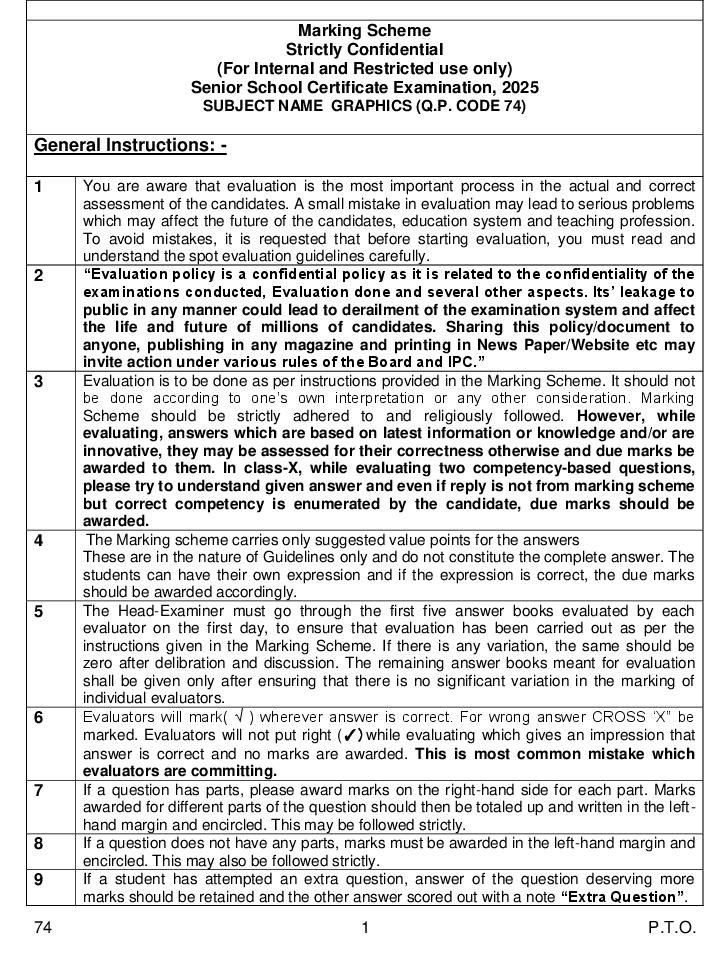
Page 1
Strictly Confidential
(For Internal and Restricted use only)
Senior School Certificate Examination, 2025
SUBJECT NAME GRAPHICS (Q.P. CODE 74)
General Instructions: -
1 You are aware that evaluation is the most important process in the actual and correct
assessment of the candidates. A small mistake in evaluation may lead to serious problems
which may affect the future of the candidates, education system and teaching profession.
To avoid mistakes, it is requested that before starting evaluation, you must read and
understand the spot evaluation guidelines carefully.
2 “Evaluation policy is a confidential policy as it is related to the confidentiality of the
examinations conducted, Evaluation done and several other aspects. Its’ leakage to
public in any manner could lead to derailment of the examination system and affect
the life and future of millions of candidates. Sharing this policy/document to
anyone, publishing in any magazine and printing in News Paper/Website etc may
invite action under various rules of the Board and IPC.”
3 Evaluation is to be done as per instructions provided in the Marking Scheme. It should not
be done according to one’s own interpretation or any other consideration. Marking
Scheme should be strictly adhered to and religiously followed. However, while
evaluating, answers which are based on latest information or knowledge and/or are
innovative, they may be assessed for their correctness otherwise and due marks be
awarded to them. In class-X, while evaluating two competency-based questions,
please try to understand given answer and even if reply is not from marking scheme
but correct competency is enumerated by the candidate, due marks should be
awarded.
4 The Marking scheme carries only suggested value points for the answers
These are in the nature of Guidelines only and do not constitute the complete answer. The
students can have their own expression and if the expression is correct, the due marks
should be awarded accordingly.
5 The Head-Examiner must go through the first five answer books evaluated by each
evaluator on the first day, to ensure that evaluation has been carried out as per the
instructions given in the Marking Scheme. If there is any variation, the same should be
zero after delibration and discussion. The remaining answer books meant for evaluation
shall be given only after ensuring that there is no significant variation in the marking of
individual evaluators.
6 Evaluators will mark( √ ) wherever answer is correct. For wrong answer CROSS ‘X” be
marked. Evaluators will not put right (✓)while evaluating which gives an impression that
answer is correct and no marks are awarded. This is most common mistake which
evaluators are committing.
7 If a question has parts, please award marks on the right-hand side for each part. Marks
awarded for different parts of the question should then be totaled up and written in the left-
hand margin and encircled. This may be followed strictly.
8 If a question does not have any parts, marks must be awarded in the left-hand margin and
encircled. This may also be followed strictly.
9 If a student has attempted an extra question, answer of the question deserving more
marks should be retained and the other answer scored out with a note “Extra Question”.
74 1 P.T.O.
Page 2
once.
11 A full scale of marks __________(example 0 to 80/70/60/50/40/30 marks as given in
Question Paper) has to be used. Please do not hesitate to award full marks if the answer
deserves it.
12 Every examiner has to necessarily do evaluation work for full working hours i.e., 8 hours
every day and evaluate 20 answer books per day in main subjects and 25 answer books
per day in other subjects (Details are given in Spot Guidelines).This is in view of the
reduced syllabus and number of questions in question paper.
13 Ensure that you do not make the following common types of errors committed by the
Examiner in the past:-
● Leaving answer or part thereof unassessed in an answer book.
● Giving more marks for an answer than assigned to it.
● Wrong totaling of marks awarded on an answer.
● Wrong transfer of marks from the inside pages of the answer book to the title page.
● Wrong question wise totaling on the title page.
● Wrong totaling of marks of the two columns on the title page.
● Wrong grand total.
● Marks in words and figures not tallying/not same.
● Wrong transfer of marks from the answer book to online award list.
● Answers marked as correct, but marks not awarded. (Ensure that the right tick mark
is correctly and clearly indicated. It should merely be a line. Same is with the X for
incorrect answer.)
● Half or a part of answer marked correct and the rest as wrong, but no marks awarded.
14 While evaluating the answer books if the answer is found to be totally incorrect, it should
be marked as cross (X) and awarded zero (0)Marks.
15 Any unassessed portion, non-carrying over of marks to the title page, or totaling error
detected by the candidate shall damage the prestige of all the personnel engaged in the
evaluation work as also of the Board. Hence, in order to uphold the prestige of all
concerned, it is again reiterated that the instructions be followed meticulously and
judiciously.
16 The Examiners should acquaint themselves with the guidelines given in the “Guidelines
for Spot Evaluation” before starting the actual evaluation.
17 Every Examiner shall also ensure that all the answers are evaluated, marks carried over to
the title page, correctly totaled and written in figures and words.
18 The candidates are entitled to obtain photocopy of the Answer Book on request on
payment of the prescribed processing fee. All Examiners/Additional Head Examiners/Head
Examiners are once again reminded that they must ensure that evaluation is carried out
strictly as per value points for each answer as given in the Marking Scheme.
74 2
Page 3
MARKING SCHEME
GRAPHICS
SECTION A
1. Select the right answer from the given options: 81=8
(i) (B) Copper (oxidized), wire and tin 1
(ii) (C) (A) is true, but (R) is false. 1
(iii) (B) Sahibdin 1
(iv) (B) Hyderabad 1
(v) (C) Ustad Mansoor 1
(vi) (D) Journey’s End 1
(vii) (A) Both (A) and (R) are true and (R) is the correct explanation of (A).
(viii) (C) Jyoti Bhatt 1
SECTION B
(Short Answer Type Questions)
Answer for these questions is expected in around 100 words.
2.(a)Name of the artist -Amrita Sher Gill 0.5
Name of the Painting-Haldi Grinders 0.5
Any two Artistic feature can include (0.5 each) =1
Haldi Grinders painting artist has used her favourite colours like red yellow green brown etc.
which fill a new visual reality in the painting. The painting has deep sense of melancholy that
finds expressions in the pensive faces of the figure. in this painting a rural scene has been shown.
74 3 P.T.O.
Page 4
minutely, one more female figure other than the three have been shown behind a dominating tree
in the foreground on the left side of the painting, on the right side the second lady’s back has been
shown only and her back is supported by another tree on right side of the painting. While the third
lady’s face is visible and she is on the left side ahead the tree. Amrita Shergill has depicted the
ladies with dark complexion. she has also shown the unhappy sad dejected poor and starving
women in such an expressive way. So, this painting has many good qualities in it to be liked by
everyone.
OR
(b) Name of the sculpture- Cries unheard 0.5
Emotions in the sculpture – 1.5
Amar Nath Sehgal’s sculpture Cries Unheard is a poignant representation of suppressed suffering
and unheard voices. The dominant emotions in this artwork are pain, despair, and helplessness,
symbolizing the agony of those who suffer in silence. The distorted and elongated forms in the
sculpture express deep emotional turmoil, evoking a sense of injustice and neglect. Sehgal
masterfully captures the silent screams of the oppressed, urging the viewer to acknowledge their
struggles. Through expressive abstraction, the sculpture becomes a powerful voice for the
unheard, emphasizing the need for empathy and social awareness in the face of human suffering.
3.(a)Name of the artist- Miskin 0.5
Name of the artwork- Krishna Lifting Mount Govardhan 0.5
Describe the painting 1
Key points that can be used in the answer:
It is an early painting of Akbar’s time in this vertical painting Krishna was shown lifting Mount
Goverdhan on the little finger on his left hand. A big multi – coloured mountain with deer,
monkeys , trees, shrubs and grass has been painted. The handling of the huge mountains shows
Persian influence. Under the mountain, all Brijvasi ( people of Brij ) have gathered with their
cattle to get shelter from the deluge caused by the angry rain god – Indra. On the top, sky is shown
with blue colour. On the right side of Krishna, a tree is shown in bright green colour.
74 4
Page 5
(b)Jahangir 2
Key points that can be used in the answer:
Ustad Mansoor knew the fondness of emperor for his pet falcon. In this painting a tamed falcon is
sitting on a cushioned bird rest. On the bird rest, Nadir – ul – As is signed by Ustad Mansoor who
was awarded this title. The cruel eye of falcon can be seen in this painting. The falcon is painted in
white against a yellow background with brown details of its folded wings, a sharp beak and round
vigilant eyes is painted in light brown and yellow ochre deep colour.
Three words Jahangir Patashah at top, Bahari near the falcon and Uttam on the bottom are written.
Bahari means falcon and Uttam means excellent.
4.(a) Appreciation of the painting Radha (Bani Thani) 2
Key points that can be used in the answer:
Radha Bani Thani, painted by Nihal Chand in 1760 A.D., is a masterpiece of the Krishangarh sub-
school of Rajasthani art. Created using tempera watercolors, the painting is admired for its
elegance and idealized beauty. Radha's elongated face, arched eyebrows, sharp nose, and thin red
lips create a delicate and refined expression. Her long black hair flows gracefully, adding to her
charm. She holds a transparent orhni with her slender fingers, decorated with golden motifs. In her
left hand, she holds two lotus buds, symbolizing purity. The deep blue background contrasts
beautifully with her peach-colored skin, enhancing the painting's mystical aura.
OR
(b) Name of artist-Guman 0.5
Name of painting- Bharat Meets Rama at Chitrakuta 0.5
Subject matter – 1
The painting depicts a scene from Ramayana when Bharat comes to chitrakuta to meet Rama with
his three mothers and guru Vishwa Mitra various episode have been shown in a single scene.
74 5 P.T.O.
Page 6
Name of artist-Manku 0.5
Aesthetic qualities 1
The painting Krishna with Eight Gopis by Manku, from the Pahari school of miniature painting, is
a mesmerizing depiction of divine love and devotion. It follows the traditional features of
Rajasthani and Pahari art, characterized by graceful figures, detailed ornamentation, and vibrant
colors.In the composition, Lord Krishna stands at the center, surrounded by eight beautifully
adorned Gopis. He is depicted with his blue complexion, wearing a yellow dhoti and an elaborate
crown decorated with peacock feathers. The Gopis, dressed in brightly colored traditional attire,
display expressions of adoration, joy, and longing as they gaze upon Krishna, illustrating their
deep spiritual connection and devotion.The background features the Yamuna River, symbolizing
the divine setting of Vrindavan, where Krishna’s playful and loving interactions with the Gopis
took place. The high horizon in the painting gives an expansive view of the landscape, enhancing
the depth and perspective. The serene waters of the Yamuna, lush greenery, and trees further
enrich the mystical and romantic atmosphere.
OR
(b) Nand, Yashoda and Krishna with Kinsmen going to Vrindavana
Composional Arrangement 2
Kangra, Water colour.This painting, inspired by the Bhagavata Purana, depicts Nanda and his
family migrating to Vrindavan for safety from demons troubling Krishna. Nanda leads the group
on a bullock cart, followed by Krishna and Balarama with their mothers, Yashoda and Rohini.
Men, women, and children carry household items, their expressions and body language reflecting
emotions like fatigue, conversation, and effort. The naturalistic landscape, a hallmark of Kangra
painters, enhances realism. The flush-cut composition, resembling a photograph, adds depth and
movement, showcasing Kangra art’s keen observation and intricate detailing, making the scene
vivid and lifelike.
6. (a) use of colours and the symbolic meaning of chakra in our National Flag 1
Key points that can be used in the answer
Colours: Saffron at the top represents courage and sacrifice, White in the middle symbolizes peace
and truth, and Green at the bottom signifies faith and prosperity. The Ashoka Chakra in the center
has 24 spokes, representing continuous movement and righteousness. It is derived from Ashoka’s
74 6
Page 7
emphasizes that life should always move forward. The 24 spokes represent 24 moral virtues, such
as truth, justice, and duty, promoting a balanced and ethical life for all citizens.
Inspiration 1
The National Flag of India symbolizes pride, unity, and dedication. Its saffron, white, and green
colors represent courage, peace, and prosperity, while the Ashoka Chakra signifies progress. It
unites Indians, evoking patriotism and a shared identity, inspiring citizens to uphold the nation's
values with honor and commitment.
OR
(b) Name of graphic print "Man, Woman and Tree" 0.5
Subject matter- of this artwork revolves around human suffering, resilience, and the
deep connection between humanity and nature. 0.5
Aesthetic features-any two (0.5 each) 1
The composition features distorted, skeletal figures of a man and a woman, symbolizing pain
and struggle, with a barren tree emphasizing desolation and hardship. Aesthetically, the print is
marked by its strong, expressive lines, rough textures, and high contrast, evoking raw emotions.
Hore’s use of minimal yet powerful imagery creates a haunting impact, making the print deeply
thought-provoking and emotionally charged.
SECTION C
(Long Answer Type Questions)
Attempt any two questions from the given options :
Answer for these questions is expected in around 200 words.
7. Name of painting- Krishna on swing 1
Name of the artist –Nuruddin 1
Compositional management 2
74 7 P.T.O.
Page 8
painting has two panels depicting two different part of scene. On the first part of the panel Krishna
is shown sitting on a swing on the left side of the panel. He is wearing a tiara on his head, his
upper part is semi-clothed and there is white flower garland on his neck. There is a Dupatta
hanging from his shoulders, and he is wearing an orange coloured ‘dhoti’. The blue complexion of
his body has been highlighted. The swing has an ornamental border is hexagonal shape. Radha
sitting in front of him in the balcony is wearing traditional but decorated ‘Ghangra’ and ‘choli’.
They are looking at each other. Her head is covered with a transparent Odhnis and she is sitting on
arced carpet. There is pillow supporting the back of both Radha and Krishna. In the lower panel,
both Radha and Krishna are sitting at different places under a tree in a foreground. An attendant of
Radha is also shown in the painting. She has perhaps brought a message for Krishna. Here again
Krishna is wearing tiara, garland and Dupatta, but his dhoti is of yellow colour. Both Radha and
Krishna are sitting on red carpets supported by pillows. Radha is wearing yellow colored
“Ghangra” and “Choli”. The attendant standing striped Ghangra Choli of light purple colors. Both
the Tree and a mound are in the background. The leaves of the trees are shown clearly in cluster of
repeating pattern. Each leaf of the tree reveals the artist’s delight in rendering details.
• Any 2 main features of Rajasthani School (1 mark each) 2
1. Vibrant Colors – The paintings prominently use bright colors like red, yellow, blue, and
green, often derived from natural sources. Gold and silver are also used for embellishment.
2. Religious Themes – Most paintings depict themes from Ramayana, Mahabharata,
Bhagavata Purana, and the life of Lord Krishna, especially his interactions with Radha and
the Gopis.
3. Rajput Influence – The paintings reflect the grandeur of Rajput culture, showcasing court
scenes, hunting expeditions, royal processions, and battle scenes.
4. Miniature Style – The paintings are small in size but rich in detail, making them visually
intricate and highly expressive.
5. Stylized Human Figures – Women are portrayed with elongated eyes, narrow waists, and
graceful postures, while men have strong facial features and well-defined turbans.
6. Flat Backgrounds – The backgrounds are often plain or decorated with floral designs,
architecture, or landscapes to highlight the main subject.
7. Regional Sub-Schools – The Rajasthani school consists of various sub-schools such as
Mewar, Marwar, Bundi, Kishangarh, Bikaner, and Jaipur, each with its own distinctive
style.
8. Nature Elements – Trees, birds, rivers, and animals are depicted in a decorative manner,
enhancing the beauty and storytelling of the paintings.
9. Use of Gold and Silver – Some paintings, especially those depicting royal subjects, use
gold and silver foiling to give a luxurious feel.
74 8
Page 9
on the aesthetic appeal rather than realism.
8. Name of painting-Marriage procession of Dara Shikoh 0.5
Name of artist- Haji Madni 0.5
Description 2
This magnificent painting, an all-time master piece, is a vertical brilliant depiction of the marriage
procession of Dara Shikoh who is riding alert on a decorated horse. While his father is also riding
on another decorated horse, just behind Dara Shikoh’s horse. He is followed by three attendant
one bearing a candle, the second one holding the horse and the third one is carrying a chowri. The
royal people are shown riding horses and some are on foot proceeding towards the bride’s house.
A large gathering of men and woman is joyfully receiving the Barat. All the figures are ek-chasm.
Marvellous depiction of various types of fireworks can be seen in the background. Well decorated
border is there. White, Red, Green, Maroon, Turquoise blue with a touch of Greyish black colour
have been used. Golden colour has also been used at important places. This meticulously done
painting brings forth all the gaiety and joy of the festive occasion.
Any 3 characteristics of Mughal school 3
- Fusion of Persian and Indian Styles – The Mughal school combines Persian influences
with Indian themes, creating a unique blend of intricate detailing and realism.
- Realism and Naturalism – Unlike earlier Indian paintings, Mughal art emphasizes
naturalistic details, realistic human figures, and accurate depictions of flora and fauna.
- Portraits and Court Scenes – The school is known for its detailed portraits of emperors,
courtiers, nobles, and saints, capturing their expressions, emotions, and elaborate
costumes.
- Use of Perspective – Unlike traditional Indian art, Mughal paintings use depth, shading,
and perspective to create a three-dimensional effect.
- Fine Brushwork – The paintings feature intricate detailing, delicate lines, and fine
brushwork, showcasing the artistic skills of the painters.
- Rich and Subtle Colors – Artists used soft, natural colors like gold, blue, red, and brown,
often derived from minerals and vegetables, to enhance the painting’s elegance.
- Themes from Literature and History – Many paintings illustrate scenes from Persian and
Indian literary works such as the Baburnama, Akbarnama, Ramayana, Mahabharata, and
Shahnameh.
- Architectural Backgrounds – The paintings often include palaces, gardens, and Mughal-
style domes, reflecting the grandeur of Mughal architecture.
- Hunting and Battle Scenes – Many paintings depict royal hunting expeditions, battles, and
processions, showcasing the power and lifestyle of Mughal rulers.
74 9 P.T.O.
Page 10
emperors like Akbar, Jahangir, and Shah Jahan, each contributing to its evolution in style
and subject matter.
9.(a)Feelings and emotions 2
Somnath Hore's graphic print Children evokes deep feelings of sorrow, empathy, and
awareness of social injustice. The figures, with their frail bodies, torn clothing, and
desperate expressions, highlight the harsh realities faced by the underprivileged. The
mother's protective hand conveys a sense of love and resilience despite suffering. The
use of black and white enhances the starkness of their pain, making the artwork even
more powerful. This composition serves as a moving reminder of inequality and human
struggle, urging society to recognize and address the plight of the poor and vulnerable
(b)Name of graphic print -Children 1
Name of the print maker-Somnath Hore 1
(c) Compositional arrangement and use of figures in this print. 2
The composition is tightly arranged, emphasizing the close-knit isolation of a struggling family.
Five figures are centrally placed, reinforcing their unity in distress. The mother, standing
protectively with her two sons, expresses quiet resilience, while the children’s frail bodies and torn
clothing reflect their vulnerability. The girl on the right, shown from the back, adds depth to the
scene, while the child at the top, with only his face and hands visible, heightens the emotional
intensity. The figures' exaggerated features—bloated stomachs, large heads, and protruding ribs—
intensify their pain and malnourishment. The mother’s hand on her children’s shoulders provides a
touch of warmth amidst despair. The geometric composition and stark contrasts in black and white
amplify the grim reality of poverty, making this print a compelling commentary on social
inequality and human suffering.
74 10
Document Details
| Board / Org | CBSE |
| Exam | Class 12 |
| Type | Solution |
| Pages | 10 |
| Updated | 24 Sep 2026 |