MAHA SET 2018 Question Paper 3 Economics
Finished viewing? Save it for later —
Download MAHA SET 2018 Question Paper 3 Economics (PDF · 40 pages)About MAHA SET 2018 Question Paper 3 Economics
MAHA SET 2018 Question Paper 3 Economics is available here for free download. Published by Maharashtra Exams for MAHA SET, this question paper can be viewed online or downloaded as a PDF (40 pages). Candidates preparing for MAHA SET can use MAHA SET 2018 Question Paper 3 Economics to understand the exam pattern, the type of questions asked, and the overall difficulty level.
Frequently Asked Questions
How can I download MAHA SET 2018 Question Paper 3 Economics?
Open this page and click the Download button to save MAHA SET 2018 Question Paper 3 Economics as a PDF. It is completely free on AglaSem Docs.
Is MAHA SET 2018 Question Paper 3 Economics free to download?
Yes. MAHA SET 2018 Question Paper 3 Economics can be viewed online and downloaded as a PDF free of cost on AglaSem Docs.
How many pages does MAHA SET 2018 Question Paper 3 Economics have?
MAHA SET 2018 Question Paper 3 Economics contains 40 pages, which you can read online or download together as a single PDF.
Where can I find more MAHA SET study material?
You can find more MAHA SET question papers, sample papers, syllabus, and answer keys on AglaSem Docs.
MAHA SET 2018 Question Paper 3 Economics – Text
Read the full text of this question paper below — useful to quickly search, copy and reference the content online without downloading the PDF.
📄 View text version (40 pages)
Page 1
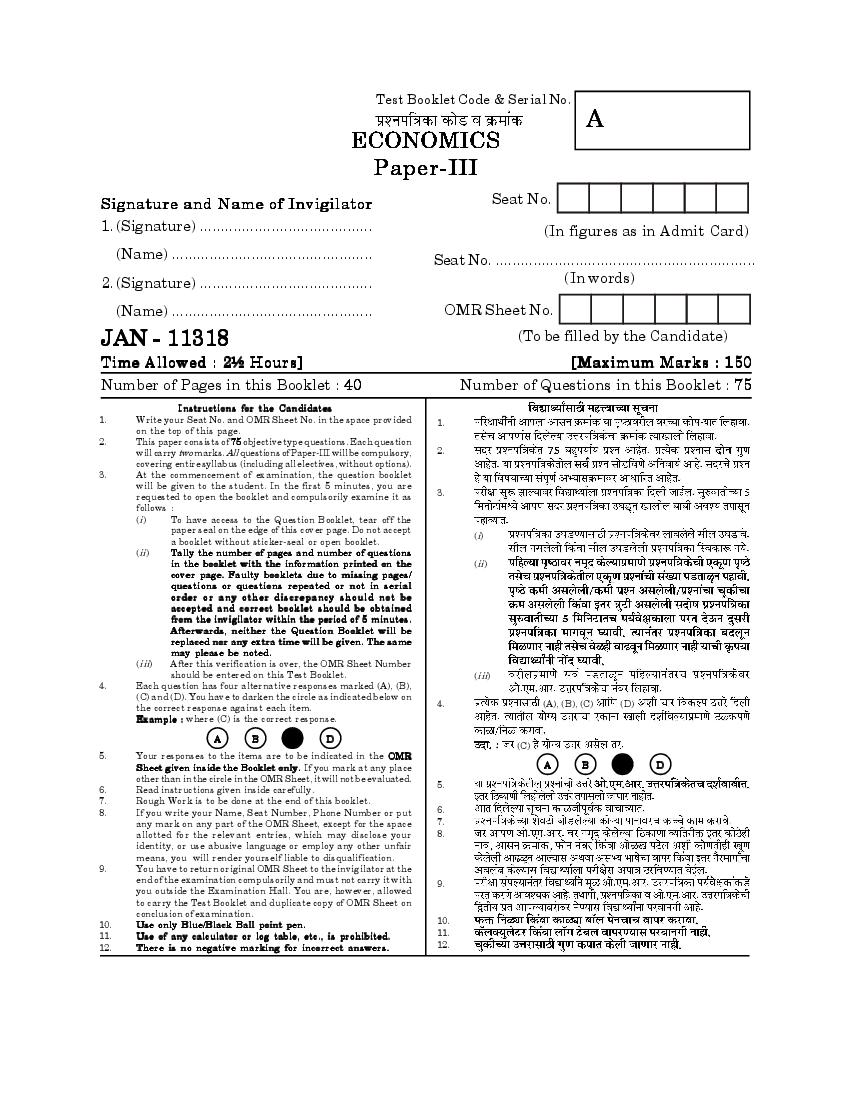
A
Paper-III
Signature and Name of Invigilator Seat No.
1. (Signature) ......................................... (In figures as in Admit Card)
(Name) ................................................ Seat No. ..............................................................
2. (Signature) ......................................... (In words)
(Name) ................................................ OMR Sheet No.
JAN - 11318 (To be filled by the Candidate)
Time Allowed : 2½ Hours] [Maximum Marks : 150
Number of Pages in this Booklet : 40 Number of Questions in this Booklet : 75
Instructions for the Candidates
1. Write your Seat No. and OMR Sheet No. in the space provided 1.
on the top of this page.
2. This paper consists of 75 objective type questions. Each question
will carry two marks. All questions of Paper-III will be compulsory, 2.
covering entire syllabus (including all electives, without options).
3. At the commencement of examination, the question booklet
will be given to the student. In the first 5 minutes, you are
requested to open the booklet and compulsorily examine it as 3.
follows :
(i) To have access to the Question Booklet, tear off the
paper seal on the edge of this cover page. Do not accept
(i)
a booklet without sticker-seal or open booklet.
(ii) Tally the number of pages and number of questions
in the booklet with the information printed on the (ii)
cover page. Faulty booklets due to missing pages/
questions or questions repeated or not in serial
o rder or any other discre pancy should not be
accepted and correct booklet should be obtained
from the invigilator within the period of 5 minutes.
Afterwards, neither the Question Booklet will be
replaced nor any extra time will be given. The same
may please be noted.
(iii) After this verification is over, the OMR Sheet Number
should be entered on this Test Booklet. (iii)
4. Each question has four alternative responses marked (A), (B),
(C) and (D). You have to darken the circle as indicated below on
the correct response against each item. 4. (A), (B), (C) (D)
Example : where (C) is the correct response.
A B D
(C)
5. Your responses to the items are to be indicated in the OMR
Sheet given inside the Booklet only. If you mark at any place A B D
other than in the circle in the OMR Sheet, it will not be evaluated.
5.
6. Read instructions given inside carefully.
7. Rough Work is to be done at the end of this booklet.
8. If you write your Name, Seat Number, Phone Number or put 6.
any mark on any part of the OMR Sheet, except for the space 7.
allotted for the relevant entries, which may disclose your 8.
identity, or use abusive language or employ any other unfair
means, you will render yourself liable to disqualification.
9. You have to return original OMR Sheet to the invigilator at the
end of the examination compulsorily and must not carry it with 9.
you outside the Examination Hall. You are, however, allowed
to carry the Test Booklet and duplicate copy of OMR Sheet on
conclusion of examination.
10. Use only Blue/Black Ball point pen. 10.
11. Use of any calculator or log table, etc., is prohibited. 11.
12. There is no negative marking for incorrect answers. 12.
Page 2
Page 3
Paper III
III
Time Allowed : 2½ Hours] [Maximum Marks : 150
Note : This Question Paper contains Seventy Five (75) multiple choice questions.
Each question carries Two (2) marks. Attempt All questions.
(75) (2)
1. The precision of OLS estimator is 1.
measured by their :
(A) Mean (A)
(B) Mode (B)
(C) Standard errors (C)
(D) Sign (D)
2. Which one of the following is not a 2.
part of classical assumptions, in
regression analysis ?
(A) Values taken by dependent (A)
variable Y is fixed in repeated
sampling
(B) Regression model is linear in (B)
parameters
(C) Error term has zero mean
(C)
(D) Error term has a constant
variance (D)
3 [P.T.O.
Page 4
2 2
hypothesized 2, the ‘t’ value will be ‘ t’
equal to :
(A) 0 (A) 0
(B) 1 (B) 1
(C) 30 (C) 30
(D) Standard error of ˆ 2 (D) ˆ 2
4. Which of the following are plausible
4.
approaches to dealing with a model
that exhibits ‘heteroscedasticity’ ?
(i) Take logarithms of each of the (i)
variables
(ii)
(ii) Use suitably modified standard
errors
(iii)
(iii) Use generalised least squares
(iv)
procedure
(iv) Add logged values of the
variables to the regression
(A) (ii) (iv)
equations
(A) (ii) and (iv) only (B) (i) (iii)
(B) (i) and (iii) only
(C) (i), (ii) (iii)
(C) (i), (ii) and (iii) only
(D) (i), (ii), (iii) (iv)
(D) (i), (ii), (iii) and (iv)
4
Page 5
with :
(A) Time varying mean (A)
(B) Time varying variance (B)
(C) Both (A) and (B) (C) (A) (B)
(D) Time invariant mean and (D)
variance
6. What can you say about the 6.
following statements ?
(i)
(i) Cournot’s duopoly model
assumes homogeneous product
of producers.
(ii)
(ii) Cournot assumes price of the
rival producer constant.
(A) (i) (ii)
(A) Both statement (i ) and
statement (ii) are incorrect
(B) (i) (ii)
(B) Both statement (i ) and
statement (ii) are correct
(C) Statement (i) is incorrect and (C) (i) (ii)
statement (ii) is correct
(D) Statement (i) is correct and (D) (i) (ii)
statement (ii) is incorrect
5 [P.T.O.
Page 6
government bonds, then :
(A) LM curve shifts to the left (A) LM
(B) LM curve becomes vertical (B) LM
(C) LM curve becomes horizontal (C) LM
(D) LM curve shifts to the right (D) LM
8. If the investment function becomes
8.
interest inelastic at a low rate of
IS
interest, the corresponding IS curve
becomes : (A)
(A) Horizontal
(B)
(B) Upward sloping
(C)
(C) Vertical
(D)
(D) Flatter
6
Page 7
Oligopoly is a situation where a few
large firms compete against each
other.
Statement II : II :
Under oligopoly there is an element
of interdependence in the decision-
making of competing firms.
(A) Statement I is true but the (A) I II
Statement II is false
(B) Statement I is false but the (B) I II
Statement II is correct
(C) Both the Statement I and (C) I II
Statement II are correct
(D) Both the Statement I and (D) I II
Statement II are false
10. Monopoly power refers to the : 10.
(A) Restraints imposed by the
(A)
competitors on each other
(B)
(B) Restraints imposed over
competitors by the price maker
(C) Restraints imposed on the (C)
quantity of production by each
other
(D)
(D) Restraints imposed on prices of
production of each other
7 [P.T.O.
Page 8
usually referred to as :
(A) Euro bonds (A)
(B) Euro currencies (B)
(C) Euro banks (C)
(D) Euro deposits (D)
12. According to the Product Cycle 12.
Hypothesis, innovation leads to
................................ for the innovating
country.
(A)
(A) absolute monopoly
(B)
(B) relative monopoly
(C)
(C) temporary monopoly
(D) long-term monopoly (D)
8
Page 9
(A) The acceptance of foreign
(A)
exchange risk
(B)
(B) The covering of foreign
exchange risk
(C)
(C) Foreign exchange arbitration
(D) Foreign exchange speculation (D)
14. Name the Economist represented 14.
United States at the Bretton Woods
Conference :
(A)
(A) Marriner S. Eccles
(B)
(B) Paul A. Samuelson
(C)
(C) John Maynard Keynes
(D) Harry Dexter White (D)
9 [P.T.O.
Page 10
Prior to Greek debt crisis, many
German banks helped finance
Greece’s debt and Greece knew
very well that the IMF and the
Western States would have to use
bailout funds to bear the lost of
Greece’s failure.
Statement II : II :
The idea of single currency market
had an unrealistic assumption of
perfect information and ignored
that in real world information is
imperfect.
(A) I II
(A) Both the Statements I and II
are correct and Statement II is II I
the reason for Statement I
(B) Both the Statements I and II (B) I II
are correct and Statement I is I II
the reason for Statement II
(C) Both the Statements I and II
(C) I II
are correct but no statement is
reason to the other
(D) Statement I is correct but
Statement II cannot be the (D) I II
reason for Statement I I
10
Page 11
Wage Rates which are applicable
for Agricultural labourers fixed
by the Central Government as on
31-12-2013 were :
(A) 465.00 186.00
(A) Rs. 465.00 and Rs. 186.00
(B) Rs. 437.00 and Rs. 165.00 (B) 437.00 165.00
(C) Rs. 439.00 and Rs. 195.00 (C) 439.00 195.00
(D) Rs. 432.00 and Rs. 188.00 (D) 432.00 188.00
17. Which one of the following is not the 17.
salient feature of the APMC Model 2003
Act, 2003 ?
(A) Permission to farmers to
establish new markets in any (A)
area.
(B) No compulsion to farmers to sell (B)
their produce through existing
regulated markets.
(C) Setting up of farmers-
consumer markets for direct (C)
sale.
(D) To facilitate processing at the
(D)
place of marketing and promote
exports.
18. In Indian agriculture farm size and 18.
productivity show :
(A) Inverse relationship (A)
(B) Positive relationship (B)
(C) Neither inverse nor positive
(C)
relationship
(D)
(D) Fluctuating relationship
11 [P.T.O.
Page 12
following statements ?
(i)
(i) NABARD was established in
July 1982 for taking over the
functions of Agricultural 1982
Refinance and Development
(ii)
Corporation (ARDC).
(ii) NABARD extends refinancing
facilities to all scheduled banks (A) (i) (ii)
in India.
(A) Statement (i) is correct and
statement (ii) is incorrect (B) (i) (ii)
(B) Statement (i) is incorrect and
statement (ii) is correct (C) ( i) (ii)
(C) Both the statements (i) and (ii)
are correct
(D) ( i) (ii)
(D) Both the statements (i) and (ii)
are incorrect
20. As per the views of the National 20.
Advisory Council, the food security 2013
legislation 2013 was expected to
cover ........................... population of
country.
(A) 68
(A) 68 percent
(B) 75 percent (B) 75
(C) 83 percent (C) 83
(D) 89 percent (D) 89
12
Page 13
following statements ?
(i)
(i) Planning Commission in India
was a statutory body.
(ii)
(ii) Finance Commission in India is
a permanent advisory body.
(A) (i) (ii)
(A) Statement (i) is correct and
statement (ii) is incorrect
(B) (i) (ii)
(B) Statement (i) is incorrect and
statement (ii) is correct
(C) (i) (ii)
(C) Both the statements (i) and (ii)
are correct
(D) (i) (ii)
(D) Both the statements (i) and (ii)
are incorrect
13 [P.T.O.
Page 14
following statements ?
(i)
(i) The share of rural incomes in
India’s GDP is falling during
recent time.
(ii)
(ii) The share of organized sector in
India’s GDP is rising during
recent time.
(A) (i) (ii)
(A) Both (i) and (ii) statements are
incorrect
(B) (i) (ii)
(B) Statement (i) is correct and
statement (ii) is incorrect
(C) Both (i) and (ii) statements are (C) (i) (ii)
correct
(D) Statement (i) is incorrect and (D) (i) (ii)
statement (ii) is correct
23. Global warming in the world is 23.
majorly due to :
(A) Hot Summers (A)
(B) Green-house Effects (B)
(C) Erratic Summers (C)
(D) Irregular Monsoons (D)
14
Page 15
with which one of the following ?
(A) Special Economic Zones (A)
(B) Full Capital Account (B)
Convertibility of Rupee
(C) Foreign Exchange Reserves (C)
(D) Effect of oil prices on the Indian (D)
Economy
25. Fill in the blanks : 25.
Census of Literacy rate
India in India
(percentage)
1991 ? 1991 ?
2001 ? 2001 ?
2011 ? 2011 ?
(A) 52.2 64.8 74.1 (A) 52.2 64.8 74.1
(B) 50.1 62.0 70.3 (B) 50.1 62.0 70.3
(C) 55.5 65.5 76.7 (C) 55.5 65.5 76.7
(D) 54.2 66.8 76.1 (D) 54.2 66.8 76.1
15 [P.T.O.
Page 16
Marginal Fixed Cost (MFC) is
always :
(A)
(A) rising
(B)
(B) falling
(C)
(C) negative
(D) zero (D)
27. The book “Value and Capital” is 27.
authored by :
(A) Tapas Majumdar (A)
(B) R.G.D. Allen (B)
(C) J.R. Hicks (C)
(D) Joan Robinson (D)
28. (i) An individual labour invariably 28. (i)
shows backward bending supply
curve.
(ii)
(ii) Supply of labour to an industry
shows high elasticity.
What can you say of these
statements ? (A) (i) (ii)
(A) Both statements (i) and (ii) are
correct
(B) (i) (ii)
(B) Both statements (i) and (ii) are
incorrect
(C) (i) (ii)
(C) Statement (i) is incorrect and
statement (ii) is correct
(D) Statement (i) is correct and (D) (i) (ii)
statement (ii) is incorrect
16
Page 17
firm will choose to exit a market
when :
(A) Fixed costs exceed sunk costs (A)
(B) Average fixed cost is rising (B)
(C) Total Revenue (TR) from (C)
production is less than Total (TR) (TC)
Cost (TC)
(D) Marginal cost is above average (D)
cost
30. Demand for factors of production 30.
is :
(A) Derived demand (A)
(B) Joint demand (B)
(C) Cross demand (C)
(D) Net demand (D)
17 [P.T.O.
Page 18
Keynesian model generates :
(A) Downward sloping aggregate
supply curve
(B) Upward sloping aggregate (A)
supply curve
(B)
(C) Vertical aggregate supply curve
(C)
(D) Horizontal aggregate supply
curve (D)
32. Choose the right answer from the 32.
options A to D given below :
(S) :
Assertion (S) :
In the classical model, no
equilibrium other than full-
(R) :
employment is possible.
Reasoning (R) :
This is ensured by a positively sloped
AS curve and a negatively sloped (A) (S) (R)
AD curve.
(A) (S) is correct and (R) is correct (B) (S) (R)
(B) (S) is correct and (R) is incorrect
(C) (S) is incorrect and (R) is correct (C) (S) (R)
(D) (S) is incorrect and (R) is
incorrect (D) (S) (R)
18
Page 19
model, if exchange rate is flexible,
then fiscal policy is a failure
because :
(A)
(A) Balance of payments is in
deficit, currency depreciates and
net exports go up
(B)
(B) Balance of payments is in
deficit, currency appreciates and
net exports go down
(C)
(C) Balance of payments is in
surplus, currency appreciates
and net exports go down
(D) Balance of payments is in (D)
surplus, currency depreciates
and net exports go down
34. Which one of the following is not a 34.
determinant of money multiplier in
an economy ?
(A)
(A) Currency to Deposit ratio
(B)
(B) Excess reserve ratio
(C)
(C) Required cash reserve ratio
(D) Consumption to currency ratio (D)
19 [P.T.O.
Page 20
hypothesis rests on the assumption
that utility function of an individual
is influenced by :
(A) Average consumption of the
economy (A)
(B) Marginal consumption of the (B)
economy
(C)
(C) Only lowest value of
consumption of the economy
(D)
(D) Only highest value of
consumption of the economy
36. Prof. Gunnar Myrdal combines 36.
national and international forces to
discuss process of economic
development on the basis of :
(A) Export and import potential
(B) Backwash effects and spread
(A)
effects
(B)
(C) Income inequalities in the
economy
(C)
(D) Demand and supply forces in
(D)
the economy
20
Page 21
of different production functions in
advanced sector and traditional
sector of an underdeveloped
economy is referred as .........................
dualism.
(A)
(A) Financial
(B)
(B) Social
(C) Technical (C)
(D) Credit (D)
38. The concept of Physical Quality of 38. (PQLI)
Life Index (PQLI) was developed
by :
(A) S. Kuznet (A)
(B) R. Nurkse (B)
(C) Arthur Lewis (C)
(D) M.D. Morris (D)
21 [P.T.O.
Page 22
accelerate the rate of capital
formation and maximum productive
capacity and employment in the
long-run in developing countries like
India.
(A)
(A) Capital intensive
(B)
(B) Labour intensive
(C)
(C) Appropriate technology
(D) Intermediate technology (D)
40. The Gini coefficient provides a 40.
measure of :
(A) The level of poverty
(A)
(B) The level of relative income
inequality (B)
(C) The level of disguised
(C)
unemployment
(D)
(D) The level of economic growth
22
Page 23
ratio of :
(A) Growth in tax revenue to the (A)
growth in GDP
(B) Growth in non-tax revenue to (B)
the growth in gross tax revenue
(C) Growth in revenue to growth in (C)
total expenditure
(D) Growth in total expenditure to (D)
growth in GDP
42. ‘Shifting of tax’ is seen in case of 42.
............................. taxes.
(A) Direct (A)
(B) Indirect (B)
(C) International (C)
(D) Local (D)
23 [P.T.O.
Page 24
was first used in :
(A) America (A)
(B) Australia (B)
(C) Germany (C)
(D) France (D)
44. The fiscal deficit is not financed 44.
through :
(A) Proceeds from State Provident
(A)
Fund
(B)
(B) Treasury Bills
(C)
(C) Dated Securities
(D) Debt raised under Market (D)
Stabilization Scheme
45. The proceeds collected under Article 45.
271 of the constitution are retained
by :
(A) State Governments (A)
(B) Union Government (B)
(C) Urban Local Bodies (C)
(D) Rural Local Bodies (D)
24
Page 25
Initial phase of trade liberalisation
in India led to an increase in
employment opportunities.
II :
Statement II :
Later phase of trade liberalisation
in India resulted into a Jobless
growth. (A) I II
(A) Both the Statement I and
Statement II are correct
(B) I II
(B) Both the Statement I and
Statement II are false
(C) I II
(C) Statement I is true but the
Statement II is false
(D) Statement I is false but the (D) I II
Statement II is correct
47. In the Balance of Payment accounts, 47.
transfer payments are included in
the :
(A) Current Account (A)
(B) Service Account (B)
(C) Capital Account (C)
(D) Official Resources Account (D)
25 [P.T.O.
Page 26
mercantilists have objected ?
(A) Free trade
(A)
(B) Stimulating exports
(B)
(C) Restricting imports
(C)
(D) Accumulation of gold by their
(D)
nation
49. I :
49. Statement I :
International trade allows creation
of an integrated market.
Statement II : II :
The international market which
emerges as a result of international
trade distorts competition.
(A) I II
(A) Statement I is true but the
Statement II is false
(B) I II
(B) Both the Statement I and
Statement II are true
(C) I II
(C) Statement I is false but the
Statement II is true
(D) Both the Statement I and (D) I II
Statement II are false
26
Page 27
(A) Firm charges higher price on
exports than it charges
(A)
domestically
(B) Firm charges lower price
domestically than it charges for (B)
exports
(C) Firm charges lower price on
(C)
exports than it charges
domestically
(D)
(D) Firm charges different prices on
exports in different countries
51. As per the RBI definition, money 51.
supply with the public in India (M1) (M1)
is defined as :
(A) Currency with the public +
(A) +
Deposit money with the public
(B) Currency with the public + Post
(B) +
office saving deposits
(C) Notes and coins in circulation
(C)
(D) Notes in circulation + demand
deposits of banks (D) +
27 [P.T.O.
Page 28
exchange in India.
(A) NSE (A)
(B) ASE (B)
(C) BSE (C)
(D) DSE (D)
53. In three-tier structure of co-operative 53.
credit institutions, the apex state
level institution is :
(A) RBI
(A)
(B) State Co-operative Bank
(B)
(C) NABARD
(C)
(D) District Central Co-operative
(D)
Bank
28
Page 29
credit controls are effective in the
economy ?
(A)
(A) To control inflation
(B)
(B) To control deflation
(C) To control imports (C)
(D) To control exports (D)
55. (i) RRBs were initially established 55. (i) 1985
in the year 1985 in India.
(ii) RRBs are scheduled Banks.
(ii)
What can you say about these
statements ?
(A) Both (i) and (ii) statements are
wrong (A) (i) (ii)
(B) Both (i) and (ii) statements are (B) (i) (ii)
correct
(C) (i) (ii)
(C) Statement (i) is correct and
statement (ii) is incorrect
(D) (i) (ii)
(D) Statement (i) is incorrect and
statement (ii) is correct
29 [P.T.O.
Page 30
place in top producers of steel in the
world.
(A) 6th (A) 6
(B) 4th (B) 4
(C) 5th (C) 5
(D) 7th (D) 7
57. Consequent to the ....................... the 57.
concept of “dominant position” in
industries was introduced in India.
(A) SICA (A) SICA
(B) Competition Act 2002 (B)
(C) MRTP Act (C)
(D) Industrial Policy Resolution
1956 (D)
30
Page 31
their intensity, the problems of
industrial development in India
during the planning period :
(i)
(i) regional imbalance
(ii)
(ii) unemployment
(iii)
(iii) poor export performance
(A) (i), (ii), (iii)
(A) (i), (ii), (iii)
(B) (ii), (iii), (i) (B) (ii), (iii), (i)
(C) (iii), (i), (ii) (C) (iii), (i), (ii)
(D) (ii), (i), (iii) (D) (ii), (i), (iii)
59. As per the new classification of 59.
industries the micro-enterprises
should have maximum investment
of Rs. ..................... in manufacturing
enterprises and Rs. ..................... in
service enterprises respectively.
(A) 10 , 5
(A) Rs. 10 lakhs, Rs. 5 lakhs
(B) 15 , 10
(B) Rs. 15 lakhs, Rs. 10 lakhs
(C) Rs. 25 lakhs, Rs. 10 lakhs (C) 25 , 10
(D) Rs. 20 lakhs, Rs. 15 lakhs (D) 20 , 15
31 [P.T.O.
Page 32
take part in the money market
transactions in India ?
(1)
(1) Certificate of deposits
(2)
(2) Commercial papers
(3) 90-
(3) 90-days treasury bills
(4)
(4) Mutual fund units
(A) (4)
(A) (4)
(B) (3)
(B) (3)
(C) (1)
(C) (1)
(D) (2) (D) (2)
61. (i) As per 2011 census, 51% of 61. (i) 2011 51
India’s population was urban.
(ii) In USA, today about 78% of
(ii) USA 78
population is urban.
What can you say about these
statements ?
(A) Both statements (i) and (ii) are
(A) (i) (ii)
incorrect
(B) (i) (ii)
(B) Both statements (i) and (ii) are
correct (C) (i) (ii)
(C) Statement (i) is correct but
statement (ii) is incorrect
(D) (i) (ii)
(D) Statement (i) is incorrect but
statement (ii) is correct
32
Page 33
....................... million plus cities and
their total population accounted
for ....................... of total urban
population.
(A) 57, 54% (A) 57, 54%
(B) 51, 61% (B) 51, 61%
(C) 53, 44% (C) 53, 44%
(D) 44, 53% (D) 44, 53%
63. Population growth and economic 63.
development have close relationship
is developed through the concept
of :
(A)
(A) Demographic transition
(B)
(B) Optimum population
(C)
(C) Density of population
(D)
(D) Population trap
33 [P.T.O.
Page 34
India the urban : rural population
ratio was .................... and ....................
respectively.
(A) 1 : 2.6, 1 : 2.2
(A) 1 : 2.6, 1 : 2.2
(B) 1 : 2.5, 1 : 2.0
(B) 1 : 2.5, 1 : 2.0
(C) 1 : 2.9, 1 : 2.3
(C) 1 : 2.9, 1 : 2.3
(D) 1 : 2.6, 1 : 2.9
(D) 1 : 2.6, 1 : 2.9
65. Which is the correct descending 65. 2011
order of proportion of urban
population in India as per 2011
census ?
(A) Tamil Nadu, Maharashtra,
Gujrat
(A)
(B) Maharashtra, Tamil Nadu,
Gujrat (B)
(C) Tamil Nadu, Gujrat,
Maharashtra (C)
(D) Gujrat, Tamil Nadu,
Maharashtra (D)
34
Page 35
in agriculture is approximately
...................... of total Indian workforce
and agricultural exports are about
...................... of total exports.
(A) 48%, 25%
(A) 48%, 25%
(B) 54%, 14%
(B) 54%, 14%
(C) 60%, 30%
(C) 60%, 30%
(D) 50%, 38%
(D) 50%, 38%
67. Which one of the following is not an 67.
objective of National Food Security
Mission (NFSM) ?
(A) Distribution of High Yielding (A)
Variety Seeds
(B) Demonstration of improved
production technology (B)
(C) Strengthening credit facilities
(C)
(D) Popularising newly varieties of
(D)
crops
35 [P.T.O.
Page 36
Agricultural Production and
Resource Use’ is written by :
(A) G.E. Foster (A)
(B) W.W. Wilcox (B)
(C) T.W. Schultz (C)
(D) E.O. Heady (D)
69. The percentage share of agriculture 69. 10
and allied sectors to total outlay in
11 12
India’s 10th, 11th and 12th five
year plans was ...............................
respectively.
(A) 22%, 20.7%, 18.1%
(A) 22%, 20.7%, 18.1%
(B) 20%, 19.7%, 17.3%
(B) 20%, 19.7%, 17.3%
(C) 23%, 20.1%, 19.5% (C) 23%, 20.1%, 19.5%
(D) 23.3%, 20.9%, 20.1% (D) 23.3%, 20.9%, 20.1%
36
Page 37
merged with Swarna Jayanti Gram
Swarojgar Yojana ?
(A) TRYSEM and MNP (A) TRYSEM MNP
(B) DPAP and IRDP (B) DPAP IRDP
(C) NREP and RLEGP (C) NREP RLEGP
(D) IRDP and TRYSEM (D) IRDP TRYSEM
71. The total revenue (R) and total 71. (R)
cost (C) functions of a firm are (C)
given by :
R = 30Q – Q2 C = 20 + 4Q
R = 30Q – Q2 C = 20 + 4Q
What would be the equilibrium
output of the firm ?
(A) 9
(A) 9
(B) 13
(B) 13
(C) 17 (C) 17
(D) 11 (D) 11
37 [P.T.O.
Page 38
Linear Programming problem is
represented as :
(A) X 0 and Y 0 (A) X 0 Y 0
(B) X 0 and Y 0 (B) X 0 Y 0
(C) X 0 and Y 0 (C) X 0 Y 0
(D) X 0 and Y 0 (D) X 0 Y 0
73. When the correlation coefficient 73. r = ±1
r = ±1, then the two regression
lines :
(A) Are perpendicular to each other (A)
(B) Coincide (B)
(C) Are parallel to each other (C)
(D) Indeterminate (D)
38
Page 39
computed value of a test statistic
should be ............................ than the
critical value.
(A)
(A) Greater
(B)
(B) Less
(C) Superior (C)
(D) Significant (D)
75. To compute the area under a curve 75.
we use the concept of :
(A) Differentiation
(A)
(B) Limits
(B)
(C) Integration
(C)
(D) Probability (D)
39 [P.T.O.
Page 40
40
Document Details
| Board / Org | Maharashtra Exams |
| Exam | MAHA SET |
| Type | Question Paper |
| Pages | 40 |
| Updated | 30 Apr 2026 |