MBOSE Class 12 Sample Question Paper 2027 Physics
Finished viewing? Save it for later —
Download MBOSE Class 12 Sample Question Paper 2027 Physics (PDF · 6 pages)About MBOSE Class 12 Sample Question Paper 2027 Physics
MBOSE Class 12 Sample Question Paper 2027 Physics is available here for free download. Published by Meghalaya Board for Class 12, this sample paper can be viewed online or downloaded as a PDF (6 pages). Candidates preparing for Class 12 can use MBOSE Class 12 Sample Question Paper 2027 Physics to understand the exam pattern, the type of questions asked, and the overall difficulty level.
Frequently Asked Questions
How can I download MBOSE Class 12 Sample Question Paper 2027 Physics?
Open this page and click the Download button to save MBOSE Class 12 Sample Question Paper 2027 Physics as a PDF. It is completely free on AglaSem Docs.
Is MBOSE Class 12 Sample Question Paper 2027 Physics free to download?
Yes. MBOSE Class 12 Sample Question Paper 2027 Physics can be viewed online and downloaded as a PDF free of cost on AglaSem Docs.
How many pages does MBOSE Class 12 Sample Question Paper 2027 Physics have?
MBOSE Class 12 Sample Question Paper 2027 Physics contains 6 pages, which you can read online or download together as a single PDF.
Where can I find more Class 12 study material?
You can find more Class 12 question papers, sample papers, syllabus, and answer keys on AglaSem Docs.
MBOSE Class 12 Sample Question Paper 2027 Physics – Text
Read the full text of this sample paper below — useful to quickly search, copy and reference the content online without downloading the PDF.
📄 View text version (7 pages)
Page 1
MBOSE Class 12
Sample Question
Paper 2027 Physics
EXAM YEAR TYPE SUBJECT
Meghalaya Class 12 2027 Sample Paper Physics
Notes · Sample Papers · Previous Year Papers · Mock Tests
Page 2
m .co
m .co s e m
se g l a
Sample Question Paper a
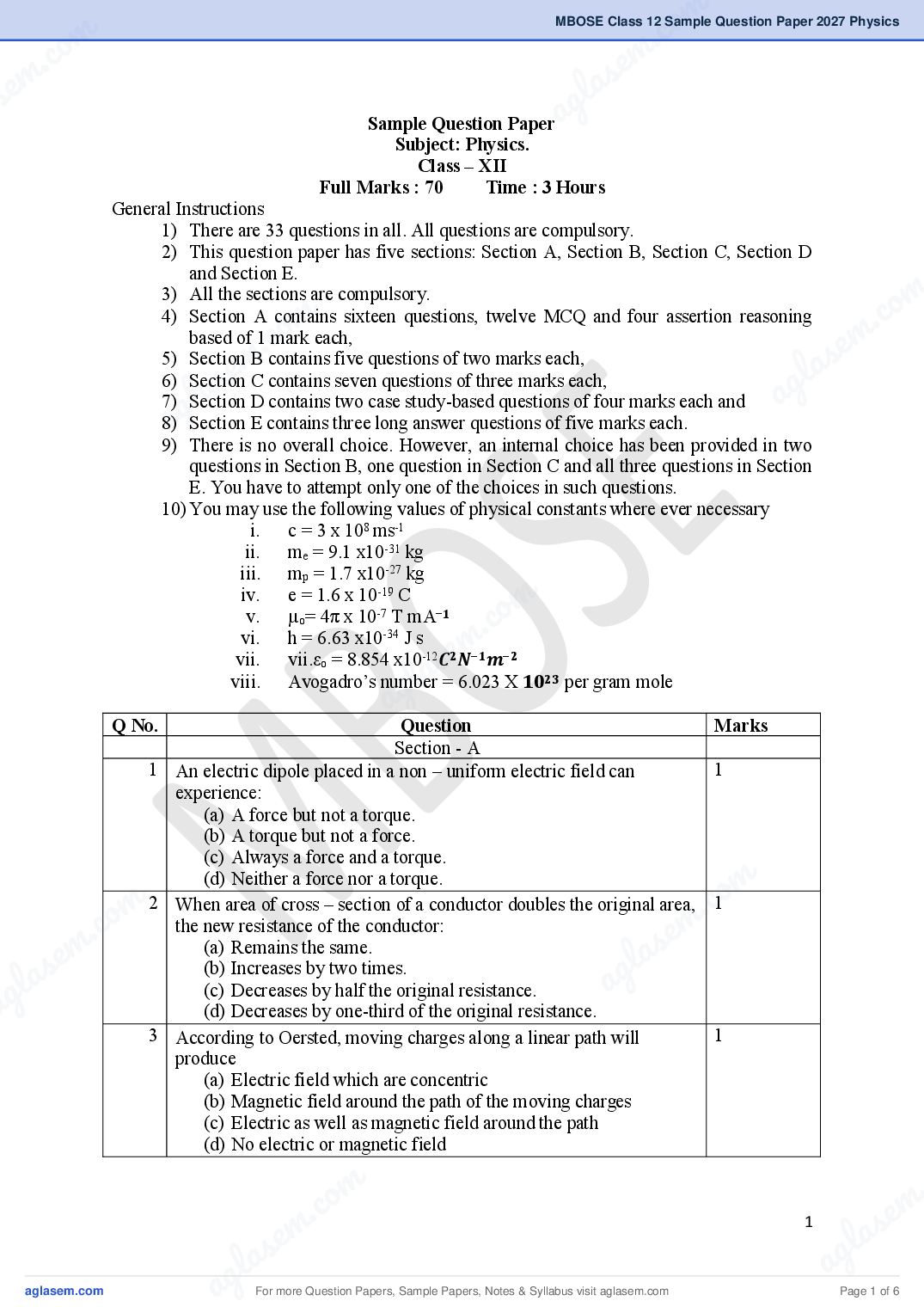
Subject: Physics.
Class – XII
Full Marks : 70 Time : 3 Hours
General Instructions
1) There are 33 questions in all. All questions are compulsory.
2) This question paper has five sections: Section A, Section B, Section C, Section D
and Section E.
m
.co
3) All the sections are compulsory.
m
.co
4) Section A contains sixteen questions, twelve MCQ and four assertion reasoning
based of 1 mark each,
e m
em
5) Section B contains five questions of two marks each,
l as
as
6) Section C contains seven questions of three marks each,
l ag
ag
7) Section D contains two case study-based questions of four marks each and
8) Section E contains three long answer questions of five marks each.
9) There is no overall choice. However, an internal choice has been provided in two
questions in Section B, one question in Section C and all three questions in Section
E. You have to attempt only one of the choices in such questions.
10) You may use the following values of physical constants where ever necessary
i. c = 3 x 10⁸ ms-1
ii. me = 9.1 x10⁻³¹ kg
iii. mp = 1.7 x10⁻²⁷ kg
e = 1.6 x 10⁻¹⁹ C
m
.co
iv.
v. µo= 4π x 10-7 T mA−𝟏
vi. h = 6.63 x10⁻³⁴ J s
e m
vii.
las
vii.εo = 8.854 x10⁻¹²𝑪𝟐𝑵−𝟏𝒎−𝟐
g
viii. Avogadro’s number = 6.023 X 𝟏𝟎𝟐𝟑 per gram mole
a
Q No. Question Marks
Section - A
1 An electric dipole placed in a non – uniform electric field can 1
experience:
(a) A force but not a torque.
(b) A torque but not a force.
(c) Always a force and a torque.
m
.c1o
(d) Neither a force nor a torque.
m 2 When area of cross – section of a conductor doubles the original area,
m .co the new resistance of the conductor:
s e m
s e (a) Remains the same.
g l a
la a
(b) Increases by two times.
ag (c) Decreases by half the original resistance.
(d) Decreases by one-third of the original resistance.
3 According to Oersted, moving charges along a linear path will 1
produce
(a) Electric field which are concentric
(b) Magnetic field around the path of the moving charges
(c) Electric as well as magnetic field around the path
(d) No electric or magnetic field
m .
.co s e m
em a
1
s l
l a ag
ag For more Question Papers, Sample Papers, Notes & Syllabus visit Page 1 of 6
Page 3
is strongest:
(a) Along the axis inside the solenoid
(b) At the mid – point of the solenoid just outside it
(c) At the end of the solenoid
(d) At the end where the current enters the solenoid
5 1
Which of the following is a para – magnetic substance?
(a) Aluminum
(b) Copper
(c) Iron
(d) Nickel
6 The phase difference between the current and the voltage in series 1
LCR circuit at resonance is
(a) π
(b) π/2
(c) π/3
(d) zero
7 The time taken by an AC of 50Hz for one cycle is : 1
(a) 1 x 10 -2 S
(b) 2 x 10 -2 S
(c) 5 x 10 -2 S
(d) 1 x 10 -3 S
8 Transmission of light in optical fibre is due to: 1
(a) Scattering
(b) Diffraction
(c) Refraction
(d) Multiple total internal reflection
9 Which of the following statement is true about the width of central 1
diffraction maximum in a single slit diffraction pattern?
(a) It increases when the width of the aperture increases.
(b) It decreases when the width of the aperture increases.
(c) It remains unchanged regardless of the aperture width.
(d) It cannot be predicted from the aperture width.
10 In mass defect, which of the statement is true: 1
(a) Mass of its constituent nucleons should remain the same as
mass of nucleus.
(b) Mass of its constituent nucleons should be more than mass of
nucleus.
(c) Mass of its constituent nucleons should be less than mass of
nucleus.
(d) Cannot be predicted about the mass of the nucleus.
11 In Alpha-particle scattering, the α – particles 1
(a) Passes straight through the gold foil.
(b) Are scattered in only one direction
(c) Are scattered in all direction
(d) Majority passes through the gold foil, some scattered at some
angle and very few rebound backwards.
12 In forward bias, the width of potential barrier in a p-n junction diode. 1
2
For more Question Papers, Sample Papers, Notes & Syllabus visit Page 2 of 6
Page 4
m .co
m .co s e m
se g l a
(a) Increases a
(b) Decreases
(c) Remains constant
(d) First increases and then decreases.
From question 13 to 16, two statements are given labeled Assertion
(A) and other labeled Reason (R). Select the correct answer to these
questions from the options given below:
(a) Both Assertion and Reason are true and Reason is the correct
m
.co
explanation of Assertion.
m
.co
(b) Both Assertion and Reason are true, but Reason is not the
e m
s
correct explanation of Assertion.
e m
(c) Assertion is true but Reason is false.
l a
l as
(d) Both Assertion and Reason are false.
ag
13
ag
Assertion (A): No work is done in moving a test charge on an
equipotential surface.
1
Reason (R): Electric field through equipotential surface is always
normal to the equipotential surface.
14 Assertion (A): When two thin convex lenses are co-axially in 1
contact with each other, their combined power increases.
Reason (R): Focal lengths of two or more lenses in contact are
added up.
m
.co
15 Assertion (A): Total energy of a revolving electron in any 1
em
stationary orbit is negative.
s
Reason (R): Energy can have positive or negative values.
latwo different sources are coherent
16
ag
Assertion (A): Two waves from 1
as they have similar wave lengths.
Reason (R): Two sources of waves having zero or constant phase
difference are coherent waves.
Section - B
17 With the help of a circuit diagram, explain the use of a junction diode 1+1=2
as a half wave rectifier.
State Kirchoff’s laws.
18 2
m
m19 What is a transformer? State its principle.
.co1+1=2
.co m
20 Using Ampere’s circuital theorem, calculate the magnetic field due 2
m s e
a
an infinitely long wire carrying current I at a distance r from the wire.
s e or
g l
g la Write an expression for the force per unit length between two a 1+1=2
a infinitely long straight parallel current carrying wires. Hence define
one ampere.
21 Calculate the frequency of radiation emitted by electrons in hydrogen 2
atom when they jump from 4th orbit to 2nd orbit.
or
Show that, R = Ro A 1/3, where symbols have their usual meanings, 2
SECTION – C
22 Arrange the following radiations in ascending order of their wave 1+2=3
lengths: Radio waves, ultraviolet rays and x – rays.
m .
.co s e m
em a
3
s l
l a ag
ag For more Question Papers, Sample Papers, Notes & Syllabus visit Page 3 of 6
Page 5
23 Draw a circuit diagram showing a wheatstone bridge. Use Kirchoff’s 3
Laws to obtain the balance condition in terms of the resistance of four
arms of wheatstone bridge.
or
With the help of a diagram, show that the reciprocal of equivalent 3
internal resistance for two cells connected in parallel with each other
is the sum of the reciprocal of the individual internal resistances of
the two cells.
24 Calculate the binding energy per nucleon for 30Zn64 3
[Take 1amu = 1.66 X 10 -27 kg,
Mass of proton = 1.00728 amu,
Mass of neutron = 1.00867 amu,
Mass of 30Zn64 = 63.9423 amu].
25 Find a relation between u, v, R, μ1 and μ2 in the case of refraction 3
from denser to rarer medium through a convex spherical surface.
26 Prove the laws of refraction by applying Huygens’ Principle when a 3
plane wavefront propagates from one medium to another medium and
is incident at an angle i.
27 Derive an expression for the electric field at any point on the axial 3
line of an electric dipole.
28 Write the relationship between magnetic moment of a current 1+2
carrying loop and current. Use this expression to derive the magnetic
di-pole moment of a revolving electron.
SECTION - D
29 A student performs an experiment on a metal that is photo-sensitive. 1+1+2=4
He keeps the frequency of light constant and changes its intensity
from I1 to I2 to I3 (I3> I2> I1). He then plots a graph of photo current
versus collector potential.
(a) Plot the graph that he would have got for all three intensities.
(b) How does stopping potential depend on intensity of incident
light?
(c) What actually changes in the incident light when intensity
changes?
30 In the following diagrams, p-n junction diodes have been biased by 1x4=4
applying voltages to the p- side and n- side.
4
For more Question Papers, Sample Papers, Notes & Syllabus visit Page 4 of 6
Page 6
m .co
m .co s e m
se g l a
a
m
.co
(a) Which of the above circuit(s) is / (are) forward biased?
m
(b) Which circuit(s) have the largest flow of current?
.co
(c) Which circuit(s) is /(are) reverse biased?
m s e m
(d) In which circuit(s) no current will flow?
s e l a
3+2=5 ag
SECTION – E
31
g l a
(a) Derive the electric field outside and inside a uniformly
a charged thin spherical shell.
(b) An electric di-pole with dipole moment 4 x 10 - 9 C–m is
aligned at 30º with the direction of uniform electric field of
magnitude 5x10⁴ NC -1. Calculate the magnitude of the torque
acting on the dipole.
OR
(a) Derive an expression for electric potential at any point at a 3+2=5
distance r from the mid-point of a dipole.
m
(b) Two charges 2 x 10 -8 C and -3 x 10 -9 C are located 16 cm
.co
apart from each other. Calculate the potential energy of this
m
e
system of two charges.
las
32 Draw a graph to show the variation of the angle of deviation (δ) with 2+ 3=5
ag
the angle of incidence (i) for a monochromatic ray of light passing
through a prism of refracting angle A. Deduce the relation
𝐴+ 𝛿 𝑚
𝑆𝑖𝑛[ ]
2
𝜇= 𝐴
𝑆𝑖𝑛(2 )
Or
m
.co
With the help of a labeled diagram of a compound microscope, derive
m 2+3=5
.co
the magnification when final image is formed at the least distance of
distinct vision.
e m
e m 33 Derive the torque on a rectangular loop carrying-current placed in a
l
4+½+½ = 5
as
las uniform magnetic field. Draw a suitable diagram. Write one
ag
ag application of this principle.
Or
Derive the expression of magnetic field at any point on the axis of a 2+1½+1½=5
current-carrying circular loop by using Biot – Savart’s Law. Find the
magnetic field at:
(a) A point far away from the axis.
(b) At the centre of the loop.
*****
m .
.co s e m
em a
5
s l
l a ag
ag For more Question Papers, Sample Papers, Notes & Syllabus visit Page 5 of 6
Page 7
Physics- Class XII
Units 1 mark 2 Marks (VSA) 3 marks (SA) 4 marks 5 marks (LA) Total unit-wise
1x16=16 2x5-10 3x7=21 Case study 5x3=15
4x2-8
1 1(2) 3(1) 5(1) 16(7)
2 1(1) 2(1) 3(1)
3 1(3) 2(1) 3(1) 17(9)
4 1(2) 2(1) 5(1)
5 3(1) 18(8)
6 1(4) 3(2) 5(1)
7 4(1) 12 (6)
8 1(3) 2(1) 3(1)
9 1(1) 2(1) 4(1) 7 (3)
Total Q- 16(16) 10(5) 21(7) 8(2) 15(3) 70 (33)
type
6
For more Question Papers, Sample Papers, Notes & Syllabus visit Page 6 of 6
Document Details
| Board / Org | Meghalaya Board |
| Exam | Class 12 |
| Type | Sample Paper |
| Pages | 6 |
| Updated | 03 Nov 2026 |