CBSE Class 12 English Core Question Paper 2020 Set 1-3-2
Finished viewing? Save it for later —
Download CBSE Class 12 English Core Question Paper 2020 Set 1-3-2 (PDF · 11 pages)About CBSE Class 12 English Core Question Paper 2020 Set 1-3-2
CBSE Class 12 English Core Question Paper 2020 Set 1-3-2 is available here for free download. Published by CBSE for Class 12, this question paper can be viewed online or downloaded as a PDF (11 pages). Candidates preparing for Class 12 can use CBSE Class 12 English Core Question Paper 2020 Set 1-3-2 to understand the exam pattern, the type of questions asked, and the overall difficulty level.
Frequently Asked Questions
How can I download CBSE Class 12 English Core Question Paper 2020 Set 1-3-2?
Open this page and click the Download button to save CBSE Class 12 English Core Question Paper 2020 Set 1-3-2 as a PDF. It is completely free on AglaSem Docs.
Is CBSE Class 12 English Core Question Paper 2020 Set 1-3-2 free to download?
Yes. CBSE Class 12 English Core Question Paper 2020 Set 1-3-2 can be viewed online and downloaded as a PDF free of cost on AglaSem Docs.
How many pages does CBSE Class 12 English Core Question Paper 2020 Set 1-3-2 have?
CBSE Class 12 English Core Question Paper 2020 Set 1-3-2 contains 11 pages, which you can read online or download together as a single PDF.
Where can I find more Class 12 study material?
You can find more Class 12 question papers, sample papers, syllabus, and answer keys on AglaSem Docs.
CBSE Class 12 English Core Question Paper 2020 Set 1-3-2 – Text
Read the full text of this question paper below — useful to quickly search, copy and reference the content online without downloading the PDF.
📄 View text version (11 pages)
Page 1
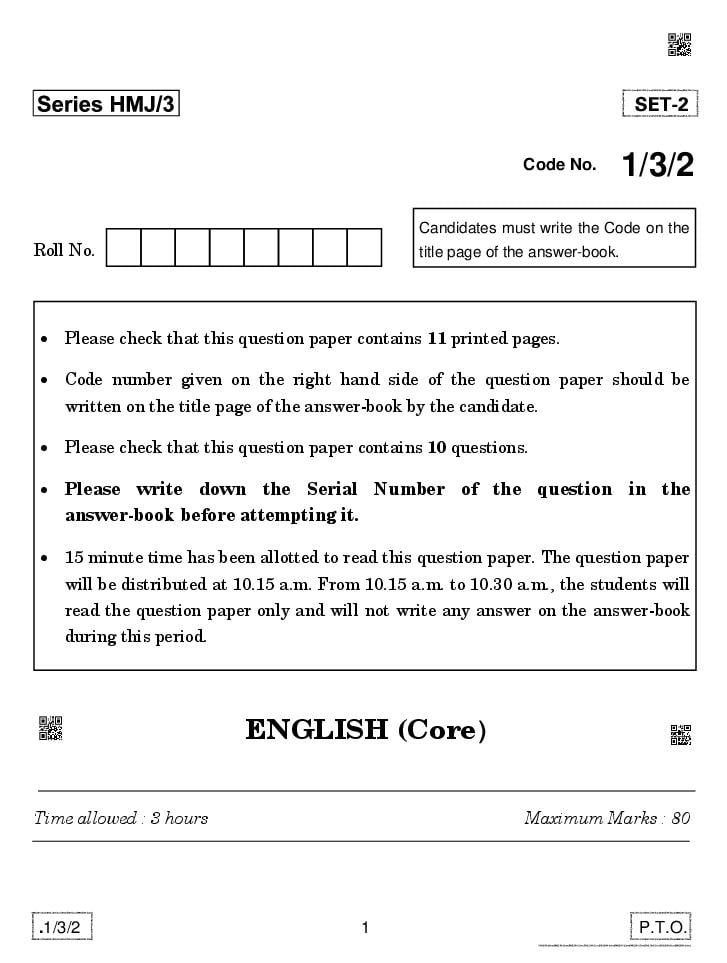
Candidates must write the Code on the
Roll No. title page of the answer-book.
Please check that this question paper contains 11 printed pages.
Code number given on the right hand side of the question paper should be
written on the title page of the answer-book by the candidate.
Please check that this question paper contains 10 questions.
Please write down the Serial Number of the question in the
answer-book before attempting it.
15 minute time has been allotted to read this question paper. The question paper
will be distributed at 10.15 a.m. From 10.15 a.m. to 10.30 a.m., the students will
read the question paper only and will not write any answer on the answer-book
during this period.
ENGLISH (Core)
Time allowed : 3 hours Maximum Marks : 80
.1/3/2 1 P.T.O.
Page 2
Read the following instructions very carefully and strictly follow them.
(i) The question paper comprises three sections - A, B and C.
Section A – 20 marks
Section B – 30 marks
Section C – 30 marks
(ii) There are 10 questions in the question paper. All questions are compulsory.
(iii) There is no overall choice. However, an internal choice has been provided in one
question in Section A, four questions in Section B and three questions in
Section C. Make your choices correctly.
(iv) However, separate instructions are given with each section and question,
wherever necessary.
(v) Do not exceed the prescribed word limit while answering the questions.
SECTION A
(Reading Skills) 20
1. Read the passage given below : 12
Donated Organs and their Transportation
1 Once an organ donor’s family gives its consent and the organs are
matched to a recipient, medical professionals are faced with the
onerous challenge of transporting organs while ensuring that the
harvested organ reaches its destination in the shortest possible
time. This is done in order to preserve the harvested organs and
involves the police and especially the traffic police department.
2 The traditional method of transporting organs by road is referred
to as a ‘green corridor’. This process entails police escorting an
ambulance, so as to move around traffic usually a specific traffic
lane is chosen and all signals on the route stay green to ensure it
.1/3/2 2
Page 3
corridor is a route cleared and cordoned off by the traffic police to
ensure the smooth and steady transportation of harvested organs,
on most occasions, to those awaiting a life-saving transplant.
Organs tend to have a very short preservation time, such as the
heart, which has to be harvested and transplanted within four
hours or the lungs, which can be preserved for only six hours once
they are harvested.
3 The first green corridor in India was created by the Chennai
Traffic Police in September 2008 when they accomplished their
task of enabling an ambulance to reach its destination within
11 minutes during peak hour traffic. That organ saved a
nine-year-old girl whose life depended on the transplant.
4 Similarly, such green corridors have been created by traffic police
of various cities such as Pune, Mumbai, Delhi NCR, etc. Personnel
are stationed at selected points to divert, control and clear the
traffic giving way to the ambulance. Apart from this, a motorcade
of police vehicles accompanies the ambulance ensuring that it does
not face any problems. Delhi Traffic Police provided a green
corridor from IGI Airport to the Institute of Liver and Biliary
Sciences in Vasant Kunj for transportation of a liver. The distance
of 14 kms was covered in 11 minutes.
5 Experts point out the lack of a robust system to transport organs to
super-speciality hospitals in least possible time. The National
Organ and Tissue Transplant Organisation (NOTTO), the
country’s apex organ donation agency, is now framing a proposal to
airlift cadaver organs and will send a report to the Union Health
Ministry. ‘‘Cadaver organs have a short life and so transplant
should be done within a few golden hours,’’ Director (NOTTO)
expressed. ‘‘Therefore, we are preparing a proposal for airlifting
organs at any given moment.’’
.1/3/2 3 P.T.O.
Page 4
perform transplant procedures. Also, there is an acute shortage of
advanced healthcare facilities to carry out a transplant. So, it is
referred to other big centres in metropolitan cities. Organs
retrieved from Aurangabad, Indore, Surat, Pune are sent to
Mumbai as these cities do not have super-specialty healthcare
centres, informed officials.
7 ‘‘In India, about fifty thousand to one lakh patients are suffering
from acute heart failure and need heart transplant at any point of
time. In a private set-up, a heart transplant costs < 15 – 20 lakh,
which is followed up by post-operative medication of about
< 30,000 per month lifelong.’’
1.1 On the basis of your understanding of the above passage, answer
any five of the following questions by choosing the most appropriate
options : 15=5
(a) The first green corridor in India was created in
(i) New Delhi
(ii) Chennai
(iii) Mumbai
(iv) Pune
(b) The organisation which is framing a proposal to airlift cadaver
organs is
(i) Union Health Ministry
(ii) Regional Organ and Tissue Transplant Organisation
(iii) National Organ and Tissue Transplant Organisation
(iv) State Organ and Tissue Transplant Organisation
.1/3/2 4
Page 5
(i) finding organ donors.
(ii) finding doctors capable of performing transplants.
(iii) to carry the harvested organ in the shortest possible time.
(iv) to arrange the requisite facilities for the transplant.
(d) Most of the people do not go for heart transplant as
(i) it is very risky.
(ii) it is very painful.
(iii) it may cause death of the recipient.
(iv) the cost is prohibitive.
(e) Most states refer organ transplant cases to big hospitals because
(i) they don’t have well-trained experts.
(ii) the patients don’t trust local doctors.
(iii) the state hospitals are very crowded.
(iv) they don’t have a pool of harvested organs.
(f) Heart retrieved from a body is alive only for _________ hours.
(i) two
(ii) three
(iii) four
(iv) five
.1/3/2 5 P.T.O.
Page 6
(a) What is a ‘green corridor’ ?
(b) Why is smooth transportation of the retrieved organ necessary ?
(c) What opinion do you form of the Chennai Police with regard to the
transportation of a harvested heart ?
(d) What does the author mean by ‘a few golden hours’ ?
(e) How much does a heart transplant cost a patient in a private
hospital ?
1.3 Pick out the words from the passage which mean the same as the
following : 12=2
(a) save (para 1)
(b) achieved/carried out (para 3)
2. Read the following passage : 8
1 How does television affect our lives ? It can be very helpful to
people who carefully choose the shows that they watch. Television
can increase our knowledge of the outside world; there are high
quality programmes that help us understand many fields of study,
science, medicine, the different arts and so on. Moreover, television
benefits very old people, who can’t leave the house, as well as
patients in hospitals. It also offers non-native speakers the
advantage of daily informal language practice. They can increase
their vocabulary and practise listening.
.1/3/2 6
Page 7
television. Of course, it provides us with a pleasant way to relax
and spend our free time, but in some countries people watch
television for an average of six hours or more a day. Many children
stare at the TV screen for more hours a day than they spend on
anything else, including studying and sleeping. It’s clear that TV
has a powerful influence on their lives and that its influence is
often negative.
3 Recent studies show that after only thirty seconds of television
viewing, a person’s brain ‘relaxes’ the same way that it does just
before the person falls asleep. Another effect of television on the
human brain is that it seems to cause poor concentration. Children
who view a lot of television can often concentrate on a subject for
only fifteen to twenty minutes. They can pay attention only for the
amount of time between commercials.
4 Another disadvantage is that television often causes people to
become dissatisfied with their own lives. Real life does not seem so
exciting to these people. To many people, television becomes more
real than reality and their own lives seem boring. Also many
people get upset or depressed when they can’t solve problems in
real life as quickly as television actors seem to.
5 Before a child is fourteen years old, he or she views eleven
thousand murders on the TV. He or she begins to believe that
there is nothing strange about fights, killings and other kinds of
violence. Many studies show that people become more violent after
viewing certain programmes. They may even do the things that
they see in a violent show.
(a) One the basis of your reading of the above passage, make notes on
it using headings and subheadings. Use recognizable abbreviations
(minimum four) and a format you consider suitable. Supply a
suitable title to it. 4
(b) Make a summary of the above passage in about 80 words. 4
.1/3/2 7 P.T.O.
Page 8
(Writing Skills) 30
3. As General Manager, Golden Software Solutions, New Delhi, you need a
software engineer for your organisation. Draft an advertisement for
‘Situation Vacant’ columns of a national newspaper stating your
requirements regarding age, qualifications, experience and salary offered.
(50 words) 4
OR
You are Nitin/Nalini, Cultural Secretary, S.V.A. Public School, Jaipur.
Your school is staging the play, ‘Shakuntalam’. Write a notice, to be
displayed on your school notice board, mentioning time, date and the city
theatre where the play will be staged. Invite the students and their
parents to come and watch the play. (50 words) 4
4. A 72-year-old Municipal Councillor of your area expired last Friday and
as she had desired, her body was donated to Army Medical College. It
would be a second life for some persons receiving some vital organs
retrieved from her body. Write a letter to the Editor, ‘Indian Times’,
Chennai, highlighting the importance of donation of eyes and other
organs to persons in need. You are Navita/Namit, 125, Sohna Road,
Kodaikanal.
(120 – 150 words) 6
OR
Fire broke out in one corner of the auditorium when your school’s annual
day function was going on. Latha/Lalith, Headgirl/Headboy took
command of the situation and got all the doors opened at once, used fire
extinguishers, vacated the auditorium, provided first-aid and called the
ambulance. Imagine you are the Principal of M.V. Public School. Write a
letter to the Director of Education, recommending your student’s name
for a bravery award. (120 – 150 words) 6
.1/3/2 8
Page 9
debate in 150 – 200 words either for or against the motion. You are
Sarita/Sachin. 10
OR
Annual Examinations are approaching. You, as Principal, want to
wish all your students to prepare well for the exams. Write a speech in
150 – 200 words on the topic, ‘Preparing for Annual Examinations’ to be
delivered in the morning assembly. You are Reena/Rohit. 10
6. You saw a stout man riding a cycle rickshaw in the market. When the
rickshaw puller took a sharp turn, it overturned and both of them fell
down. The man started beating the poor rickshaw puller. You along with
some of the shopkeepers intervened and sorted the matter out. Write a
report in 150 – 200 words on the incident. You are Sohan/Sohani. 10
OR
The attitude of the parents towards the girl child is changing. They have
begun to realise that daughters are as good as sons. Parents are more
supportive and paying more attention to their education. Write an article
in 150 – 200 words on the topic, ‘Today’s Parents and the Girl Child’. You
are Suhas/Suhasini. 10
.1/3/2 9 P.T.O.
Page 10
(Literature : Text Books) 30
7. Read the extracts given below and answer the questions that follow each
of them : 4+4=8
(a) There was a wooden bench beneath a solitary elm where lovers
sometimes came. She sat down to wait. It was the perfect place,
she had always thought so, for a meeting of this kind.
(i) Who is ‘she’ ? 1
(ii) Who was she waiting for ? 1
(iii) Why did lovers like this place for their meetings ? 1
(iv) What was special about this meeting ? 1
(b) Sometimes I feel myself I can hardly bear
The thought of so much childish longing in vain,
The sadness that lurks near the open window there,
That waits all day in almost open prayer
For the squeal of brakes, the sound of a stopping car.
(i) Why does the poet call this desire childish ? 1
(ii) Why is there sadness among people ? 1
(iii) Why do these people pray for a car to stop ? 1
(iv) What does the word ‘squeal’ mean ? 1
8. Answer any five of the following questions in 30 – 40 words each : 25=10
(a) Why was the order from Berlin called a thunderclap by Franz ?
(b) What caused the lack of communication between the Englishman
and the people of Gemini Studio ?
(c) Explain Roosevelt’s observation, ‘‘All we have to fear is fear itself . ’’
(Deep Water)
(d) How can suspension of activities help in making life better ?
(Keeping Quiet)
.1/3/2 10
Page 11
semi-inflated rubber ring ? What did it actually contain ?
(f) What objects/activities in the marketplace attracted Bama on her
way back from school ?
(g) Was it fear or a feeling of patriotism which prompted the servants
to leave Dr. Sadao’s residence ?
9. Answer the following question in 120 – 150 words : 6
Why do the bangle makers of Firozabad have to live in poverty ?
OR
What impressions do you form of Umberto Eco as a scholar and writer on
the basis of your study of ‘The Interview’ ?
10. Answer the following question in 120 – 150 words : 6
Describe Charley’s experiences at the third level of the Grand Central
Station.
OR
Attempt a character sketch of the Tiger King.
.1/3/2 11 P.T.O.
Document Details
| Board / Org | CBSE |
| Exam | Class 12 |
| Type | Question Paper |
| Pages | 11 |
| Updated | 22 Jul 2026 |