CBSE Class 12 Question Paper 2025 Solution Hindustani Music
Finished viewing? Save it for later —
Download CBSE Class 12 Question Paper 2025 Solution Hindustani Music (PDF · 11 pages)About CBSE Class 12 Question Paper 2025 Solution Hindustani Music
CBSE Class 12 Question Paper 2025 Solution Hindustani Music is available here for free download. Published by CBSE for Class 12, this solution can be viewed online or downloaded as a PDF (11 pages). Candidates preparing for Class 12 can use CBSE Class 12 Question Paper 2025 Solution Hindustani Music to understand the exam pattern, the type of questions asked, and the overall difficulty level.
Frequently Asked Questions
How can I download CBSE Class 12 Question Paper 2025 Solution Hindustani Music?
Open this page and click the Download button to save CBSE Class 12 Question Paper 2025 Solution Hindustani Music as a PDF. It is completely free on AglaSem Docs.
Is CBSE Class 12 Question Paper 2025 Solution Hindustani Music free to download?
Yes. CBSE Class 12 Question Paper 2025 Solution Hindustani Music can be viewed online and downloaded as a PDF free of cost on AglaSem Docs.
How many pages does CBSE Class 12 Question Paper 2025 Solution Hindustani Music have?
CBSE Class 12 Question Paper 2025 Solution Hindustani Music contains 11 pages, which you can read online or download together as a single PDF.
Where can I find more Class 12 study material?
You can find more Class 12 question papers, sample papers, syllabus, and answer keys on AglaSem Docs.
CBSE Class 12 Question Paper 2025 Solution Hindustani Music – Text
Read the full text of this solution below — useful to quickly search, copy and reference the content online without downloading the PDF.
📄 View text version (10 pages)
Page 1
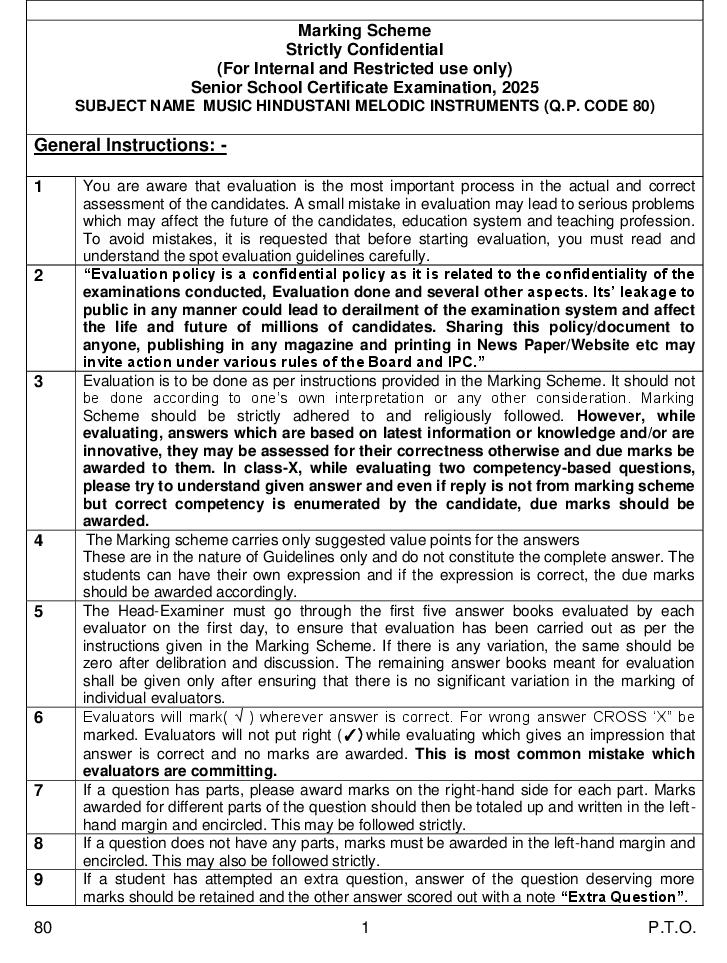
Strictly Confidential
(For Internal and Restricted use only)
Senior School Certificate Examination, 2025
SUBJECT NAME MUSIC HINDUSTANI MELODIC INSTRUMENTS (Q.P. CODE 80)
General Instructions: -
1 You are aware that evaluation is the most important process in the actual and correct
assessment of the candidates. A small mistake in evaluation may lead to serious problems
which may affect the future of the candidates, education system and teaching profession.
To avoid mistakes, it is requested that before starting evaluation, you must read and
understand the spot evaluation guidelines carefully.
2 “Evaluation policy is a confidential policy as it is related to the confidentiality of the
examinations conducted, Evaluation done and several other aspects. Its’ leakage to
public in any manner could lead to derailment of the examination system and affect
the life and future of millions of candidates. Sharing this policy/document to
anyone, publishing in any magazine and printing in News Paper/Website etc may
invite action under various rules of the Board and IPC.”
3 Evaluation is to be done as per instructions provided in the Marking Scheme. It should not
be done according to one’s own interpretation or any other consideration. Marking
Scheme should be strictly adhered to and religiously followed. However, while
evaluating, answers which are based on latest information or knowledge and/or are
innovative, they may be assessed for their correctness otherwise and due marks be
awarded to them. In class-X, while evaluating two competency-based questions,
please try to understand given answer and even if reply is not from marking scheme
but correct competency is enumerated by the candidate, due marks should be
awarded.
4 The Marking scheme carries only suggested value points for the answers
These are in the nature of Guidelines only and do not constitute the complete answer. The
students can have their own expression and if the expression is correct, the due marks
should be awarded accordingly.
5 The Head-Examiner must go through the first five answer books evaluated by each
evaluator on the first day, to ensure that evaluation has been carried out as per the
instructions given in the Marking Scheme. If there is any variation, the same should be
zero after delibration and discussion. The remaining answer books meant for evaluation
shall be given only after ensuring that there is no significant variation in the marking of
individual evaluators.
6 Evaluators will mark( √ ) wherever answer is correct. For wrong answer CROSS ‘X” be
marked. Evaluators will not put right (✓)while evaluating which gives an impression that
answer is correct and no marks are awarded. This is most common mistake which
evaluators are committing.
7 If a question has parts, please award marks on the right-hand side for each part. Marks
awarded for different parts of the question should then be totaled up and written in the left-
hand margin and encircled. This may be followed strictly.
8 If a question does not have any parts, marks must be awarded in the left-hand margin and
encircled. This may also be followed strictly.
9 If a student has attempted an extra question, answer of the question deserving more
marks should be retained and the other answer scored out with a note “Extra Question”.
80 1 P.T.O.
Page 2
once.
11 A full scale of marks __________(example 0 to 80/70/60/50/40/30 marks as given in
Question Paper) has to be used. Please do not hesitate to award full marks if the answer
deserves it.
12 Every examiner has to necessarily do evaluation work for full working hours i.e., 8 hours
every day and evaluate 20 answer books per day in main subjects and 25 answer books
per day in other subjects (Details are given in Spot Guidelines).This is in view of the
reduced syllabus and number of questions in question paper.
13 Ensure that you do not make the following common types of errors committed by the
Examiner in the past:-
● Leaving answer or part thereof unassessed in an answer book.
● Giving more marks for an answer than assigned to it.
● Wrong totaling of marks awarded on an answer.
● Wrong transfer of marks from the inside pages of the answer book to the title page.
● Wrong question wise totaling on the title page.
● Wrong totaling of marks of the two columns on the title page.
● Wrong grand total.
● Marks in words and figures not tallying/not same.
● Wrong transfer of marks from the answer book to online award list.
● Answers marked as correct, but marks not awarded. (Ensure that the right tick mark
is correctly and clearly indicated. It should merely be a line. Same is with the X for
incorrect answer.)
● Half or a part of answer marked correct and the rest as wrong, but no marks awarded.
14 While evaluating the answer books if the answer is found to be totally incorrect, it should
be marked as cross (X) and awarded zero (0)Marks.
15 Any unassessed portion, non-carrying over of marks to the title page, or totaling error
detected by the candidate shall damage the prestige of all the personnel engaged in the
evaluation work as also of the Board. Hence, in order to uphold the prestige of all
concerned, it is again reiterated that the instructions be followed meticulously and
judiciously.
16 The Examiners should acquaint themselves with the guidelines given in the “Guidelines
for Spot Evaluation” before starting the actual evaluation.
17 Every Examiner shall also ensure that all the answers are evaluated, marks carried over to
the title page, correctly totaled and written in figures and words.
18 The candidates are entitled to obtain photocopy of the Answer Book on request on
payment of the prescribed processing fee. All Examiners/Additional Head Examiners/Head
Examiners are once again reminded that they must ensure that evaluation is carried out
strictly as per value points for each answer as given in the Marking Scheme.
80 2
Page 3
MARKING SCHEME
MUSIC HINDUSTANI MELODIC INSTRUMENTS
SECTION A
1. (B) 29 1
2. (A) Sarod 1
3. (A) Alankar 1
4. (B) II, III and IV 1
5. (D) I and III 1
6. (A) 1-III; 2-I; 3-II; 4-IV 1
7. (C) Statement I is true, but II is false. 1
8. (C) Statement I is true, but II is false. 1
SECTION B
9. (a) Defining of any two terms chosen their definition
1
Varieties of the – terms chosen for definition. 1 2
OR
(b) Sangeet Ratnakar’s author and chapters
contents given in chapters in brief
10. (a) Definition of two terms chosen with specialties. 1+1=2
OR
(b) Allaudin Khan’s birth, death, family, training
Contribution as teacher, composer and artiste
80 3 P.T.O.
Page 4
into this. 1+1=2
OR
(b) Defining the Tuning of the instrument opted for
In which swara each string is tuned and how Tarab (if
there) are tuned.
12. (a) Mushtaq Ali Khan’s birth-place date, death, training 1
Speciality of style, Gharana, as teacher and other
contributions 1 2
OR
(b) Sangeet Parijat’s Author, year and chapters.
Contents in chapters specially the one author gave for the
first time in music theory in his text.
13. (a) Raga Bageshree’s thata, swara – its nature, no. of swaras
used in Aroh Avroh, Varjit swara 1
Vadi – Samvadi, Aroh – Avroh, Pakad, Time and other
specialities. 1 2
OR
(b) Description of Tala Rupak – Matra, Tali – Khali – Bol
Vibhag and specialities
Writing of Bols in Tigun with Matra, Vibhag, Tali – Khali
signs in Notation.
SECTION C
14. (a) Writing of Sthai and Antawra with Bol in Matra,
Vibhag, Tali-Khali signs in Notation system. 2+2
Writing of four Todas in the same raga in Masatkhani,
That is, chaugun or other laya. 1
+ 1 + 1 + 1 =2 6
2 2 2 2
OR
(b) Writing of Sthai and Antara with Bols, of the Raga chosen
with Matra, Vibhag, Tali, Khali, signs in Notation system
Writing of tanas 16 beats with swara’s signs and two
32 beats tanas with swara’s signs in Notation.
80 4
Page 5
Style of performance – Stroke, Laya, Raga’s
performance 2
Anlysing the style – why you like this 2 6
OR
(b) Writing of Alap in the three Ragas with their permitted
swara and chalan, signs of Komal Shuddha, Mandra, Tar
according to Raga’s nature.
80 5 P.T.O.
Page 6
Strictly Confidential
(For Internal and Restricted use only)
Senior School Certificate Examination, 2024-25
SUBJECT NAME HINDUSTANI MUSIC (Vocal) (Theory) (SUBJECT CODE 034)
(Q.P. CODE 79) MM : 30
General Instructions: -
1 You are aware that evaluation is the most important process in the actual and correct
assessment of the candidates. A small mistake in evaluation may lead to serious problems
which may affect the future of the candidates, education system and teaching profession.
To avoid mistakes, it is requested that before starting evaluation, you must read and
understand the spot evaluation guidelines carefully.
2 “Evaluation policy is a confidential policy as it is related to the confidentiality of the
examinations conducted, Evaluation done and several other aspects. Its’ leakage to
public in any manner could lead to derailment of the examination system and affect
the life and future of millions of candidates. Sharing this policy/document to anyone,
publishing in any magazine and printing in News Paper/Website etc may invite action
under various rules of the Board and IPC.”
3 Evaluation is to be done as per instructions provided in the Marking Scheme. It should not
be done according to one’s own interpretation or any other consideration. Marking Scheme
should be strictly adhered to and religiously followed. However, while evaluating, answers
which are based on latest information or knowledge and/or are innovative, they may
be assessed for their correctness otherwise and due marks be awarded to them. In
class-X, while evaluating two competency-based questions, please try to understand
given answer and even if reply is not from marking scheme but correct competency
is enumerated by the candidate, due marks should be awarded.
4 The Marking scheme carries only suggested value points for the answers
These are in the nature of Guidelines only and do not constitute the complete answer. The
students can have their own expression and if the expression is correct, the due marks
should be awarded accordingly.
5 The Head-Examiner must go through the first five answer books evaluated by each
evaluator on the first day, to ensure that evaluation has been carried out as per the
instructions given in the Marking Scheme. If there is any variation, the same should be zero
after delibration and discussion. The remaining answer books meant for evaluation shall be
given only after ensuring that there is no significant variation in the marking of individual
evaluators.
6 Evaluators will mark( √ ) wherever answer is correct. For wrong answer CROSS ‘X” be
marked. Evaluators will not put right (✓)while evaluating which gives an impression that
answer is correct and no marks are awarded. This is most common mistake which
evaluators are committing.
7 If a question has parts, please award marks on the right-hand side for each part. Marks
awarded for different parts of the question should then be totaled up and written in the left-
hand margin and encircled. This may be followed strictly.
8 If a question does not have any parts, marks must be awarded in the left-hand margin and
encircled. This may also be followed strictly.
9 If a student has attempted an extra question, answer of the question deserving more marks
should be retained and the other answer scored out with a note “Extra Question”.
10 No marks to be deducted for the cumulative effect of an error. It should be penalized only
once.
Page 7
Question Paper) has to be used. Please do not hesitate to award full marks if the answer
deserves it.
12 Every examiner has to necessarily do evaluation work for full working hours i.e., 8 hours
every day and evaluate 20 answer books per day in main subjects and 25 answer books
per day in other subjects (Details are given in Spot Guidelines).This is in view of the reduced
syllabus and number of questions in question paper.
13 Ensure that you do not make the following common types of errors committed by the
Examiner in the past:-
● Leaving answer or part thereof unassessed in an answer book.
● Giving more marks for an answer than assigned to it.
● Wrong totaling of marks awarded on an answer.
● Wrong transfer of marks from the inside pages of the answer book to the title page.
● Wrong question wise totaling on the title page.
● Wrong totaling of marks of the two columns on the title page.
● Wrong grand total.
● Marks in words and figures not tallying/not same.
● Wrong transfer of marks from the answer book to online award list.
● Answers marked as correct, but marks not awarded. (Ensure that the right tick mark is
correctly and clearly indicated. It should merely be a line. Same is with the X for
incorrect answer.)
● Half or a part of answer marked correct and the rest as wrong, but no marks awarded.
14 While evaluating the answer books if the answer is found to be totally incorrect, it should be
marked as cross (X) and awarded zero (0)Marks.
15 Any unassessed portion, non-carrying over of marks to the title page, or totaling error
detected by the candidate shall damage the prestige of all the personnel engaged in the
evaluation work as also of the Board. Hence, in order to uphold the prestige of all concerned,
it is again reiterated that the instructions be followed meticulously and judiciously.
16 The Examiners should acquaint themselves with the guidelines given in the “Guidelines for
Spot Evaluation” before starting the actual evaluation.
17 Every Examiner shall also ensure that all the answers are evaluated, marks carried over to
the title page, correctly totaled and written in figures and words.
18 The candidates are entitled to obtain photocopy of the Answer Book on request on payment
of the prescribed processing fee. All Examiners/Additional Head Examiners/Head
Examiners are once again reminded that they must ensure that evaluation is carried out
strictly as per value points for each answer as given in the Marking Scheme.
Page 9
MARKING SCHEME
HINDUSTANI MUSIC (Vocal) (Theory) (034)
SECTION A
1 (C) Re – Pa 1
2 (C) Male and female Tanpura 1
3 (C) Re – Dha 1
4 (B) i, iii 1
5 (D) ii, iii, iv 1
6 (A) 1-(iii), 2-(iv), 3-(i), 4-(ii) 1
7 (C) Statement I is correct, but Statement II is incorrect. 1
8 (C) Statement I is correct, but Statement II is incorrect. 1
SECTION B
9A Introduction of Dhamar / Jhaptal Name, Matra, Tali - Khali, Vibhag ½
* Writing Bol in Matra ½
* Writing Tigun in Matra, Vibhag, Tali-Khali, Signs (Any other relevant point) 1
OR
RAGA BAGESHRI
* Thata, No. of Swars, Aroha, Avroha and Pakad 1
* Vadi Samvadi, Time of Performance and any other feature (Any other relevant point) 1
10 WRITING OF DEFINITION OF ANY TWO
* Murcchana with number and importance ½+ ½
* Alap and its varieties ½+ ½
* Gram and its varieties ½+ ½
OR
* INTRODUCTION OF TANPURA ½
* Process of tuning tanpura 1 ½
(Any other relevant point)
Page 10
Any two of the followings 1+1
* Time theory of Ragas as given by Bhatkhande
* Poorvang and Uttrang Vadi Raga
* Mausami Ragas
(Any other relevant point)
OR
B * Swaras of Raga Bhairav According to 2
the rules of raga bhairav signs of Komal, Mandra, Tar Saptak
(Any other relevant point)
12 A SANGEET PARIJAT
* Author of Book, Period, Major Chapters 1
* Main contents given in these of chapters 1
(Any other relevant point)
OR
B BADE GULAM ALI KHAN 2
* Birth Date, Place, Education
* Training, Gharana, Singing Style
* Teaching, Awards, Musicals forms
(Any other relevant point)
13 A SANGEET RATNAKAR
* Author Name & Titles of seven chapters 1
* Main contents given in these of chapters 1
(Any other relevant point)
OR
B Writing the definition of any two
* KAN - Meaning and varieties ½+ ½
* MEEND - Meaning and Symbols ½+ ½
* GAMAK - Meaning and varieties ½+ ½
* ALANKAR - Meaning and varieties ½+ ½
Page 11
SECTION C
(12)
14 A NOTATION OF VILAMBIT KHAYAL (PRESCRIBED SYLLABUS)
* Name of Raga and Taal 1
1½+1
* Notation of Sthai & Antara
½
* Two Tanas 2
OR
Notation of Dhamar 1
* Name of Raga & Taal 2½
* Notation of Sthai & Antara 2½
* Notation of Antara
15 A PASSAGE
* Two Alap of 20 swaras with signs of Meend, Kan, Khatka, Gamak Etc. in any two ragas of 1 ½ + 1
prescribed syllabus ½
* Any two tanas of 32 beats each in different varities of tanas in any two ragas or prescribed 1½+1
syllabus ½
OR
B CONTEMPORARY ARTISTE OF DHAMAR OR KHYAL
* Name of the artiste of Dhamar or Khayal 1
* Style of singing raga presentation, talas used, layakari etc. 4
* Reason of liking his/her style 1
Document Details
| Board / Org | CBSE |
| Exam | Class 12 |
| Type | Solution |
| Pages | 11 |
| Updated | 24 Sep 2026 |